1862 $3, DCAM PR(PCGS#98025)
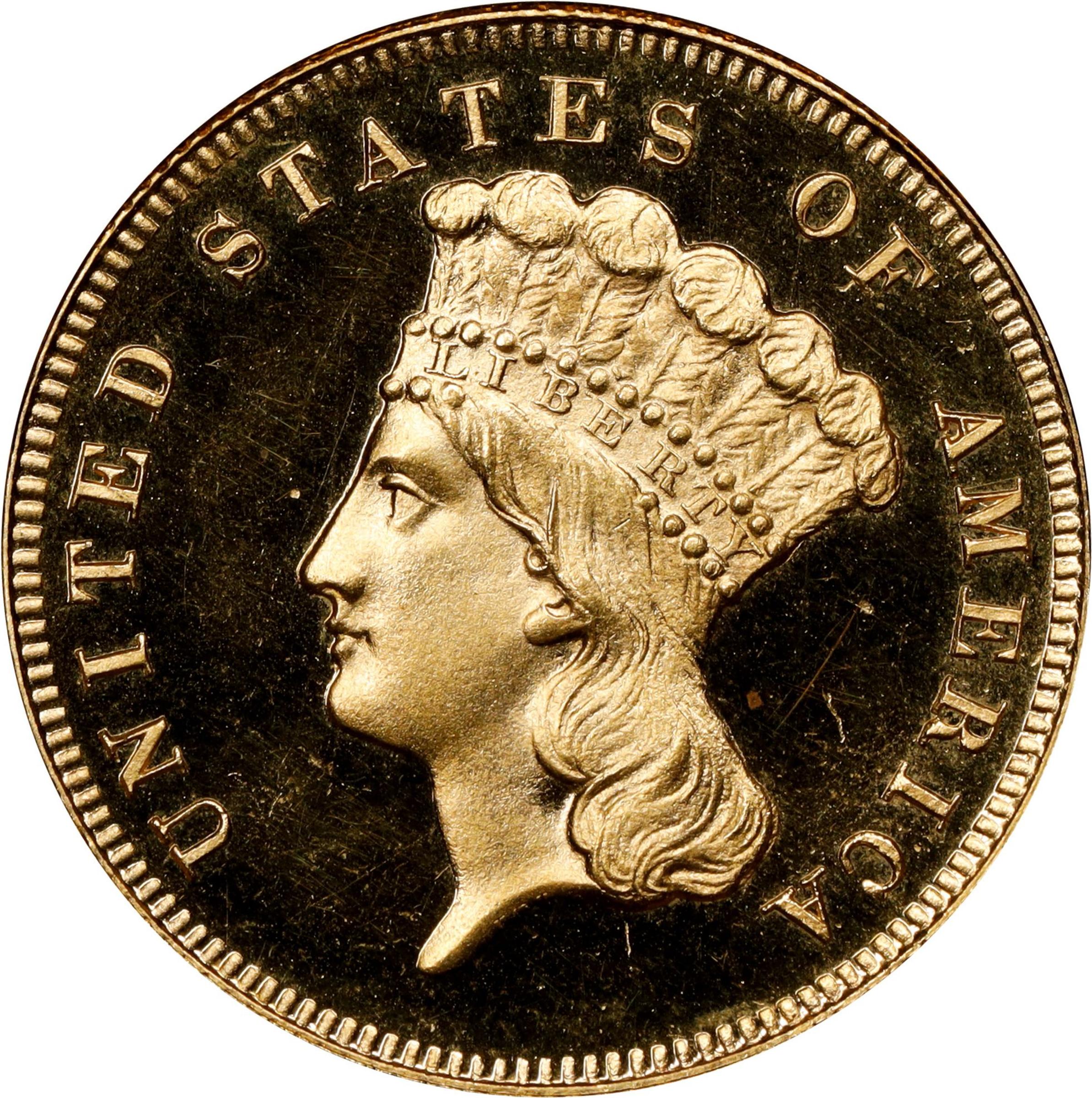
1862 $3, DCAM PR (PCGS#98025)
Summer 2025 Global Showcase Auction U.S. Coins
- 拍卖行
- Stack's Bowers
- 批号
- 3251
- 等级
- PR67DCAM
- 价格
- 1,799,462
- 详细说明
- The year 1862 saw profound changes at the Philadelphia Mint. After a string of early Confederate victories in the Civil War, including the First Battle of Bull Run, uncertainty over the outcome of the conflict led to Northern banks suspending gold specie payments late in 1861. Subsidiary silver coinage had remained generally at par with the paper Demand Notes of 1861, which explains the sizable mintages of half dimes, dimes, quarters, and half dollars at Philadelphia in 1861 and early 1862. The Legal Tender or "greenback" notes issued in the spring of 1862, however, were not redeemable in either gold or silver, and their appearance in quantity was quickly followed by the withdrawal of silver coinage from circulation in the East and Midwest after June of that year.<p>The hoarding of gold and silver was followed by a sharp reduction in circulation strike coinage for most denominations that would continue well into the Reconstruction era. The three-dollar gold piece was not much affected by this, however, since mintages for commerce had already plummeted by the late 1850s when the unpopularity of the denomination became obvious. (It was actually largely superfluous as circulating specie from the start of the series in 1854.) The 5,750 circulation strikes struck at the Philadelphia Mint in 1862, therefore, continued the trend of extremely limited mintages that, with a single exception in 1859, began in 1858.<p>On the other hand, one major change early in the Civil War did affect the three-dollar gold series, specifically the Proofs, and it was a new policy on the part of the Mint. In 1860 and 1861, the Mint followed the policy of Director James Ross Snowden and offered Proofs both individually and as part of sets. In late 1861, however, his successor James Pollock changed this policy and beginning in 1862, collectors could no longer obtain individual Proof coins unless a new denomination or design was introduced mid-year. This policy remained in force for Proof gold coins until 1881, when individual specimens became available once again.<p>The requirement to buy a complete Proof set to obtain these coins certainly put a damper on collector demand, especially for the expensive gold and complete Proof sets, and especially under the uncertain economic conditions that prevailed during the war. The Mint adjusted its expectations and produced only 35 gold Proof sets in 1862, all delivered on February 16. For the three-dollar gold piece this was a huge decrease in production from the overconfident days of 1859, 1860, and 1861, in which years the Mint struck 80, 119 and 113 $3 Proofs, respectively. Of the Proof 1862 threes, fewer than half survive today, 14 to 16 per John W. Dannreuther (2018), and that offered here is one of the very finest and most famous.<p>Without a doubt, the two best Proof 1862 threes are the Bass specimen and this one. Harry Bass acquired his example from our (Stack's) Theodore Ullmer Collection sale of May 1974, lot 413; it was eventually certified Proof-67+ Deep Cameo by PCGS and sold by Heritage in their May 2023 offering of the Harry W. Bass, Jr. Core Collection, Part III. The Floyd T. Starr specimen that we are offering here, however, has remained largely under the radar for the last 70 years. Walter Breen was aware of it when he wrote his <em>Encyclopedia of United States and Colonial Proof Coins</em>, but it is not included anywhere in the roster of confirmed or unconfirmed specimens provided in the 2018 Dannreuther reference <em>United States Proof Coins</em>.<p>The Starr specimen was acquired from our (Stack's) April 1954 Davis-Graves Sale, which included a remarkable trio of original gold Proof sets of 1862, 1882 and 1883. The coins in each set were offered individually, thereby dispersing the sets. The 1862 Proof set, double eagle through gold dollar, was offered as lots 872 through 877. The sale takes it name from the collections of George L. Davis and H.P Graves, but some material from the estate of R. Coulton Davis was also included, as Breen relates:<p><em>The Davis-Graves set (:872-77), perfect and possibly original from Mint to R. Coulton Davis, was also dispersed.</em><p>The Parmelee and Garrett gold Proof sets of this year were also dispersed, as presumably were most of the others. Only two 1862 Proof sets are known to remain intact, both of which are complete for all denominations of the year: the Mint Cabinet set that is now in the Smithsonian Institution, and the set in the American Numismatic Society Collection, ex J.P. Morgan.<p>If Breen's thought is correct, the Proof 1862 three-dollar gold piece in this offering has been in only two collections since it was acquired directly from the Mint as part of a gold Proof set in 1862: those of R. Coulton Davis and Floyd T. Starr. In any event, this coin remains virtually as struck and essentially as perfect as the day it left the Mint 163 years ago. The finish is exactly as Dannreuther describes for this issue:<p><em>The look of 1862 Proof threes is usually like the gold dollars - very flat, brilliant fields that contrast nicely with frosted elements, usually without the orange peel effect.</em><p>The surfaces are virtually flawless, just a few trivial lint marks and planchet voids in the obverse field and near the left reverse border (all as made), and no detracting post-production blemishes. A tiny void in the right obverse field below the letter E in AMERICA and another, lengthier one close by under the I, are offered as identifiers for future provenance work. As with so many of the Proof threes from the Floyd T. Starr Collection, this one is updating the census for the Proof 1862 in a significant way. Breathtakingly beautiful and of the utmost significance, the desirability of this special coin knows no bounds.