1839/8 $10 Type of 1838 MS(PCGS#8576)
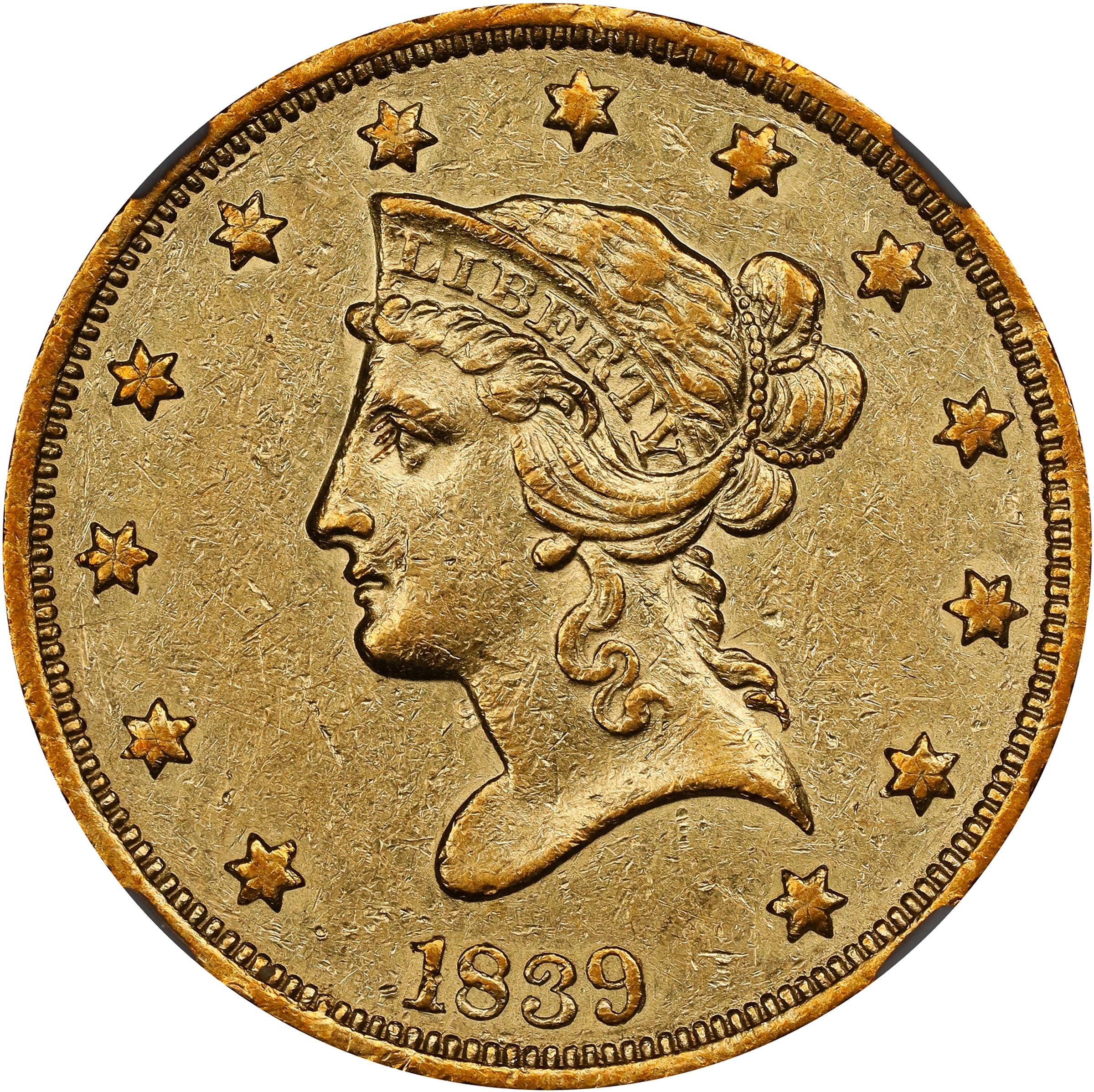
1839/8 $10 Type of 1838 MS (PCGS#8576)
November 2025 Showcase Auction U.S. Coins
- 拍卖行
- Stack's Bowers
- 批号
- 3147
- 等级
- AU58
- 价格
- 81,059
- 详细说明
- This desirable example exhibits subtle olive undertones to dominant bright honey-gold color. Traces of prooflike reflectivity are seen in the fields, while the design elements exhibit a more frosty texture. Sharply defined throughout the focal points, only at the obverse stars do we note significant - and expected - softness of strike. The surfaces are lightly to moderately marked, but reveal few singularly distracting marks during in hand viewing.<p>The longest-running $10 gold eagle series produced in the United States Mint, the Liberty Head eagle was struck without interruption from 1838 through early 1907. It is the first eagle produced since 1804, as President Thomas Jefferson halted production of this denomination and the silver dollar that year as rising bullion prices made the coins highly susceptible to exportation and melting. From 1805 through 1837, the largest gold denomination that the United States Mint produced was the $5 half eagle. By 1838, however, two laws had been passed that made it possible for the Mint to resume eagle coinage. The first was the Act of June 28, 1834, which reduced the weight of standard U.S. gold coins and, in so doing, placed the nation's monetary system on a gold standard. The second was the Act of January 18, 1837, a general overhaul of the nation's coinage laws that, among other things, standardized the fineness of gold and silver coins at 900 thousandths.<p>When eagle production finally resumed in 1838, the Mint settled upon the Liberty Head design of Christian Gobrecht, featuring a portrait of Liberty facing left, her hair tied in a bun at the back of her head and wearing a coronet inscribed LIBERTY. Thirteen stars encircle the border, and the date is below the portrait. The initial portrait utilized in 1838 and early 1839 had deeper curvature to the truncation of the bust with Liberty's hair pulled back over her ear. The design was modified slightly in 1839 to create the Liberty Head motif that would remain in use through 1907.<p>The basic reverse design also remained unchanged from 1838 to 1907, featuring an eagle with outstretched wings and a shield on its breast. The eagle clutches a group of three arrows in its left talon and an olive branch in its right talon. The legend UNITED STATES OF AMERICA is around the border and the denomination TEN D. is below the eagle. The reverse was modified in 1866, however, with the addition of the motto IN GOD WE TRUST on a scroll above the eagle. To distinguish them from their No Motto predecessors, the Motto eagles of 1866 to 1907 are known as the Type II Liberty Head design.<p>As above, the first iteration of Christian Gobrecht's new Liberty Head eagle bore a distinctive obverse featuring a sweep of hair completely covering Liberty's ear and a peculiarly deep curve to the bust's truncation. Benjamin West's painting <em>Omnia Vincit Amor</em> ("Love Conquers All") served as Gobrecht's model, even down to the beaded cord and coronet style. The first eagles using this design were struck at the end of 1838, with 7,200 pieces intended for circulation on top of four "specimen" coins presented to Secretary of the Treasury Levi Woodbury. In 1839, the same obverse design was employed for the first 2,801 eagles struck bearing that date before the design was modified.<p>With such a limited mintage, it is little wonder that the 1839 Type of 1838 eagle is a very scarce coin in all grades. Just under 250 examples are known, the vast majority of which are well circulated. While just a hair more available than the first year of issue, there is quite a bit of competition between type collectors and classic period gold specialists when an example appears for sale, regardless of condition. As a pleasing AU-58 certified by NGC, this is a numismatically desirable specimen that will attract significant attention from advanced numismatists.