1855 $20 Wass, Molitor & Co. Large Head MS(PCGS#10360)
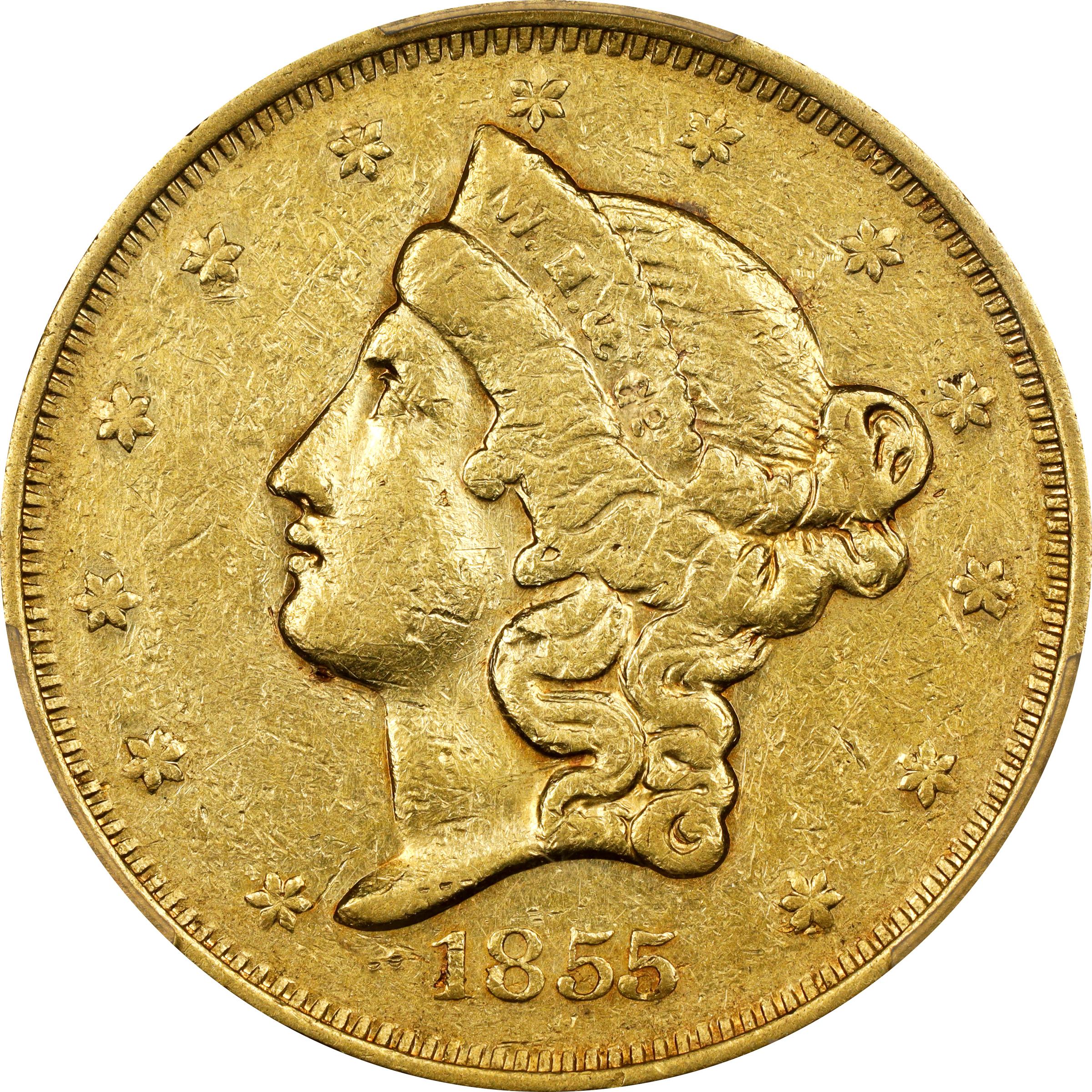
1855 $20 Wass, Molitor & Co. Large Head MS (PCGS#10360)
November 2025 Showcase Auction U.S. Coins
- 拍卖行
- Stack's Bowers
- 批号
- 3218
- 等级
- AU50
- 价格
- 3,583,662
- 详细说明
- One of the most significant privately issued coins from the California Gold Rush era that we have ever had the privilege of bringing to auction, our offering of the unique Kagin-8a Wass, Molitor & Co. $20 represents what could very well be a once in a lifetime bidding opportunity for advanced pioneer gold enthusiasts. All eyes will be on this lot for what promises to be a round of intense bidder competition.<p>The assay firm of Wass, Molitor & Co. was founded in October 1851 by Hungarian expatriates Count Samuel C. Wass and Agoston P. Molitor. An expert in mining and mineralogy, Wass arrived in the gold fields in October 1850 and Molitor, himself an expert in metallurgy, emigrated from Hungary via London shortly thereafter in early 1851. With their combined expertise, the pair set up their first assay office on Montgomery Street. Their firm was successful from the outset, having secured ingot production business from Adams & Company, a subsidiary of Adams Express Company. They moved to a larger facility on the corner of Montgomery and Merchant streets, formerly occupied by banker Henry M. Naglee. From there, Wass, Molitor & Co. struck $5 and $10 gold coins dated 1852. The coins were eagerly accepted in commerce. An early assay report showed that while the coins were slightly less pure than their federal counterparts, they were slightly overweight, just enough to make the coins' actual value higher than their declared value. As a result, some Wass, Molitor & Co. coins fetched a slight premium in commerce, eventually trading at two to three percent above that coinage of the United States Assay Office. Many examples of the 1852-dated issues were found with the treasure of the S.S. <em>Central America</em>, lost in 1857, confirming that these coins remained in circulation in California for many years after they were struck. Yet despite the commercial success of their initial coinage, Wass, Molitor & Co.'s minting operation of 1852 lasted for only a month or so, during which it produced $7,000 to $8,000 in $5 gold coins per day. Coining operations were suspended on February 12, 1852, and with the opening of the San Francisco Mint in 1854, it seemed that Wass, Molitor & Co. had struck its final gold coins.<p>Problems plagued the San Francisco mint during its earliest years, however, and in particular a chronic shortage of parting acids forced the intermittent closure of the facility. Under such trying conditions it could not hope to meet the needs of the regional economy, with its seemingly insatiable demand for gold coins for both domestic circulation and export. Responding to the appeals of local merchants and bankers to help alleviate the shortage, the principals of Wass, Molitor & Co. recommenced their coining operation in late April 1855. Production of $10, $20, and round $50 gold pieces soon followed, and the coins were once again eagerly accepted into commercial channels on the West Coast. Sometime around late 1855 or early 1856, the firm dissolved under the original name and was reorganized as Wass, Usznay & Co. Molitor moved to London around the same time.<p>The Wass, Molitor & Co. $20 issue of 1855 includes two major design types, one with a large head of Liberty, presumably intended for use on its $50 gold coin of the year, and one with a small head, evidently taken from a die punch intended for the $10 coins. Both types are celebrated numismatic rarities, although with 25 to 30 examples known (per Kagin and McCarthy, 2023), the Kagin-7 Small Head $20 exists in sufficient numbers that examples appear in the market at least several times per decade under normal conditions. The same cannot be said for the Large Head $20 - an exceedingly rare type with only four specimens known to exist. Perhaps surprisingly, these comprise two die varieties:<p>1 - <strong>First Reverse, Kagin-8a. PCGS/CAC AU-50.</strong> Ex possibly S.H. & H. Chapman's sale of the O.P. Hayes Collection, February 1896, lot 51; DeWitt Smith; Virgil Brand (Brand Journal #47413); Brand estate; Horace Brand; Ruth Green, advertised in the December 1942 issue of <em>The Numismatist</em>, p. 928; B. Max Mehl's sale of the Belden E. Roach Collection, February 1944, lot 298; B. Max Mehl's sale of the Frederic W. Geiss Collection, February 1947, lot 2226; Amon G. Carter, Sr.; Among G. Carter, Jr.; our (Stack's) sale of the Amon G. Carter, Jr. Family Collection, January 1984, lot 1161; unknown intermediaries; Heritage's sale of the Riverboat Collection, April 2014 CSNS Signature Auction, lot 5445; Heritage's Chicago ANA Signature Auction of August 2015, lot 4562. <em><strong>The present example</strong></em>, and the plate coin for the K-8a attribution in the 2023 Kagin-McCarthy reference on private and pioneer gold coins of the United States, p. 206.<p>2 - <strong>Second Reverse, Kagin-8. PCGS AU-53.</strong> Discovered circa 1922, per Wayne Burt; ex Thomas L. Elder's sale of the Dr. George Alfred Lawrence Collection, June 1929, lot 1406; Henry Chapman; Francis Patrick Garvin; Yale University, stolen in 1965, recovered. The plate coin for the K-8 attribution in the 2023 Kagin-McCarthy reference on private and pioneer gold coins of the United States, p. 207.<p>3 - <strong>Second Reverse, Kagin-8. About Uncirculated.</strong> Ex Abner Kreisberg; Josiah K. Lilly; Lilly estate; Smithsonian Institution. The plate coin for the Large Head type in the 1981 Kagin reference on private gold coins of the United States, p. 307.<p>4 - <strong>Second Reverse, Kagin-8. Extremely Fine.</strong> Ex Waldo C. Newcomer; B. Max Mehl, circa 1931; Charles M. Williams; Abe Kosoff, offered in the January 1951 issue of the <em>Numismatic Gallery Monthly</em>; Lammot du Pont; Willis H. du Pont, stolen in 1967, present location unknown.<p>As the foregoing census makes clear, only two examples of the Large Head Wass, Molitor & Co. $20 are currently available for private ownership. The unique First Reverse, K-8a specimen, offered here, was identified as a separate variety in 2014 by Stuart Levine; it was struck from the same reverse die as the K-7 Small Head $20, but in a later state with several cracks engaging the peripheral lettering. On this reverse, the tip of the eagle's right wing points to the extreme left corner of the letter R in FRANCISCO, whereas on the second reverse employed in the K-8 pairing the wing tip is directly under the letter F in that word.<p>The example in the Smithsonian Institution is generally credited as the discovery coin for the Large Head Wass, Molitor & Co. $20. The present specimen was once owned by the great collector Virgil Brand of Chicago. Its earliest auction appearance was in B. Max Mehl's 1944 celebrated sale of the Belden E. Roach Collection, in which it was cataloged as:<p><em><strong>The Exceedingly Rare Wass Molitor & Co. Twenty-Dollar Gold Piece WITH LARGE HEAD</strong></em><p><em><strong>Lot No. 298</strong></em><p><em>1855 $20.00. Wass Molitor & Co. Obverse, very <strong>large head</strong>, diadem inscribed W.M. & Co. Date below. Thirteen six pointed stars. Reverse, small eagle, shield on breast, an olive branch in its right talon and three arrows in its left. 900 THOUS. On small scroll above. Legend SAN FRANCISCO CALIFORNIA TWENTY DOL. Milled edge. Fine to very fine. Of excessive rarity. Only three specimens known to exist, one of which is in the Yale University Numismatic Collection. Another is in the great Mid-West Collection which will undoubtedly never come on the market in our lifetime. And this one is the only one now available. The specimen in the Mid-West Collection I sold some fifteen years ago for well over $2,000.00. The specimen in the Yale Collection is from the Lawrence Sale, 1929, where the coin brought $7,000.00. The specimen here offered is the second best. One of the real great rarities of the Pioneer Gold Series. When we consider the number of specimens known to exist and the still smaller available, I consider this coin equal in rarity to any Pioneer gold coin. It has a starting bid of $2,000.00. This coin is originally from the great Virgil Brand Collection of Chicago.</em><p>The "great Mid-West Collection" coin referred to by Mehl is ex Charles M. Williams, the famous du Pont specimen stolen in 1967. Mehl was not aware that the Brand collection included a second example, hence his belief that only three examples were known. Selling to Frederic W. Geiss, the present example was offered again by Mehl in his February 1947 sale of the Geiss Collection, from which it was acquired by Amon G. Carter, Sr. Passing to Amon G. Carter, Jr. the coin did not appear in the market again until our (Stack's) sale of the Carter Family Collection in January 1984. Once again only three Large Head $20s were reported, although the Band-Smithsonian specimen was substituted for the du Pont coin, the former having emerged from the Brand holdings in 1951, the latter stolen in 1967. This was the last time a Large Head Wass, Molitor & Co. $20 would appear at auction for three decades.<p>The drought ended when the present example returned to auction as part of Heritage's April 2014 sale of the Riverboat Collection, followed a year later by its offering in the firm's Chicago ANA Signature Auction of August 2015. Now, another decade having gone by, today's advanced collectors of California Gold Rush era coinage will once again have the opportunity to compete for the honor of acquiring this legendary rarity. It is an exceptional example of the type, challenging the Brand-Smithsonian coin for finest known honors. The surfaces are predominantly medium yellow gold in color with subtle olive undertones and, on the reverse, playful highlights of iridescent pinkish-rose hugging the design elements. The strike illustrates the challenging conditions faced by all private minting establishments that served Gold Rush California, for it is soft overall with significant bluntness affecting the eagle in an around the central reverse. Rather that detract, such shortcomings add to the rustic charm and appeal of these privately issued rarities. The entire design on both sides is fully appreciable, nonetheless, and traces of frosty lister persist in the more protected areas. Lightly abraded overall, yet surprisingly free of sizeable or otherwise singularly distracting marks for such a large gold coin produced and circulated in 1850s California.<p>The most aggressive bidding strategy is recommended for collectors seeking to pursue this prize. It will be a cherished example and leading highlight in the collection of its next fortunate owner.