1875 $3, CAM PR(PCGS#88039)
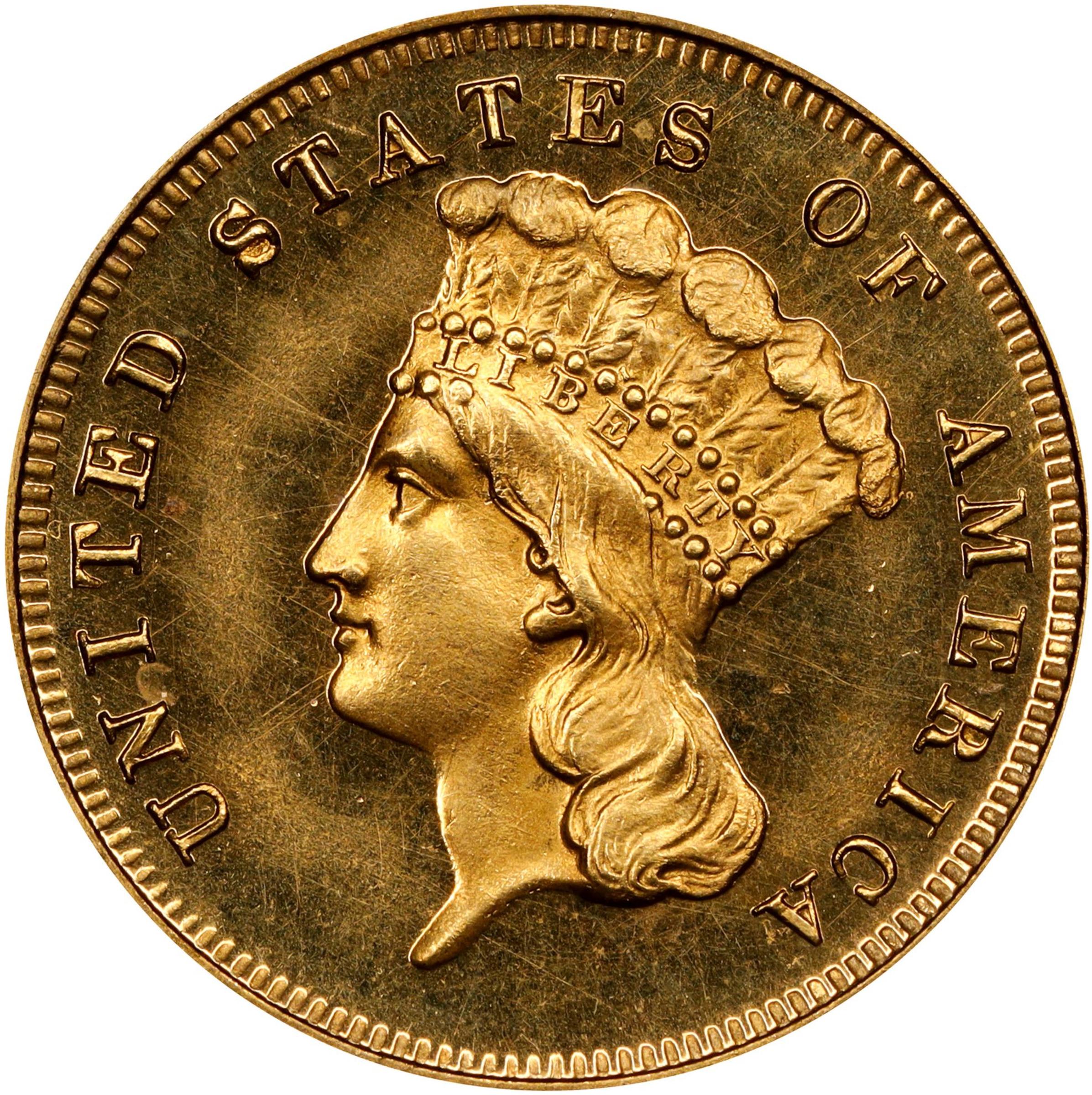
1875 $3, CAM PR (PCGS#88039)
Summer 2025 Global Showcase Auction U.S. Coins
- 拍卖行
- Stack's Bowers
- 批号
- 3262
- 等级
- PR64CAM
- 价格
- 1,799,462
- 详细说明
- Offered is one of the most famous and desirable examples of this legendary Proof-only three-dollar gold issue. This lovely Choice Proof 1875 is beautiful deep yellow-gold with heavily frosted motifs and deeply reflective fields resulting in spectacular cameo contrast. The strike is razor sharp to full throughout. Hints of faint frost mingle within the obverse field, especially in front of Liberty's profile, a feature noted in other examples of this rare issue that we have been honored to bring to auction through the years (including, most recently, the Pogue III specimen in PCGS Proof-65+ Deep Cameo). Marks and blemishes are few and far between on this carefully preserved, nicely composed example.<p>Struck only in Proof format, the 1875 is the most important and rarest date in the three-dollar gold series after the unique 1870-S. In fact, a Proof 1875 $3 was the first American coin to sell for a sum in excess of $100,000 at auction. Though Mint records indicate 20 examples of this rare prize were struck, those 20 pieces represent the coins delivered on February 13 and sold in gold and complete Proof sets. A few others were made, either in 1875 or later, and, indeed, Jeff Garrett and Ron Guth estimate that 20 to 30 exist today. In the fifth edition (2019) of the influential reference <em>100 Greatest U.S. Coins</em>, in which the Proof 1875 $3 is ranked No. 57, the authors commented:<p><em>In the field of United States gold coinage, the year 1875 has a magical allure. Indeed, the 1875 gold dollar, quarter eagle, three-dollar gold piece, half eagle and eagle are all formidable rarities. However, the 1875 three-dollar gold piece has been a long-time favorite among numismatists, given its tiny mintage and perennial fame.</em><p><em></em>Published a year earlier in his <em>United States Proof Coins</em> reference, the 2018 Dannreuther census traced 21 distinct specimens, but also included 30 additional appearances in auctions and private collections that could not be positively linked to any of the 21 confirmed examples. Many were from auctions during the late 19th century and first three-quarters of the 20th century, the trail of ownership going cold in the years following the sale. Some of these represent earlier appearances of one of the 21 examples with confirmed provenances in the modern market, missing or poor auction plates making definitive provenance work impossible. Others, probably the minority, represent coins that disappeared from wider numismatic consciousness when they passed into a tightly held collection, their rediscovery and confirmation by modern numismatic researchers still delayed even decades later. An example of the latter is the additional appearance that John W. Dannreuther lists as:<p><em><strong>H.</strong> William B. Wetmore; Chapman Brothers William B. Wetmore Collection 6/27-28/1906 Wetmore:158 @$430 part of 6-piece set to William Forrester Dunham (Virgil Brand's mail bid was $300); B. Max Mehl W.F. Dunham Collection MBS 6/3/1941 Dunham:2047 @ $1725.</em><p>S.H. and H. Chapman's Major W.B. Wetmore Collection sale was truly a memorable numismatic event, including, among other rarities, original gold Proof sets of most years from 1863 through 1881, and a Class I 1804 silver dollar, the coin now more widely known as the Cohen specimen. The cataloging of lot 158 among the gold Proof sets either is or could easily have been the inspiration for Garrett and Guth's writing on the Proof coinage of 1875 more than a century later:<p><em>1875 $20, $10, $5, $3, $2 1/2, $1. Of this set, with the exception of the $20 all the pieces are very rare. Of the $10 only 120 were struck; of the $5 only 220; of the $3 only 20 pieces; of the $2 1/2 piece 420; of the dollar 420. As only 20 $3 were coined there could not have been more than twenty sets struck. We once bought in Europe two sets of this year lacking the $3 which no doubt were used for cuff buttons. The $3 alone sold at our Wilcox sale in 1901 for $205, and would bring vastly more to-day. Complete set of excessive rarity.</em><p>The copy of the Wetmore catalog on the Newman Numismatic Portal has written in the left column the name of the winning bidder - Dunham - and in the right column underbids that include that for $300 from Virgil Brand.<p>The 1875 Proof set remained intact in the collection of William Forrester Dunham of Chicago. Upon his death in 1939, his collection was acquired en bloc by B. Max Mehl, who auctioned it in his famous W.F. Dunham Collection sale of June 1941. Dunham also owned a Class I 1804 dollar, the Dexter specimen, which he acquired from Lyman H. Low's October 1904 sale of the H.G. Brown Collection. So, for its second auction offering, this 1875 gold Proof set was appearing alongside an example of the "King of American Coins" (although Mehl had already placed the 1804 with Charles M. Williams before the sale, at $4,250).<p>The Dunham Collection sale turned out to be the last time this 1875 gold Proof set was held intact, and also the last offering for the three-dollar gold piece therein during the 20th century. Walter Breen recorded the fate or the set in his <em>Encyclopedia of United States and Colonial Proof Coins</em>, although he misidentified the owner before Dunham:<p><em><strong>Gold proof sets.</strong> [20] Feb. 13, 1875. H.P. Smith's was broken up at the Dunham sale, 1941; Ely's, to Garrett, was dispersed and brought $320,000.</em><p>For the next 84 years the Proof 1875 $3 from this set was forgotten by the wider numismatic community. The buyer from the Dunham sale, not generally known before this writing, was Floyd T. Starr of Philadelphia. Mr. Starr became a steady participant in our (as Stack's) auctions beginning in the early 1940s, although he was active in the hobby much earlier and acquired coins through such auctions as Henry Chapman's sale of the John Story Jenks Collection (1921), Thomas L. Elder's and J.C. Morgenthau's sales of the 1930s, and many of B. Max Mehl's famous named sales: Chatillon (1938), Hale (1939), Roach (1944), Geiss (1947) and, of course, W.F. Dunham. He continued acquiring coins through the 1960s, and after his death in 1971, Floyd T. Starr's collection remained part of his estate. Important sections have already been auctioned by Stack's, the early copper in 1984, and a larger and more diverse offering in 1992. Mr. Starr's $3 gold set, however, remained a carefully guarded secret of his estate until brought forward for inclusion in our Summer 2025 Global Showcase Auction.<p>The rediscovery of the Starr $3s brings the roster of distinct specimens of the Proof 1875 up to 22 coins. It is one of the leading highlights of this installment of the Floyd T. Starr Collection, and a coin whose offering will result in strong bidder competition before its transitions into another world-class cabinet.<p>In American commerce in 1875, silver coins continued to be hoarded. Despite efforts to redeem the Postage and Fractional currency notes that had been in circulation since August 1862, they were still found in circulation and collecting them had become a numismatic pastime. Confederate currency had also become popular in collecting circles.<p>Meanwhile at the Mint, coinage of silver dimes, quarters, and half dollars picked up as the Treasury anticipated placing them into circulation in large numbers. The twenty-cent piece was introduced as a convenient medium of exchange for the western portions of the country where silver still circulated freely, though the public took them for quarter dollars in some instances. Silver continued to glut the international market making miners in the West unhappy. In December 1875, the Senate approved a bill that was taken up by the House and passed on January 7, 1876, stipulating that gold coin payments would resume January 1, 1879.