1861-O $20 MS(PCGS#8934)
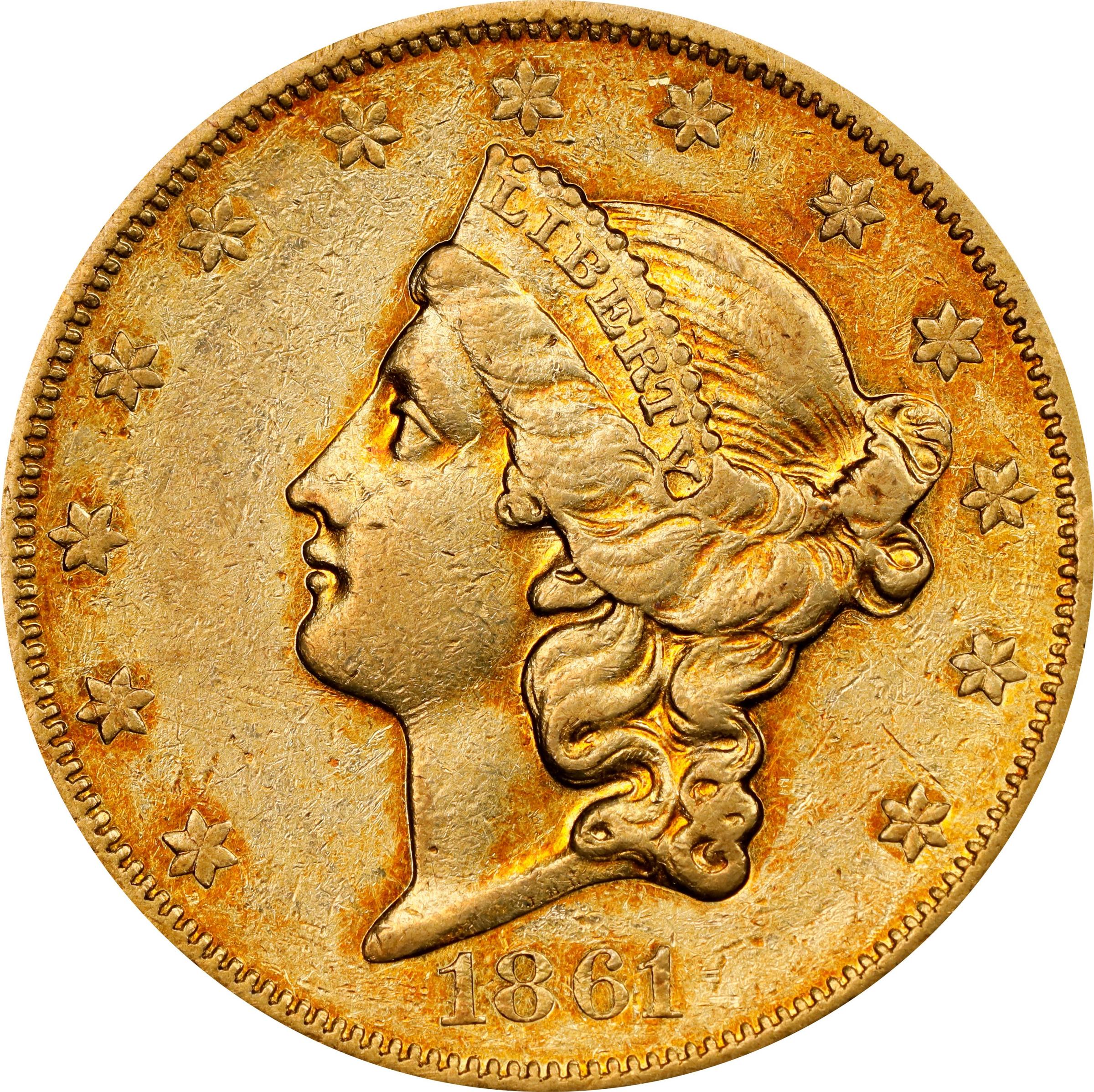
1861-O $20 MS (PCGS#8934)
December 2025 Showcase Auction - The James A. Stack, Sr. Collection Part I
- 拍卖行
- Stack's Bowers
- 批号
- 20031
- 等级
- AU50
- 价格
- 508,628
- 详细说明
- The desirability of the 1861-O double eagle is well established and stems from three important characteristics of this issue. First and foremost, the mintage for the 1861-O comprises coins that were struck under three different governments - a unique occurrence in the Liberty Head double eagle series and a circumstance that has affected few other issues throughout U.S. history. Production of the 1861-O, in fact, closely followed the shifting political landscape of the nation during the months leading up to the outbreak of the Civil War. The year opened with a delivery of 5,000 coins under the authority of the United States of America. This mintage, achieved from January 1 through 26, was in keeping with the trend for limited yearly mintages of New Orleans Mint double eagles that began in 1853.<p>After Louisiana seceded from the Union on January 26, 1861, a committee from the Secession Convention visited the New Orleans Mint from January 26 through January 31. It audited all government property and received a bond for the bullion in the hands of mint officers. On January 30, New Orleans Mint Superintendent William A. Elmore submitted his formal resignation to Mint Director James Ross Snowden; the entire staff remained in place and continued operations after swearing a new oath of allegiance. The following day, the committee from the Secession Convention formally took possession of the New Orleans Mint in the name of the State of Louisiana. Some of the remaining gold bullion was used to strike 9,750 double eagles under the State of Louisiana, additional examples of the 1861-O issue, delivered between January 26 and March 31.<p>In April 1861, control of the New Orleans Mint was officially transferred to the Confederate States of America. During that month the Confederacy used whatever gold remained on hand to strike 2,991 double eagles. These represent the last of the 1861-O issue, for a total mintage of 17,741 pieces, the breakdown of which can be summarized as follows: <p>-January 1-26, 1861: 5,000 coins struck under the authority of the United States of America<p>-January 26-March 31, 1861: 9,750 coins struck under the authority of the State of Louisiana after it seceded from the Union and took over control of the New Orleans Mint<p>-April 1-30, 1861: 2,991 coins struck under the authority of the Confederate States of America after Louisiana joined the Southern Confederacy<p>All 1861-O double eagles were struck using a single pair of dies, however, and even the pieces produced by the Southern Confederacy bear the legend UNITED STATES OF AMERICA as part of the reverse design. The staff in the New Orleans Mint simply had no other way of creating or otherwise obtaining new dies after the facility left Union control, and it was forced to use what tools were on hand to strike coins before the supply of bullion became exhausted.<p>Regardless of under what authority the individual coins were produced, the 1861-O $20 pieces entered the channels of commerce in the same manner as all early date New Orleans Mint double eagles, presumably paid out to the bullion depositors who requested them. Certainly no bullion remained at the New Orleans Mint when it was closed by Confederate authorities on May 31, 1861, and there would have been no coins (double eagles or otherwise) in the building when Dr. Bonzano, a special agent of the U.S. Treasury, took change of it in June 1862, after Union forces had captured New Orleans in a campaign lasting from April 25 to May 1, 1862.<p>The economic conditions prevailing in the regions east of the Mississippi River during the Civil War and Reconstruction eras conspired to drive most 1861-O double eagles into the export trade. This continued well into the second half of the 19th century, with many coins exported after acquiring wear through transfers between domestic bullion holdings. Ultimately most 1861-O double eagles were melted, and the high rate of attrition that the issue suffered brings us to the second characteristic that underlies the numismatic desirability of this issue: its extreme scarcity. Based on an estimate of no more than 175 coins extant from the mintage of 17,741 pieces, Doug Winter (2025) ranks the 1861-O seventh in rarity among the 13 New Orleans Mint Liberty Head double eagles, ahead of the 1850-O, 1851-O, 1852-O, 1853-O, 1857-O and 1858-O.<p>Finally, the close association of this issue with the Confederate States of America solidifies its desirability among specialized collectors, for the 1861-O double eagle is one of the few regular issue coins produced by that short-lived government. Since all examples were struck from the same die pair, as above, how, then, do numismatists differentiate between those coins struck by the Union, the State of the Louisiana, and the Confederate States of America? The process is imprecise and somewhat conjectural, but Doug Winter has identified a late die state of this variety (Die State III) with a bold date and an obverse die crack (as made) from the rim outside star 2 to Liberty's chin. He believes that these late die state examples were struck by the Confederate States of America.<p>The coin we offer here is one of these particularly desirable Die State III examples, the date equally bold for all four digits and the obverse die crack from the rim outside star 2 plainly evident under magnification. As such, this coin is almost certainly one of the 2,291 1861-O double eagles struck by the Confederate States of America between April 1 and 30 of that year. According to a study conducted by Doug Winter and Joe Gaines, approximately 20% of 1861-O double eagles extant are attributed as Die State III. Interestingly, the 2,991 coins struck under authority of the Confederate States of America represents 17% of the issue's total mintage of 17,741 pieces.<p>While the historical significance and overall rarity of the issue means that any 1861-O double eagle is a numismatic treasure, the James A. Stack, Sr. specimen is clearly on an even higher level of importance. It is an exceptionally well preserved and visually stunning coin. Rich deep honey-olive color blankets the surfaces with enhancing blushes of reddish-rose engaging many of the design elements - very attractive. Ample remnants of a semi-prooflike finish can be seen, most intense in the protected areas around the devices. Both sides are overall boldly defined and free of singularly mentionable handling marks. Rare CAC approval at the AU grade level confirms the superior quality and eye appeal and, as a product of the Southern Confederacy, we can think of few other survivors of this issue that are as desirable. We anticipate that this coin will find its way into another advanced collection of double eagles or Southern gold coinage.