1796 25C MS(PCGS#5310)
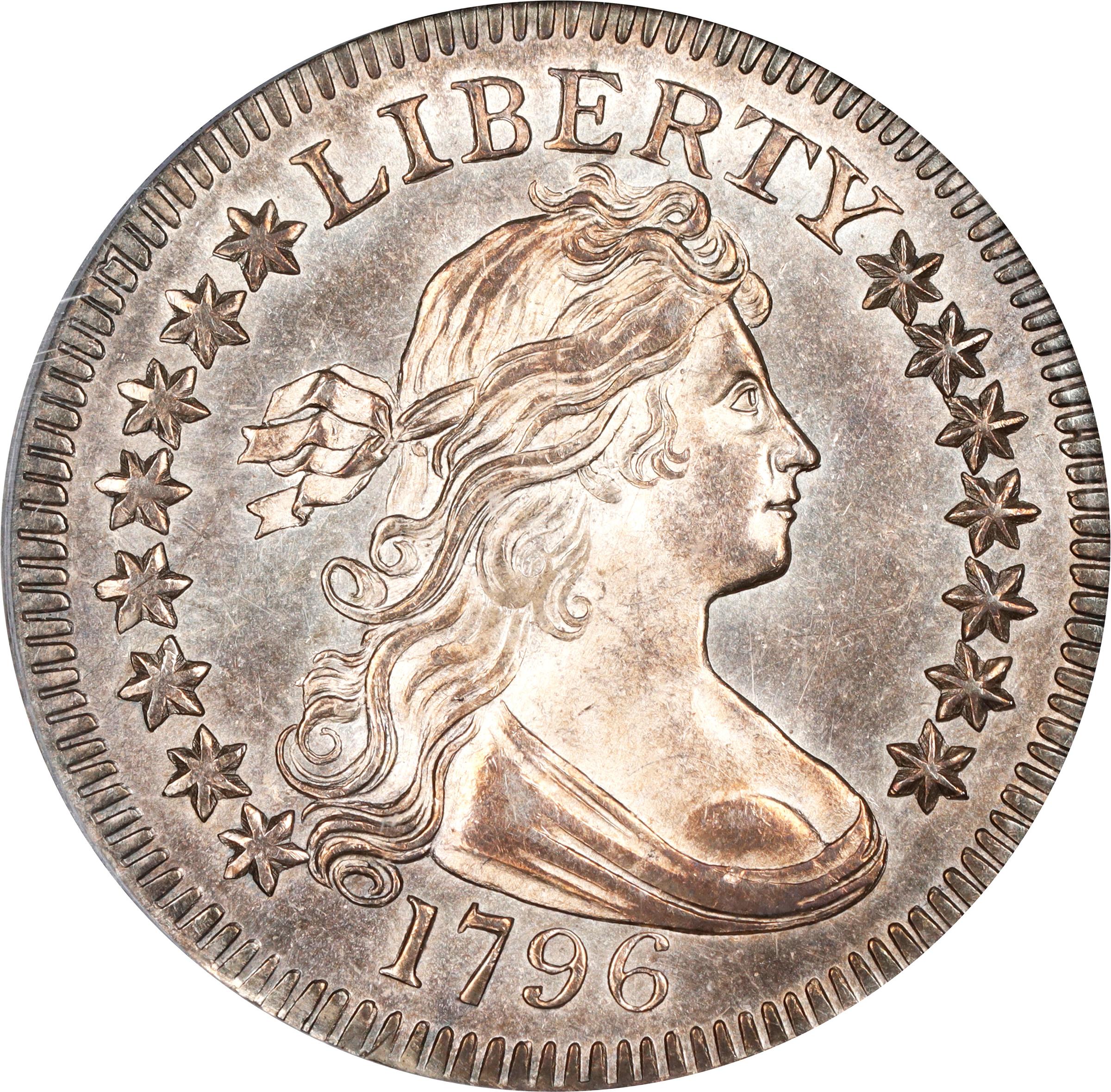
1796 25C MS (PCGS#5310)
November 2025 Showcase Auction U.S. Coins
- 拍卖行
- Stack's Bowers
- 批号
- 3039
- 等级
- MS65
- 价格
- 3,413,011
- 详细说明
- One of the finest and most famous examples of this classic one year design type from the first year in which the United States Mint delivered quarter dollars at the request of bullion depositors. This sale marks the sixth time that our firm and its predecessors have been privileged to bring this stunning Gem Mint State rarity to auction. When first offered in our (Bowers an Ruddy's) May 1973 sale of the Terrell Collection, it was cataloged, in part, as:<p><em>The presently-offered 1796 is a magnificent Uncirculated specimen with prooflike surfaces on obverse and reverse. This choice and beautiful piece may well be a presentation piece.</em><p>This theme was expanded upon in our (Bowers and Ruddy's) May 1974 sale of the Austin Collection, in which the cataloger noted for this coin, "it is said to have been passed down through several generations of the family of a former officer of the Mint." Walter Breen picked up on all this for, years later, in 1991, when he updated the classic Browning reference on early U.S. Mint quarters, he noted that "there are also about seven prooflike presentation coins (EPC), including J. Stack Collection and others." This coin is not ex James A. Stack, Sr. but, after being included in our (Stack's) 1977 sale of the fabulous Reed Hawn Collection of United States Quarters, it appeared in our (Stack's) October 1994 James A. Stack, Sr. Collection sale, and is the coin to which Breen refers. Of course, Breen (as well as many auction catalogers from earlier generations) was sometimes overzealous in attributing presentation status to especially beautiful prooflike coins, and most high grade 1796 quarters show some evidence of field reflectivity. It is also unfortunate that no further information has come down to us regarding this coin's connection to the family of a "former officer of the Mint." Regardless, there is no doubt that this is a special coin that was obviously set aside soon after striking and preserved with the utmost care by several generations of owners. While a small number of 1796 Draped Bust quarters have been so fortunate, this is a very rare set of circumstances not only for the issue, but for all early U.S. Mint coinage of the 1790s, an era in which commercial use and eventual loss through export and/or melting was the normal path for gold and silver specie.<p>Brilliant, lustrous, and beautiful - that in a nutshell describes this stunning coin. It is very close to perfection, except for a lack of detail on the eagle's head, standard for the Browning-2 variety. Otherwise the hair strands, stars, letters, and other features on the obverse, plus the body of the eagle on the reverse, the botanical details of the leaves, and the peripheral letters are all bold. The denticulation is especially prominent on both obverse and reverse, serving perfectly to frame the design. The surfaces are exceptionally smooth and well preserved, as one should expect for assigned grade, and it is only for provenance purposes that we mention the following trivial blemishes. There is a miniscule void on the top edge of the drapery, at Liberty's right breast, a tiny mark further along the drapery line to the right, and on the reverse faint remnants of ancient finger marks at the lower and lower left borders, the latter engaging the letters NIT in UNITED. None of these identifiers affect the eye appeal, which is exceptionally strong in an absolute sense, and nothing short of remarkable for a 1796 quarter.<p>The 1796 quarter has long been an object of desire for all who form type sets of American coinage. Struck only in this single year, the Draped Bust obverse in combination with the Small Eagle reverse is very rare relative to the demand for it, as no type set can be complete without an example. Survivors are scarce as the mintage was just 6,146 pieces. The Mint required two obverse dies and one reverse to achieve this mintage, with Browning-2, as offered here, the more frequently encountered by a small margin. This is the High 6 variety of the issue, so named because the digit 6 in the date is closer to the bust than on the B-1 Low 6 variety.<p>While a number of Mint State 1796 quarters are extant from both die marriages, the vast majority of survivors are circulated to one degree or another. Demand for high grade coins is particularly intense and, indeed, the Reed Hawn specimen is an ideal example - the very best that most collectors could realistically hope for in a 1796 quarter. It is tied for CC#1 for the B-2 variety in the 2008 Tompkins census, and tied for CC#4 in the 2010 Rea et al. census. A glorious coin, historically significant and of the utmost rarity, that is worthy of a strongest bids and is destined for inclusion in another fine cabinet.