



1942 10C PR67+ 认证号35997079, PCGS号5077
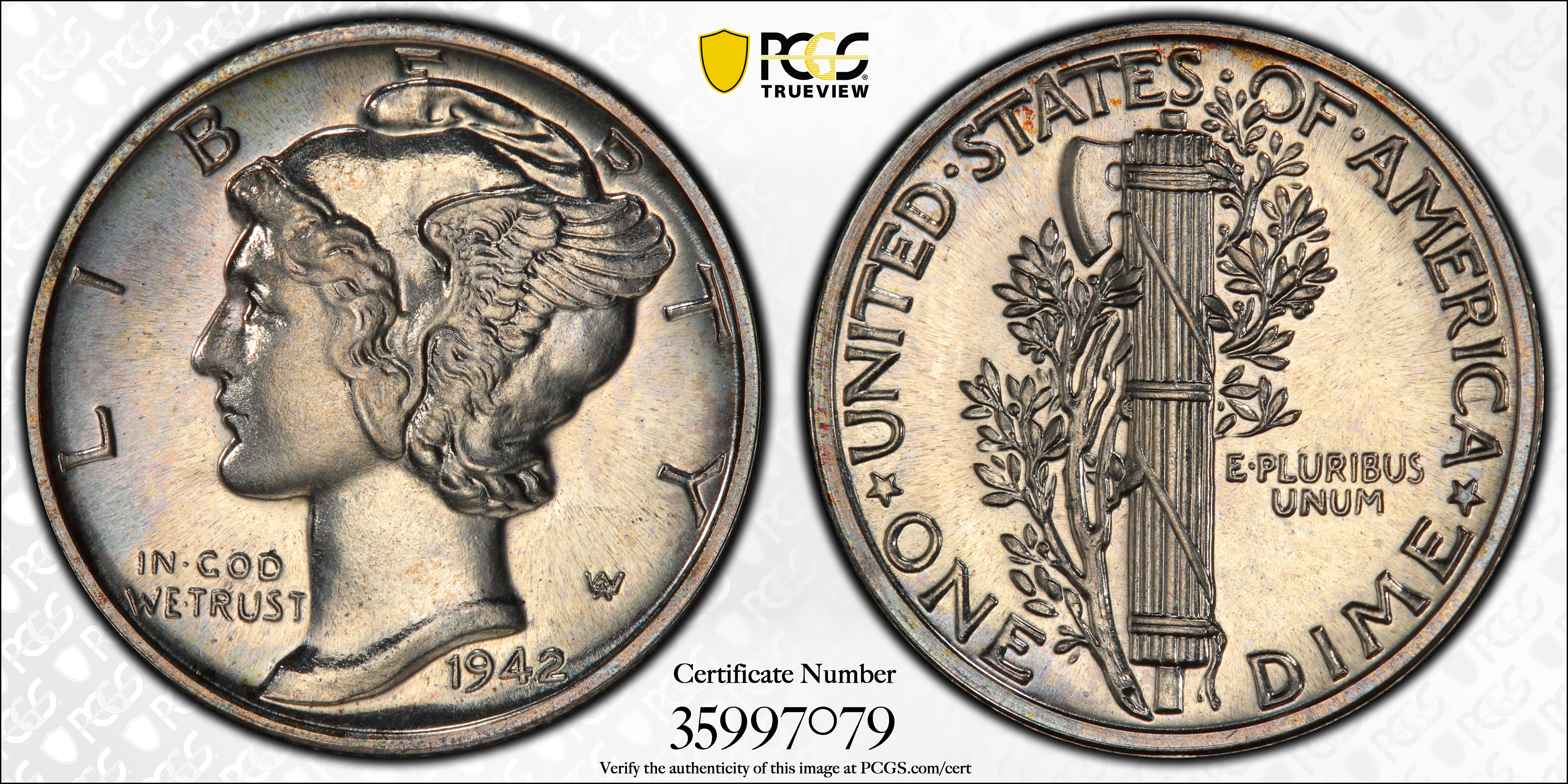
专家评论
Charles Morgan
1942: A Proof Set of Firsts and Lasts
The 1942 Proof Set was the first—and only—such set issued during America's involvement in World War II. It is unique for containing the silver-composition Jefferson "War Nickel" (#4180). Although the Mint struck Proof nickels in the traditional copper-nickel composition through May of that year, the transition to the silver-manganese-copper alloy resulted in two distinct nickel types for the 1942 set. This set also marked the final Proof appearances of two iconic Adolph A. Weinman designs: the Mercury Dime, which was replaced in 1946, and the Walking Liberty Half Dollar, which gave way to the Franklin design in 1948.
The resumption of Proof coinage in 1936 was an idea championed by Roosevelt ally Louis Howe. It proved to be a striking success, with demand increasing annually until the wartime suspension in 1942. Although World War II ended in 1945, the Mint did not resume Proof production until 1950. From that point through 1964, neither the Korean War nor the Vietnam War triggered a suspension; however, a severe national coin shortage and the transition from silver to clad coinage in 1965 finally brought the era to a close.
The Proof issues of 1936–1942 and 1950–1964 are siblings of a sort—the last of their kind struck at the Philadelphia Mint. When Proof production resumed in 1968, the San Francisco Assay Office was tasked with striking the coins, which were by then composed mostly of base metals. This transition signaled a new era for the hobby and a fundamental shift in the relationship between collectors and the United States Mint.
Deliveries Begin
Proof production was suspended in 1943 as the Mint was tasked with producing millions of military medals and decorations due to America’s involvement in World War II. Campaign medals, Purple Hearts, and the American Defense Service Medal made up the bulk of this production. Additionally, the Mint suffered staffing shortages as employees left for higher-paying wartime industry jobs or joined the armed services.
Burdette's research into the Mint's records held at the National Archives reveals modest deliveries starting on January 26 and continuing throughout the year.
| 1942 Mercury Dime Proof Deliveries | |||
| January 26 | 503 | February 2 | 503 |
| February 4 | 503 | February 5 | 503 |
| February 6 | 503 | February 9 | 503 |
| February 13 | 503 | February 18 | 503 |
| February 23 | 503 | February 26 | 503 |
| March 2 | 503 | March 5 | 503 |
| March 6 | 203 | March 9 | 303 |
| March 12 | 503 | March 16 | 503 |
| March 20 | 503 | April 7 | 303 |
| April 20 | 503 | May 5 | 503 |
| May 18 | 503 | June 16 | 1,003 |
| June 22 | 1,003 | August 6 | 603 |
| September 1 | 503 | September 14 | 503 |
| September 28 | 503 | October 6 | 503 |
| October 14 | 503 | October 28 | 503 |
| November 6 | 503 | November 18 | 503 |
| November 20 | 503 | December 3 | 503 |
| December 8 | 503 | December 14 | 503* |
| December 15 | 503* | December 18 | 503* |
| December 23 | 503* | December 28 | 503* |
| December 30 | 603* | Total: 22,329** | |
* Burdette's extrapolated deliveries. **Less 129 held for Assay. Source: Burdette, Roger. United States Proof Coins: 1936-1942. Seneca Mill Press. (2016)
In a letter dated March 4, 1943, Philadelphia Mint Superintendent Edwin H. Dressel justified the suspension to Mint Director Nellie Tayloe Ross. He cited the significant time and expense required to create Proofs, noting that it took eight people under the supervision of the Medal Room Foreman to produce them. Dressel explained that these same personnel and equipment were desperately needed to strike military medals; in fact, immediately after the last Proofs were struck in December 1942, those workers were reassigned to medal production. Furthermore, he noted that the new zinc-plated steel cents and debased silver five-cent coins were ill-suited for Proof striking due to the inevitability of discoloration.
According to Mint records, the Philadelphia Mint delivered a record 22,329 Proof Mercury Dimes to the cashier for the 1942 issue, out of a total of 30,185 pieces struck. With 73.98% of the dimes produced passing quality control, the 1942 issue suffered a slight degradation in quality compared to previous years, a result of the increased production speed.
Eight obverse dies and four reverse dies were used to strike the 1942 Proofs. The most common cause for obverse die failure was worn lettering. Given the diminutive size of the date, the designer’s monogram, and the "IN GOD WE TRUST" motto, it is expected that these areas would be the first to show wear. Obverse dies 81 and 83 were the primary workhorses, producing 4,050 and 4,800 units respectively, while dies 84, 267, and 1823 saw more limited use.
Collecting the 1942 Mercury Dime Proof
PCGS has certified nearly 7,000 1942 Mercury Dime Proofs, accounting for approximately 31% of the total mintage. While most submitted coins qualify for a numerical grade, the leading causes for "Genuine" (no grade) designations are PVC contamination and environmental damage.
The population bell curve is centered between PR64 and PR67, though the drop-off in frequency from PR66 to PR67 is steep. Coins in PR68 or finer conditions remain exceptionally scarce; these high-grade specimens often exhibit attractive toning, with "Premium Quality" (PQ) examples occasionally displaying dazzling color.
To date, PCGS has certified only one 1942 Mercury Dime in Cameo. This example graded PCGS PR66CAM.
* * *
稀有性和存量估计 了解更多
| 所有评级 | 19000 |
| 60或以上 | 18950 |
| 65或以上 | 12000 |
| 所有评级 | R-2.8 |
| 60或以上 | R-2.8 |
| 65或以上 | R-2.9 |
| 所有评级 | 7 / 7 |
| 60或以上 | 7 / 7 |
| 65或以上 | 7 / 7 |
| 所有评级 | 7 / 7 |
| 60或以上 | 7 / 7 |
| 65或以上 | 7 / 7 |
状况普查 了解更多
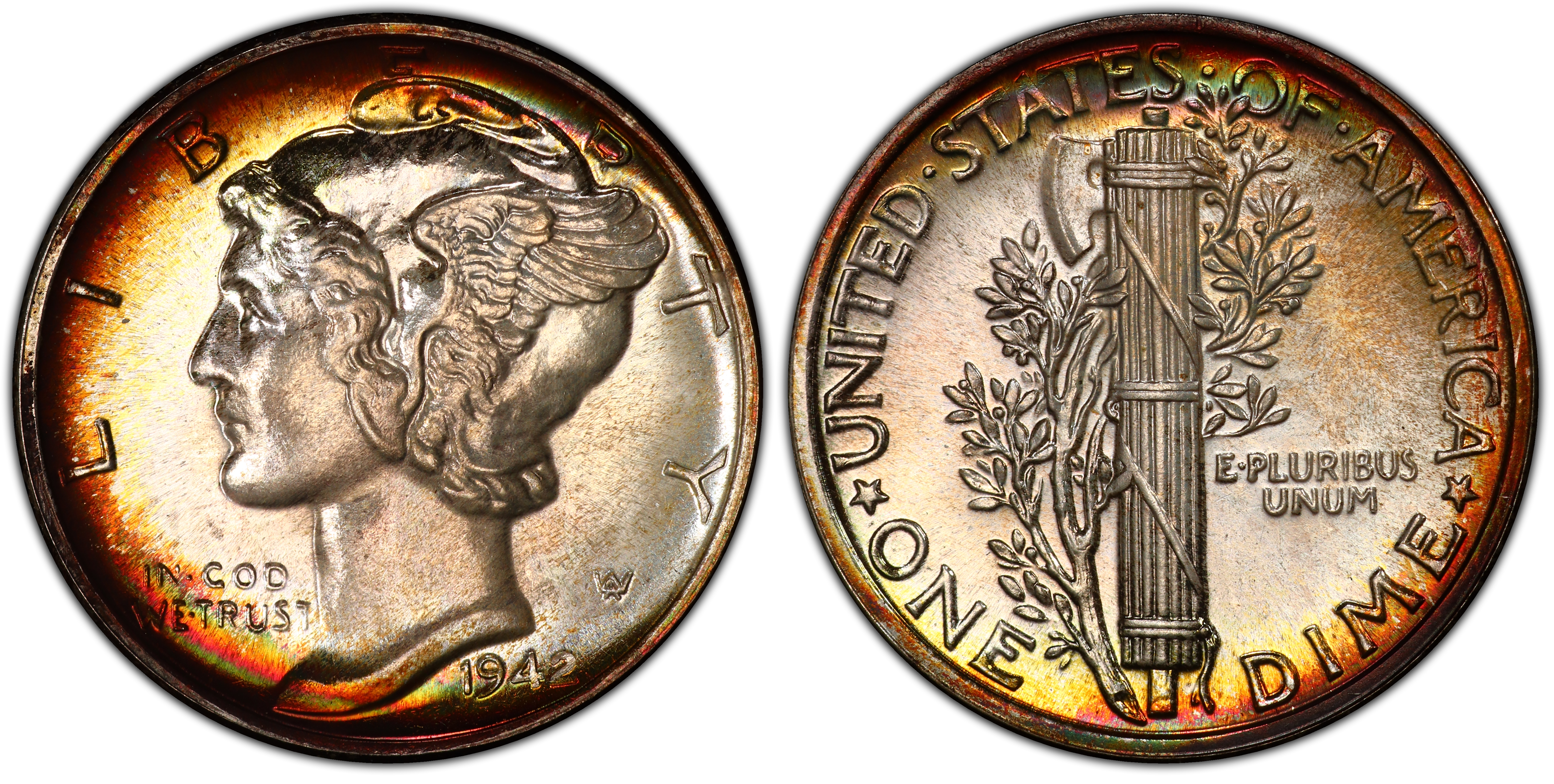 #1 PCGS PR69
GreatCollections, September 15, 2019, Lot 744265 - $98,437.50. Crescent of amber, gold, and green toning at the left obverse border. Same coloration fully wraps around the reverse border. |
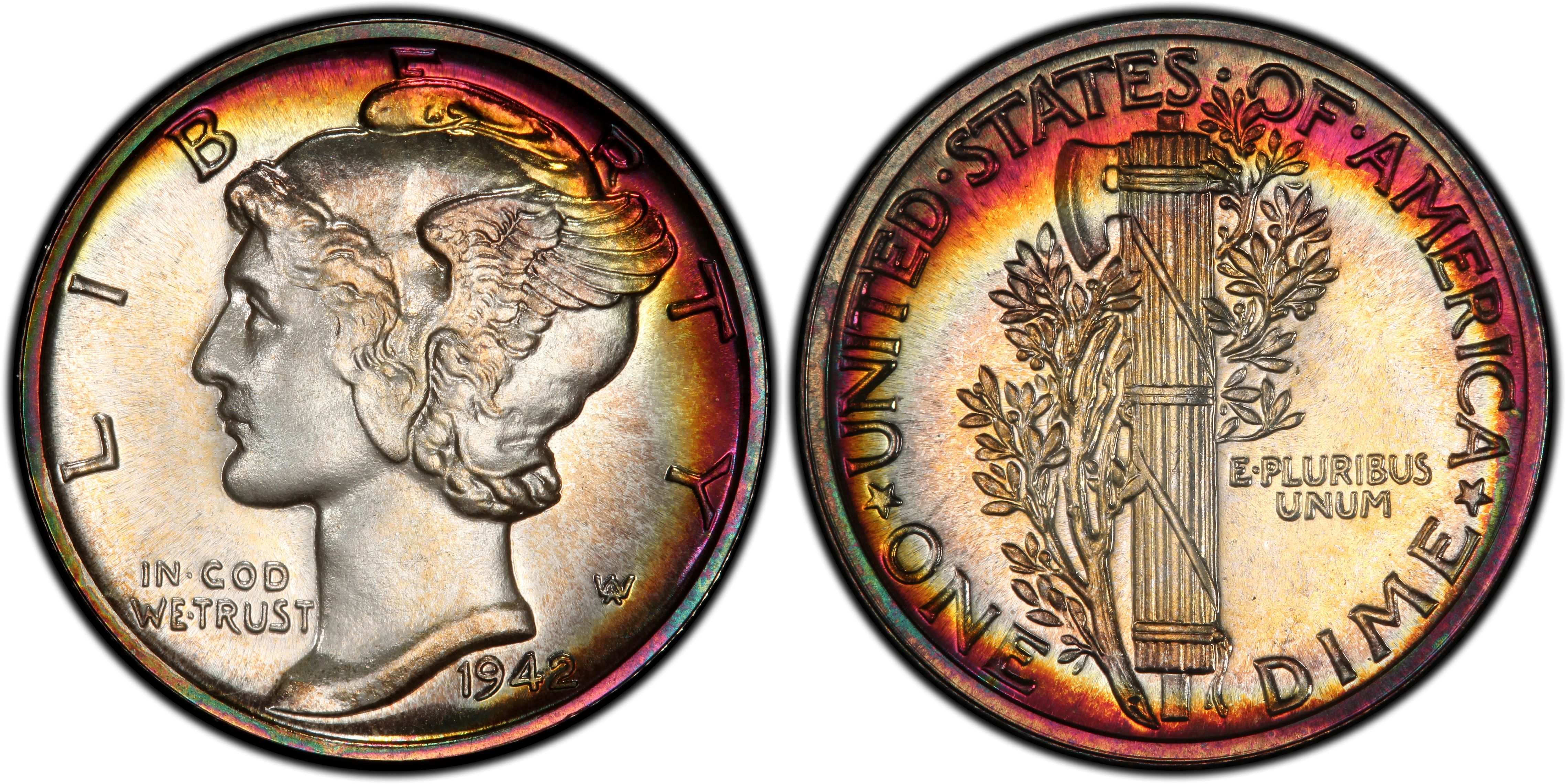 #1 PCGS PR69
As PCGS PR68+ #31451308. Stack's Bowers, March 2015, Lot 5395 - $9,106.25. As PCGS PR69 #25696168. Heritage Auctions, June 4, 2015, Lot 3882 – $37,600. "The Big Stone Collection" (PCGS Set Registry). Top pop, pop one when offered. Magenta and gold crescent toning along the right periphery of the obverse and nearly encircling the entire center of the reverse. |
 #1 PCGS PR69
MADHATTER's "MERC MADNESS Collection" (PCGS Registry Set). Intense target toning in gold, amber, and green that reaches into the field from the upper right obverse. |
 #4 PCGS PR68+
|
 #4 PCGS PR68+
|