



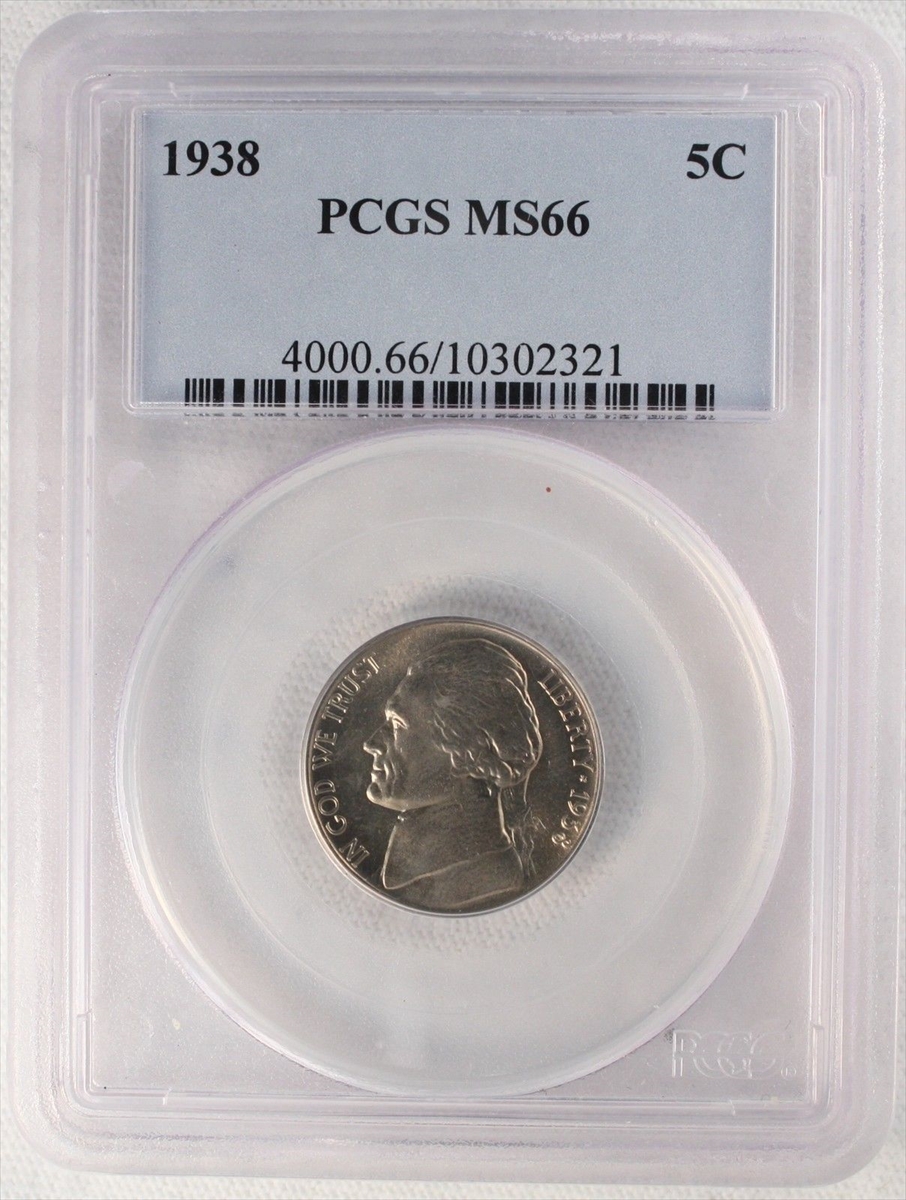
1938 5C MS66 认证号10302321, PCGS号4000
专家评论
Jaime Hernandez
This is the first year of issue for the Jefferson Nickel series. Felix Schlag was awarded $1,000 for submitting the winning design for the Jefferson Nickel. The Mint struck a reasonable amount of coins this first year to meet the public demand. It struck just over 19 million coins at the Philadelphia Mint which is considered a large mintage in the series. Compare this mintage to that of the 1938-D where the Mint only struck about 5 million and for the 1938-S it only struck around 4 million coins. This is why today there are still more 1938-P Nickels available than for its D and S mint mark counterparts, even though they were struck the same year.
Charles Morgan
A New Nickel Design Debuts in 1938
The Jefferson Nickel debuted in 1938, replacing the Buffalo Nickel midway through the 25th year of its production run. This transition followed a 1937 design contest to commemorate Founding Father and third president of the United States, Thomas Jefferson. The competition was open to "all American sculptors," drawing hundreds of entries to replace the James Earle Fraser design.
The Competition and Felix Schlag
The winner of the $1,000 prize was Felix Oscar Schlag, a German émigré and American artist. Born in Frankfurt, Germany, in 1891, Schlag was educated at the Munich University of Fine Arts before moving to the United States in 1929. Although he won numerous art competitions and commissions throughout his life, the Jefferson Nickel remains his only coin design. Schlag was a friend to the numismatic community and promoted the Jefferson Nickel at conventions later in his life. He passed away in 1974, but his work remains one of the most widely circulated pieces of art in American history.
The Design
Obverse: Schlag’s obverse design is likely based on Jean-Antoine Houdon’s 1789 bust of Jefferson. Schlag depicts Jefferson facing left, complete with a colonial-era pigtail. The portrait dominates the space; the top of his head nearly touches the rim, with the barest truncation at the bottom where his left shoulder meets the edge. The motto IN GOD WE TRUST arcs clockwise along the left side. Behind Jefferson, the inscription LIBERTY, a small five-pointed star, and the date 1938 run clockwise along the right edge.
Reverse: Schlag’s original reverse concept—an innovative three-quarters perspective of Jefferson’s mansion, Monticello—was rejected by the Treasury Department. Per competition rules, Schlag was required to revise the design for no additional compensation. Here, the revised Monticello is depicted as a flat, head-on portrayal of the neoclassical mansion Jefferson designed himself near Charlottesville, Virginia. While the rendering loses much dimensionality, the octagonal dome and portico details remain visible on better strikes. The inscription E PLURIBUS UNUM sits atop the reverse. The word MONTICELLO—a revision forced upon Schlag that required adjusting all other text—sits directly under the building. The denomination FIVE CENTS curves beneath it, with UNITED STATES OF AMERICA running counterclockwise along the bottom rim.
Production and Circulation
The Philadelphia Mint struck 19,496,000 1938 Jefferson Nickels (#4000), though they did not enter circulation until late in the year. As the first year of a new type, many people hoarded examples from change or purchased full rolls. Consequently, the 1938 remains fairly common in almost all grades today, though finding one in active circulation is now a rare event.
Strike Quality and "Full Steps"
The strike quality of the 1938 issue is best described as inconsistent. While these coins were struck from fresh hubs, fully struck examples are the exception rather than the rule. The true difficulty of finding well-struck Jefferson nickels would not fully manifest until the master hubs aged further in the 1950s and ’60s.
For specialists, the ultimate measure of a strike is the Full Steps (FS) designation on the reverse. PCGS designates a Full Steps Jefferson Nickel as a Jefferson Nickel graded PCGS MS60 or better, with at least five complete steps on Monticello. Any steps that join or fuse together—whether created that way or subsequently damaged—cannot be considered for the Full Steps designation.
To identify a proper strike, the step area is divided into four distinct sections:
- The Plinth: The base of the four columns.
- The Stylobate: The walking surface leading into the residence.
- The Steps: The individual lines sandwiched between the stylobate and the foundation.
- The Foundation: The thicker segment at the base of the design, located below the steps.
Among coins in PCGS holders, Non-Full Steps outnumber Full Steps by approximately 2.43:1. This ratio is not representative of the total Mint State population, as collectors and dealers usually only submit better than average coins for encapsulation. The typical certifed grade with and without the FS designation is PCGS MS65.
* * *
稀有性和存量估计 了解更多
| 所有评级 | 8500000 |
| 60或以上 | 170000 |
| 65或以上 | 140000 |
| 所有评级 | R-1.0 |
| 60或以上 | R-1.9 |
| 65或以上 | R-1.9 |
| 所有评级 | 9 / 68 TIE |
| 60或以上 | 13 / 68 TIE |
| 65或以上 | 31 / 68 TIE |
| 所有评级 | 12 / 82 TIE |
| 60或以上 | 16 / 82 TIE |
| 65或以上 | 36 / 82 TIE |
状况普查 了解更多
 #1 PCGS MS67+
Ice blue and violet toning. Bluntness at the foundation of the steps precludes FS designation. |