



1927-S 10C MS64 认证号24267808, PCGS号4964
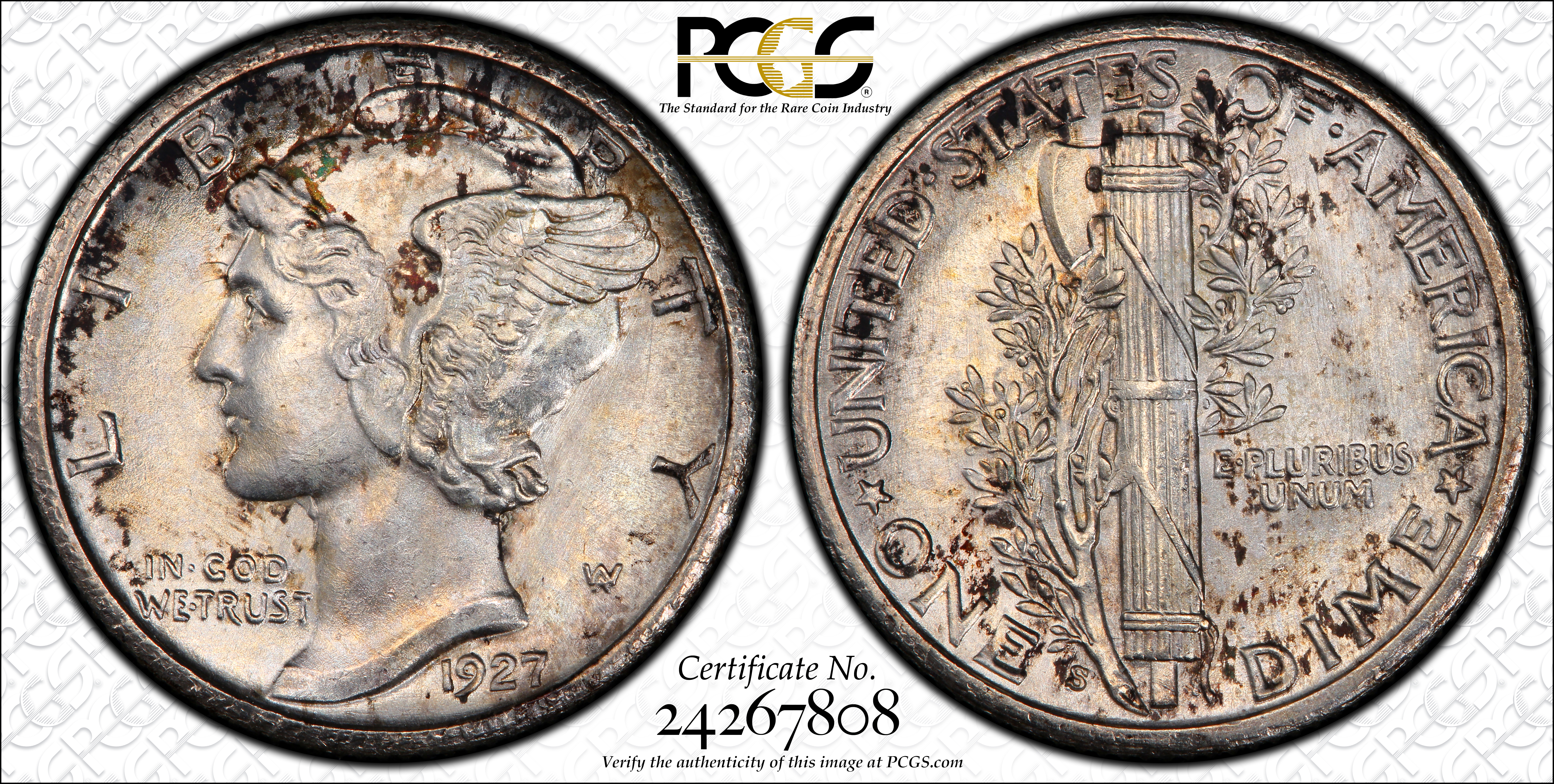
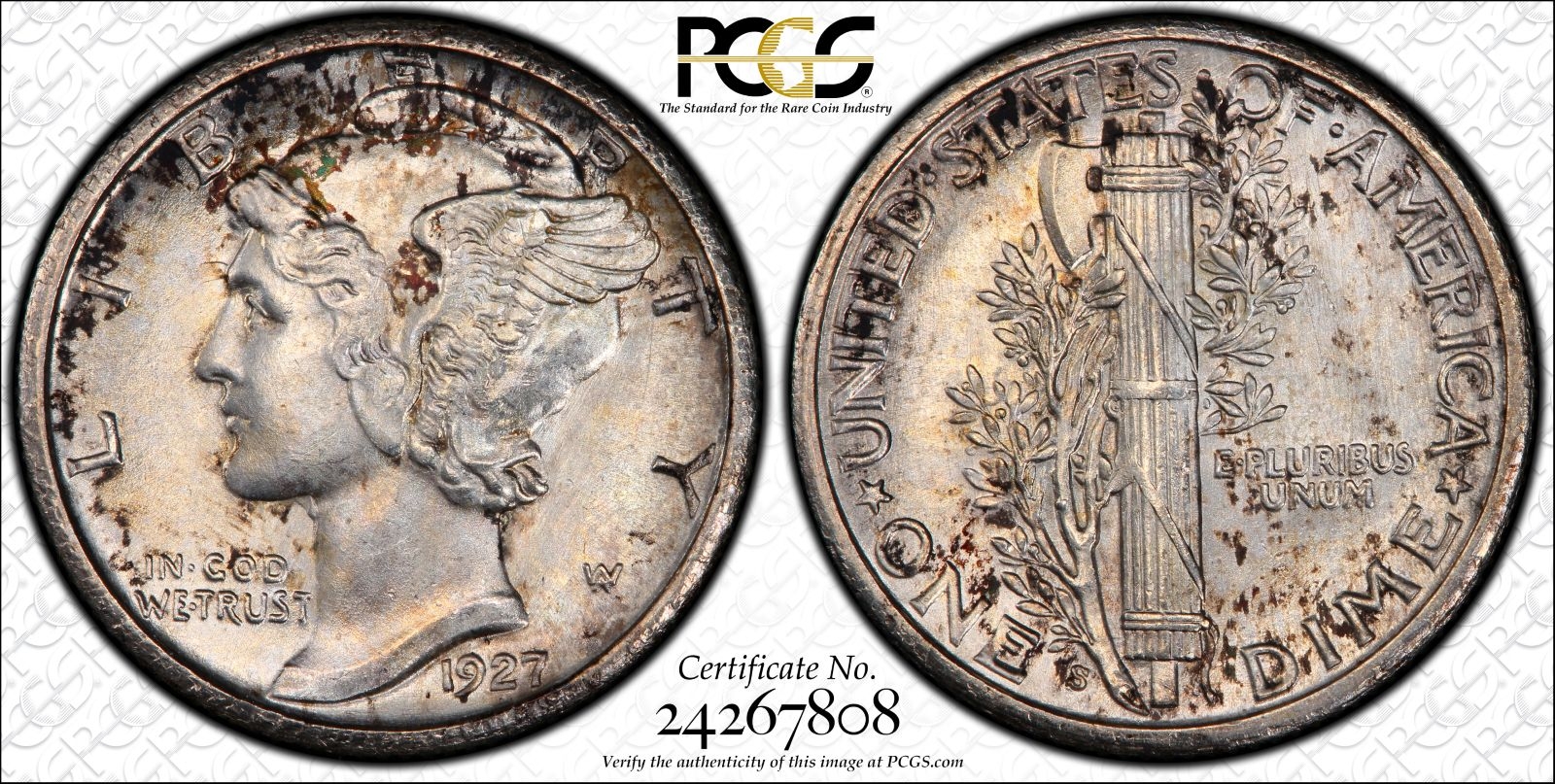
拥有者评论
专家评论
Charles Morgan
1927 was a banner year for progress in America, and San Francisco was a primary beneficiary of this economic boom. The city’s skyline was transformed by the completion of the Russ Building, a 31-story Neo-Gothic "Temple of Finance" that reigned as the tallest building in San Francisco for decades. This architectural surge reflected the era’s prosperity, as the city solidified its status as the financial hub of the West.
Transportation also reached new heights that year. On June 6, 1927, Mills Field opened with a single 5,000-foot dirt runway; this modest airfield would eventually evolve into San Francisco International Airport (SFO). Just months later, on September 16, the city’s new aviation infrastructure was validated when Charles Lindbergh landed the Spirit of St. Louis at Mills Field as part of his national victory tour, following his historic solo flight across the Atlantic.
Amid this local expansion, broader cultural shifts were taking hold. The Jazz Singer—a film whose use of blackface makes it a complicated relic today—heralded the arrival of the "talkies," while the Ford Model T gave way to the more modern Model A. On the diamond, Babe Ruth clobbered 60 home runs, leading the New York Yankees’ “Murderers’ Row” to a four-game World Series sweep of the Pittsburgh Pirates.
Yet, amid this progress, a portent of trouble emerged from Europe. Fearing a lending bubble, German central bankers implemented credit restrictions that spiked interest rates, triggering a stock market crash. By late 1929, over two million Germans were unemployed—a crisis that served as a significant catalyst for the rise of the Nazi Party.
San Francisco Mint Coin Production (1927)
Against this global and local backdrop, the San Francisco Mint struck seven denominations in 1927. The most consequential for collectors is the 1927-S Saint-Gaudens Double Eagle (#9188). Despite a robust mintage of over three million, the coin did not circulate widely, and only a few hundred survived the gold melts of the 1930s. Today, a typical example grades MS62 to MS63 and trades for over $55,000—a relative bargain compared to the legendary 1927-D Saint-Gaudens Double Eagle (#9187). San Francisco also struck all four silver denominations that year. The production of 2,392,000 1927-S Walking Liberty Half Dollars (#6587) marked the first halves struck at any branch mint since 1923. Meanwhile, the 1927-S Mercury Dime (#4964, #4965) saw a mintage of 4,770,000. While this emission is on the lower side for a San Francisco Mercury Dime, the issue only becomes truly scarce in Choice Mint State grades or better.
The 1927-S Mercury Dime is Ellusive in Gem or Finer
What's most striking about the 1927-S Mercury Dime is that its availability in circulated grades belies the scarcity of Mint State survivors. While the 1926-S Mercury Dime (#4958, FB #4959) is traditionally labeled a "semi-key" date by standard references, the PCGS Population Report suggests that Mint State survival rates for both dates are much closer than their disparate mintages would imply. Whether designated with Full Bands or not, the 1927-S remains scarce in Mitn State and is truly rare in Gem.
* * *
稀有性和存量估计 了解更多
| 所有评级 | 6000 |
| 60或以上 | 300 |
| 65或以上 | 45 |
| 所有评级 | R-3.8 |
| 60或以上 | R-6.4 |
| 65或以上 | R-8.6 |
| 所有评级 | 26 / 80 TIE |
| 60或以上 | 15 / 80 TIE |
| 65或以上 | 13 / 80 |
| 所有评级 | 26 / 80 TIE |
| 60或以上 | 15 / 80 TIE |
| 65或以上 | 13 / 80 |
状况普查 了解更多
 #1 PCGS MS67
Heritage Auctions, August 18, 2024, Lot 3242 - $6,600. Brilliant with scattered russet toning along the border. Die crack advances from 10 o'clock rim towards Liberty's eyebrow. Another die crack runs through the branch across the lower straps to D. |
 #2 PCGS MS66+
Displays salmon toning with gold highlights. A shallow contact mark runs partially down Liberty's neck, below the wing. Reverse: Features a cooler palette with maroon toning along the outer lettering. |
 #2 PCGS MS66+
Gold toning dominates the right field. A spiderweb of die cracks spans the bust truncation and the back of Liberty's neck. Another crack runs vertically from the rim to the AW monogram, while a third extends from the rim to the left side of the two feathers in Liberty's cap. On the reverse, a small tick runs across the lower fasces. |