



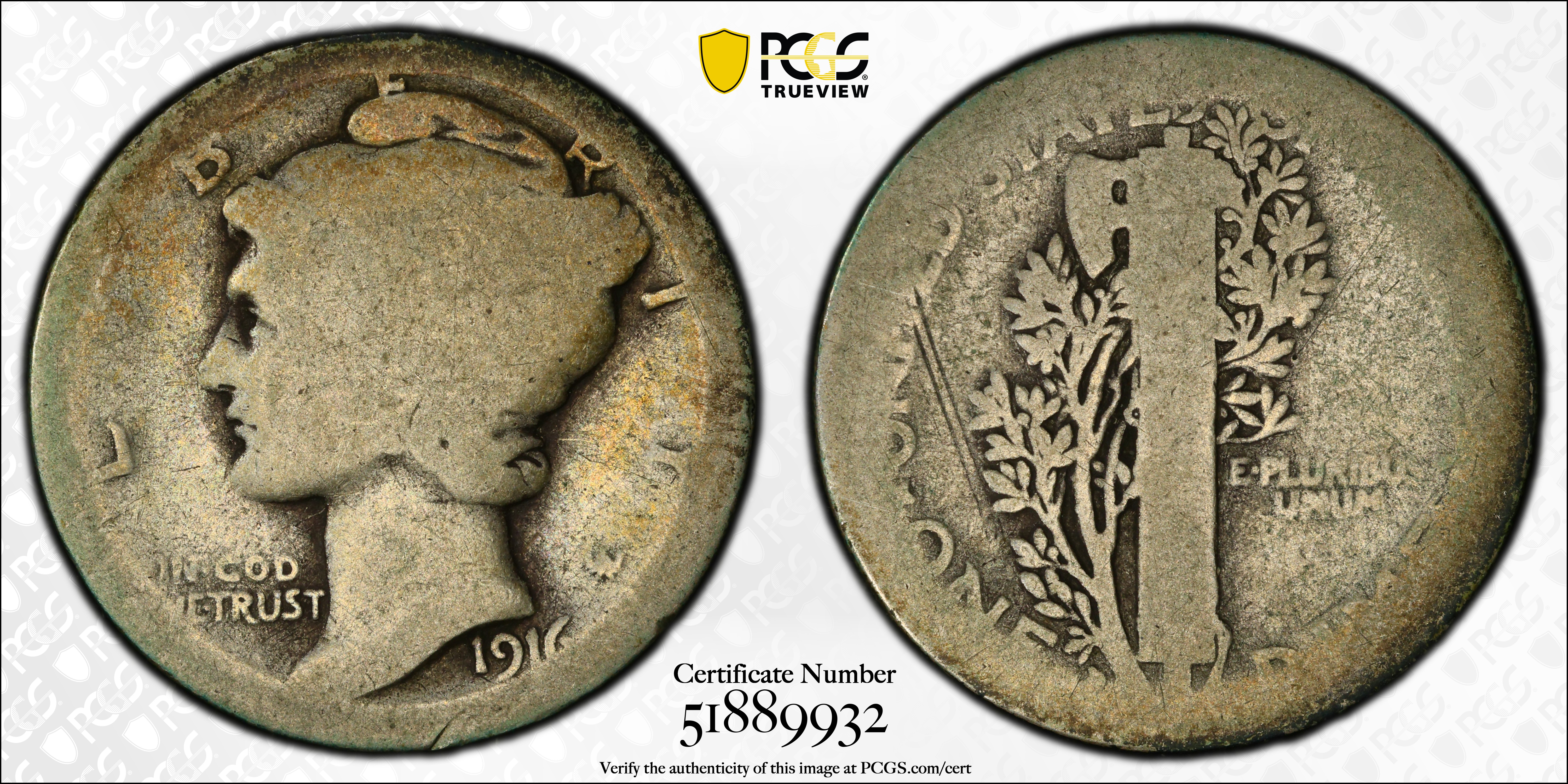
1916-D 10C FR2 认证号51889932, PCGS号4906
专家评论
PCGS Set Registry
The 1916-D is the iconic key date of one of America's most beautiful coin series: the Mercury Dime (also known as the Winged Liberty Dime). This dime's elegant design, heavily influenced by the late 19th-century French Beaux-Arts movement, was released in 1916 alongside the Standing Liberty Quarter (1916–1930) and the Walking Liberty Half Dollar (1916–1947). It immediately preceded the Roosevelt Dime (1946–Present) and holds the distinction of being the last dime struck by the United States Mint entirely in .900 silver.
The Mercury Dime: An American Classic
Entering circulation at the end of October 1916, the Mercury Dime remained in production for nearly 30 years, serving as America's dime through the crucible of World War I, the entirety of the Great Depression, and World War II.
Heralded for its beauty, the Mercury Dime was a constant presence in American life. It was the coin behind countless Charles Atlas advertisements in the back of comic books and magazines. When “Yip” Harburg wrote the somber anthem, “Brother, Can You Spare a Dime?” (1932) or Richard Rodgers and Lorenz Hart wrote "Ten Cents a Dance" (1930, more recently appearing in the videogame Bioshock Infinite), the Mercury Dime was the coin they spoke of. Its legacy even reached the Space Age: on July 21, 1961, astronaut Gus Grissom carried 52 Mercury Dimes into space aboard the Mercury-Redstone 4 Mission as souvenirs.
Design Success, But with Striking Flaws
While all three 1916 designs are celebrated for their artistic merit, they all presented the Mint with production challenges due to striking issues. The Mint never perfected a method to fully strike the Walking Liberty Half Dollars (though the design was later successfully reused on the American Silver Eagle), and the Standing Liberty Quarter had to be redesigned to improve its durability and wearability.
Only the Dime design escaped the need for major revision. Still, variability in production quality across Mints and decades meant that most dimes were not struck with their full intended design features. Specialists often seek out perfectly struck examples featuring Full Split Bands on the reverse—a condition rarity for many issues. Despite these striking nuances, the Mercury Dime is ultimately remembered as an elegant and practical coin that successfully elevated the image of American coinage.
What Makes the 1916-D Mercury Dime a Key Date?
The disparity in 1916 mintage figures is striking. Philadelphia produced 22,180,080 1916 Mercury Dimes, and San Francisco struck 10,450,000 1916-S Mercury Dimes. In light of these numbers, the Denver Mint’s output of just 264,000 is puzzling.
Numismatists widely speculate that the Denver Mint halted dime production shortly after its initial run to dedicate resources to the higher-priority production of quarters. As noted by Q. David Bowers, the first delivery of 1916-D Mercury Dimes did not occur until December 29, meaning the coin did not enter circulation until 1917.
Nonetheless, the 1916-D did circulate, many for decades, as evidenced by the number of well-worn examples found in the marketplace. These future valuable collectibles passed undetected from hand to the next until the growth of coin collecting boards and albums raised public awareness of the issue's scarcity.
Mint State examples, however, are genuinely rare, with choice examples approaching $20,000 in recent sales. Many 1916-D Mercury Dimes were struck with Full Split Bands details, but demand for these is considerable. In MS63, a 1916-D with FB sells at a 50% premium. Gems and Superb Gems are challenging. In 2010, Heritage set a record
Gems and examples with Full Bands are exponentially more challenging; a beautifully-toned MS67FB set a record price of $204,000 in the March 2020 Stack's Bowers sale of D. Brent Pogue's personal collection.
Because of Fakes PCGS Certification is a Must
Given its status as a high-value key date and one of the most widely counterfeited U.S. coins (often by adding a “D” mintmark to a common 1916 dime), it is highly recommended that collectors only purchase third-party certified examples, even in grades as low as AG3.
* * *
David Hall
The 1916-D Mercury dime is one of the most heralded key dates of 20th century numismatics. If you collected coins in the 1950s or 1960s, you dreamed of finding a 1916-D dime...or a 1909-S VDB or 1914-D Lincoln cent, or 1932-D or 1932-S quarter...in circualtion. And I certainly did have that dream as a young pre-teen coin collector.
The 1916-D is rare in all grades. Walter Breen has written that mint production of dimes in Denver in 1916 was stopped so that personnel could devote full time to making quarters. The original mintage of 264,000 for the 1916-D is by far the lowest of the Mercury dime series. For comparision, the mintage of the 1916 was 22,180,080 and the mintage for the 1916-S was 10,450,000. The 1916-D is an extremely high demand coin in all grades and even very low grade examples sell for in excess of $1,000.
The 1916-D is rare in mint state and very rare in Gem condition. The strike is usually very sharp and I'd estimated that 80% of more of the mint state survivors have fully struck crossbands. Luster is typically modest. Many examples have some degree of toning.
Note that this is one of the most counterfeited of all U.S. rare coins. The bad guys add a "D" to a 1916 Philadelphia. I have seen counterfeits in all grades and PCGS sees an average of 5 to 10 counterfeits a week. Needless to say, third party authentication is highly recommended.
稀有性和存量估计 了解更多
| 所有评级 | 10000 |
| 60或以上 | 100 |
| 65或以上 | 10 |
| 所有评级 | R-3.0 |
| 60或以上 | R-8.0 |
| 65或以上 | R-9.5 |
| 所有评级 | 40 / 80 TIE |
| 60或以上 | 3 / 80 |
| 65或以上 | 2 / 80 TIE |
| 所有评级 | 40 / 80 TIE |
| 60或以上 | 3 / 80 |
| 65或以上 | 2 / 80 TIE |
状况普查 了解更多
| #1 PCGS MS66 |
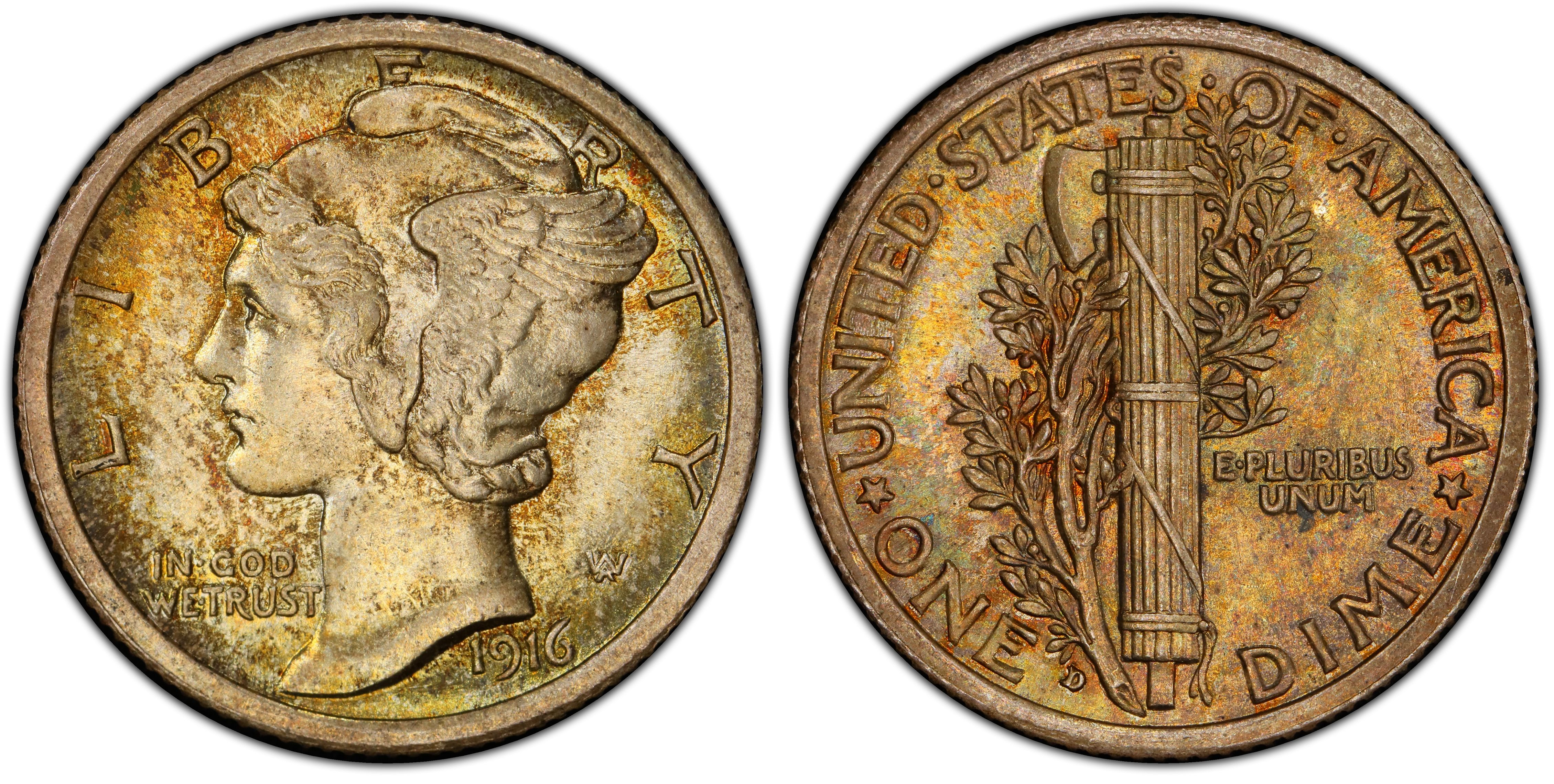 #2 PCGS MS65
Olive and gold toning. |
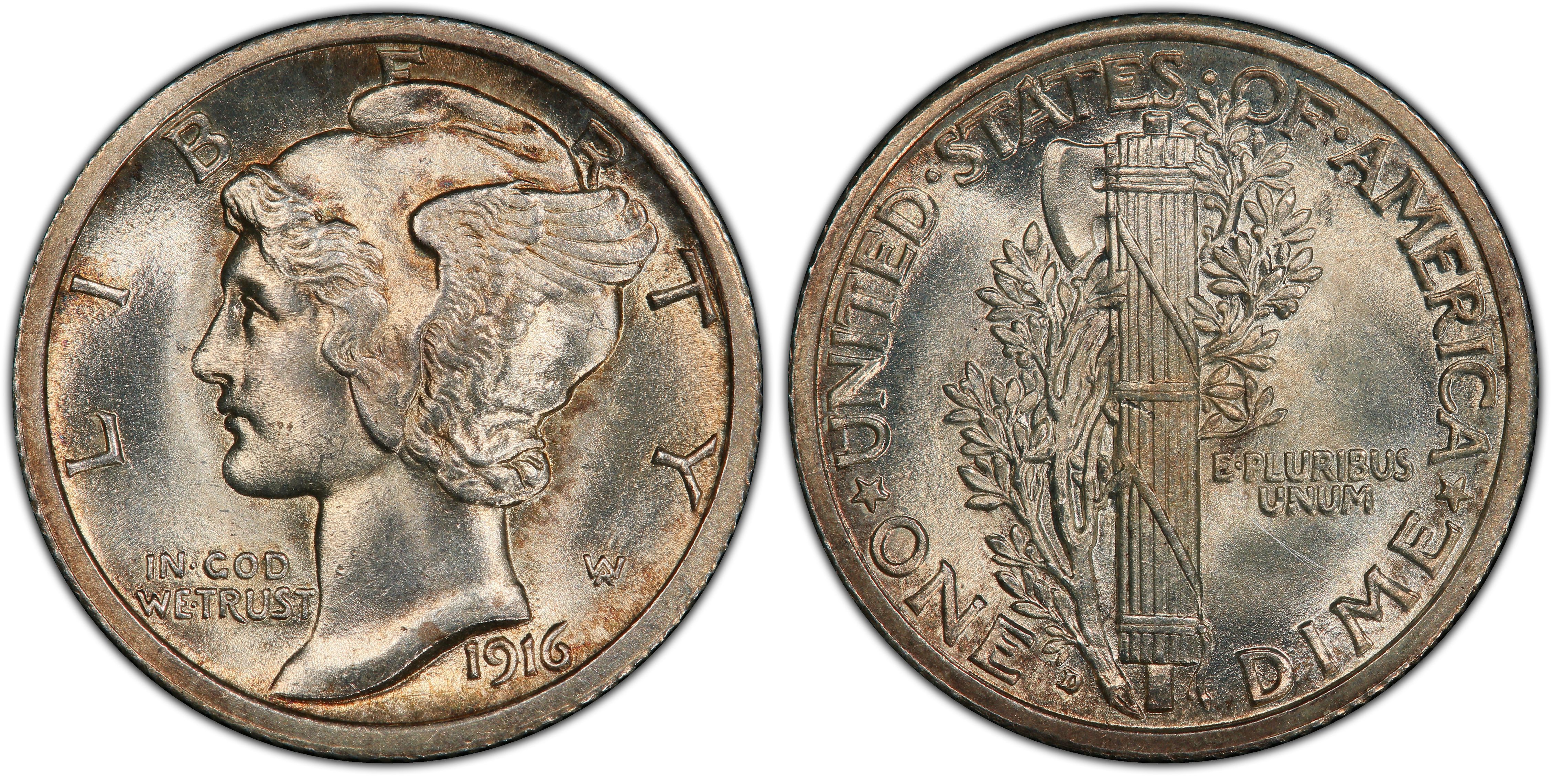 #2 PCGS MS65
|
| #2 PCGS MS65 |
| #2 PCGS MS65 |