



1900 $1 Lafayette MS64 PCGS号9222
专家评论
Charles Morgan
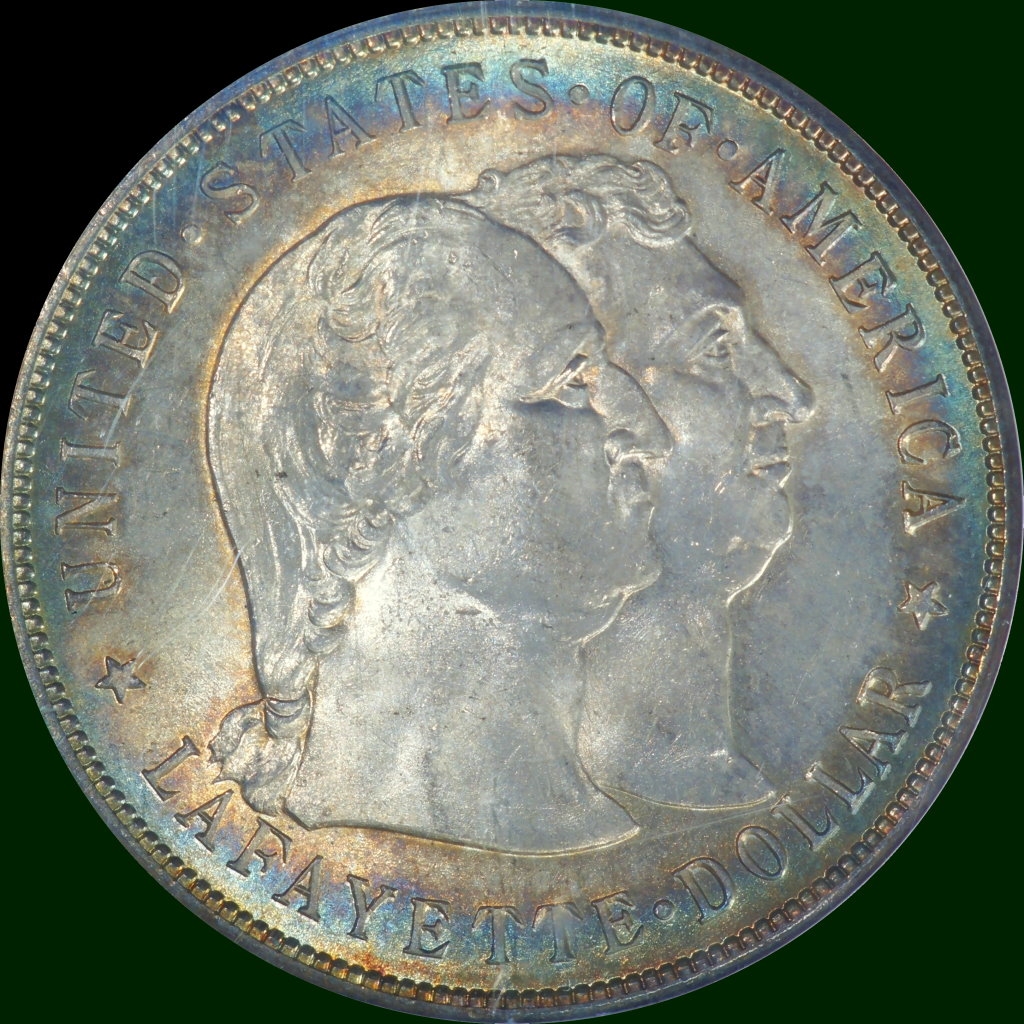
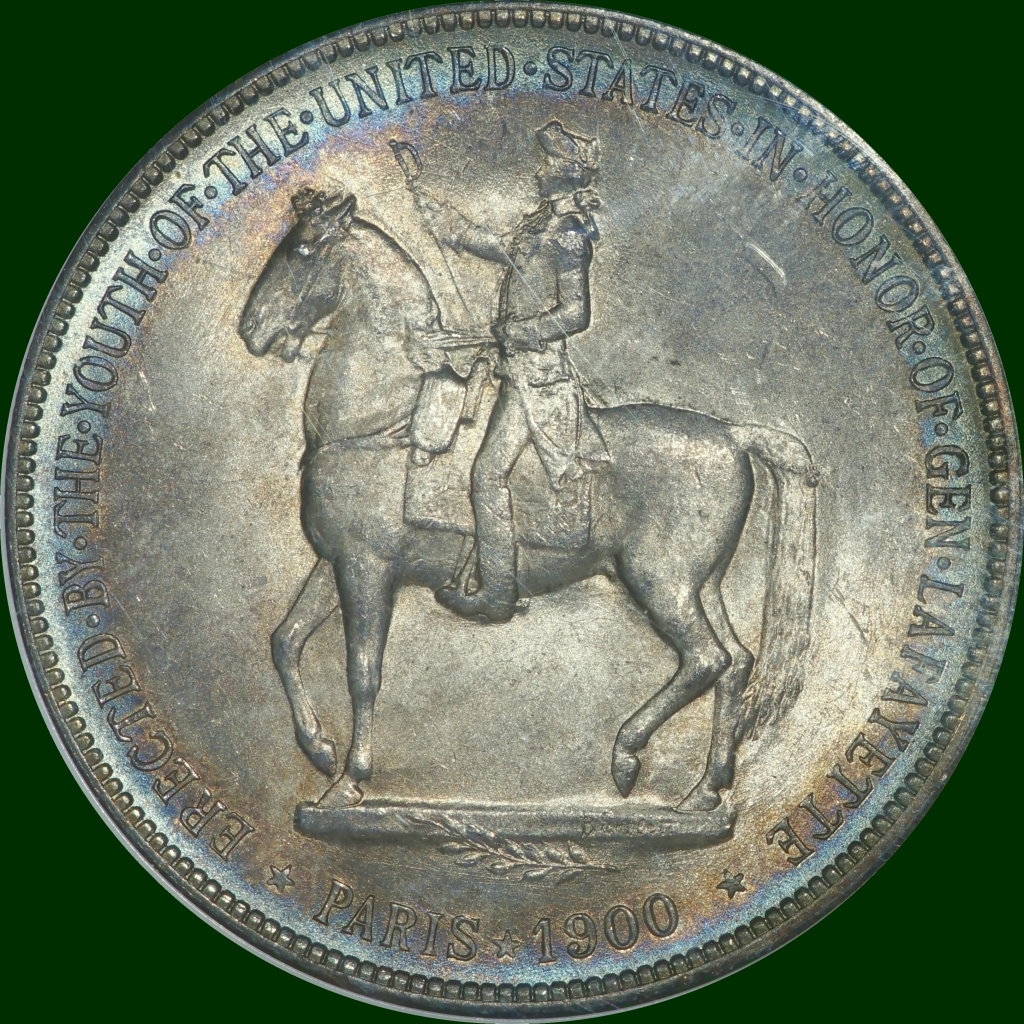
While the Lafayette Dollar (#9222) was the third official United States commemorative coin—following the 1892-1893 Columbian Exposition Half Dollars (#9296, #9297) and the 1893 Isabella Quarter (#9220) —it holds an important list of American numismatic "firsts." It was the first and only commemorative silver dollar coin issued in the "classic" commemorative coin series of 1892-1954, the first U.S. coin to feature a U.S. citizen, and the first coin issued by the United States Mint to feature President George Washington. Washington’s accolated bust appears alongside Gilbert du Motier, the Marquis de La Fayette, making this the first coin in U.S. history to depict the same individual on both the obverse and reverse (Lafayette appears both in the portrait and on horseback).
After its release, no other commemorative silver dollar would be issued until a triumvirate of discus-themed Olympic coins in 1983 (P #9605, D #9606, S #9607) helped launch the modern era. Authorized by an Act of Congress on March 3, 1899, the coin was a fundraising vehicle for the Lafayette Memorial Commission. While the Commission originally hoped for 100,000 half dollars, they ultimately received an authorization for 50,000 dollars. To produce them, the Treasury purchased $23,032.80 worth of silver bullion on the open market, rather than using existing stock. Proceeds supported the construction of a monument in the Place du Carrousel, adjacent to the Louvre in Paris, intended as a gift from American schoolchildren to the people of France.
The obverse of the coin features the jugate portraits of Washington and Lafayette. According to a Philadelphia Ledger article from 1909, the "heads" side was modeled after high-profile sources: Washington’s bust was taken from the work of Jean-Antoine Houdon, while Lafayette’s was derived from an 1824 French medal by François Augustin Caunois. However, numismatic historians like Arlie Slabaugh have noted that Chief Engraver Charles Barber’s design is a direct plagiarism of Peter L. Krider’s 1881 Yorktown Centennial Medal (#670476). The similarities between the two pieces in unmistakable.
The reverse, designed by New York artist Paul Bartlett, depicts Lafayette on horseback. This image was based on an early plaster model Bartlett created in just six weeks. Because the project was delayed, the actual bronze statue wasn't ready for the 1900 Paris Exposition; instead, a colossal plaster model was sawed into pieces, cast in various French workshops, and reassembled just days before the unveiling. Bartlett later expressed dissatisfaction with this version, and the final bronze installed in 1908 featured significant changes: Lafayette’s hat and coat were removed, and the horse was changed to a less flamboyant breed.
Upon release, the Lafayette Silver Dollar was offered for sale at $2 each. Although a $5,000 bid was made for the first coin struck, it was rejected so that President William McKinley could present the specimen to French President Émile Loubet in an ornate $1,000 silver case. The entire production run was minted in a single day—Friday, December 14, 1899—marking the 100th anniversary of Washington’s death. Because the Mint was legally required to date coins in the year they were struck, the "1900" on the reverse is technically part of the inscribed legend ("Paris 1900"), making the coin "undated" in an official capacity.
These coins were struck on an aging "Merrick" press and ejected into hoppers with little regard for their surfaces. This rough handling, combined with the Treasury’s 1945 melting of 14,000 unsold units, makes high-grade specimens remarkably scarce today. To put this scarcity in perspective, the Lafayette Dollar’s distribution of 36,026 represents less than half of 1% of the Philadelphia Mint's 1900 Morgan Dollar (#7266) production. Furthermore, the entire Lafayette mintage is 25% lower than the total number of 1900 Morgan Dollars currently housed in PCGS holders alone. Taking it one step further, there are more 1900 Morgan Dollars graded PCGS MS67 than there are Lafayette Dollars graded MS65+ or finer.
1900 Lafayette Dollar Varieties
Collector George H. Clapp first noticed the existence of multiple varieties in 1925 when his coin differed from the one described in Howland Wood’s 1922 monograph. Wood eventually identified three obverse dies and four reverse dies, creating a system of marriages known as 1A, 1B, 2C, and 3D. Modern research has expanded this list.
Obverse 1: Features a small point on Washington’s bust; the tip of Lafayette’s bust is positioned over the top of the "L" in DOLLAR. "AT" in STATES is cut high.
- 1-A: Scarce. (14 long leaves, long stem; leaf over "1" in 1900).
- 1-B: The most common variety. (14 shorter leaves, short stem; leaf over space between "1" and "9").
- 1-C: Very rare; first reported by Anthony Swiatek in 1980. (14 medium leaves, short bent stem; leaf over "9").
Obverse 2: The left foot of the final "A" in AMERICA is recut; "A" in STATES is high, and the second "S" in STATES is repunched (a key diagnostic).
- 2-C: Rare. (14 medium leaves, short bent stem; leaf over "9").
Obverse 3: "AT" in STATES is recut and the final "S" is low. The letters "F" in OF and "L" in LAFAYETTE are broken. AMERICA is spaced "A ME RI C A" with the period after OF close to the "A." The tip of Lafayette’s vest falls to the right of the first "L" in DOLLAR.
- 3-D: Very rare. (15 long leaves, short bent stem; leaf over "9").
Obverse 4: The "C" in AMERICA is repunched at the inside top (a key diagnostic); "CA" in AMERICA features unique spacing compared to other obverses.
- 4-E: Very rare; discovered by Frank DuVall and first published in 1988. (Lowest leaf tip over space to the left of "1" in 1900).
1900 Lafayette Dollar Vintage Market Snippets
The market for the Lafayette dollar has seen dramatic swings. In 1903, they were so unpopular that dealers sold them for as little as $1.10. By July 1964, dealer Roy L. Baker offered a Brilliant Uncirculated example for $135. Prices climbed to $575 in 1974 and $900 for "GEM BU" coins in 1976.
Of the finest known, the toned example in the J & L Collection is the first coin to ever earn the PCGS MS68 grade. Other examples with spectacular toning from named collections have also traded at public auction over the course of the past few twenty years.
An interesting example—valued for its provenance rather than its technical grade—sold at a Stack’s Bowers auction on August 13, 2024. While the coin was not graded by PCGS, it was accompanied by a letter signed by President William McKinley and authenticated by PSA/DNA. In the letter, McKinley asserts that he presented the coin to the Masonic Fair in Canton, Ohio, to be featured in a benefit raffle. The coin was won by a member of the Heacock family, who preserved it through two generations before it was eventually sold at the 1988 Long Beach Expo.
* * *
David Hall
The 1900 Lafayette dollar is one of the most important issues of the silver commemorative series. It is the only silver dollar commemorative of the 1892-1954 "classic era" of U.S. commemorative coinage. The Lafayette dollar was actually struck in December, 1900. The original amount struck was 50,026. There were 14,000 coins melted as unsold at the $2 issue price, leaving an effective mintage of 36,036 coins. Though this is not a particularly low mintage by silver commemorative standards, the Lafayette was an early issue in the series and many specimens saw circulation. The typical surviving Lafayette grades in the AU50 to MS62/63 range. There are a number of lower grade examples. Specimens in MS64 are scarce, and MS65 examples are rare. Above MS65, Lafayettes are very rare.
The relative rarity in Gem condition can be explained by the fact that the surfaces are large (as a silver dollar is considerably larger than a half dollar) and the design is quite flat. This design set-up attracts marks and abraisions and there are also a number of survivors with noticeable high point "rub". Hence the rarity of Gem examples. The luster on Lafayettes is typically a mix of satiny surfaces and a soft frosty iridescent look. A Gem condition Lafayette is a really beautiful coin. It is also highly desirable and one of the key issues in the silver commemorative series.
稀有性和存量估计 了解更多
| 所有评级 | 25000 |
| 60或以上 | 15000 |
| 65或以上 | 1650 |
| 所有评级 | R-2.7 |
| 60或以上 | R-2.9 |
| 65或以上 | R-4.7 |
| 所有评级 | 103 / 144 TIE |
| 60或以上 | 91 / 144 TIE |
| 65或以上 | 23 / 144 TIE |
| 所有评级 | 103 / 144 TIE |
| 60或以上 | 91 / 144 TIE |
| 65或以上 | 23 / 144 TIE |
状况普查 了解更多
 #1 PCGS MS68
As PCGS MS67+ #32961649. "The J & L Collection." As PCGS MS68 #59895877. "The J & L Complete Set" (PCGS Registry Set). Richly toned on both sides. The obverse features target toning, with the portraits of Washington and Lafayette bathed in peach and framed by prismatic shades of peacock green, aubergine, gold, and magenta. The reverse follows a similar palette, though the vibrant color is concentrated on the right side, at a slight diagonal. |
 #2 PCGS MS67+
As PCGS MS67 #35623478. "The San Diego Collection." As PCGS MS67+ #59823056. Gold toning throughout, accented by splashes of blue, magenta, and peacock green. A green "patina" highlights the details of Washington and Lafayette's hair. |
| #3 PCGS MS67 |
|
#3 PCGS MS67
As PCGS MS67 #34358723. "The Bruce Scher Collection"; "The Hidden Liberty Collection. As PCGS MS67 #4537305. “Pavonini Collection of Toned Silver Commemoratives,” GreatCollections, September 25, 2022, Lot 1146221 – $90,000. Evenly toned on both dies. The obverse is dominated by well-blended shades of mauve, sage, and golden-green. Mauve and aubergine dominate the target-toned reverse, accented by a bluish-green and gold ring along the periphery. An untoned area at the "ON" of "HONOR" serves as a pedigree marker. |
|
#3 PCGS MS67
Heritage Auctions, January 7, 2004, Lot 2233 – $66,700; Heritage Auctions, January 10, 2008, Lot 3414 – $69,000; Heritage Auctions, April 17, 2008, Lot 2528 – $86,250; “The Louis Bassano Collection of U.S. Commemoratives,” Heritage Auctions, July 31, 2009, Lot 1388 – $77,625; “The Empire Collection,” Heritage Auctions, January 7, 2015, Lot 4438 – $73,437.50; DuVall 1-B variety. Toned on both sides. On the obverse, peripheral aqua toning transitions to shades of red and gold toward the interior. The reverse features streaky red toning punctuated by patches of aqua and green. |