



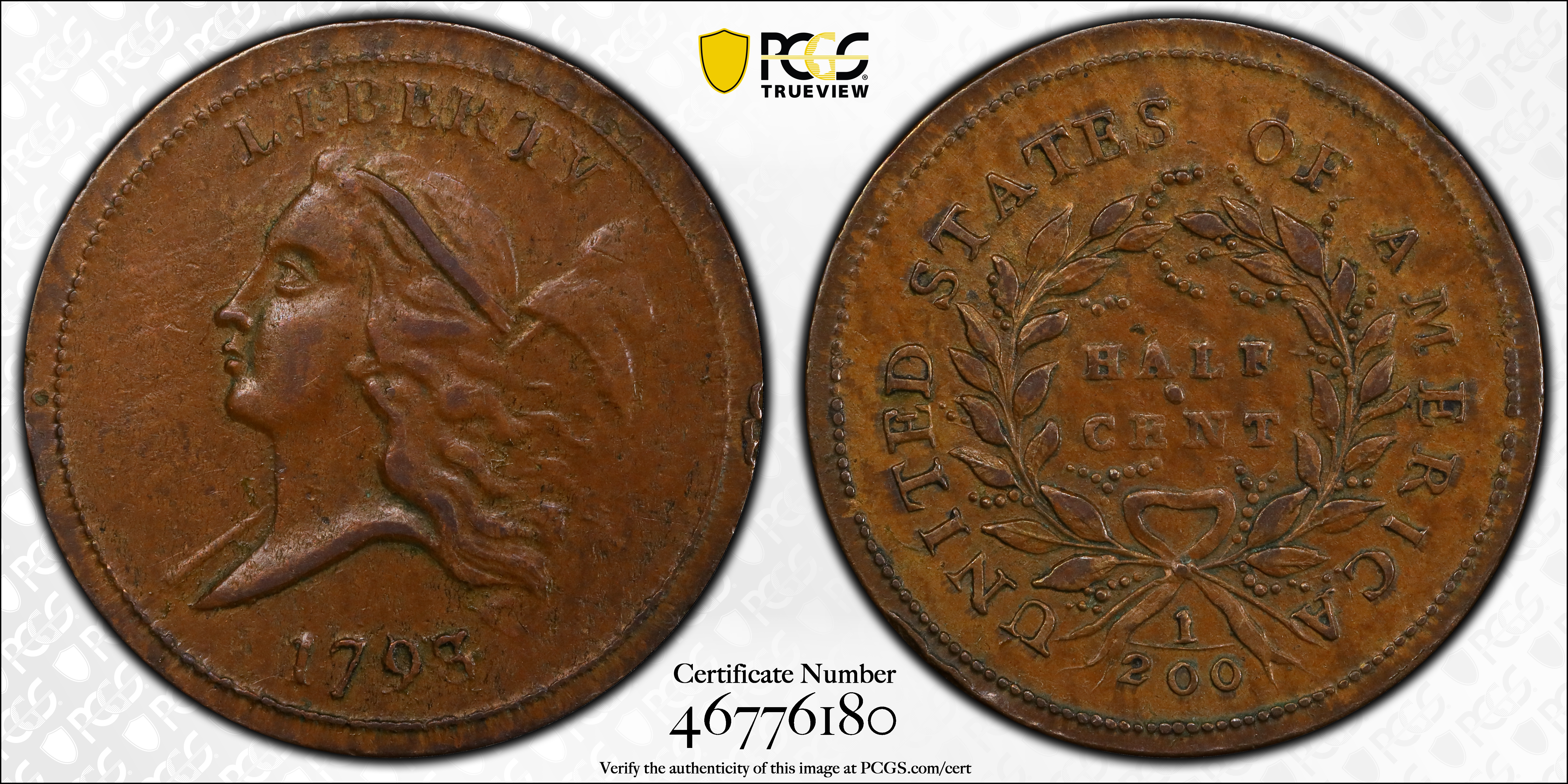
1793 1/2C, BN AU55BN 认证号46776180, PCGS号1000
拥有者评论
专家评论
PCGS Set Registry
Copper Before Silver or Gold
The 1793 Flowing Hair, Cap Left Half Cent (#1000) was the first design of the U.S. half cent denomination. This copper coin, worth 1/200th of a dollar, was issued for use alongside America’s gold and silver coinage, although the precious metal coins did not begin production at the Philadelphia Mint until a year after the half cent's introduction.
The half cent was first conceived by Thomas Jefferson in 1784 while he was a member of Congress under the Articles of Confederation. Although Congress approved coinage legislation in 1785 that included provisions for half cents, they lacked the means to establish a mint or strike the coins.
Under the Constitutional government, Treasury Secretary Alexander Hamilton also endorsed the denomination, writing:
“Pieces of very small value, are a great accommodation, and the means of a beneficial economy to the poor, by enabling them to purchase, in small portions, and at a more reasonable rate, the necessaries of which they stand in need… a half cent is low enough for the minimum of price. Excessive minuteness would defeat its object. To enable the poorer classes to procure necessaries cheap, is to enable them, with more comfort to themselves, to labor for less; the advantages of which need no comment.”
The authorty for the Mint to strike half cents came from the Coinage Act of April 2, 1792. The Act called for the half cent to be a copper coin weighing 132 grains (8.55 grams). However, due to the rising cost of copper, Congress voted to lower the weight before coinage began in 1793. The Act of January 14, 1793, set the new standard at 104 grains (6.74 grams).
Despite the official standard, 1793 Flowing Hair, Cap Left Half Cents vary in weight. Dr. Ronald P. Manley’s survey, detailed in The Half Cent Die State Book: 1793-1857 (1998), found the coins averaged 102 grains and ranged between 95 and 111 grains. The average diameter was 22 mm. Such variation underscores the rustic nature of America's early coinage.
Production and Design
The year 1793 was pivotal for the fledgling United States Mint, but it faced early challenges. Bonding issues with Mint staff prevented the striking of silver and gold coins, limiting the Mint's first year of operations to only cents and half cents.
In his Encyclopedia of United States Half Cents: 1793-1857, Walter Breen noted that the Philadelphia Mint prepared two obverse and three reverse dies for this issue between April and July 1793. The initial design and dies were prepared by Henry Voigt. While Breen postulated that Mint Director David Rittenhouse may have been the designer, half cent expert Bill Eckberg dismisses this theory. In his book, The Half Cent, 1793-1857: The Story of America’s Greatest Little Coin (2019), Eckberg instead links the Liberty figure to Voigt's 1792 Bust Half Disme (#11020) design.
Regardless, the artwork was inspired by French engraver Augustin Dupré’s Libertas Americana (#15100) medal, which had been struck in Paris at the request of Benjamin Franklin.
Copper Coins Did Not Have the Same Legal Tender Status as Silver and Gold Coins
At the time of their creation, half and large cents were not fully legal tender. This status was reserved for silver and gold coins, which were first produced the following year. Section 16 of the Mint Act of April 2, 1792, specified:
“That all the gold and silver coins which shall have been struck at, and issued from the said mint, shall be a lawful tender in all payments whatsoever, those of full weight according to the respective values herein before declared, and those of less than full weight at values proportional to their respective weights.”
Production History
Two obverse and three reverse dies were used to strike the 1793 half cents. The Mint acquired any copper it could get and prepared approximately 30,000 planchets with edge lettering by mid-May. Coinage began on July 19, and 7,000 pieces were delivered the next day. An additional 24,934 pieces were struck and delivered between July 23rd and 26th.
Mint operations were suspended in July due to the outbreak of yellow fever. When work resumed on November 23, 1793, newly appointed engraver Robert Scot began preparing dies for the new design: the 1794 Liberty Cap Half Cent (#1003).
The published mintage for the 1793 issue is 35,334, citing deliveries ending on September 18, 1793. However, Eckberg disputes this figure, citing Mint Treasurer Tristram Dalton’s receipt book, which indicates that the 3,400 pieces delivered on September 18 were one-cent coins. Removing these 3,400 coins leaves a corrected mintage figure of 31,934 half cents for the year.
Die Varieties
The 1793 Flowing Hair, Cap Left Half Cent has four known varieties, all of roughly equivalent scarcity. These varieties are traditionally cataloged using the Cohen numbering system, devised by Roger S. Cohen, Jr. This system was more recently modernized by Eckberg in 2019.
The four known varieties are classified using two common numismatic systems:
- Cohen 1 | Eckberg 1-A | PCGS #35003 (Brown) | Scarce
- Cohen 2 | Eckberg 1-B | PCGS #35006 (Brown) | Scarce
- Cohen 3 | Eckberg 2-B | PCGS #35009 (Brown) | Scarce
- Cohen 4 | Eckberg 2-C | PCGS #35012 (Brown) | Scarce
Collectibility
Demand for this date is exceptionally high because it represents the first and only year of its type. Consequently, pieces that possess excellent preservation are very rare:
- High-grade examples are seldom seen.
- Coins featuring nice surfaces, perfect planchets, and original surfaces command a significant premium.
- Coins attached to famous collections also, often generate considerable interest.
* * *
稀有性和存量估计 了解更多
| 所有评级 | 1090 |
| 60或以上 | 43 |
| 65或以上 | 4 |
| 所有评级 | R-4.9 |
| 60或以上 | R-8.6 |
| 65或以上 | R-9.8 |
| 所有评级 | 1 / 1 |
| 60或以上 | 1 / 1 |
| 65或以上 | 1 / 1 |
| 所有评级 | 1 / 1 |
| 60或以上 | 1 / 1 |
| 65或以上 | 1 / 1 |
状况普查 了解更多
 #1 MS66BN PCGS grade
George H. Earle, Jr. Collection - Henry Chapman 6/1912:3598, $35 - Clarence S. Bement Collection - Henry Chapman 5/1916:413, $35 - S. H. Chapman - Dr. Christian A. Allenburger Collection - B. Max Mehl 3/1948:311 - Philip M. Showers Collection - Stack's, sold privately in 1969 - Willis Harrington duPont Collection - Fred S. "Freddy" Werner, sold privately in 2/1976 - Superior, sold privately in 2/1976 - Joe Flynn and Son Rare Coins, Inc. (Joseph S. Flynn, Jr.), sold privately on 4/20/1976 - R. Tettenhorst Collection - Eric P. Newman Numismatic Education Society - Missouri Cabinet (Mocab 93.4.1) - Goldbergs 1/2014:6, $920,000 |
 #1 MS66BN PCGS grade
T. James Clarke Collection - Charles M. Williams Collection - Numismatic Gallery 12/1950:659 - Harold Bareford Collection - William J. Bareford Collection - Jules Reiver Collection, sold privately in 6/1984 - Jim McGuigan Collection |
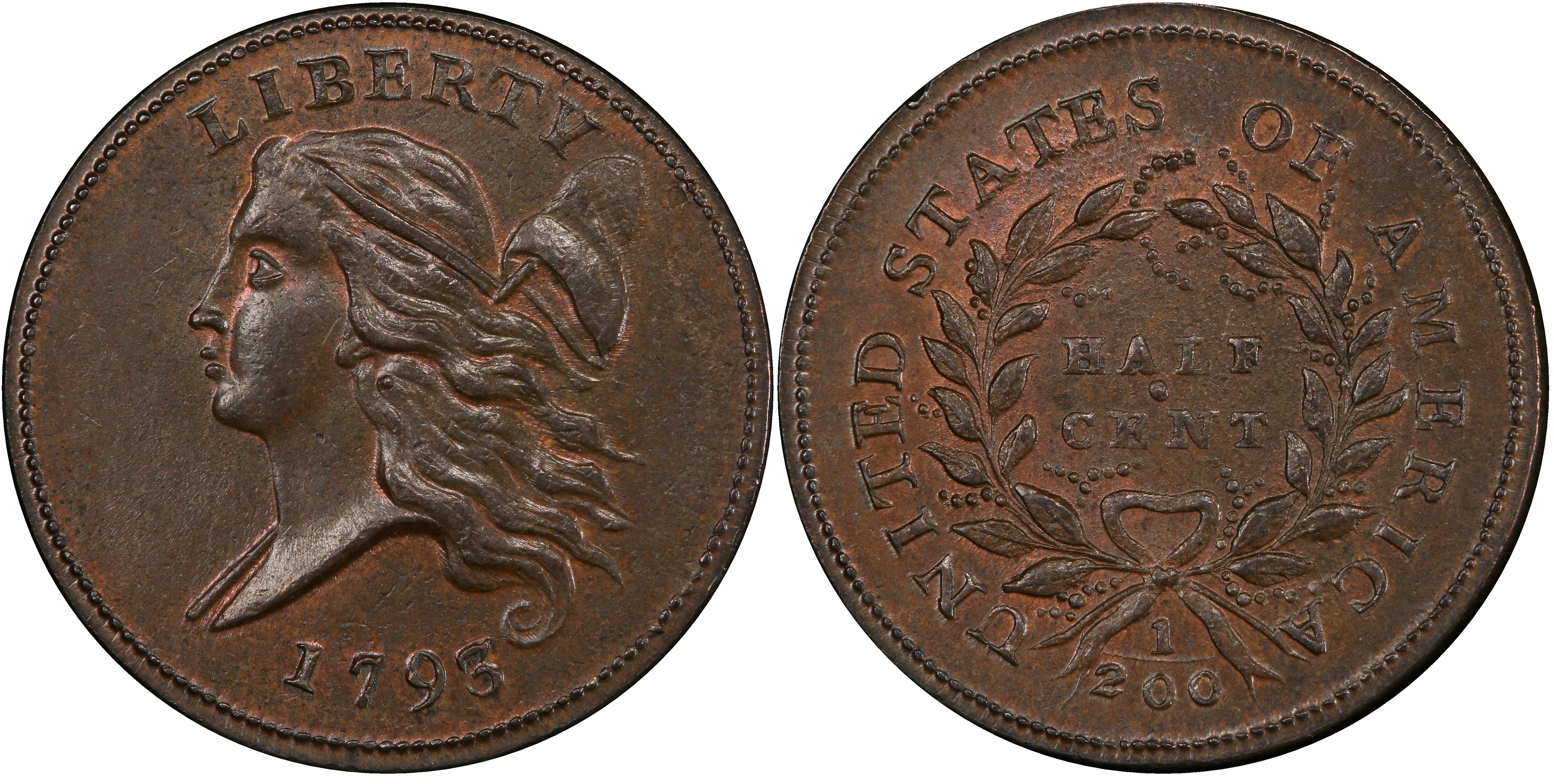 #3 MS65BN PCGS grade
Charles Morris Collection - S.H. & H. Chapman 4/1905:857 - Allison W. Jackman Collection - Henry Chapman 6/1918:851 - Virgil M. Brand Collection - Horace and Armin Brand - Armin Brand, consigned to the following on 8/1935 - Burdette G. Johnson - Douglas Weaver, sold privately in 1/1972 - George W. "Hank" Rodgers, sold privately on 3/27/1972 - R. Tettenhorst Collection - Eric P. Newman Numismatic Education Society - Missouri Cabinet (Mocab 93.3.1) - Goldbergs 1/2014:4, $718,750 - Larry Hanks and Richard Burdick, as agents for the following) - D. Brent Pogue Collection - Stack's/Bowers 2/2016:3001, $446,500 - Stack's/Bowers 2/2016:3001, $446,500 |
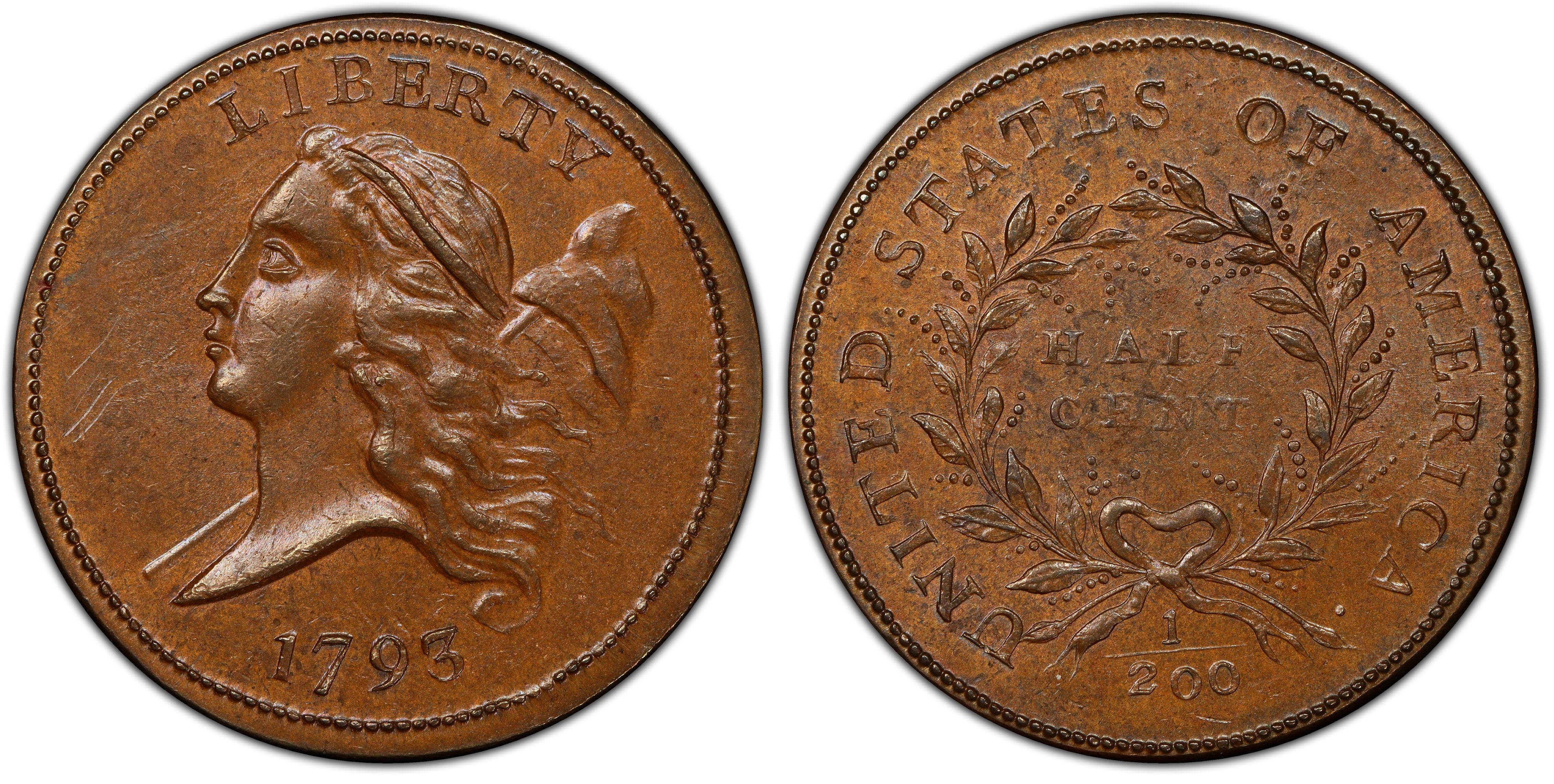 #3 MS65BN PCGS grade
Frederick Reed "F. R." Alvord Collection - S. H. Chapman 6/1924:8 (as Raw Uncirculated), $68 - Henry Chapman, privately - Howard Rounds Newcomb Collection (valued by Newcomb at $32.50), sold privately in 1935 - B. Max Mehl, who purchased the entire half cent collection of Howard Rounds Newcomb in 1935, advertised it for sale on page 814 in the November 1935 issue of The Numismatist, and sold the collection intact to E. H. R. Green) - "Colonel" Edward Howland Robinson "E. H. R." Green collection (appraised by Frederick Charles Cogswell "F. C. C." Boyd for the Green Estate at $15 on 8/9/1937), sold in 4/1943 for $30.01 - Partnership of Eric P. Newman & Burdette G. Johnson (St. Louis Coin Co.) - Burdette G. Johnson, valued by his estate at $125 - Charles J. duPont Collection - Stack's “Anderson-Dupont” 11/1954:1029 (as Raw Mint State), $675 - Harold S. Bareford, 4/1978 - William J. Bareford, sold 6/1984 (via Julius "Jules" Reiver) - R. Tettenhorst Collection - Eric P. Newman Numismatic Education Society - Missouri Cabinet (Mocab 93.1.3) - Goldbergs 1/2014:1, $379,500 |
|
#3 MS65BN PCGS grade
Joseph Brobston Collection - Stack's FPL 1/1963, offered at $2,500 - Stack’s “Gardner Collection 2/1965:1109, $4,800 |