



cardinal 的钱币相册
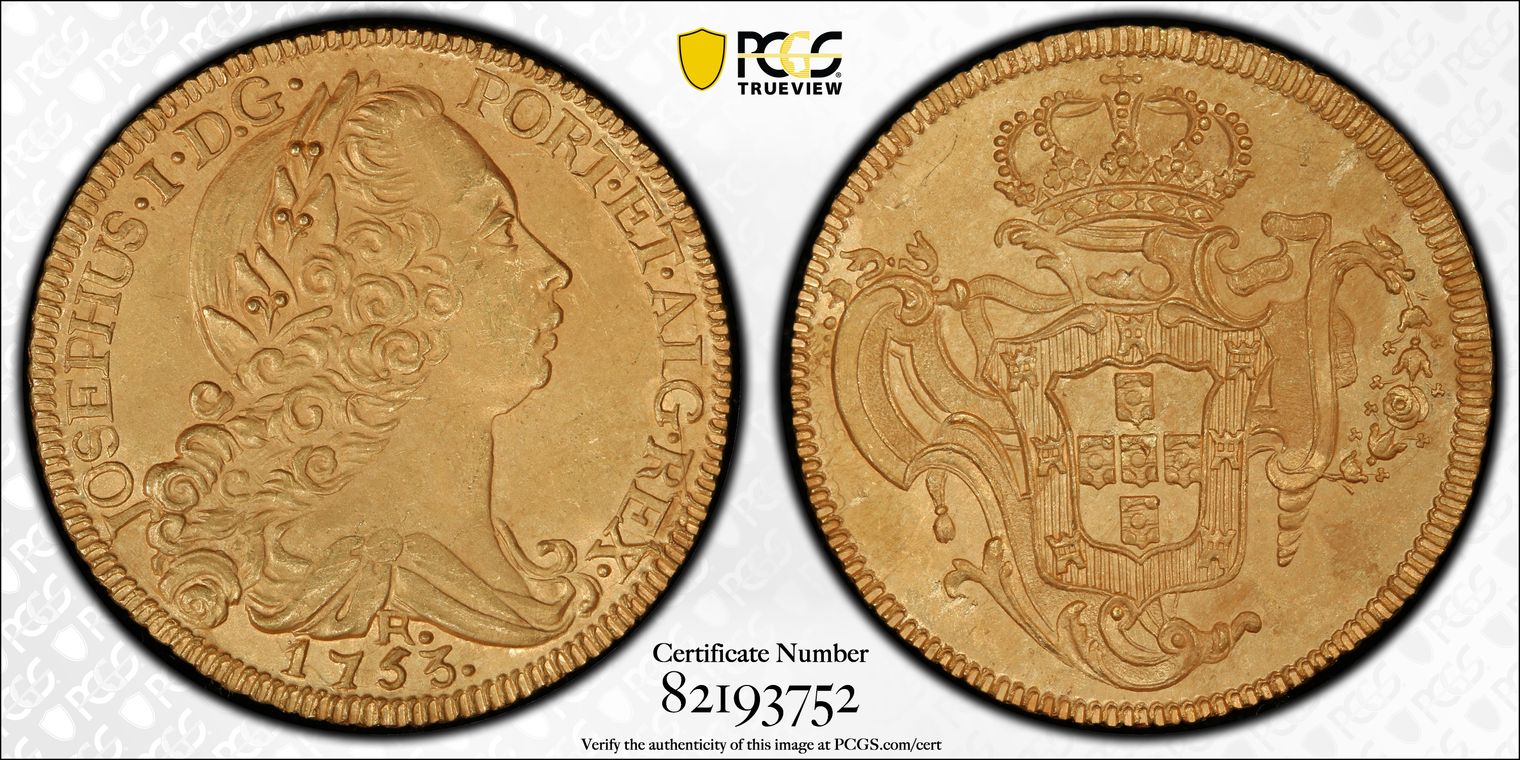
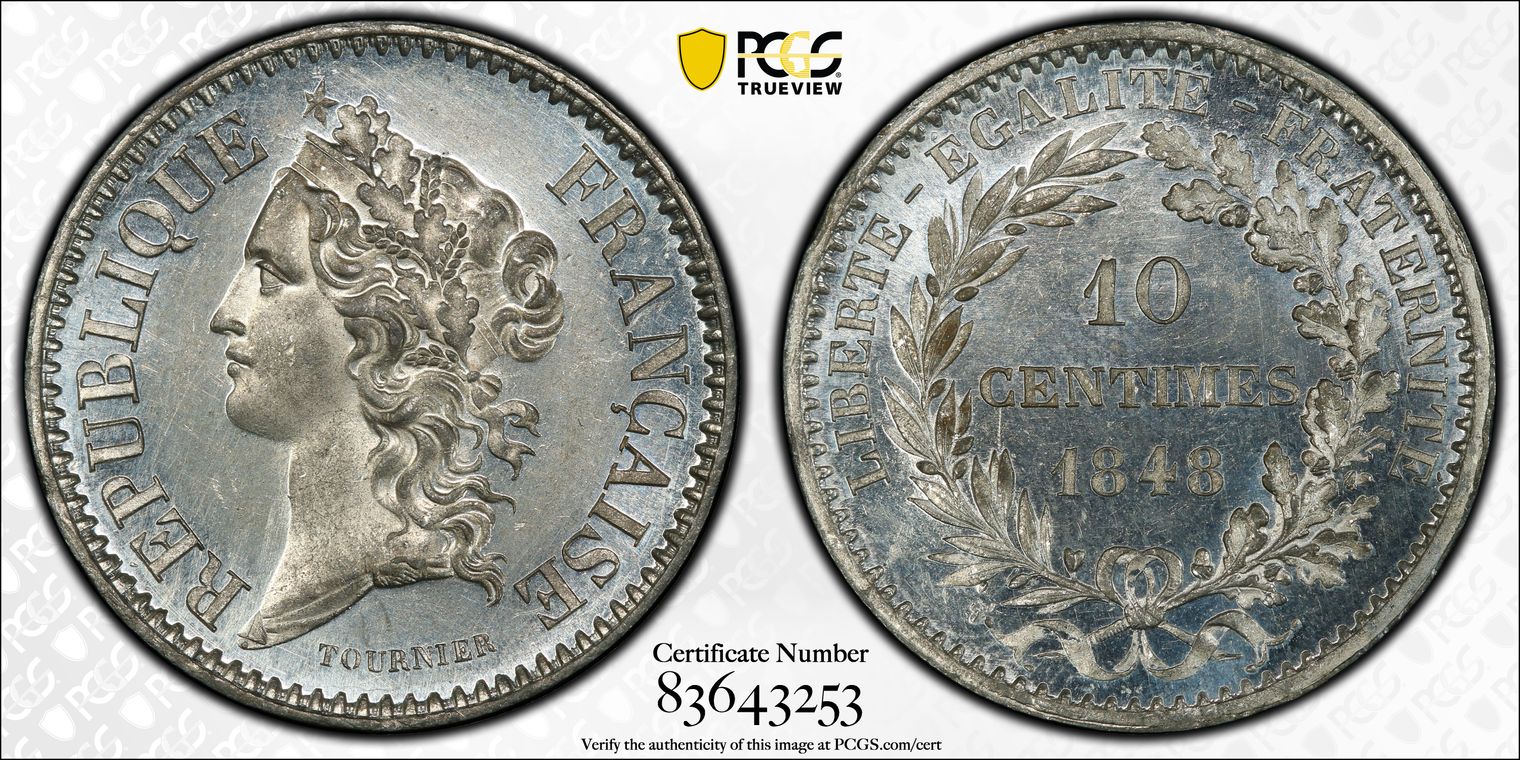

Sometimes referred to as the "French" Libertas medal, this medal commemorates the convention of artists in Lyon in 1792. Clearly, the flowing hair portrait of Liberty and Liberty Cap of the Libertas Americana medal show their influence here.
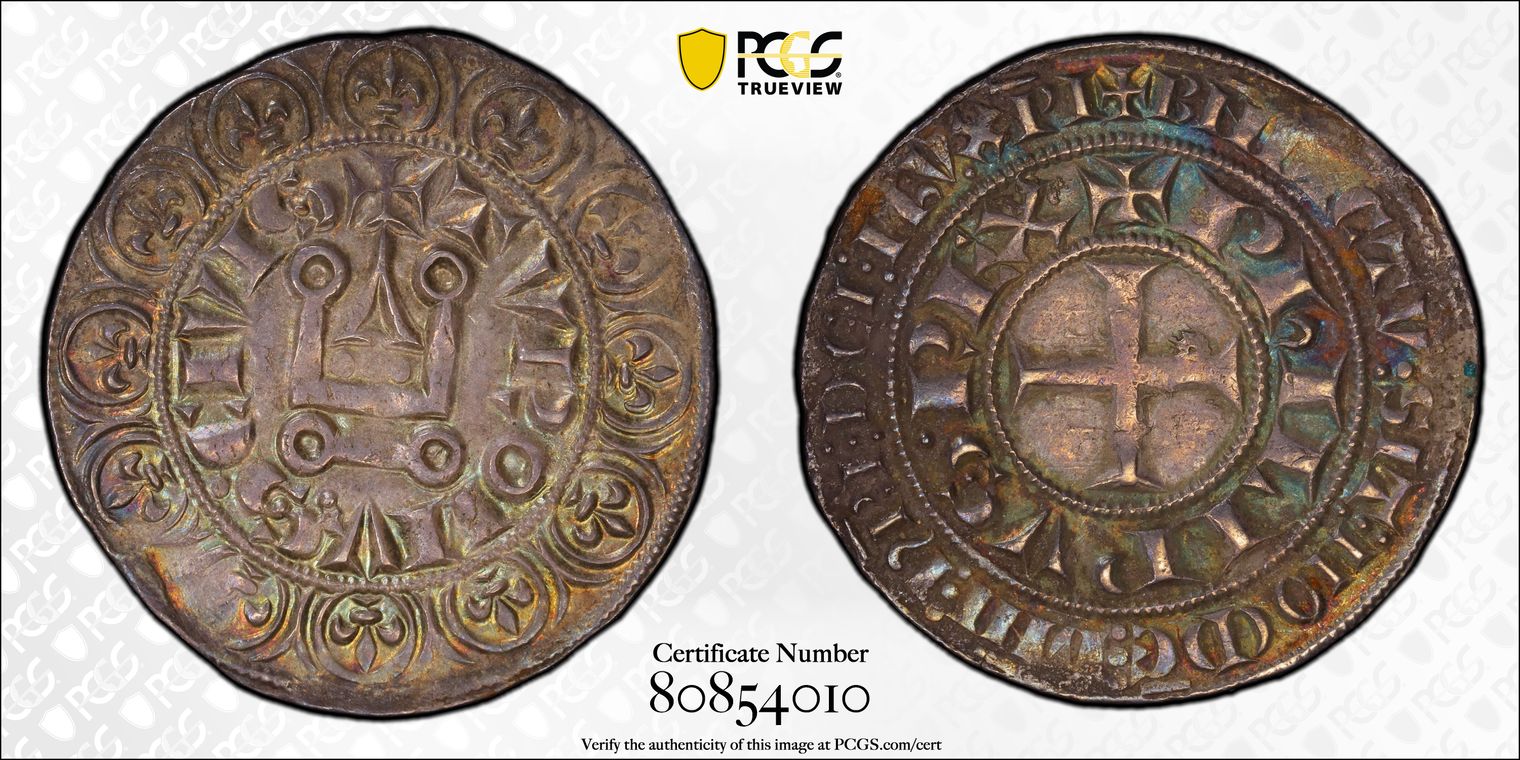
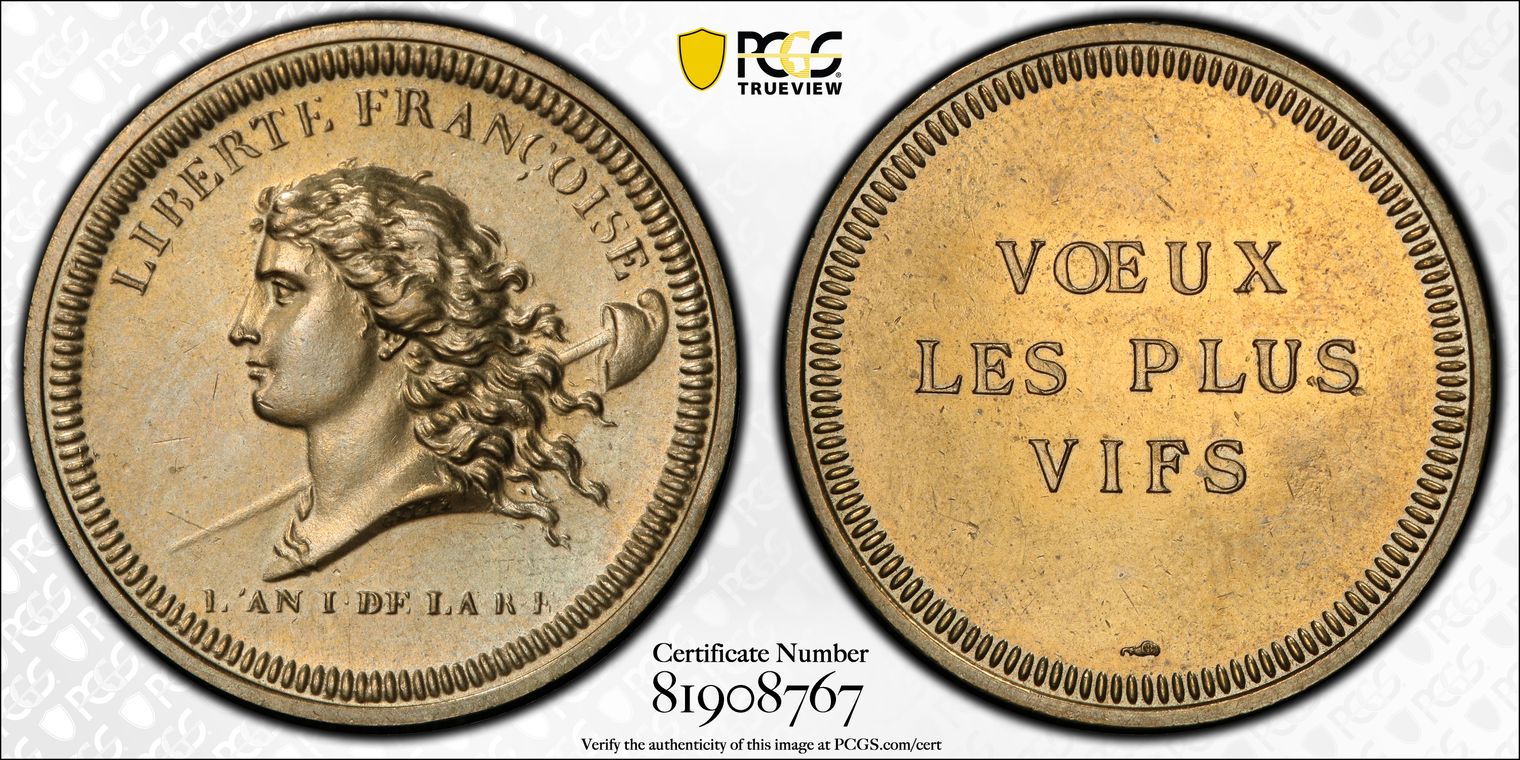
This French Jeton combines the obverse of the France Liberte Francoise Lyon Convention medal with a new reverse, translated as "Best Wishes." The cornucopia hall mark on the reverse places this as a somewhat modern creation.




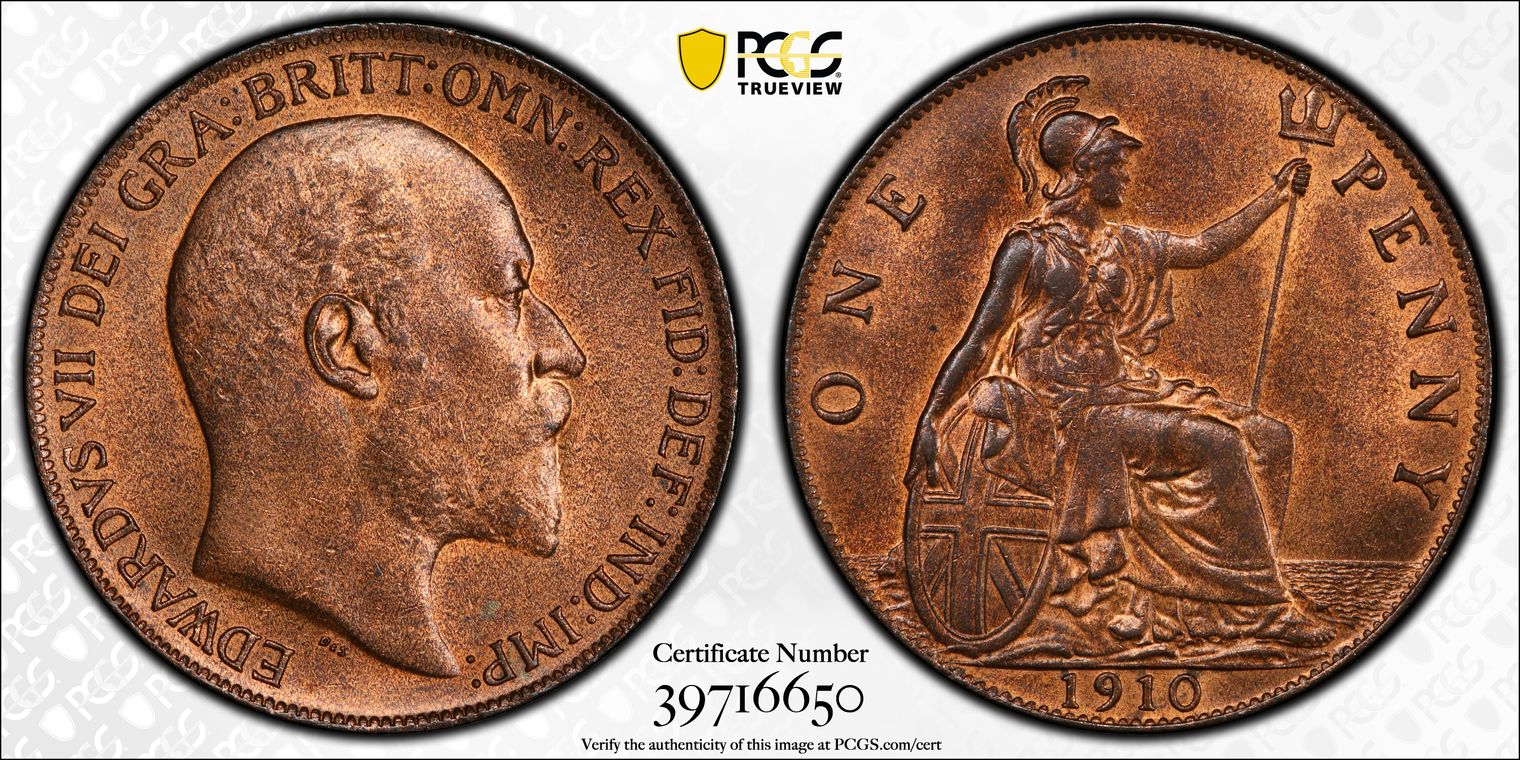
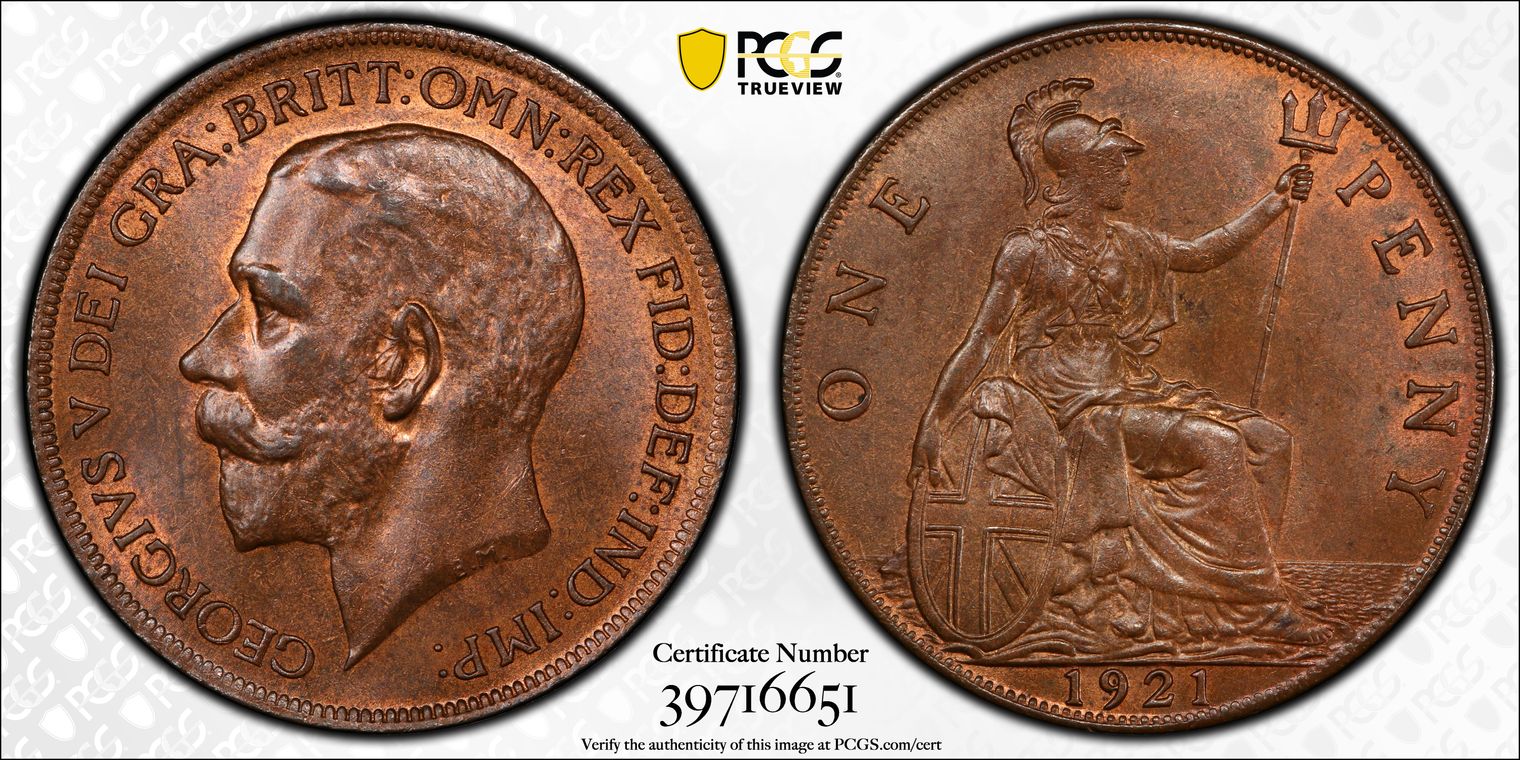
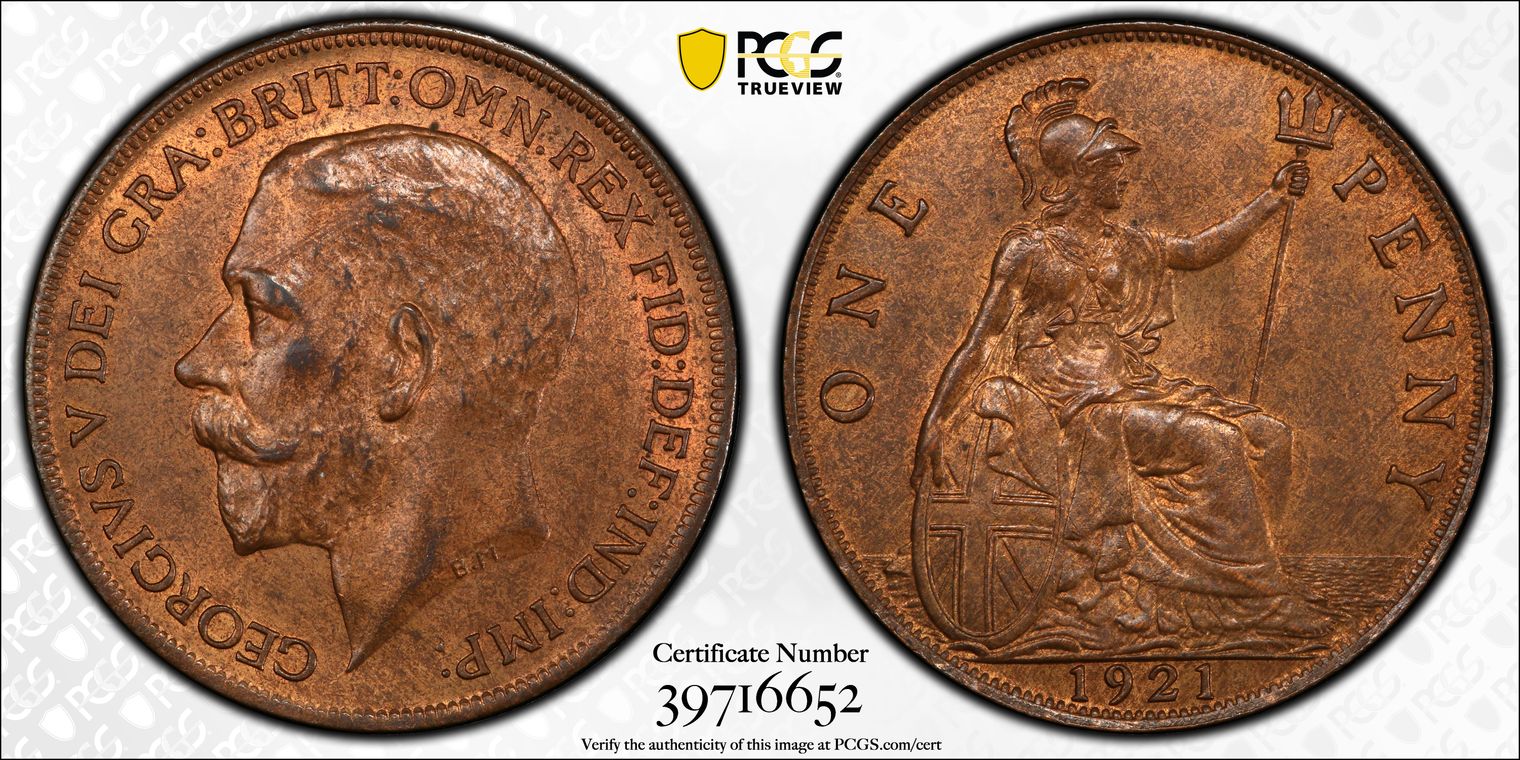
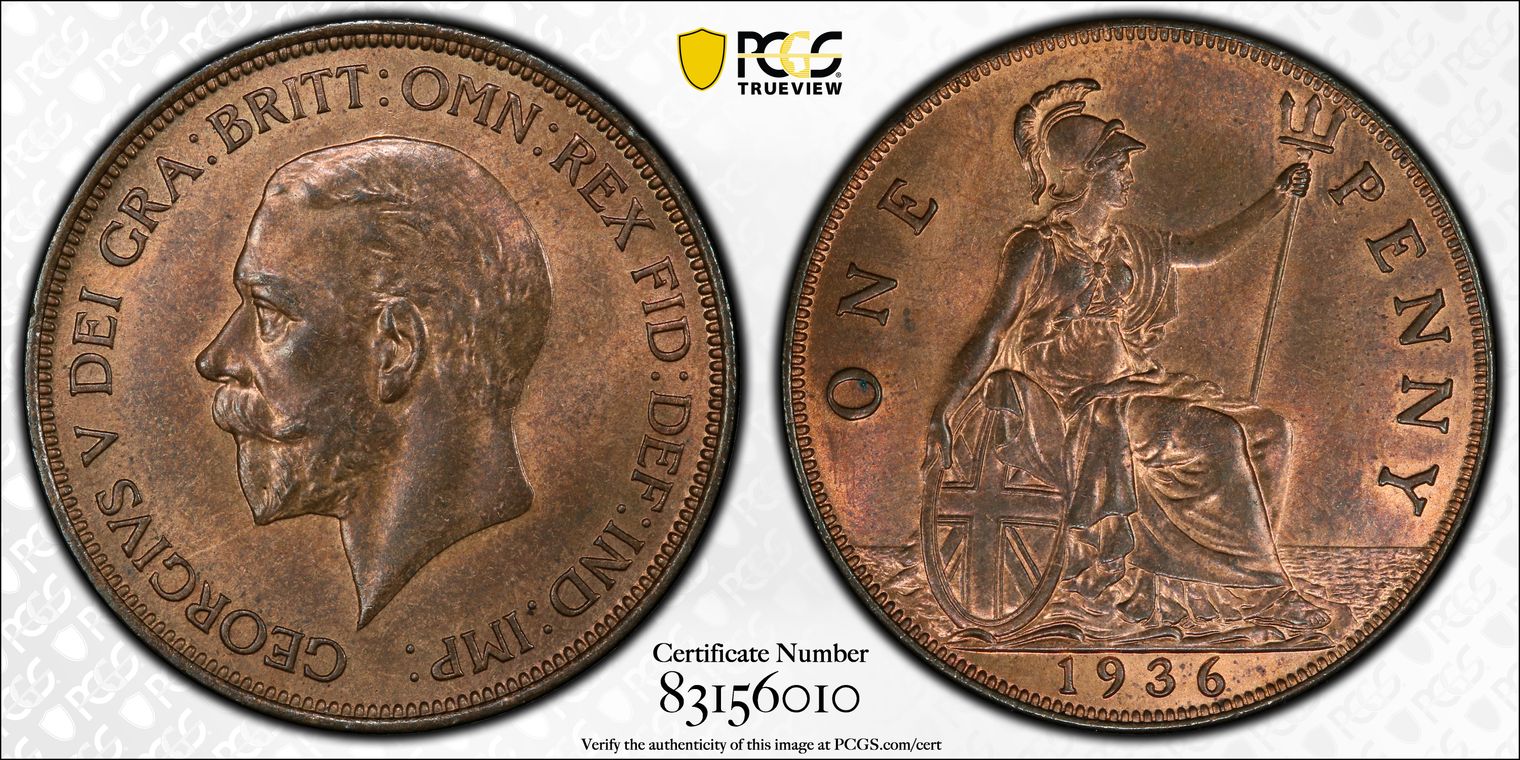

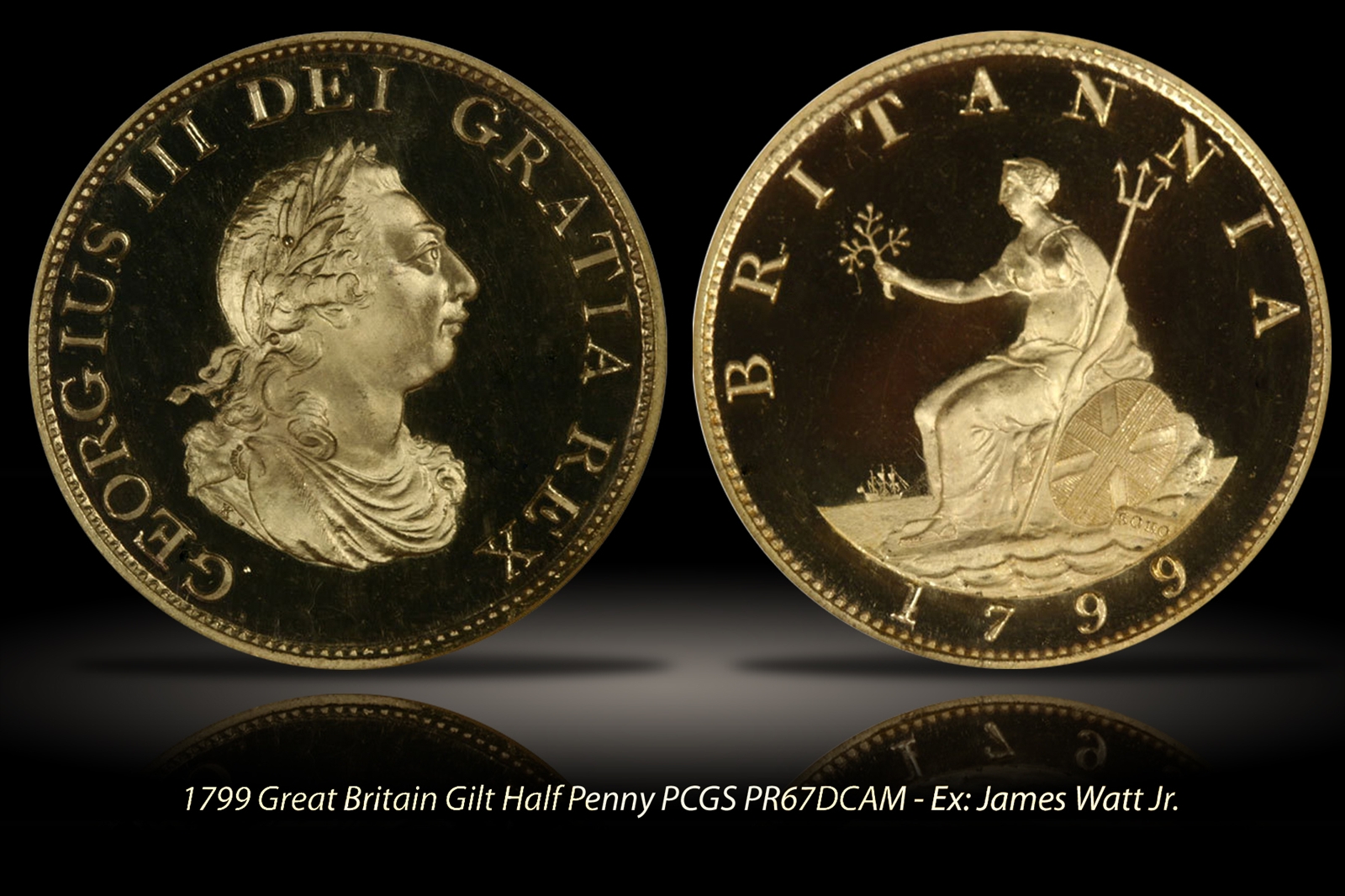
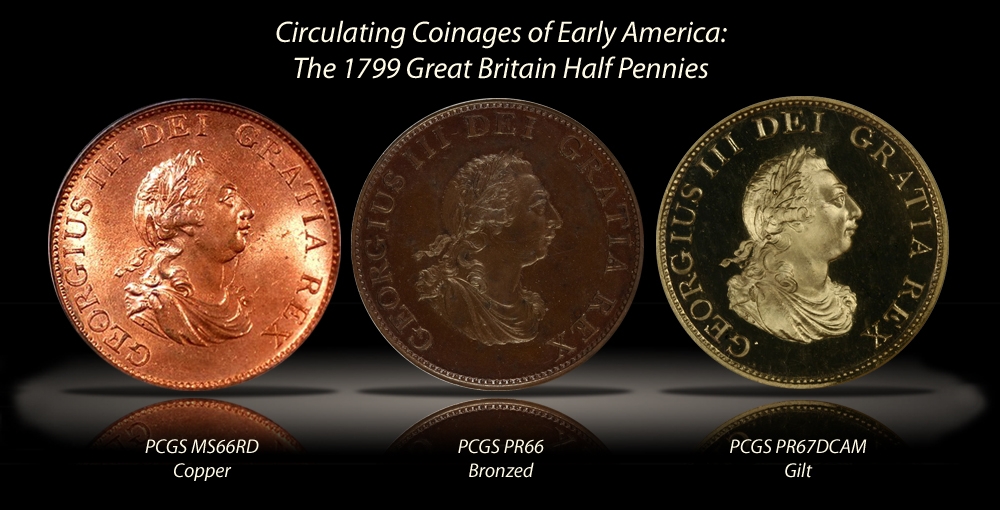
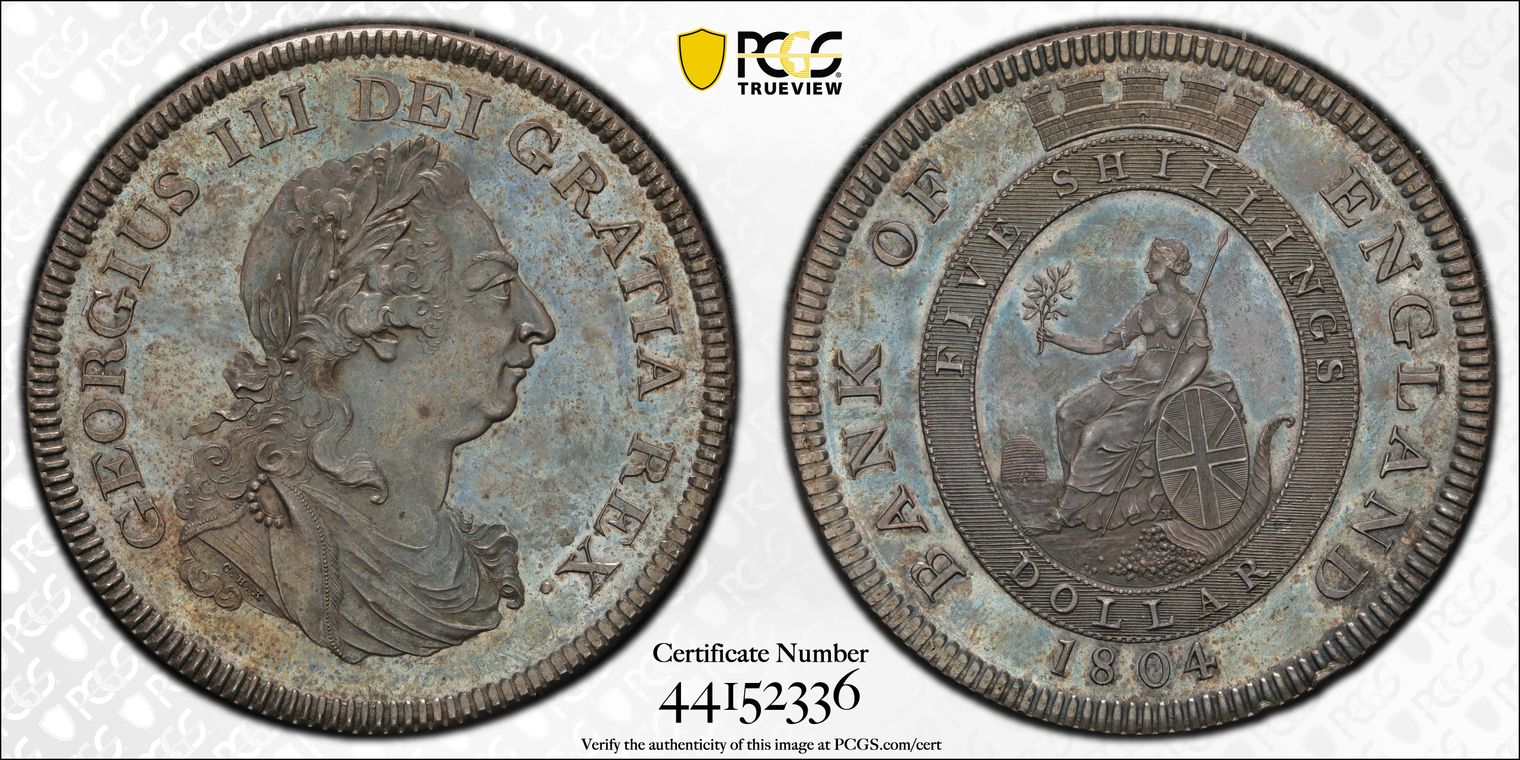







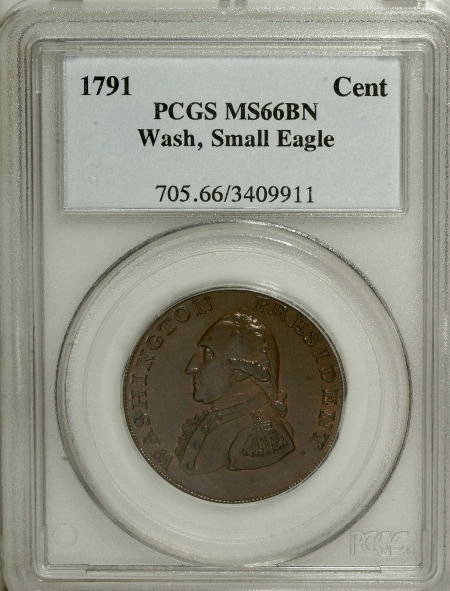
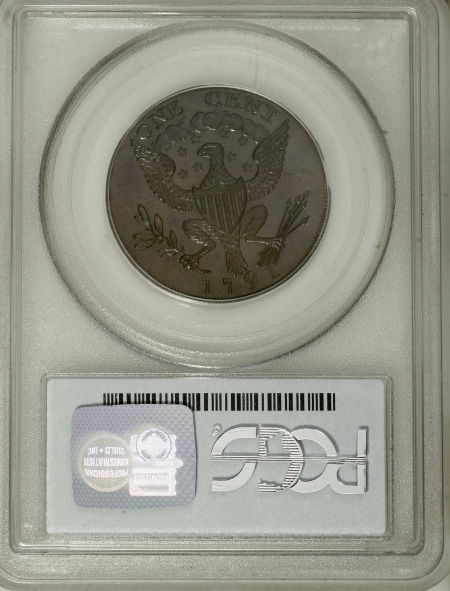
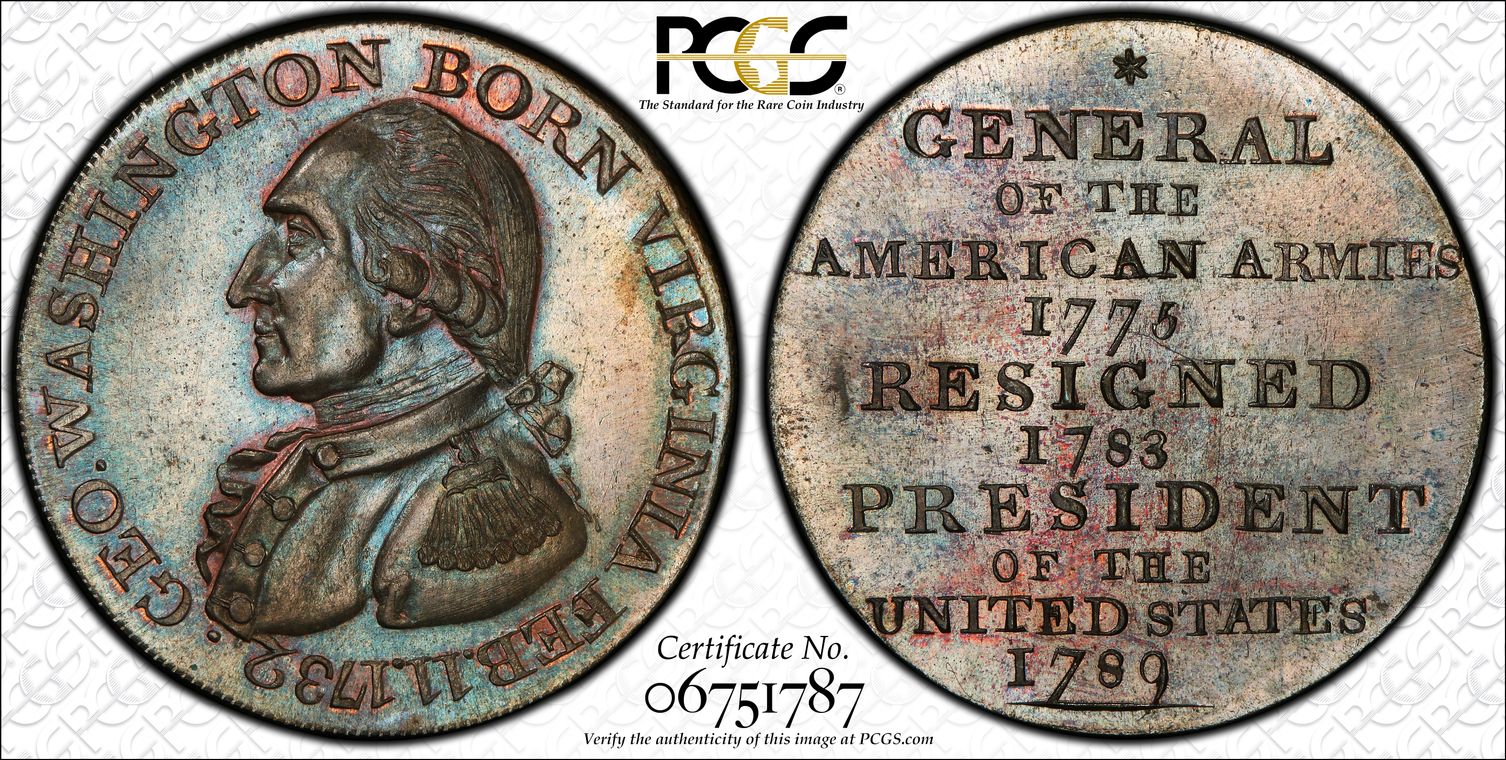
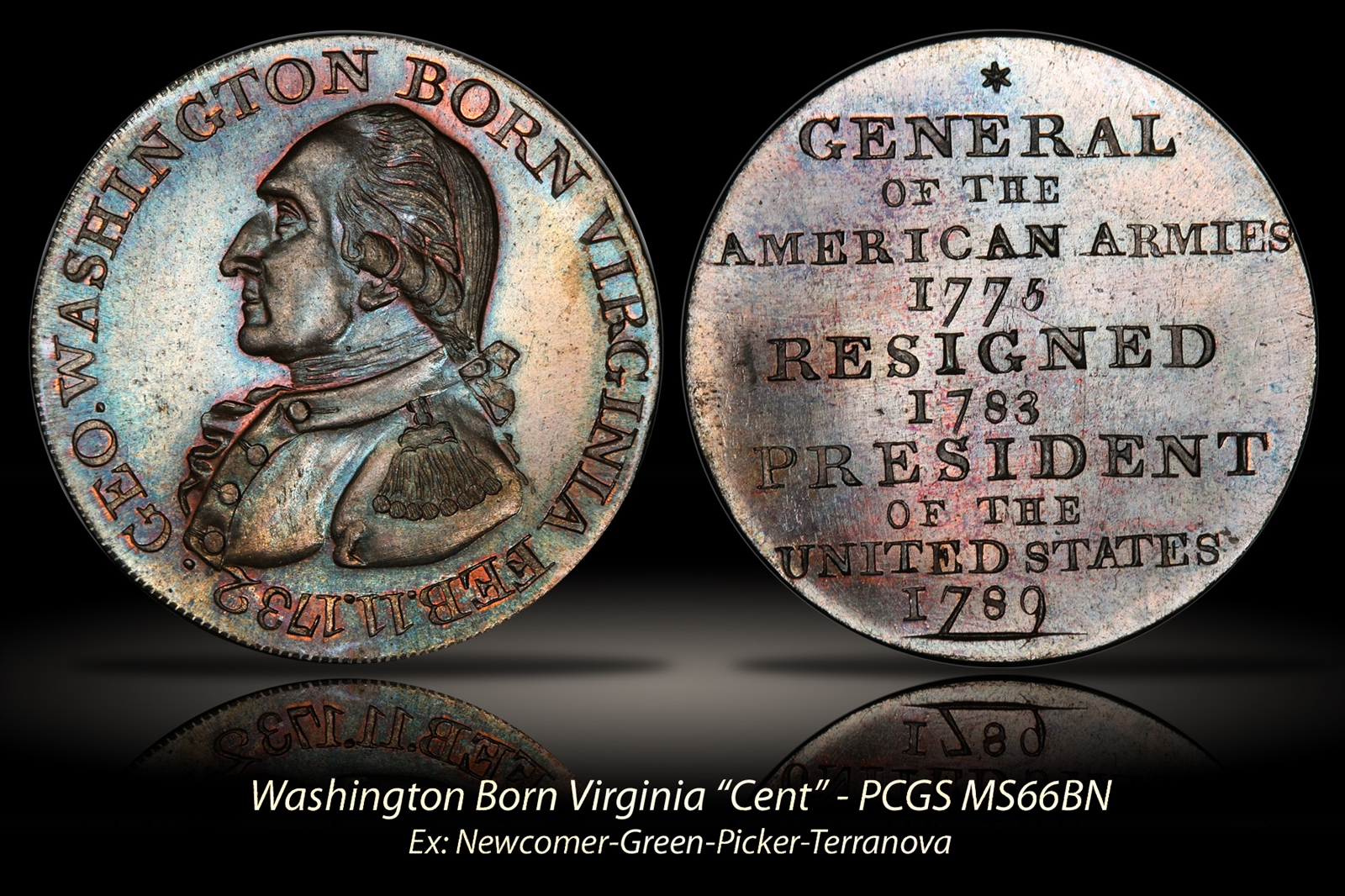





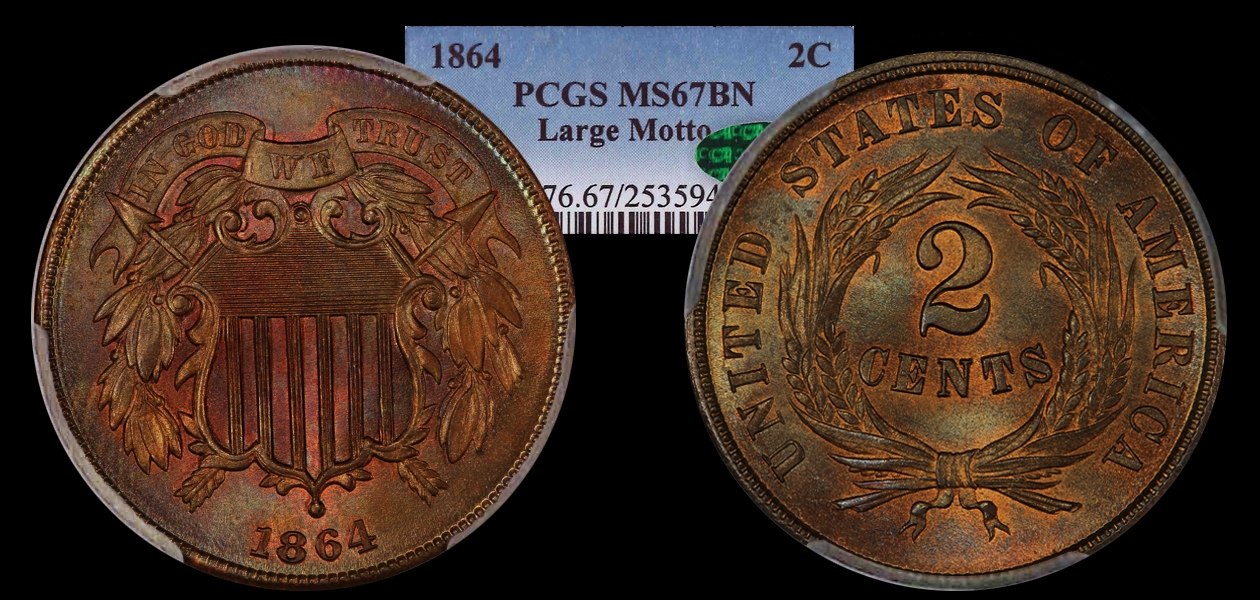
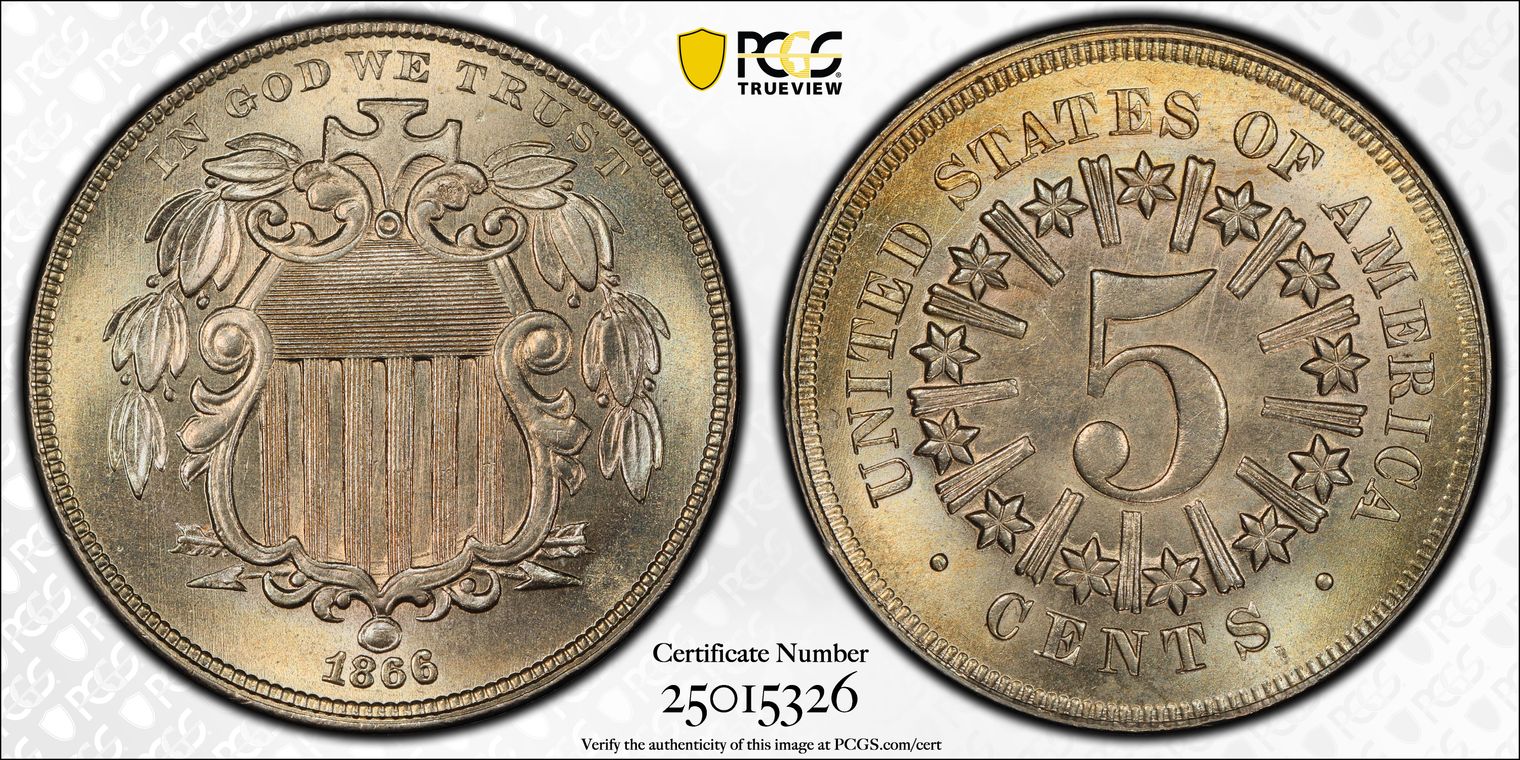
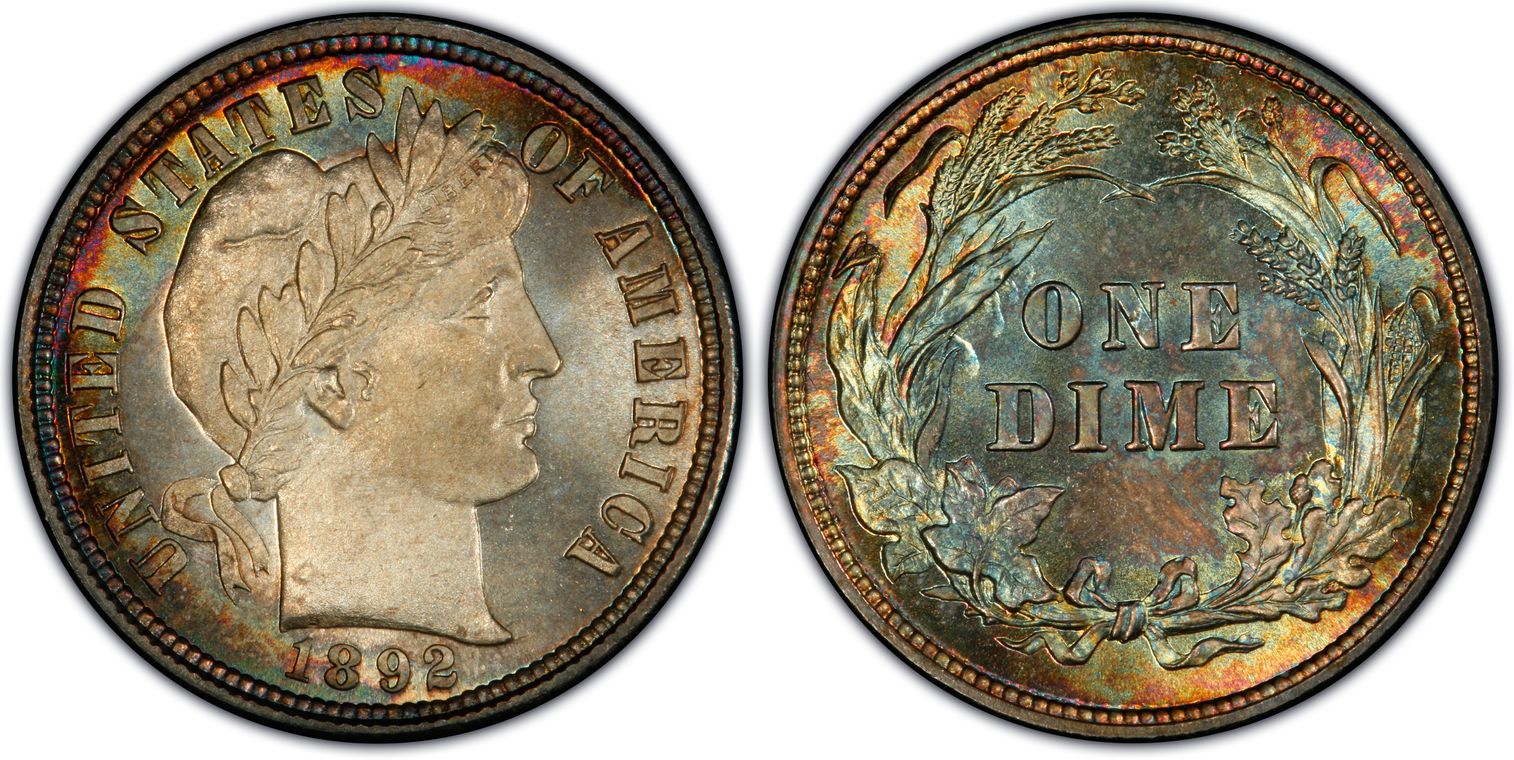
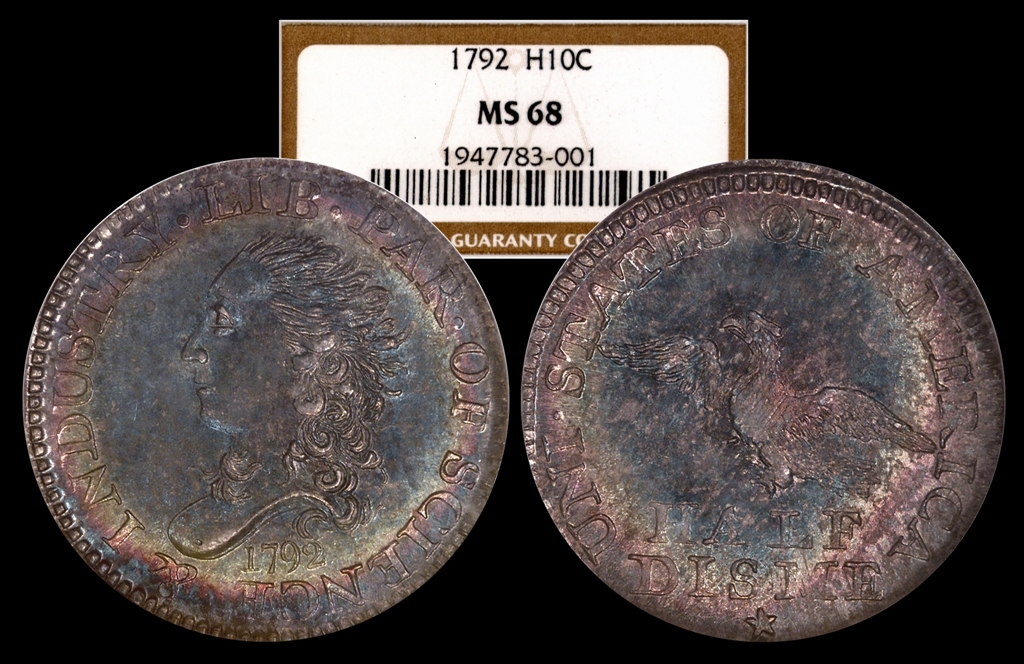
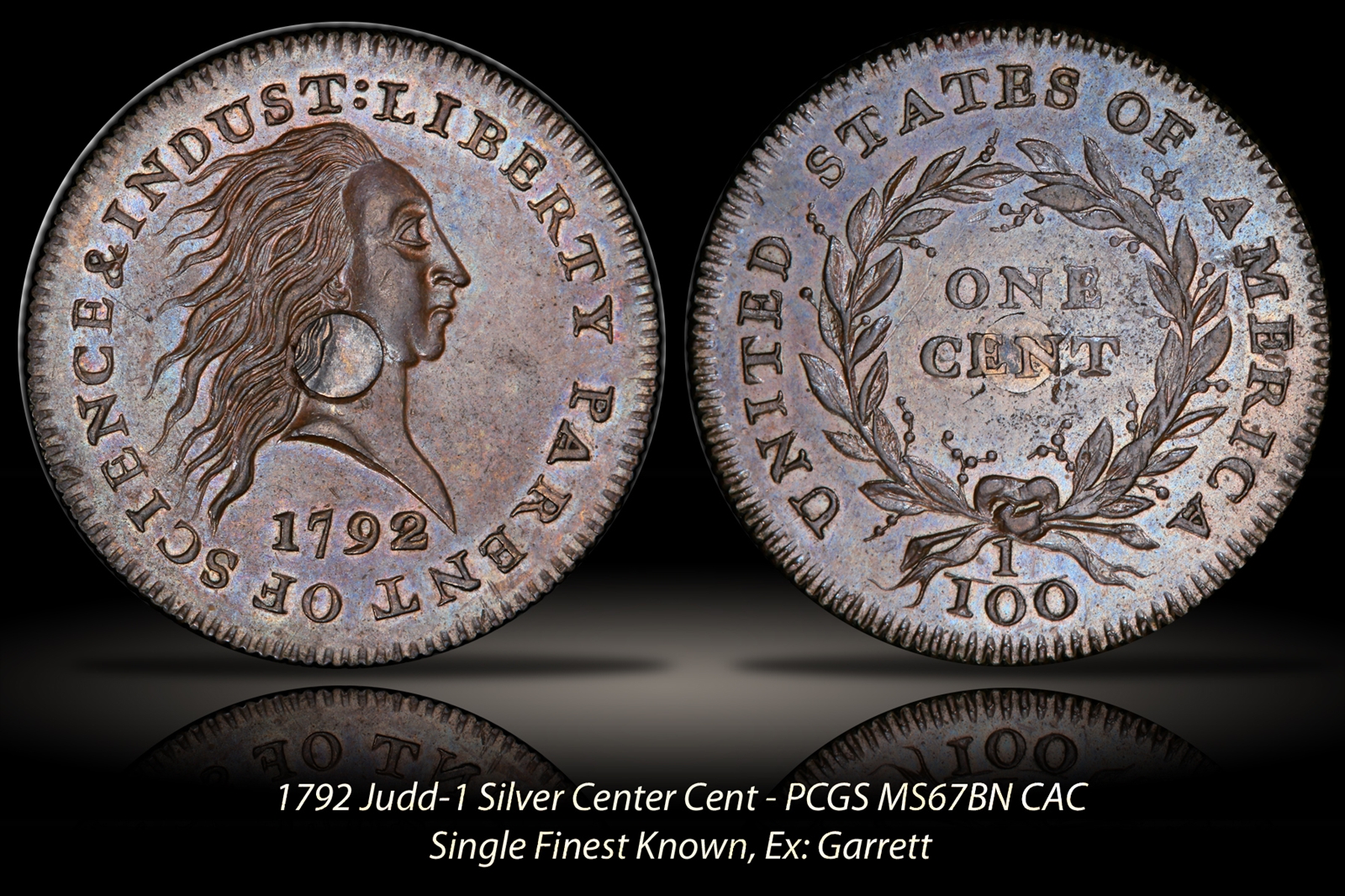

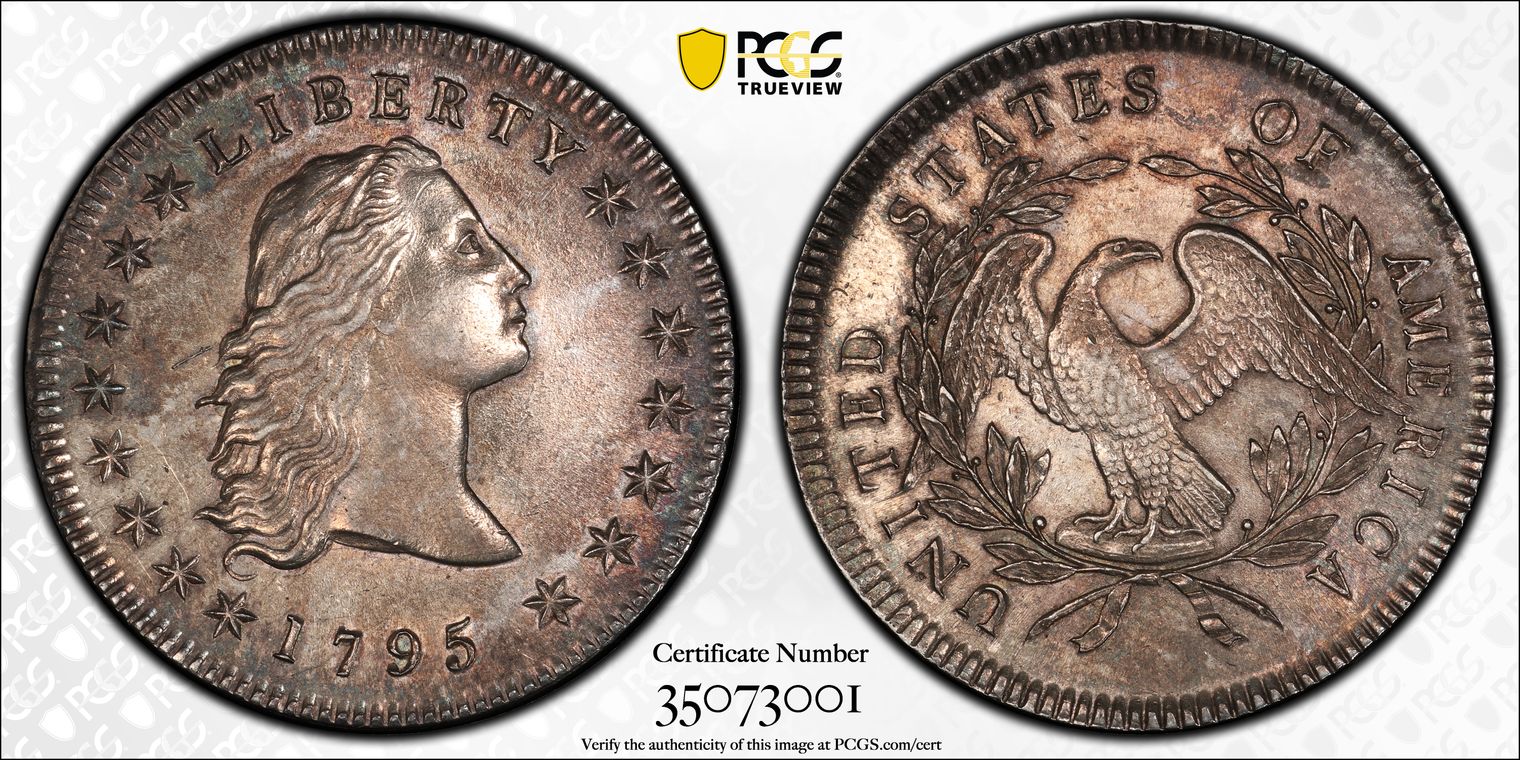
Like the half dollars of 1794 and 1795, the dollars of 1794 and 1795 provided a canvas for artistic designs. While the dollars of 1794 were all struck from one set of dies, the flowing hair dollars of 1795 were struck in much larger quantities, using multiple dies with multiple nuances of their designs. Alas, as with the other silver denominations, Miss Liberty no longer has her Liberty Cap or pole.




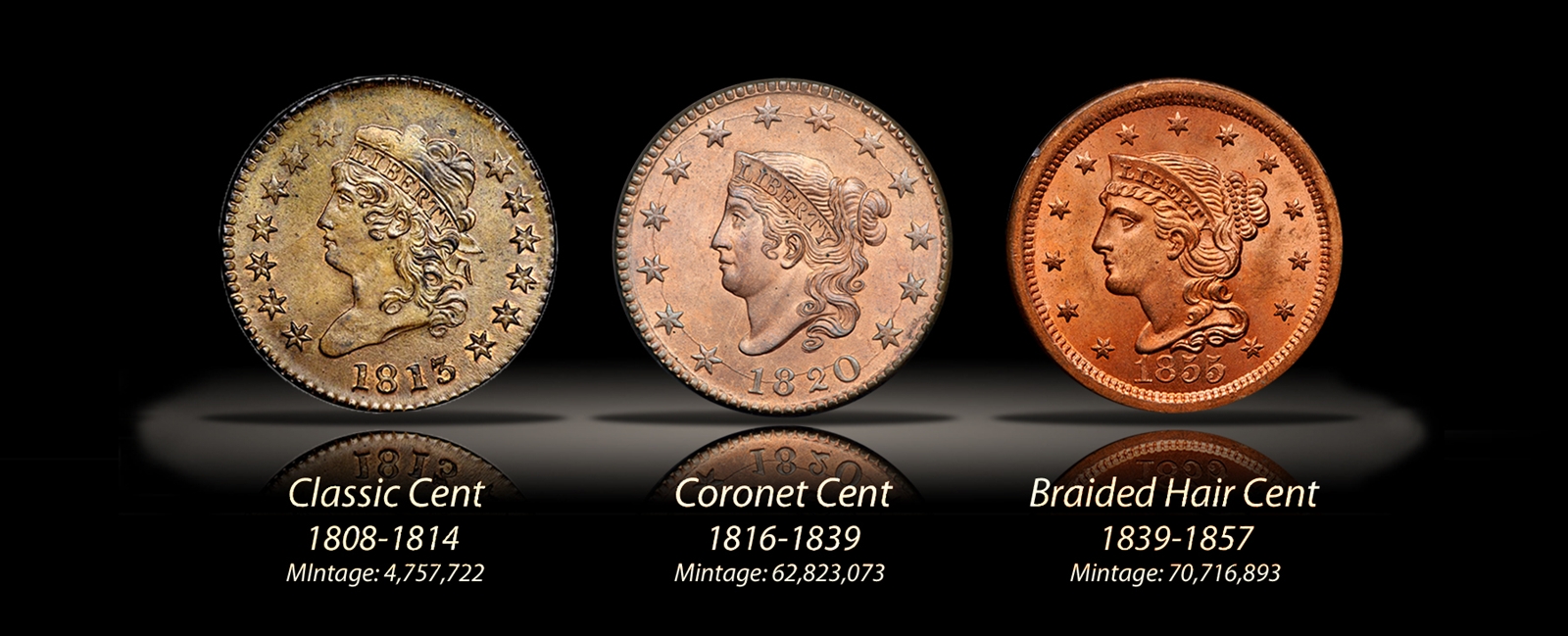
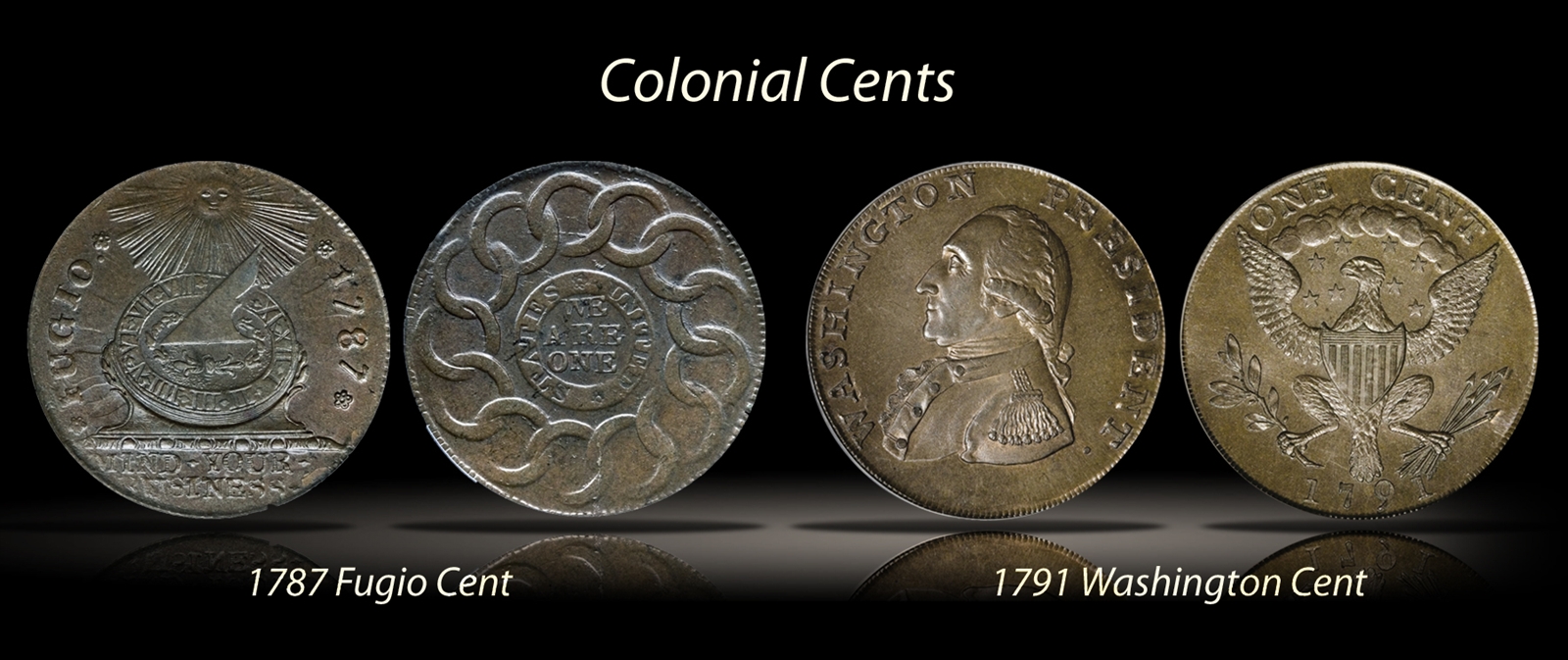
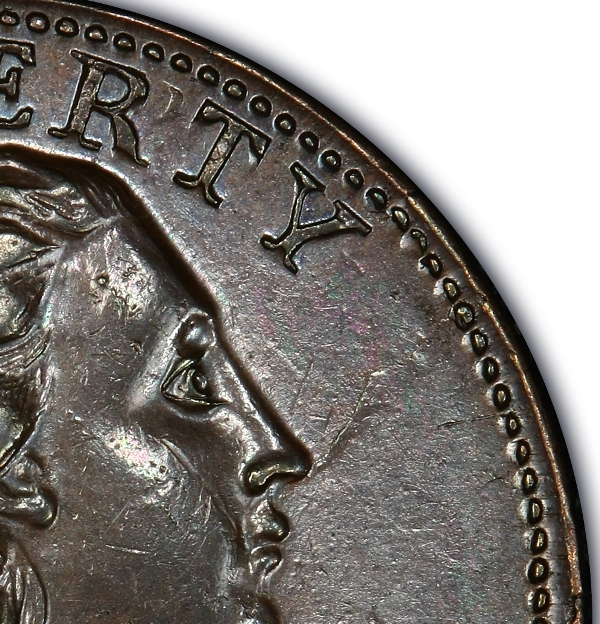
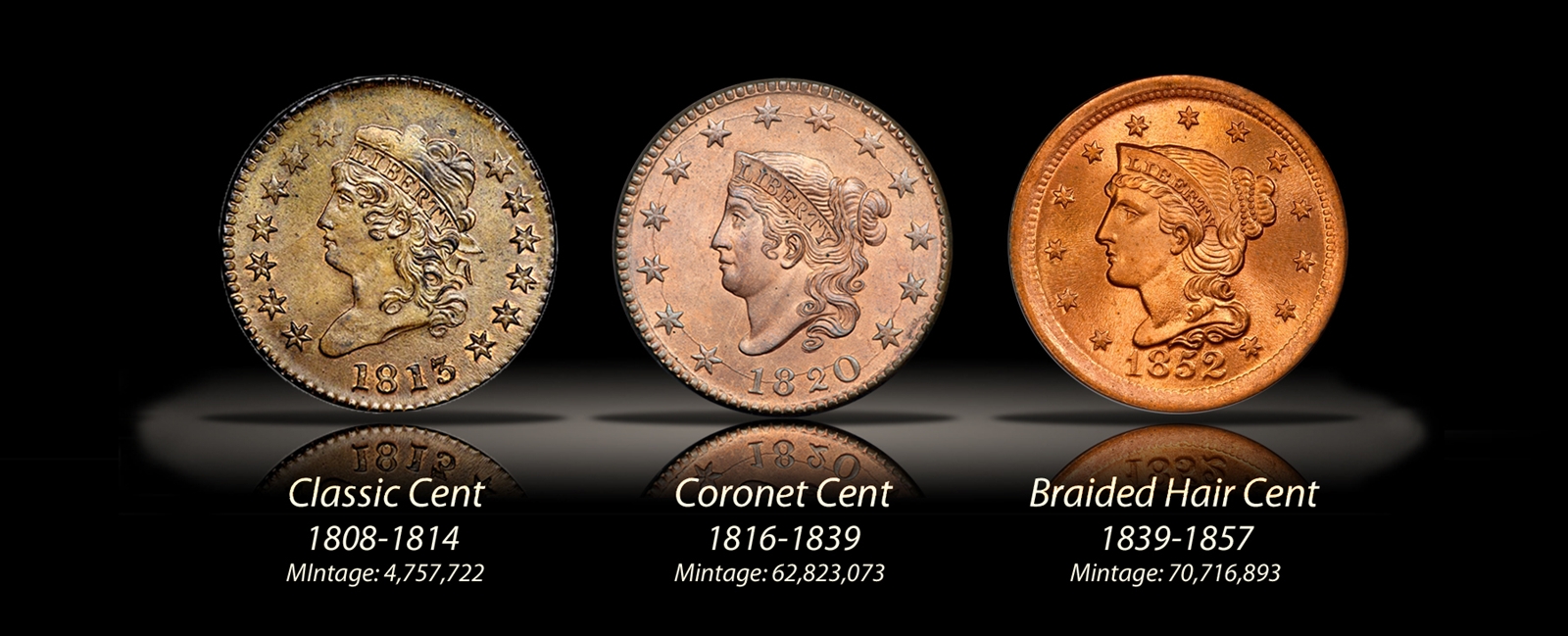
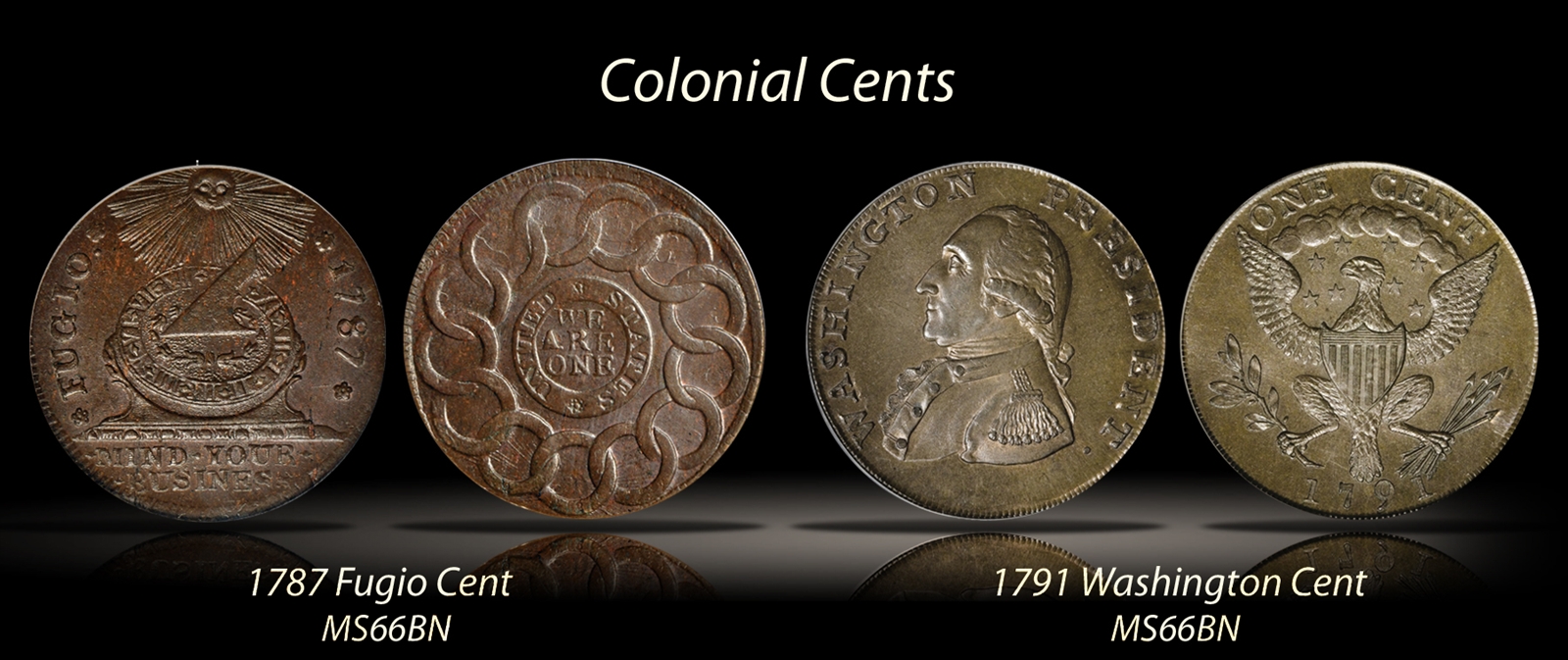
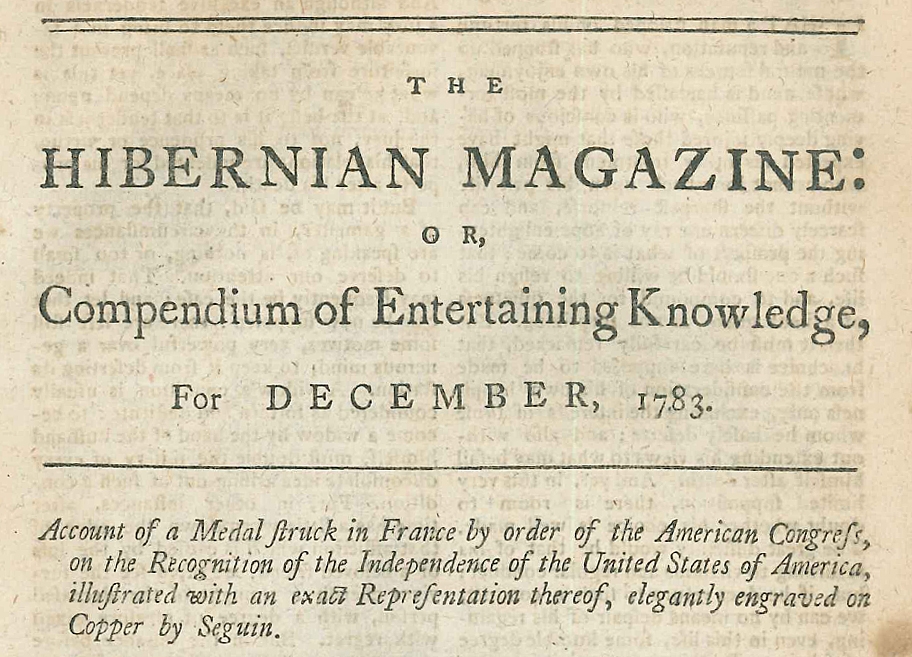
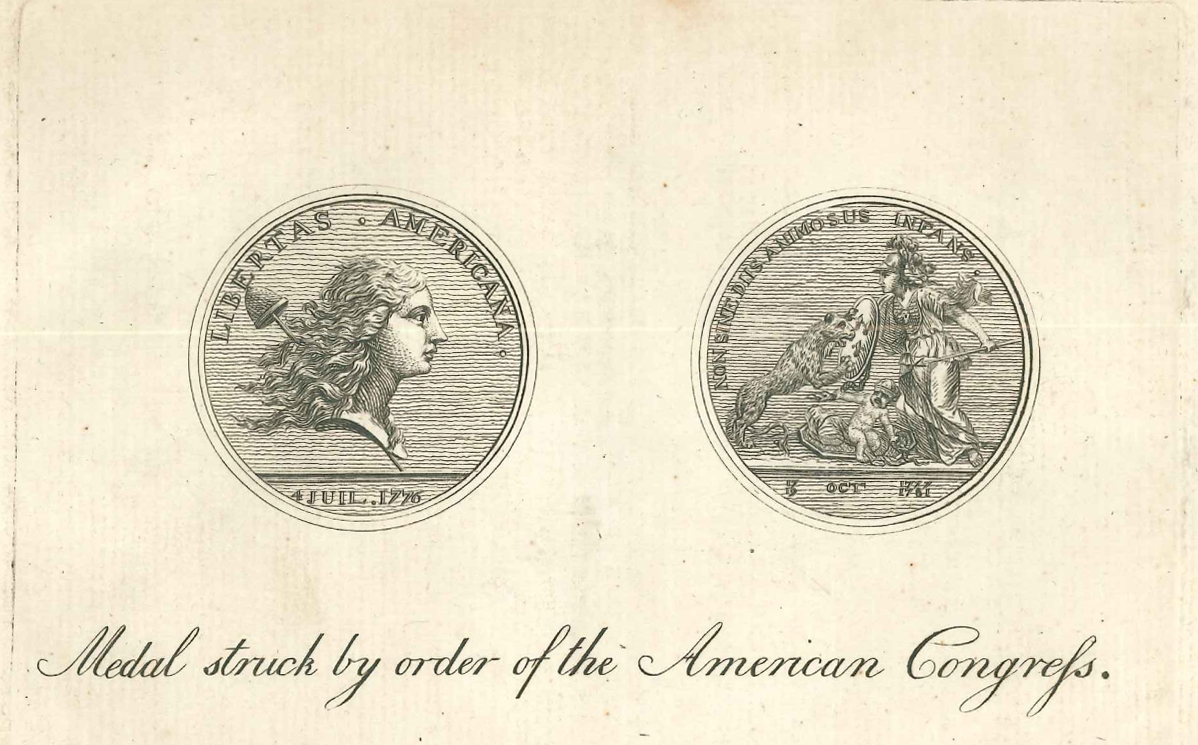
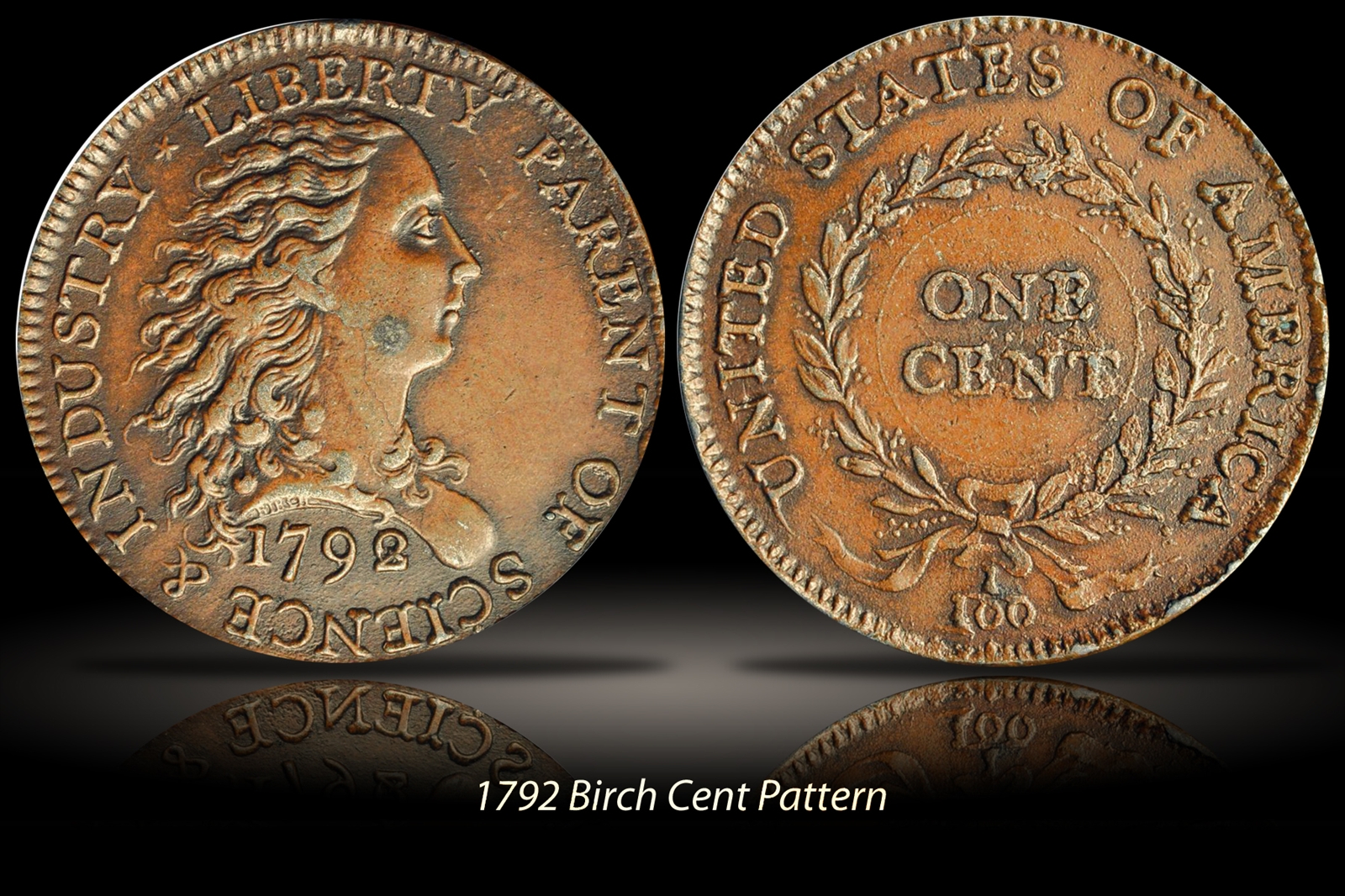
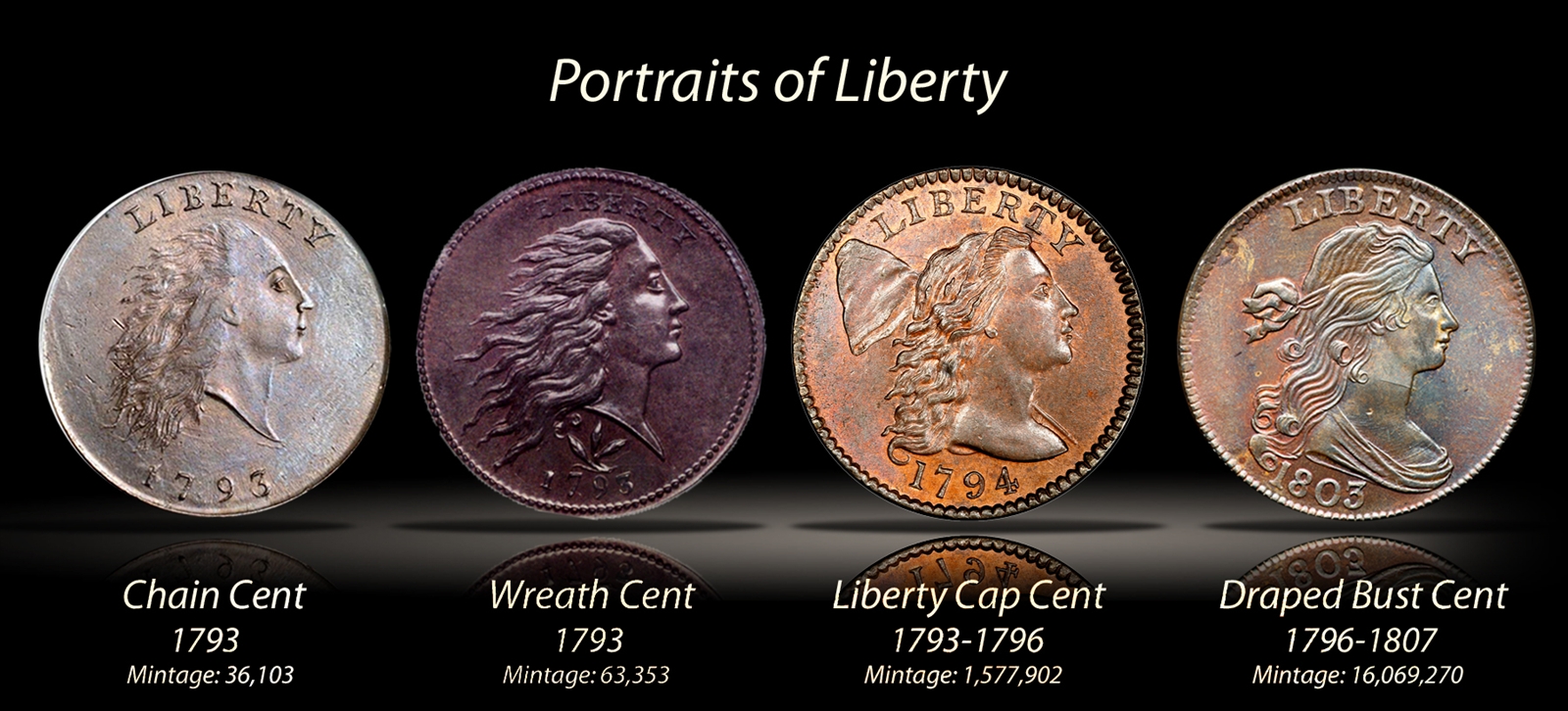


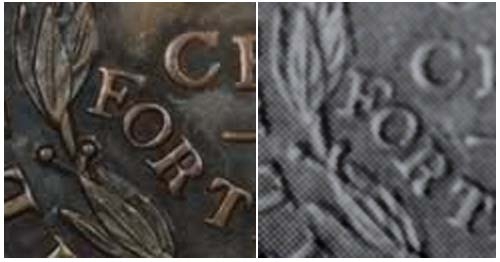
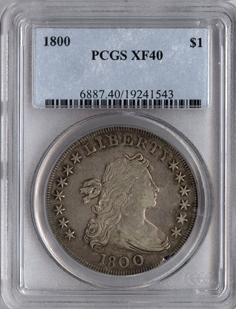

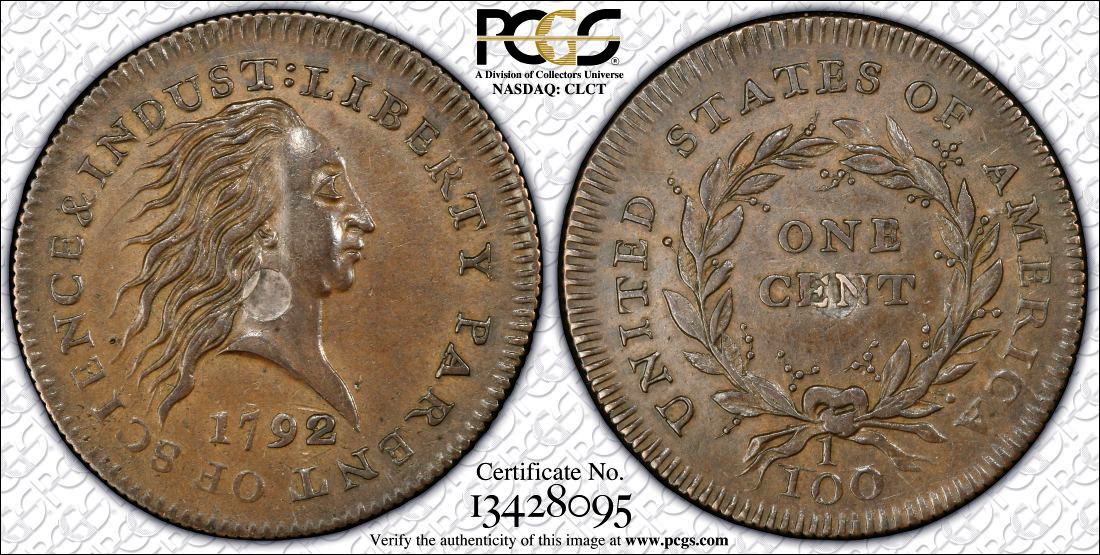
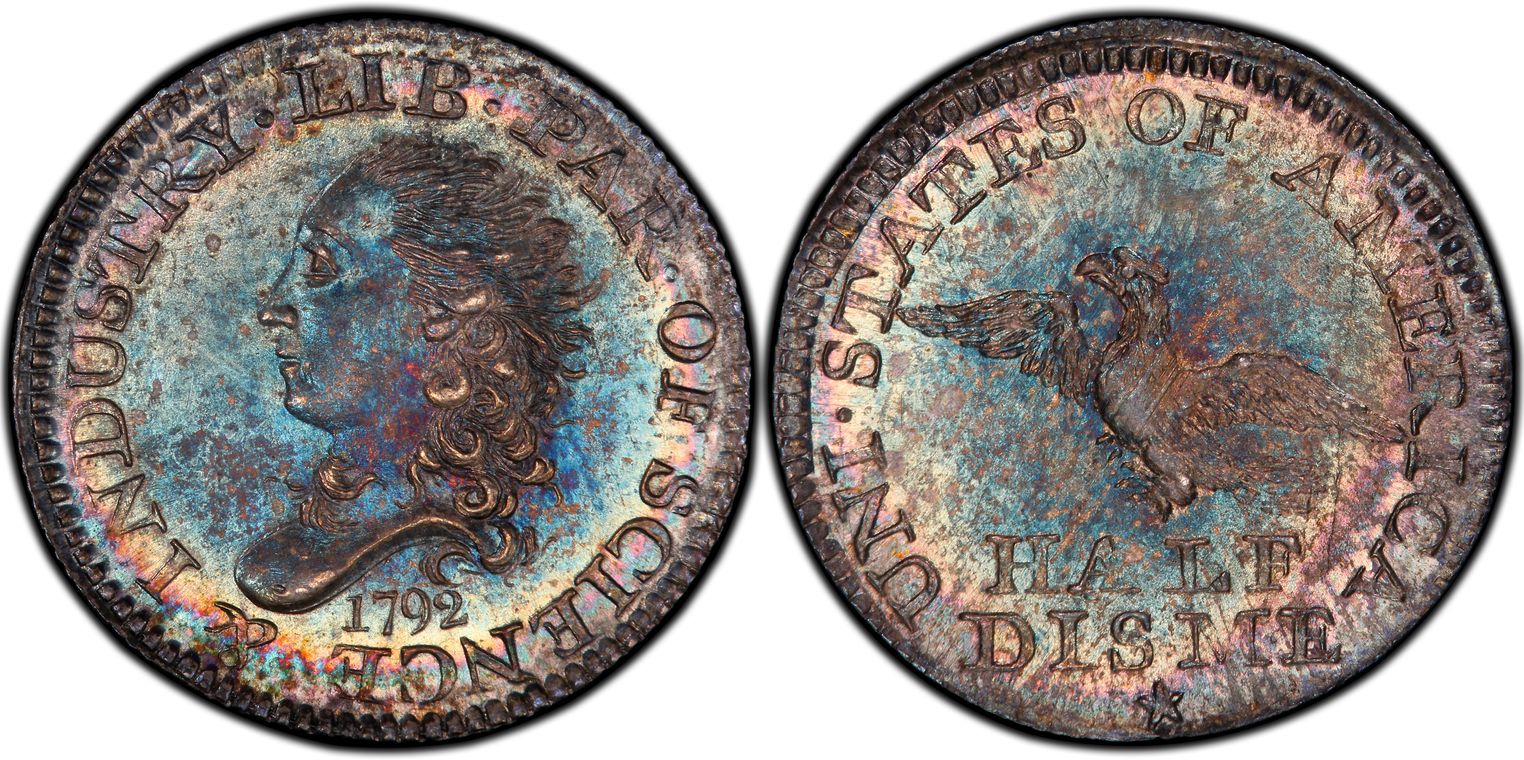
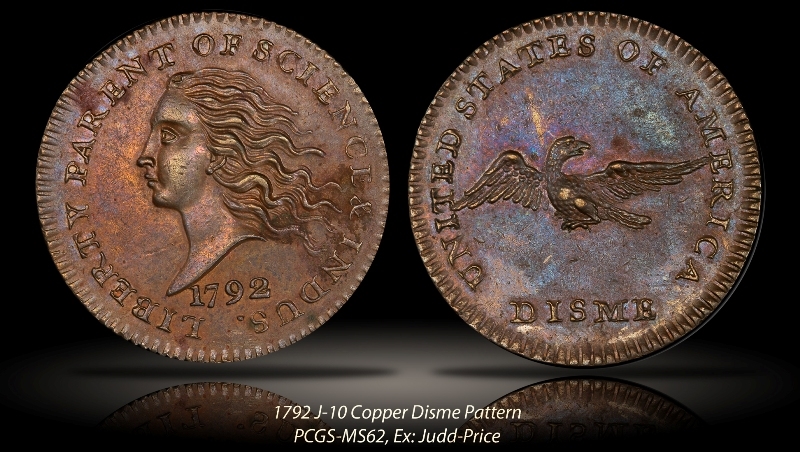
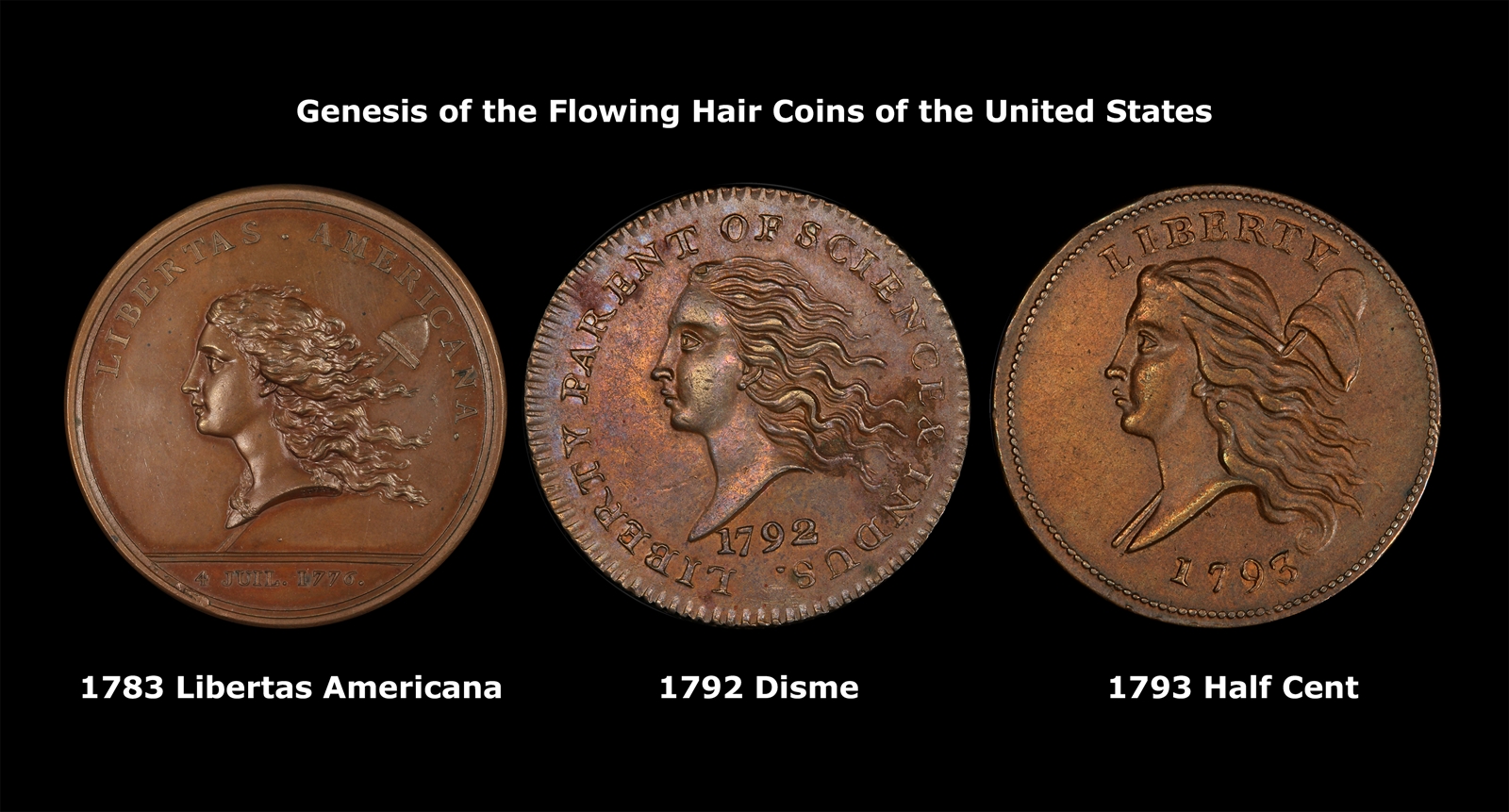
With the R-6 copper pattern Disme of 1792, we see the direct influence of the famed Libertas Americana medal on the genesis of coinage designs for the new United States Mint. As the Senate and House of Representatives debated back and forth as to coinage designs to be mandated within the "Mint Act," or, more accurately, "An Act Establishing a Mint, and Regulating the Coins of the United States," the Senate was in favor of using the President's portait for circulating coinage. The House of Representatives, though, was steadfast in its resolve that coinage should bear an "image emblematic of Liberty." Ultimately, the Senate accepted the Representatives' resolution, and the Mint Act was signed into law on April 2, 1792. The copper Disme patterns were among the earliest patterns produced for the new coinage of the United States, and from there, the beautiful flowing hair design of the Libertas Americana Medal spread throughout the copper coinage of 1793 through 1797, and the silver coinage of 1794 and 1795.
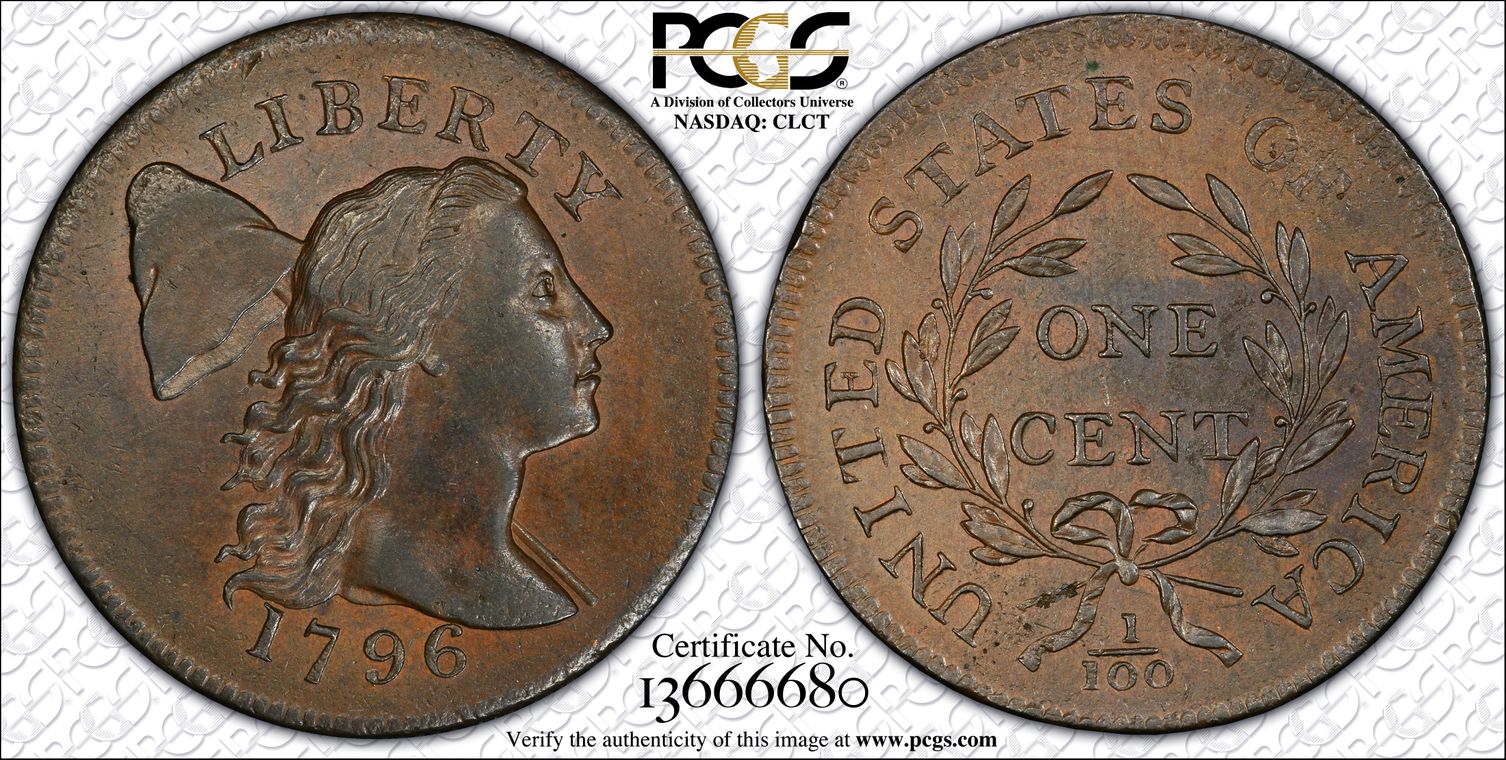
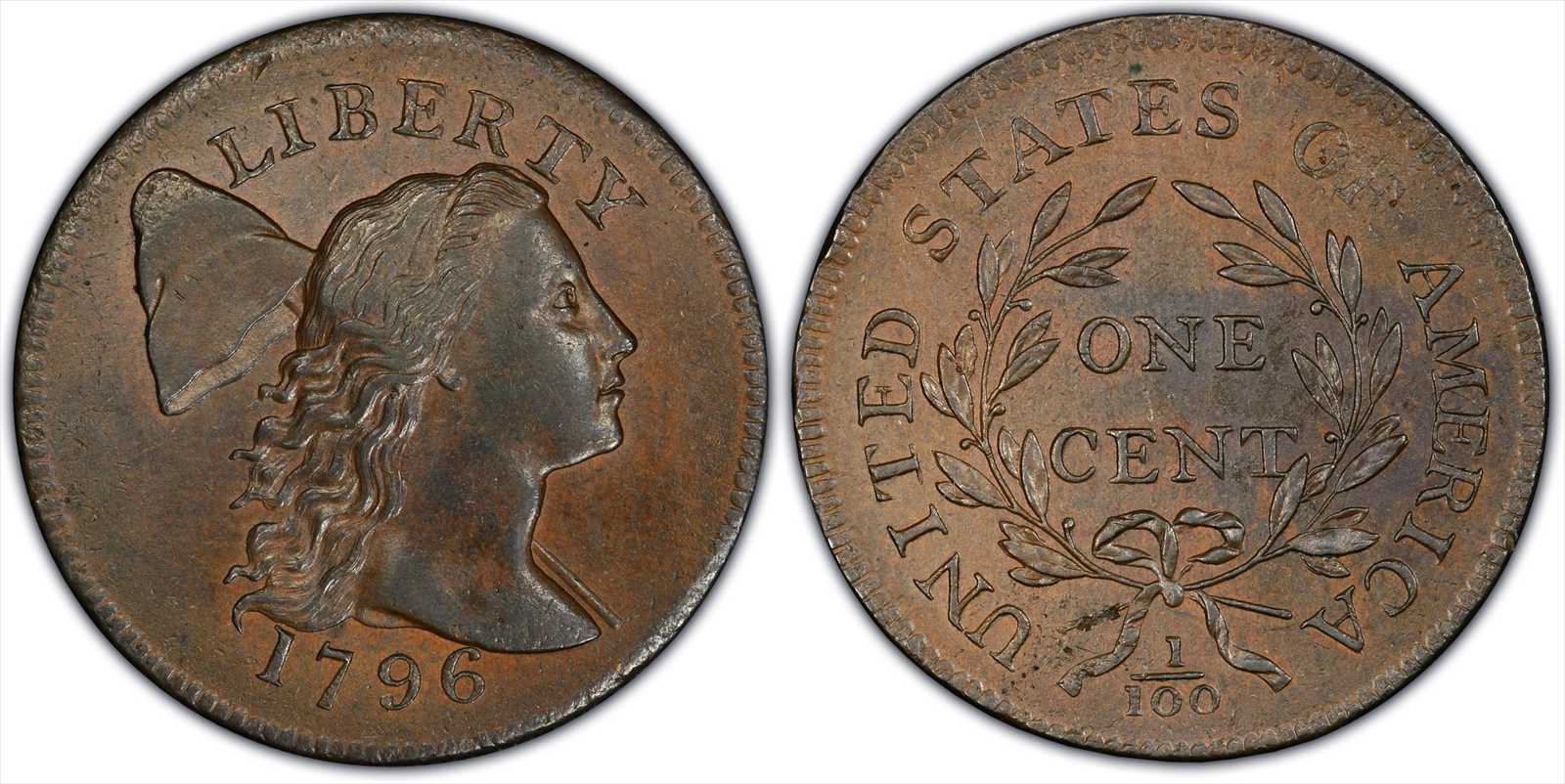
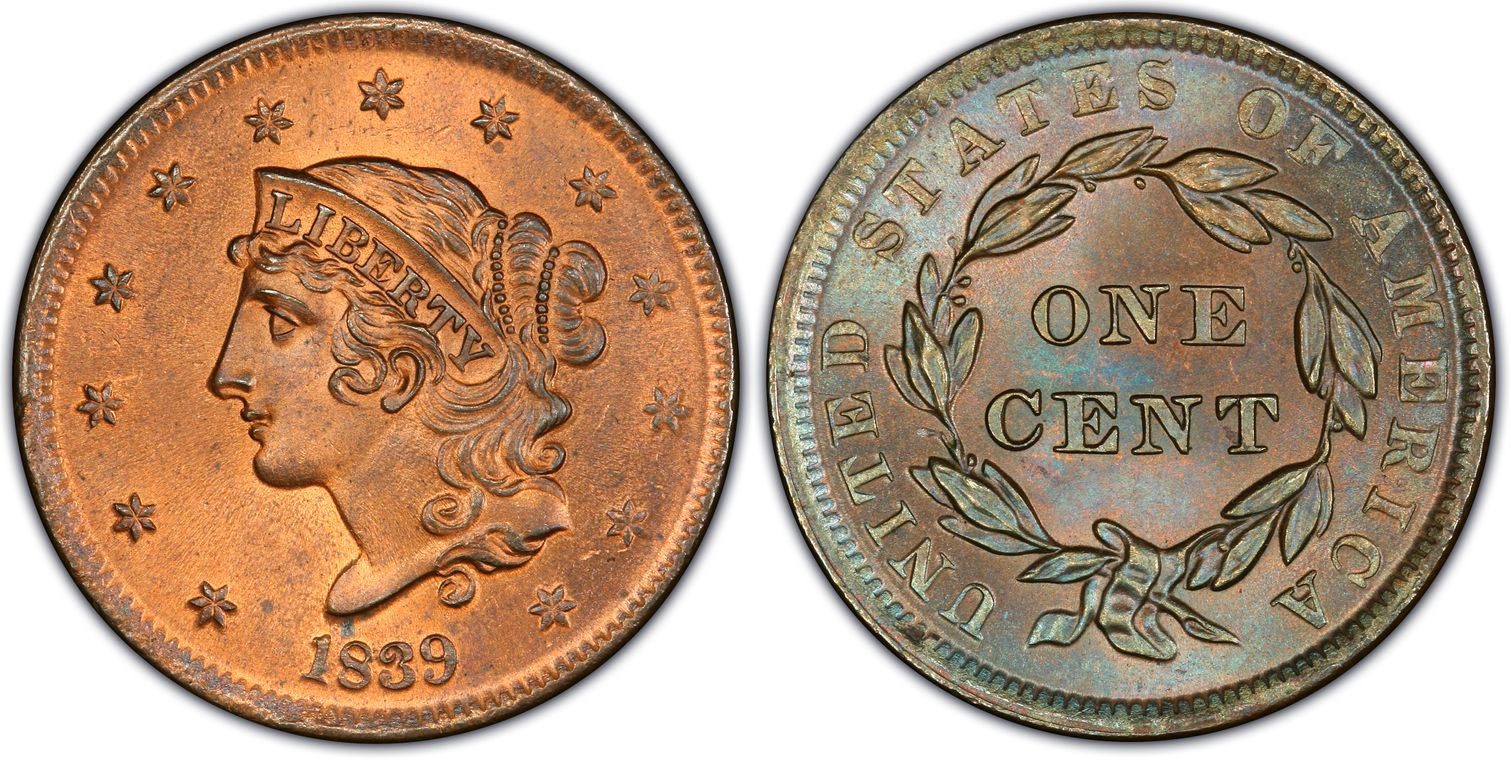
The Year 1839 was a very active one for the Mint's engravers, resulting in no less than three distinctly different styles of the Coronet Cent (and the first Braided Hair Cents). 19th century coin dealer Ebenezer Locke Mason described the distinguishing features of each, including two with rather colorful nicknames of "Silly Head" and "Booby Head." All four portrait styles are present in the collection, including the "Head of 1838" (N-3 Noyes #20596), the "Silly Head" (N-9 Noyes #20945), the "Booby Head" (N-11 Noyes #20819), and the Braided Hair "Head of 1840" (N-8, not in Noyes).
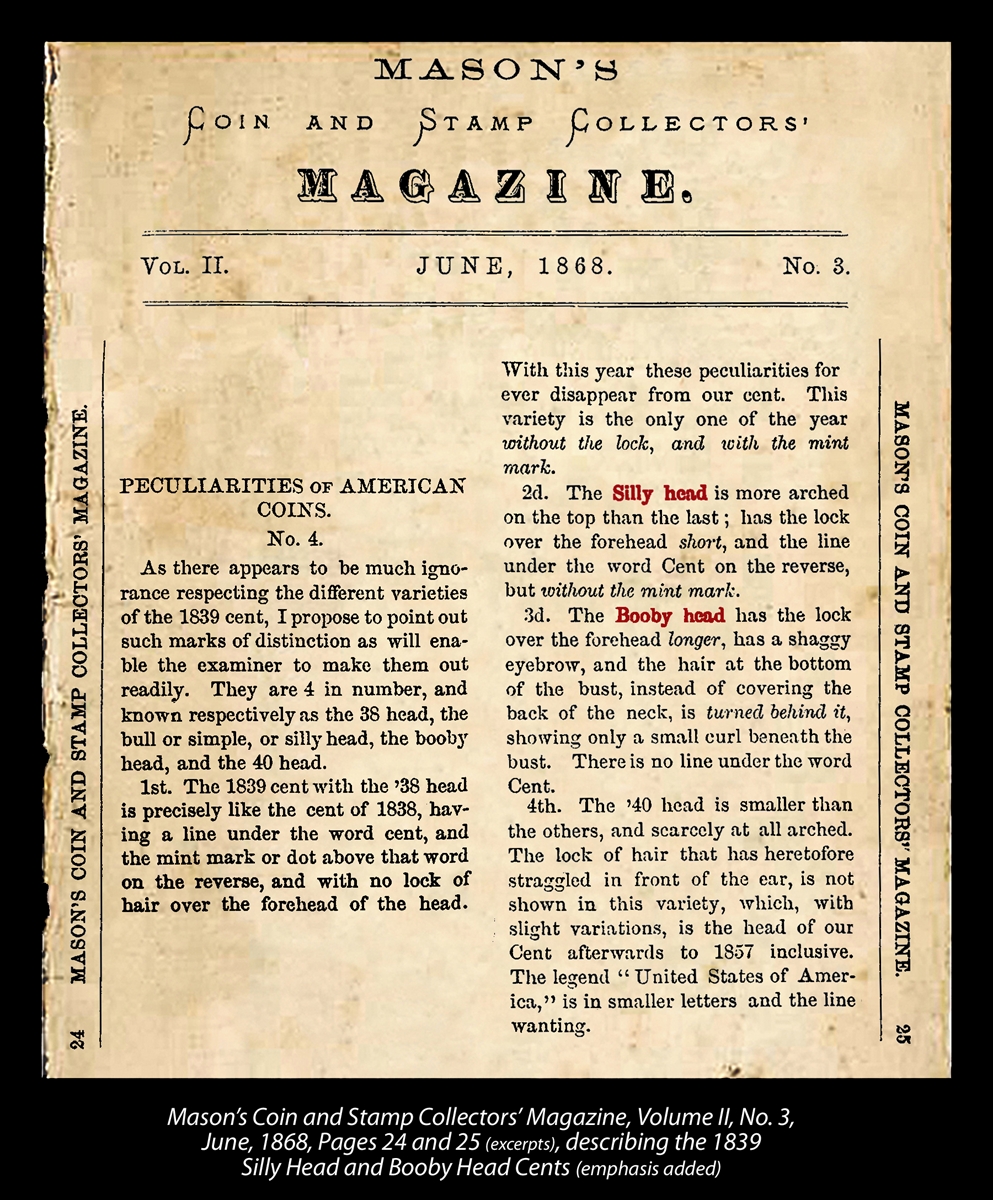
The Year 1839 was a very active one for the Mint's engravers, resulting in no less than three distinctly different styles of the Coronet Cent (and the first Braided Hair Cents). 19th century coin dealer Ebenezer Locke Mason described the distinguishing features of each, including two with rather colorful nicknames of "Silly Head" and "Booby Head." All four portrait styles are present in the collection, including the "Head of 1838" (N-3 Noyes #20596), the "Silly Head" (N-9 Noyes #20945), the "Booby Head" (N-11 Noyes #20819), and the Braided Hair "Head of 1840" (N-8, not in Noyes).
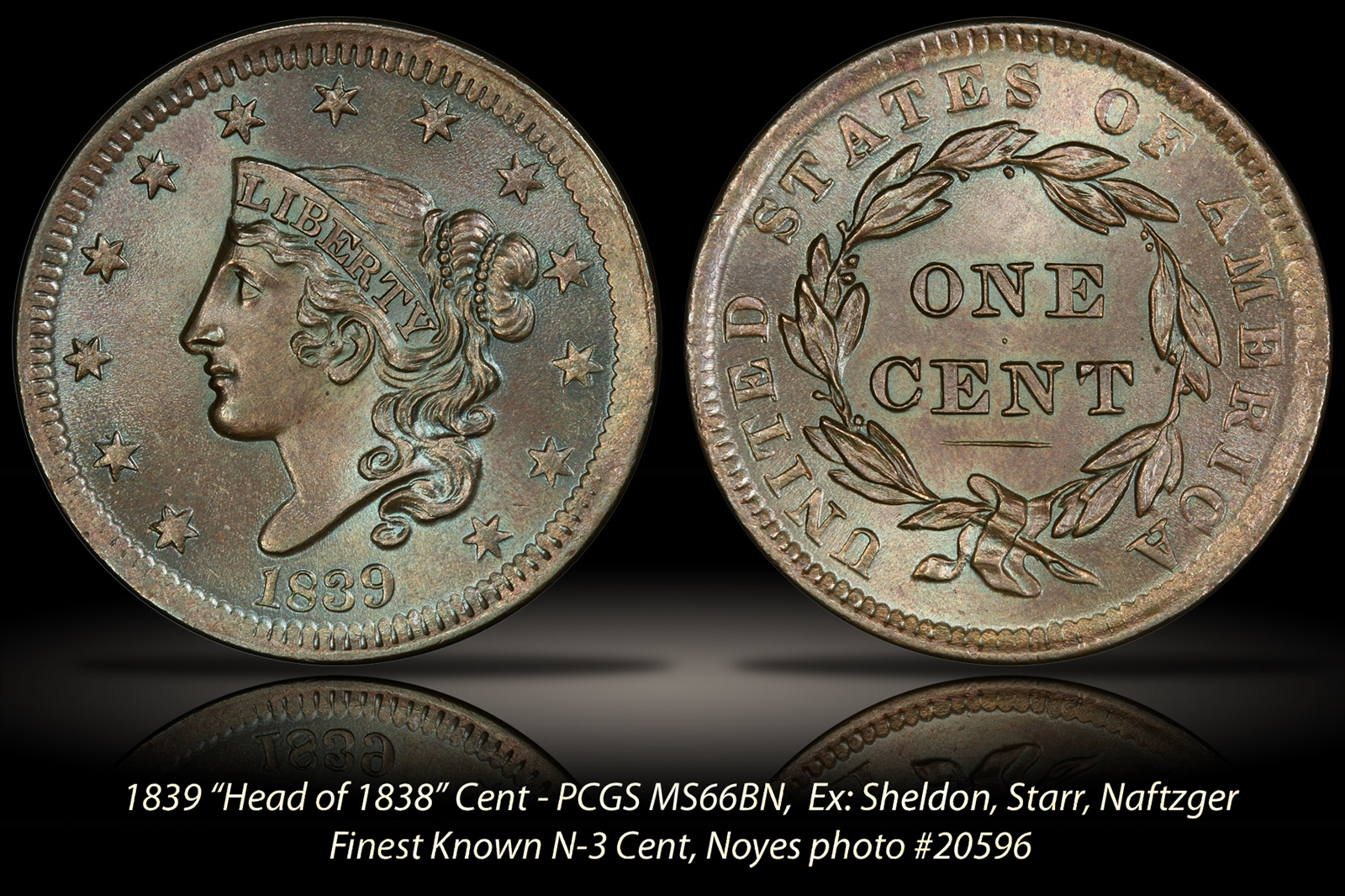
The Year 1839 was a very active one for the Mint's engravers, resulting in no less than three distinctly different styles of the Coronet Cent (and the first Braided Hair Cents). 19th century coin dealer Ebenezer Locke Mason described the distinguishing features of each, including two with rather colorful nicknames of "Silly Head" and "Booby Head." All four portrait styles are present in the collection, including the "Head of 1838" (N-3 Noyes #20596), the "Silly Head" (N-9 Noyes #20945), the "Booby Head" (N-11 Noyes #20819), and the Braided Hair "Head of 1840" (N-8, not in Noyes).
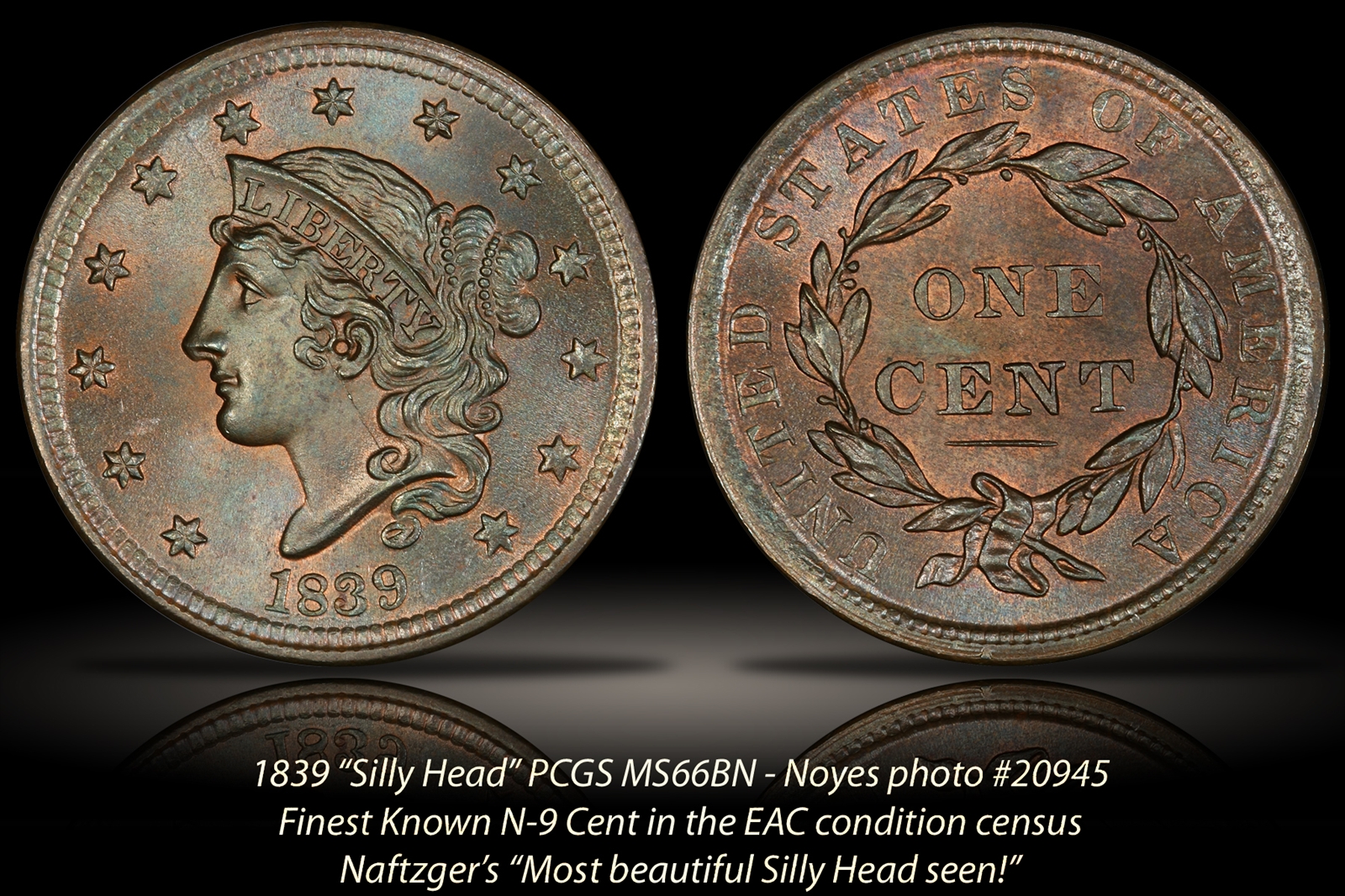
The Year 1839 was a very active one for the Mint's engravers, resulting in no less than three distinctly different styles of the Coronet Cent (and the first Braided Hair Cents). 19th century coin dealer Ebenezer Locke Mason described the distinguishing features of each, including two with rather colorful nicknames of "Silly Head" and "Booby Head." All four portrait styles are present in the collection, including the "Head of 1838" (N-3 Noyes #20596), the "Silly Head" (N-9 Noyes #20945), the "Booby Head" (N-11 Noyes #20819), and the Braided Hair "Head of 1840" (N-8, not in Noyes).
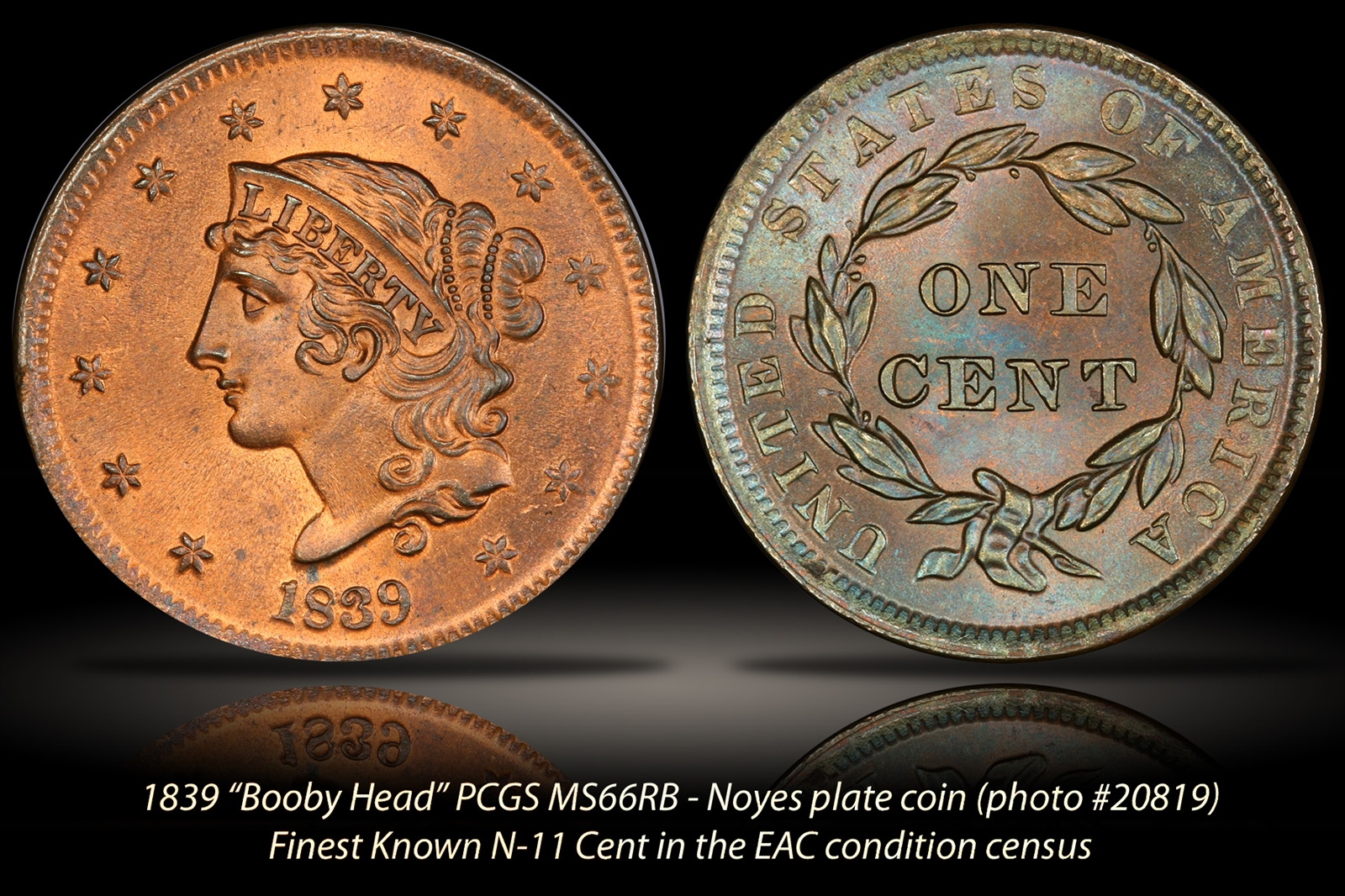
The Year 1839 was a very active one for the Mint's engravers, resulting in no less than three distinctly different styles of the Coronet Cent (and the first Braided Hair Cents). 19th century coin dealer Ebenezer Locke Mason described the distinguishing features of each, including two with rather colorful nicknames of "Silly Head" and "Booby Head." All four portrait styles are present in the collection, including the "Head of 1838" (N-3 Noyes #20596), the "Silly Head" (N-9 Noyes #20945), the "Booby Head" (N-11 Noyes #20819), and the Braided Hair "Head of 1840" (N-8, not in Noyes).
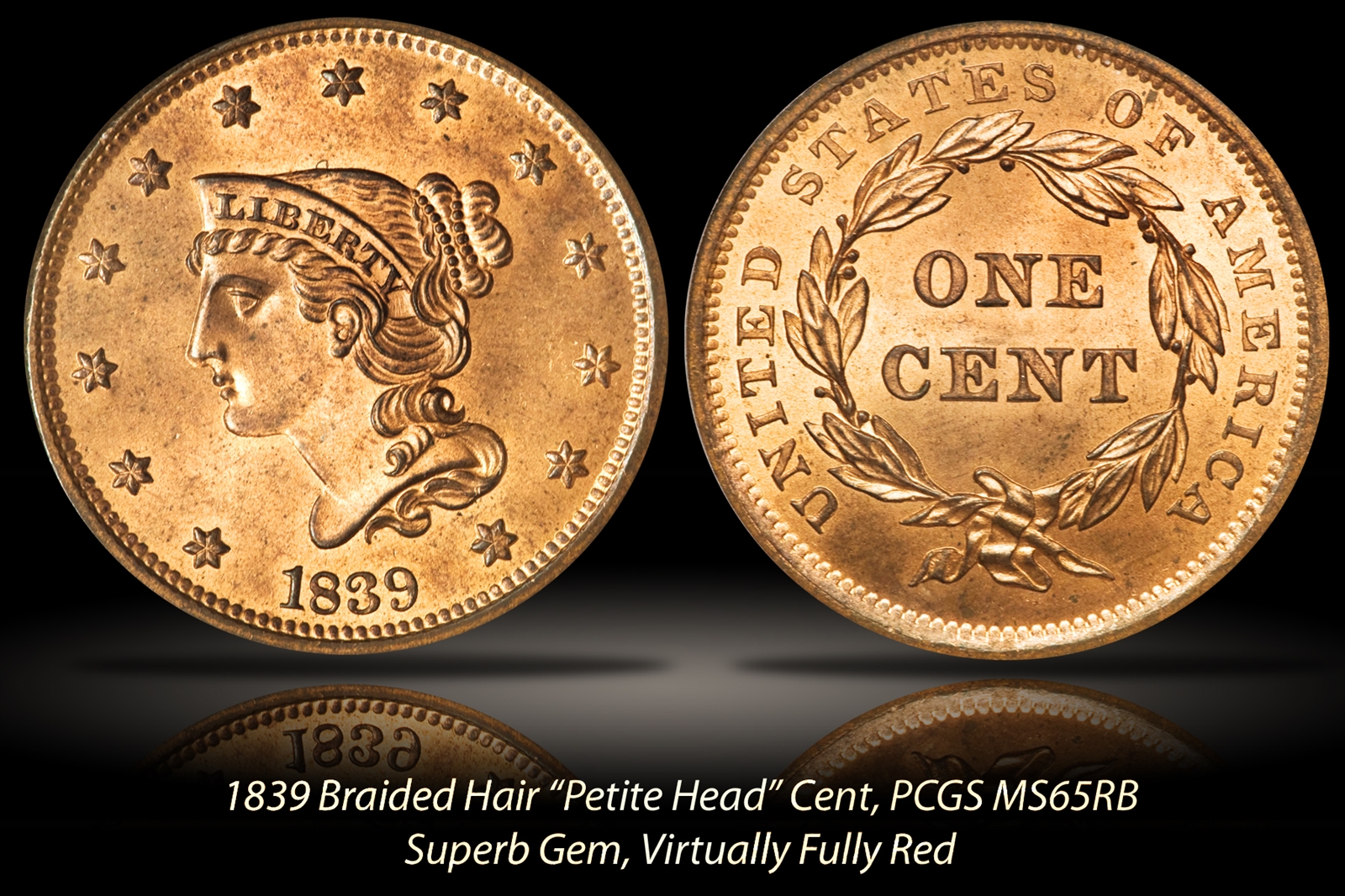
The Year 1839 was a very active one for the Mint's engravers, resulting in no less than three distinctly different styles of the Coronet Cent (and the first Braided Hair Cents). 19th century coin dealer Ebenezer Locke Mason described the distinguishing features of each, including two with rather colorful nicknames of "Silly Head" and "Booby Head." All four portrait styles are present in the collection, including the "Head of 1838" (N-3 Noyes #20596), the "Silly Head" (N-9 Noyes #20945), the "Booby Head" (N-11 Noyes #20819), and the Braided Hair "Head of 1840" (N-8, not in Noyes).
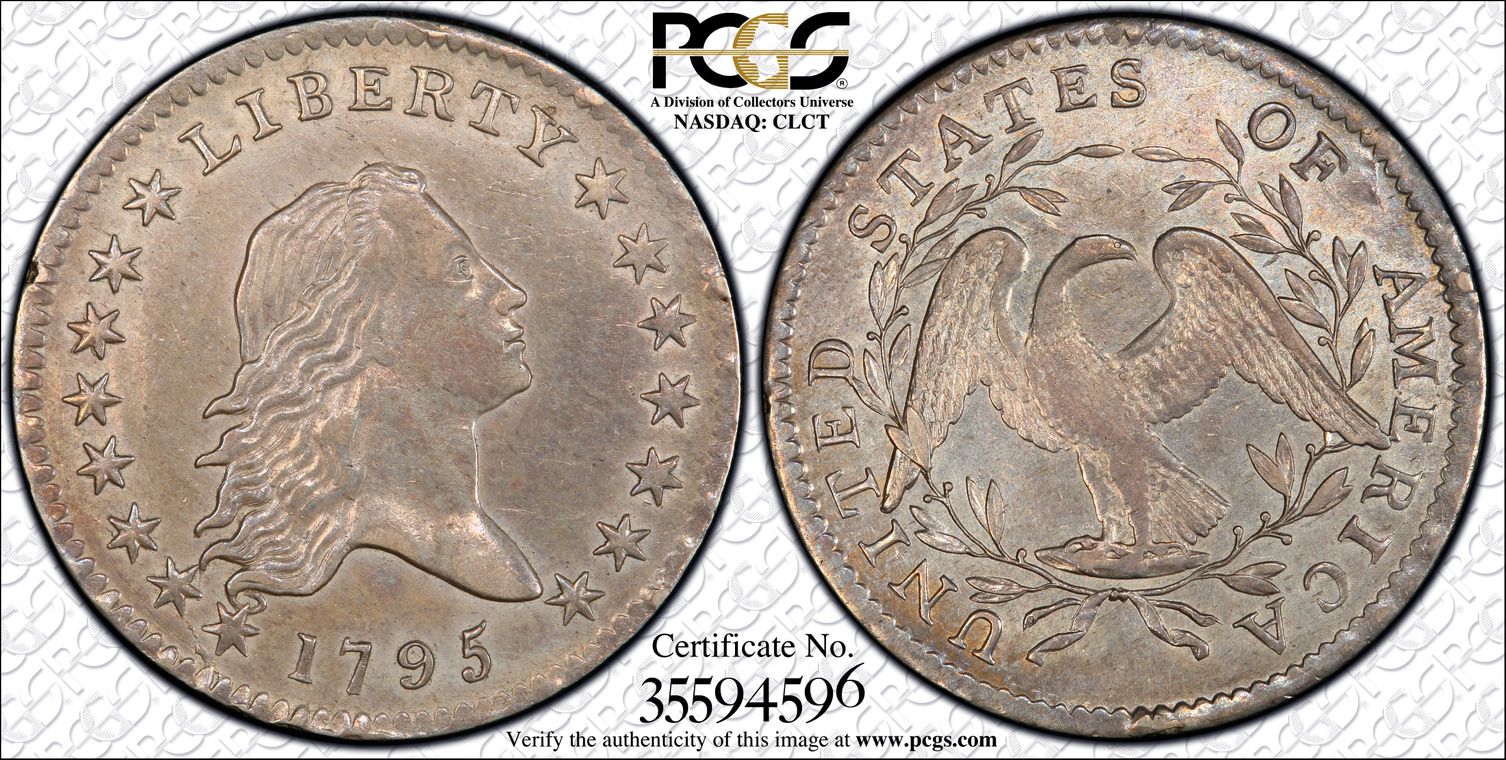
The half dollars of 1794 and 1795 were large enough for an attractive artistic version of Miss Liberty. Indeed, as the small half dime design was more akin to the obverse of the Wreath Cent, the half dollar was much refined and certainly not "too unkempt." Alas, as with the half dime, however, Miss Liberty no longer has her Liberty Cap or pole.
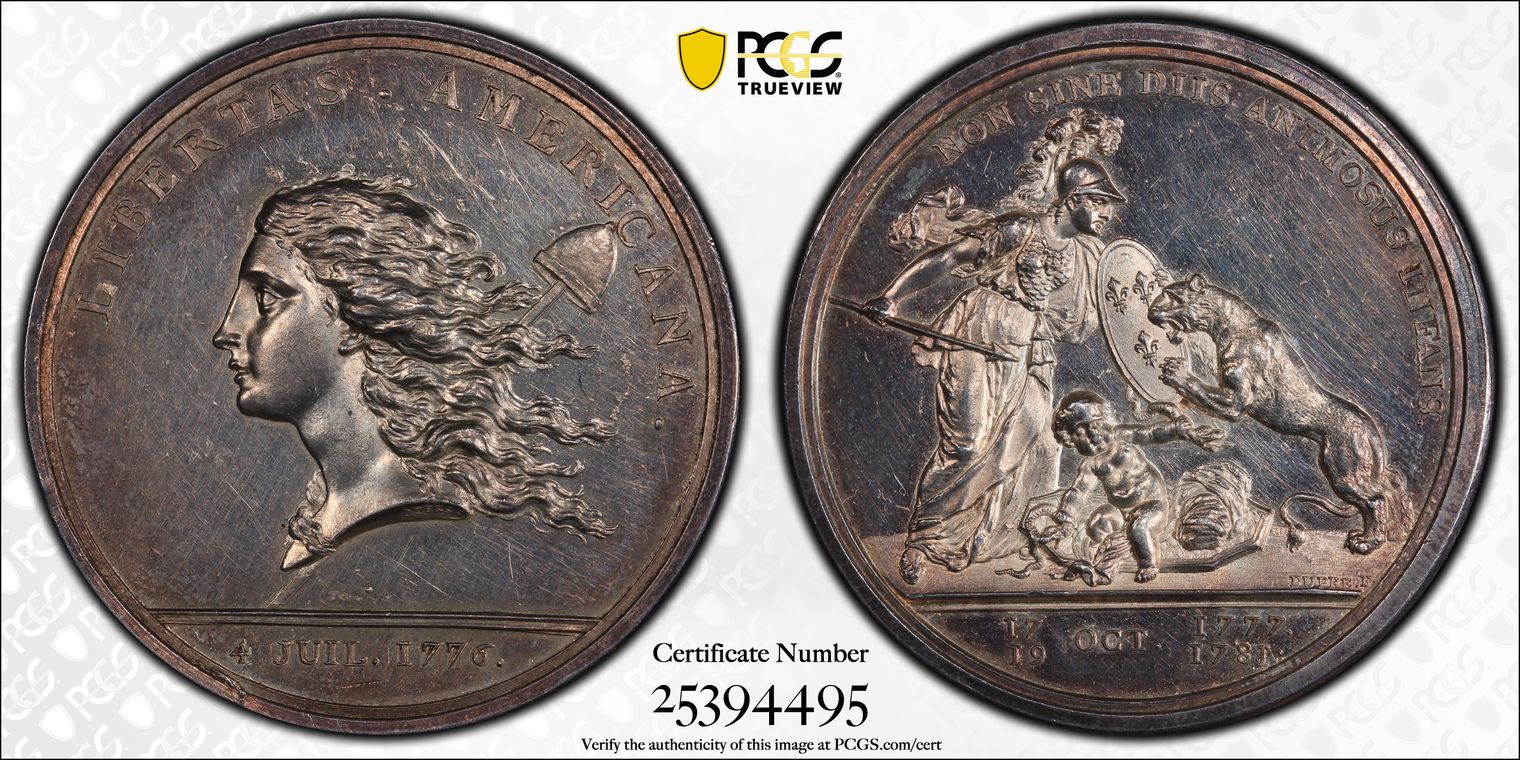
The unanimous choice for the Number 1 spot in the 100 Greatest American Medals and Tokens, the original 1780's Libertas Americana Medals have been famous for the entirety of their 200+ year history. Conceived, commissioned, and funded by Benjamin Franklin himself, the Medals were ordered and delivered on at least four separate occasions between March 1783 and September 1784, likely totaling to 60 silver medals and 200 bronze. Each order included silver and bronze medals, all struck from a single set of dies, which still remain at the Paris Mint. Accordingly, some of the bronze medals were struck before certain of the silver medals. Progressive deterioration of the dies can be seen, and can distinguish early strikes from late strikes. From this, we can know that the first group of silver medals were struck before the bronze medals, as all bronze examples seen show greater die damage than the earliest of the silver medals. The specific silver example seen here displays the very earliest state of the dies seen by this researcher, and thus was likely included in the first group of 20 silver medals delivered to Franklin and covered with his payment of April 4th, 1783. These earliest of medals were presented personally by Franklin, and are thought to have been accompanied by hand-written copies of the "Explication" of their symbolism and meaning, using the draft sent to Franklin on March 31, 1783 by Abbe Andre Morellet. The Explication was later printed in an official format by Philippe-Denis Pierres, with 300 copies delivered to Franklin on May 5, 1783. Today, original specimens of the Explication are exceedingly rare, with the example in the Collection being perhaps the sole copy in private hands.
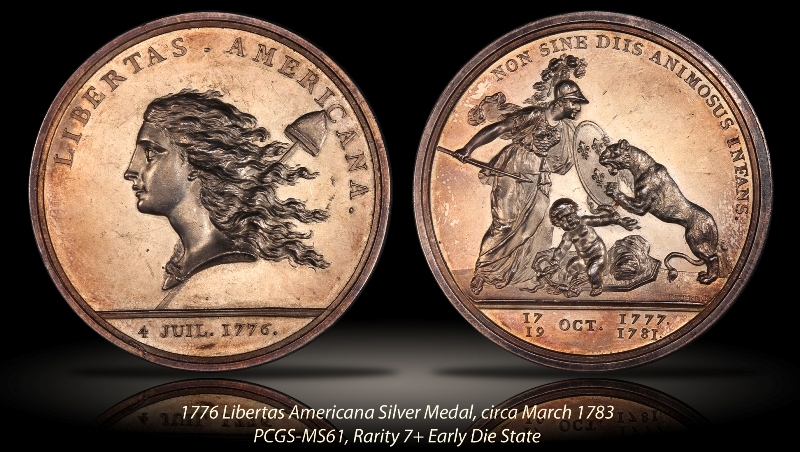
The unanimous choice for the Number 1 spot in the 100 Greatest American Medals and Tokens, the original 1780's Libertas Americana Medals have been famous for the entirety of their 200+ year history. Conceived, commissioned, and funded by Benjamin Franklin himself, the Medals were ordered and delivered on at least four separate occasions between March 1783 and September 1784, likely totaling to 60 silver medals and 200 bronze. Each order included silver and bronze medals, all struck from a single set of dies, which still remain at the Paris Mint. Accordingly, some of the bronze medals were struck before certain of the silver medals. Progressive deterioration of the dies can be seen, and can distinguish early strikes from late strikes. From this, we can know that the first group of silver medals were struck before the bronze medals, as all bronze examples seen show greater die damage than the earliest of the silver medals. The specific silver example seen here displays the very earliest state of the dies seen by this researcher, and thus was likely included in the first group of 20 silver medals delivered to Franklin and covered with his payment of April 4th, 1783. These earliest of medals were presented personally by Franklin, and are thought to have been accompanied by hand-written copies of the "Explication" of their symbolism and meaning, using the draft sent to Franklin on March 31, 1783 by Abbe Andre Morellet. The Explication was later printed in an official format by Philippe-Denis Pierres, with 300 copies delivered to Franklin on May 5, 1783. Today, original specimens of the Explication are exceedingly rare, with the example in the Collection being perhaps the sole copy in private hands.

The unanimous choice for the Number 1 spot in the 100 Greatest American Medals and Tokens, the original 1780's Libertas Americana Medals have been famous for the entirety of their 200+ year history. Conceived, commissioned, and funded by Benjamin Franklin himself, the Medals were ordered and delivered on at least four separate occasions between March 1783 and September 1784, likely totaling to 60 silver medals and 200 bronze. Each order included silver and bronze medals, all struck from a single set of dies, which still remain at the Paris Mint. Accordingly, some of the bronze medals were struck before certain of the silver medals. Progressive deterioration of the dies can be seen, and can distinguish early strikes from late strikes. From this, we can know that the first group of silver medals were struck before the bronze medals, as all bronze examples seen show greater die damage than the earliest of the silver medals. The specific silver example seen here displays the very earliest state of the dies seen by this researcher, and thus was likely included in the first group of 20 silver medals delivered to Franklin and covered with his payment of April 4th, 1783. These earliest of medals were presented personally by Franklin, and are thought to have been accompanied by hand-written copies of the "Explication" of their symbolism and meaning, using the draft sent to Franklin on March 31, 1783 by Abbe Andre Morellet. The Explication was later printed in an official format by Philippe-Denis Pierres, with 300 copies delivered to Franklin on May 5, 1783. Today, original specimens of the Explication are exceedingly rare, with the example in the Collection being perhaps the sole copy in private hands.
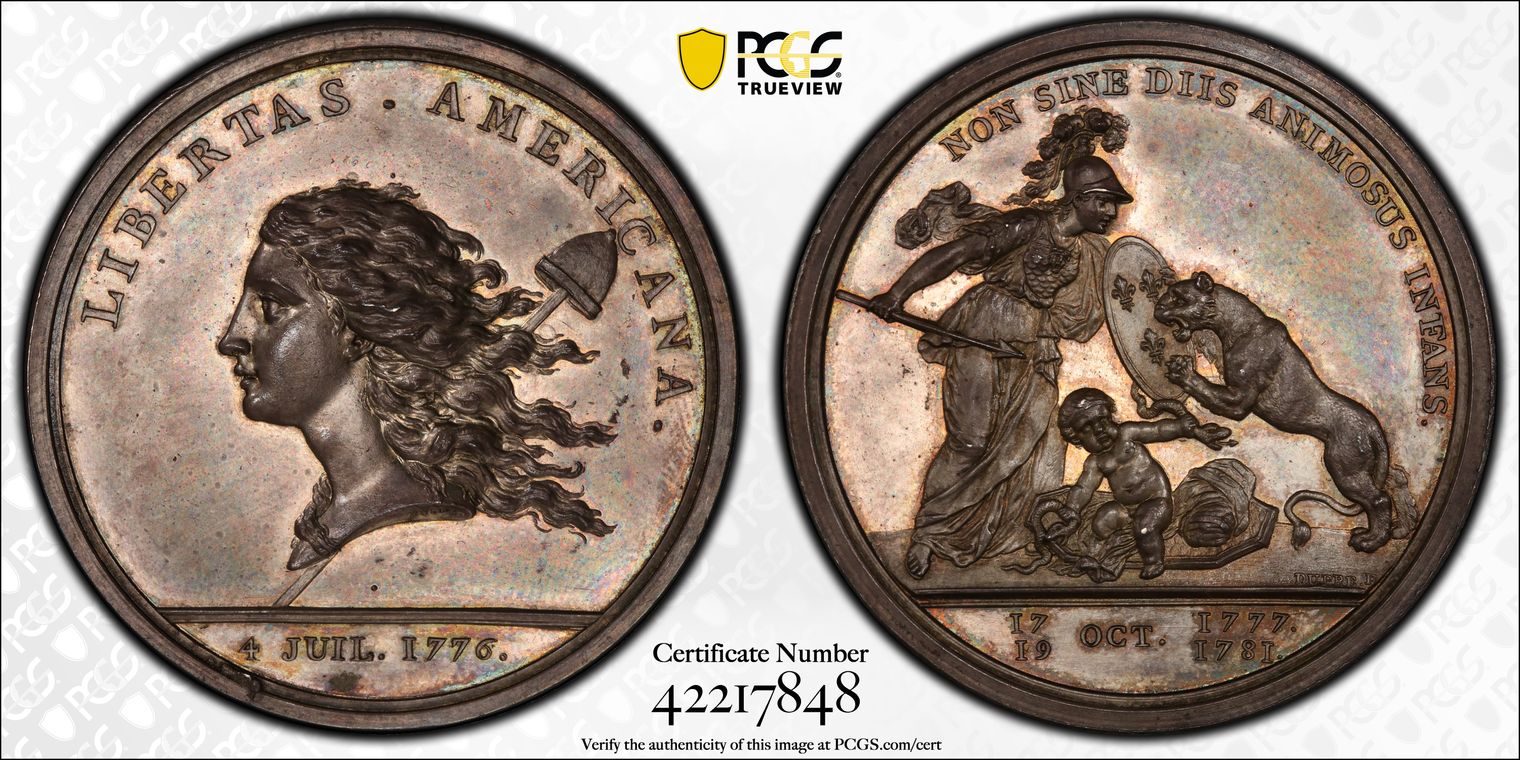
This fabulous specimen of the Original Silver Libertas Americana Medal ranks at the 2nd place in the known population. Tracing back to the legendary coin dealer Virgil Michael Brand, this medal passed on to Burdette Garner Johnson after Virgil's death. Sadly, Burdette Johnson was unmarried. During the Great Depression, Johnson took in a young girl named Mary Cruzan who had been abandoned by her parents. He raised and educated her as his own daughter, and Cruzan later inherited the entirety of Johnson's U.S. colonial coin stock. Cruzan's inherited stock was sold at record auction for $1.1 million USD after Cruzan's own death in 1996. Thereafter, Alan Weinberg owned this medal until it passed to The Cardinal Collection Educational Foundation in January 2013. Truly pristine, this specimen also ranks as the heaviest specimen of the known population, coming from a later die state, with die breaks more notable.
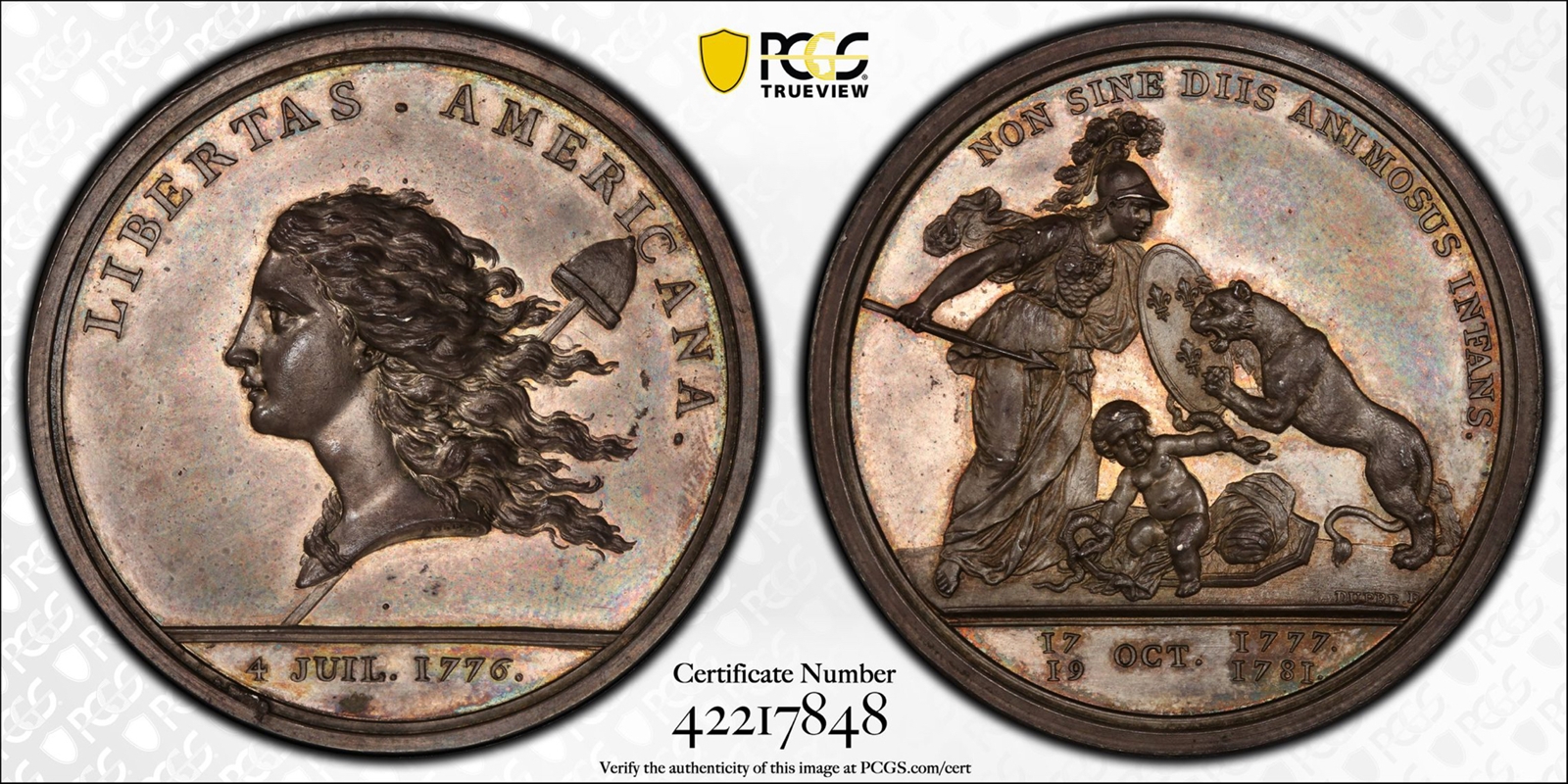
This fabulous specimen of the Original Silver Libertas Americana Medal ranks at the 2nd place in the known population. Tracing back to the legendary coin dealer Virgil Michael Brand, this medal passed on to Burdette Garner Johnson after Virgil's death. Sadly, Burdette Johnson was unmarried. During the Great Depression, Johnson took in a young girl named Mary Cruzan who had been abandoned by her parents. He raised and educated her as his own daughter, and Cruzan later inherited the entirety of Johnson's U.S. colonial coin stock. Cruzan's inherited stock was sold at record auction for $1.1 million USD after Cruzan's own death in 1996. Thereafter, Alan Weinberg owned this medal until it passed to The Cardinal Collection Educational Foundation in January 2013. Truly pristine, this specimen also ranks as the heaviest specimen of the known population, coming from a later die state, with die breaks more notable.
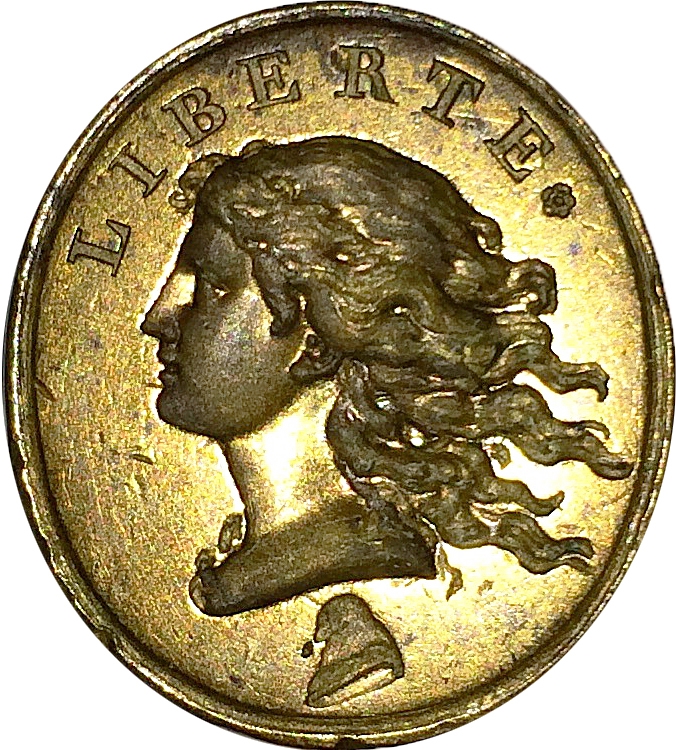
Perhaps the single earliest example of Miss Liberty created by Augustin Dupre in metallic form, this unique incused oval die was completely unknown to the world at large until the Dupre Family Archive was released by Augustin's descendants and dispersed in the Spring of 2014. Here we see the genesis of the Flowing Hair Liberty design, with her locks flowing behind her, a single lock crossing her neck, and a phrygian cap beneath the truncation of her bust as a symbol of freedom and the pursuit of Liberty.
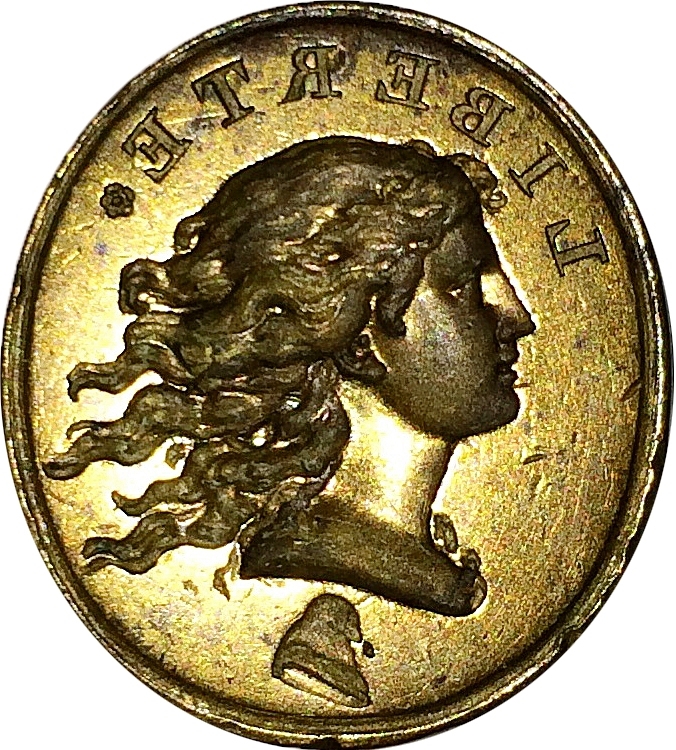
Perhaps the single earliest example of Miss Liberty created by Augustin Dupre in metallic form, this unique incused oval die was completely unknown to the world at large until the Dupre Family Archive was released by Augustin's descendants and dispersed in the Spring of 2014. Here we see the genesis of the Flowing Hair Liberty design, with her locks flowing behind her, a single lock crossing her neck, and a phrygian cap beneath the truncation of her bust as a symbol of freedom and the pursuit of Liberty.
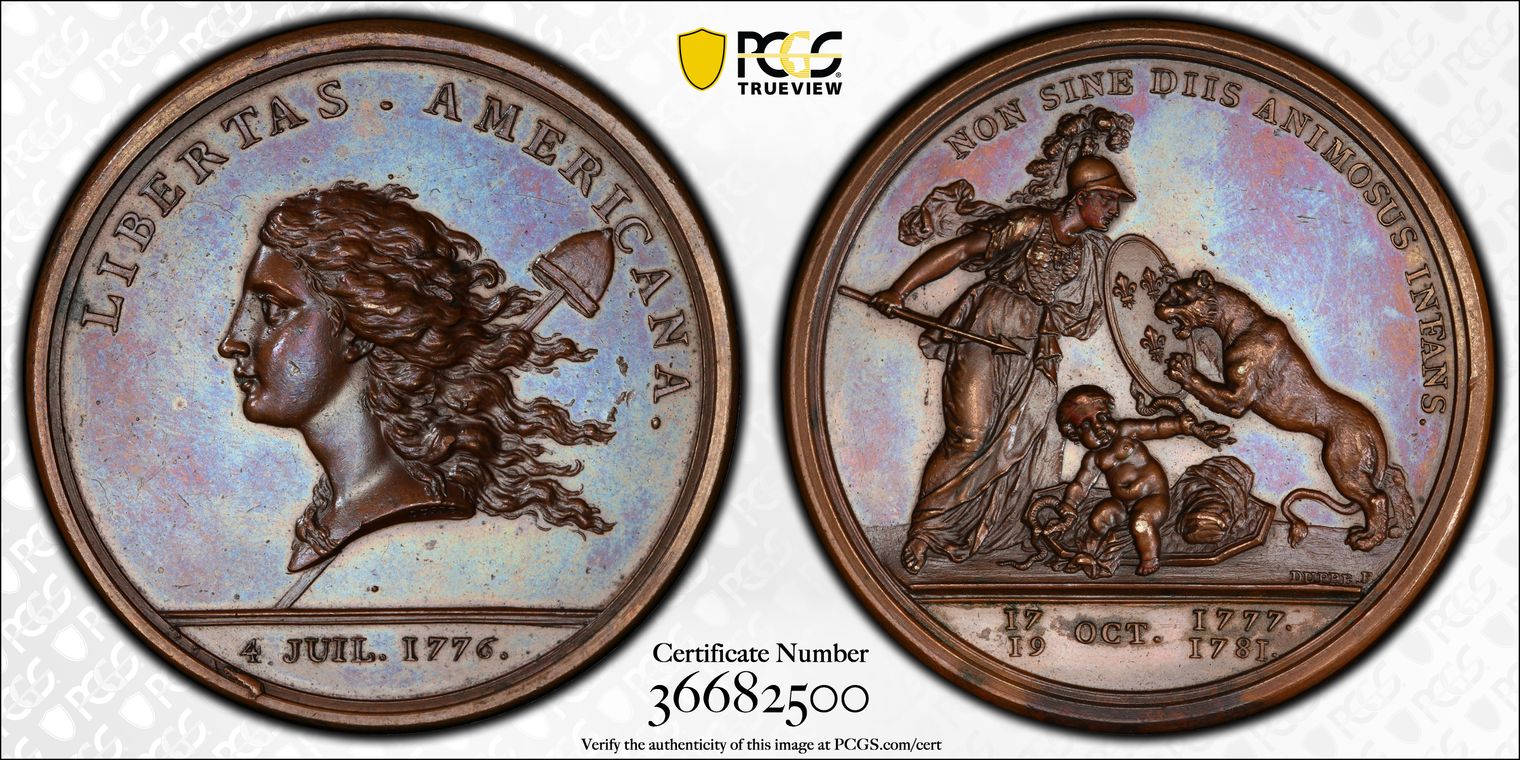
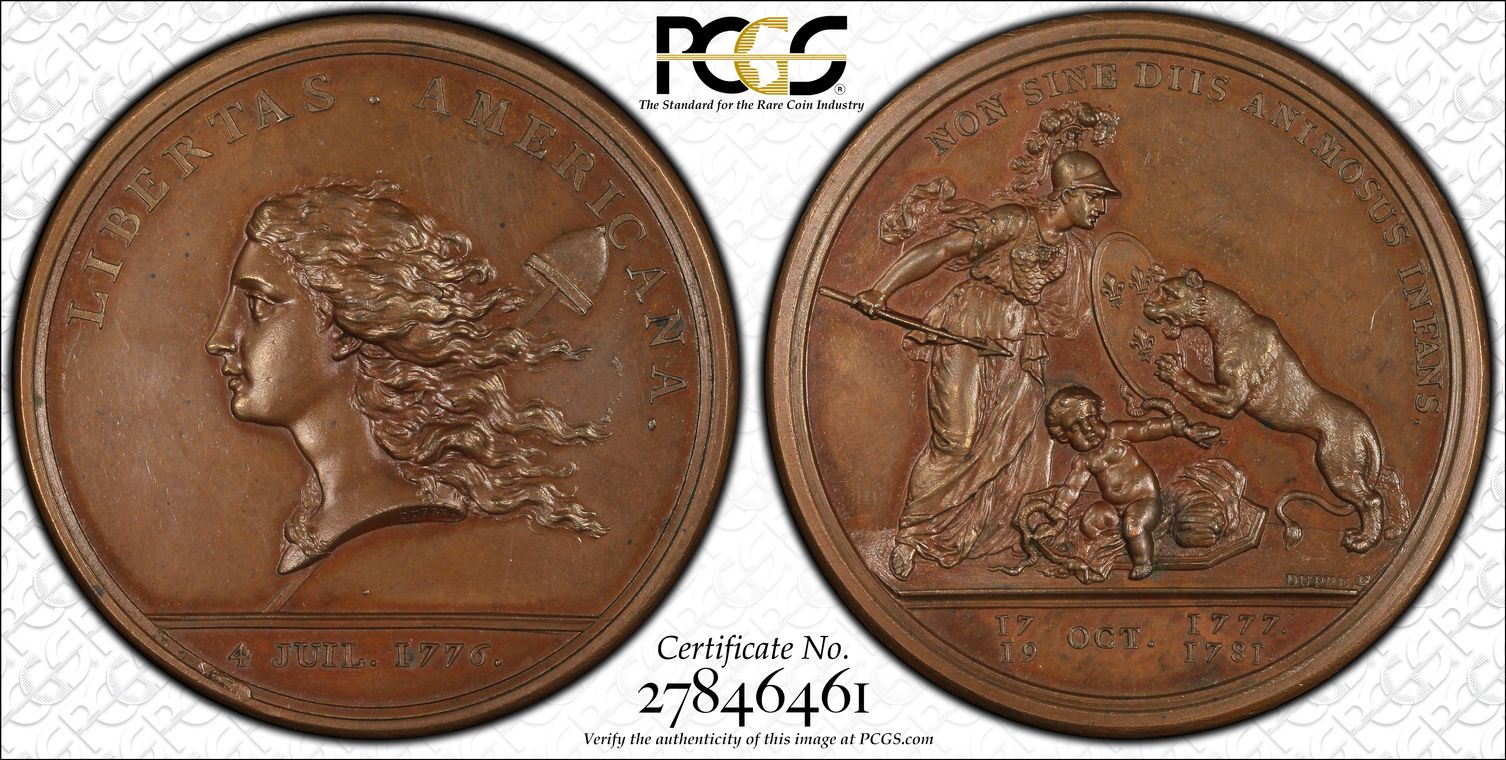
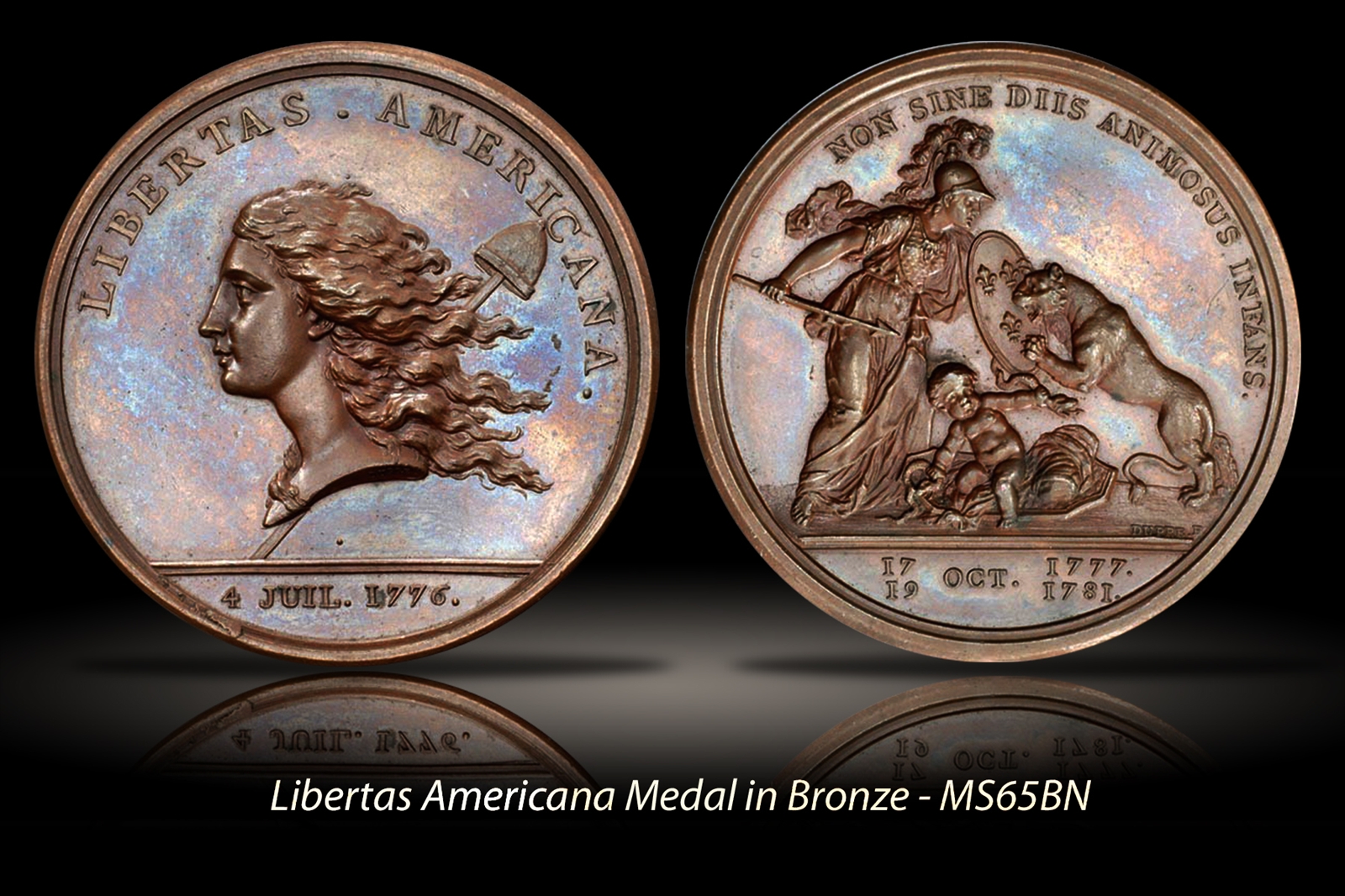
A fanstastically preserved specimen, this gem bronze example of the Libertas Americana Medal is the finest seen by this researcher. Its die state places it near the middle of the production period, with considerable die damage now visible in comparison to the early die state silver and bronze medals in the Collection, yet not so advanced as the very latest die state examples. The Collection does include a very early die state example, that being the sole Red-Brown bronze Libertas Americana medal.

A fanstastically preserved specimen, this gem bronze example of the Libertas Americana Medal is the finest seen by this researcher. Its die state places it near the middle of the production period, with considerable die damage now visible in comparison to the early die state silver and bronze medals in the Collection, yet not so advanced as the very latest die state examples. The Collection does include a very early die state example, that being the sole Red-Brown bronze Libertas Americana medal.

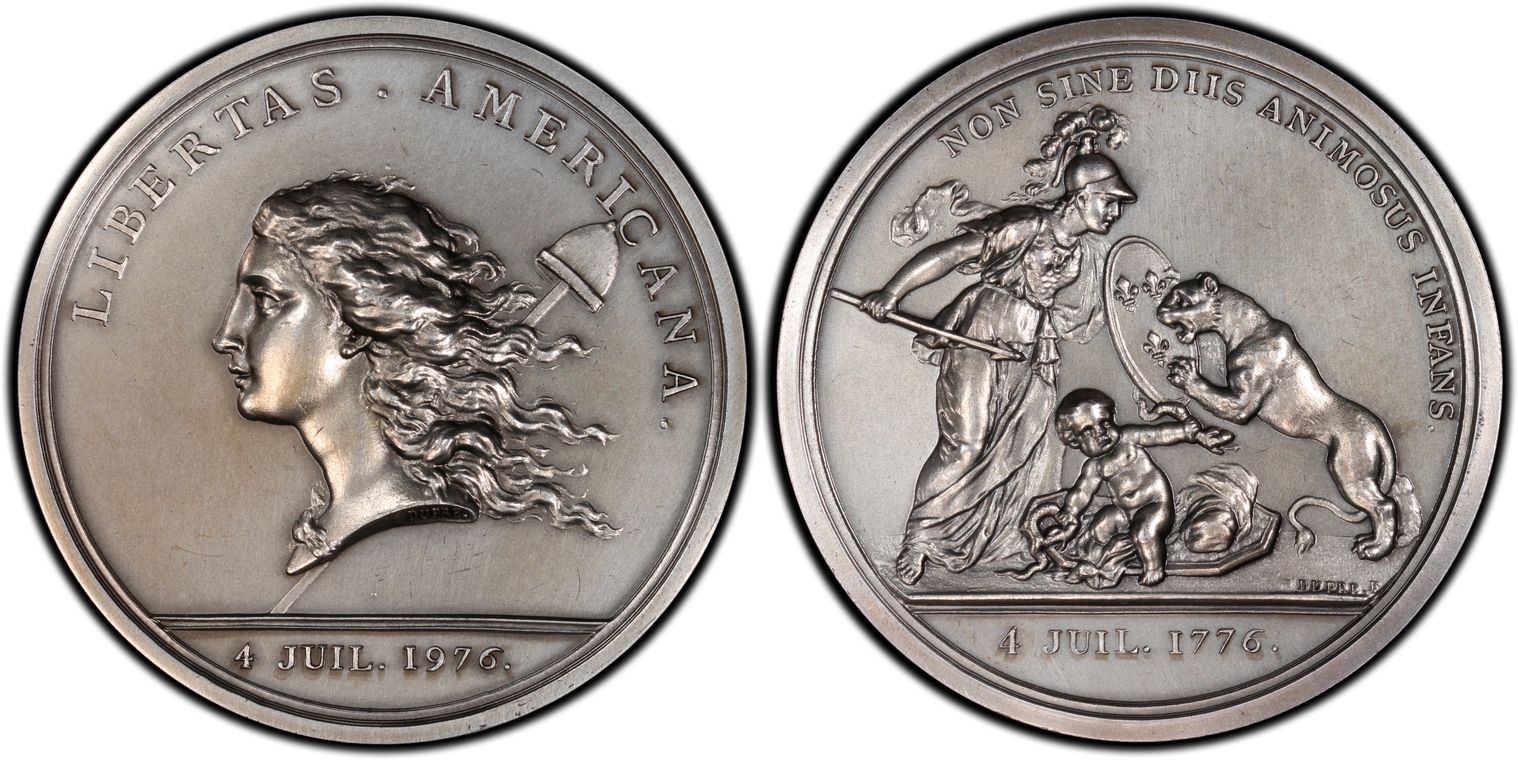
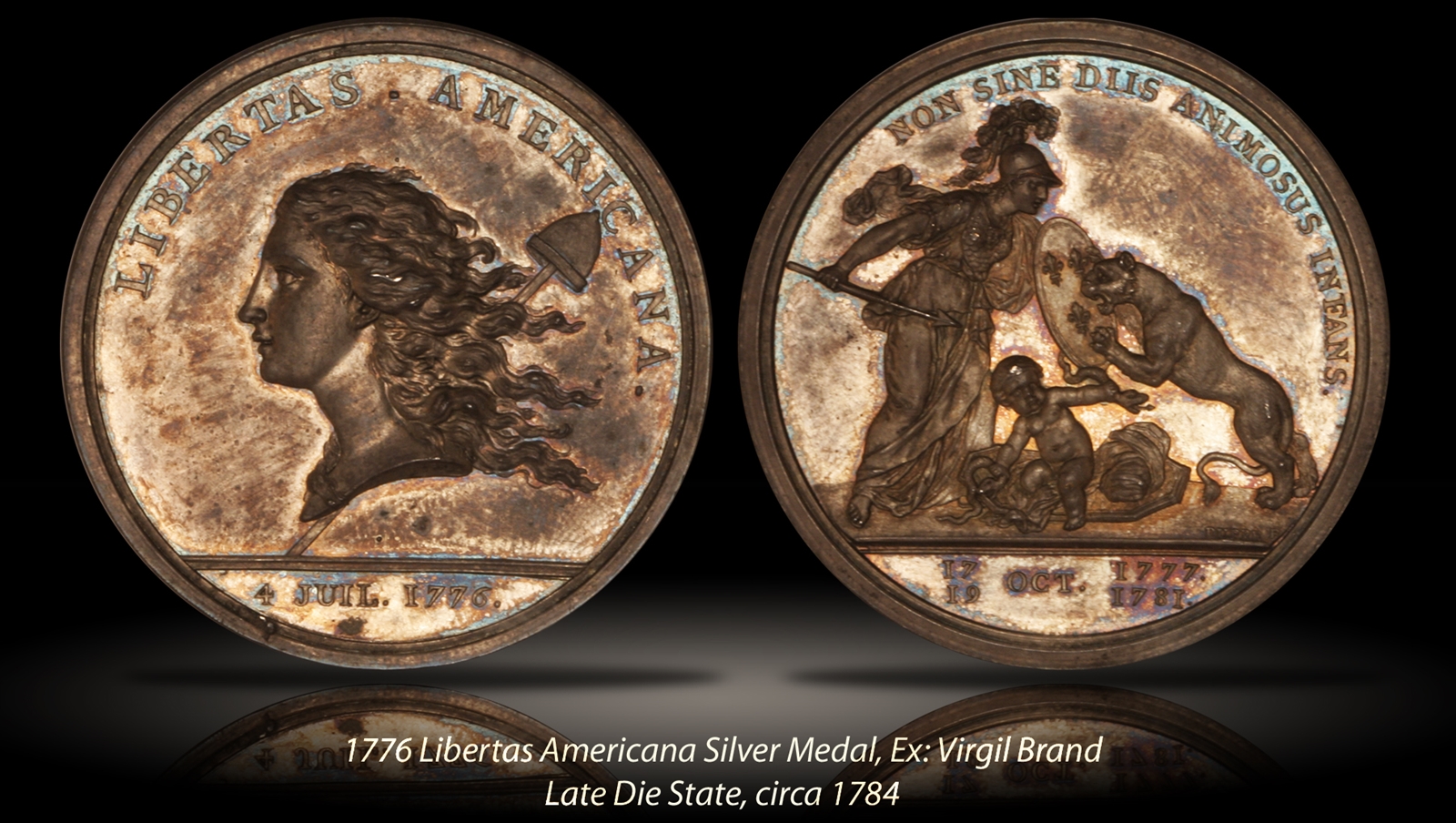
An incredibly well-preserved original Silver specimen, formerly from the incomparable collection of Virgil Brand, this medal is a likely contender for the finest known original Silver Libertas Americana Medal (PCGS grading pending). Free from noticeable handling this specimen displays crisp frosted details all the way to the highest points of the design, contrasting with watery mirrored prooflike fields. Utterly and completely fully struck, even the finest of die characteristics stand out boldly for examination. Based on the raised die artifacts, this awe-inspiring example was struck during the later production periods, likely in 1784.
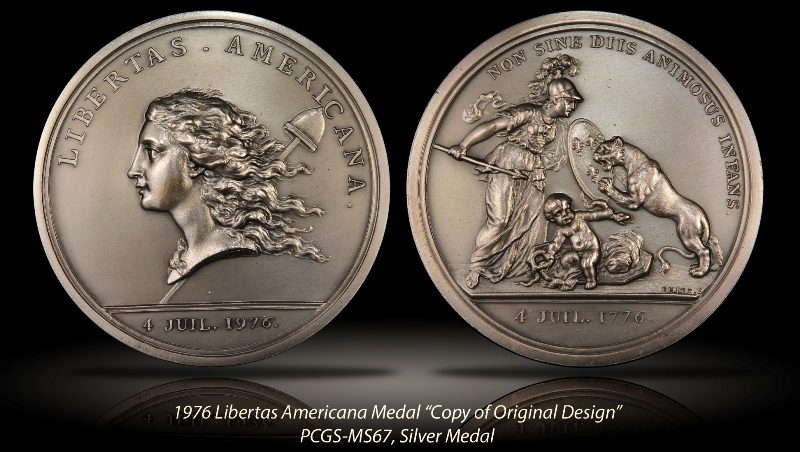
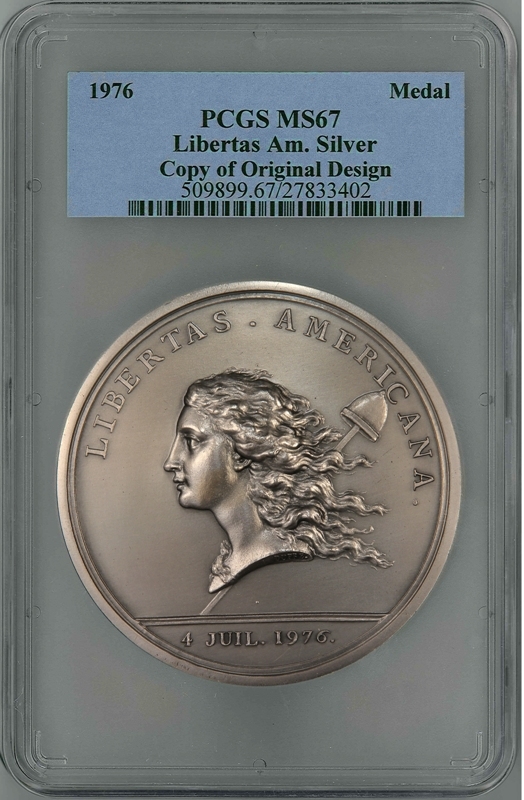
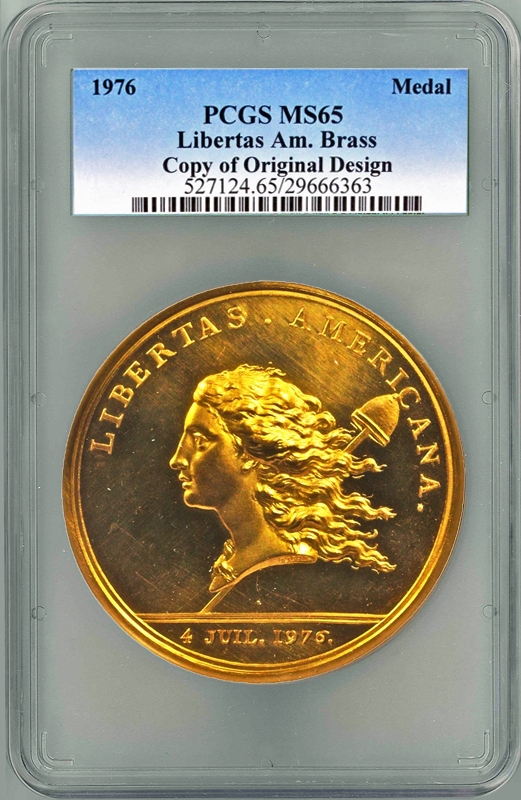
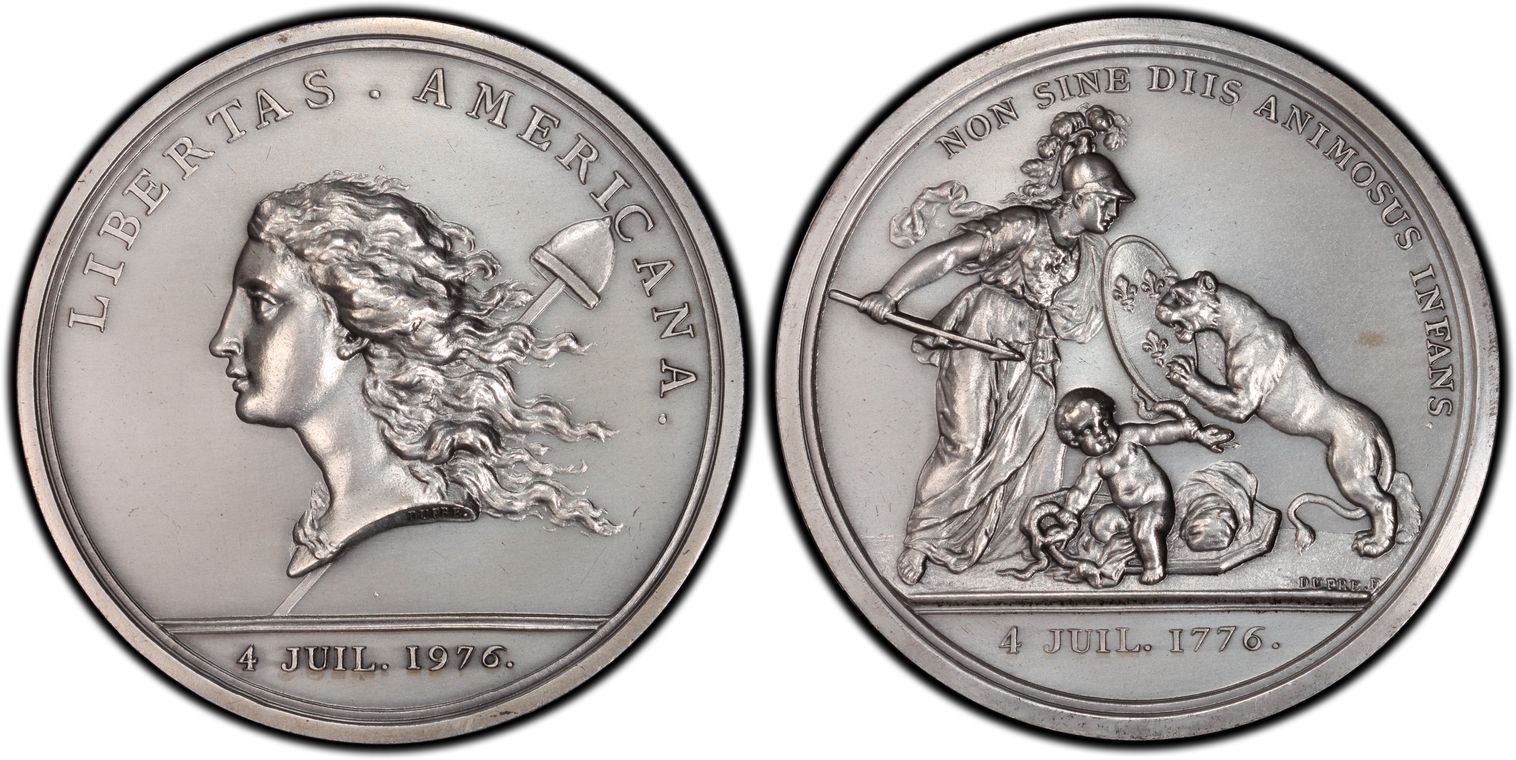
During a visit to the Paris Mint in 1958, John J. Ford re-discovered the previously lost original dies for the Libertas Americana Medal in the Mint's Museum "Musee de Monnaies." As the U.S. Bicentennial grew nearer, he suggested to Stanley Applebaum of First Coinvestors that transfer dies be created for a bicentennial commemorative restriking. First Coinvestors funded the project, in exchange for the exclusive rights of the new dies. The dies were expanded to a diameter of 77mm, and the dates were changed on the obverse and reverse dies. Further markings were added to the edge, to designate the restrikes as "COPY OF DESIGN BY BENJAMIN FRANKLIN - ORIGINAL STRUCK IN 1783". Just 500 examples were struck in silver, as in the specimen seen here. Records report that 3 examples were also struck in gold (likely .920 fineness), but none are known today. Presumably, melted for their high bullion value during 1980.
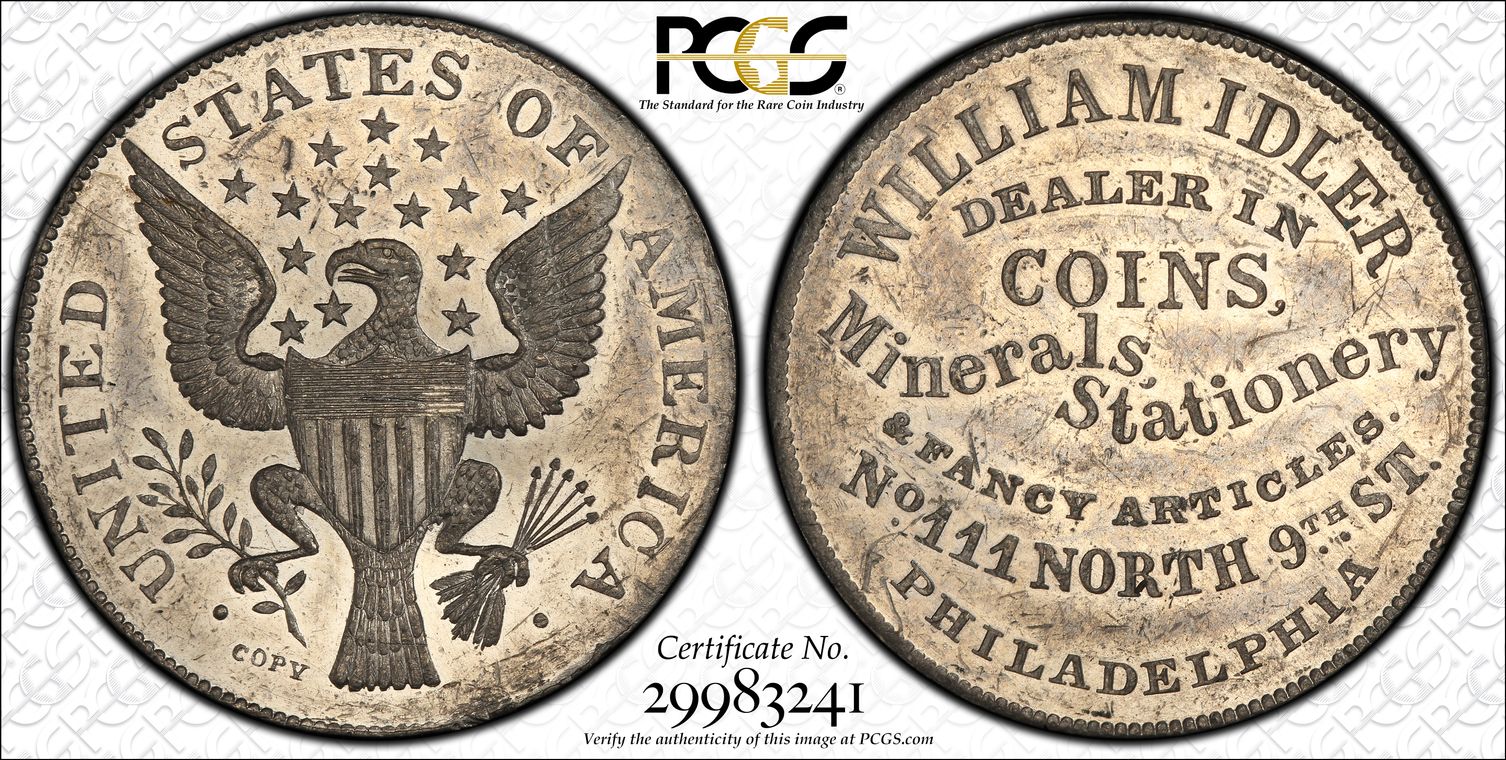
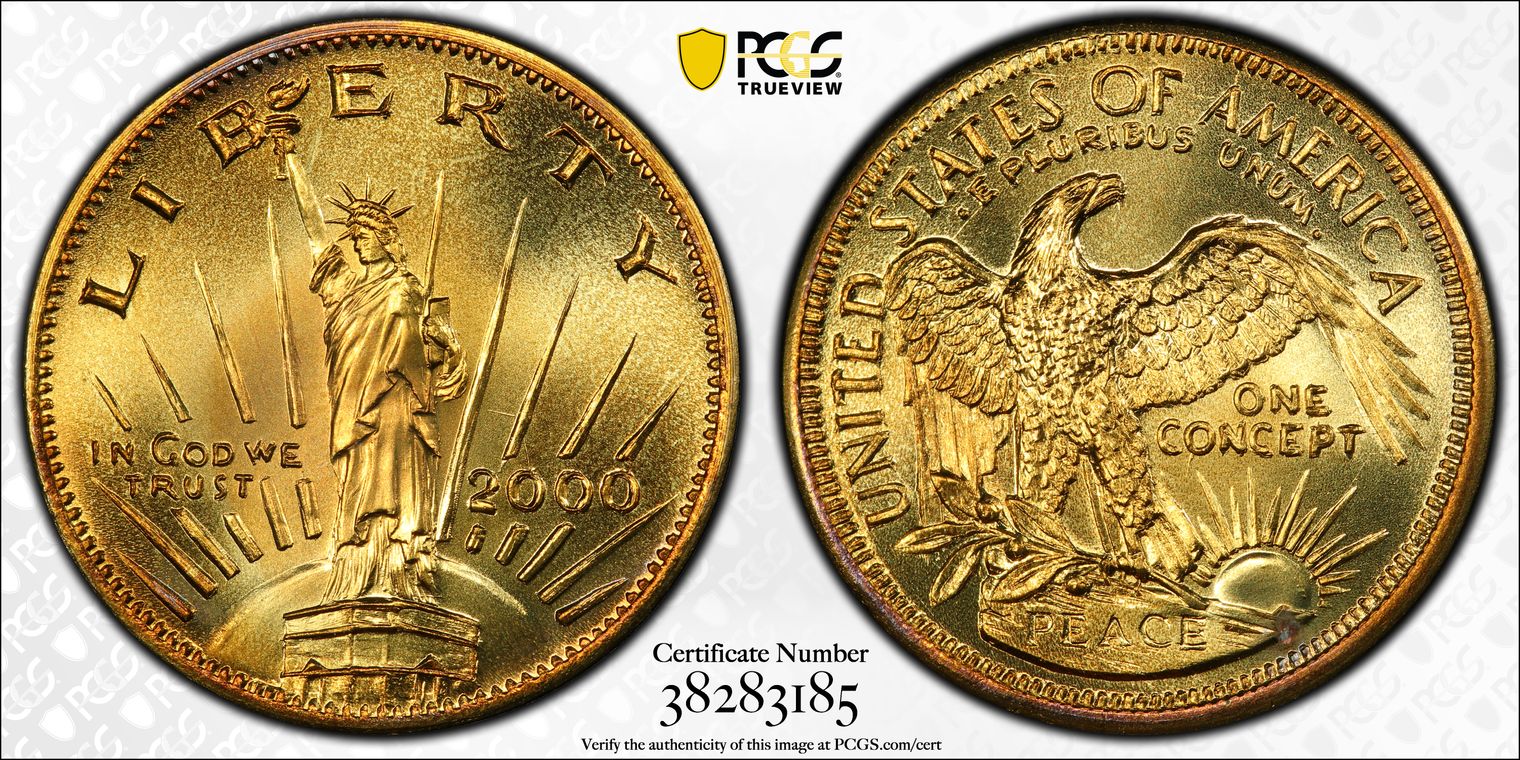
This is one of the advertising tokens created by the Bowers & Merena Galleries, and was issued in 2000.
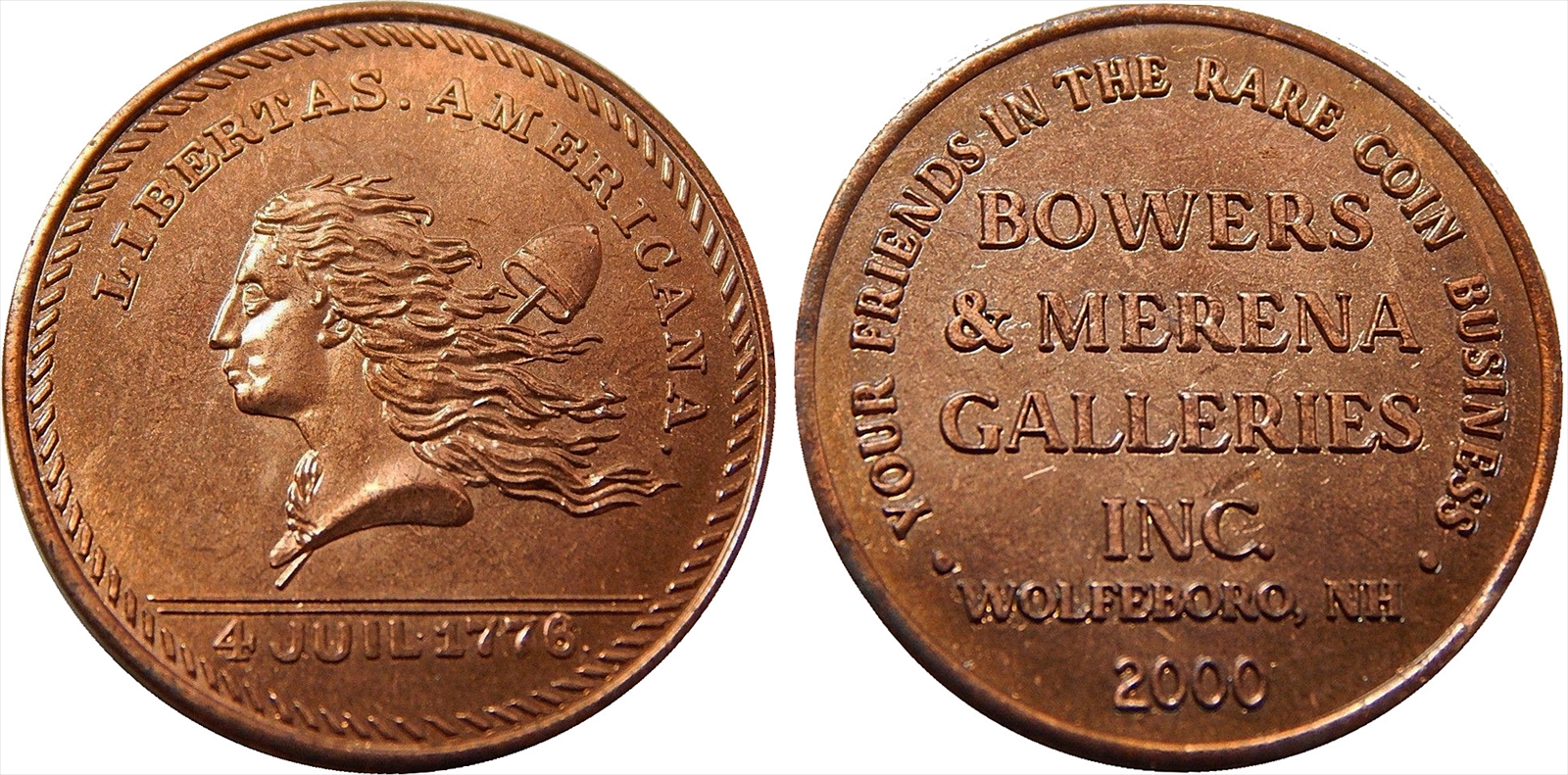
This is one of the advertising tokens created by the Bowers & Merena Galleries, and was issued in 2000.
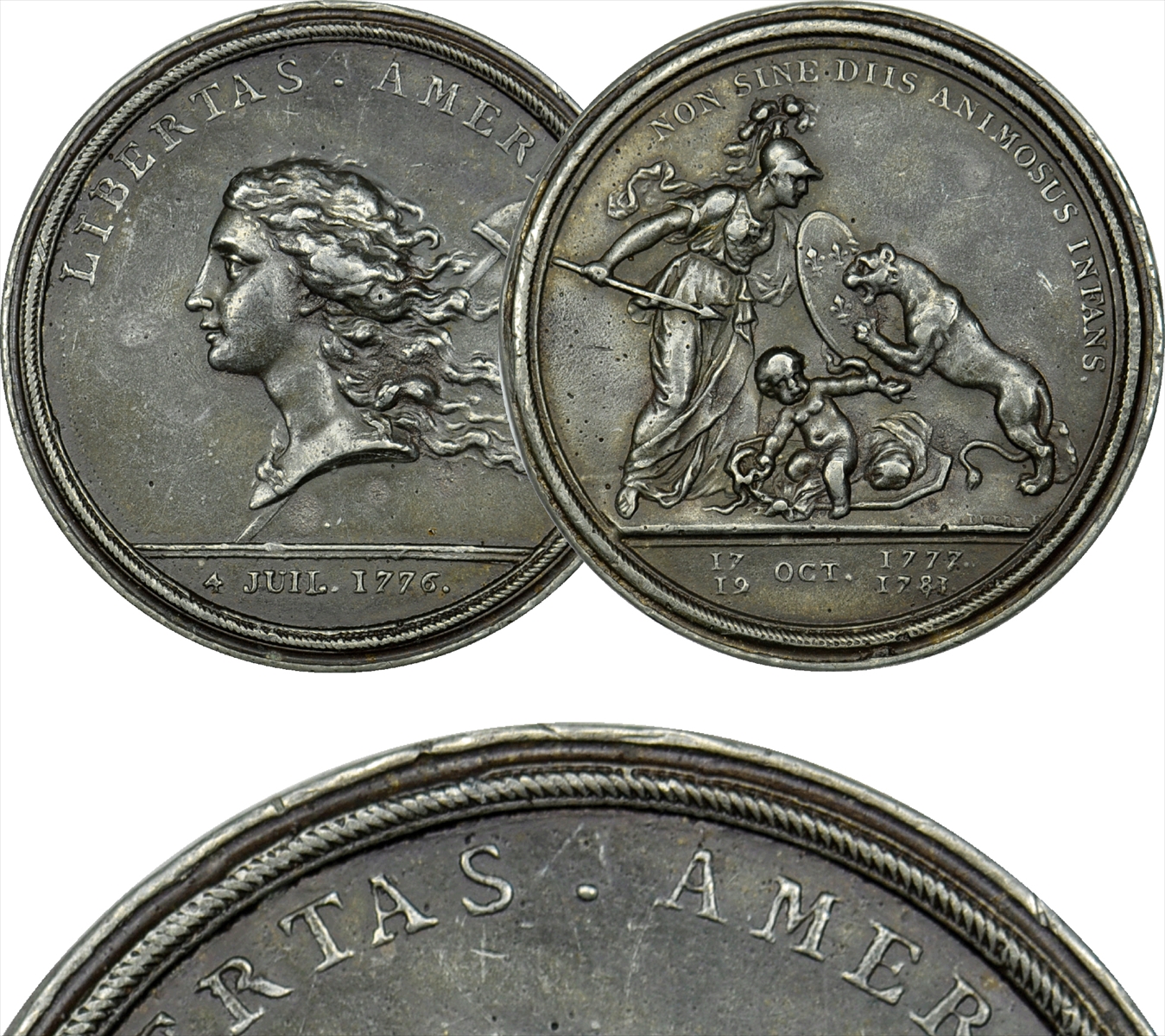
This unique piece has been named the "White Libertas," but should be known as the "Corded Edge" Libertas." It's origin is unknown, but it is thought to be have been at die trial to cover over the ubiquitous die break always seen beneath the "4" on the bottom of the obverse. It is also thought that after creating this piece, that the corded edge would take away from the all of the historic allegories.

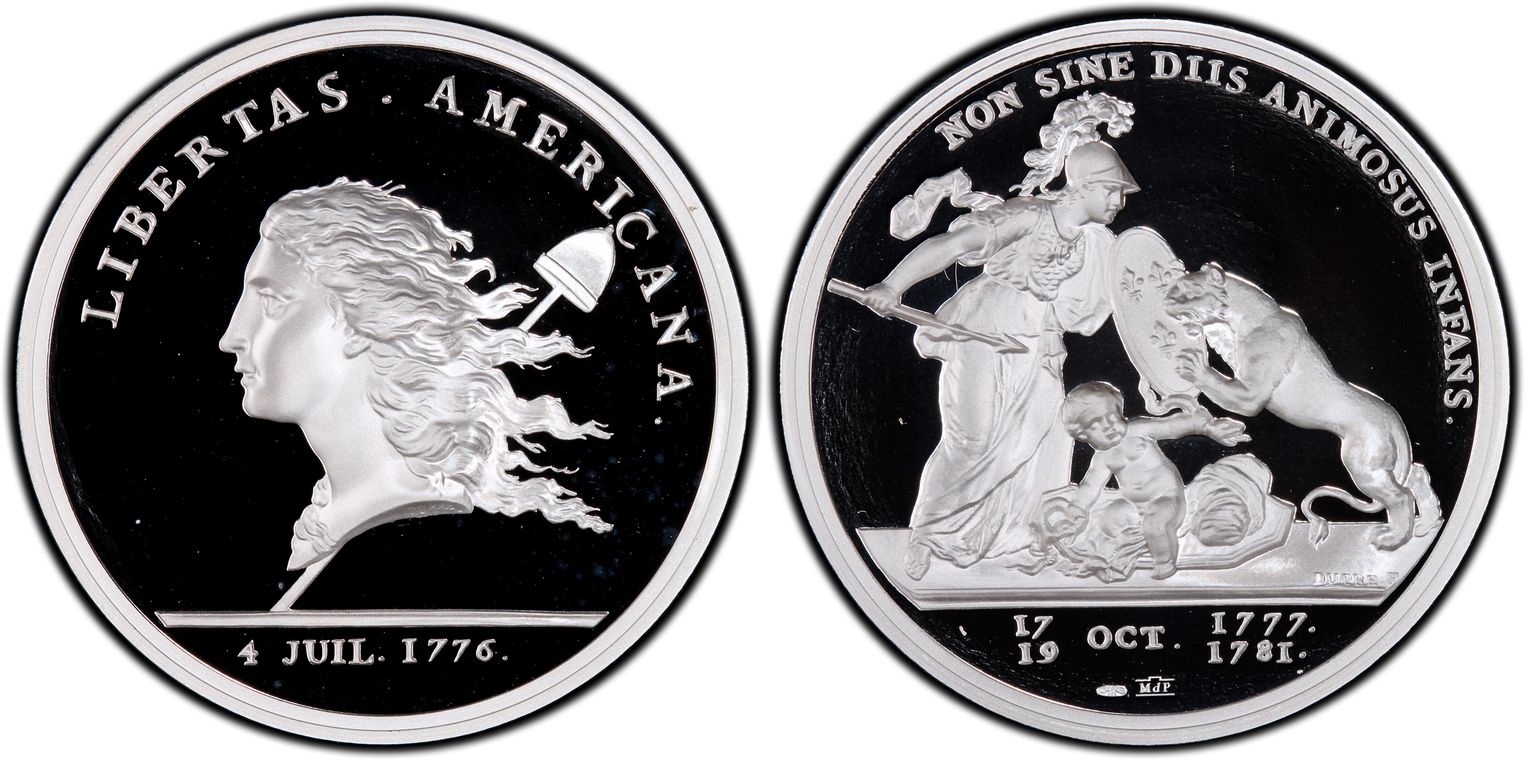
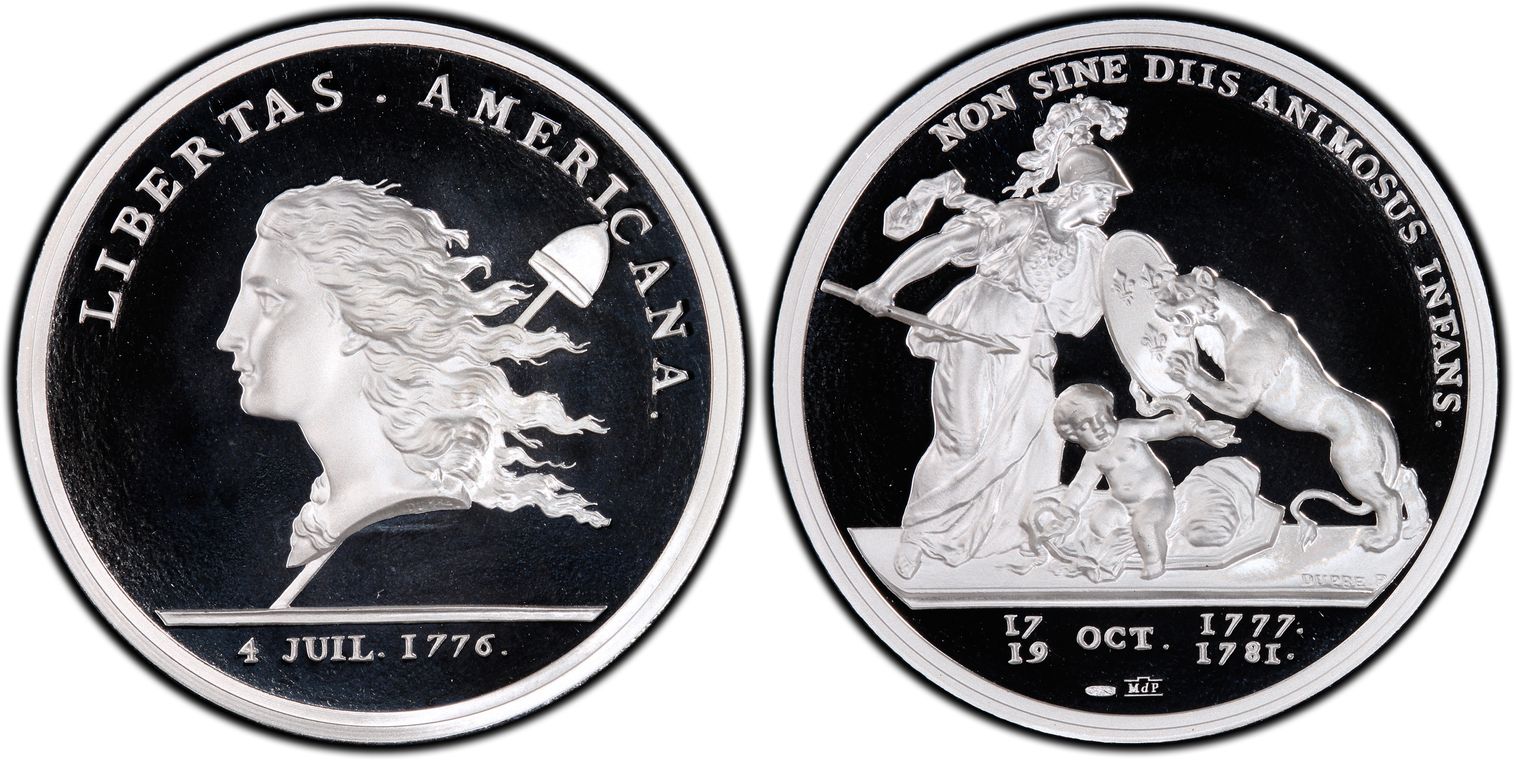
Clearly, the Paris Mint found a favorable reception for the Libertas Americana Medals it produced during 2000, and so further restrikes were executed in 2004 with greater mintages. The 2004 Silver Libertas Americana Medals, as seen here, were produced to the extent of 15,000 pieces -- all in Deep Cameo Proof format, each 40mm in diameter and containing 24 grams of .999 silver. The new 40mm size of these silver restrikes was the smallest ever issued by the Paris Mint up until that point; however, that size makes them a perfect fit for display in dual-coin holders, allowing both the obverse and reverse to be viewed simultaneously.
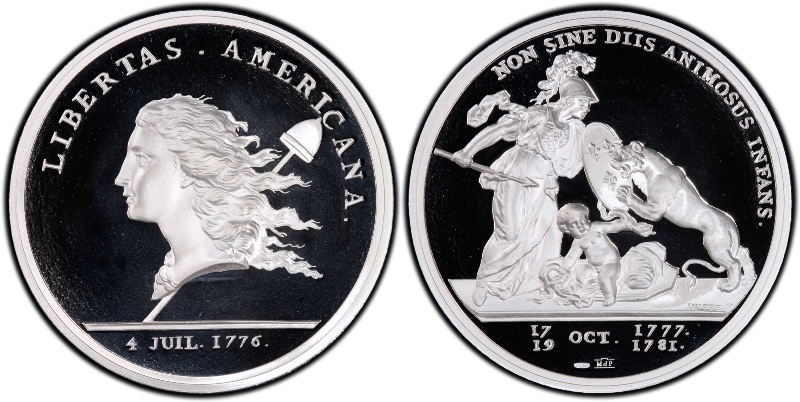
Clearly, the Paris Mint found a favorable reception for the Libertas Americana Medals it produced during 2000, and so further restrikes were executed in 2004 with greater mintages. The 2004 Silver Libertas Americana Medals, as seen here, were produced to the extent of 15,000 pieces -- all in Deep Cameo Proof format, each 40mm in diameter and containing 24 grams of .999 silver. The new 40mm size of these silver restrikes was the smallest ever issued by the Paris Mint up until that point; however, that size makes them a perfect fit for display in dual-coin holders, allowing both the obverse and reverse to be viewed simultaneously.
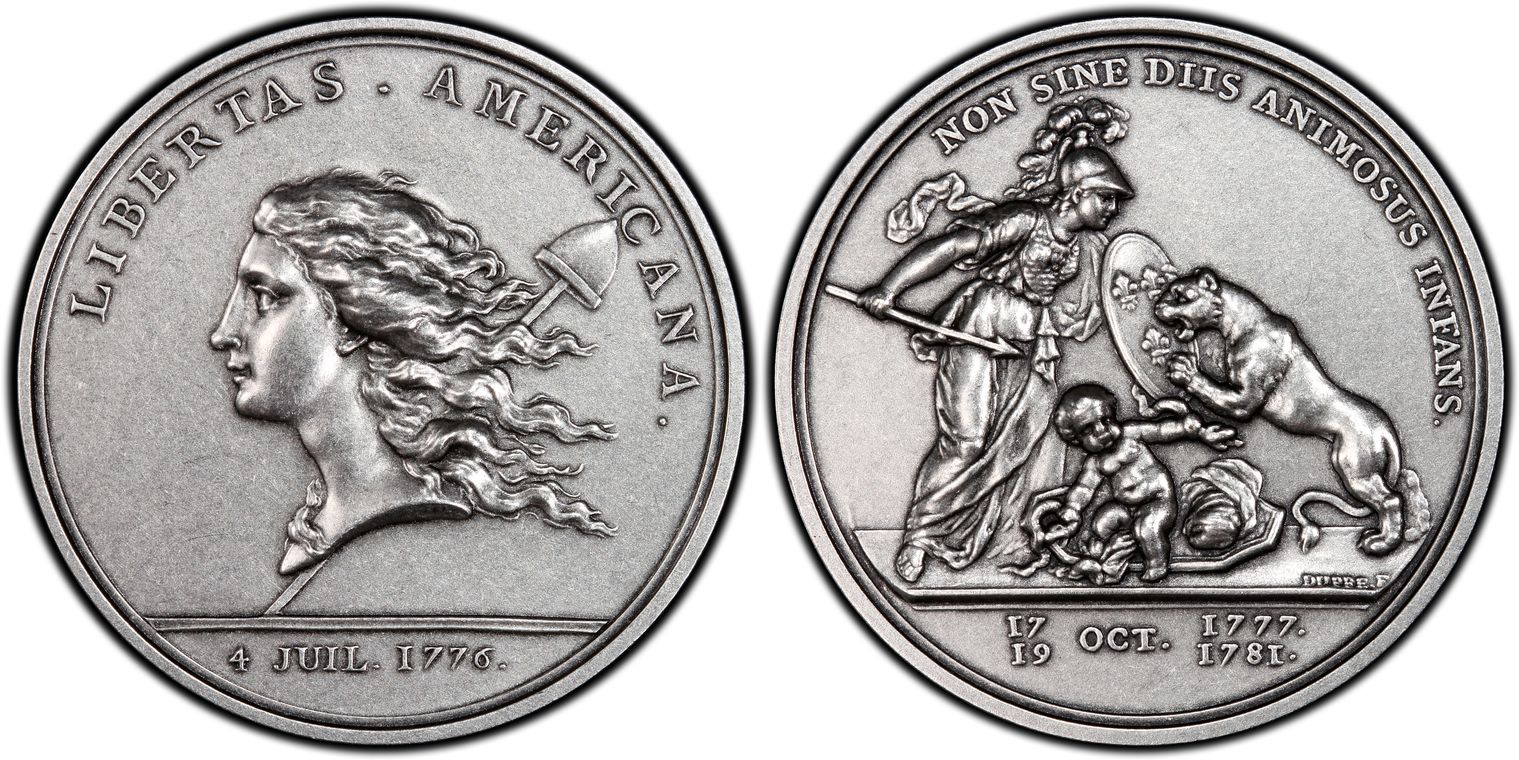

While the production quality of the Deep Cameo proof restrikes of 2004 was exceptional, the Paris Mint's follow-up in 2005 did not match that standard. Talisman Coin Company, an official distributor of Monnaie de Paris products, contracted with the Mint to produce circulation-strike examples of the Libertas Americana medals in both Silver and Bronze, with no mintage limits for either. These were intended to be retailed at a lower price point, and thus it appears that production standards were relaxed to facilitate that. Produced at a 50mm diameter with 60 grams of .950 silver, the 2005 Silver Libertas Americana restrike seen here is precisely in the condition it left the Paris Mint; yet, its softened details and finely granular surface (as in all examples seen) merits only the grade of MS61.
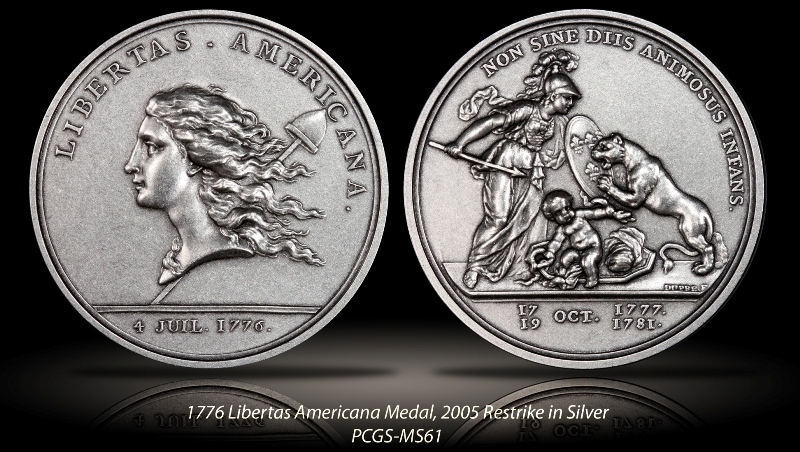
While the production quality of the Deep Cameo proof restrikes of 2004 was exceptional, the Paris Mint's follow-up in 2005 did not match that standard. Talisman Coin Company, an official distributor of Monnaie de Paris products, contracted with the Mint to produce circulation-strike examples of the Libertas Americana medals in both Silver and Bronze, with no mintage limits for either. These were intended to be retailed at a lower price point, and thus it appears that production standards were relaxed to facilitate that. Produced at a 50mm diameter with 60 grams of .950 silver, the 2005 Silver Libertas Americana restrike seen here is precisely in the condition it left the Paris Mint; yet, its softened details and finely granular surface (as in all examples seen) merits only the grade of MS61.
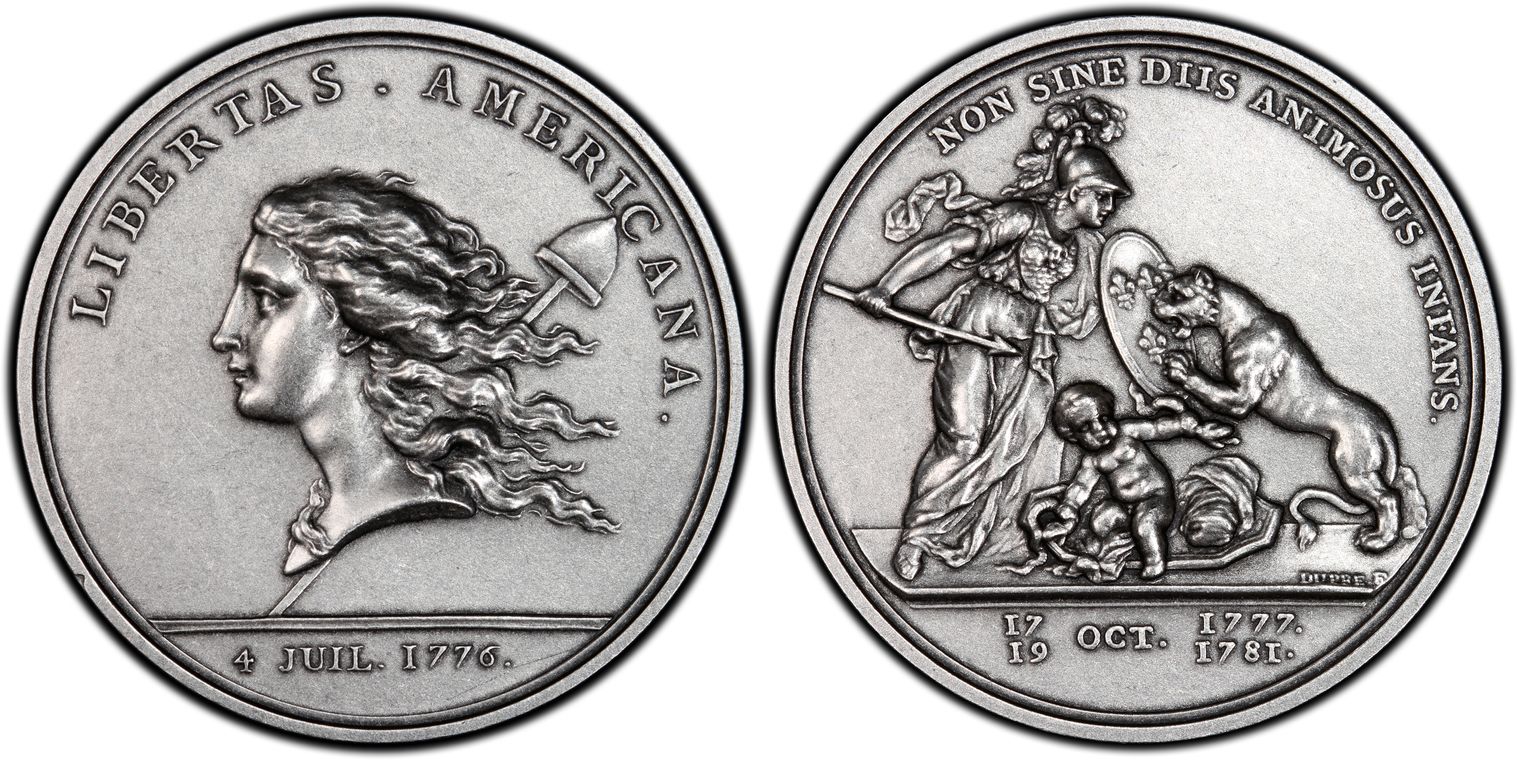

While the production quality of the Deep Cameo proof restrikes of 2004 was exceptional, the Paris Mint's follow-up in 2005 did not match that standard. Talisman Coin Company, an official distributor of Monnaie de Paris products, contracted with the Mint to produce circulation-strike examples of the Libertas Americana medals in both Silver and Bronze, with no mintage limits for either. These were intended to be retailed at a lower price point, and thus it appears that production standards were relaxed to facilitate that. Using the worn dies from the 1980's production of silver restrikes as the model, these new restrikes were produced at a 50mm diameter with 60 grams of .950 silver. The 2005 Silver Libertas Americana restrike seen here is precisely in the condition it left the Paris Mint and is the single finest known by a wide margin; yet, its softened details and finely granular surface (as in all examples seen) merits only the grade of MS64.
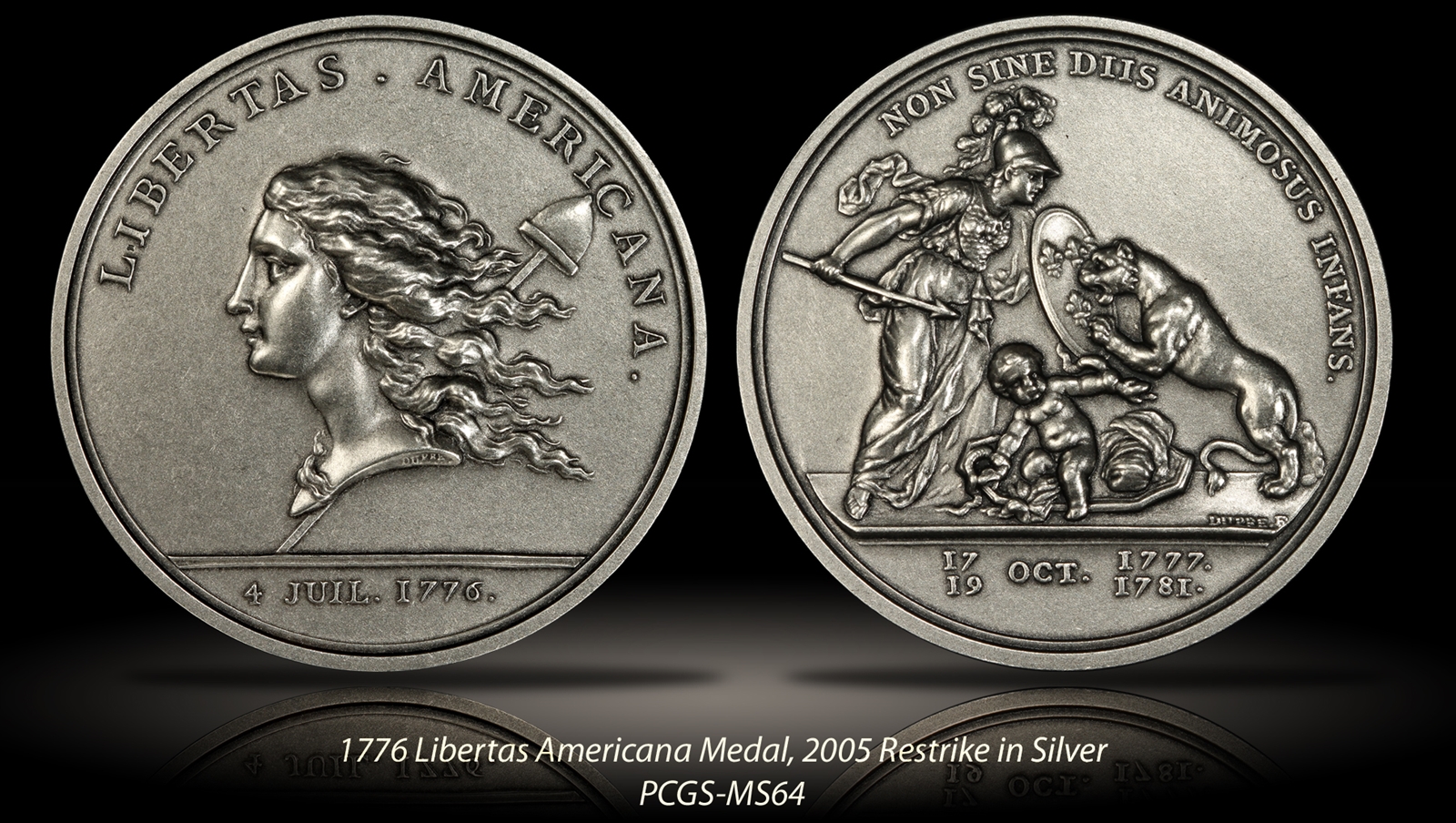
While the production quality of the Deep Cameo proof restrikes of 2004 was exceptional, the Paris Mint's follow-up in 2005 did not match that standard. Talisman Coin Company, an official distributor of Monnaie de Paris products, contracted with the Mint to produce circulation-strike examples of the Libertas Americana medals in both Silver and Bronze, with no mintage limits for either. These were intended to be retailed at a lower price point, and thus it appears that production standards were relaxed to facilitate that. Using the worn dies from the 1980's production of silver restrikes as the model, these new restrikes were produced at a 50mm diameter with 60 grams of .950 silver. The 2005 Silver Libertas Americana restrike seen here is precisely in the condition it left the Paris Mint and is the single finest known by a wide margin; yet, its softened details and finely granular surface (as in all examples seen) merits only the grade of MS64.
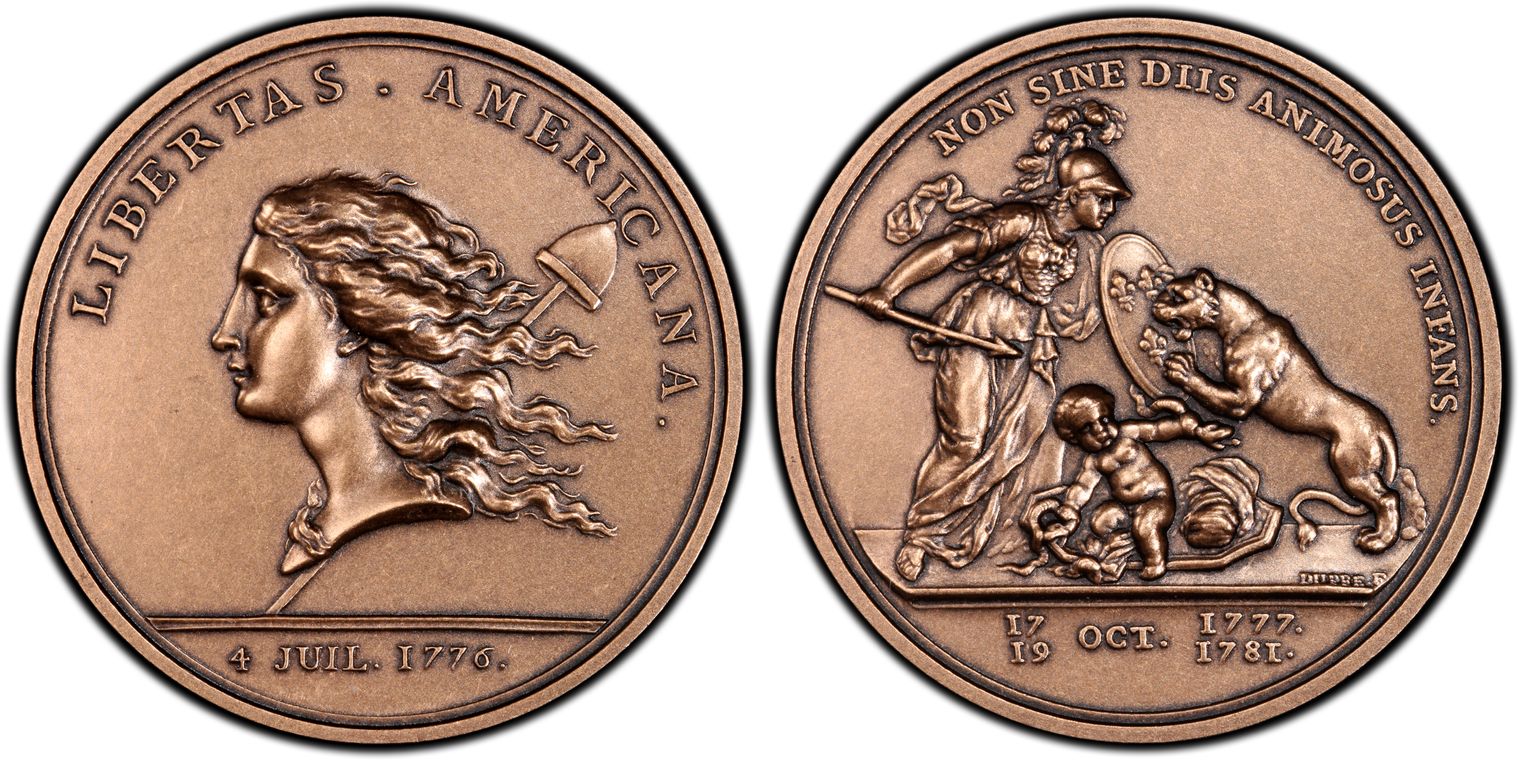
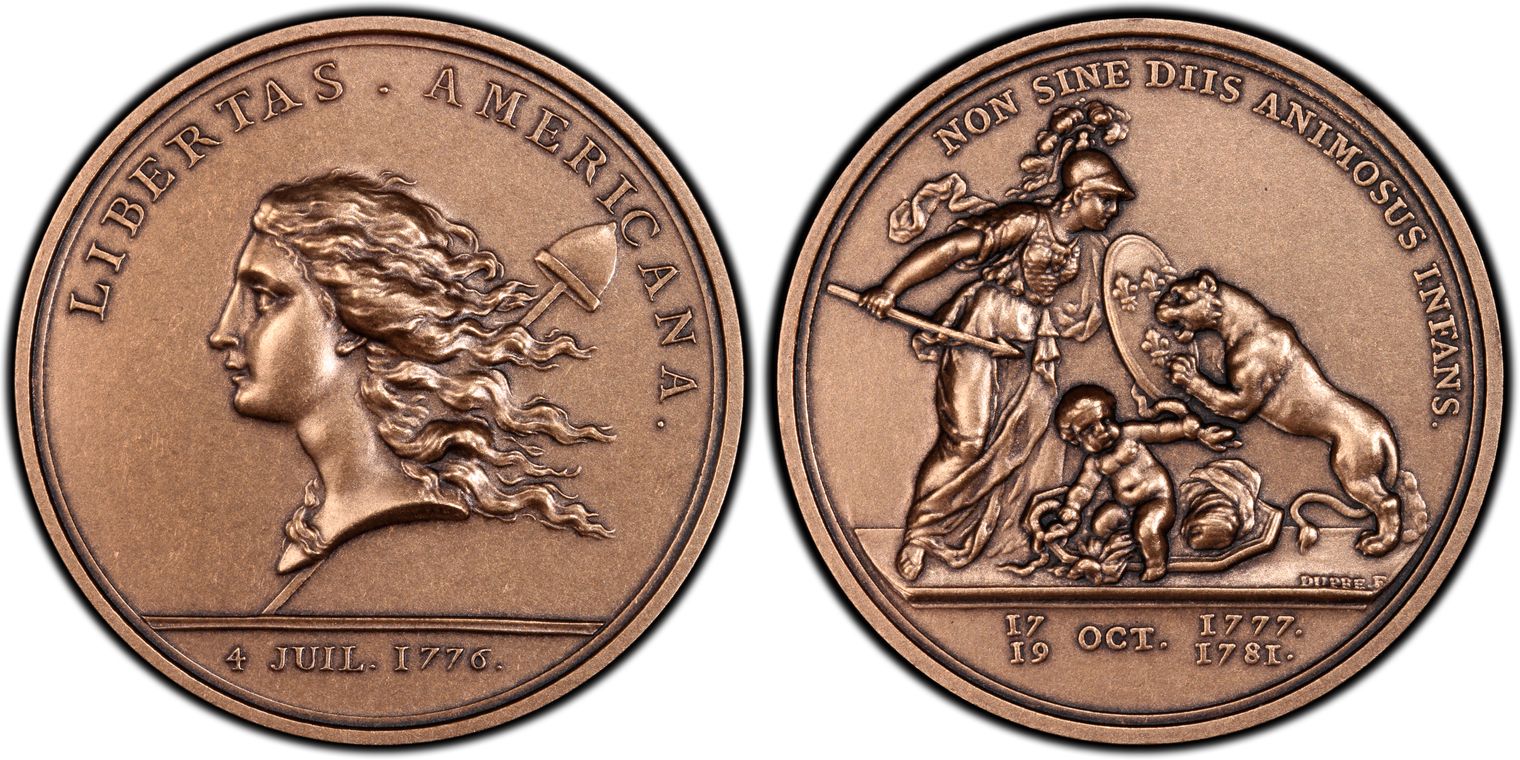
As with the 2005 Silver Libertas Americana restrikes, the 2005 Bronze restrikes feature softened details and finely granular surfaces, these produced at a 47mm size from 57 grams of pure bronze. Like its Silver counterpart in the Collection, the Bronze example seen here is precisely in the condition it left the Paris Mint; yet, it merits only the grade of MS62RB.
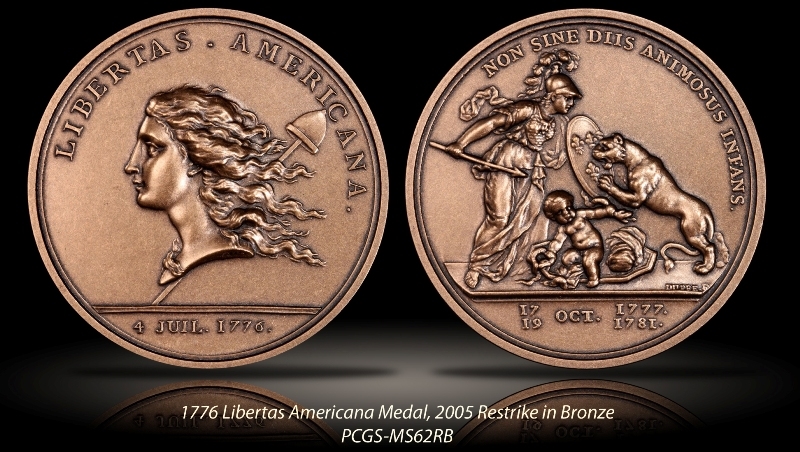
As with the 2005 Silver Libertas Americana restrikes, the 2005 Bronze restrikes feature softened details and finely granular surfaces, these produced at a 47mm size from 57 grams of pure bronze. Like its Silver counterpart in the Collection, the Bronze example seen here is precisely in the condition it left the Paris Mint; yet, it merits only the grade of MS62RB.
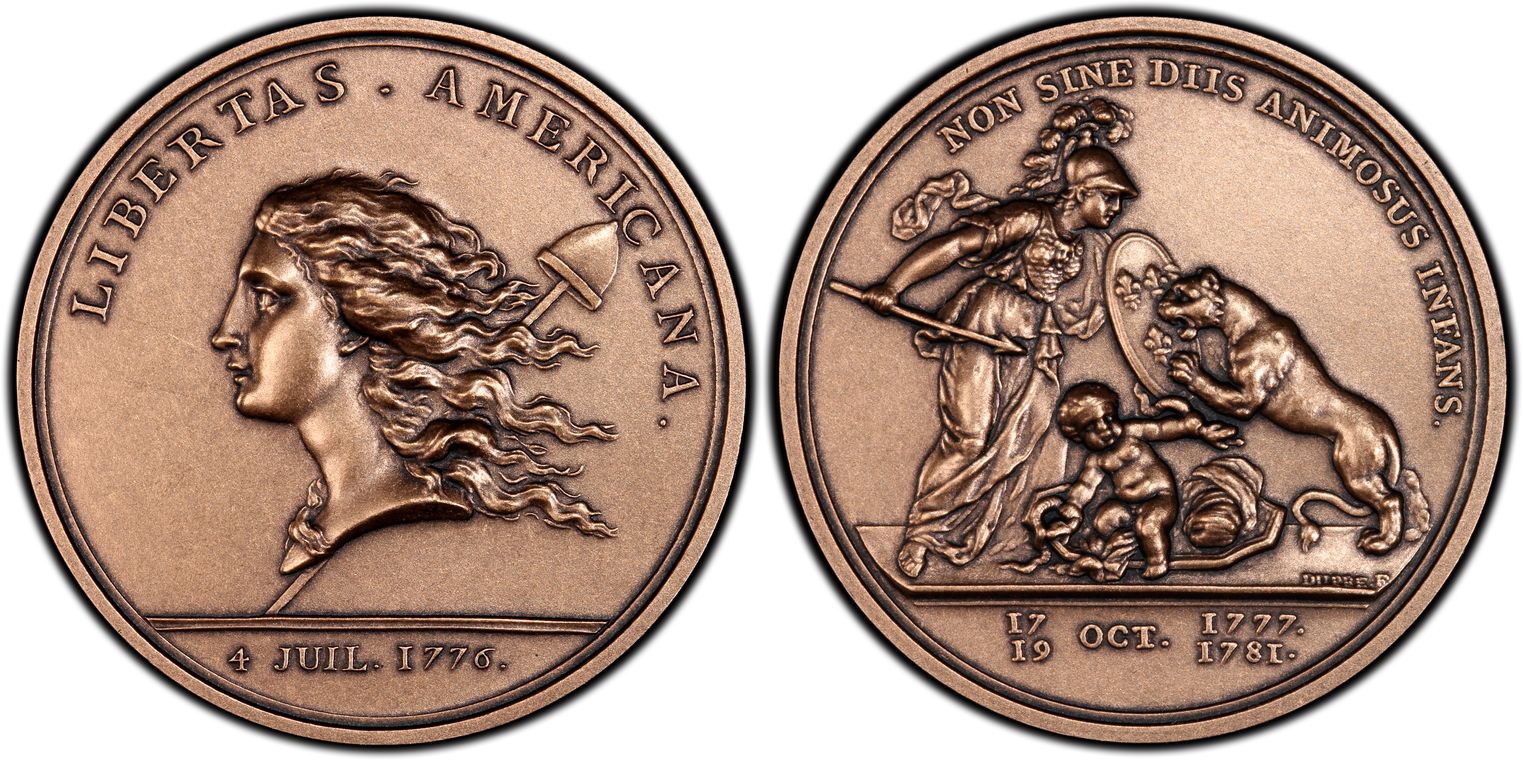
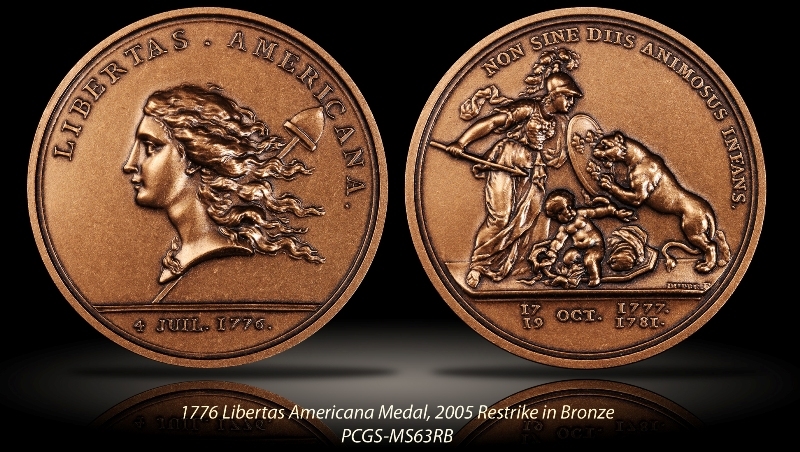
As with the 2005 Silver Libertas Americana restrikes, the 2005 Bronze restrikes feature softened details and finely granular surfaces, these produced at a 47mm size from 57 grams of pure bronze. Like its Silver counterpart in the Collection, the Bronze example seen here is precisely in the condition it left the Paris Mint; yet, it merits only the grade of MS63RB.
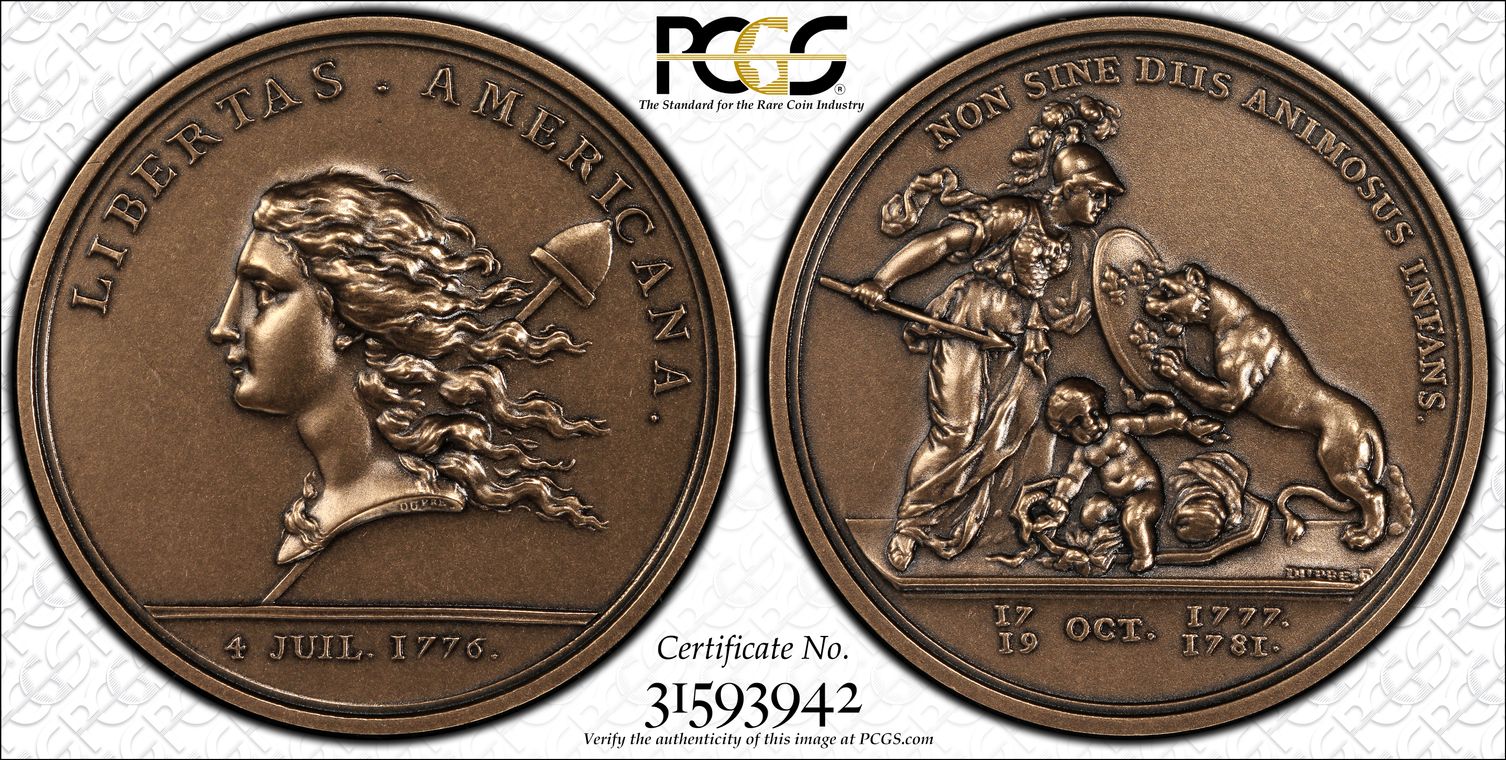
As with the 2005 Silver Libertas Americana restrikes, the 2005 Bronze restrikes feature softened details and finely granular surfaces, these produced at a 47mm size from 57 grams of pure bronze. Like its Silver counterpart in the Collection, the Bronze example seen here is precisely in the condition it left the Paris Mint and the single finest known; yet, it merits only the grade of MS64RB.
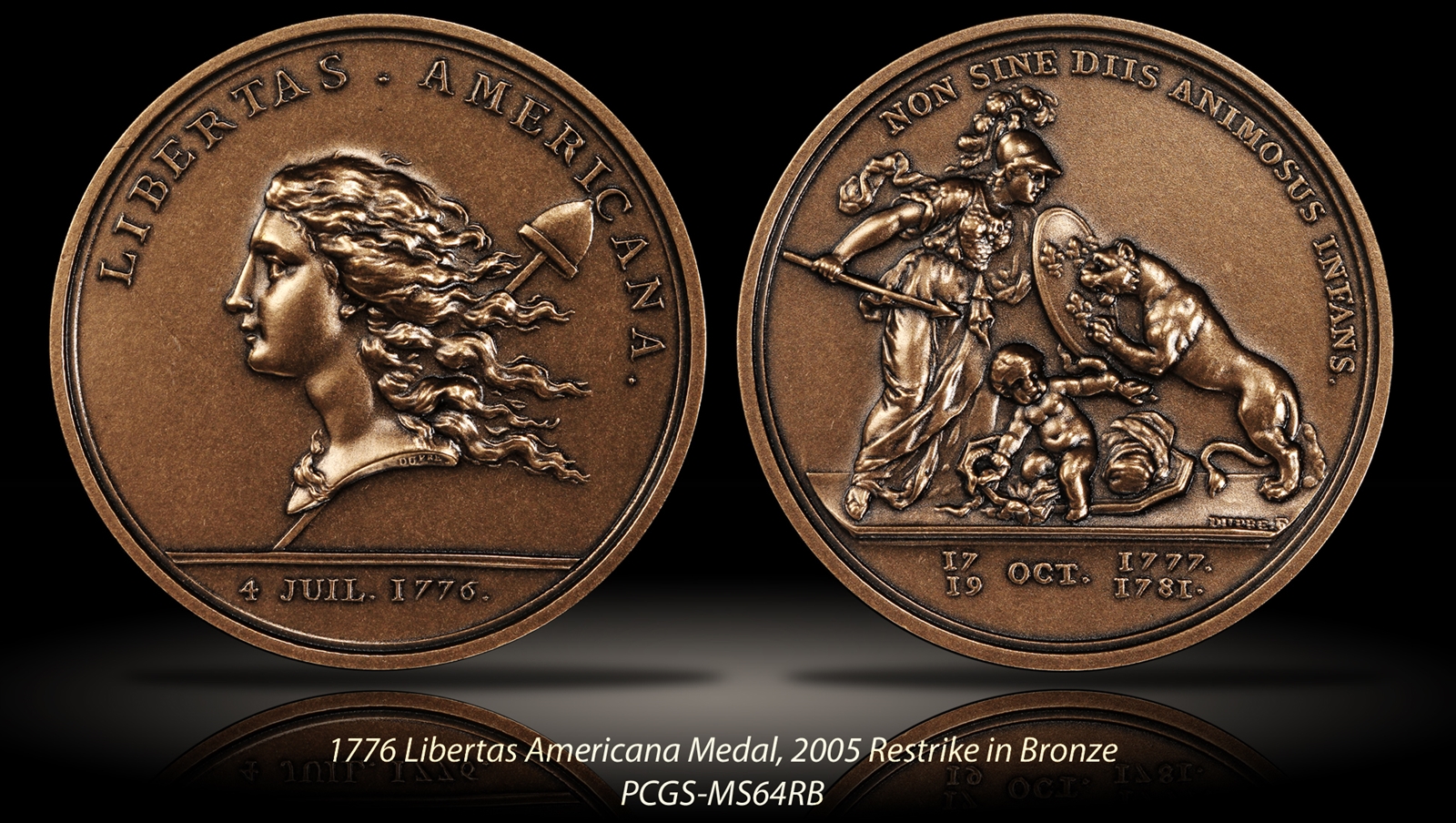
As with the 2005 Silver Libertas Americana restrikes, the 2005 Bronze restrikes feature softened details and finely granular surfaces, these produced at a 47mm size from 57 grams of pure bronze. Like its Silver counterpart in the Collection, the Bronze example seen here is precisely in the condition it left the Paris Mint and the single finest known; yet, it merits only the grade of MS64RB.

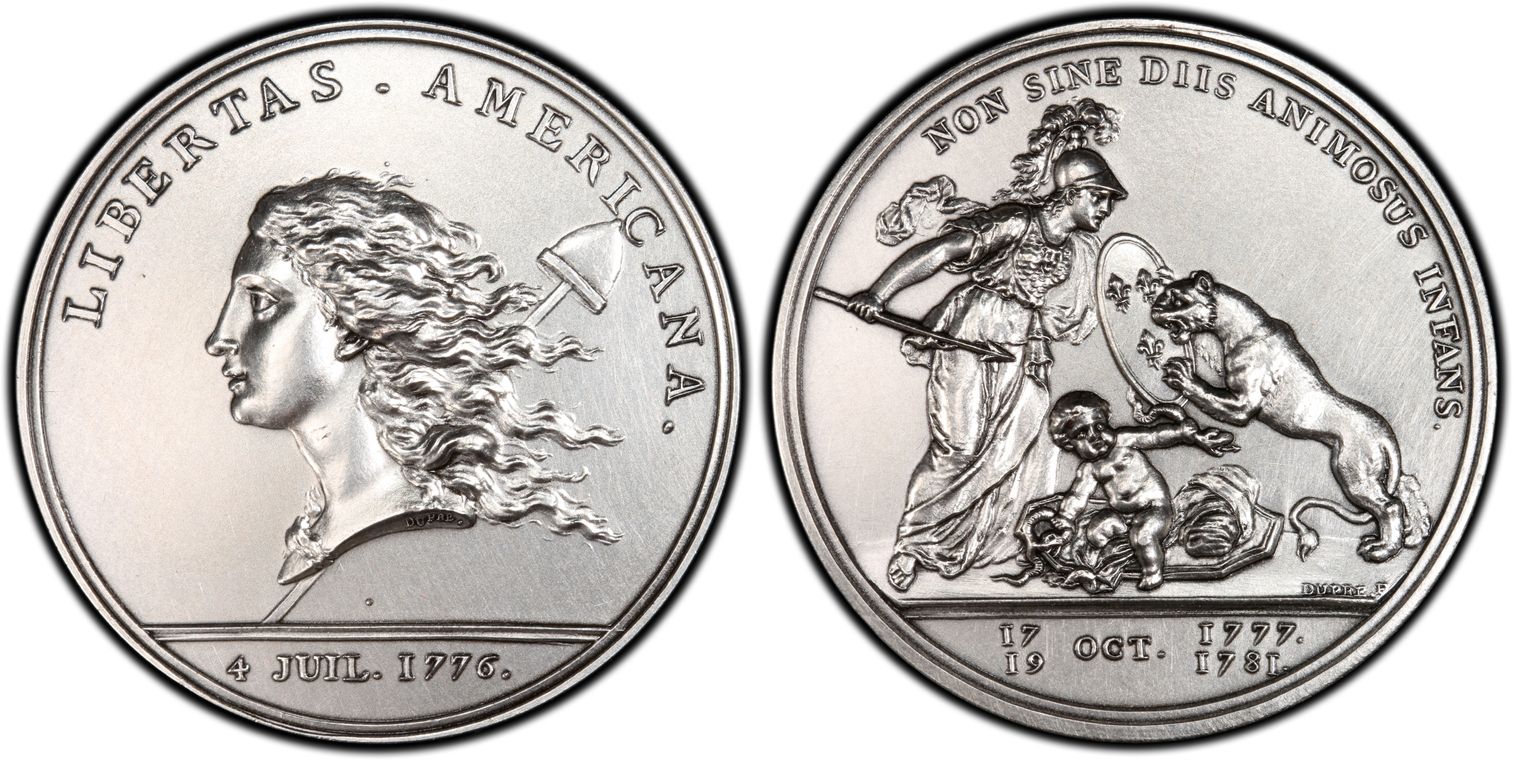
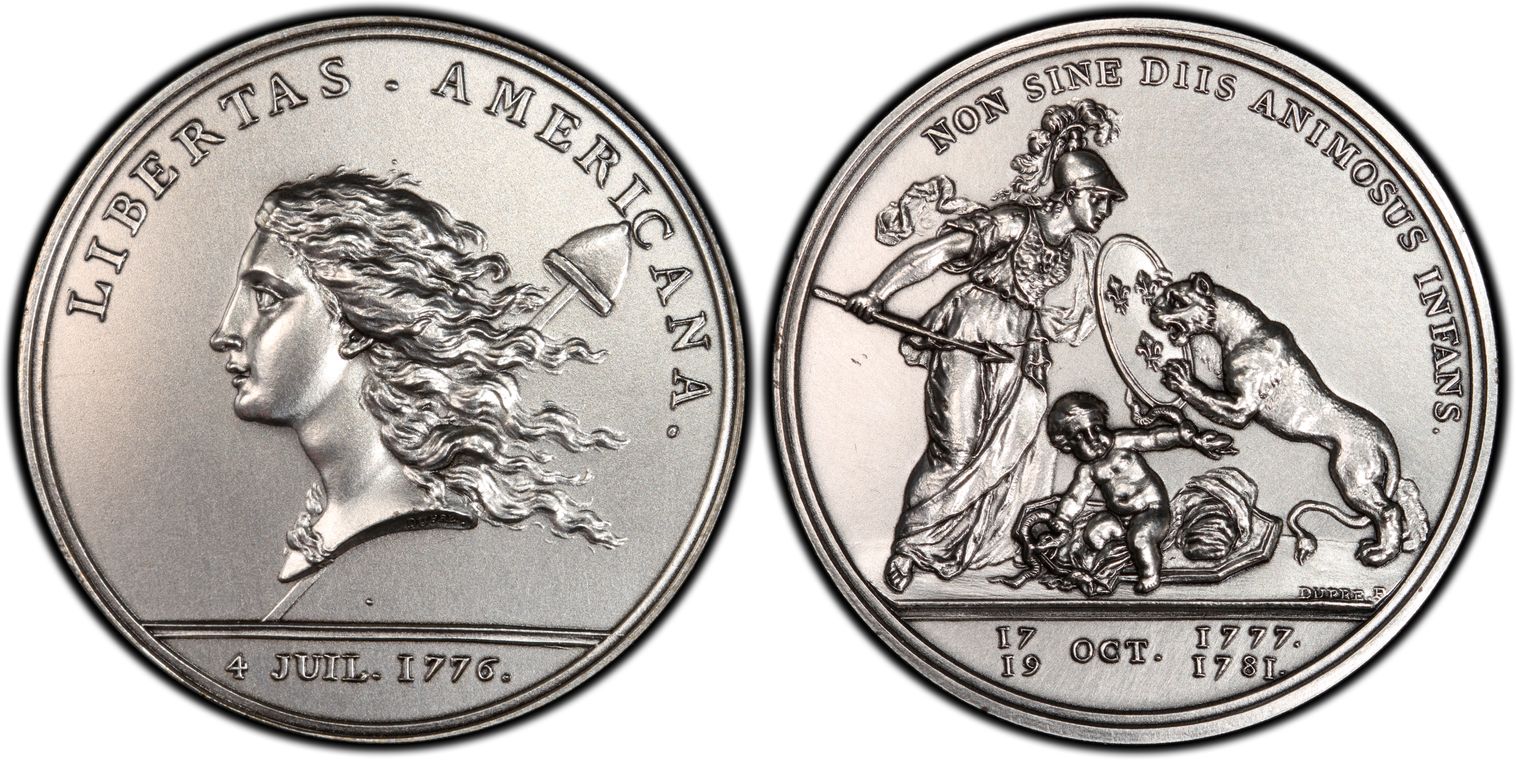
The Silver Restrike seen here was issued for the New Millenium in 2000 in a limited edition of 2500 pieces, each 45.86mm in diameter and containing 42.80 grams of .950 silver. For this issue, the Paris Mint used the same dies that had been used to produce the earlier Bronze restrikes sold to Mint visitors.
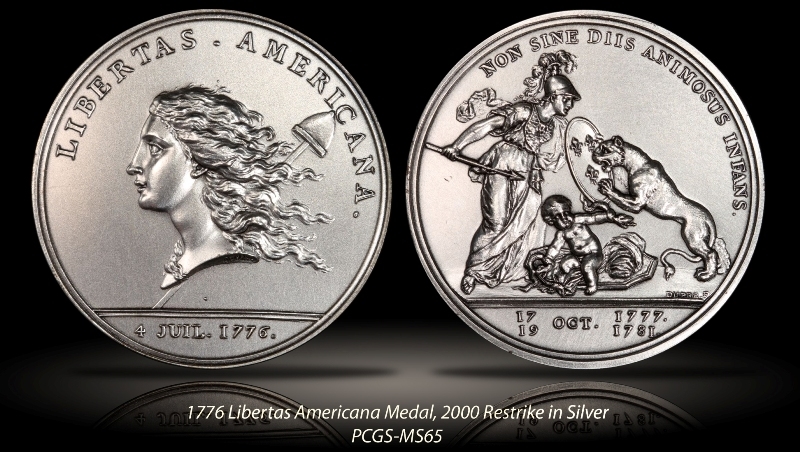
The Silver Restrike seen here was issued for the New Millenium in 2000 in a limited edition of 2500 pieces, each 45.86mm in diameter and containing 42.80 grams of .950 silver. For this issue, the Paris Mint used the same dies that had been used to produce the earlier Bronze restrikes sold to Mint visitors.
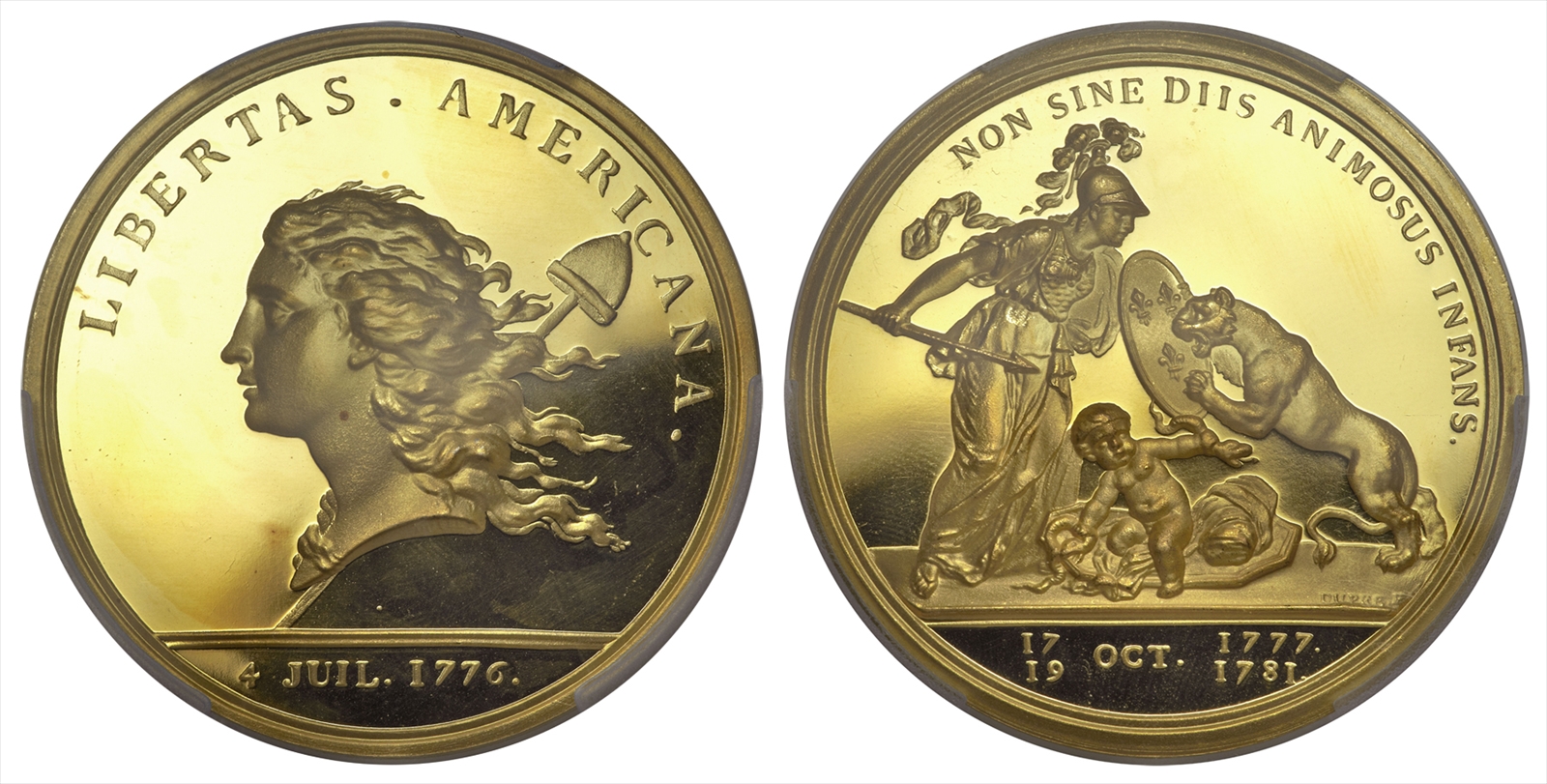
This is the #207 from the mintage.
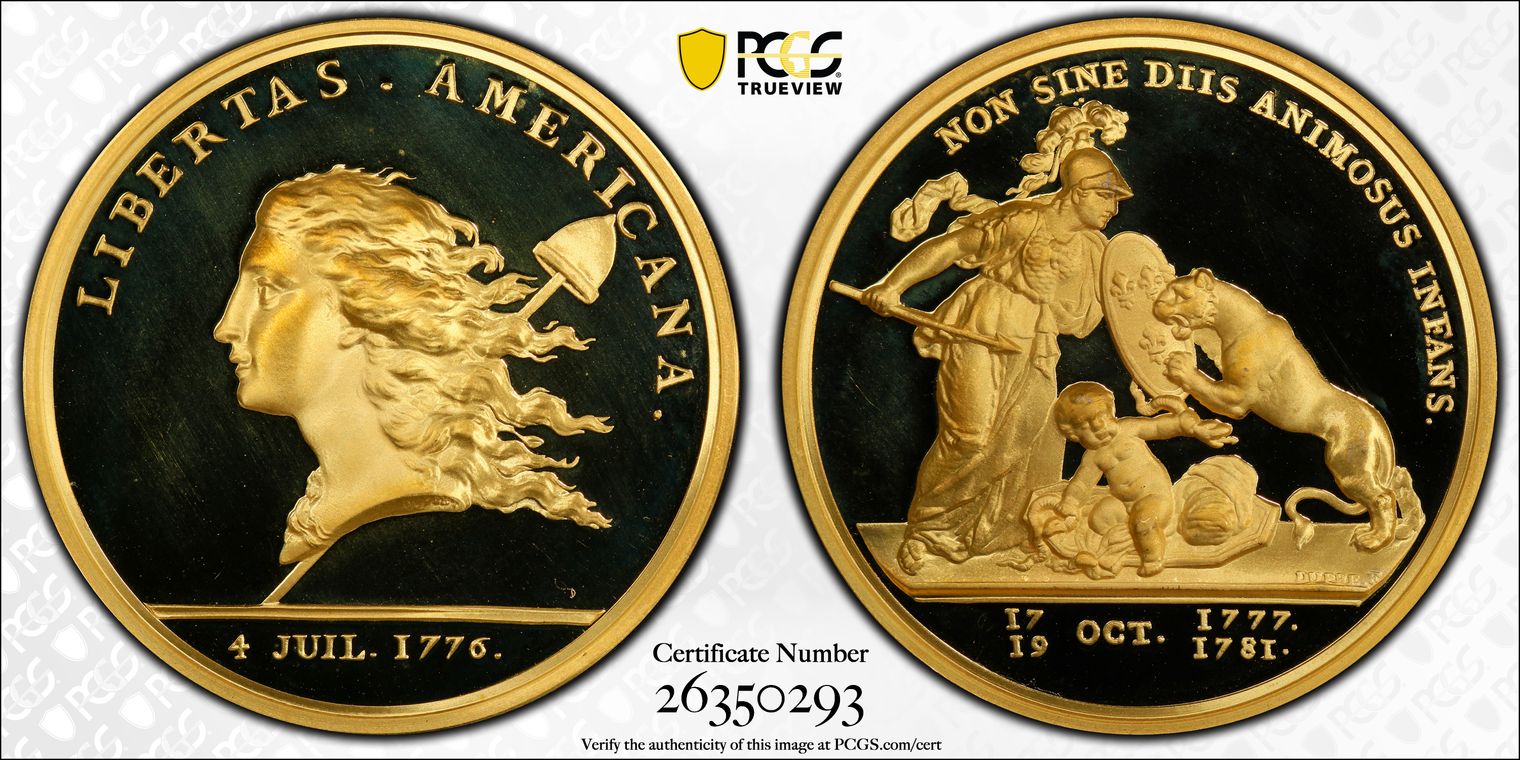
This is the #113 from the mintage.
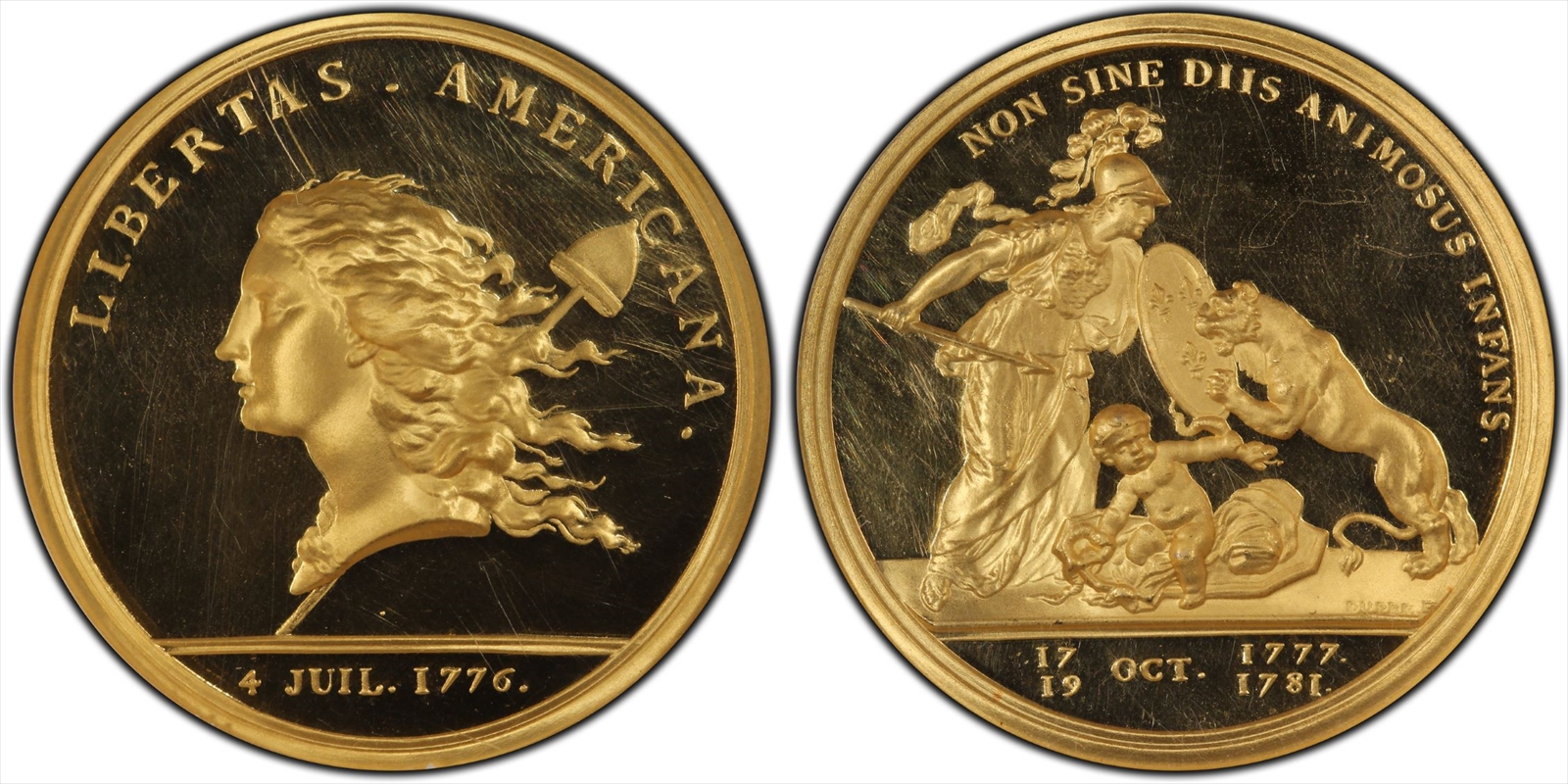
This is the #485 from the mintage.
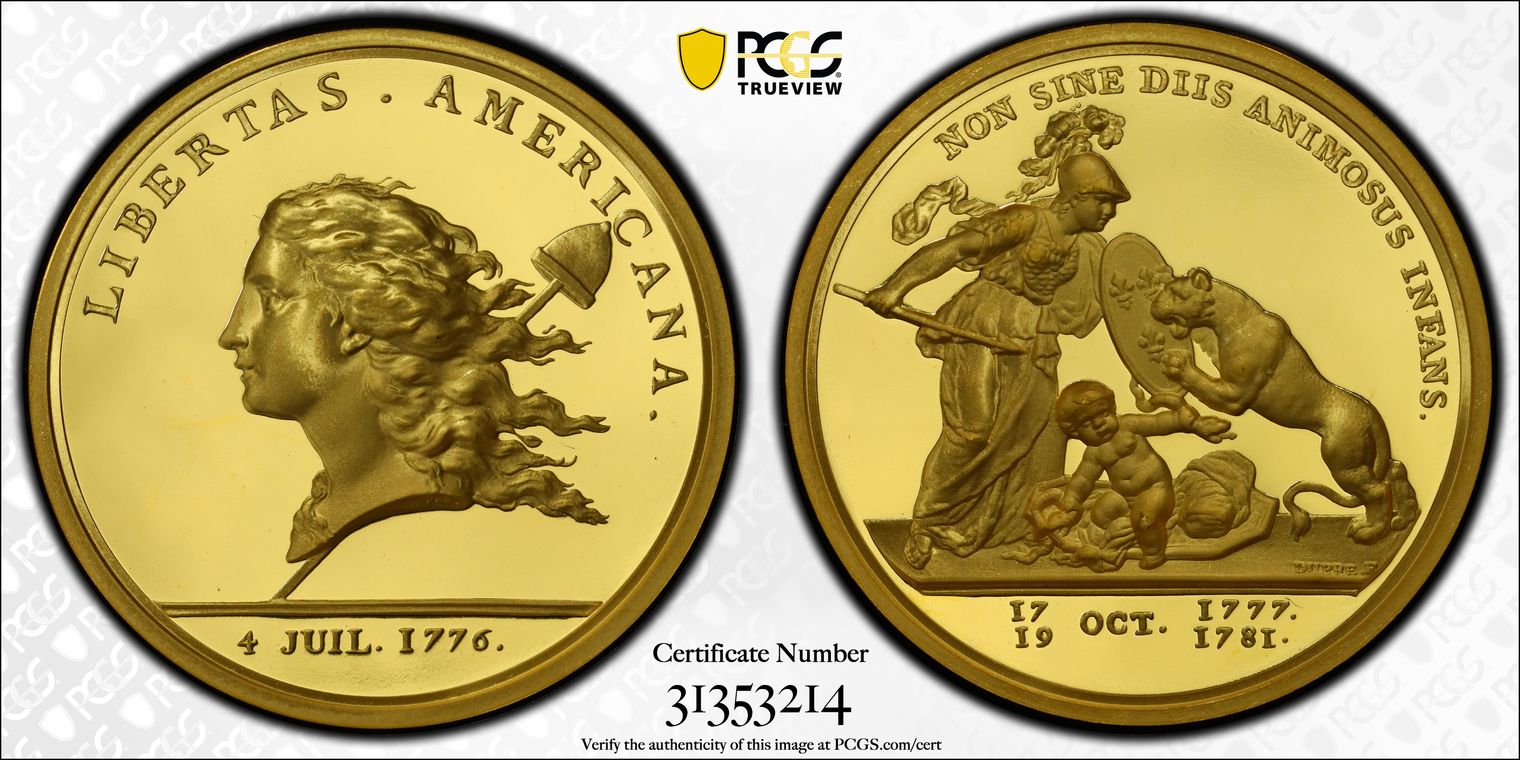
This is the #143 from the mintage.
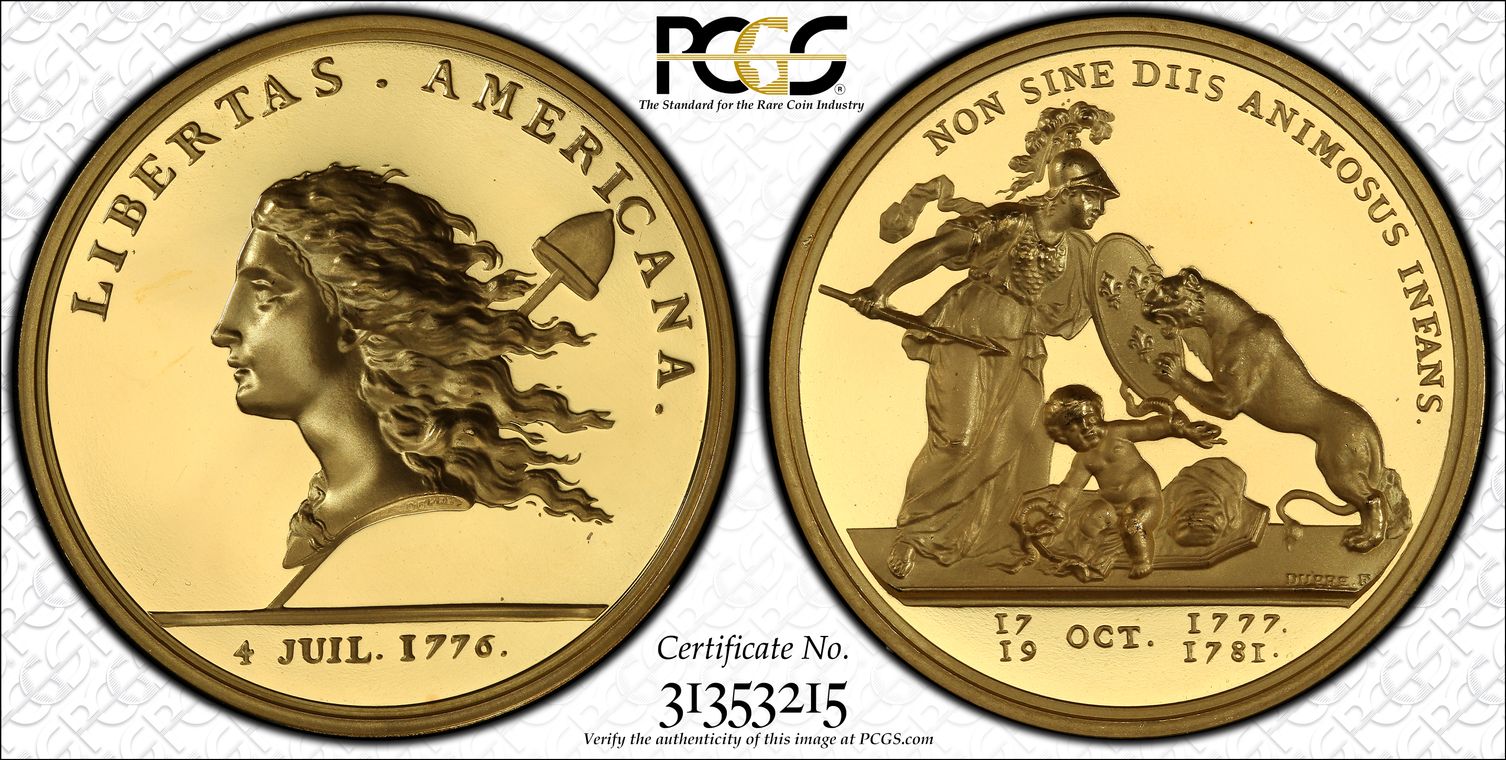
This is the #321 of from the mintage.
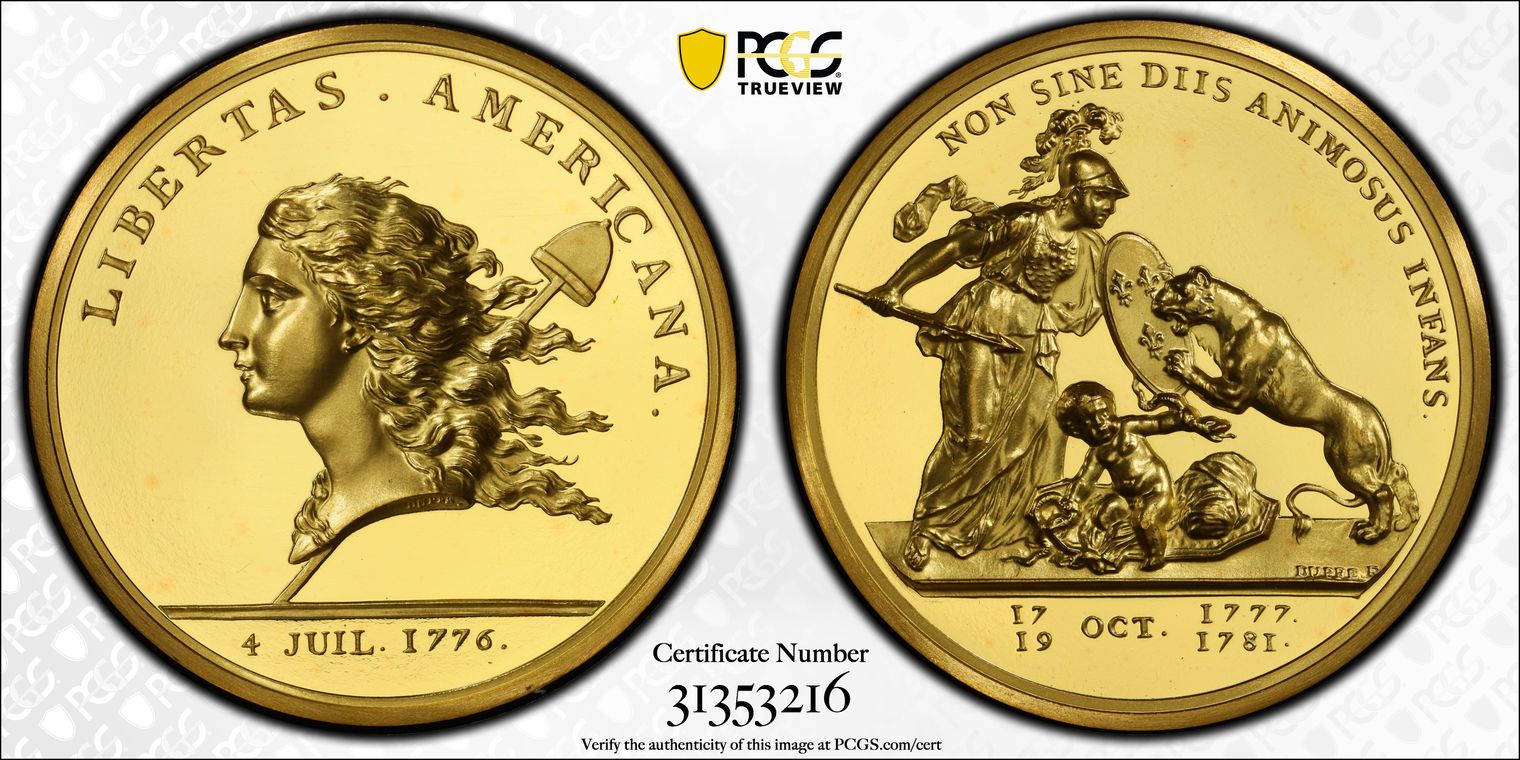
This is the #384 from the mintage.
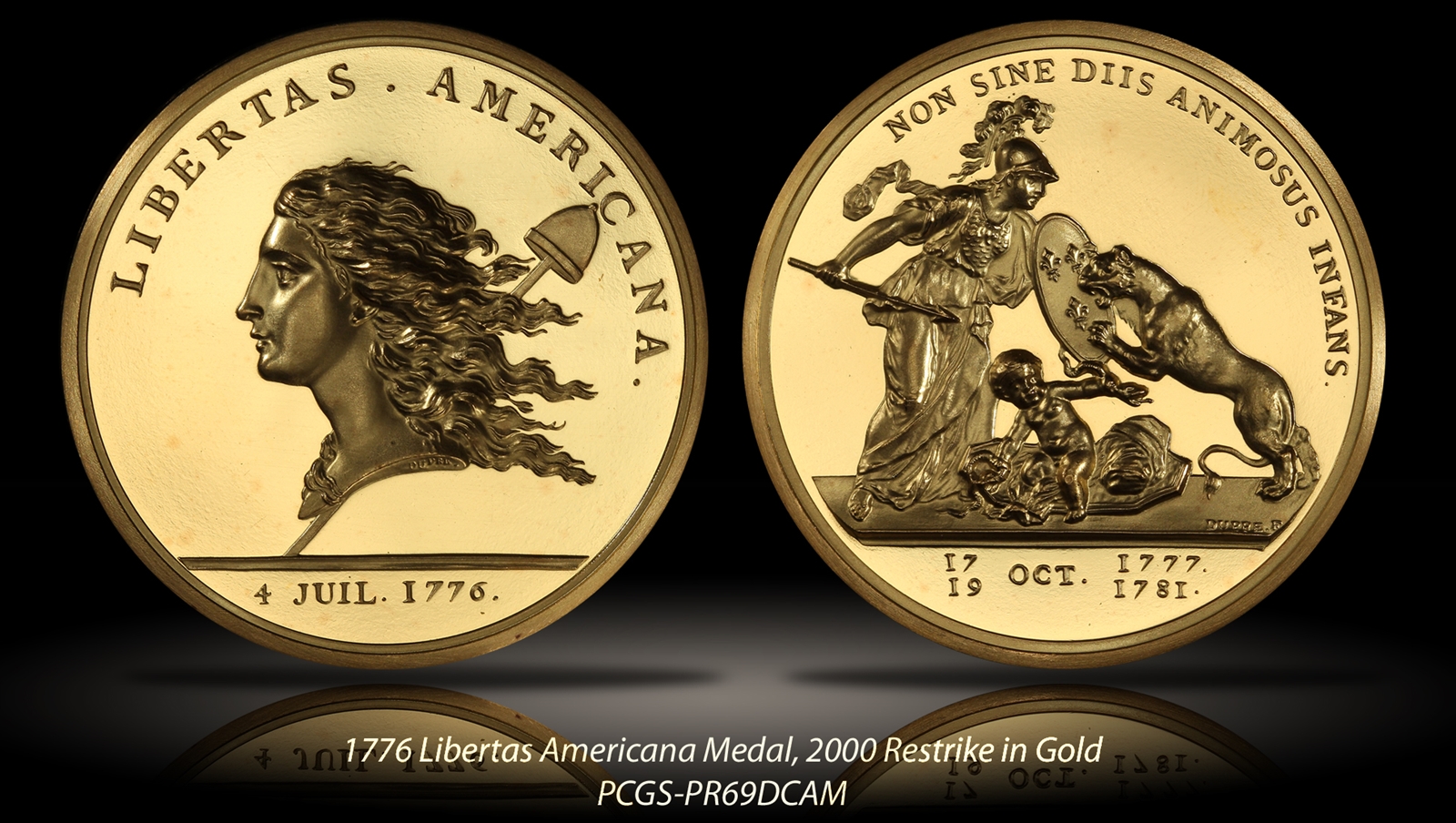
This is the #384 from the mintage.
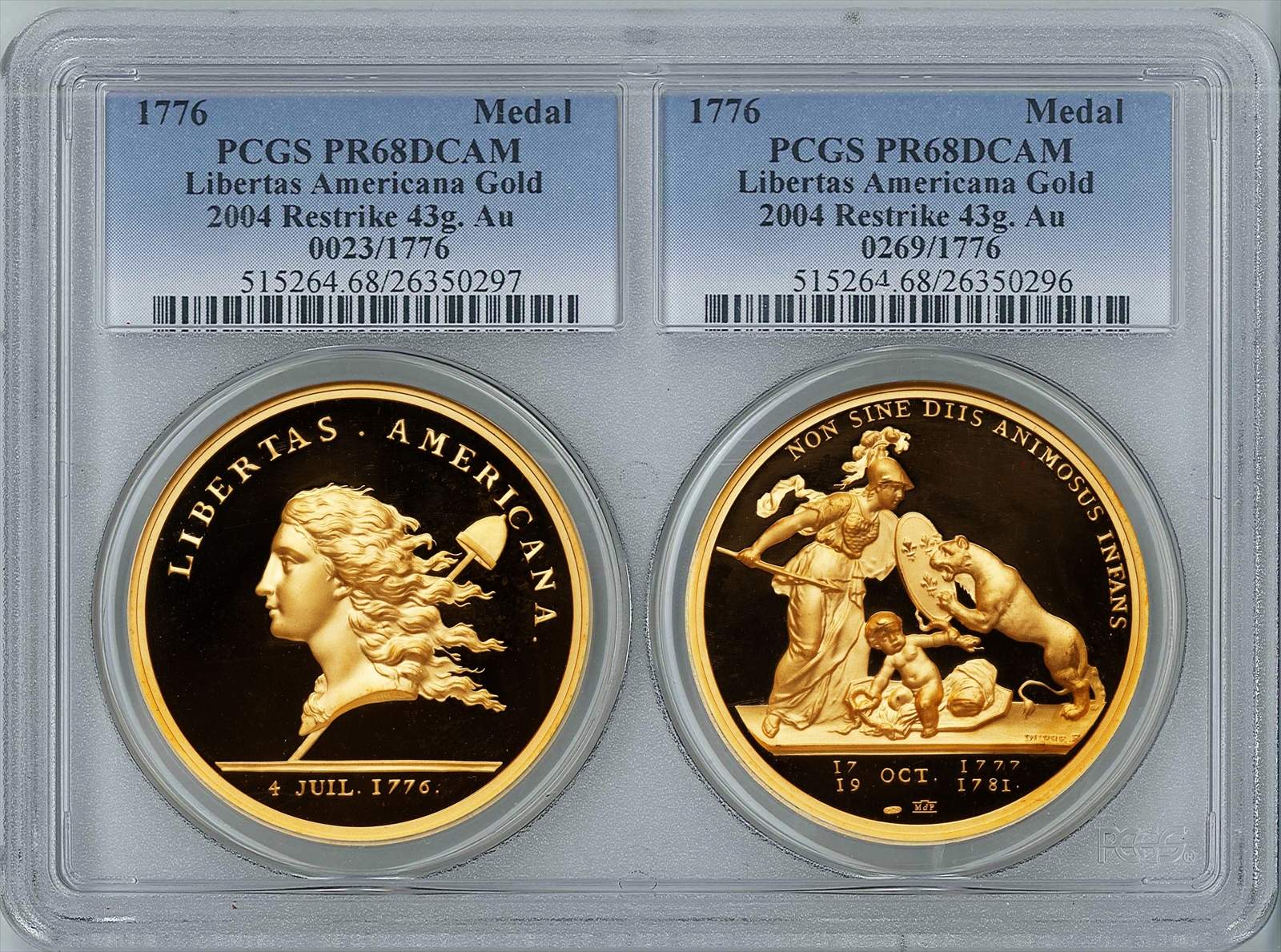
The Gold Libertas Americana Medal restrikes issued in 2004 came from the same 40mm dies as the 2004 Silver restrikes, and were executed in Deep Cameo format as well. Containing 43 grams of .999 gold, the 2004 Gold restrikes are a bit smaller than those produced during 2000. These can be easily distinguished from their 2000 counterparts by the presence of the Paris Mint's markings near the lower rim of the reverse, something not seen on the 2000 restrikes. Like the DCAM silver restrikes, the 40mm size of these gold restrikes make them suitable for display in dual-coin holders, with both obverse and reverse presented side-by-side. Just 1776 gold restrikes were produced from these dies.
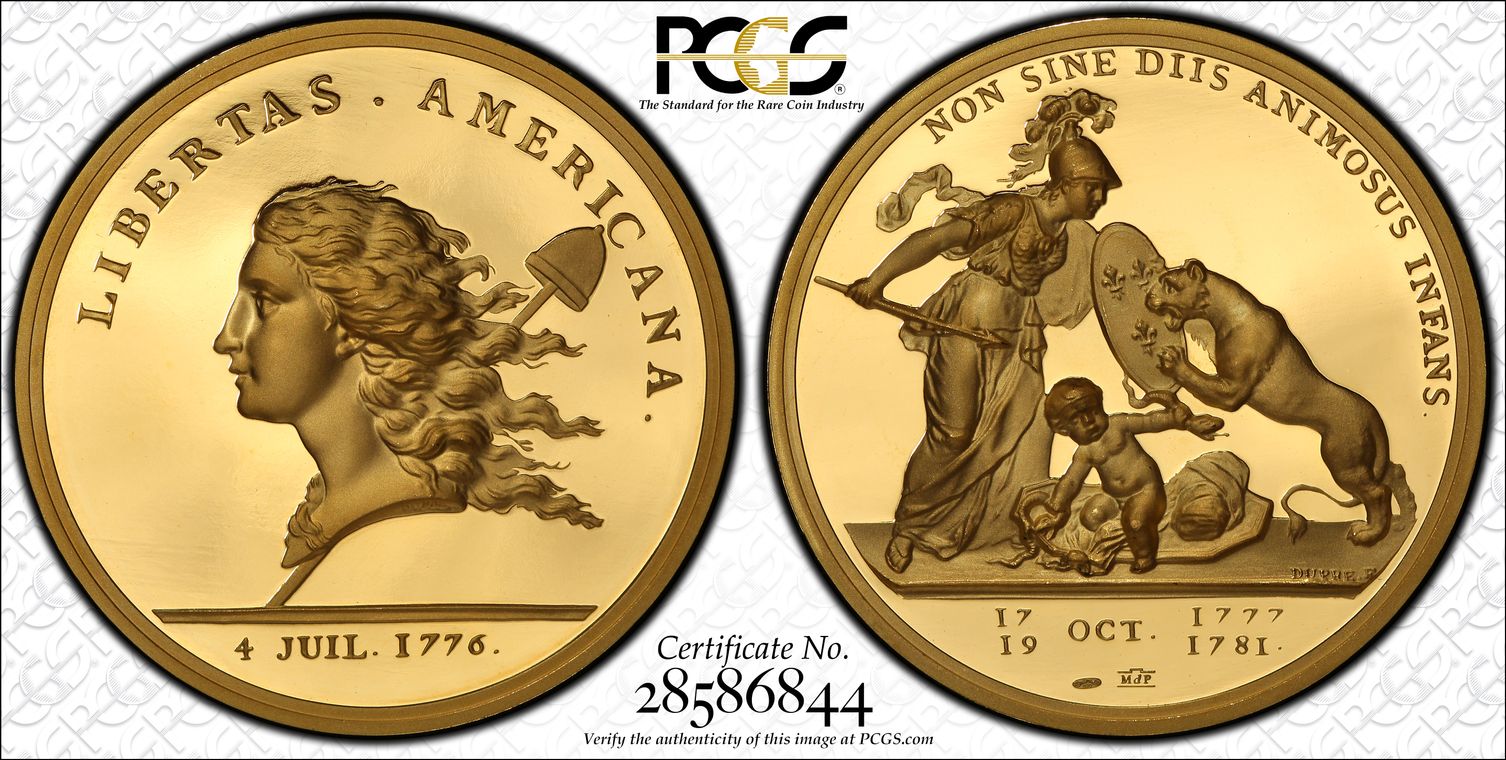
The Gold Libertas Americana Medal restrikes issued in 2004 came from the same 40mm dies as the 2004 Silver restrikes, and were executed in Deep Cameo format as well. Containing 43 grams of .999 gold, the 2004 Gold restrikes are a bit smaller than those produced during 2000. These can be easily distinguished from their 2000 counterparts by the presence of the Paris Mint's markings near the lower rim of the reverse, something not seen on the 2000 restrikes. Like the DCAM silver restrikes, the 40mm size of these gold restrikes make them suitable for display in dual-coin holders, with both obverse and reverse presented side-by-side. Just 1776 gold restrikes were produced from these dies.
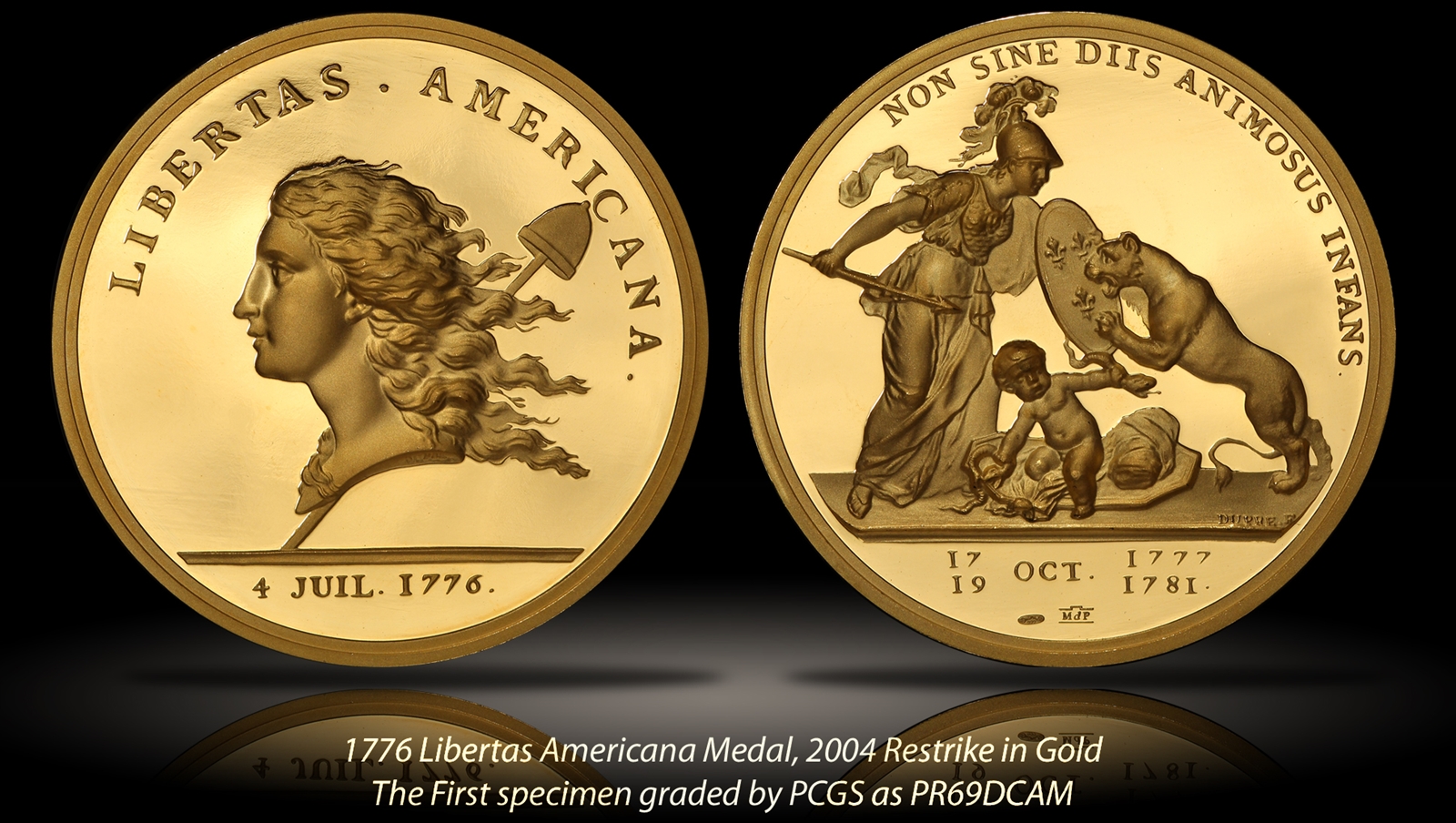
The Gold Libertas Americana Medal restrikes issued in 2004 came from the same 40mm dies as the 2004 Silver restrikes, and were executed in Deep Cameo format as well. Containing 43 grams of .999 gold, the 2004 Gold restrikes are a bit smaller than those produced during 2000. These can be easily distinguished from their 2000 counterparts by the presence of the Paris Mint's markings near the lower rim of the reverse, something not seen on the 2000 restrikes. Like the DCAM silver restrikes, the 40mm size of these gold restrikes make them suitable for display in dual-coin holders, with both obverse and reverse presented side-by-side. Just 1776 gold restrikes were produced from these dies.
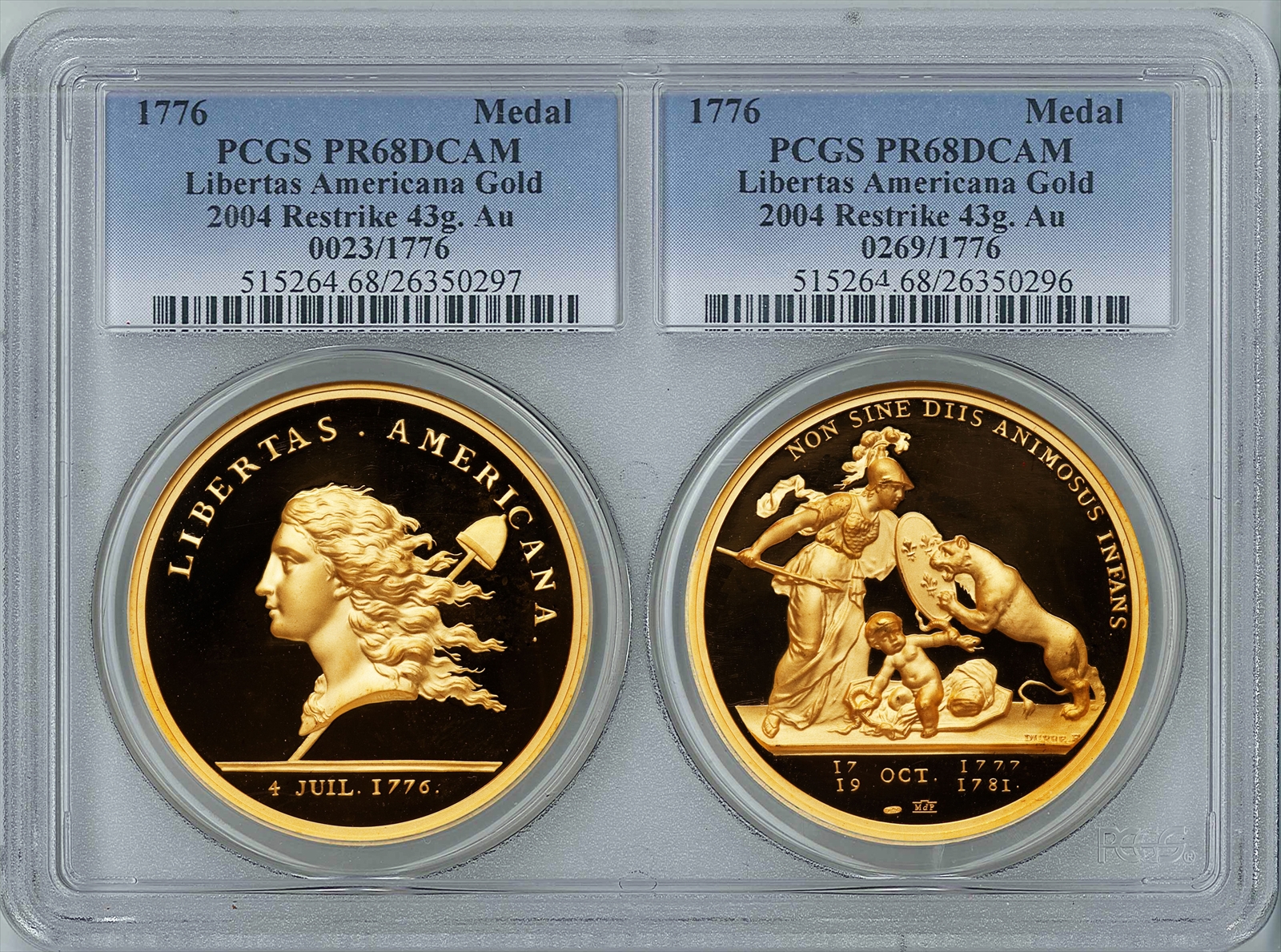
The Gold Libertas Americana Medal restrikes issued in 2004 came from the same 40mm dies as the 2004 Silver restrikes, and were executed in Deep Cameo format as well. Containing 43 grams of .999 gold, the 2004 Gold restrikes are a bit smaller than those produced during 2000. These can be easily distinguished from their 2000 counterparts by the presence of the Paris Mint's markings near the lower rim of the reverse, something not seen on the 2000 restrikes. Like the DCAM silver restrikes, the 40mm size of these gold restrikes make them suitable for display in dual-coin holders, with both obverse and reverse presented side-by-side. Just 1776 gold restrikes were produced from these dies.
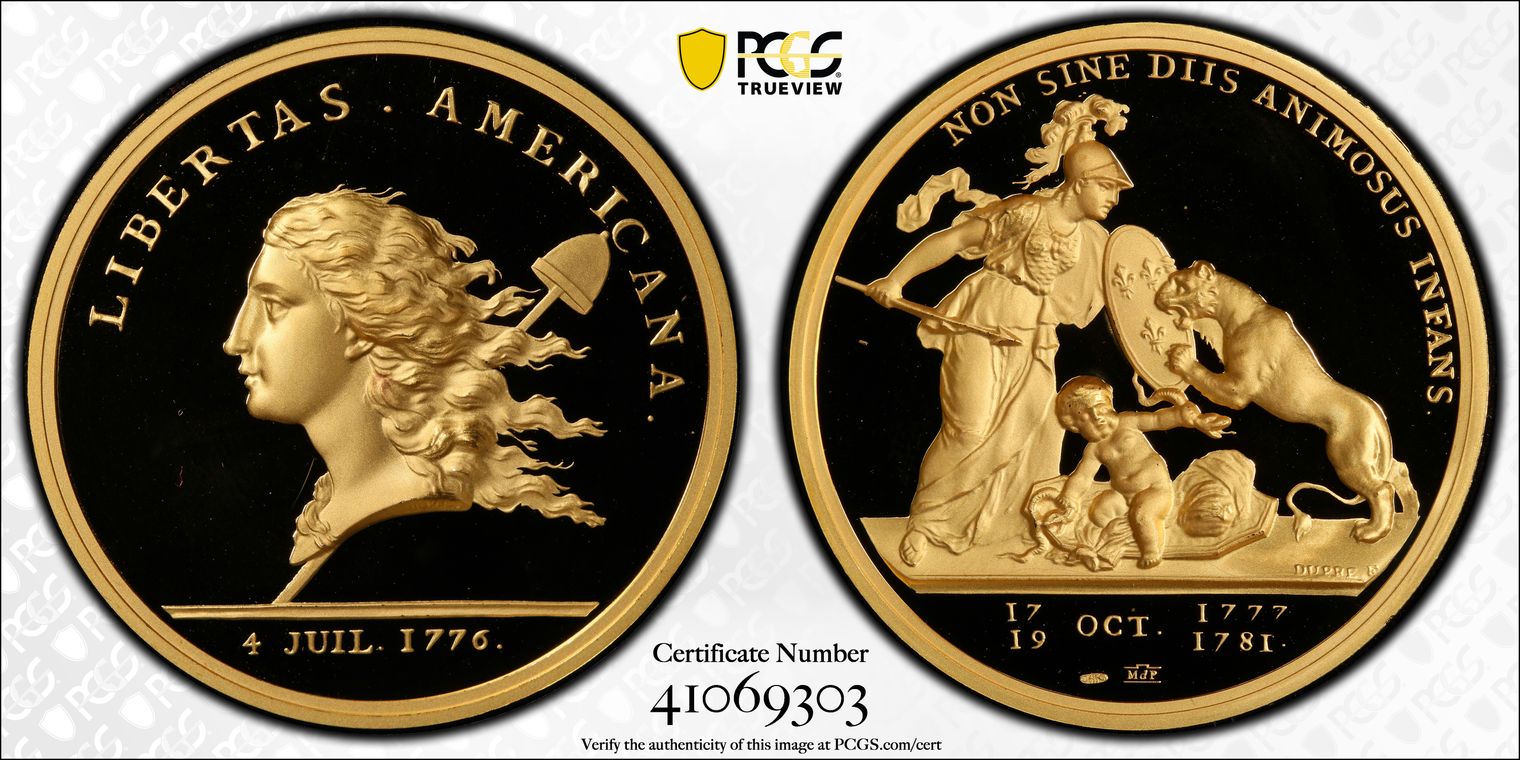
The Gold Libertas Americana Medal restrikes issued in 2004 came from the same 40mm dies as the 2004 Silver restrikes, and were executed in Deep Cameo format as well. Containing 43 grams of .999 gold, the 2004 Gold restrikes are a bit smaller than those produced during 2000. These can be easily distinguished from their 2000 counterparts by the presence of the Paris Mint's markings near the lower rim of the reverse, something not seen on the 2000 restrikes. Like the DCAM silver restrikes, the 40mm size was used for these gold restrikes. Just 1776 gold restrikes were produced from these dies. This is the single finest specimen, graded as PR70DCAM.
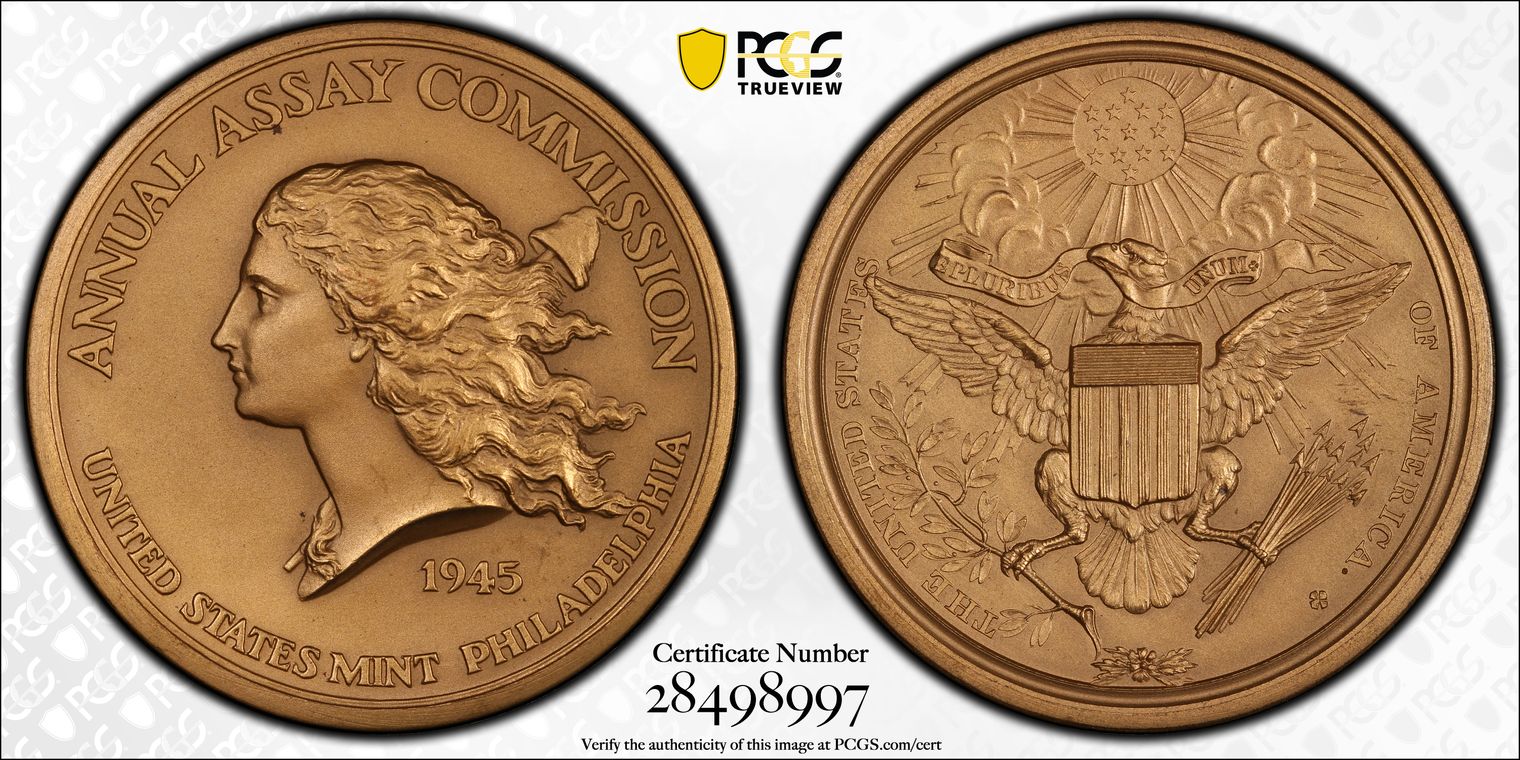
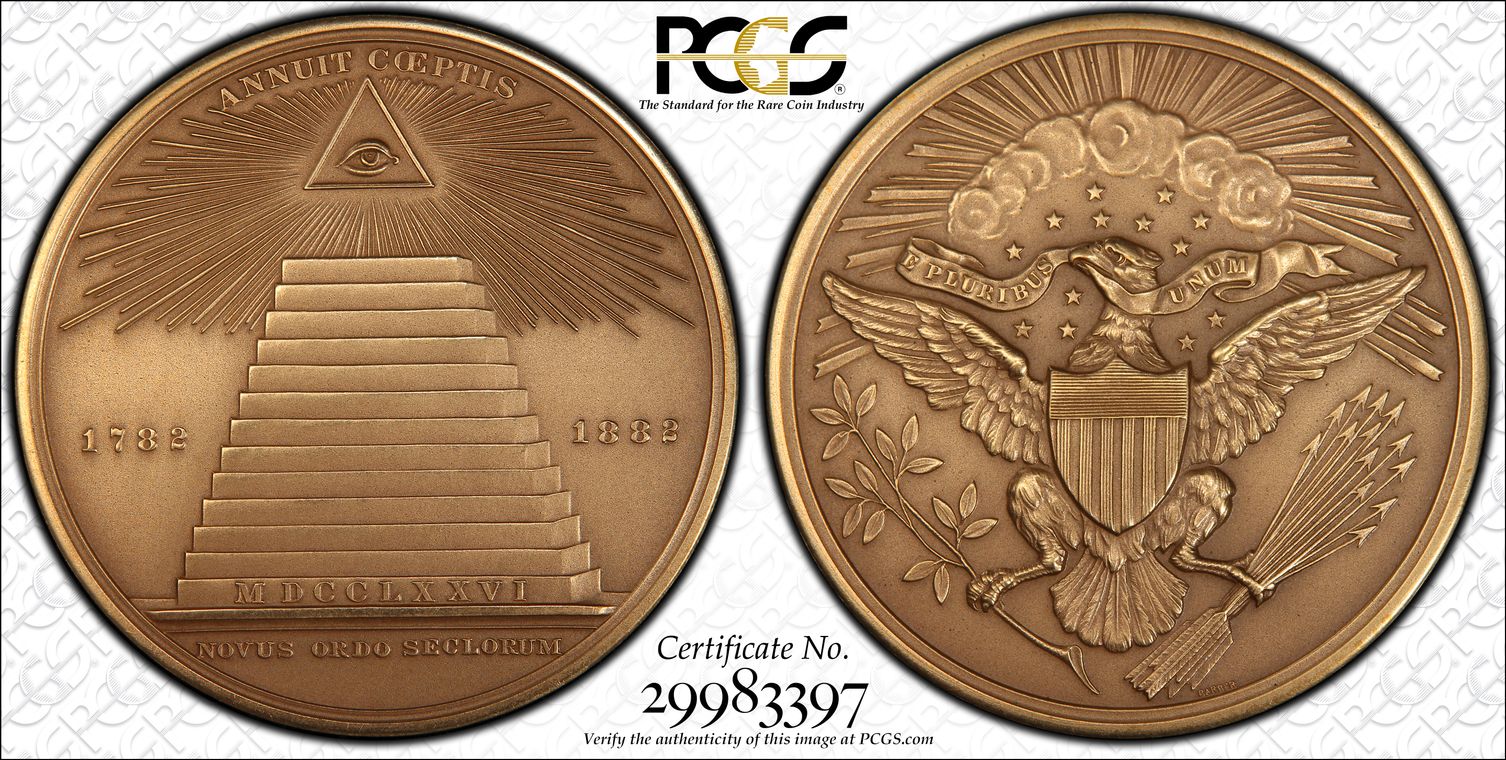
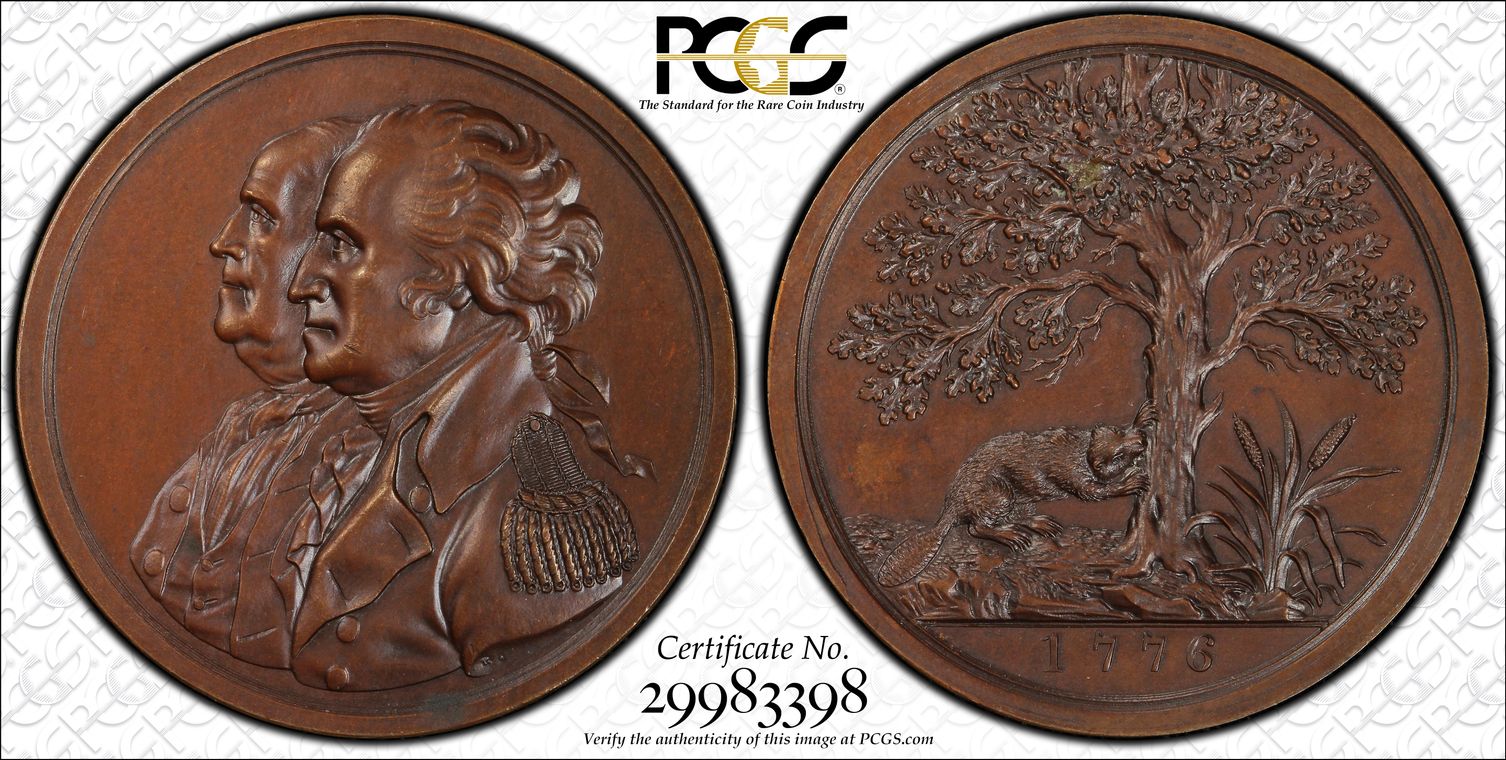
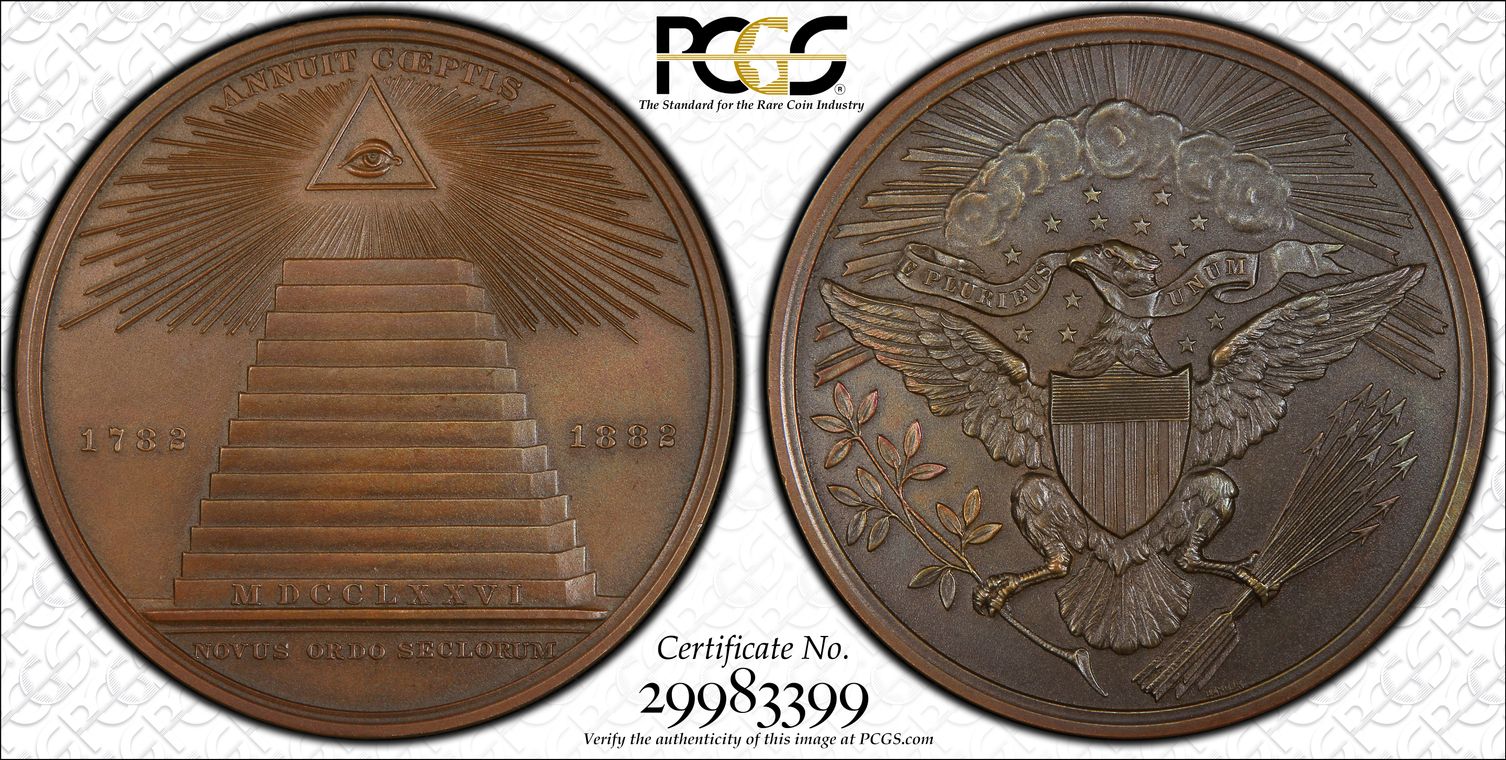
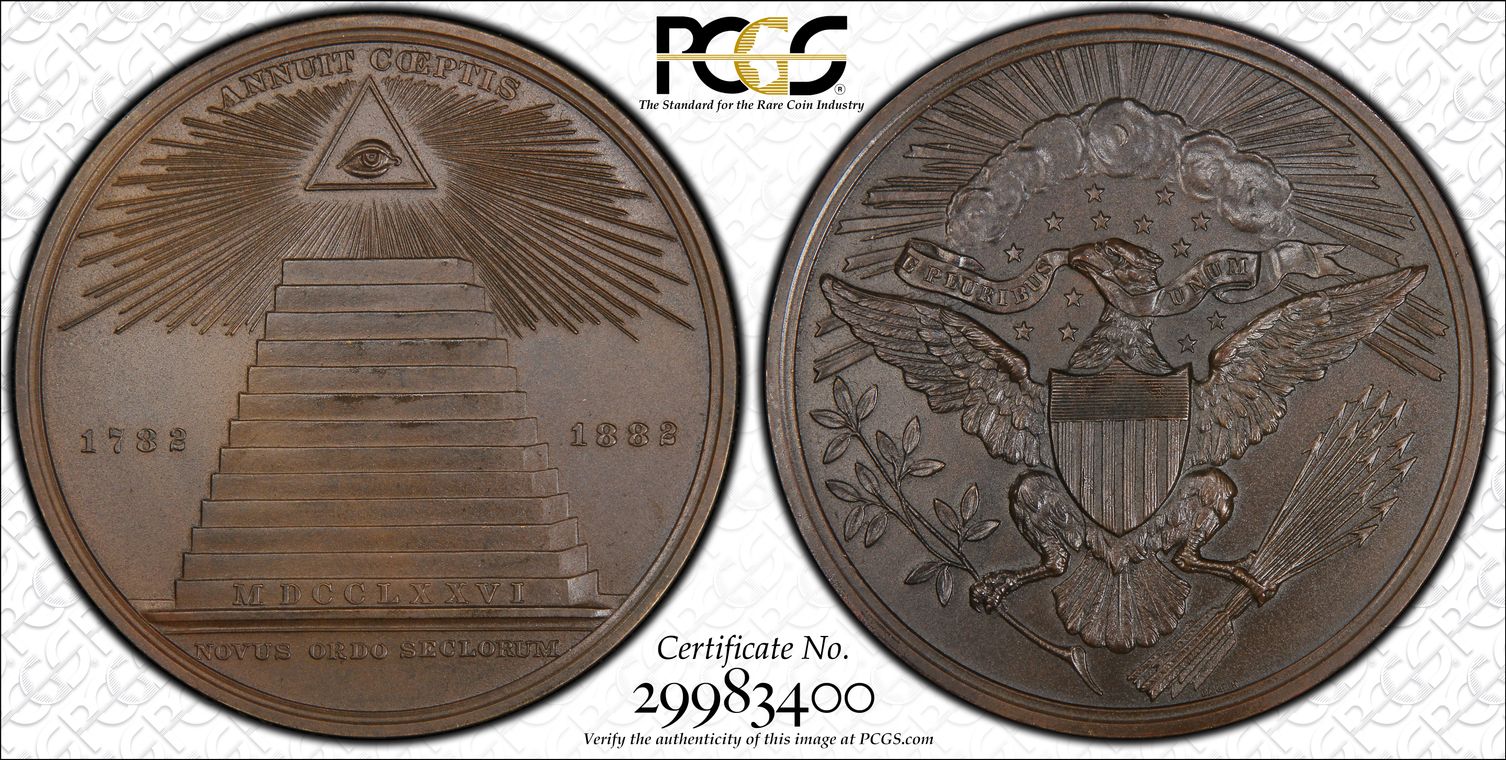
With the Libertas Americana medal serving to commemorate the American victory in the Revolutionary War and the peace that followed, the U.S. Mint revisited that theme for the American victory in World War II in 1945 for its Annual Assay Commission medal. Here the Mint chose to make the medal a truly American commemoration, by replacing the reverse design with the Great Seal of the United States, as seen on Washington's Diplomatic Medal.

With the Libertas Americana medal serving to commemorate the American victory in the Revolutionary War and the peace that followed, the U.S. Mint revisited that theme for the American victory in World War II in 1945 for its Annual Assay Commission medal. Here the Mint chose to make the medal a truly American commemoration, by replacing the reverse design with the Great Seal of the United States, as seen on Washington's Diplomatic Medal.
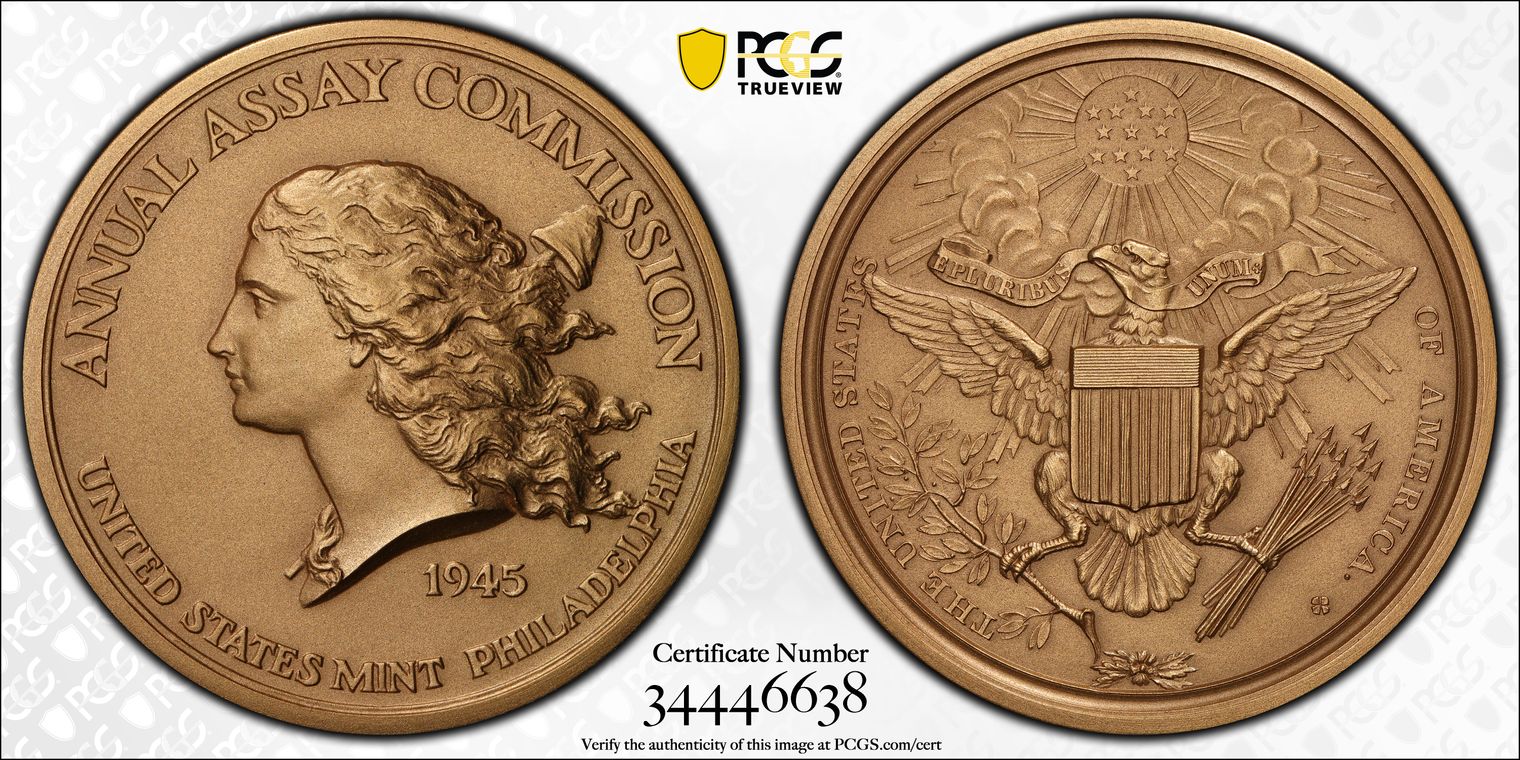
With the Libertas Americana medal serving to commemorate the American victory in the Revolutionary War and the peace that followed, the U.S. Mint revisited that theme for the American victory in World War II in 1945 for its Annual Assay Commission medal. Here the Mint chose to make the medal a truly American commemoration, by replacing the reverse design with the Great Seal of the United States, as seen on Washington's Diplomatic Medal.
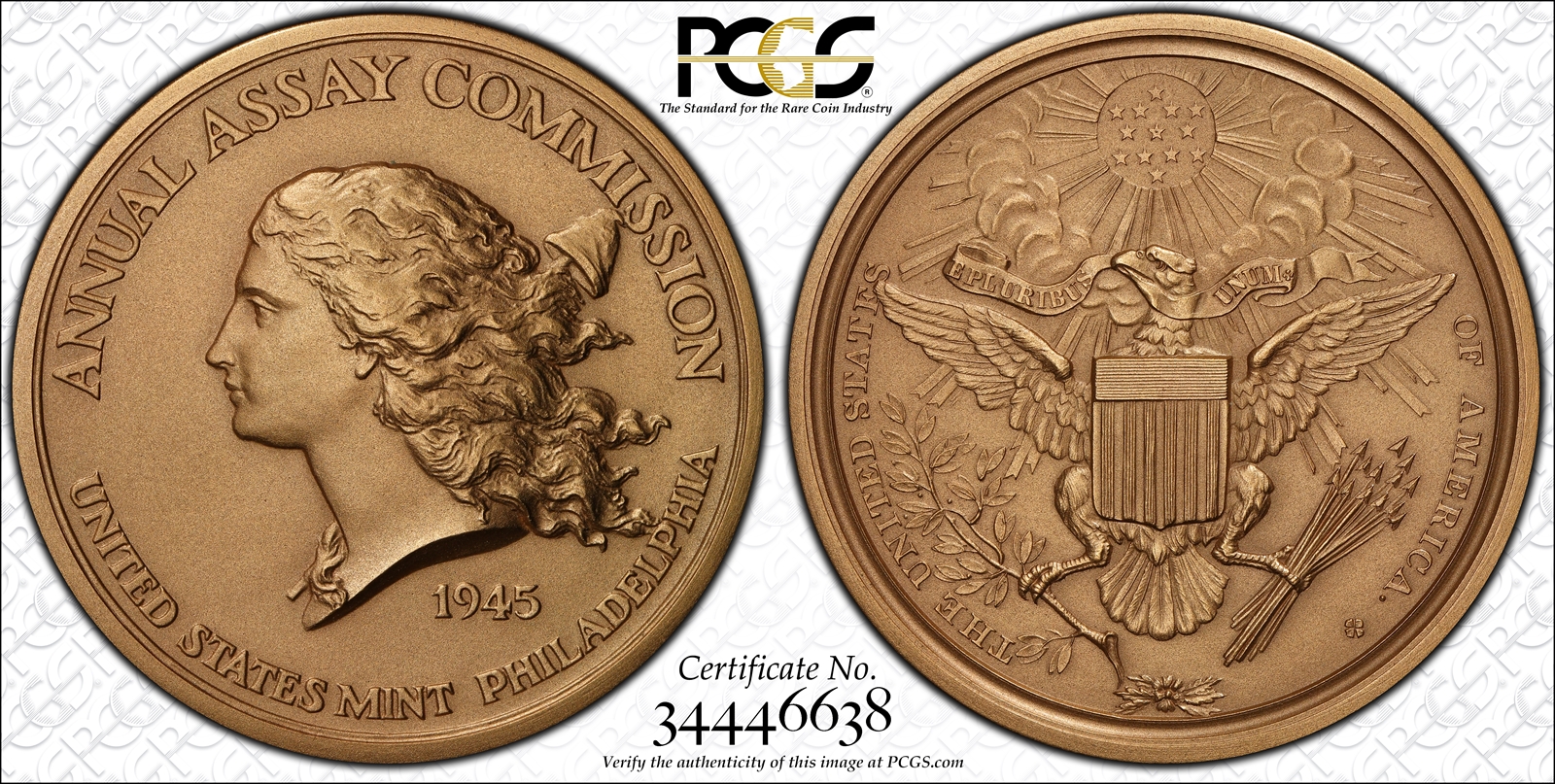
With the Libertas Americana medal serving to commemorate the American victory in the Revolutionary War and the peace that followed, the U.S. Mint revisited that theme for the American victory in World War II in 1945 for its Annual Assay Commission medal. Here the Mint chose to make the medal a truly American commemoration, by replacing the reverse design with the Great Seal of the United States, as seen on Washington's Diplomatic Medal.
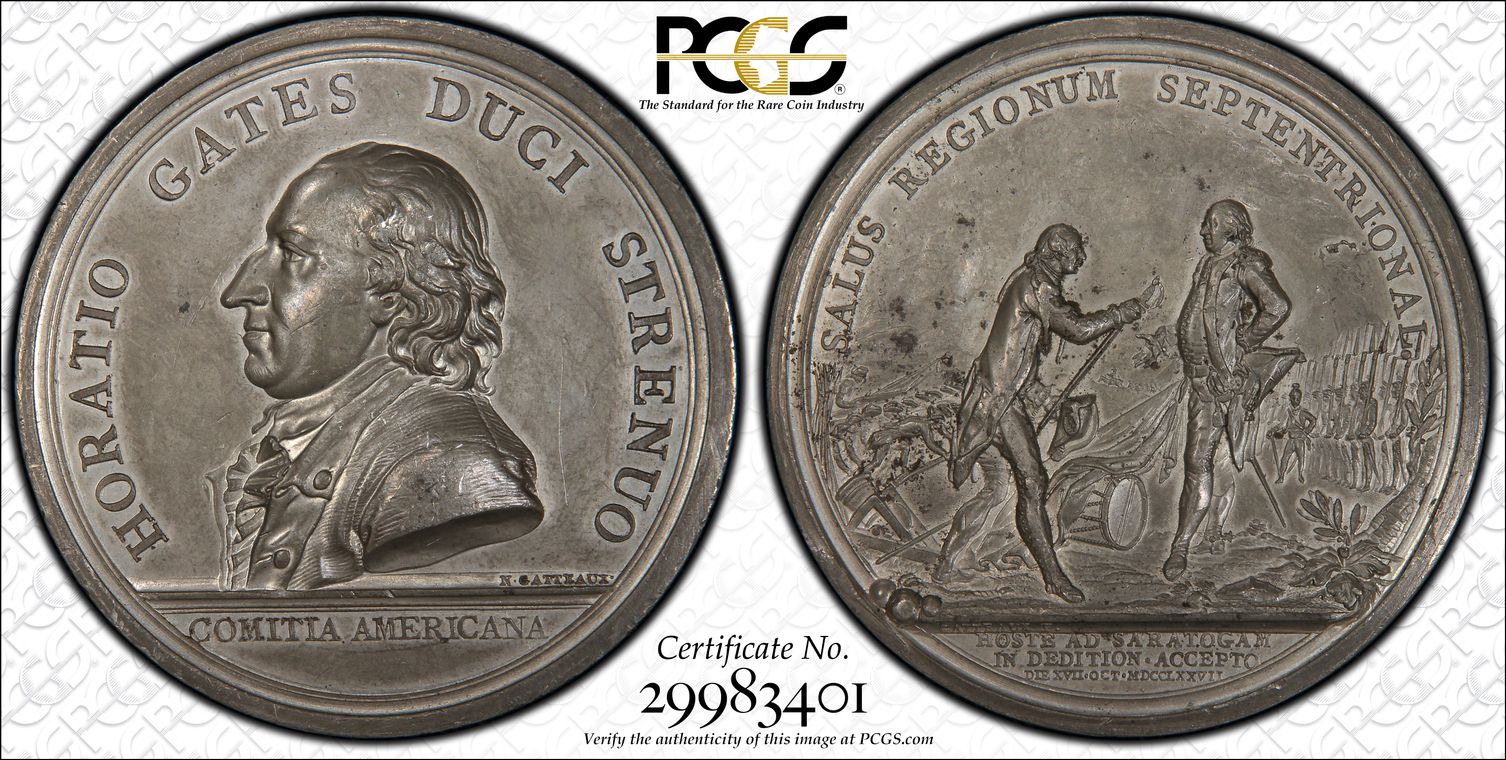

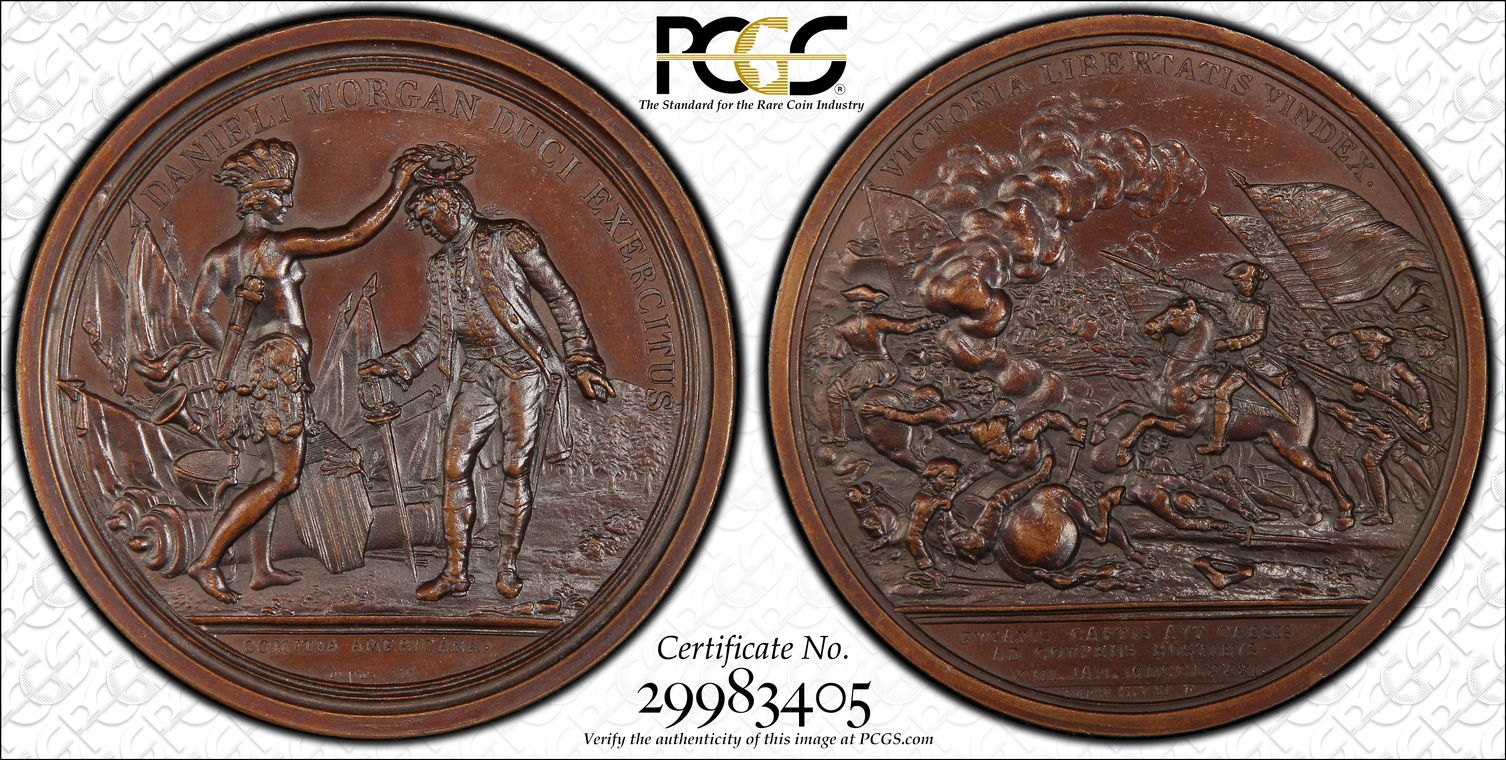
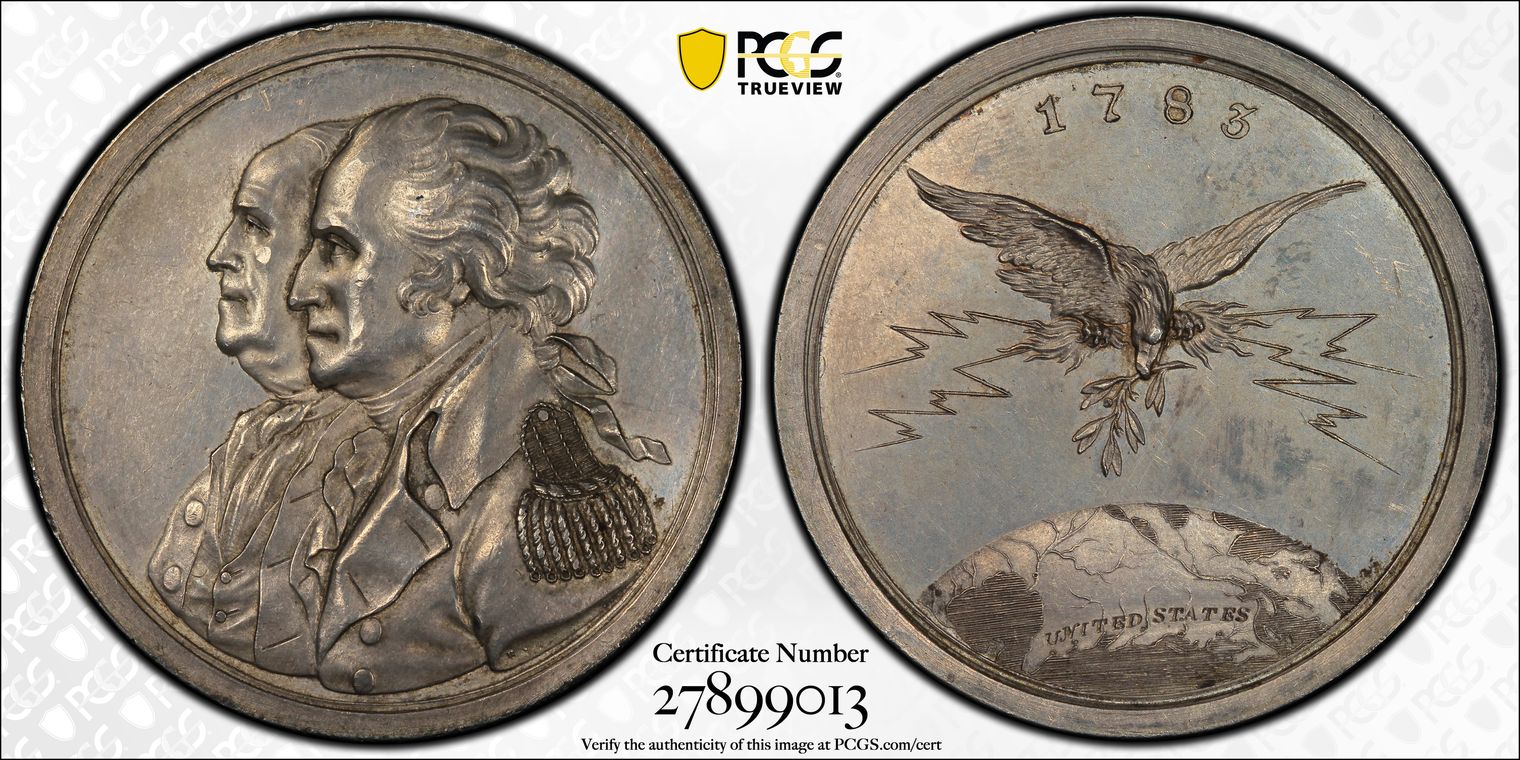
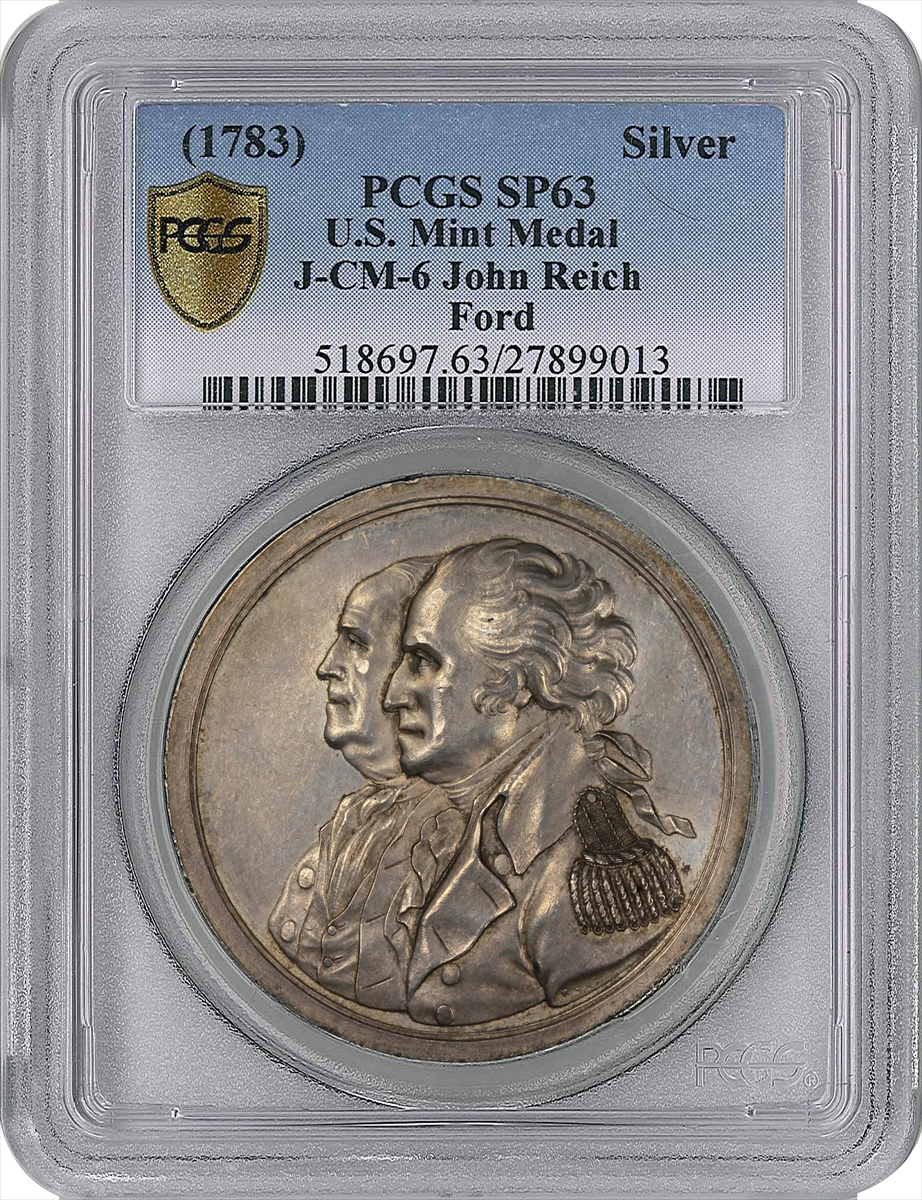
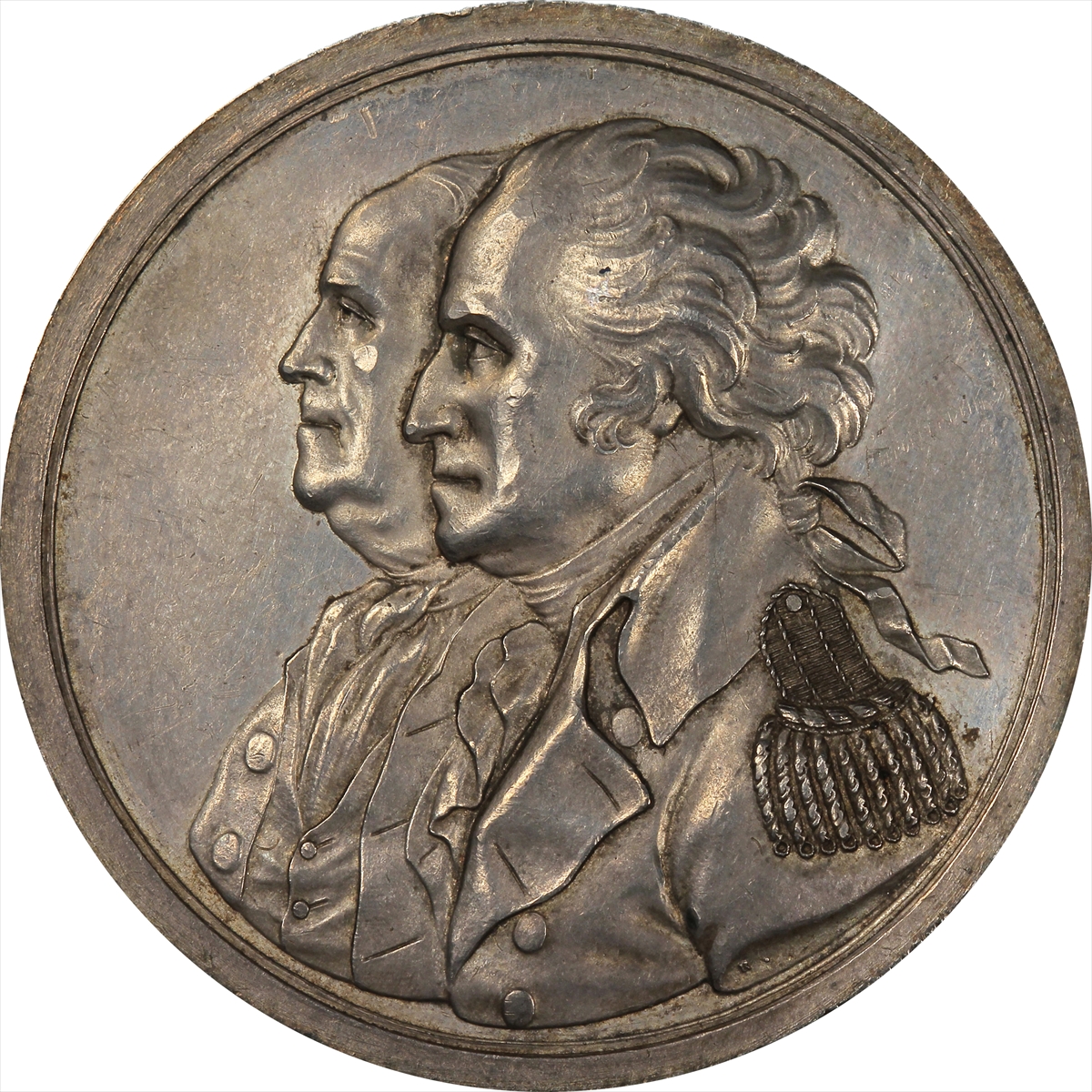
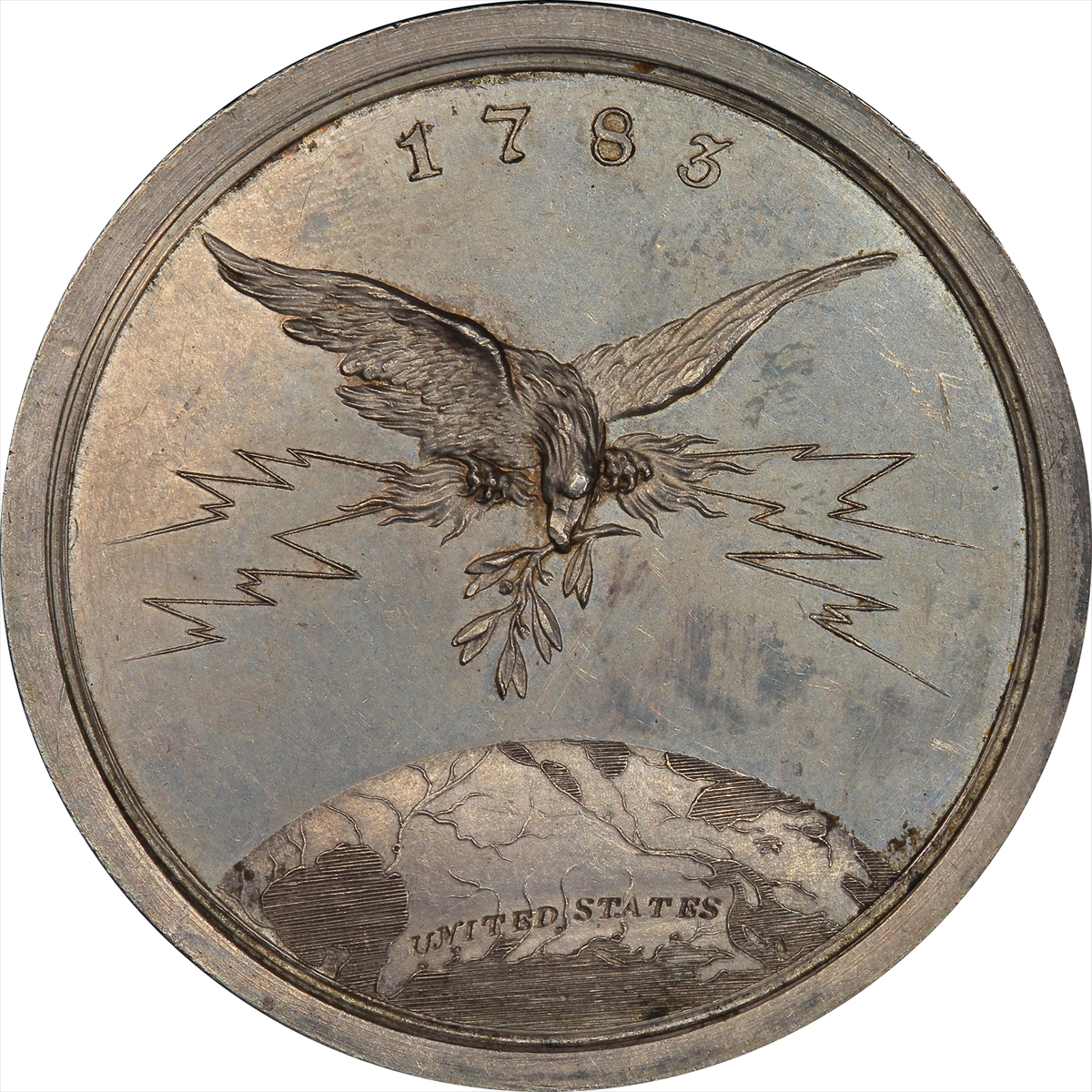
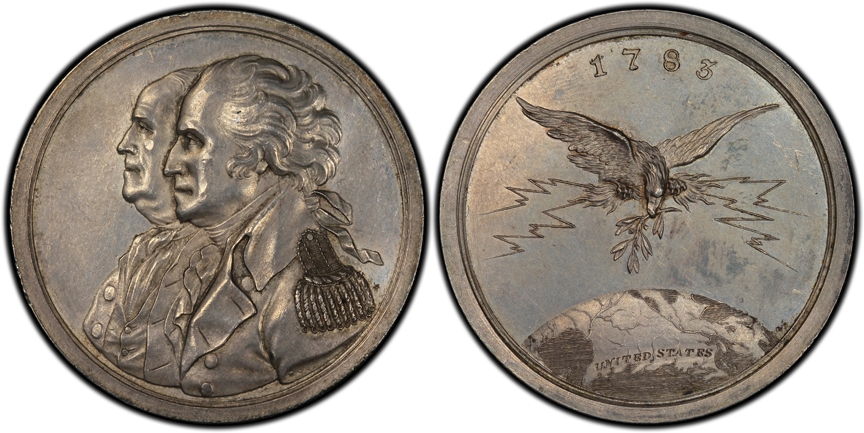
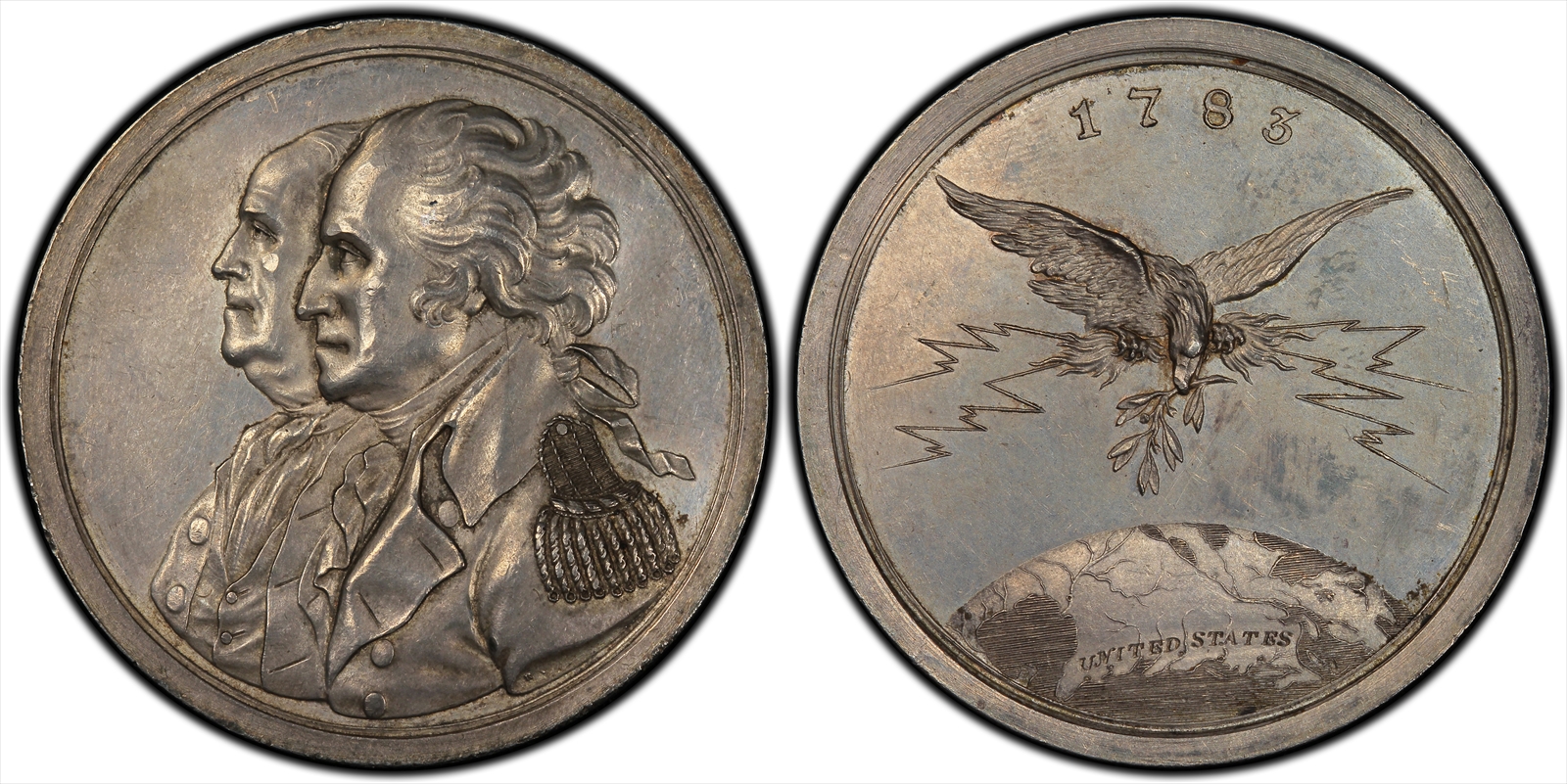
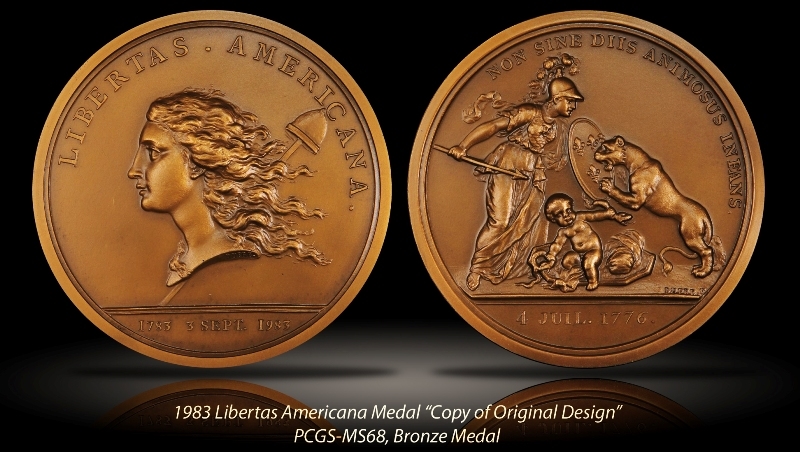
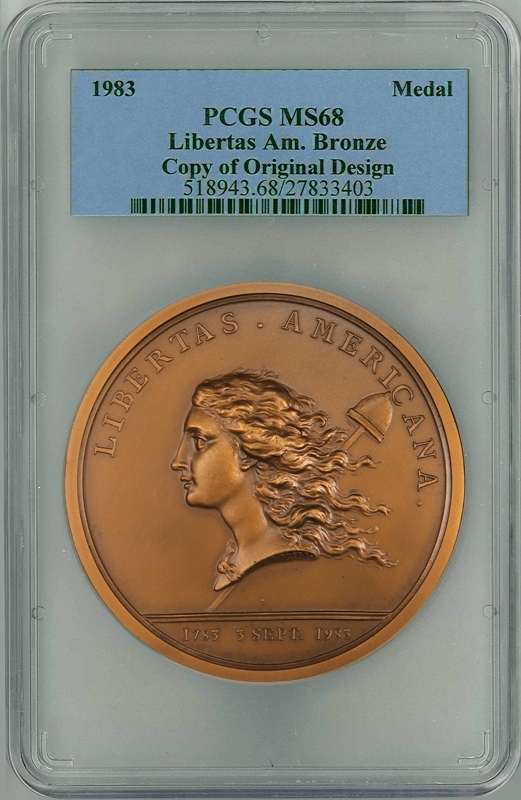
A further extension of First Coinvestors rights to the new 77mm Libertas dies, bronze "Copies" such as this one were struck in 1983 for the Bicentennial. Whereas the 1976 Silver "Copies" celebrated the bicentennial of the signing of the Declaration of Independence, these 1983 Medals were dated "1783 3 SEPT 1983", to commemorate the bicentennial of the signing of the Peace Treaty that ended the Revolutionary War.
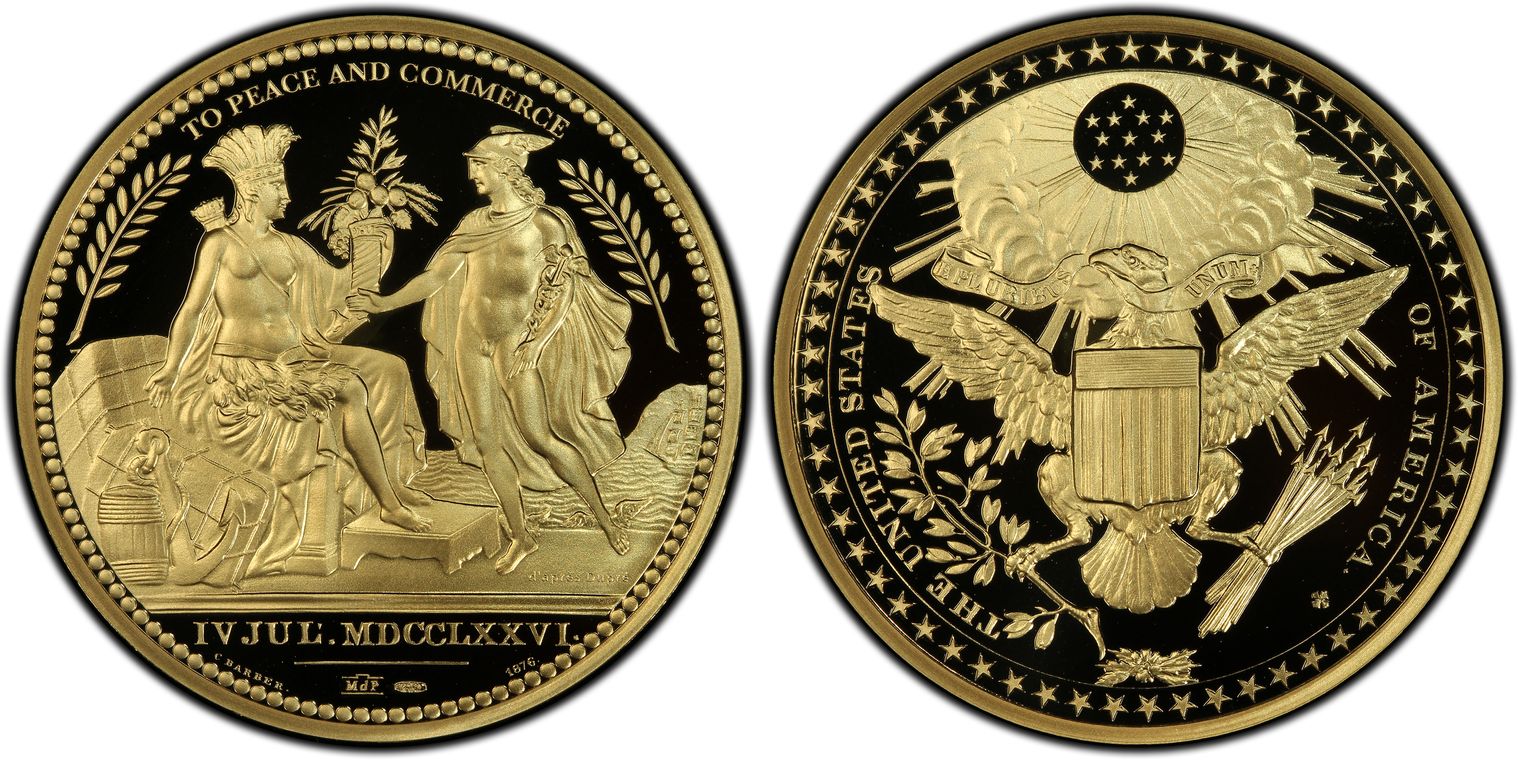
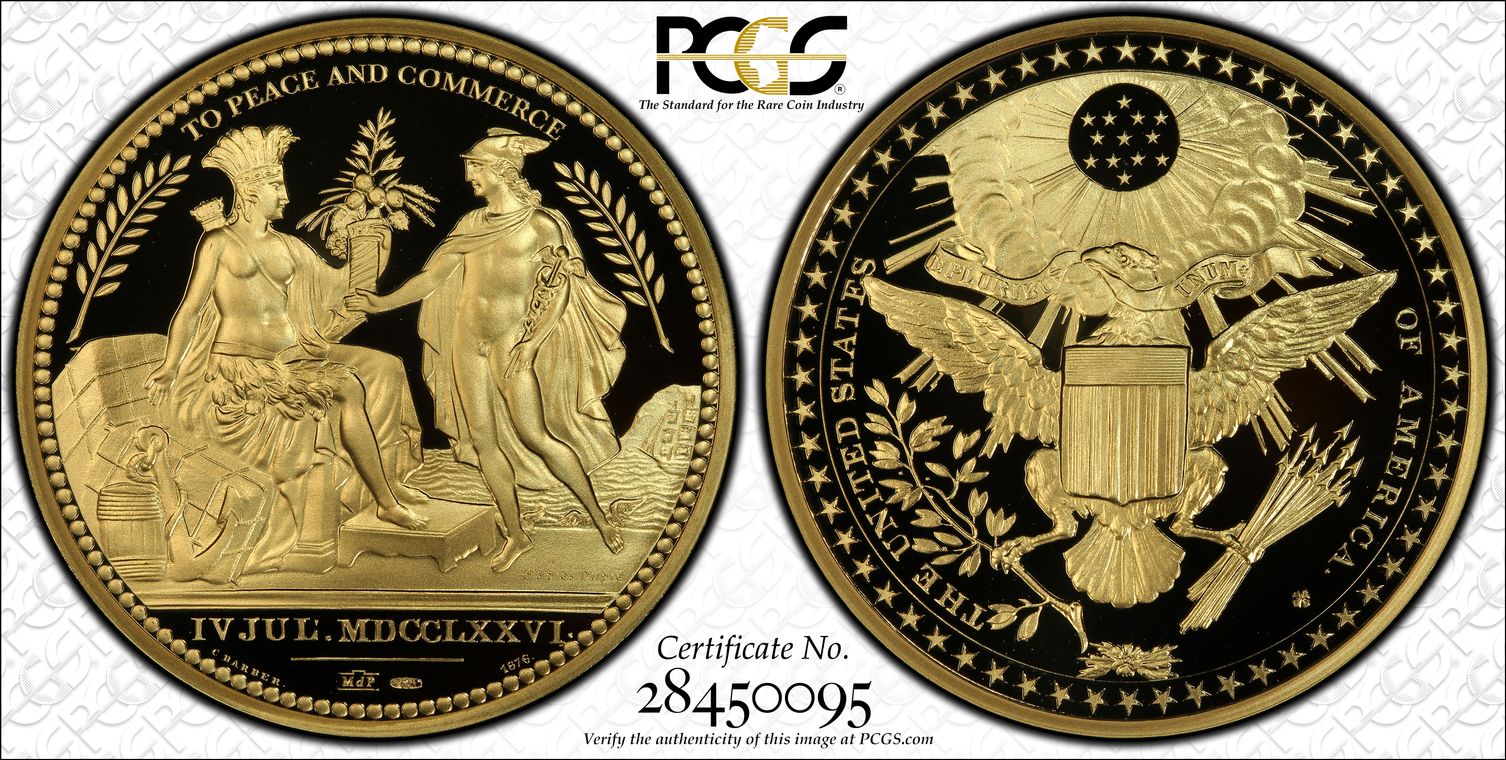
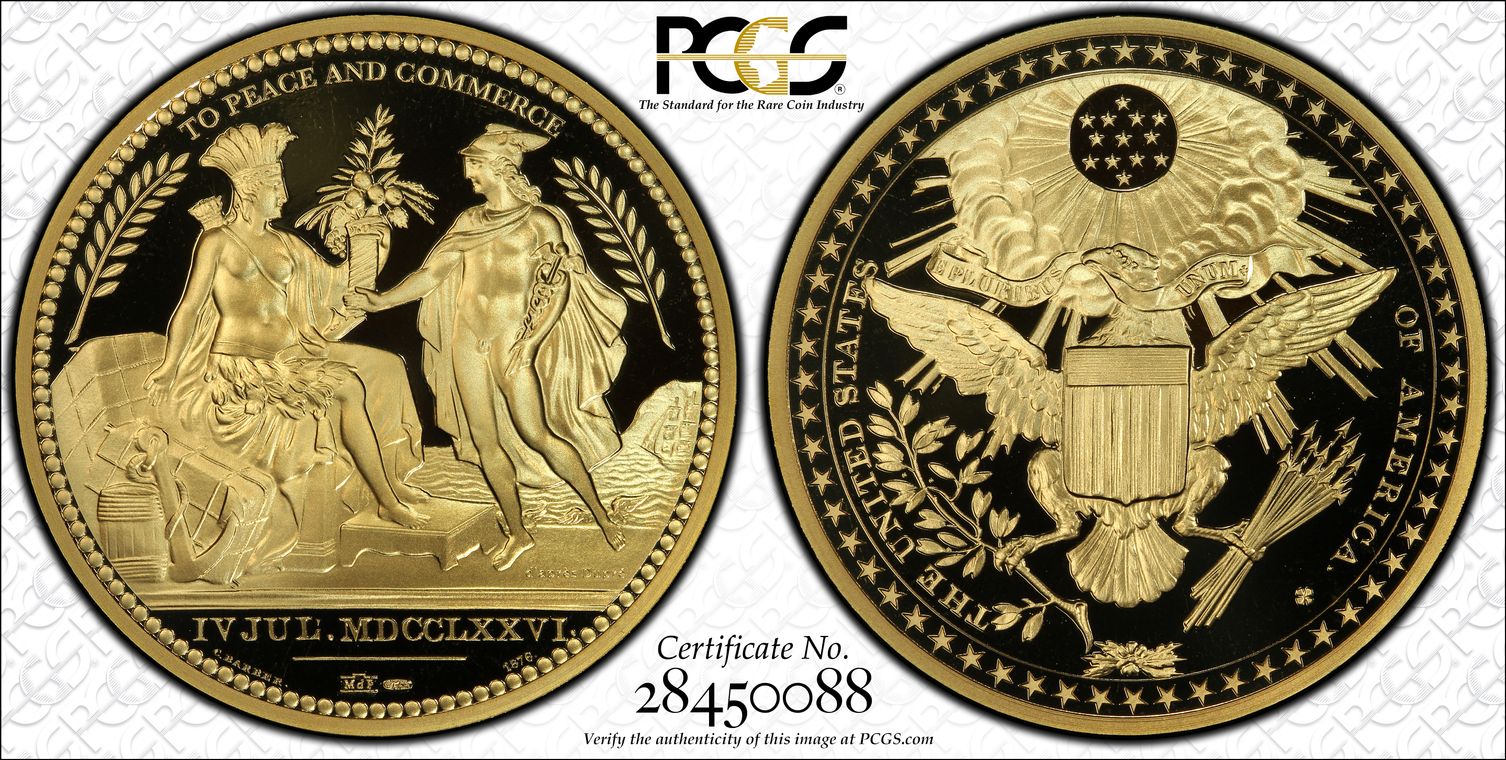

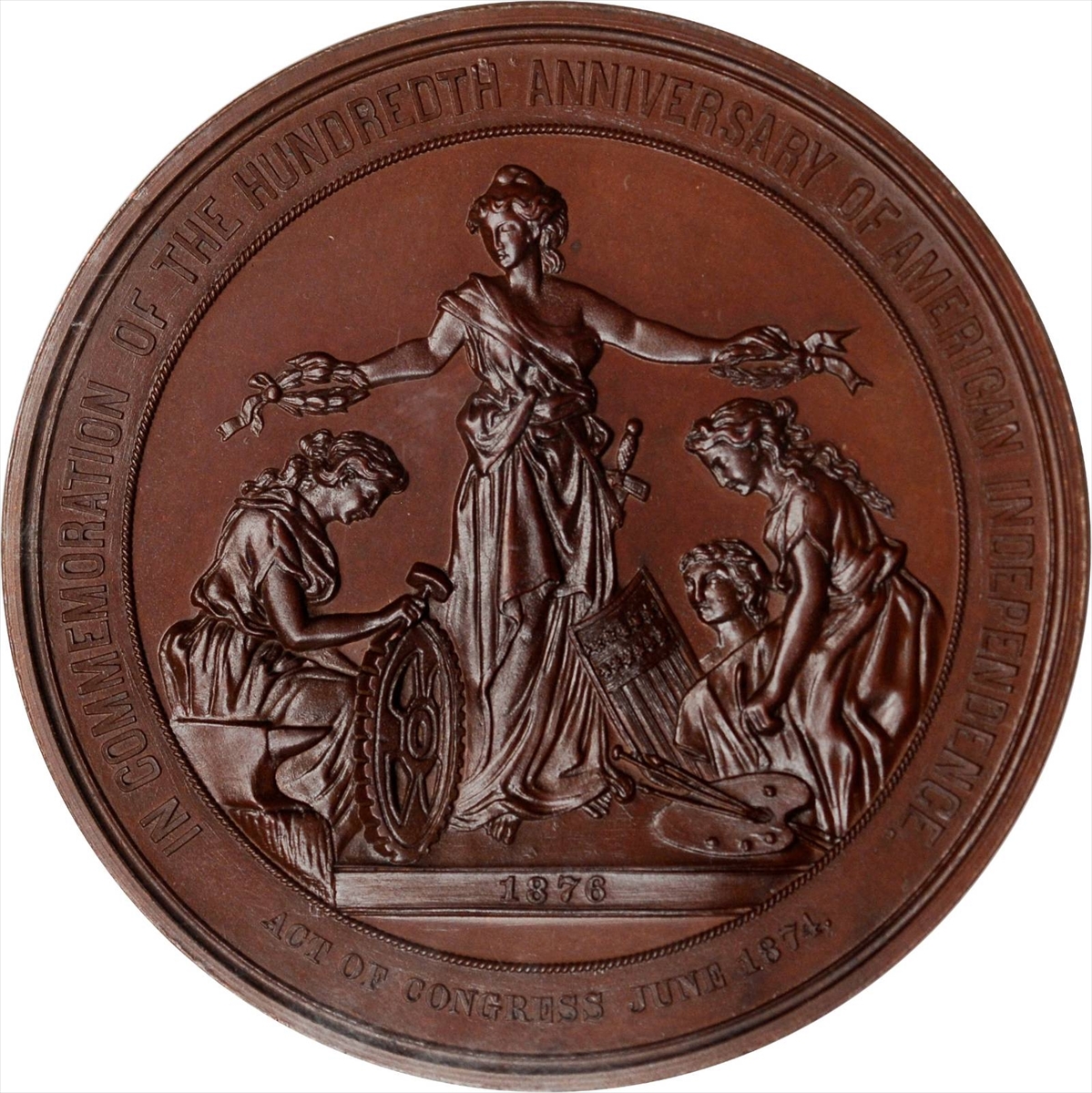

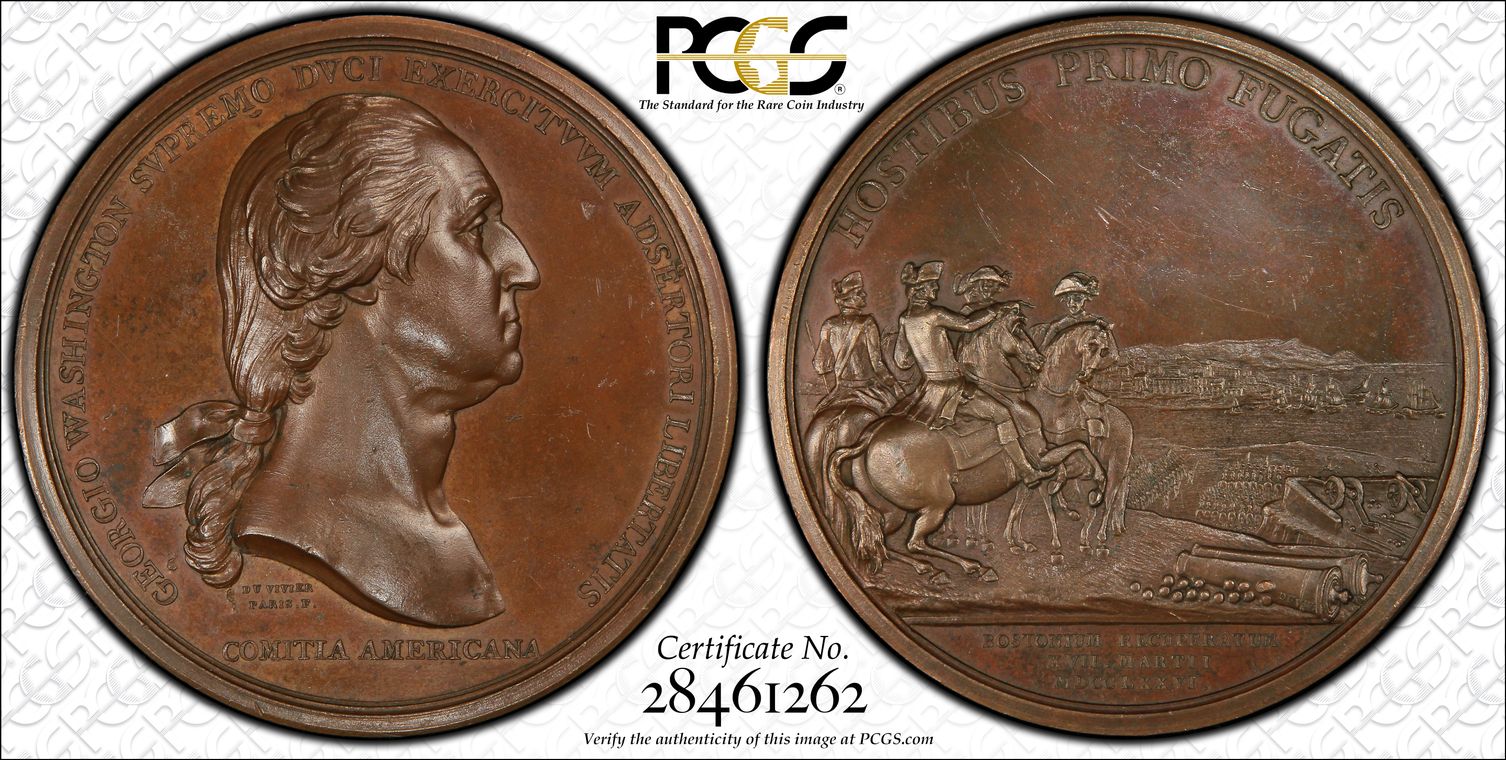
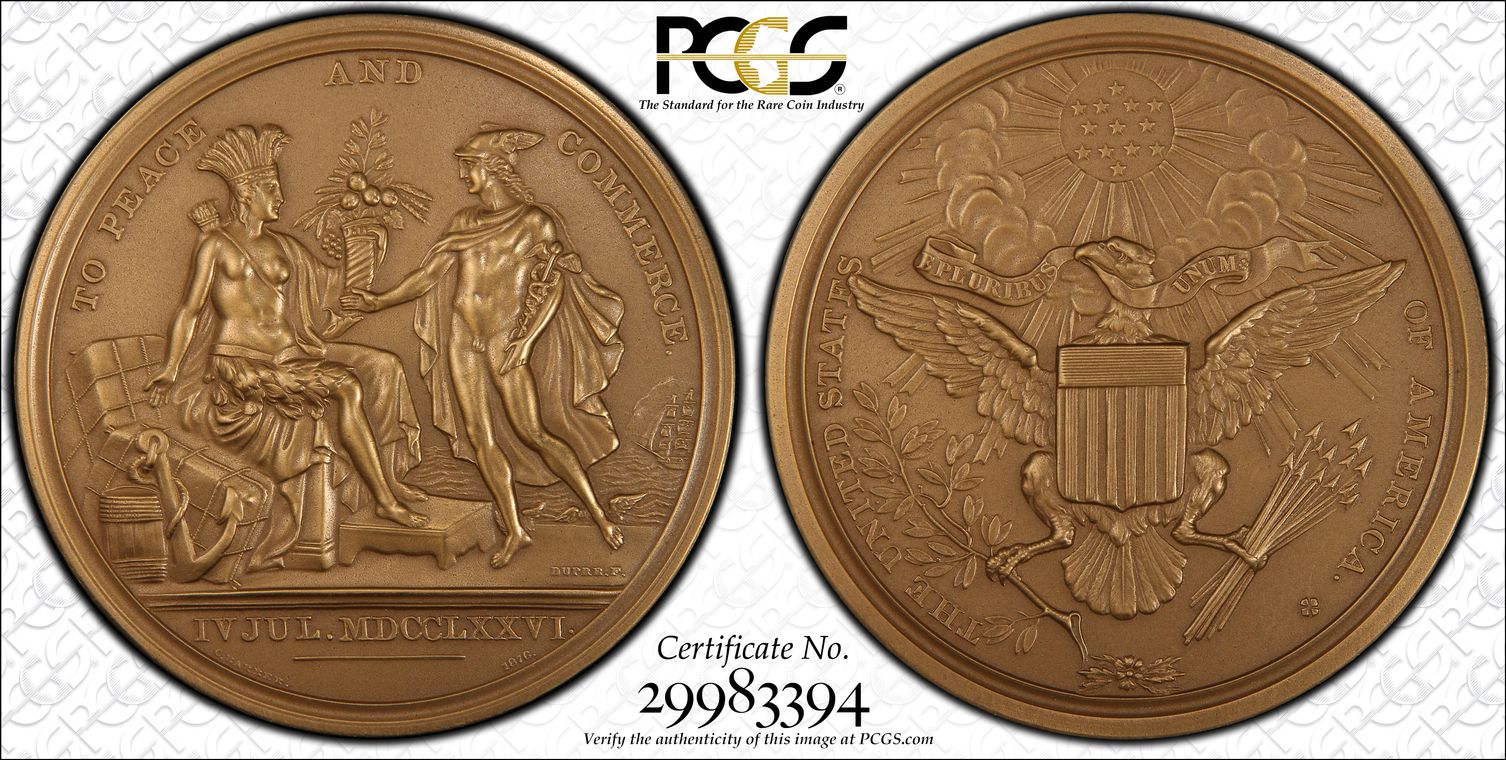

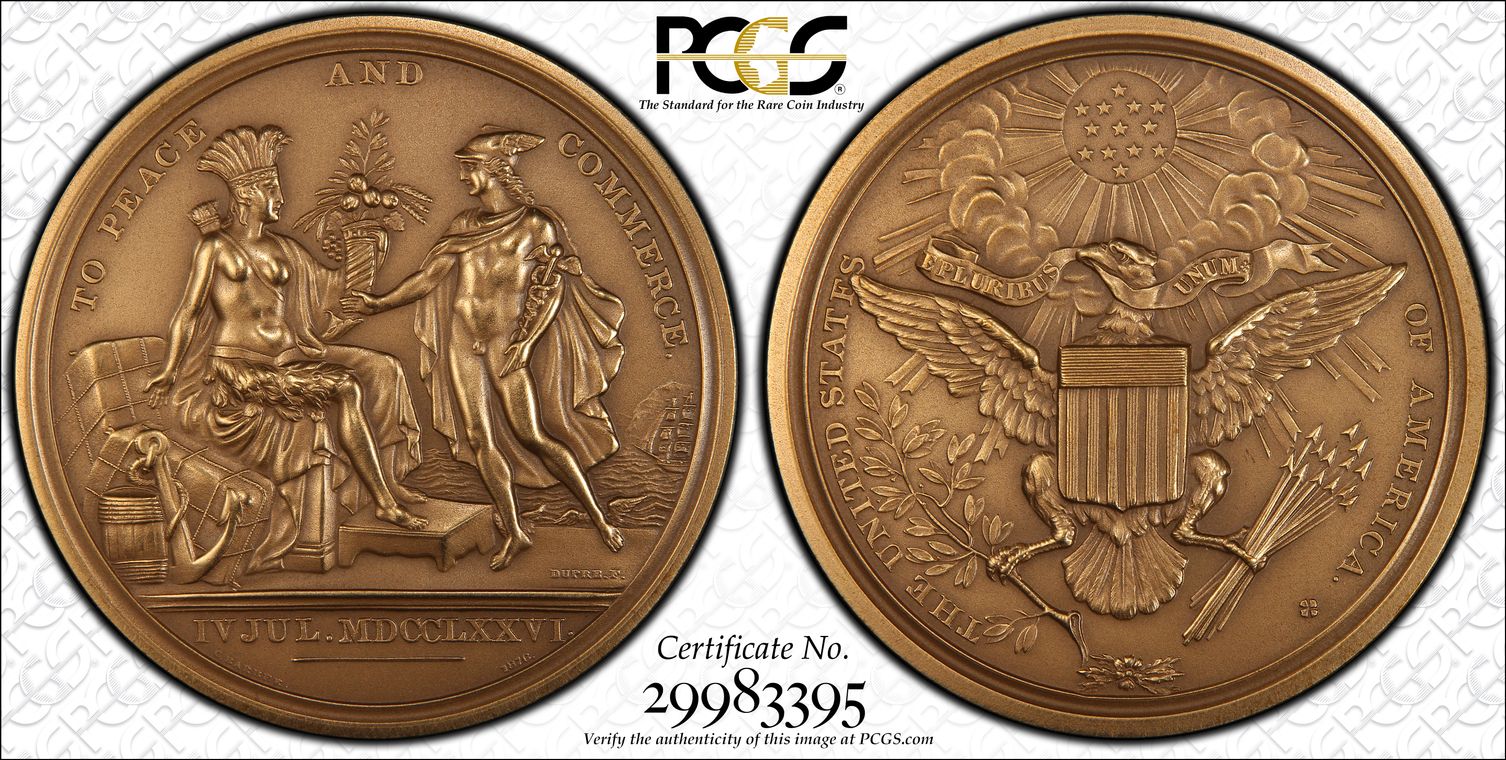
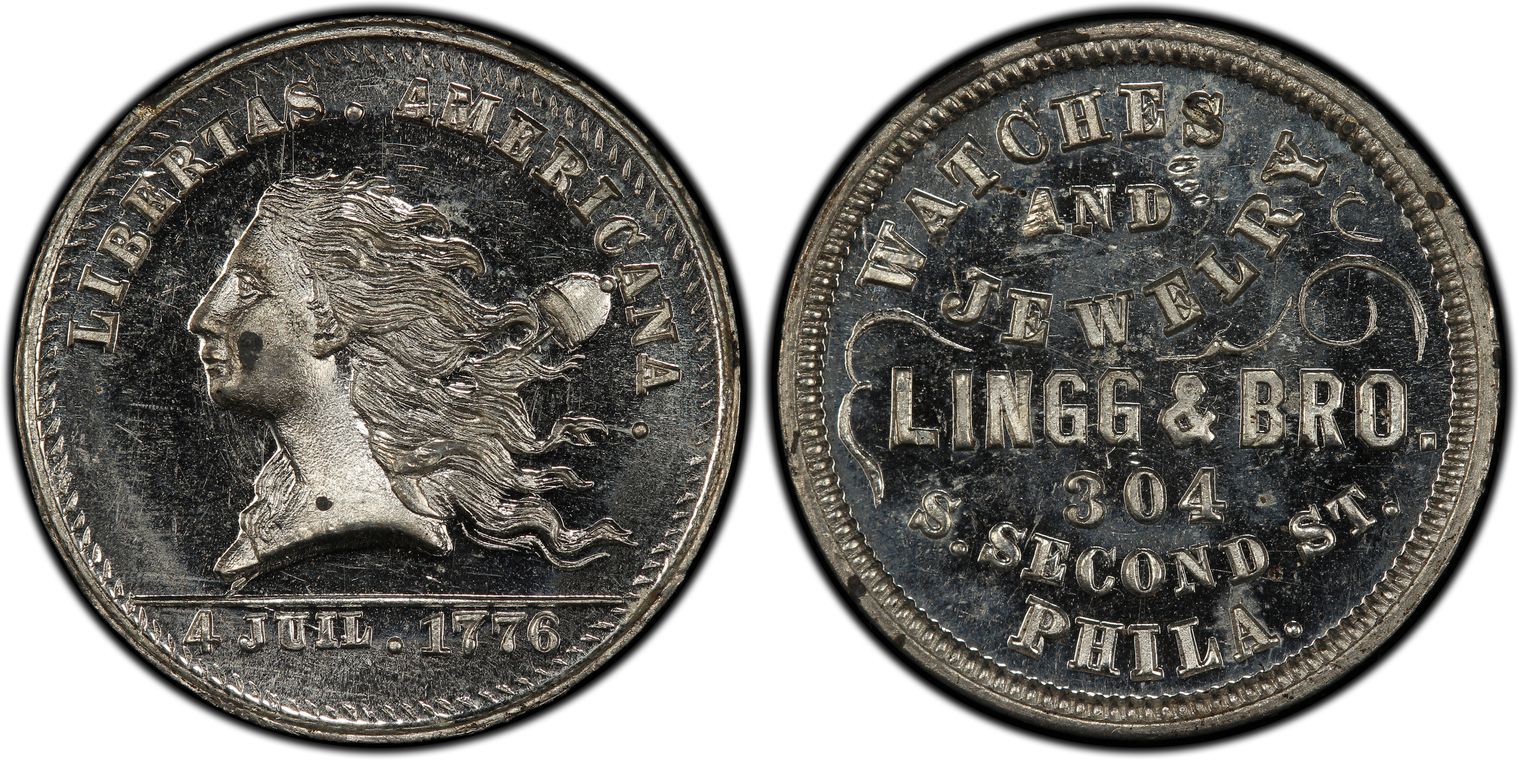
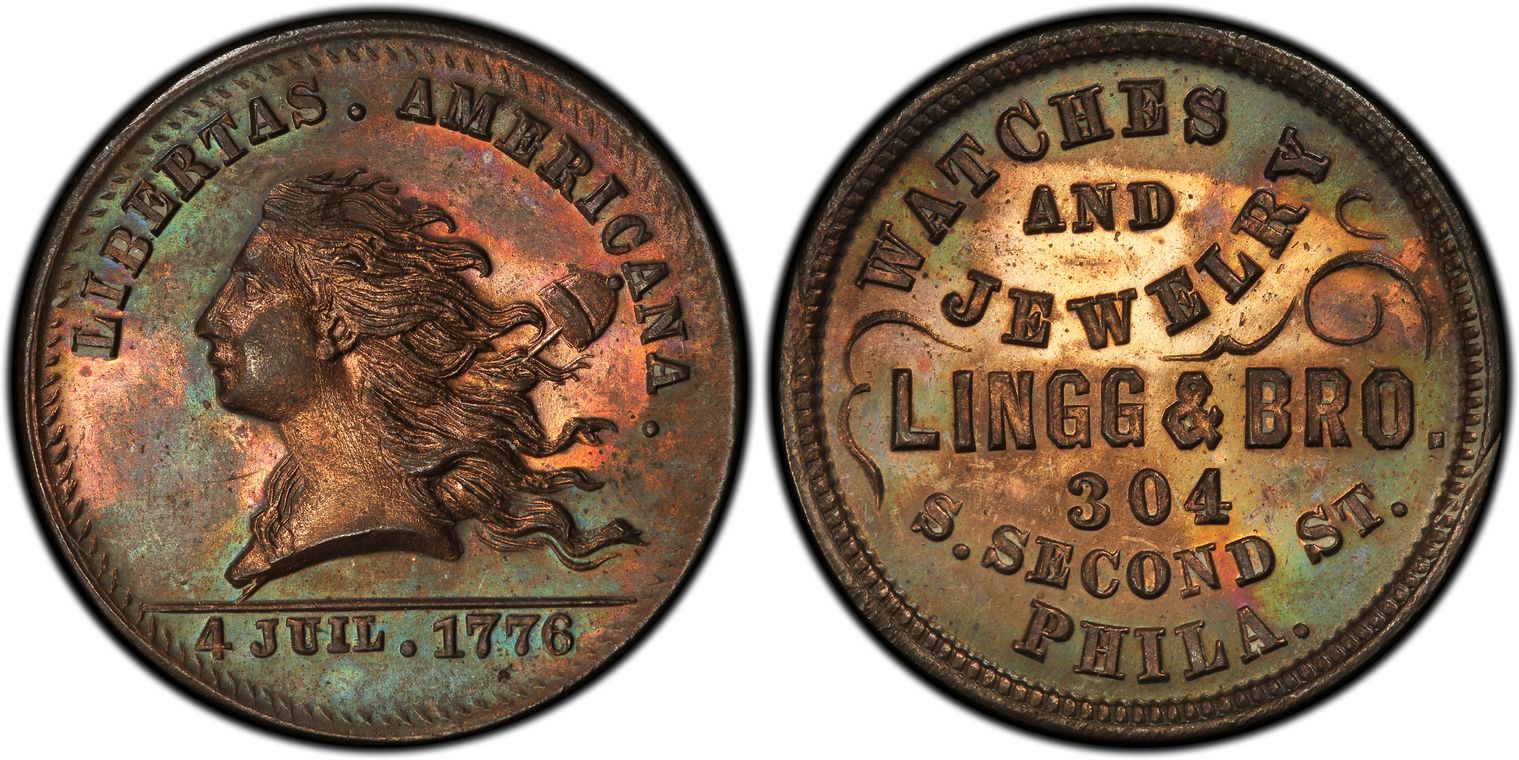
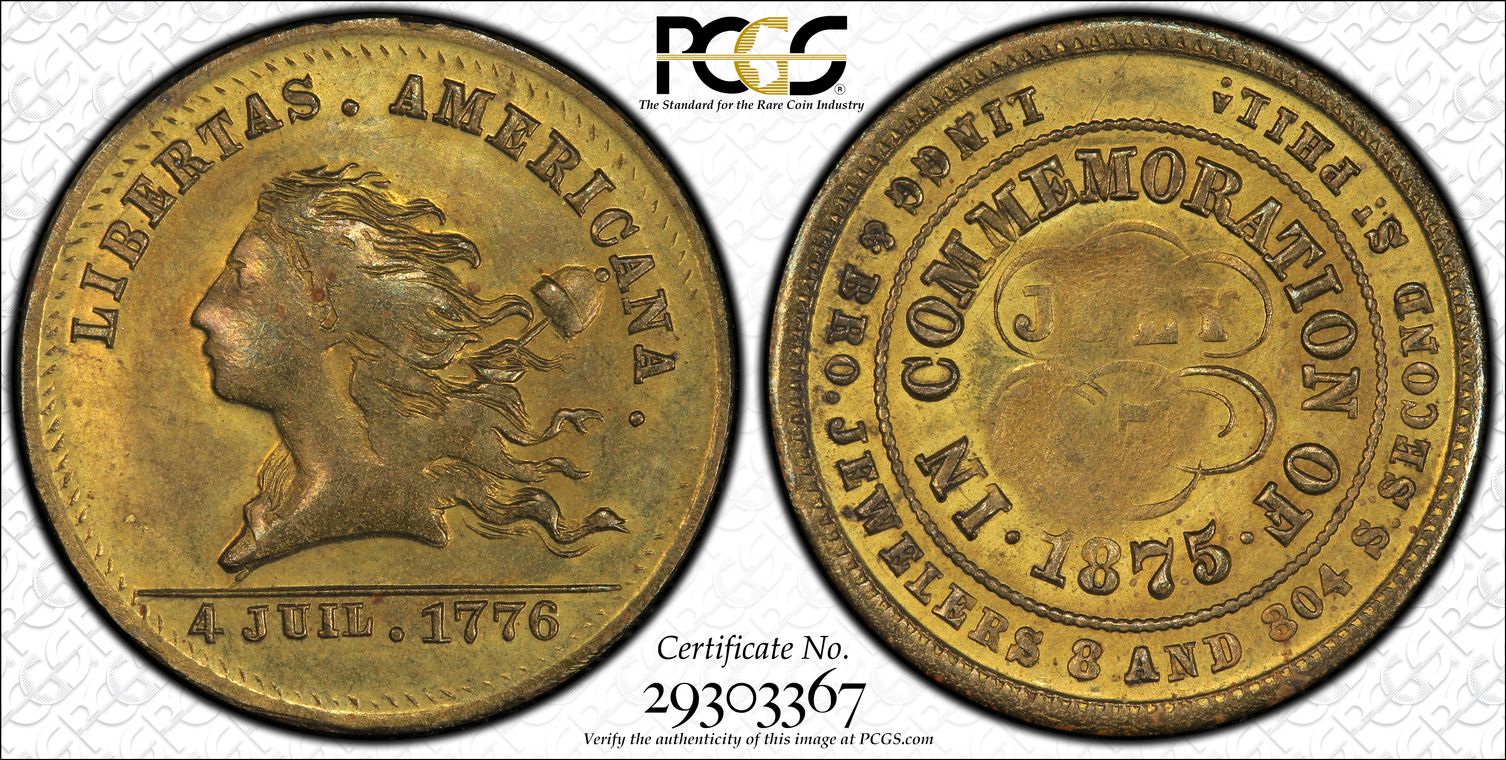
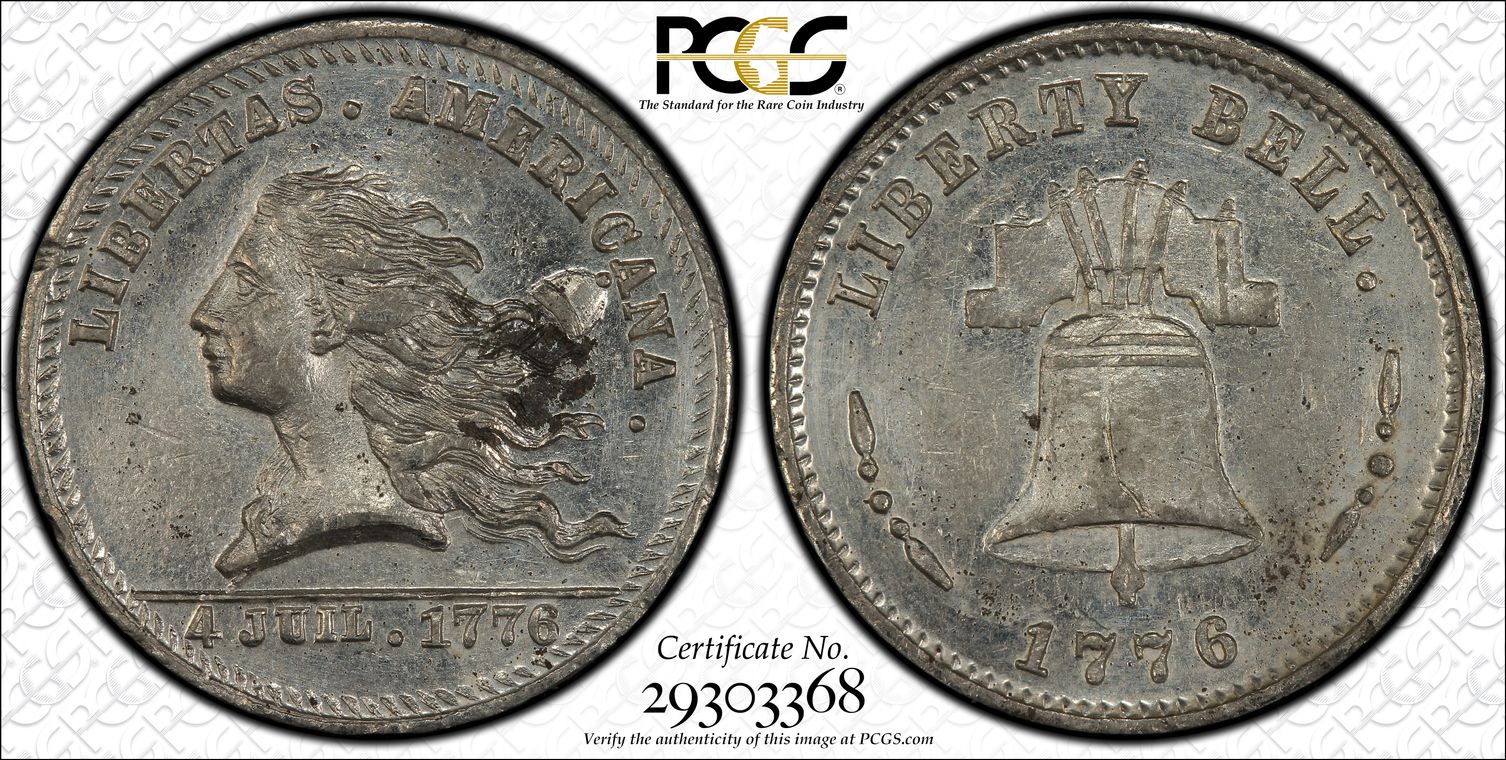
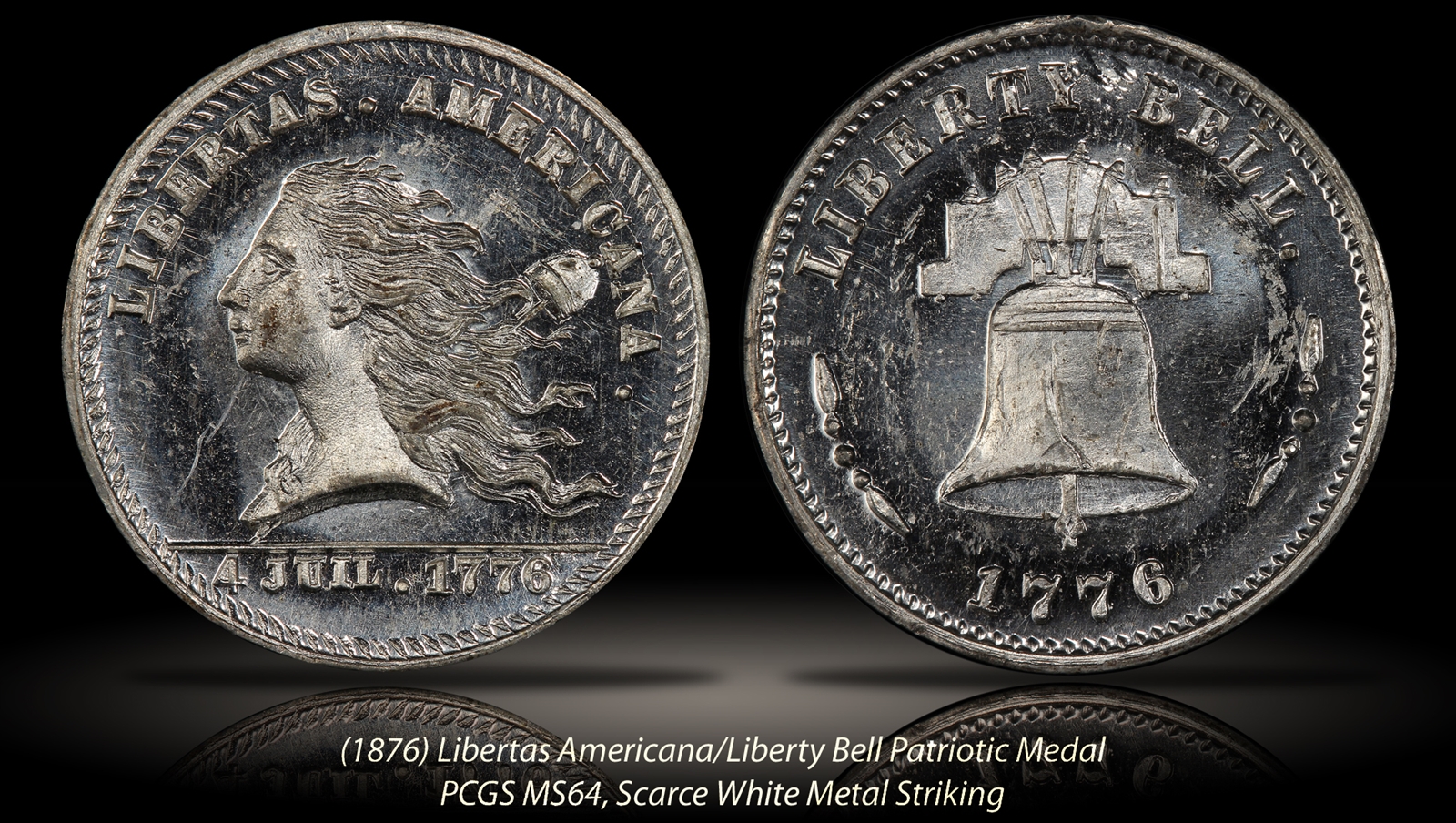
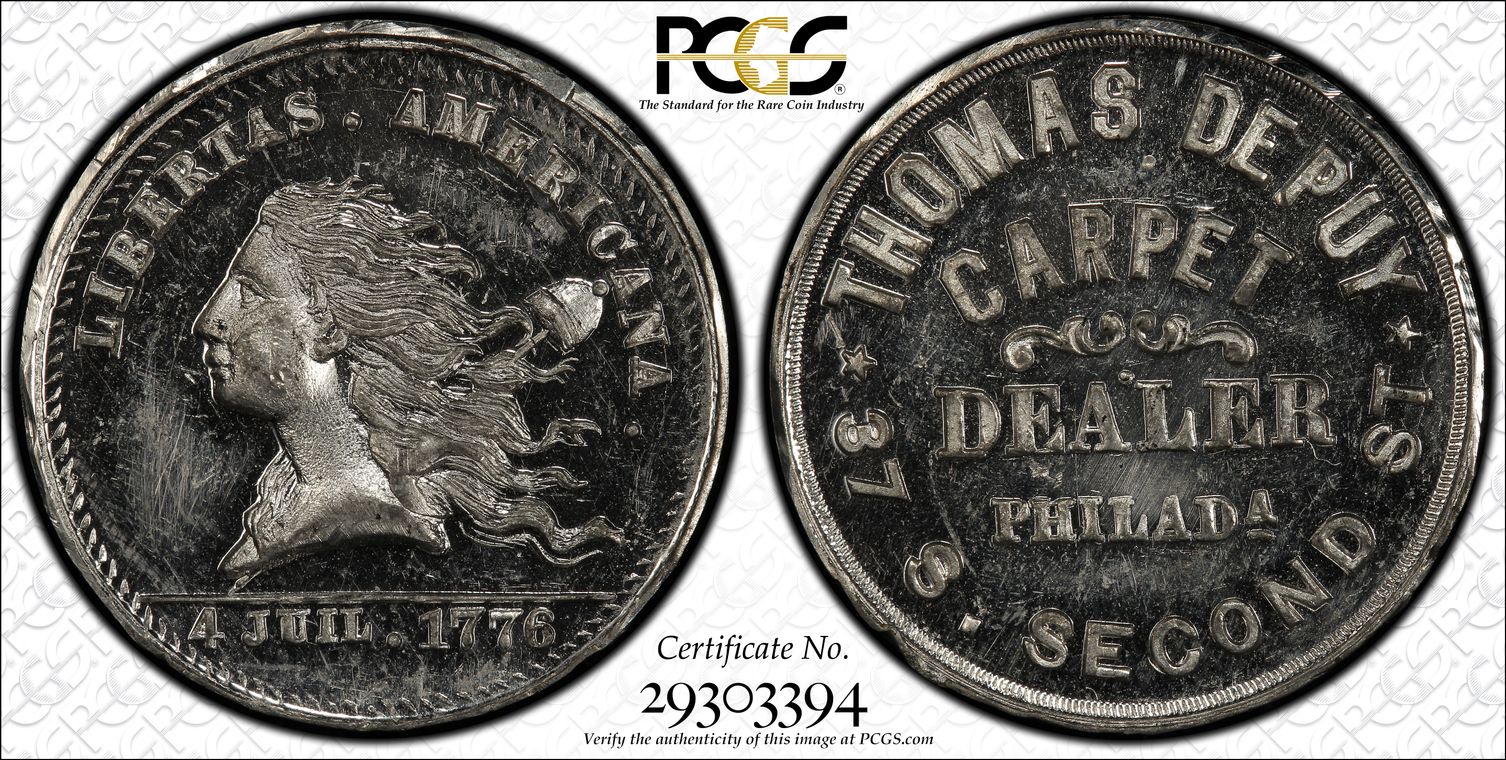
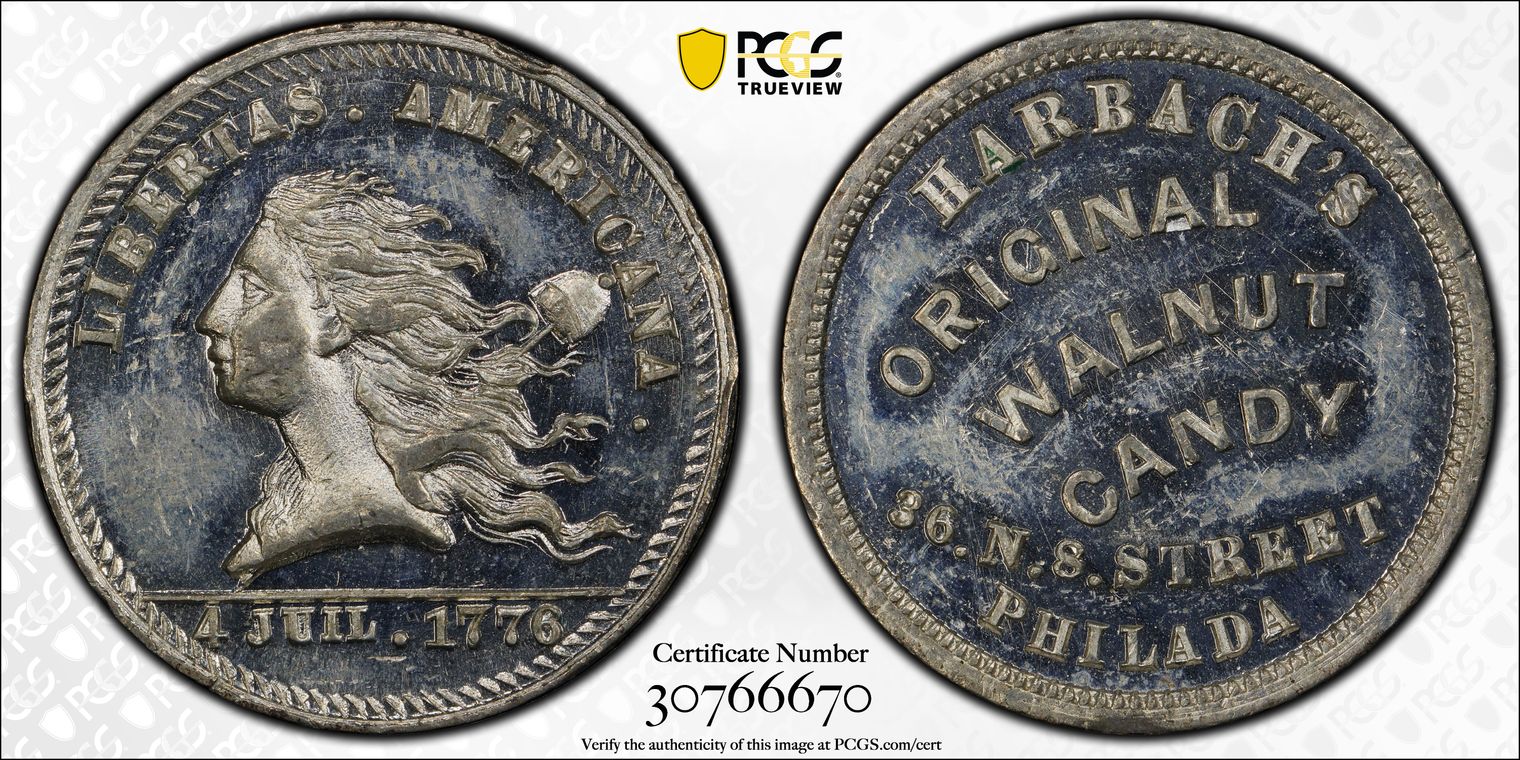
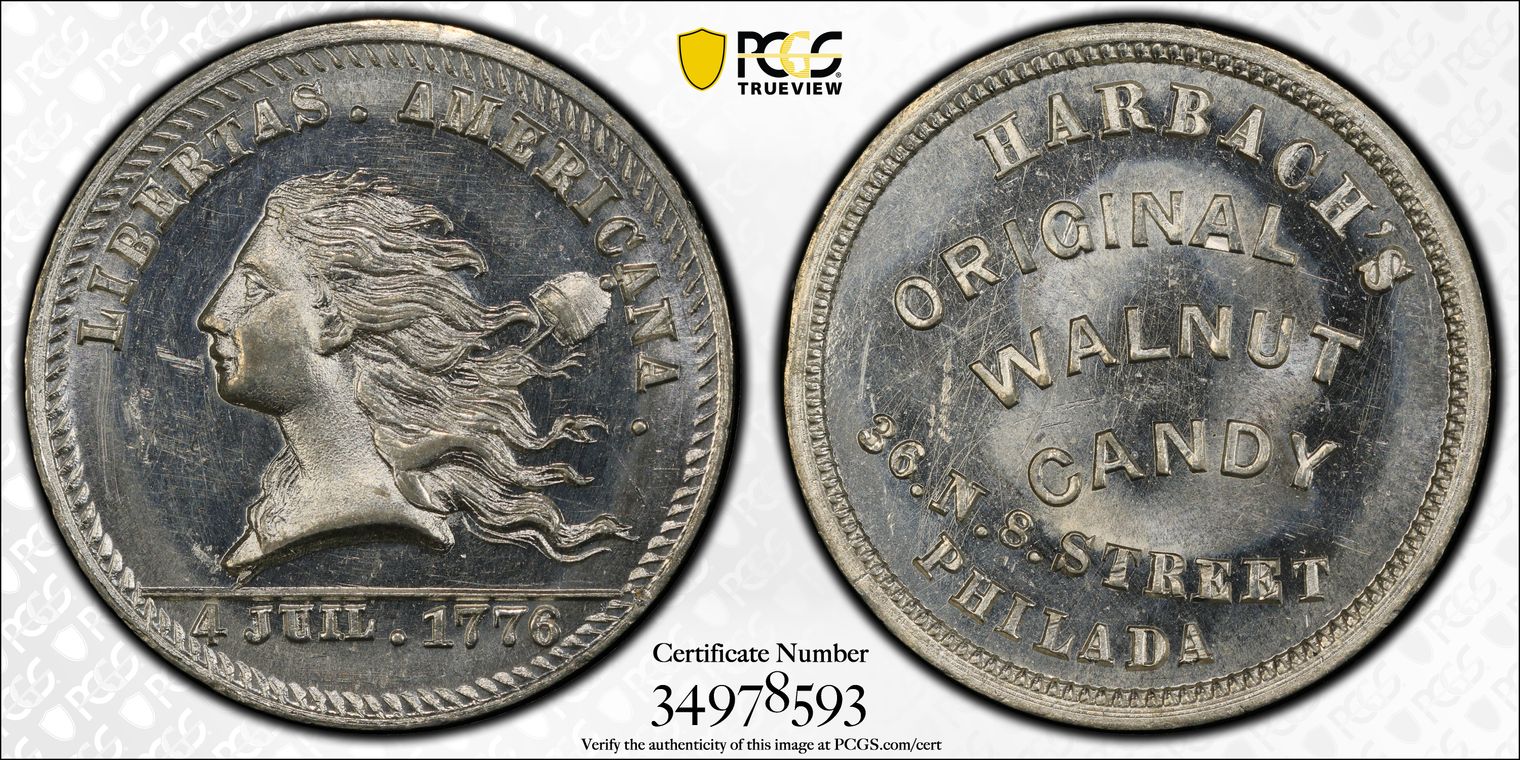
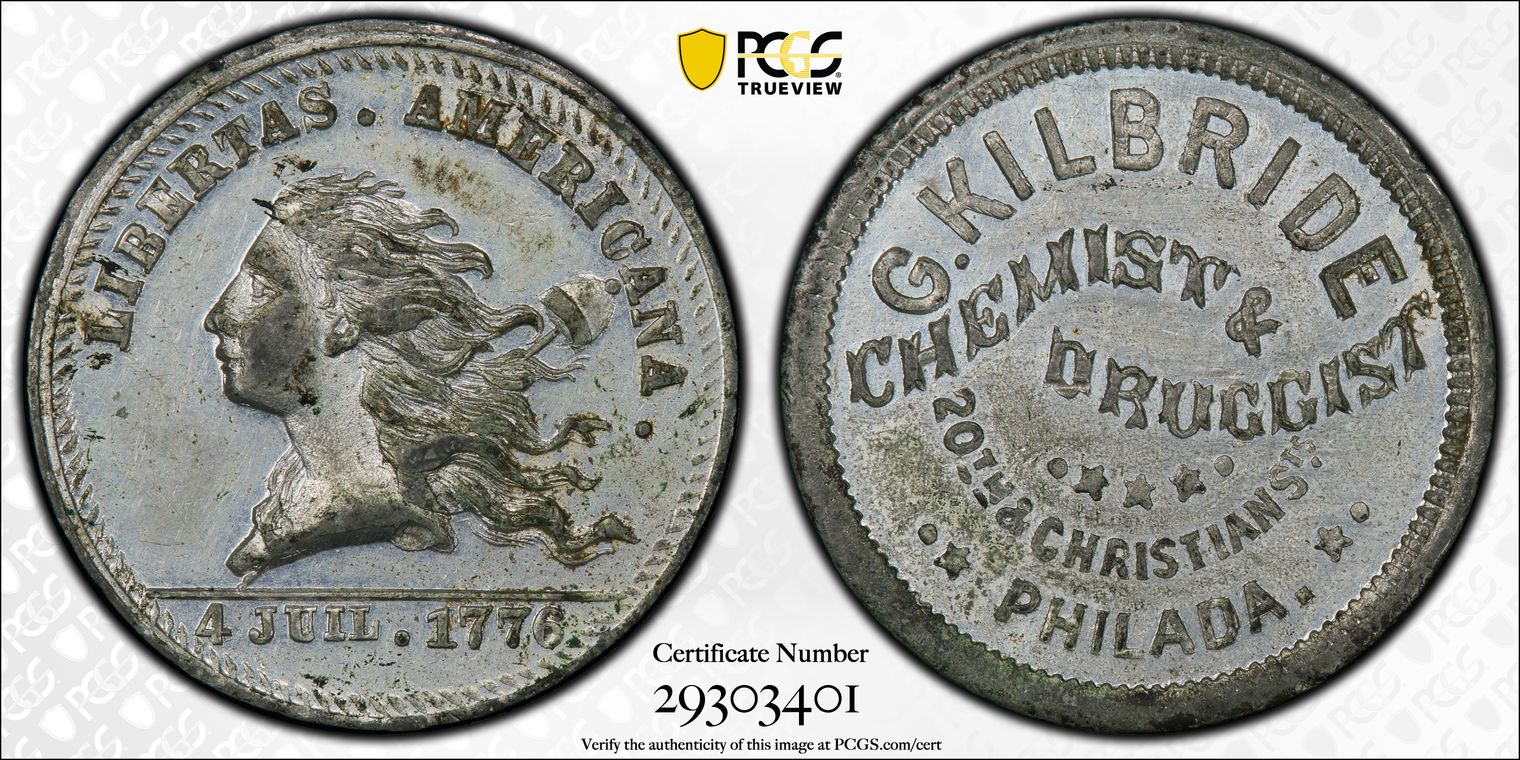
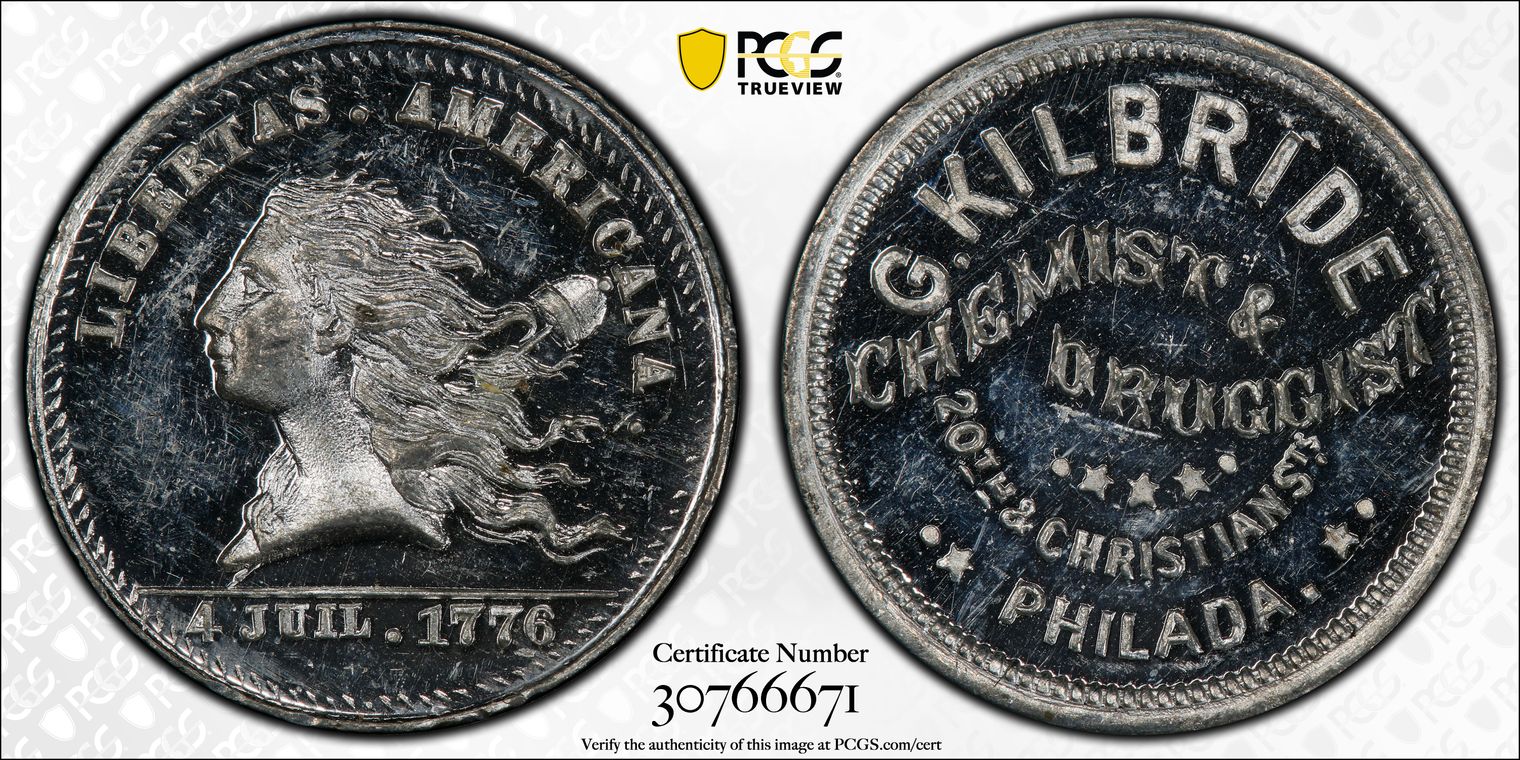
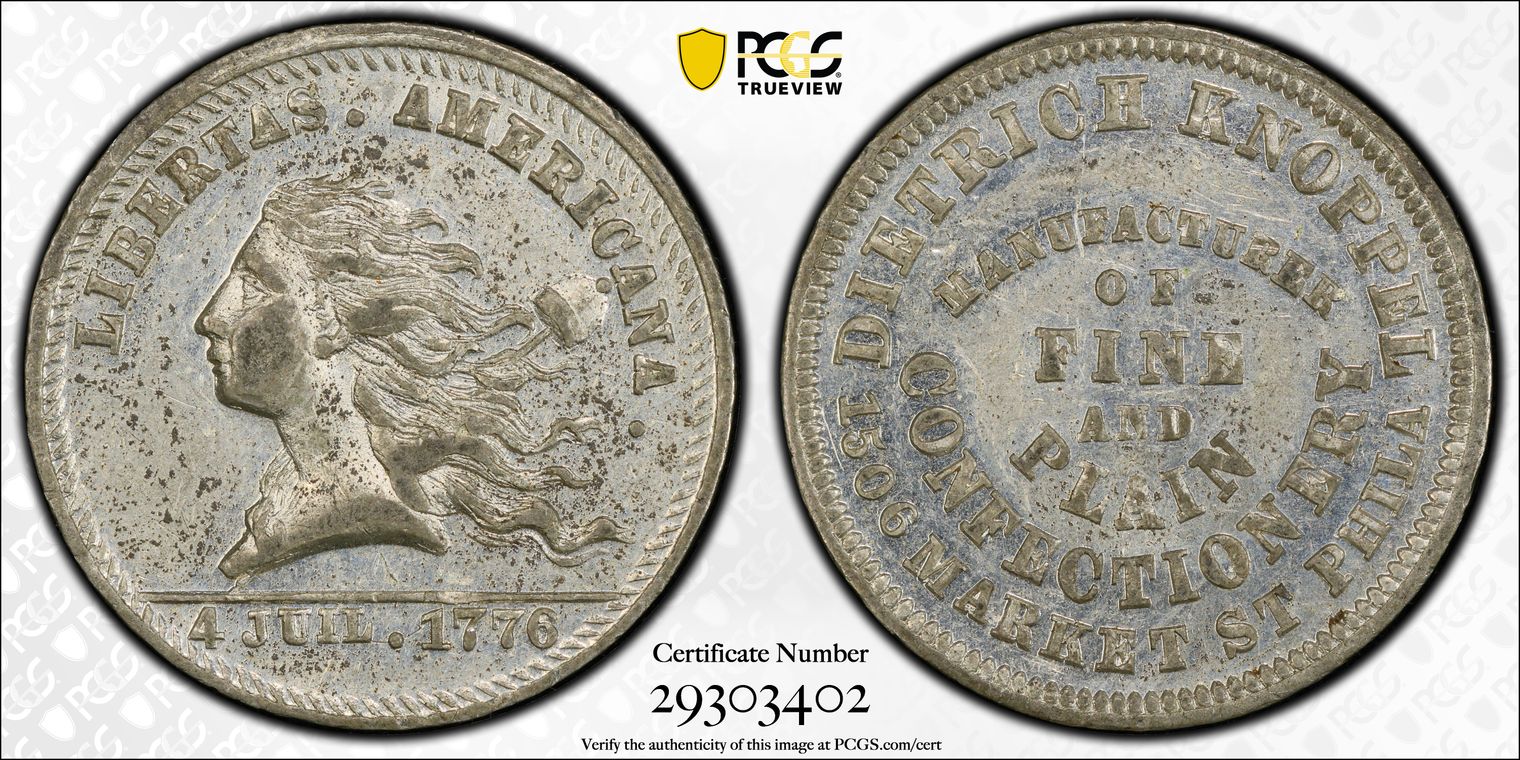
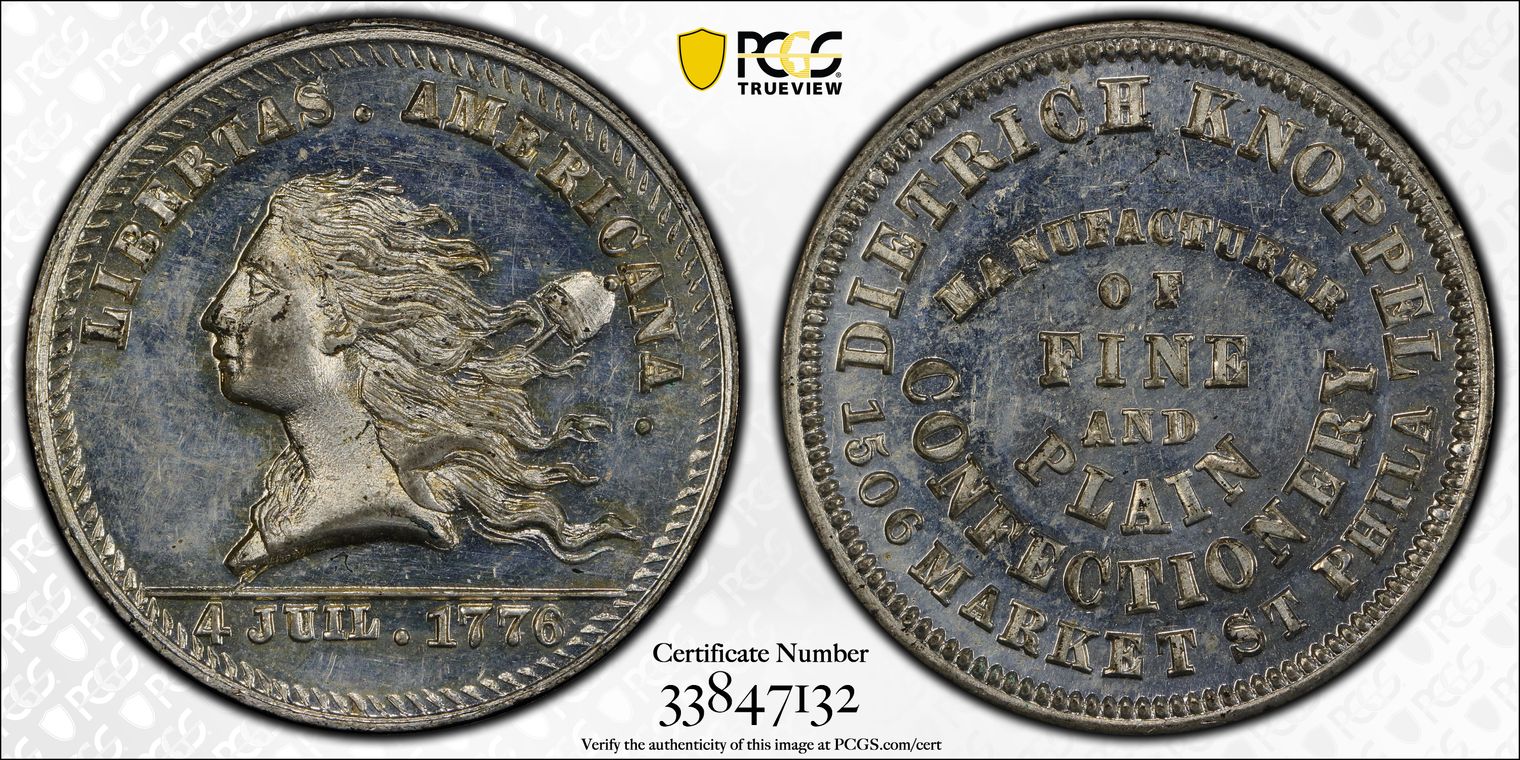
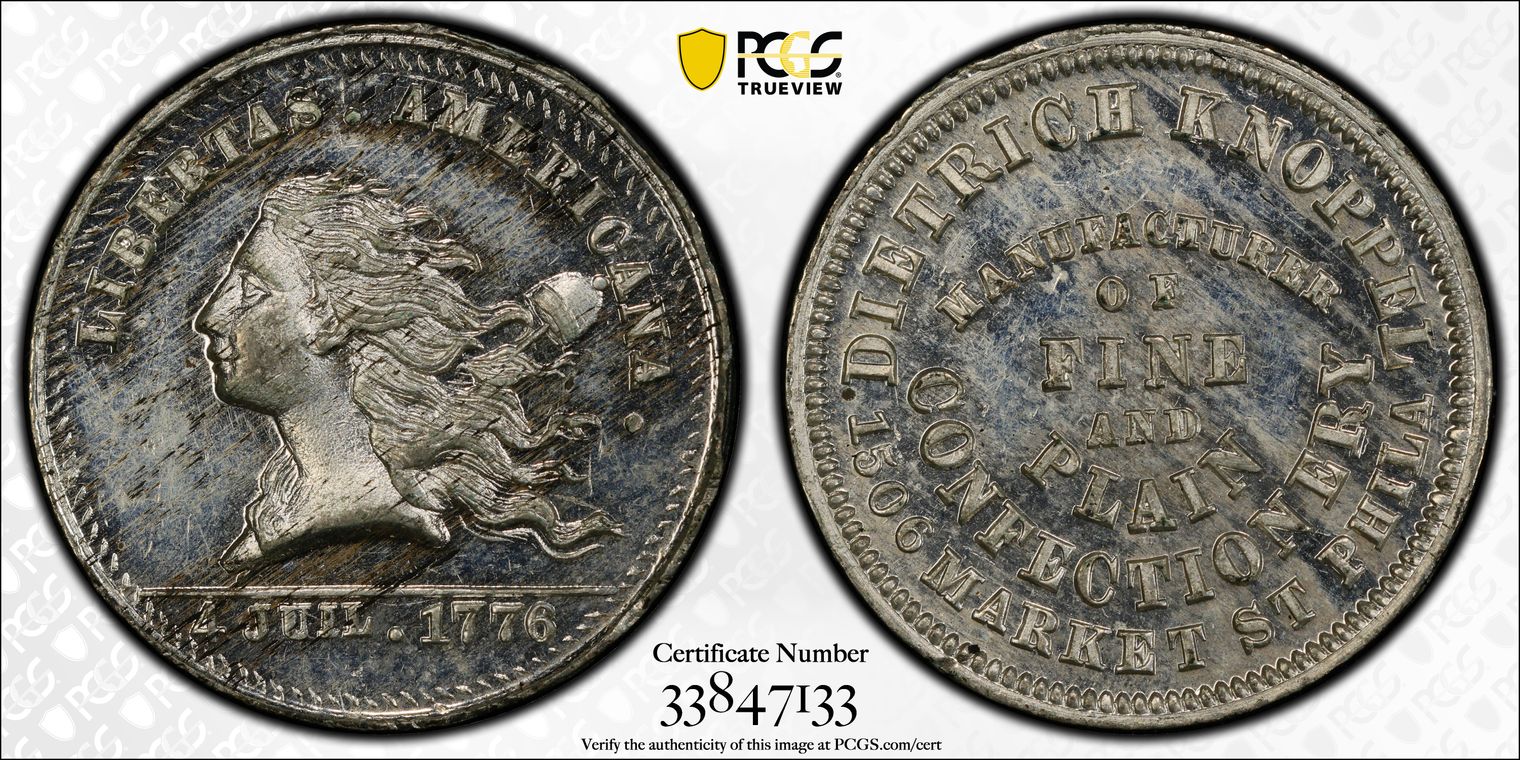
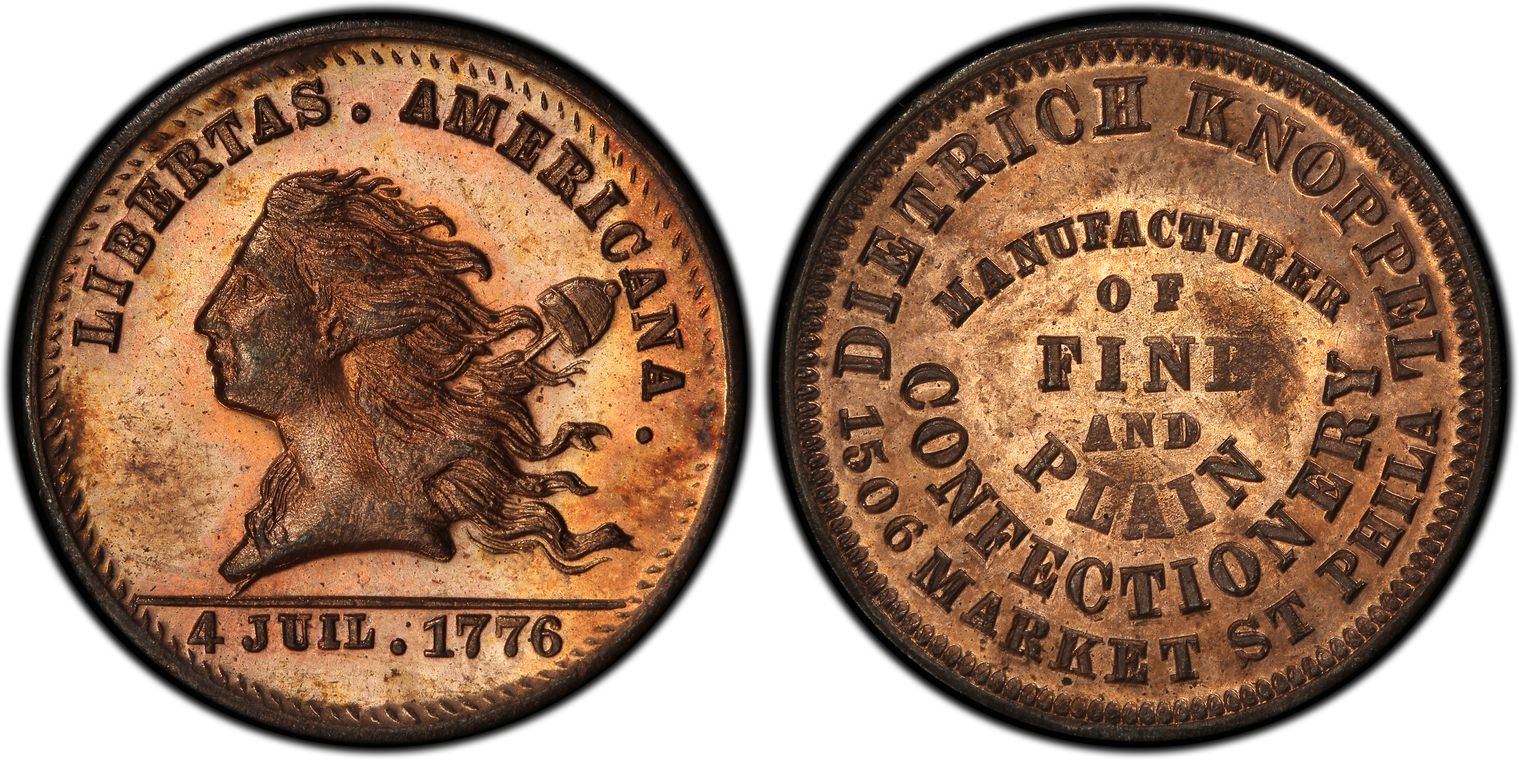
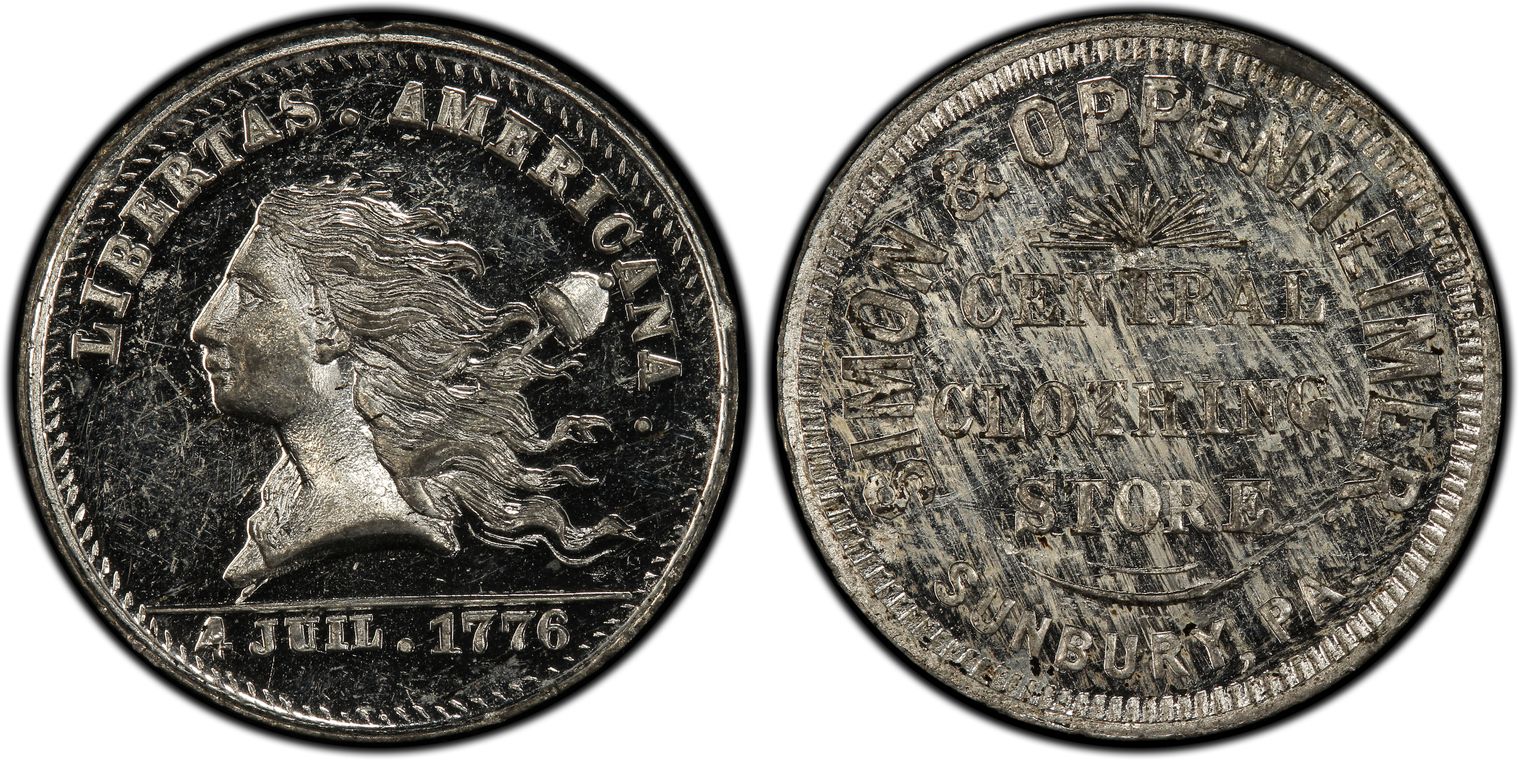
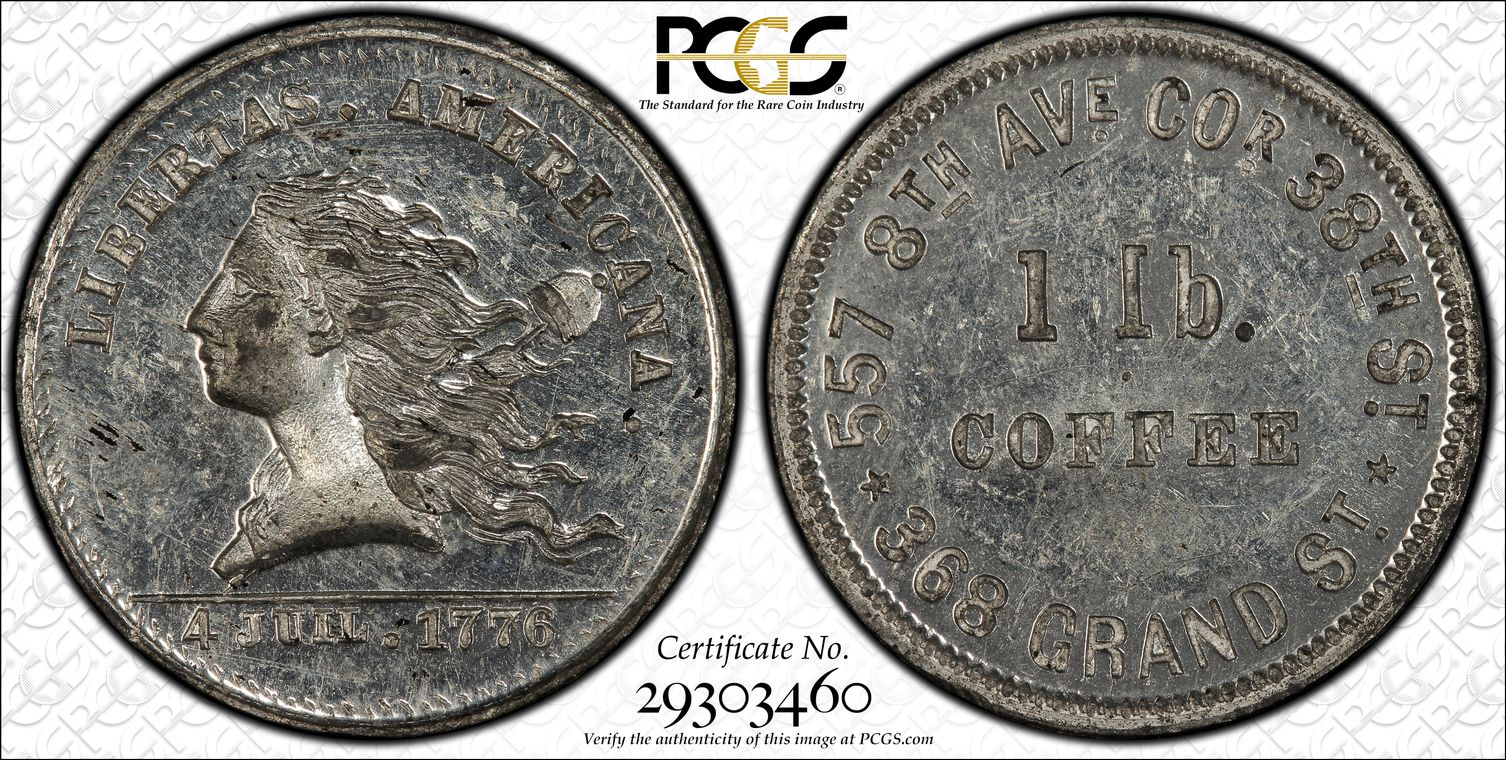
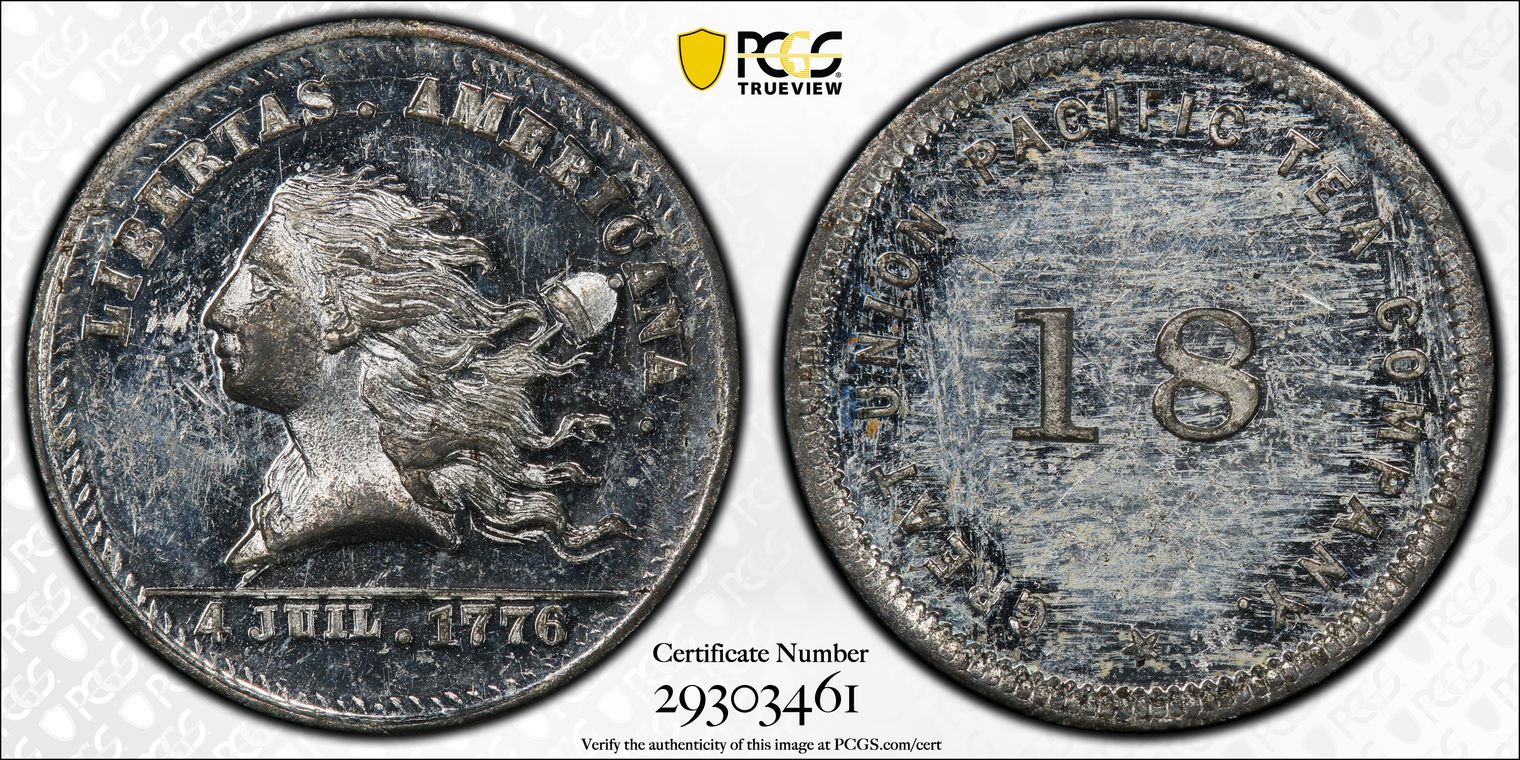
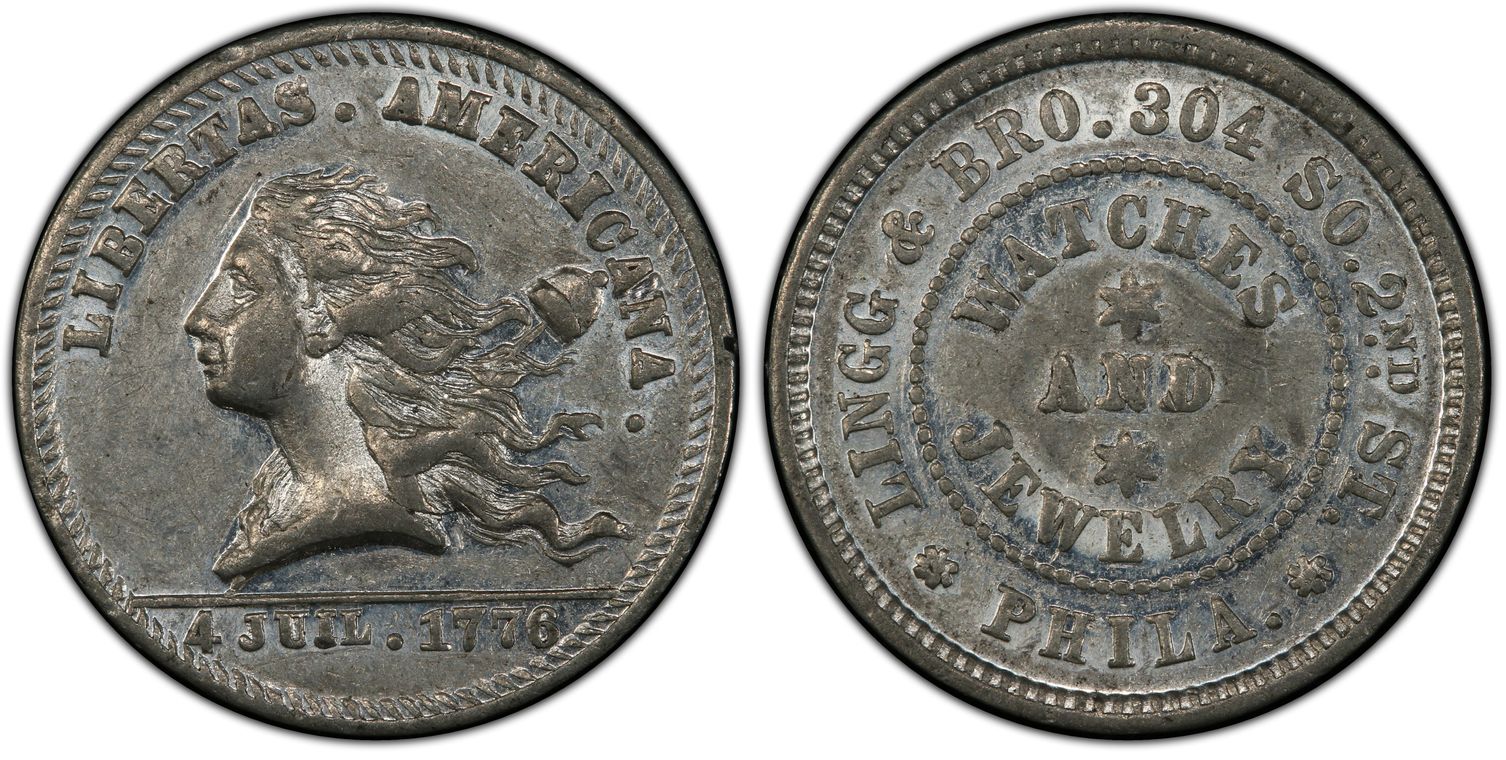
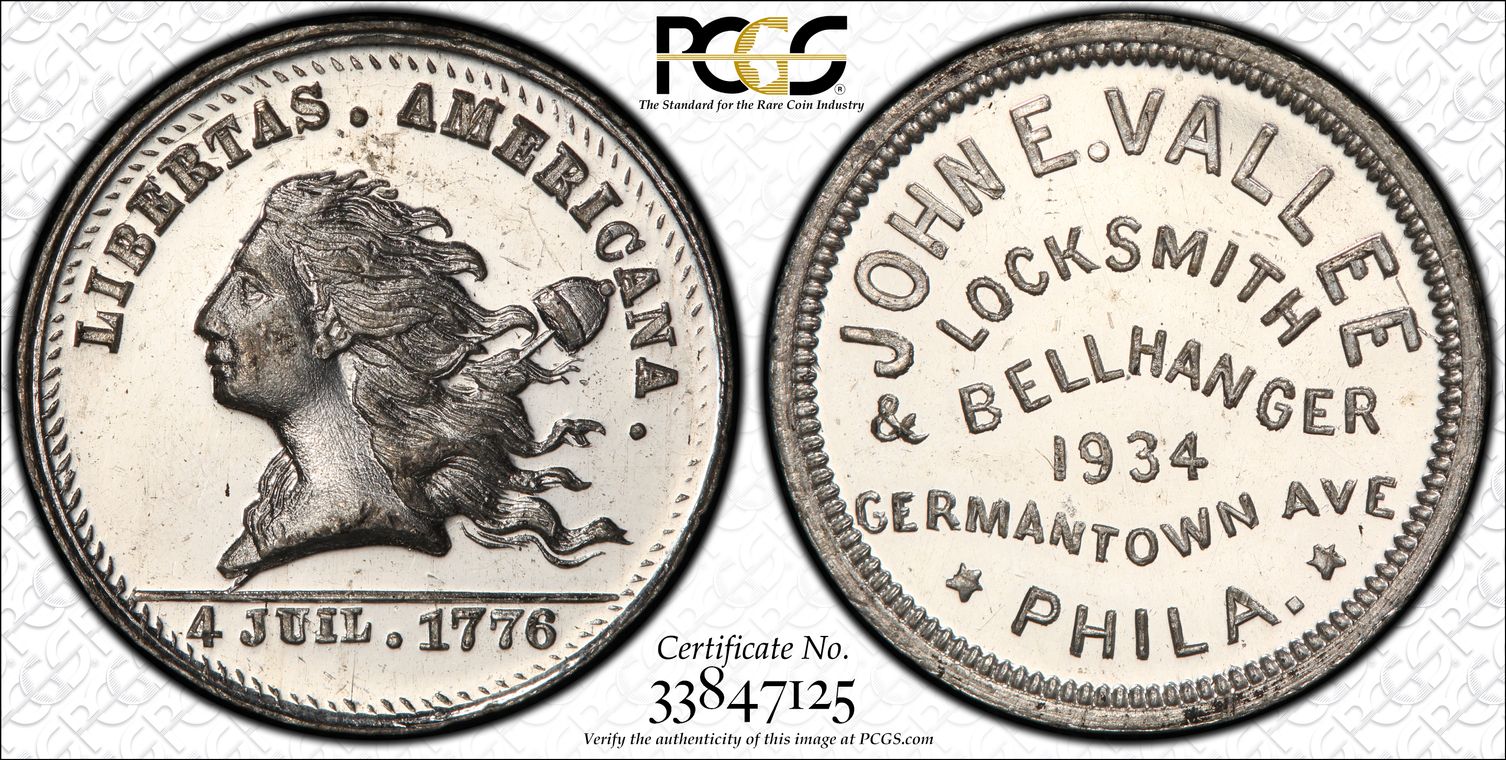
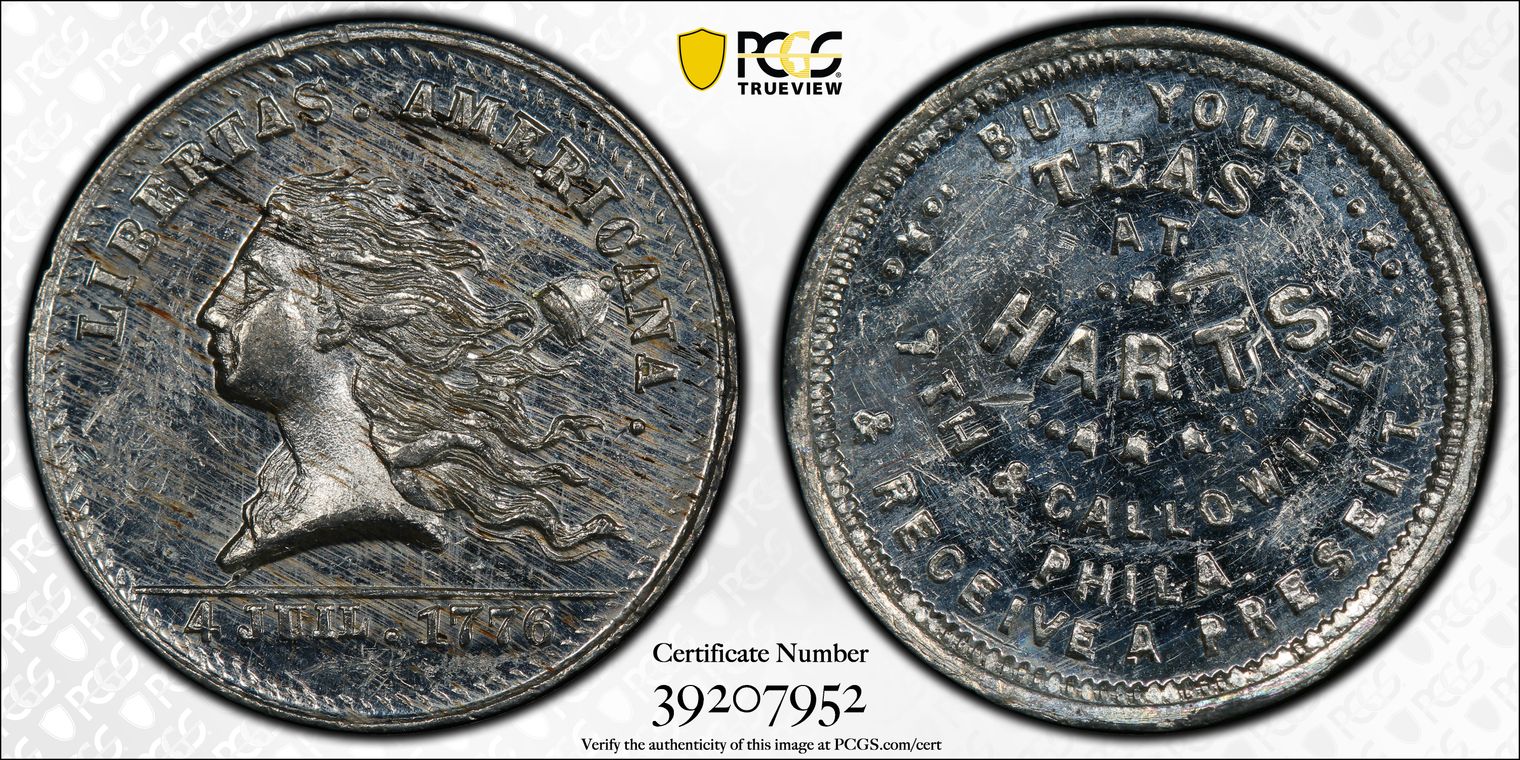
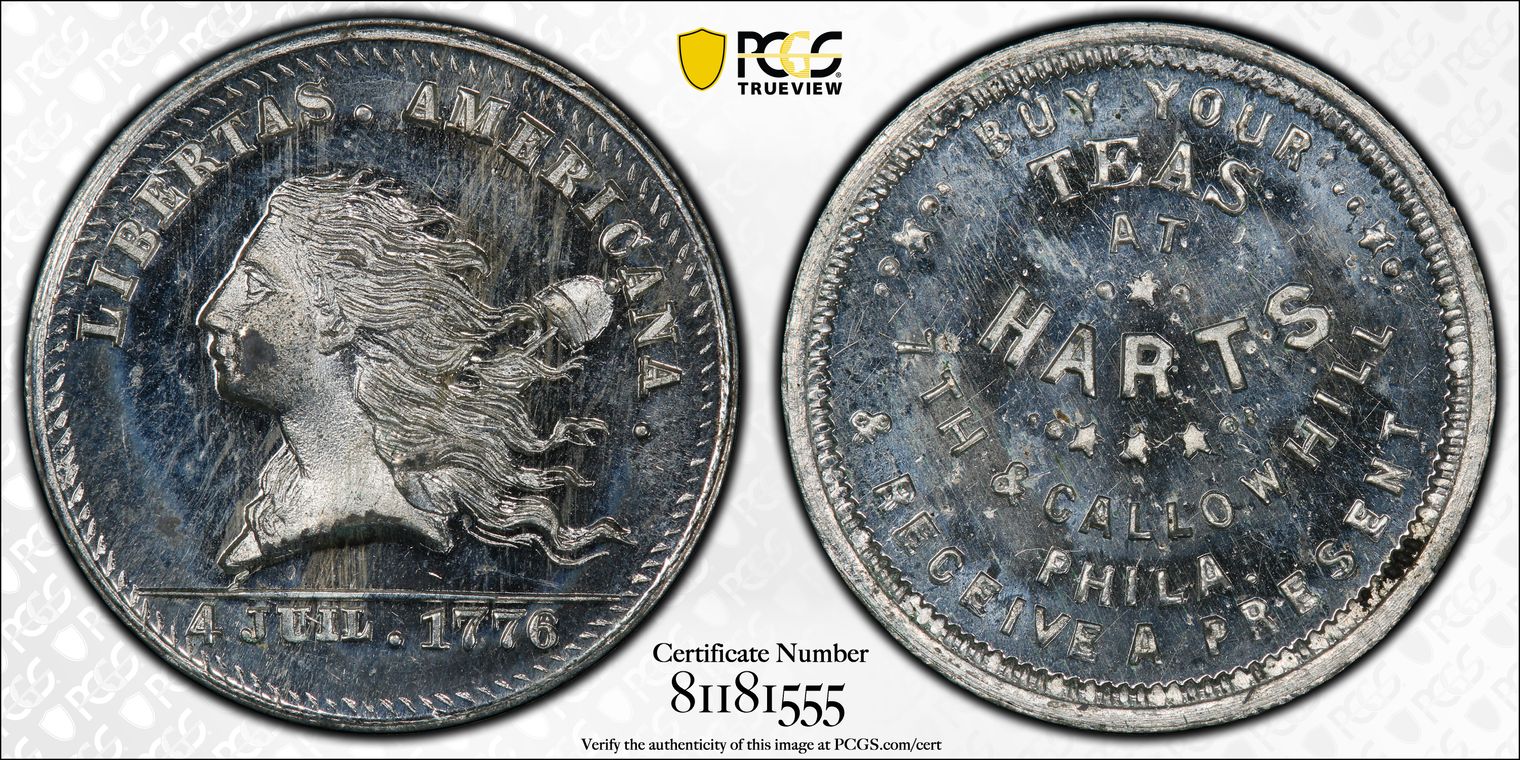
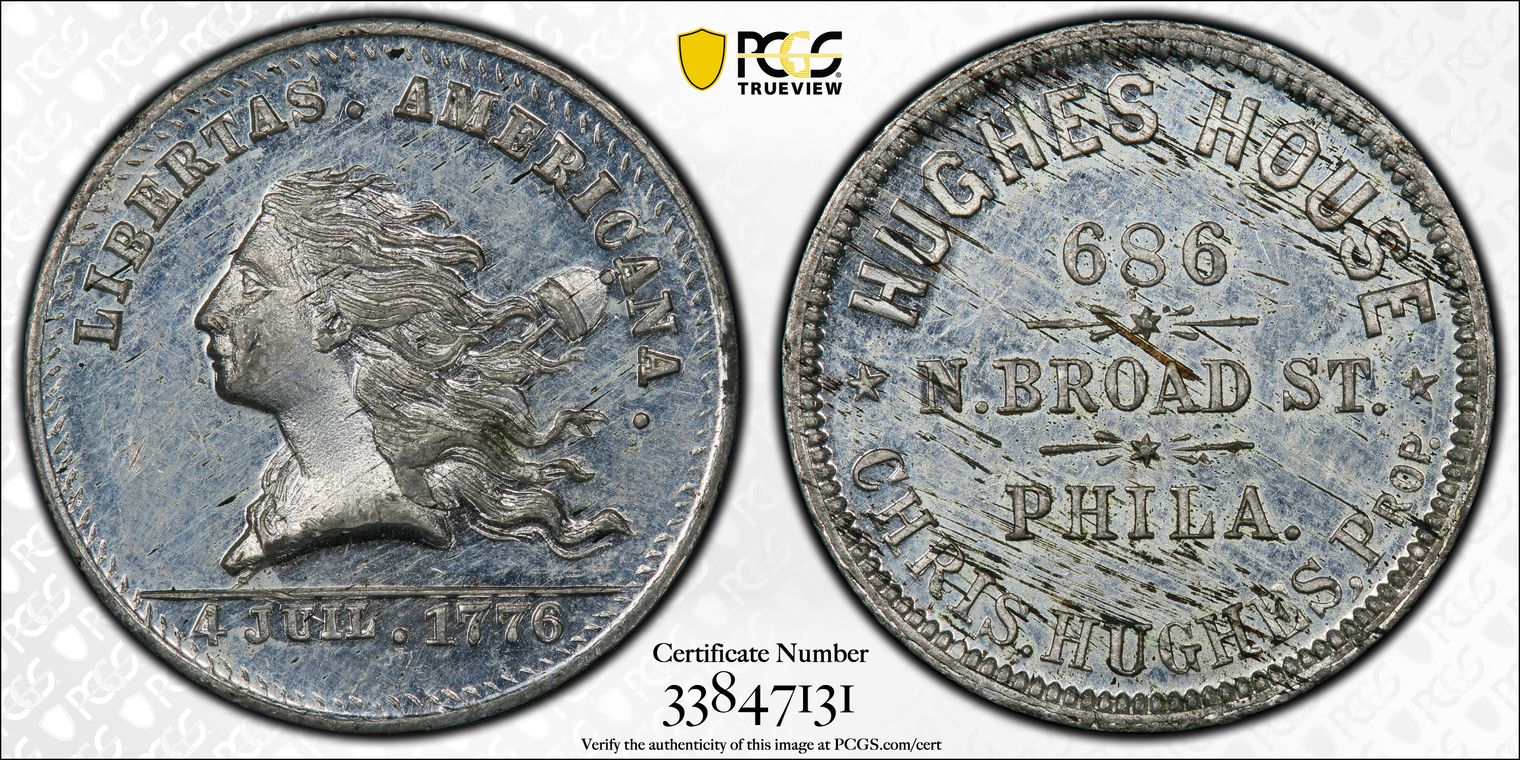
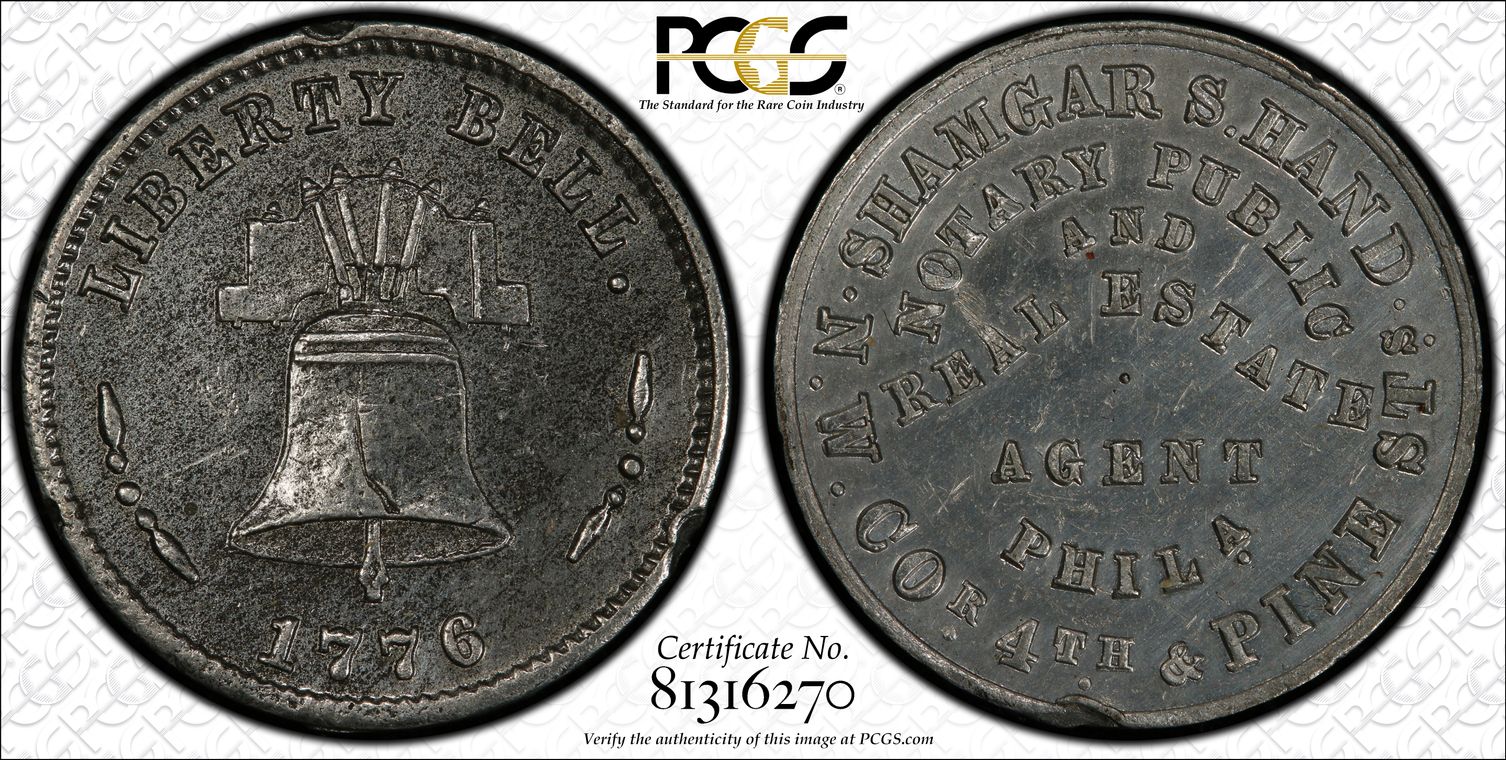
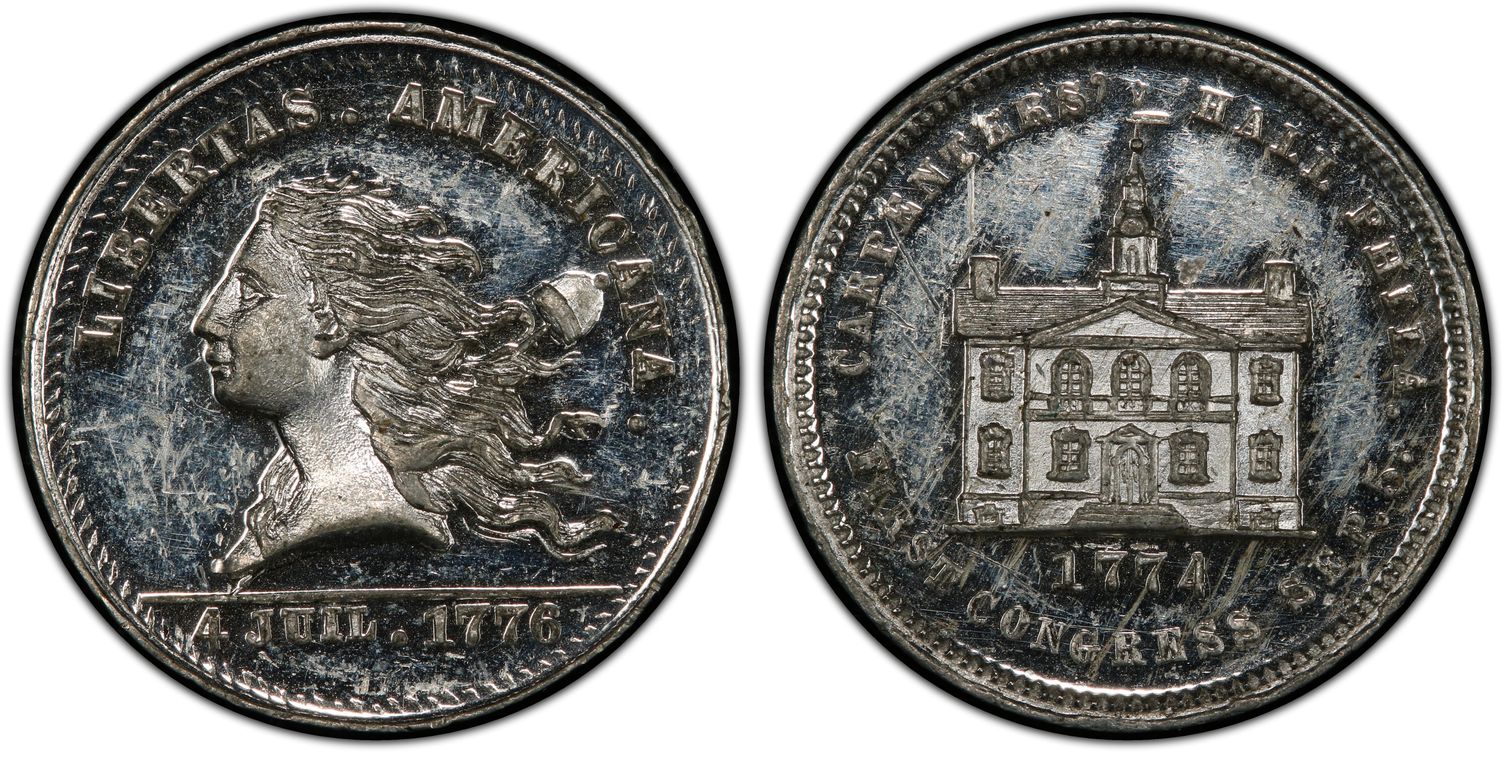
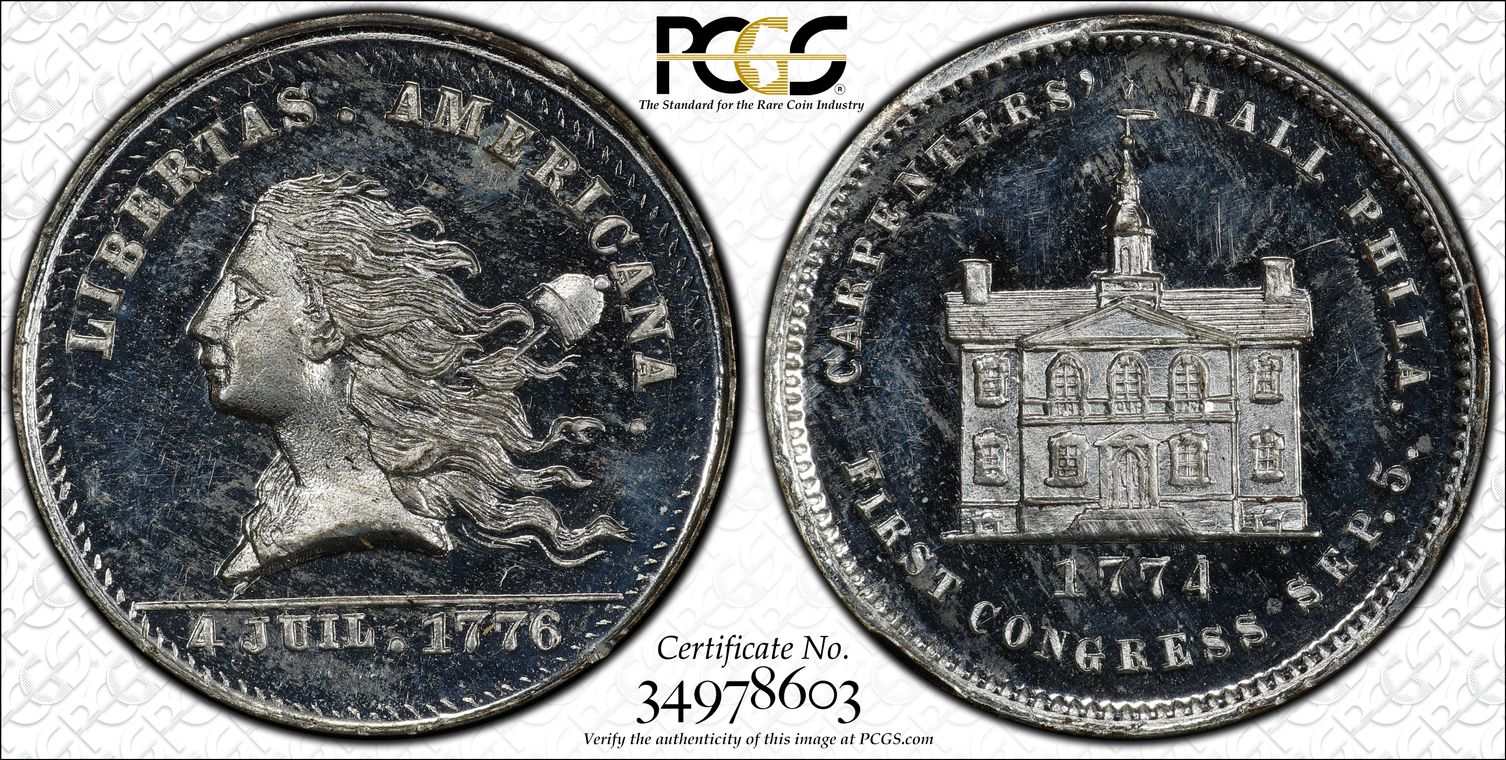
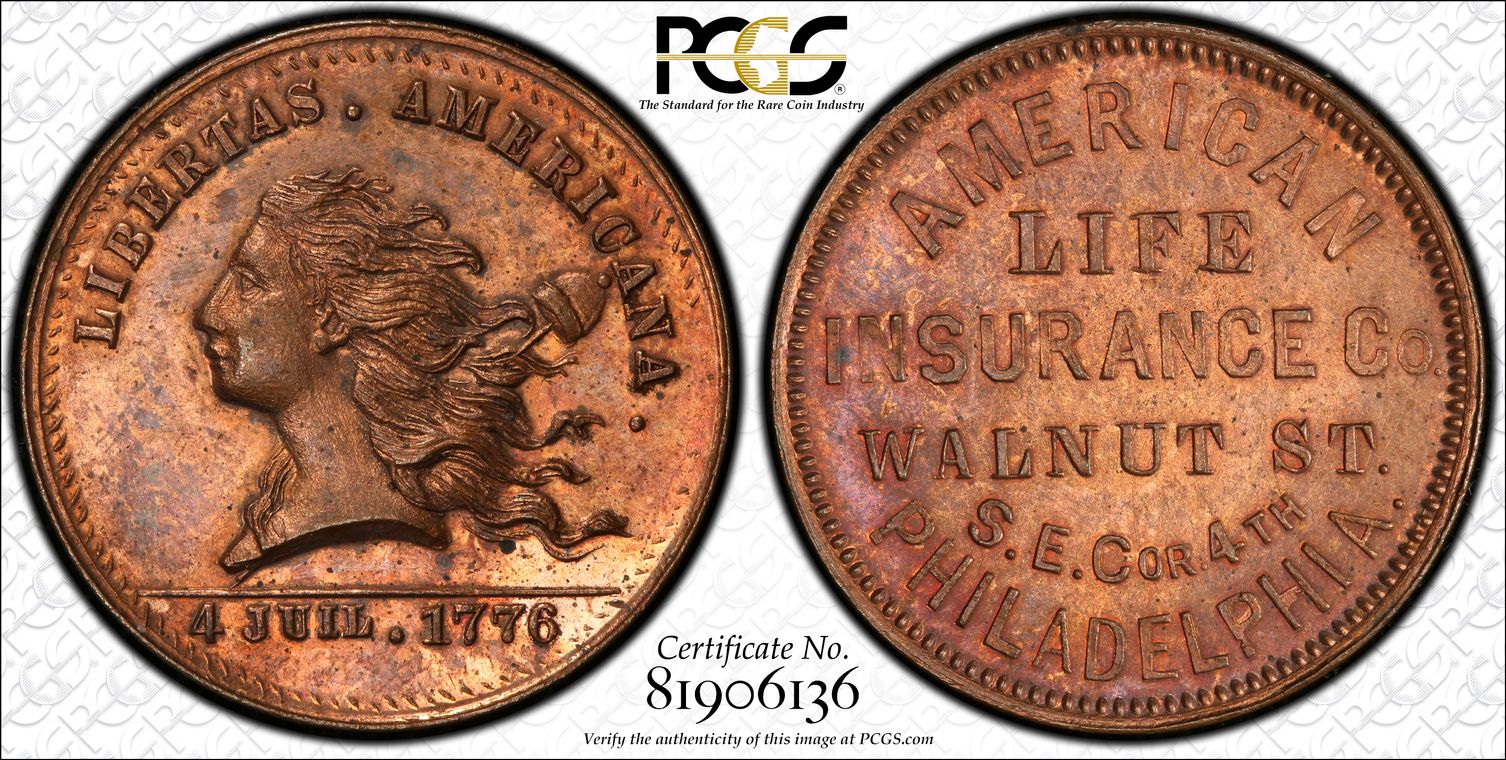
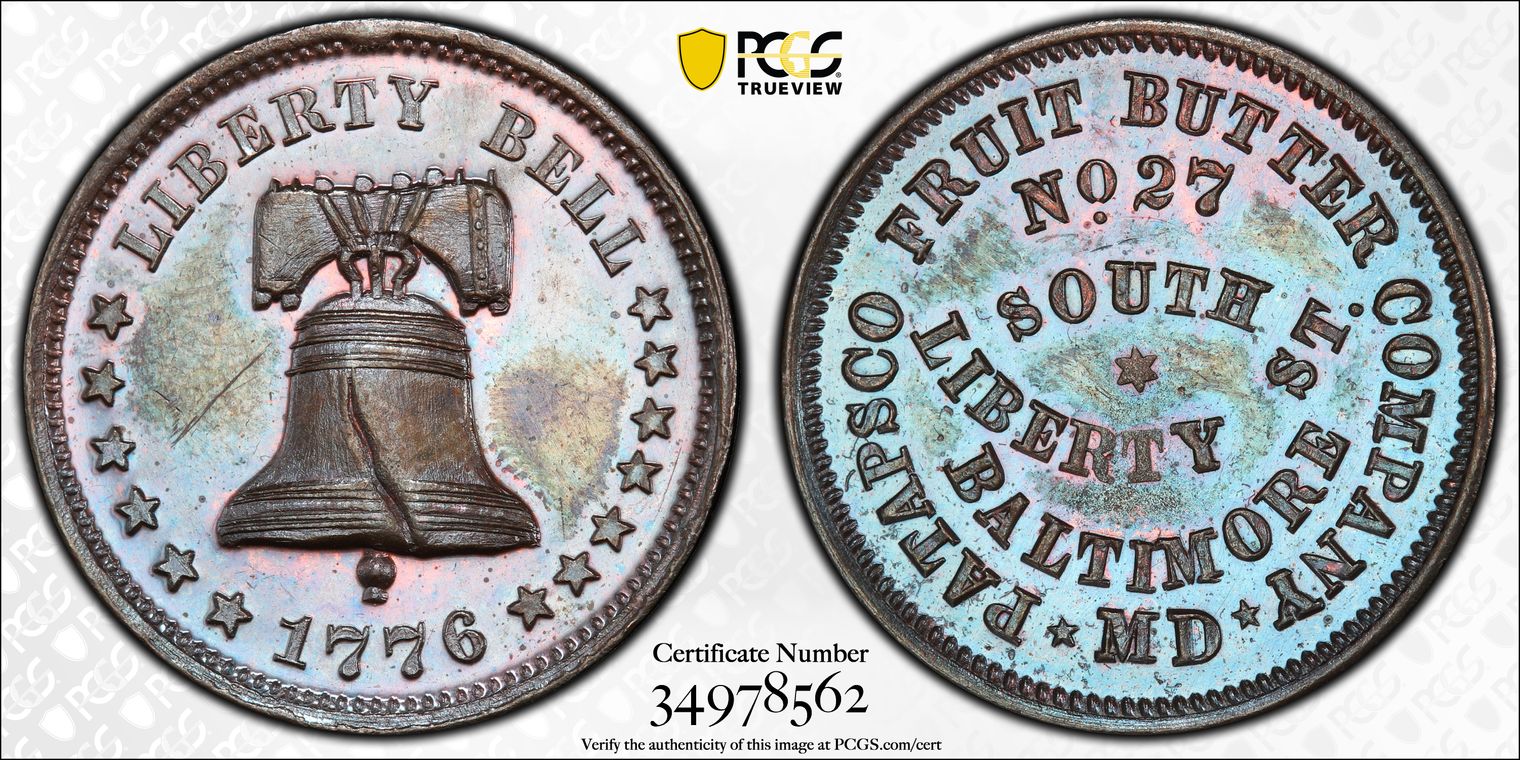
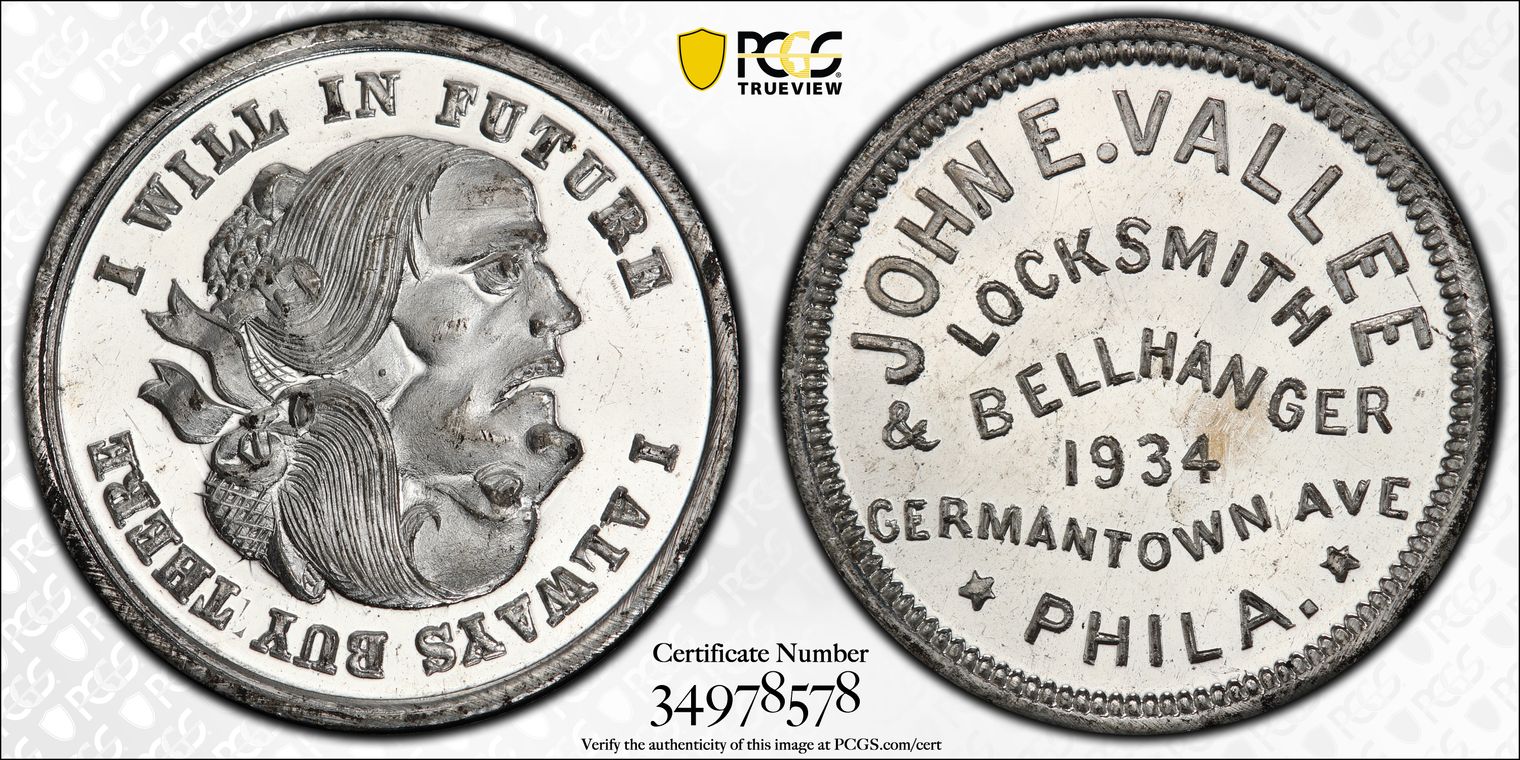
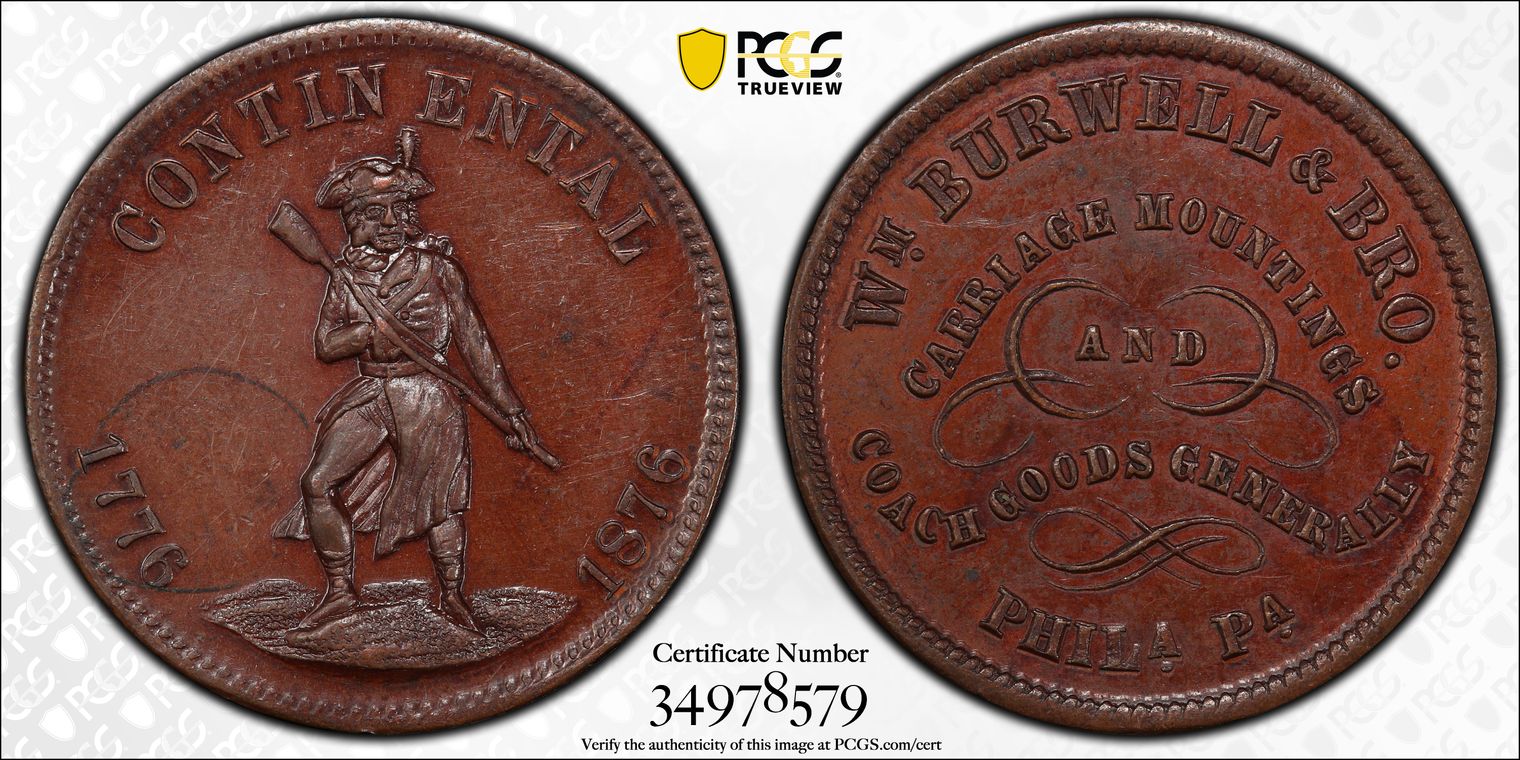
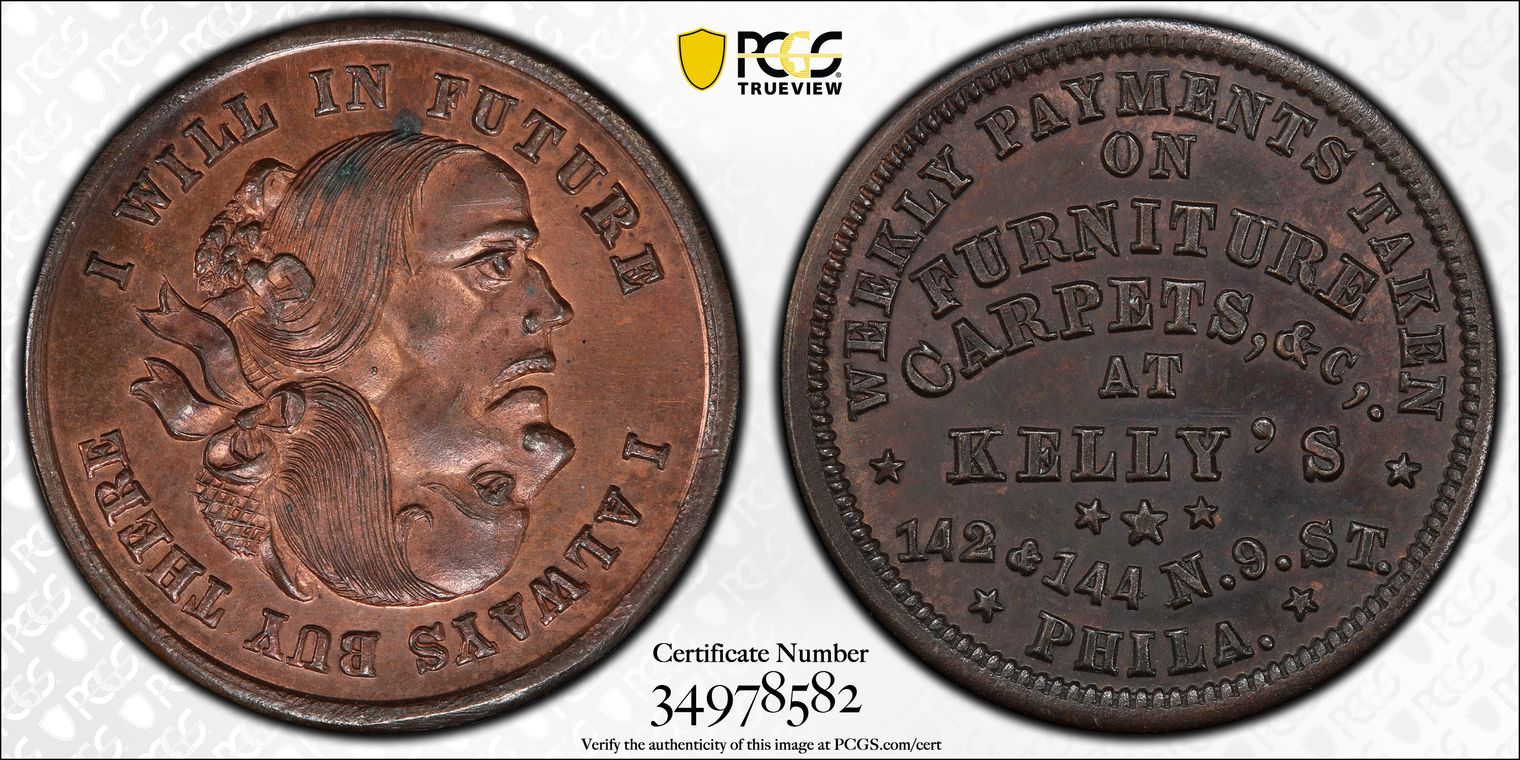
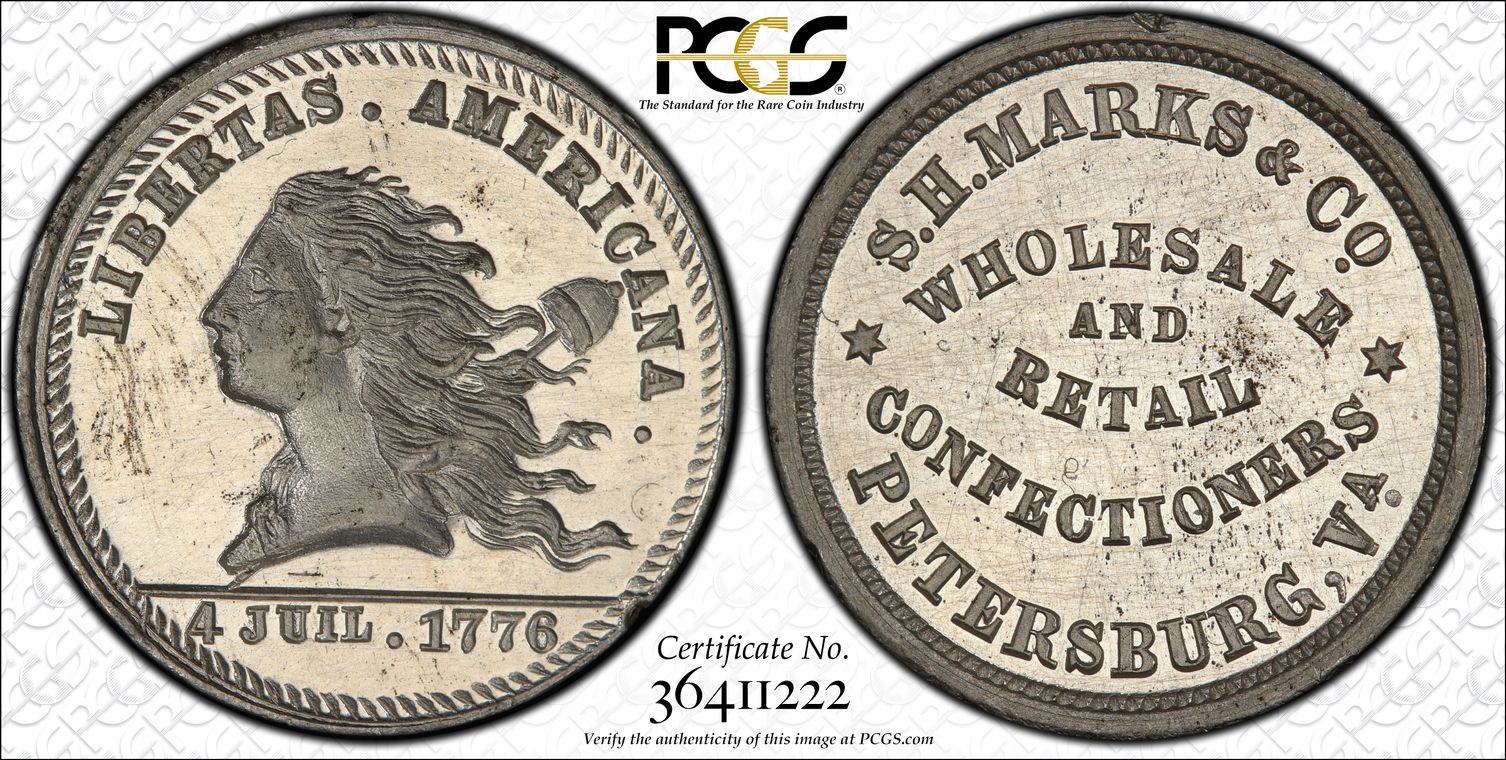
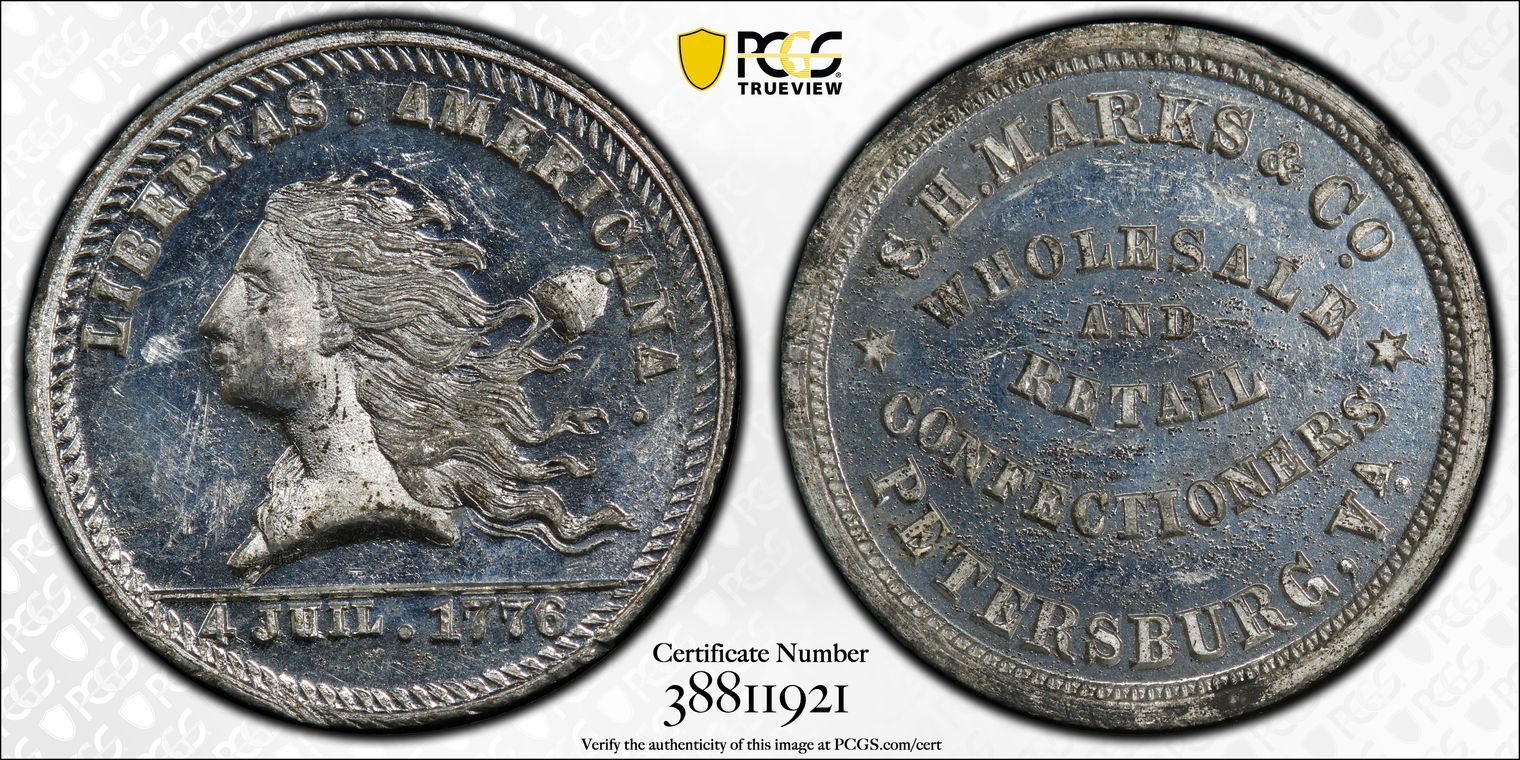
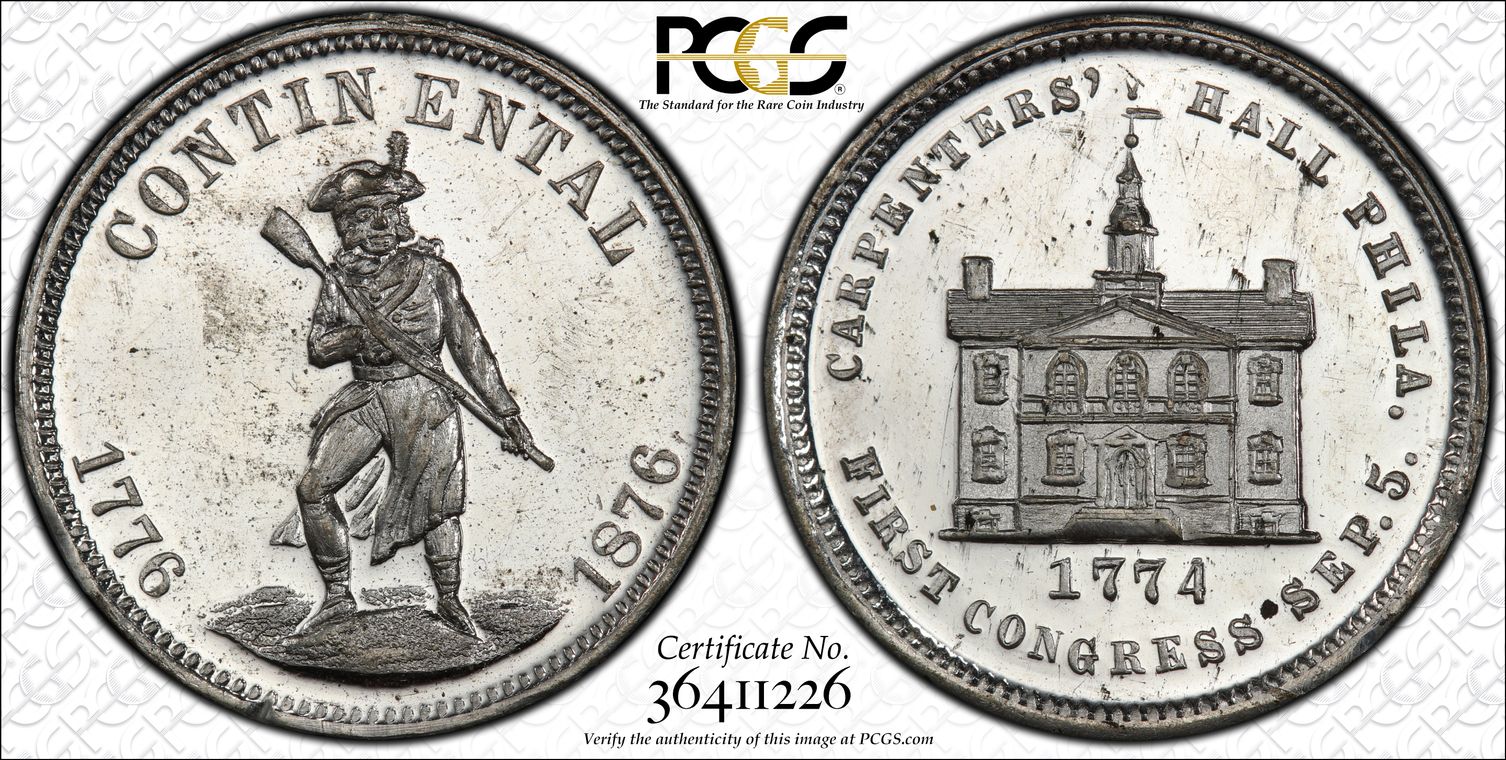
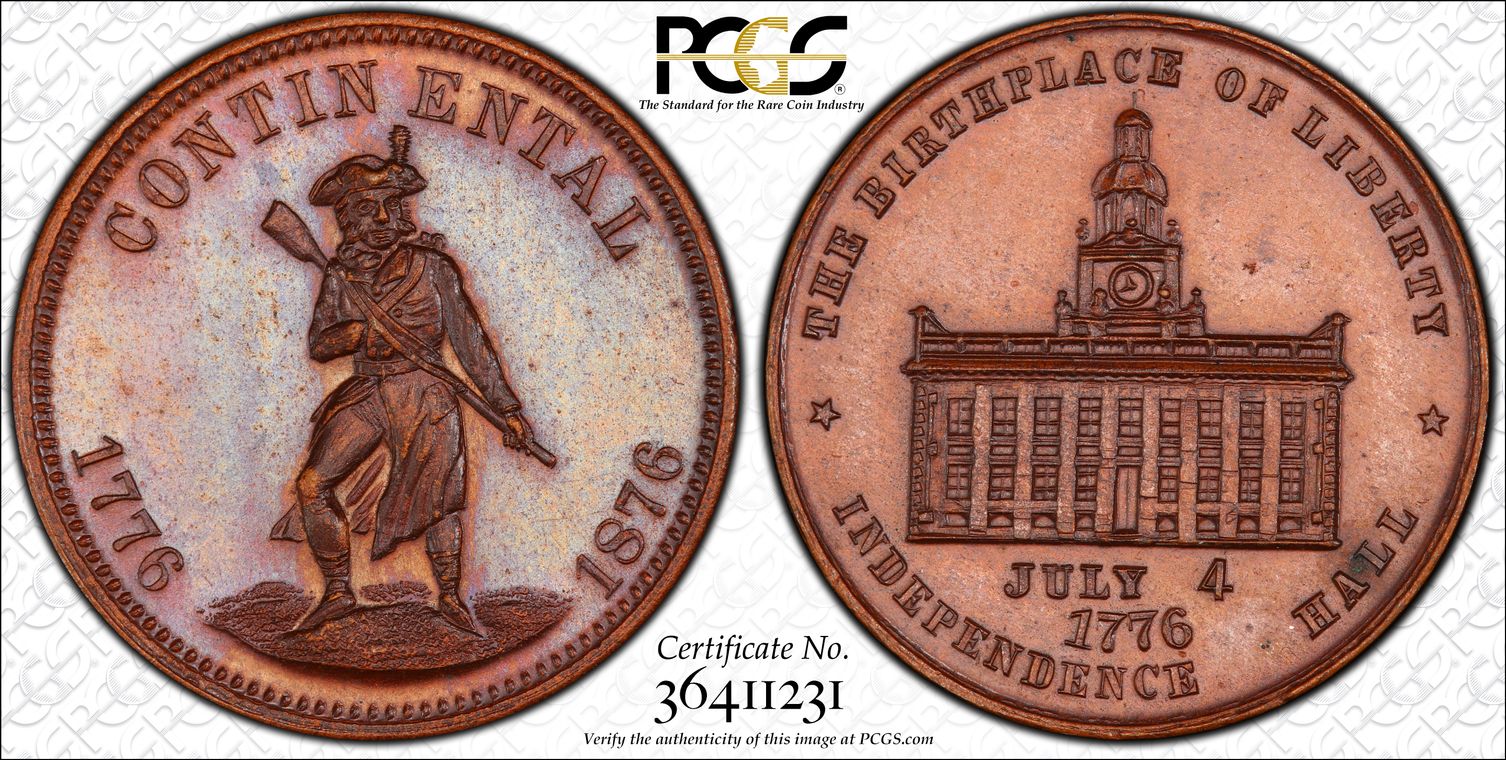
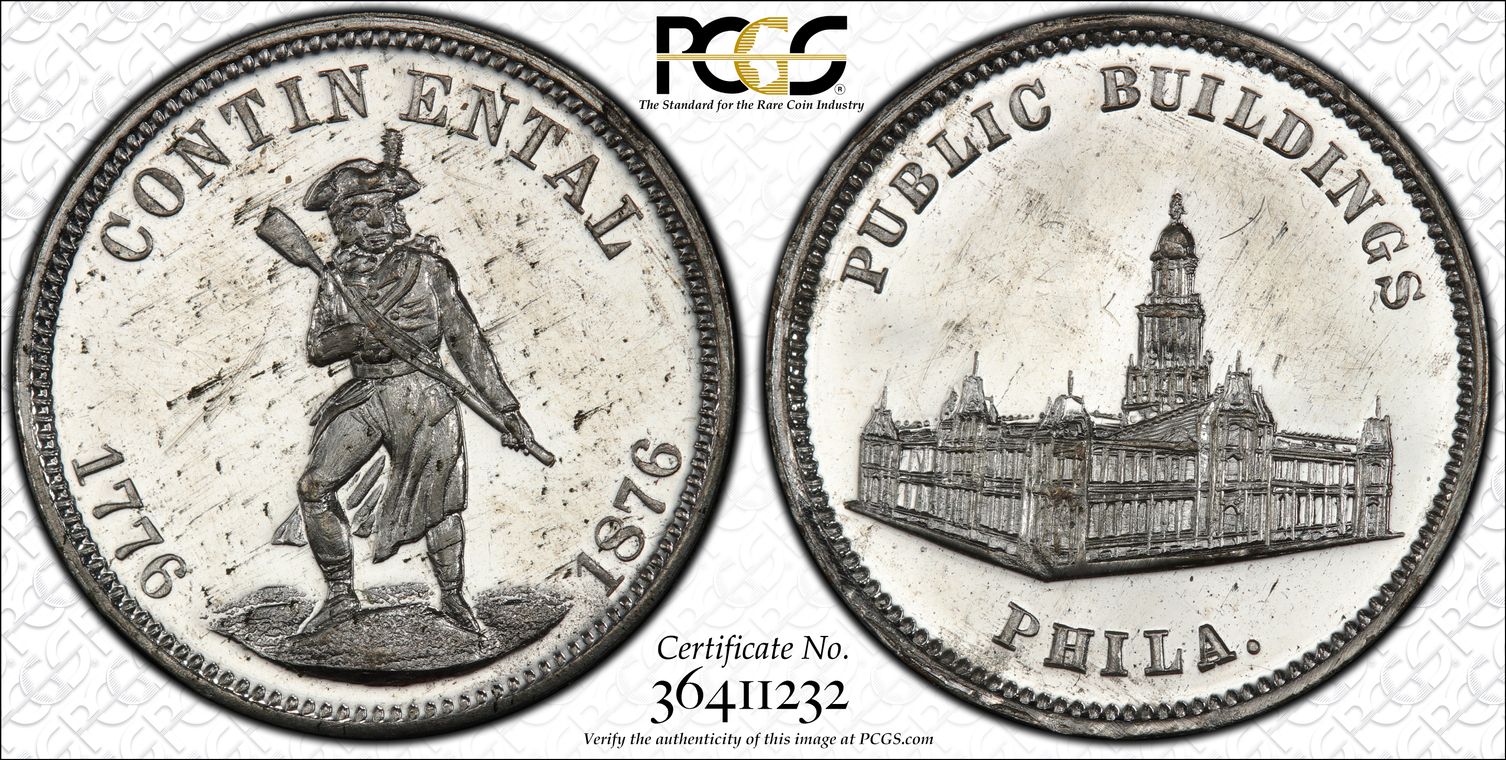
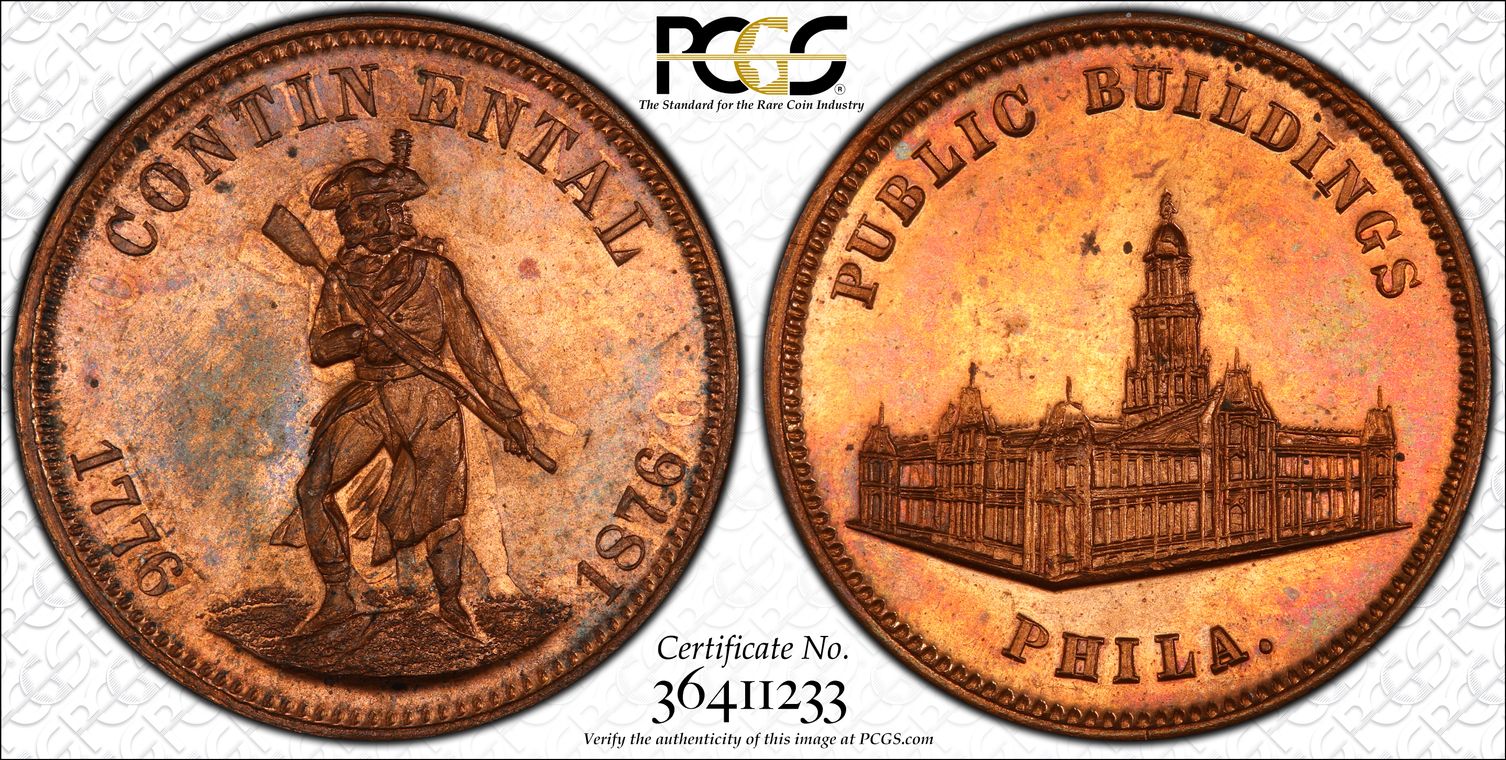
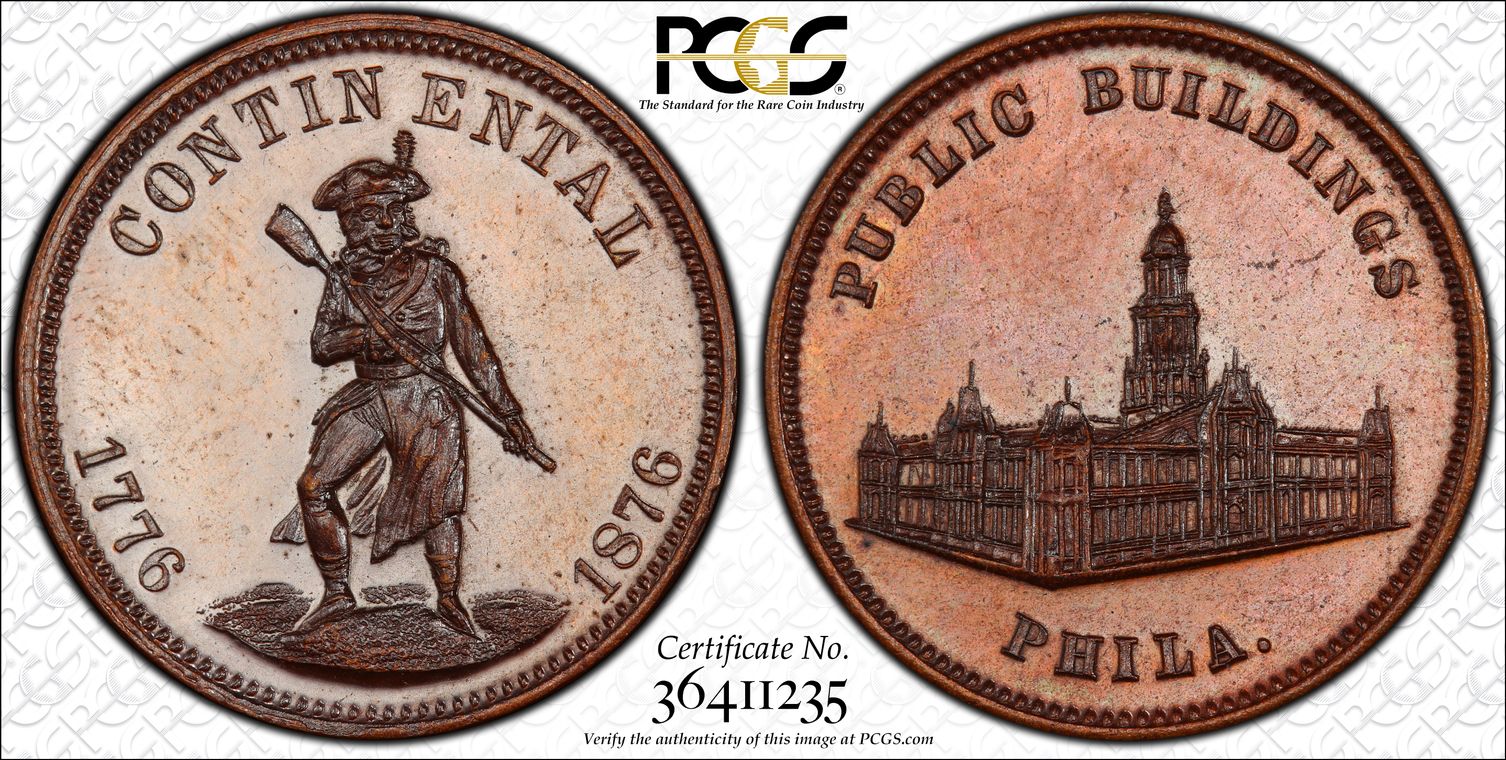
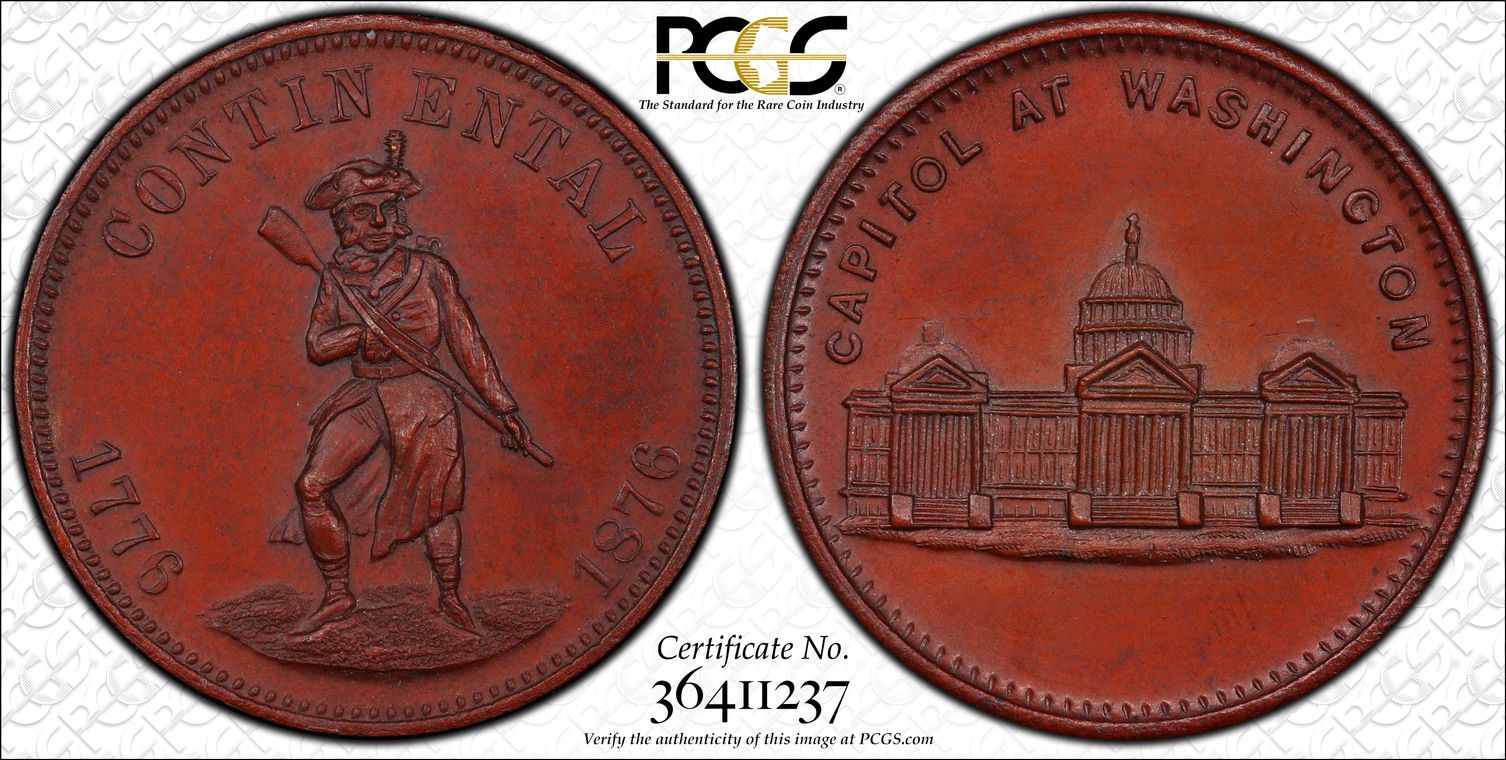
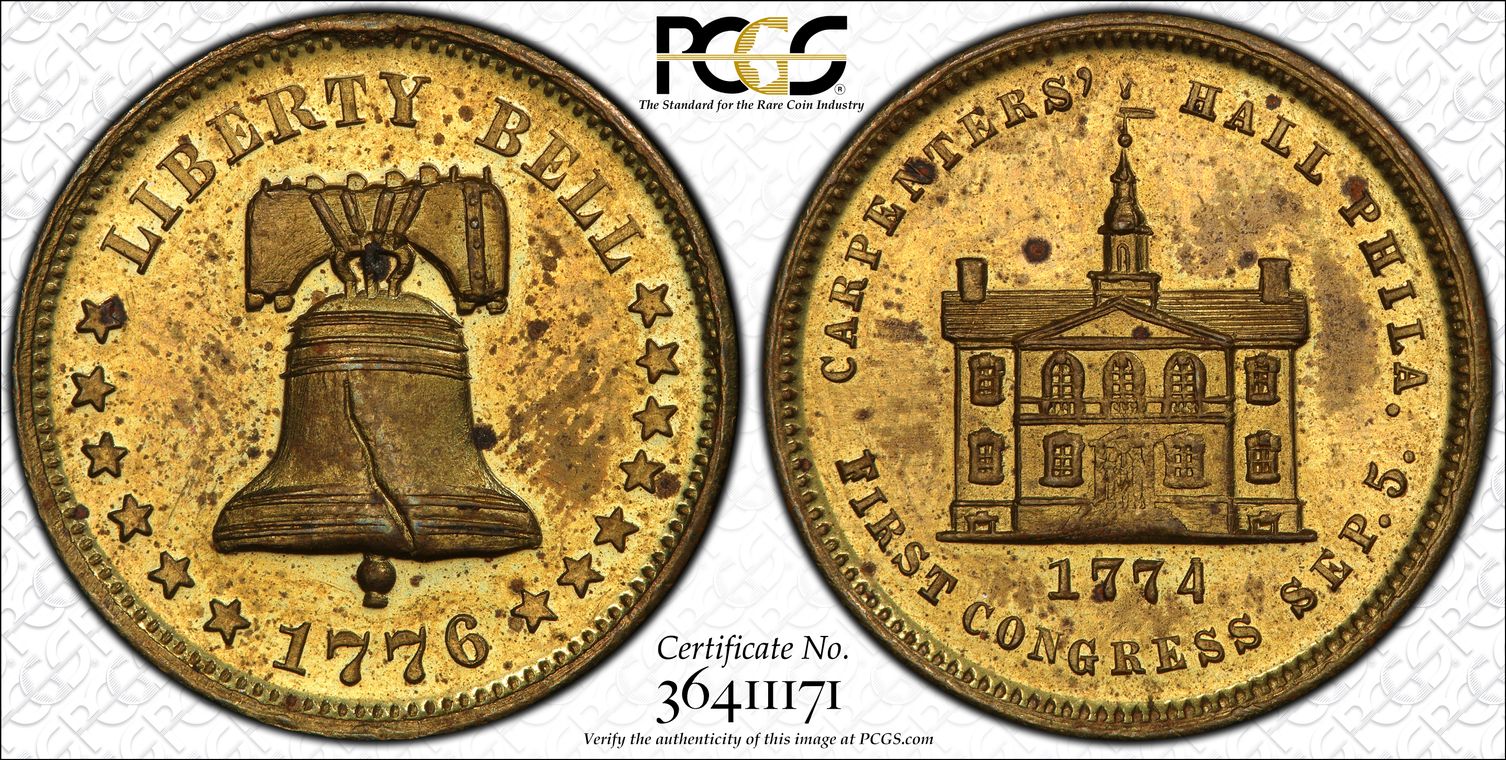
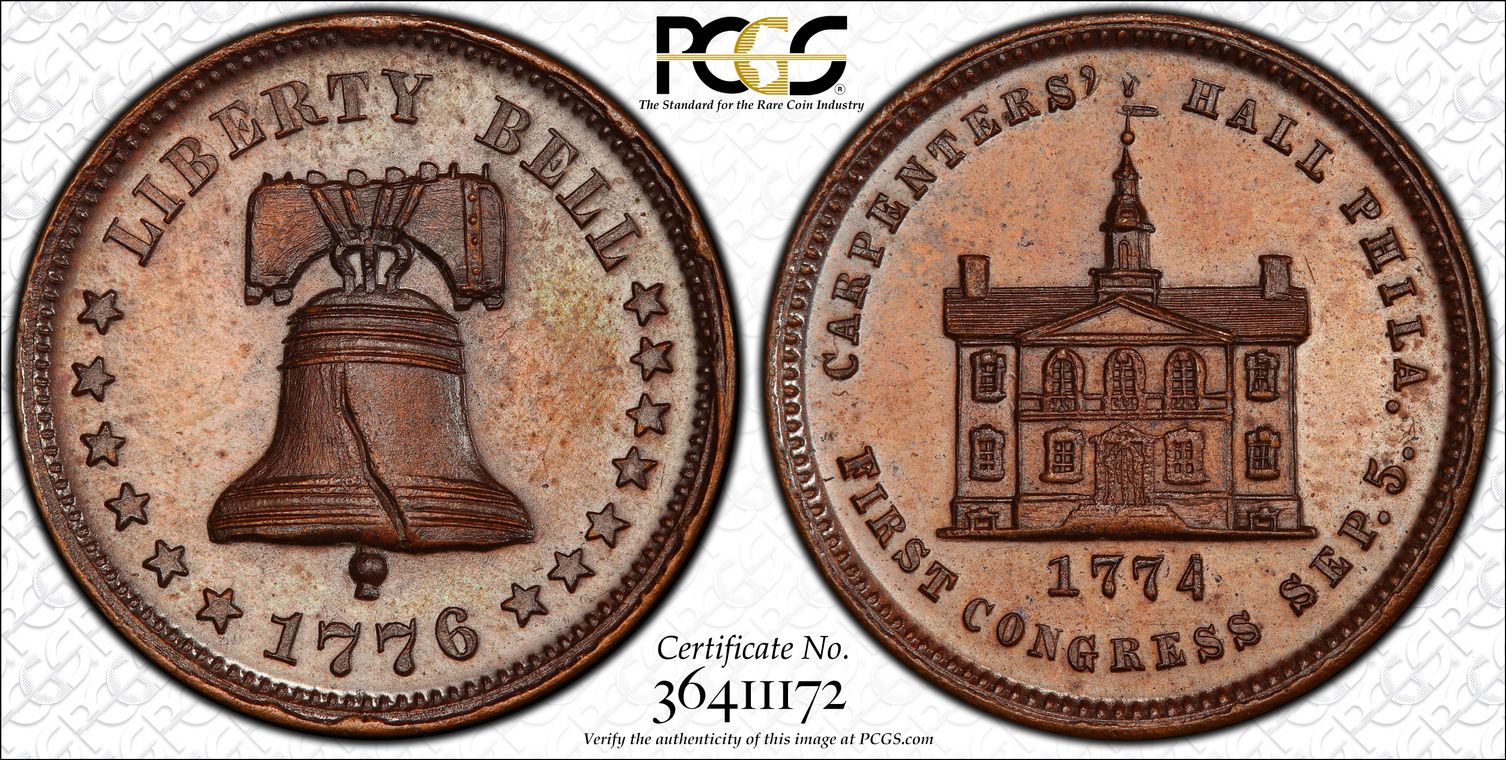
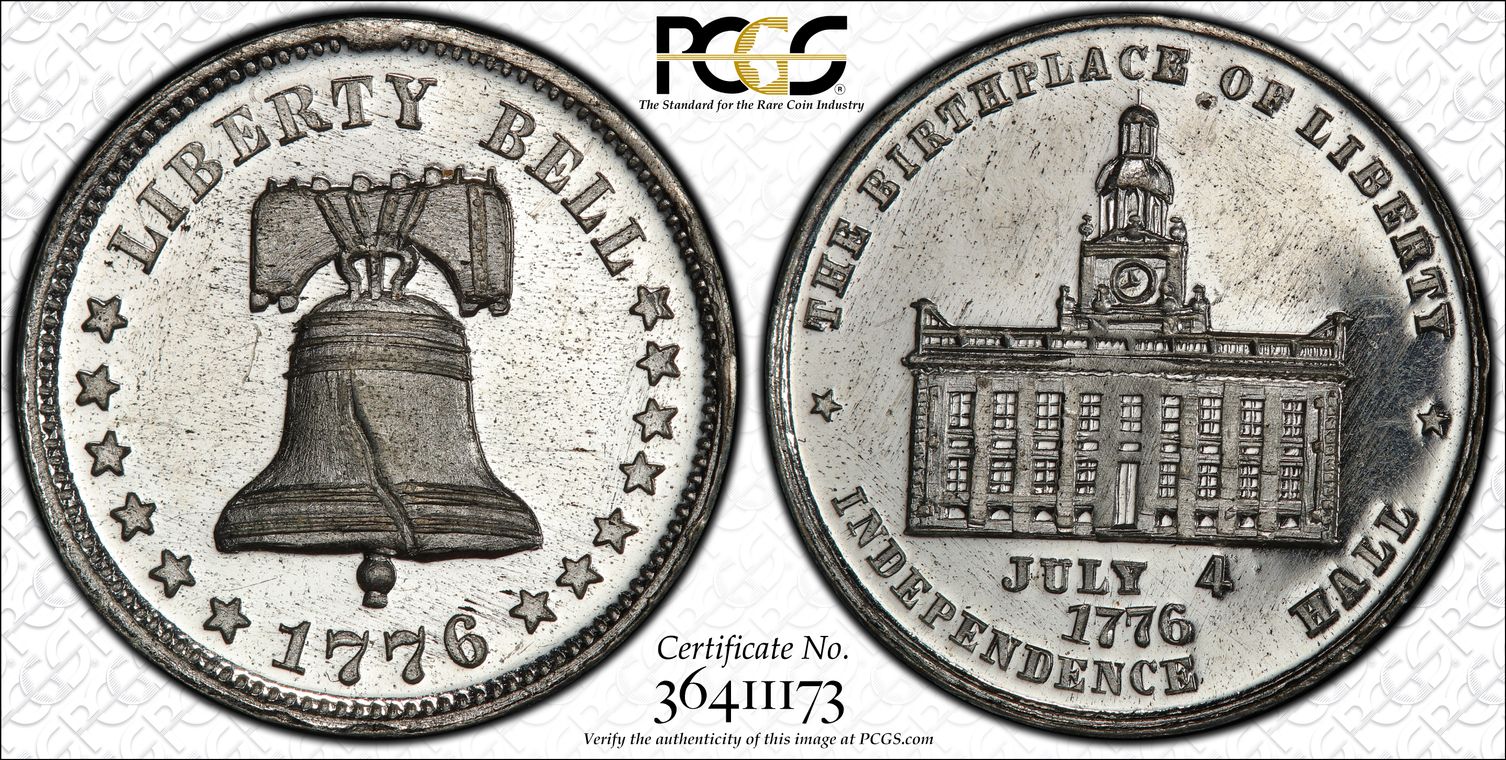
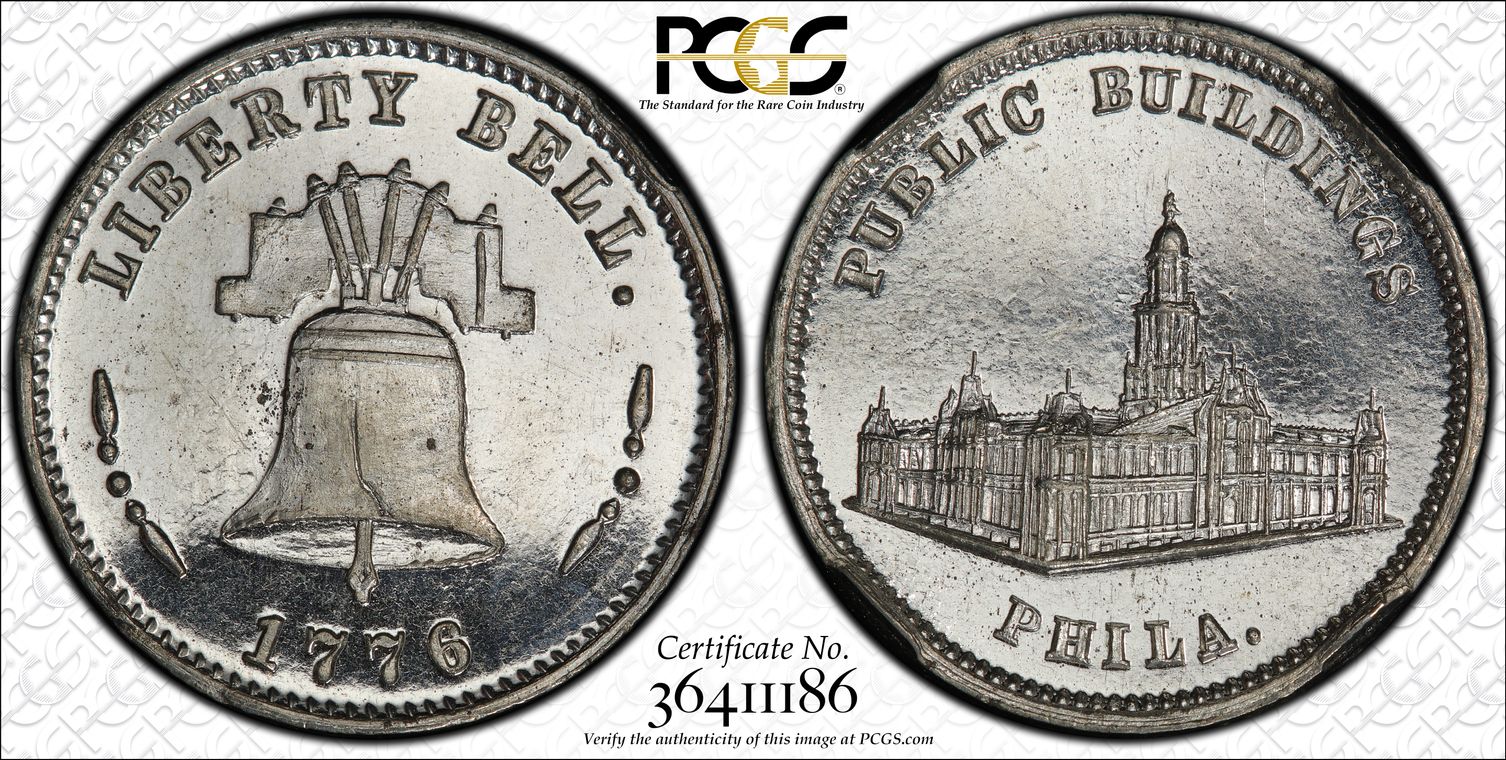
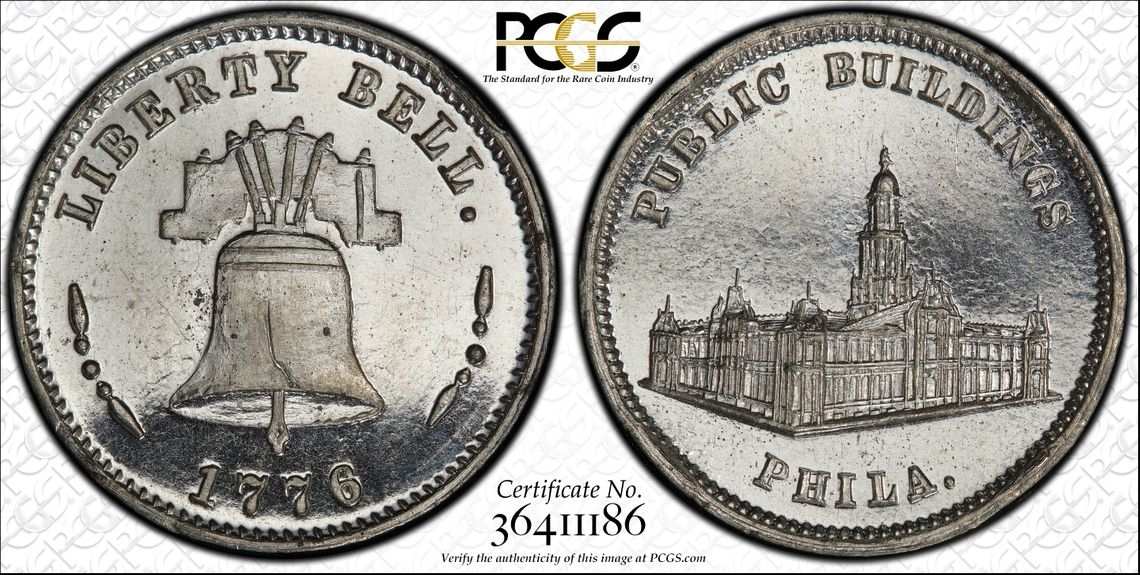
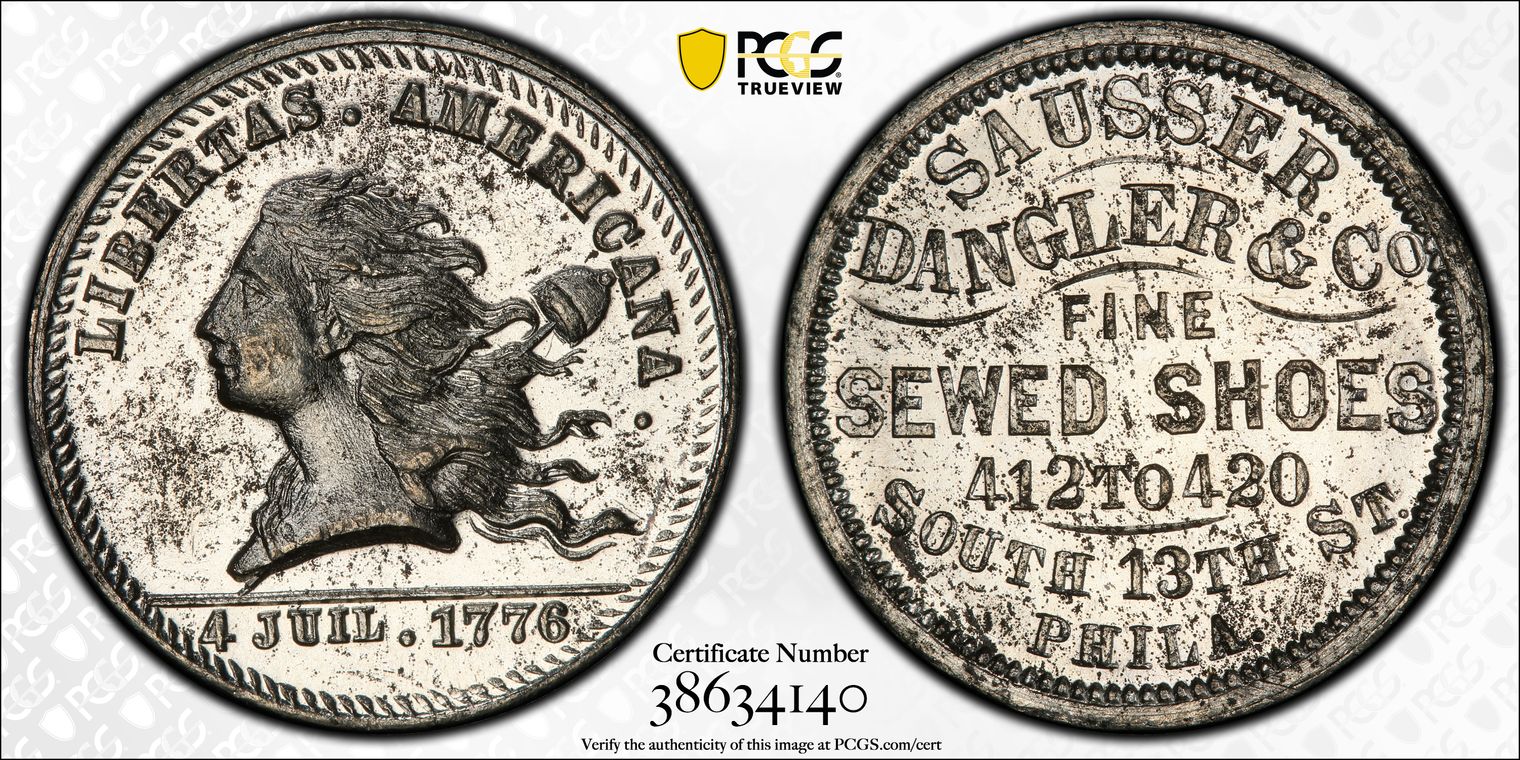
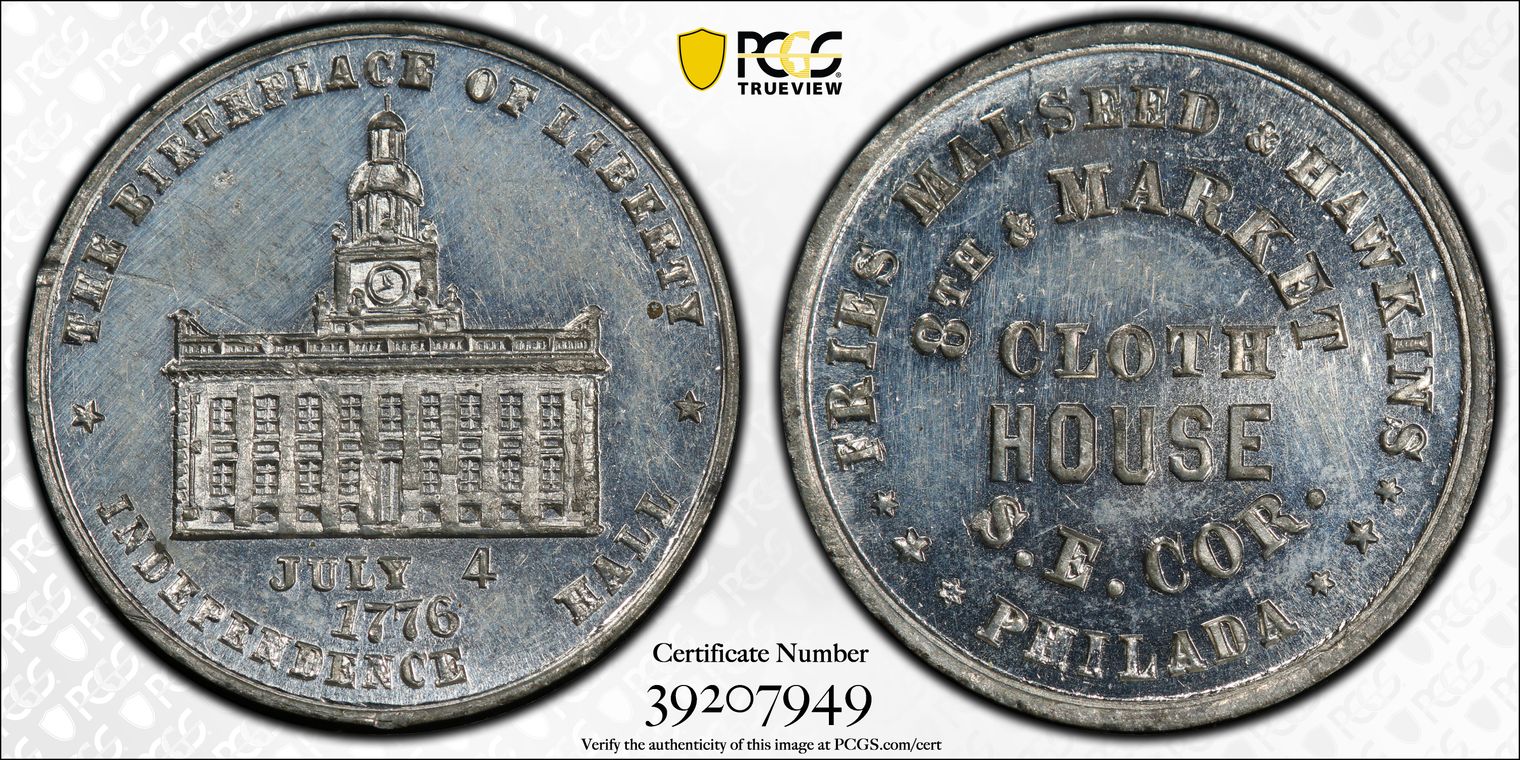
For the United States Centennial celebration in 1876, the Libertas Americana design was once again brought into the spotlight, with the Lingg Brothers of Philadelphia producing their own 23mm Libertas die for patriotic medals and merchant tokens. Aside from its somewhat smaller size, this die is readily distinguished from Bolen's Libertas die by the orientation of Liberty's cap. On the Bolen die, the cap points to the "I" in Americana; whereas on the Lingg die, the cap points to the second "A". Like the Bolen die, the Lingg die was used to strike medals and tokens with an assortment of reverse dies in a variety of metals. All totalled, this Libertas Americana die was paired with 67 different reverse dies, resulting in 152 known die/metal combinations. Here we see the the Libertas Americana die paired with a Liberty Bell die, creating a patriotic medal purely in commemoration of the Centennial.
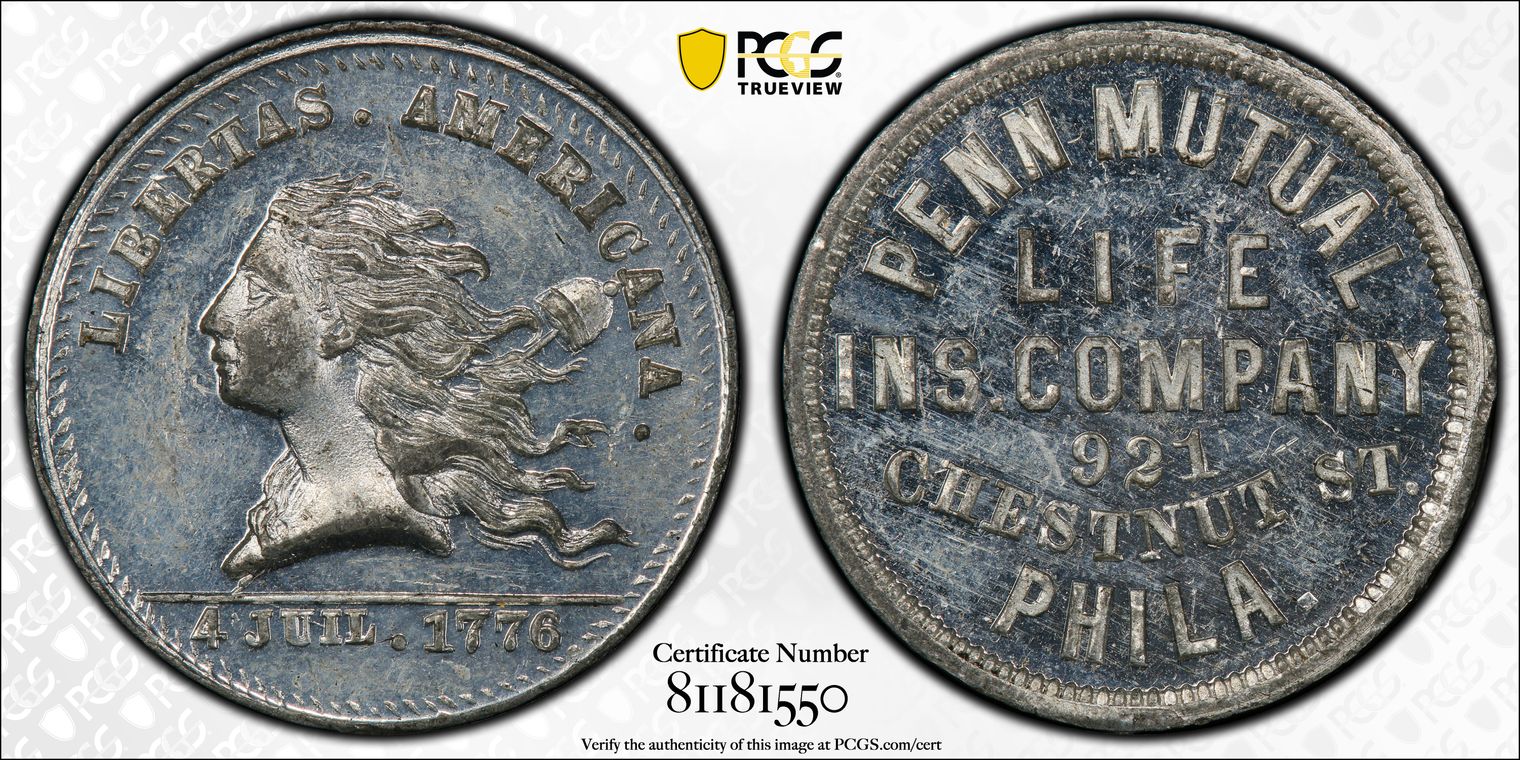
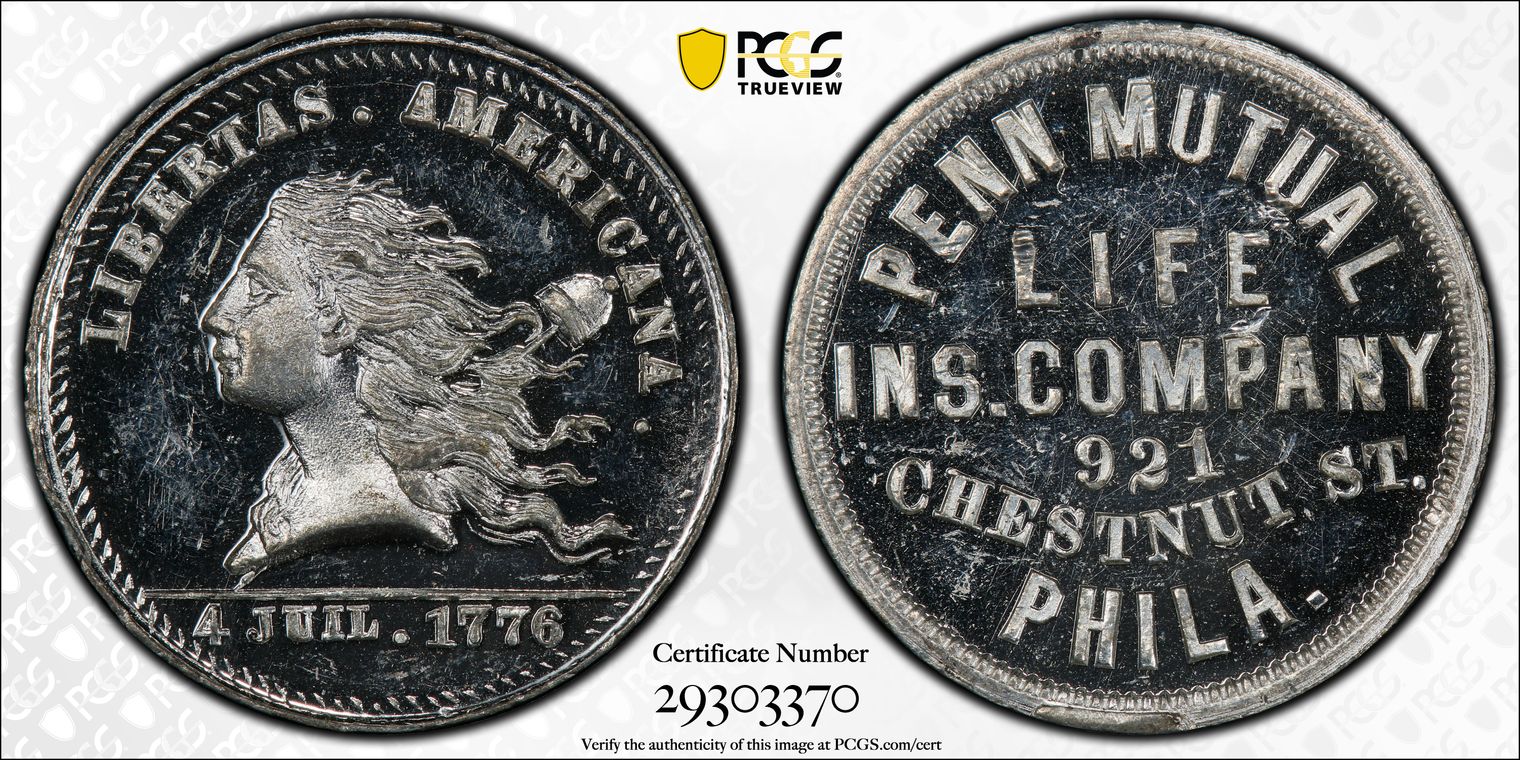
Ex: Richard Crosby
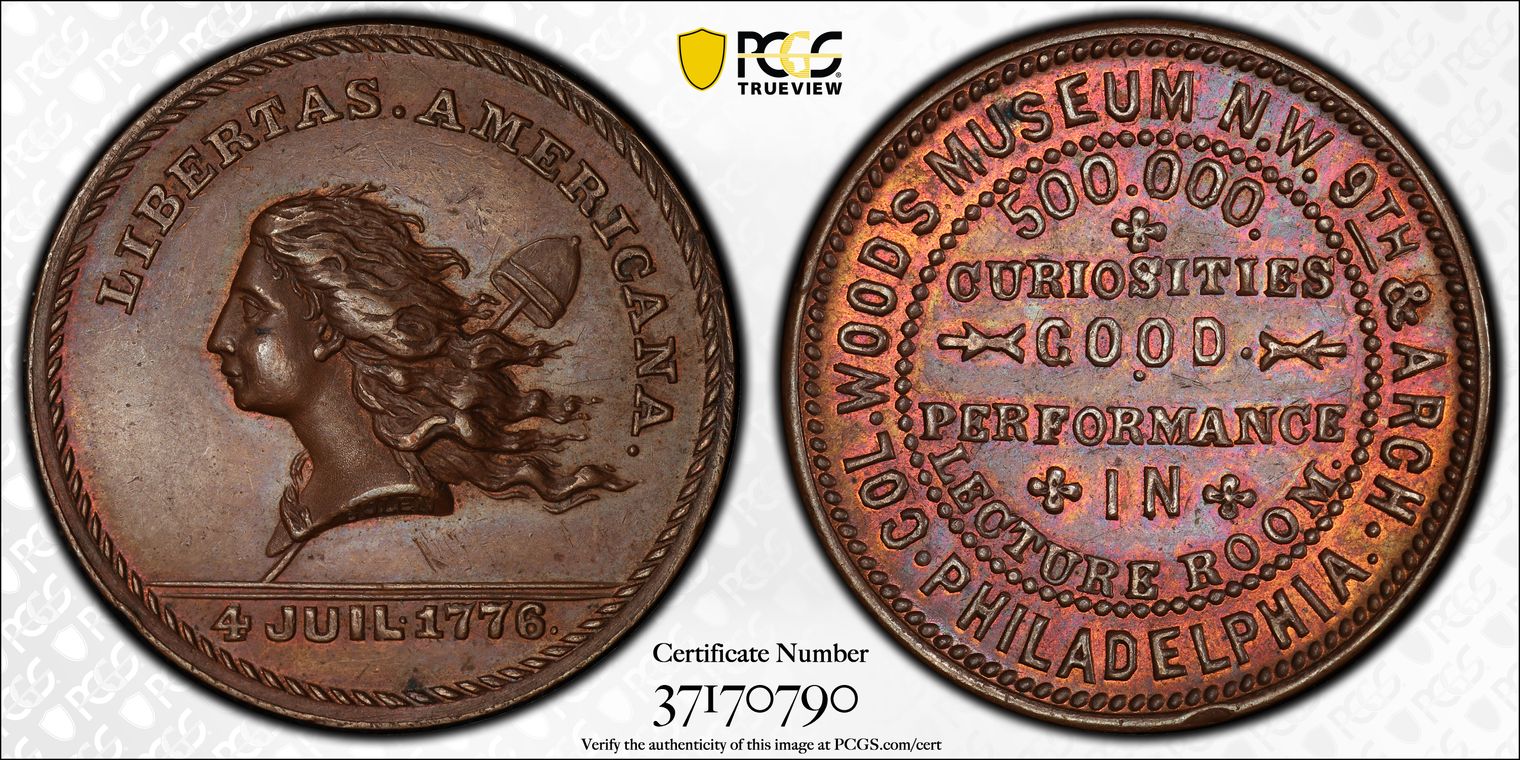

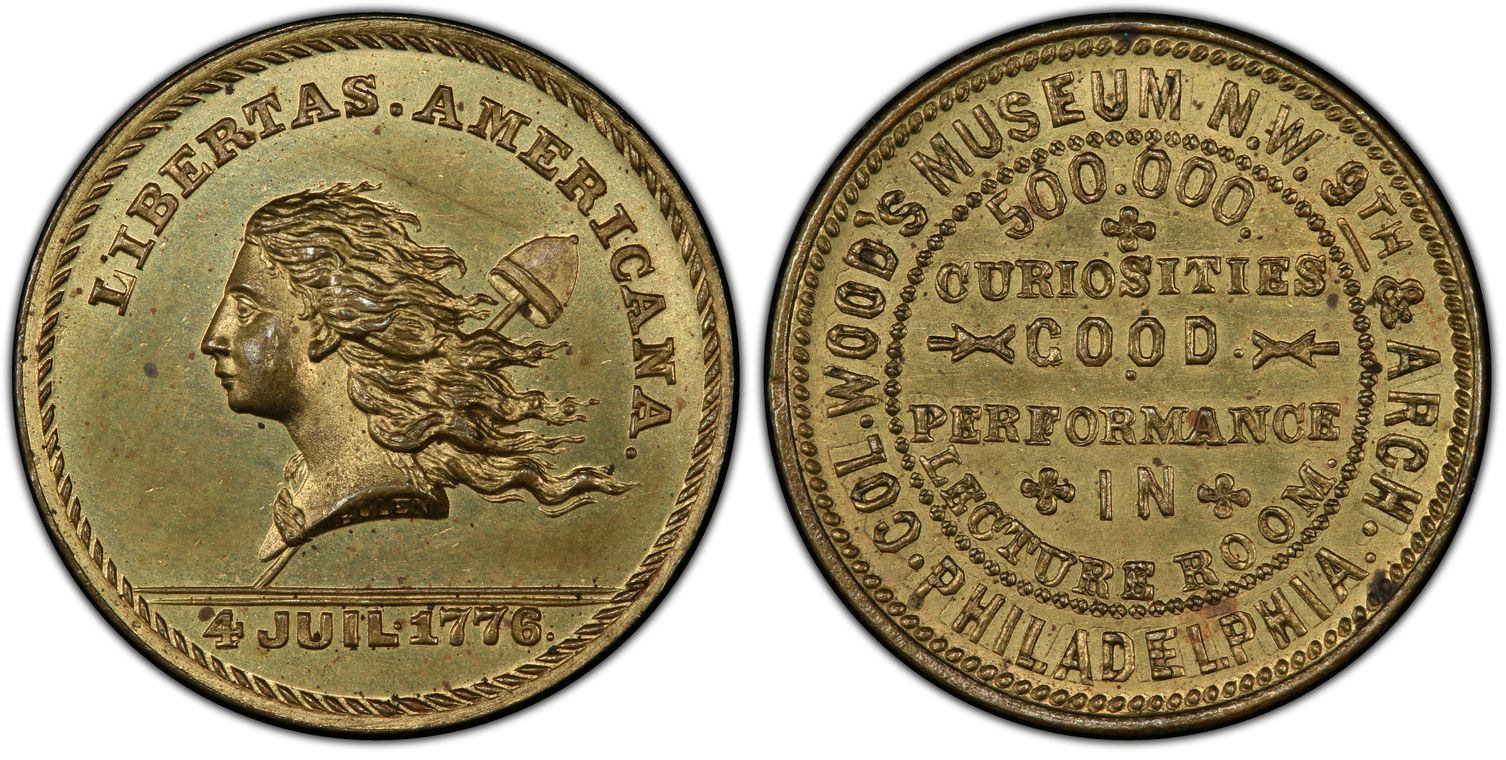
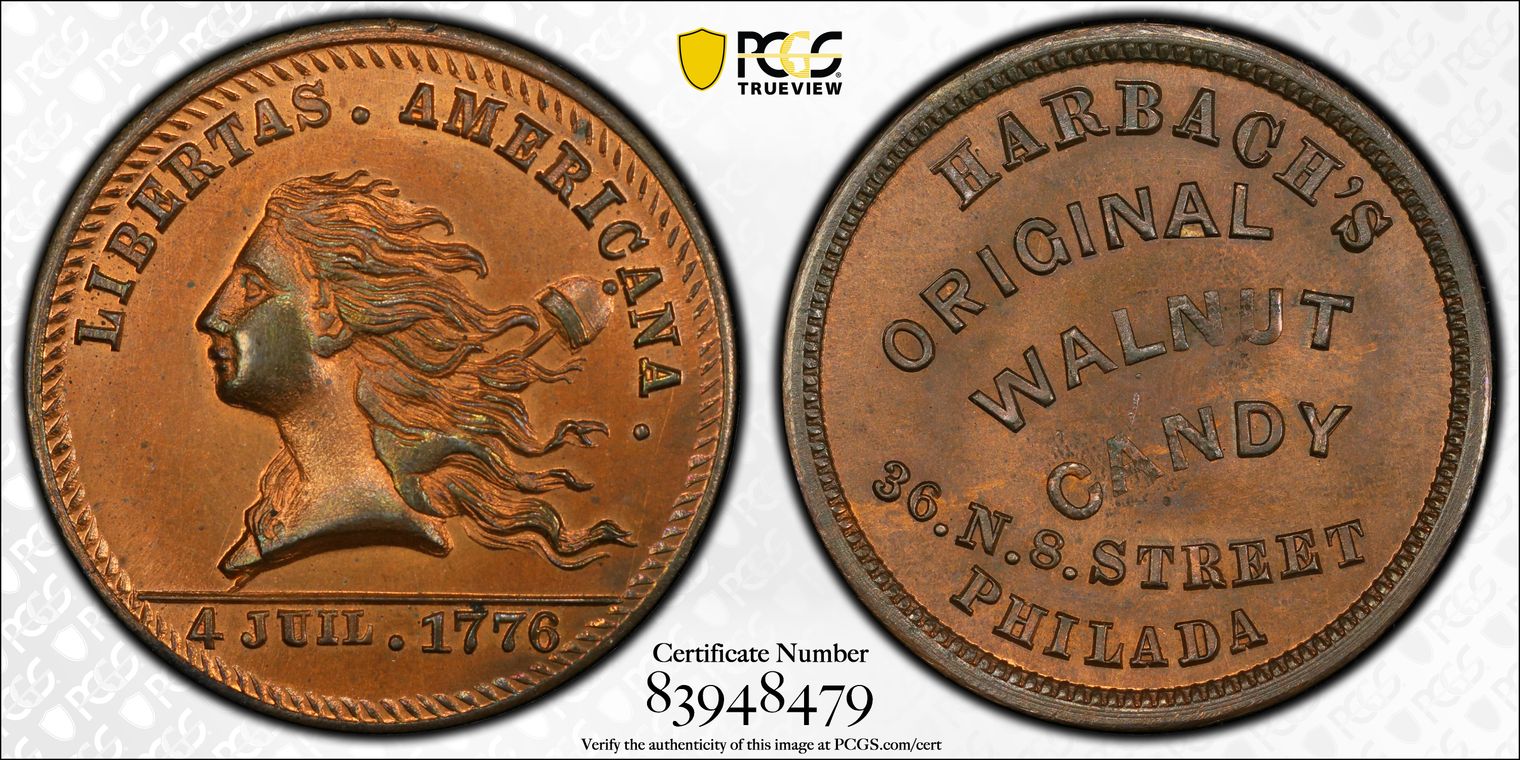
This advertising token for the Wood's Museum of Philadelphia features Bolen's Libertas Americana die in a scarce striking in Brass. Ex: Musante
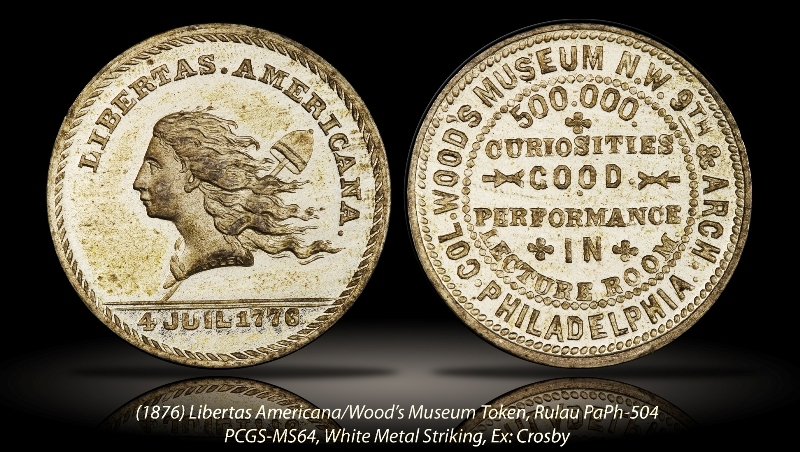
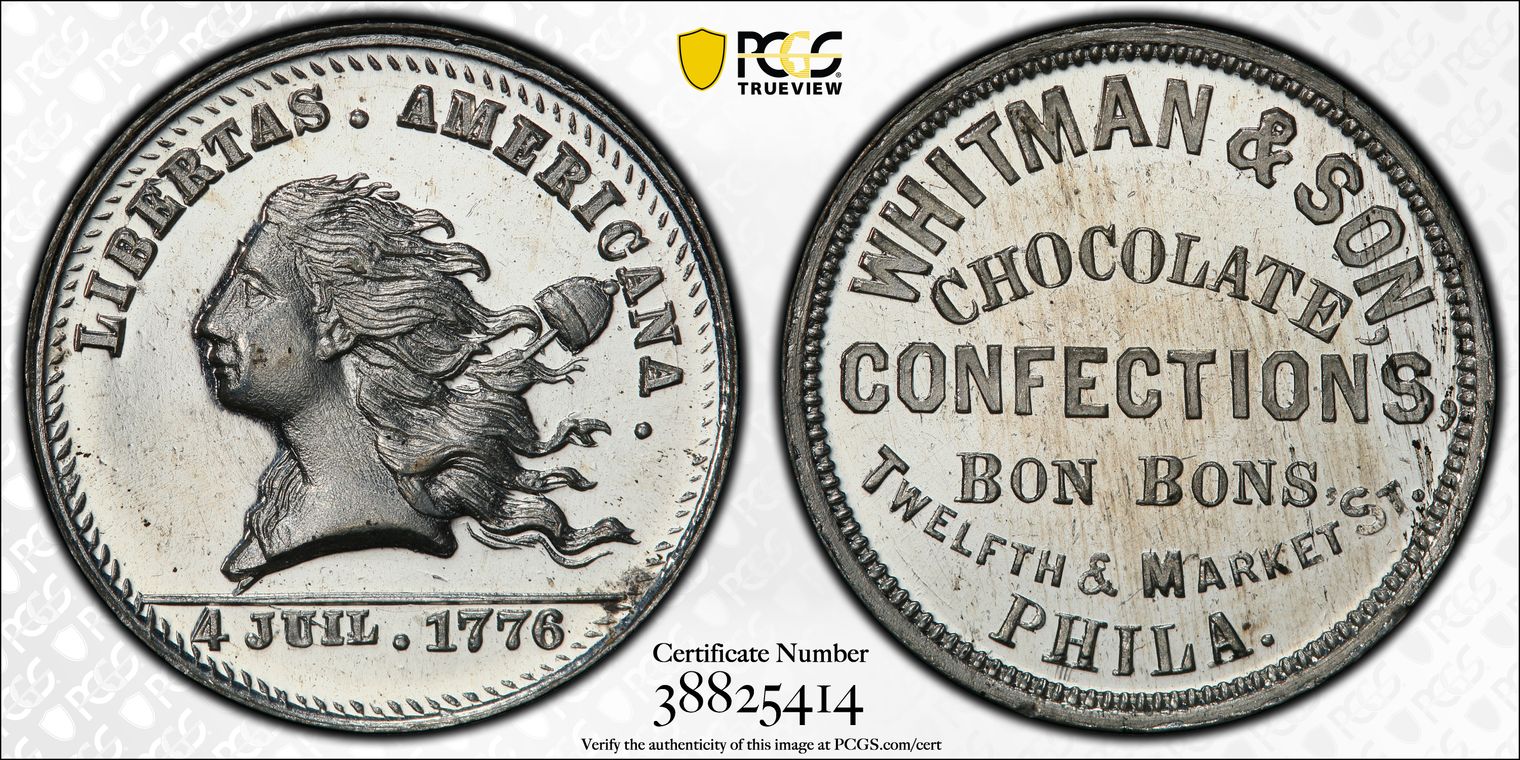
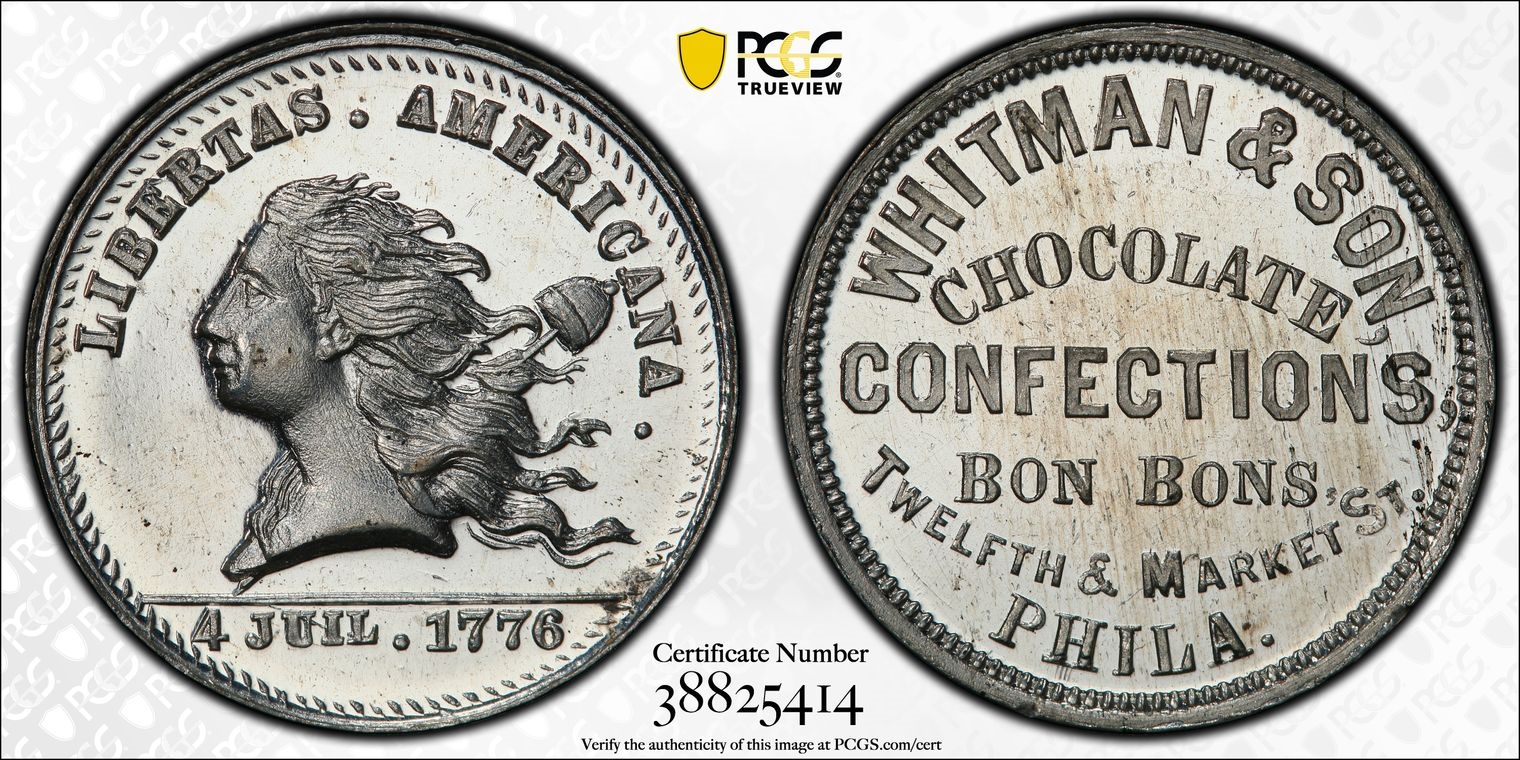
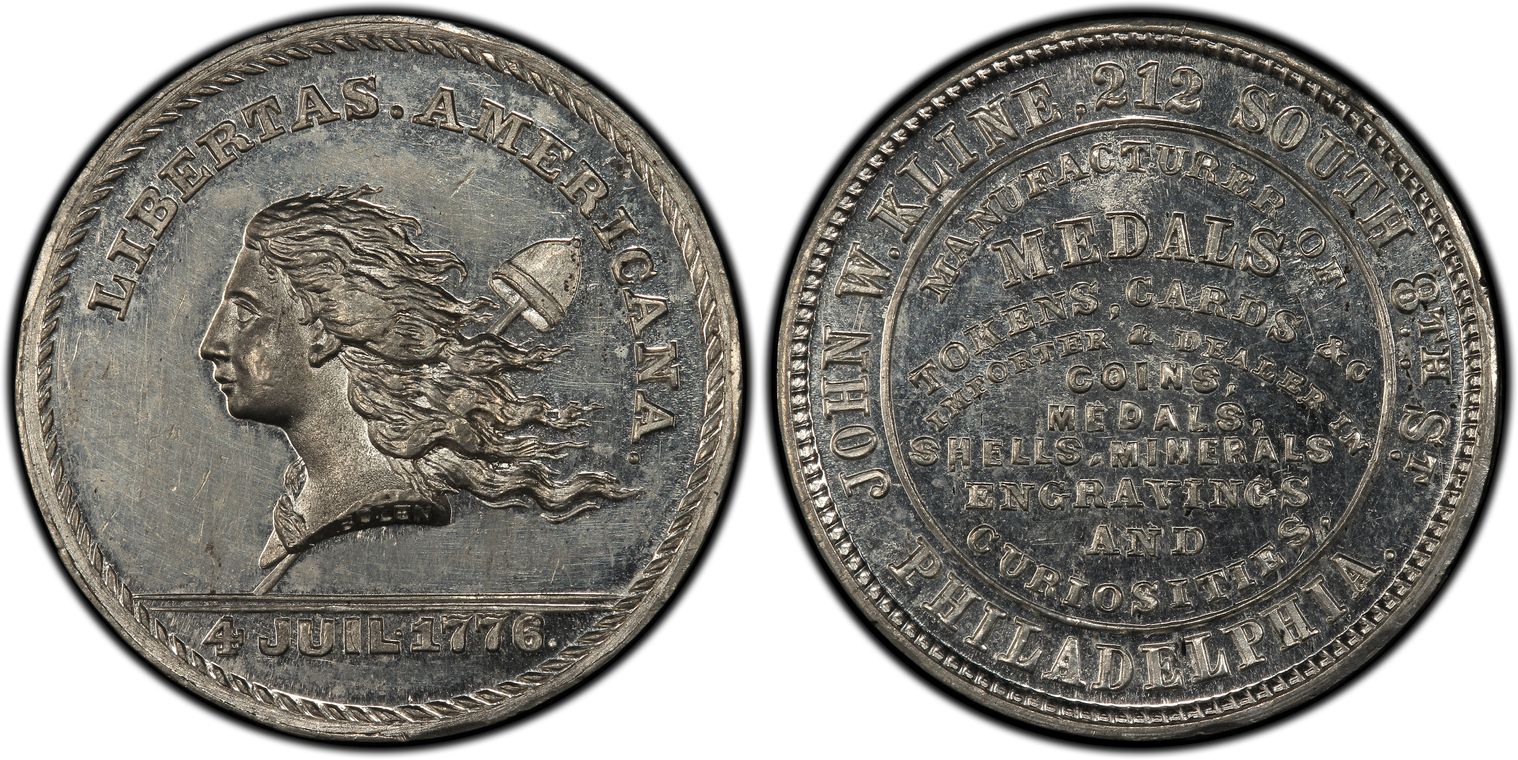
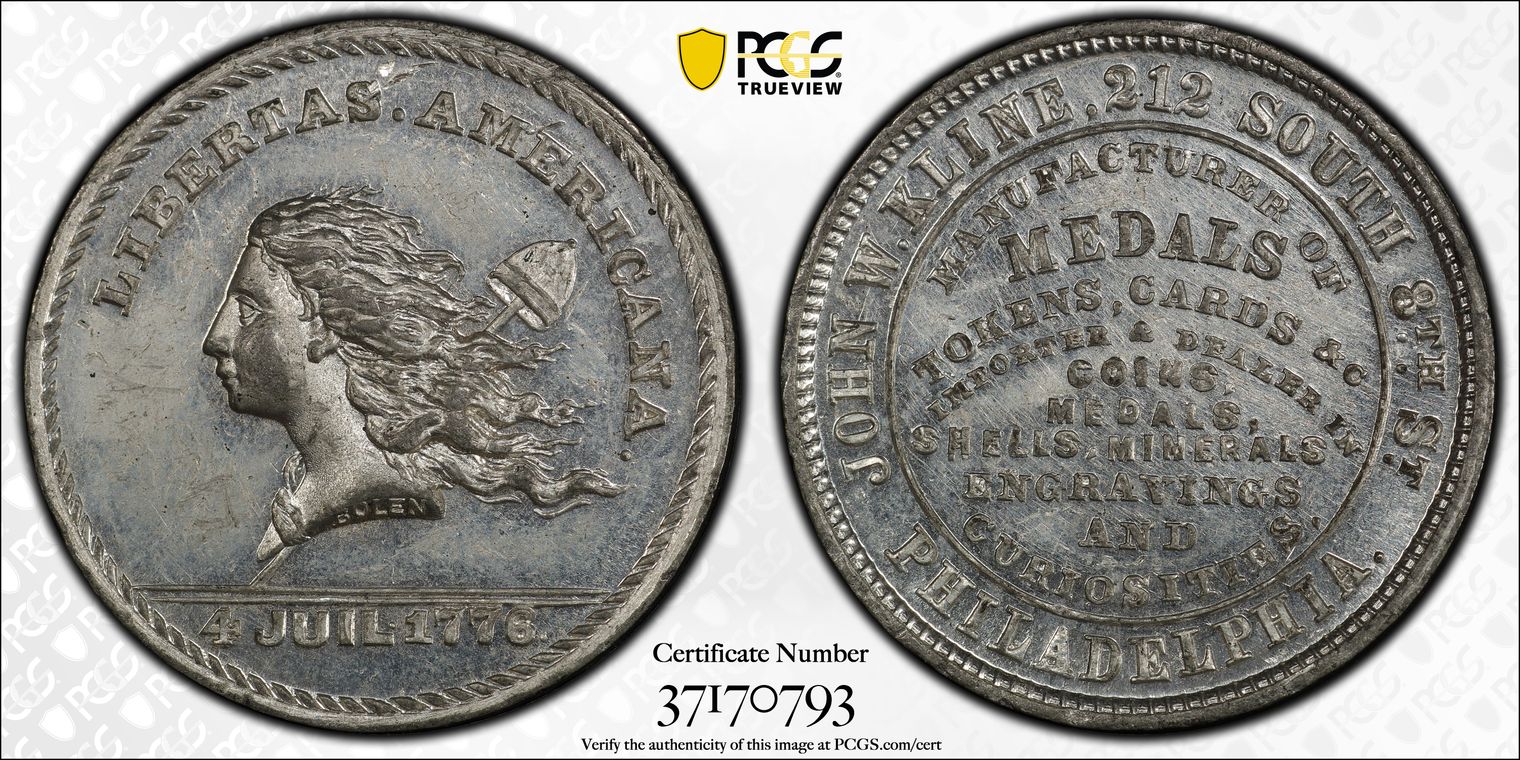
With this specimen, we see Bolen's Libertas Americana die in its most widely produced medium -- struck in soft White Metal. Ex: Richard Crosby

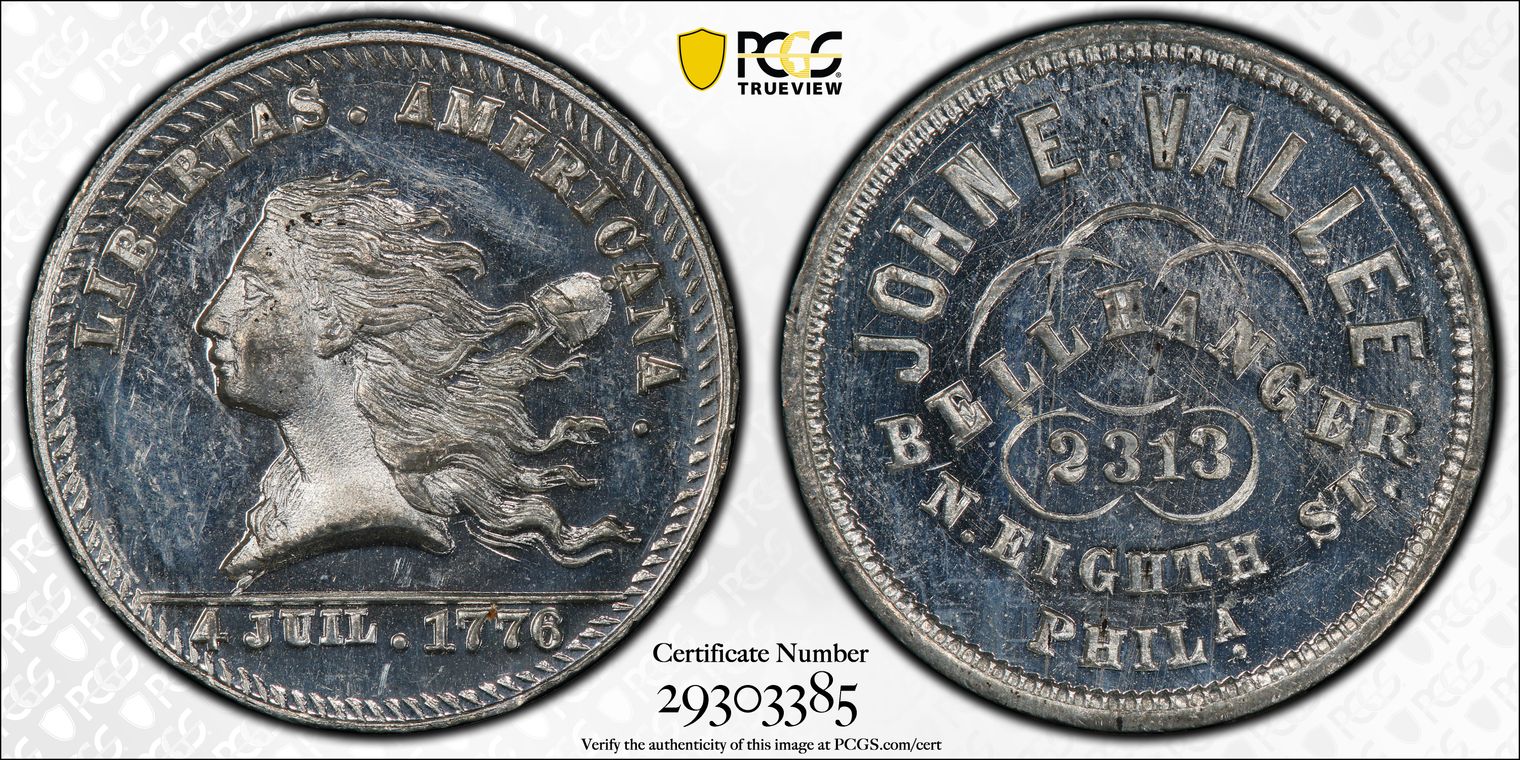

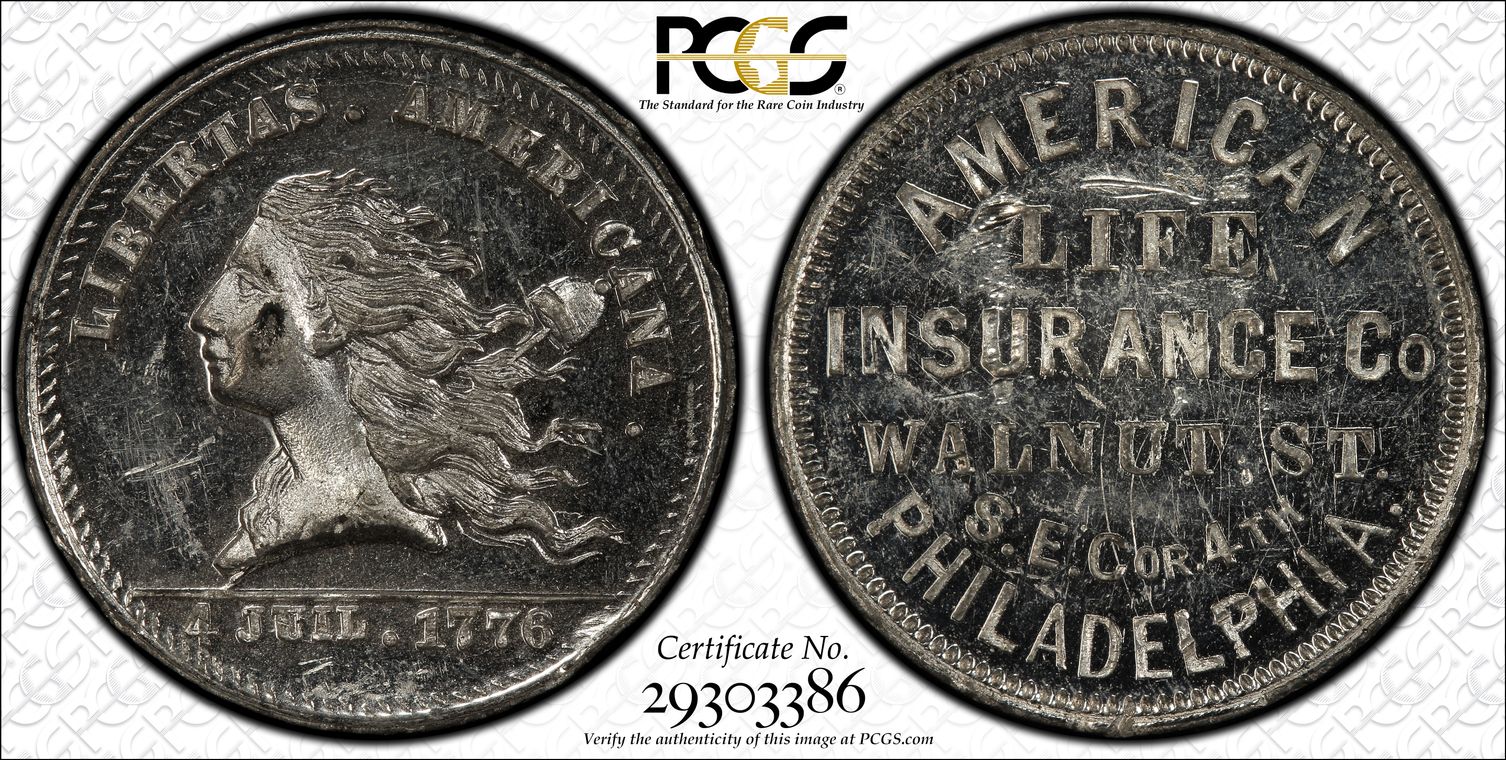
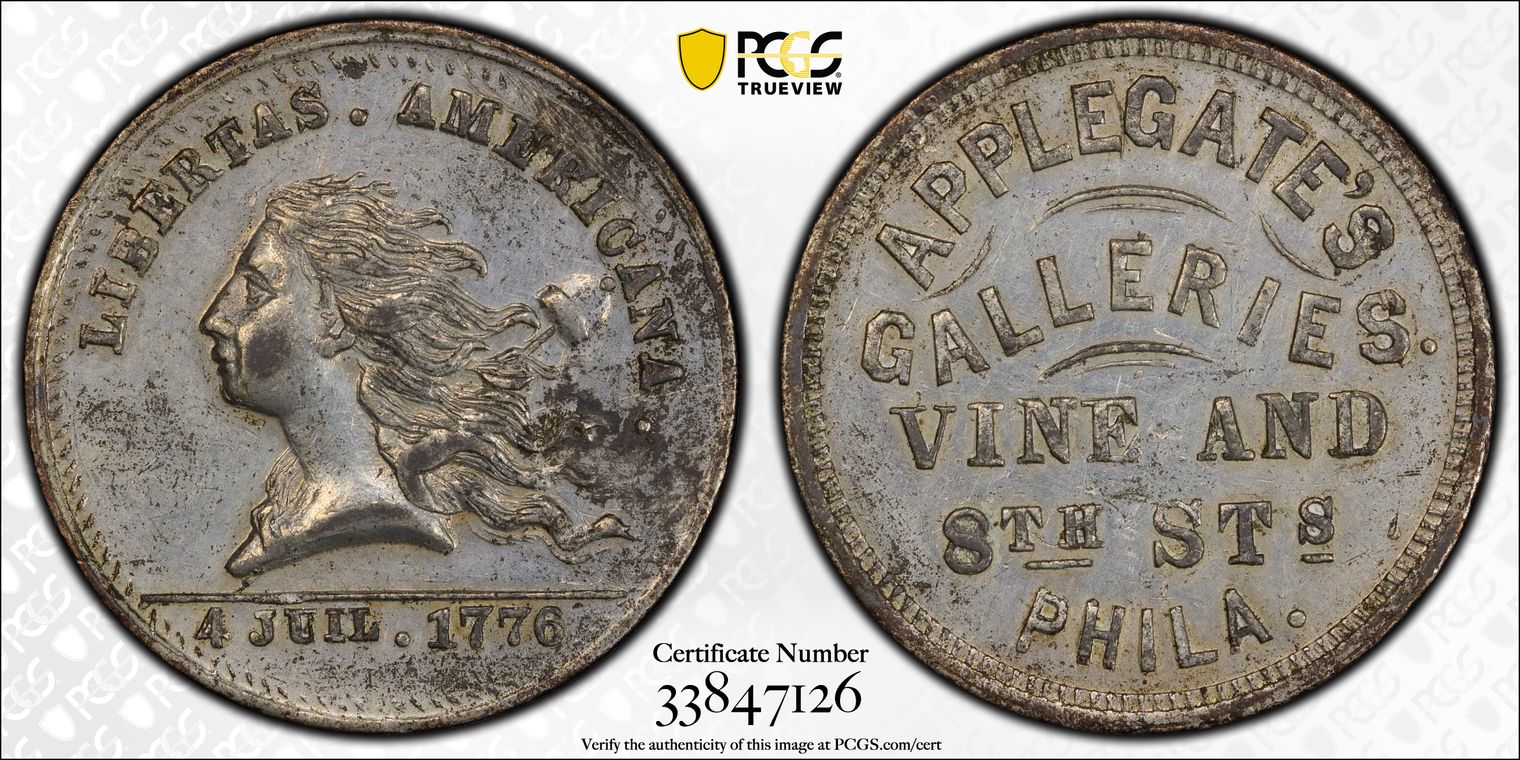
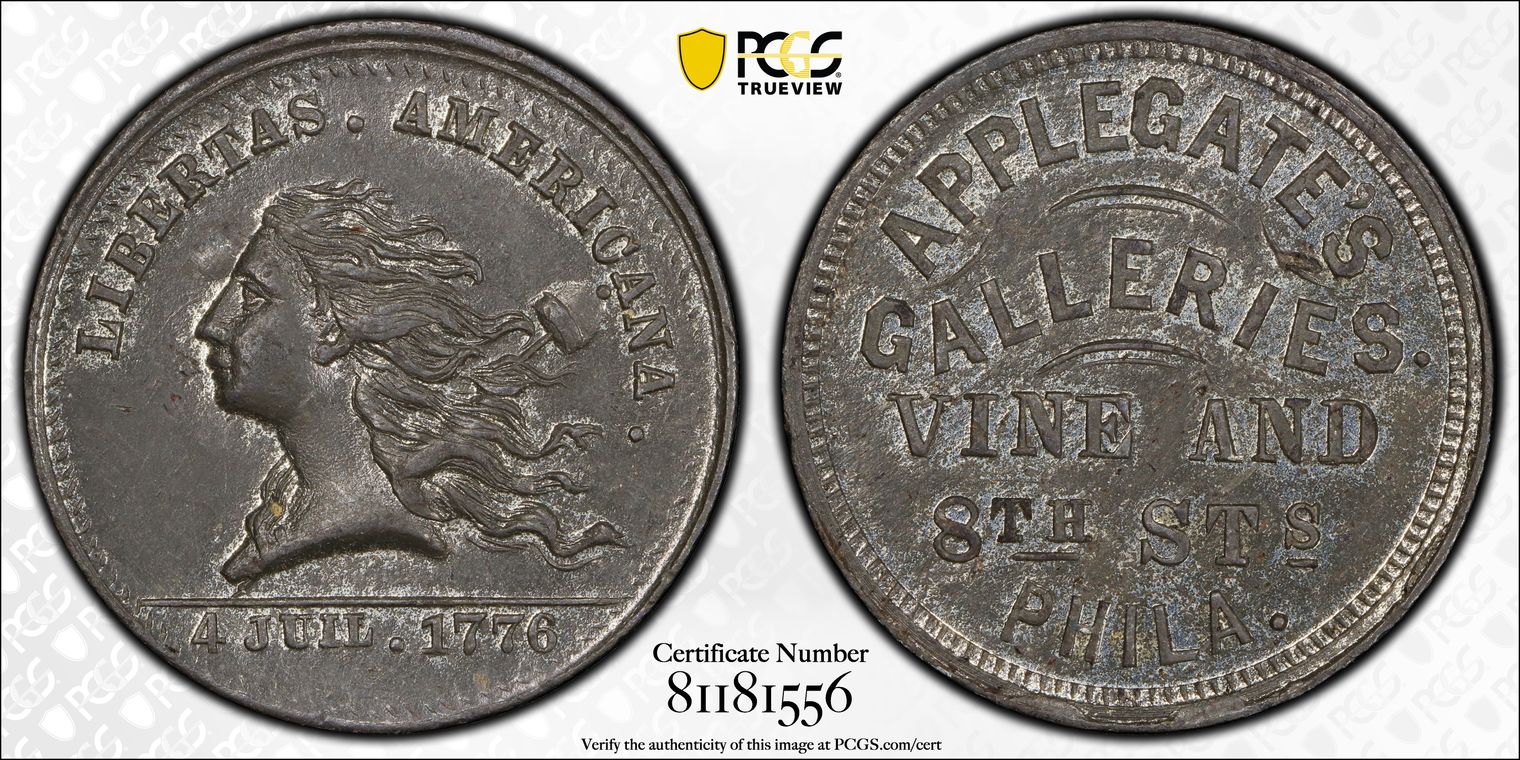
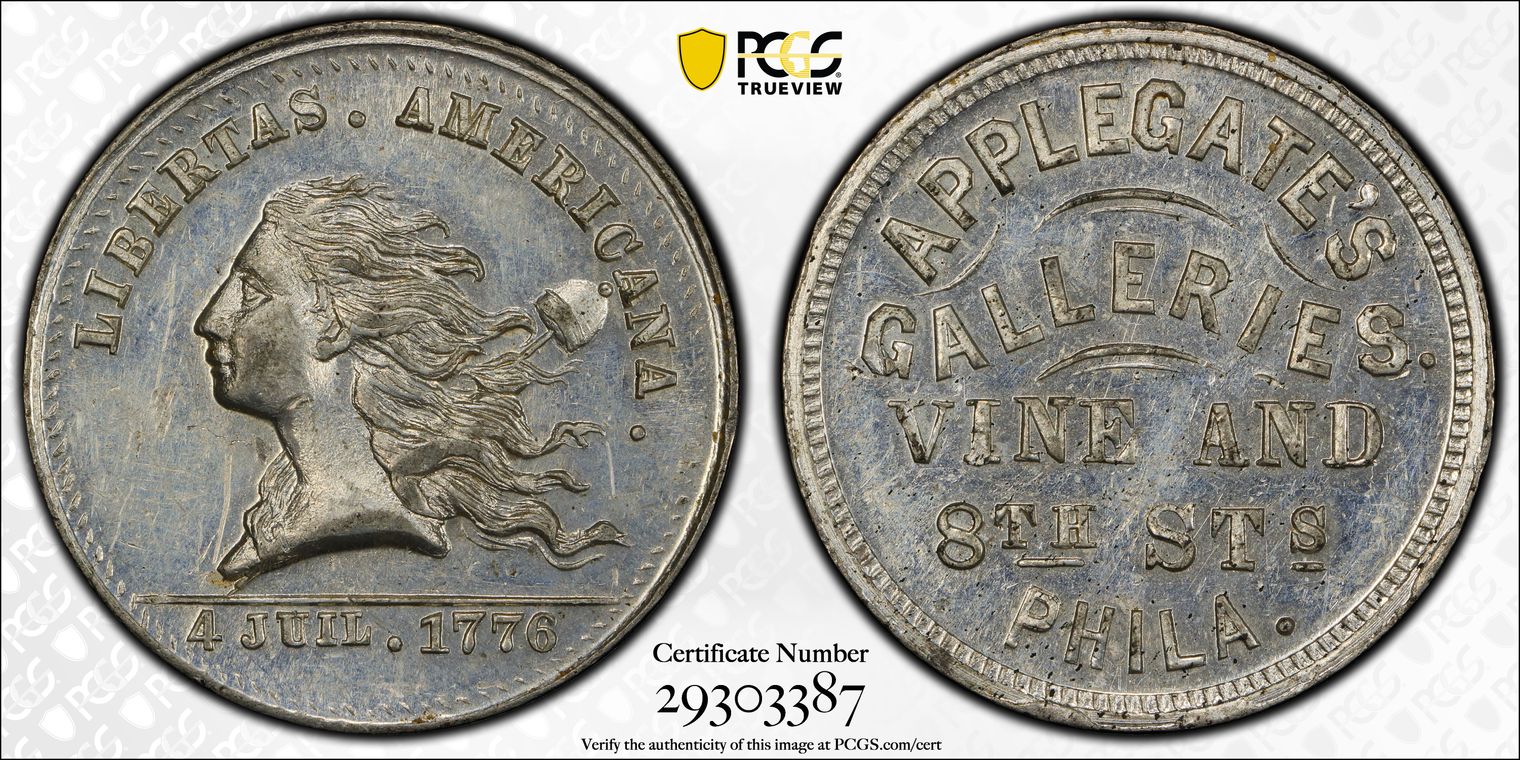
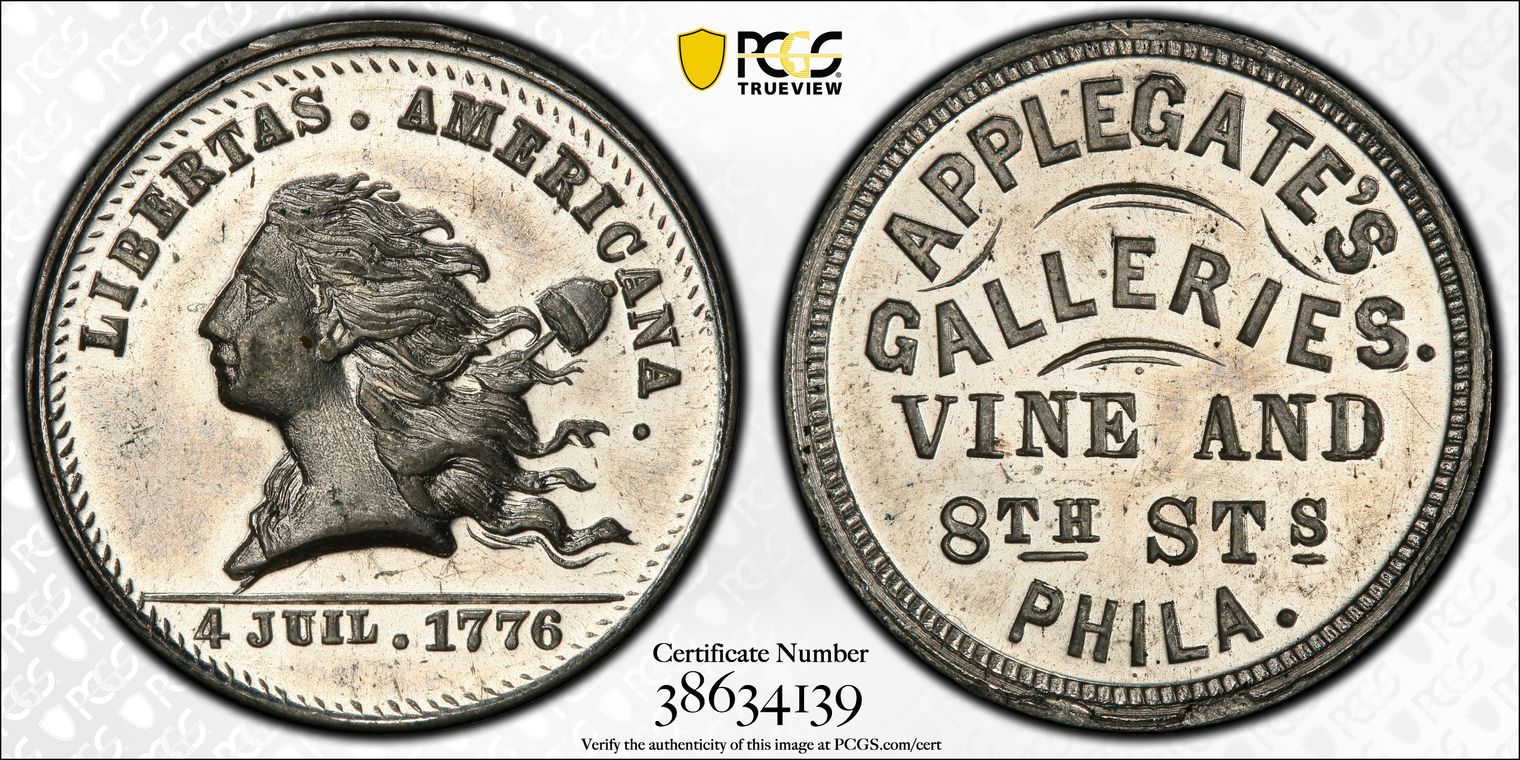
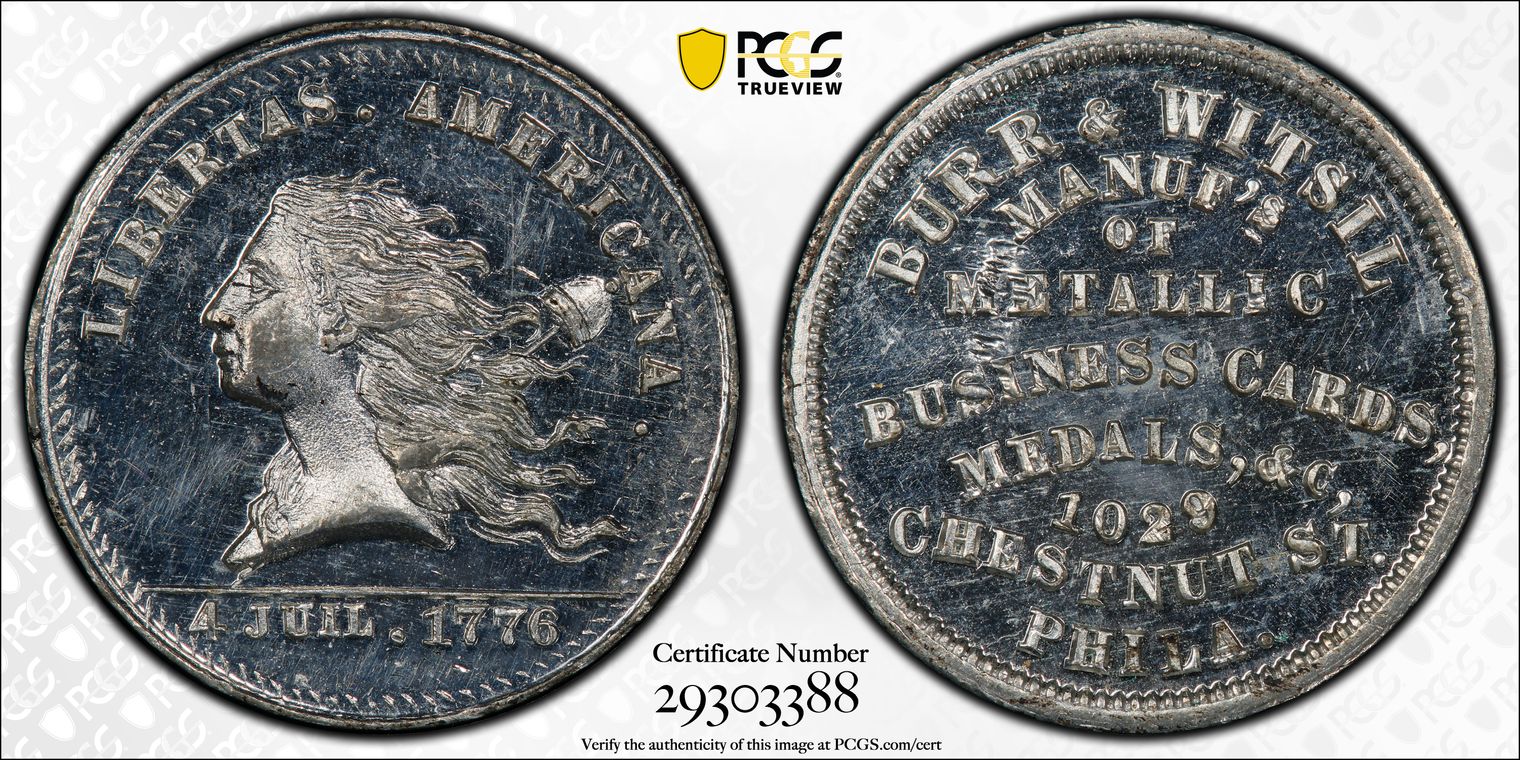
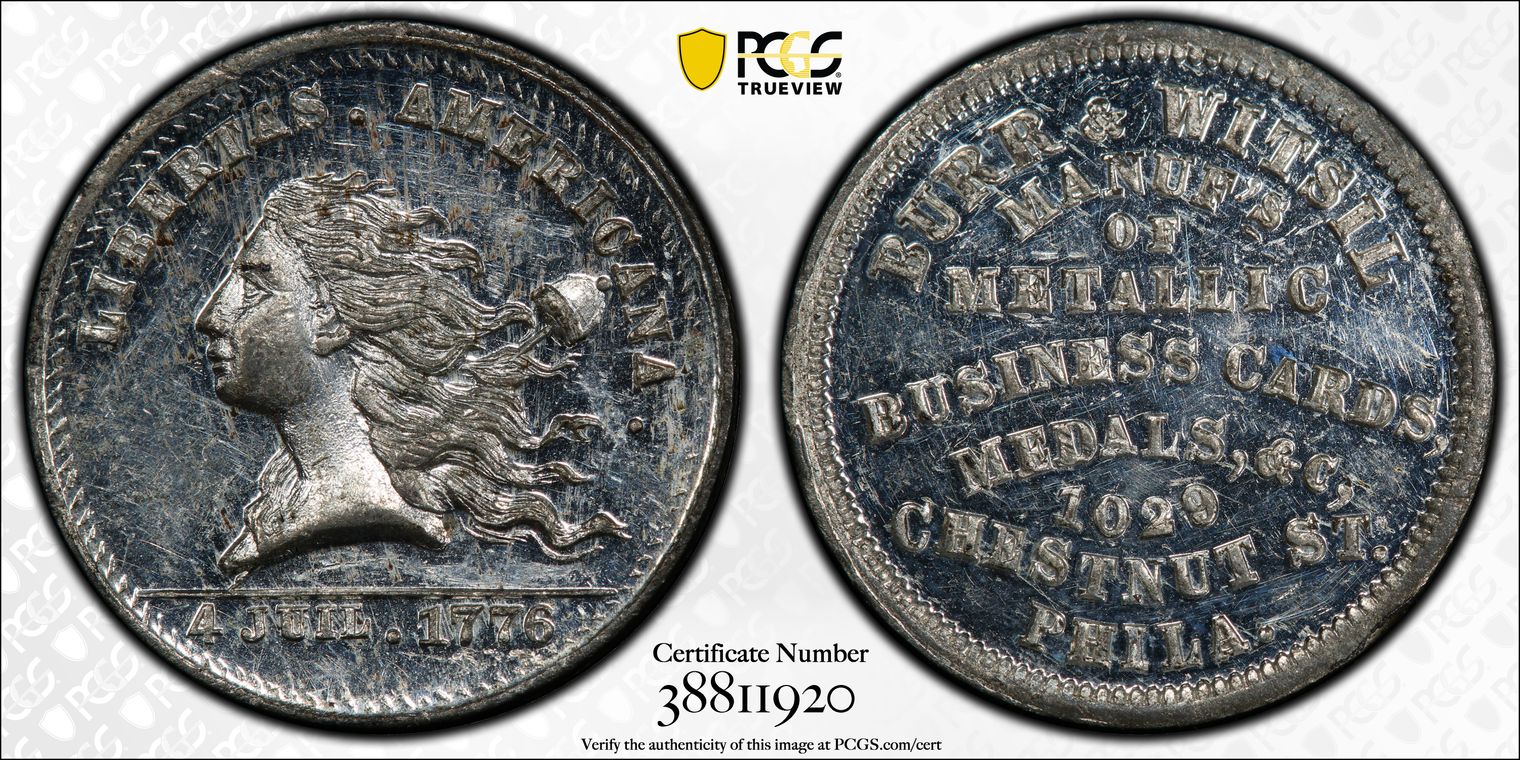
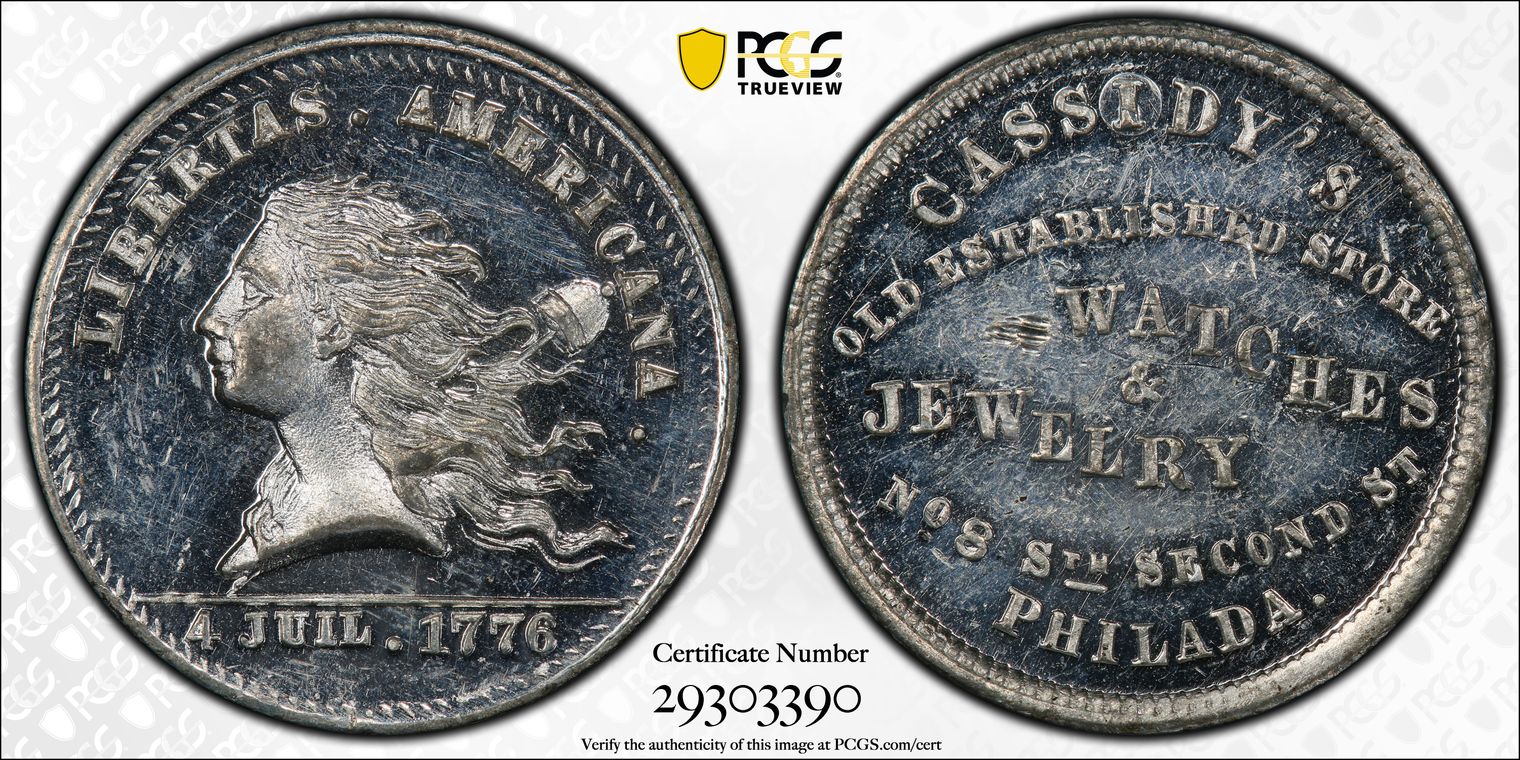
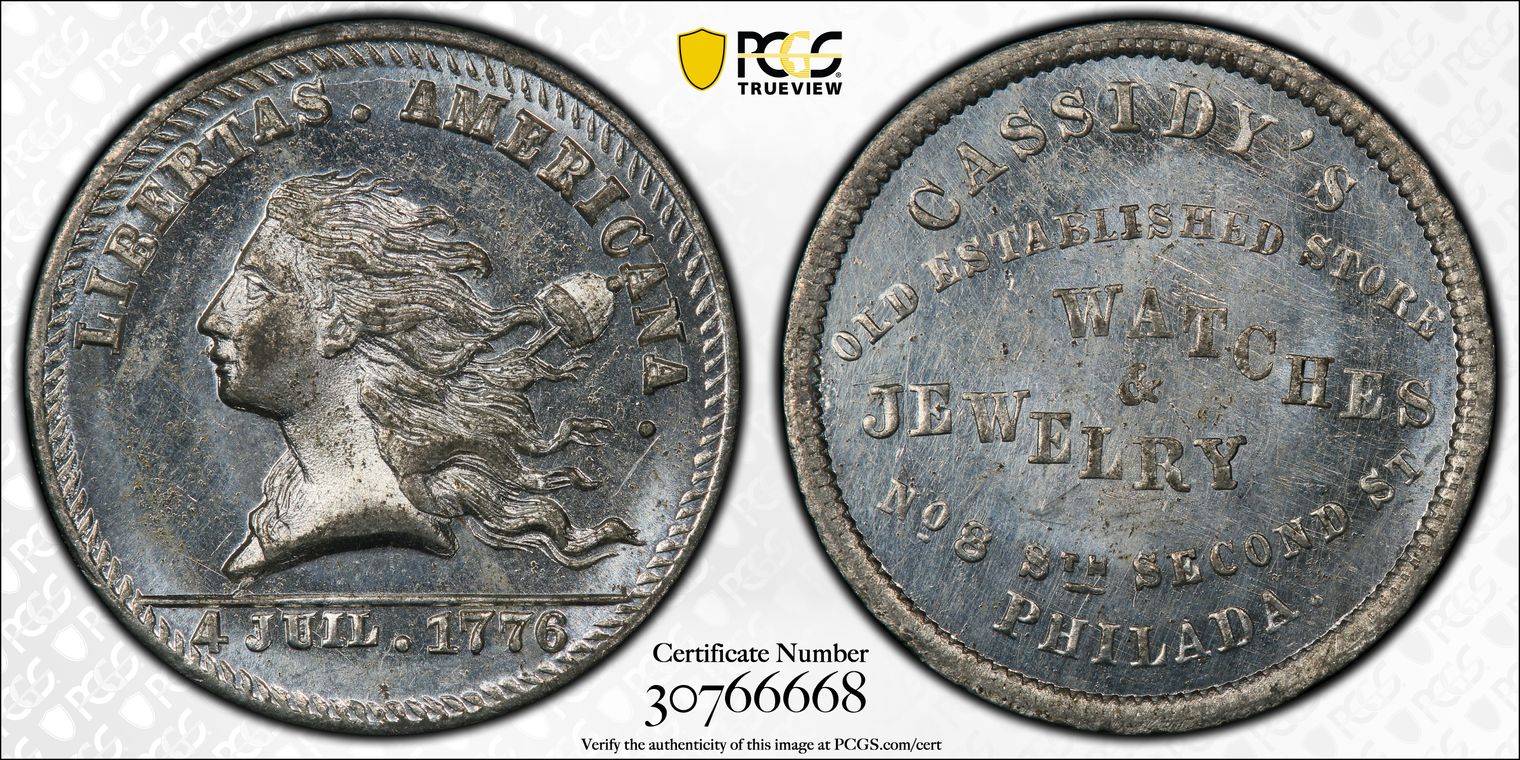
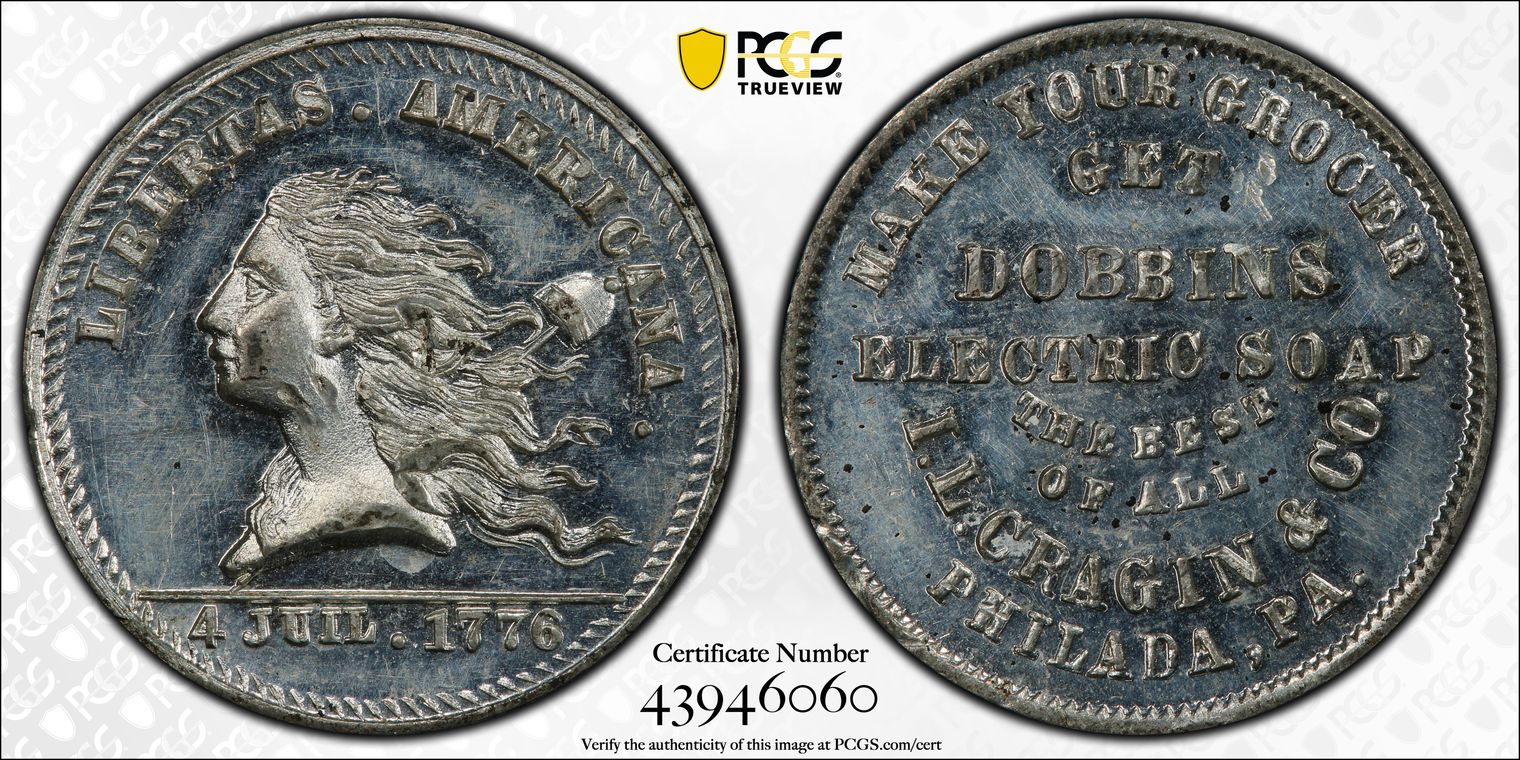
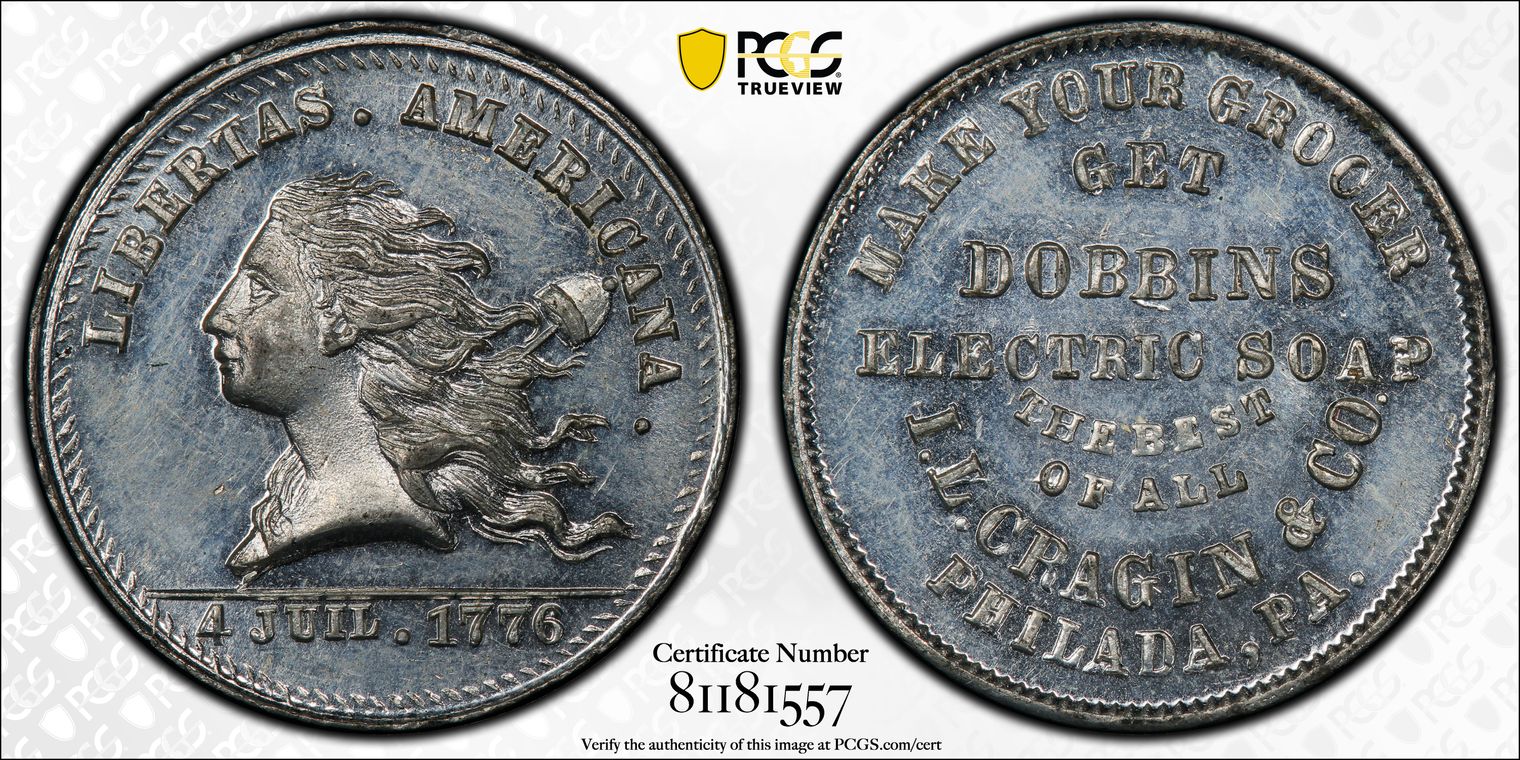
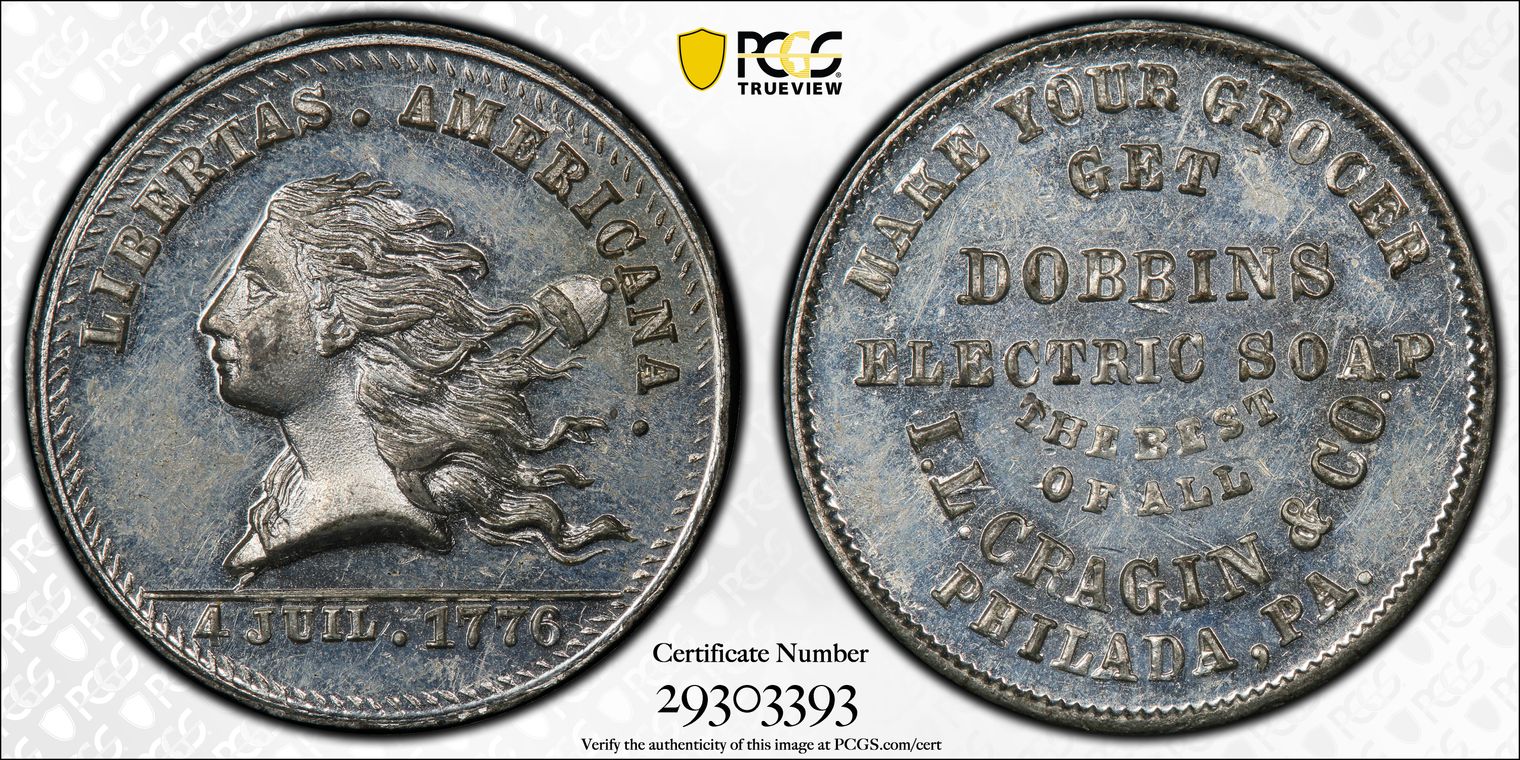
Early Die State, Ex: Richard Crosby

Late Die State, with noticeable breaks on obverse and reverse. Ex: John Kraljevich
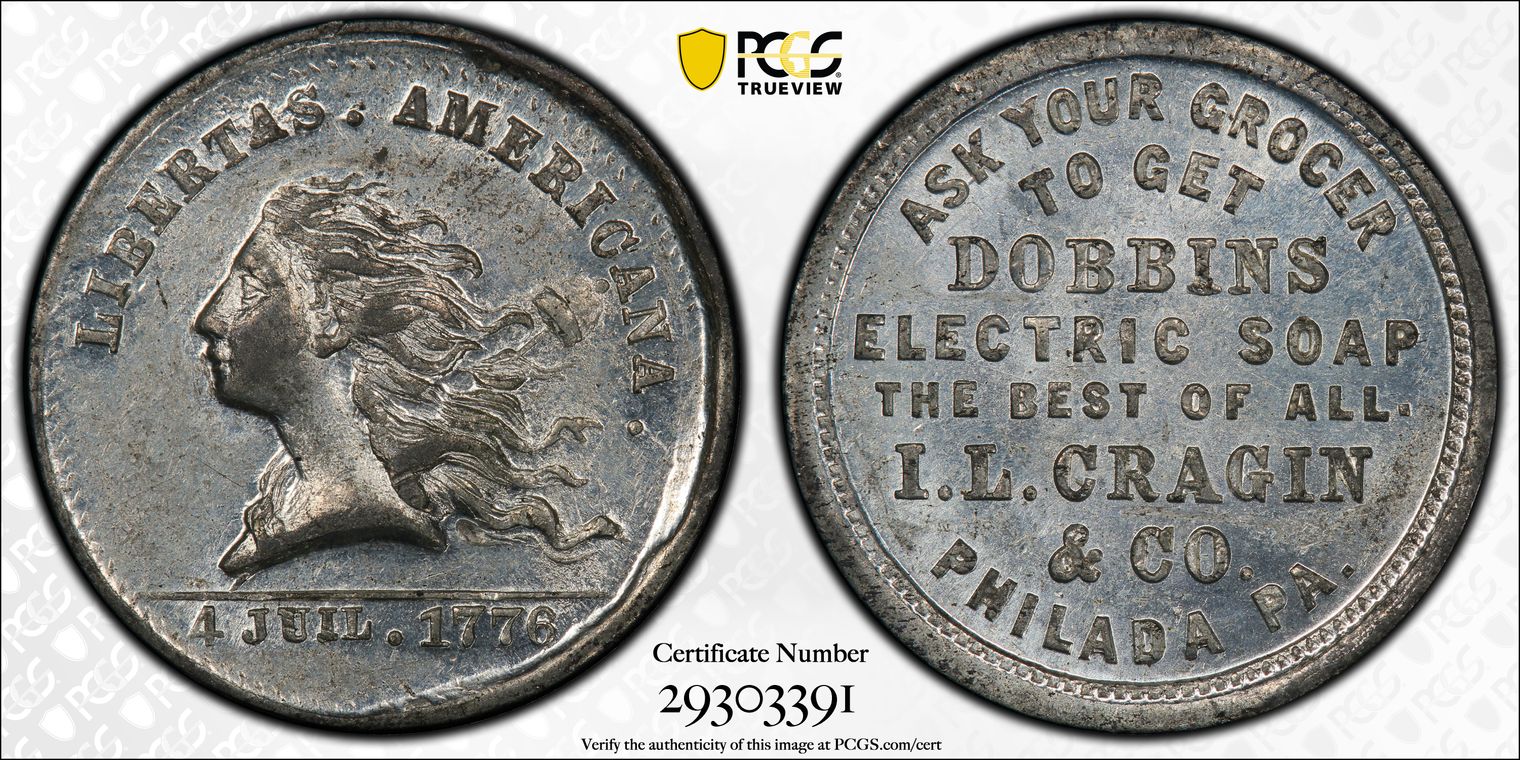
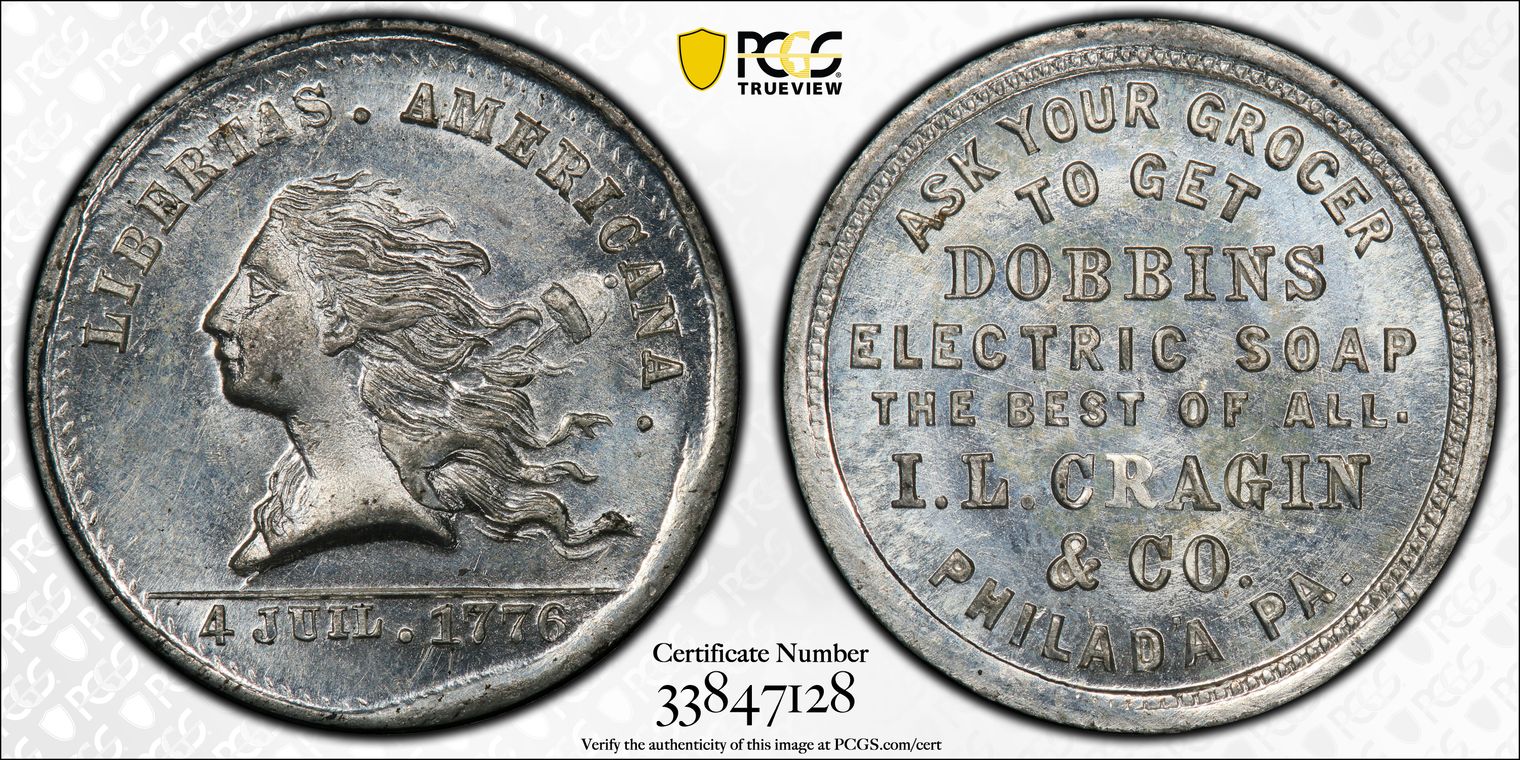

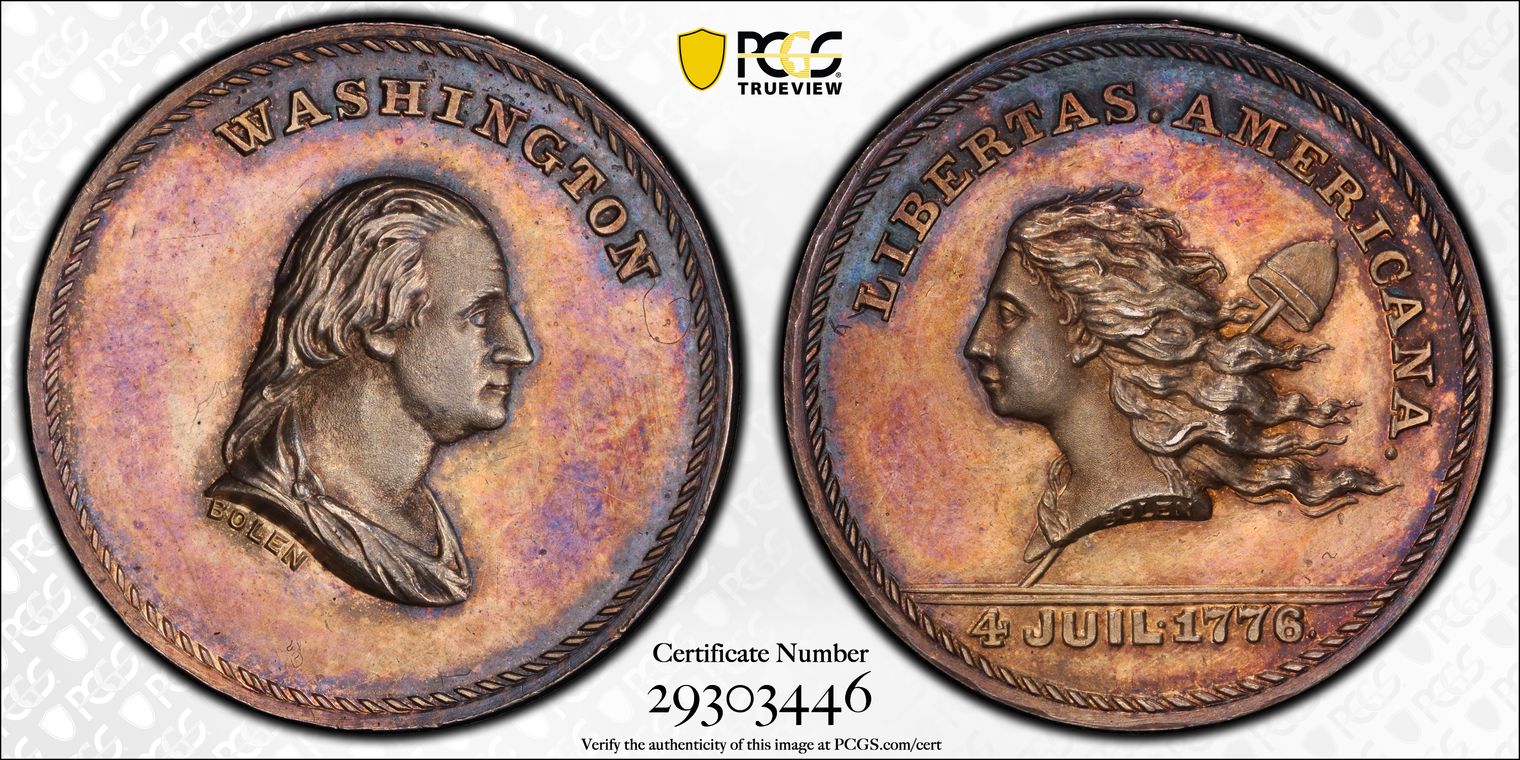
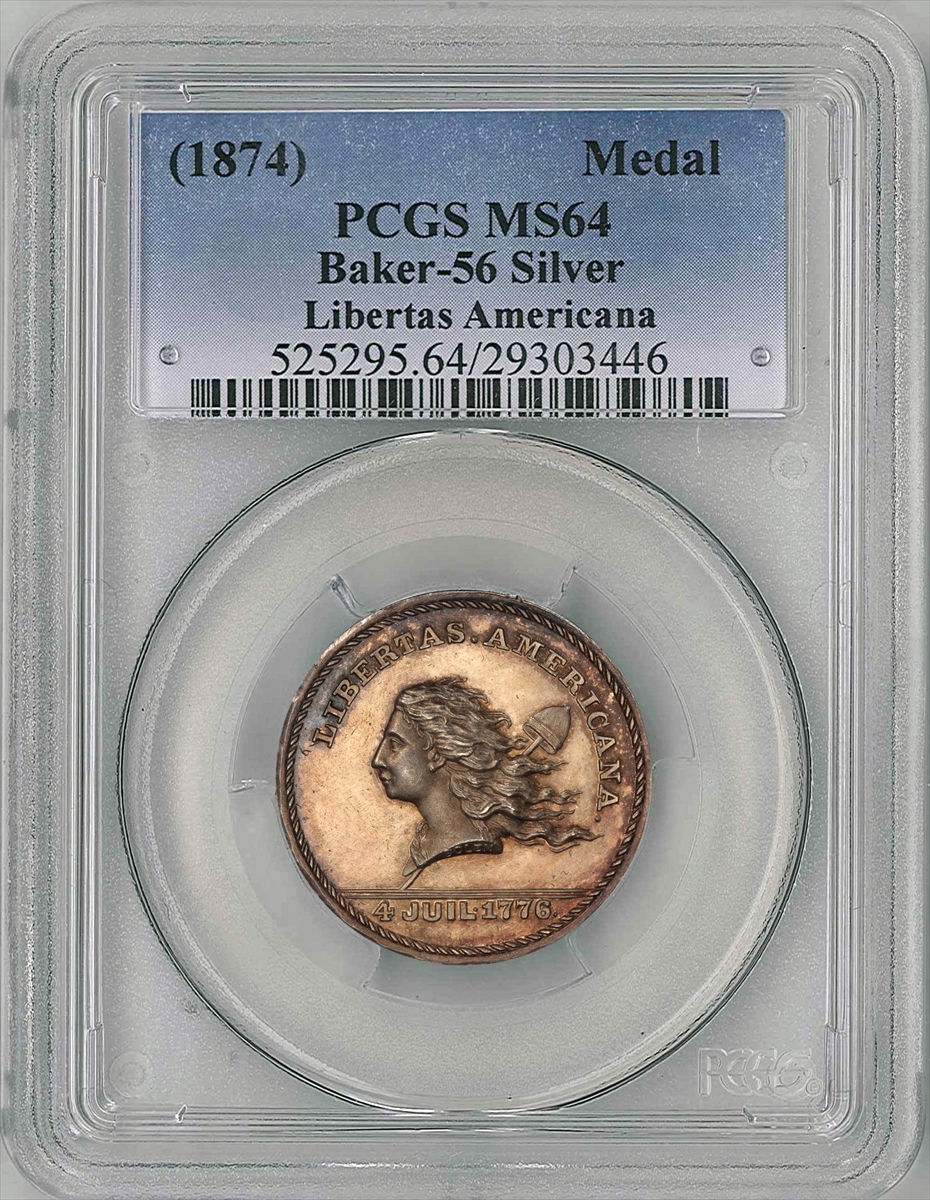
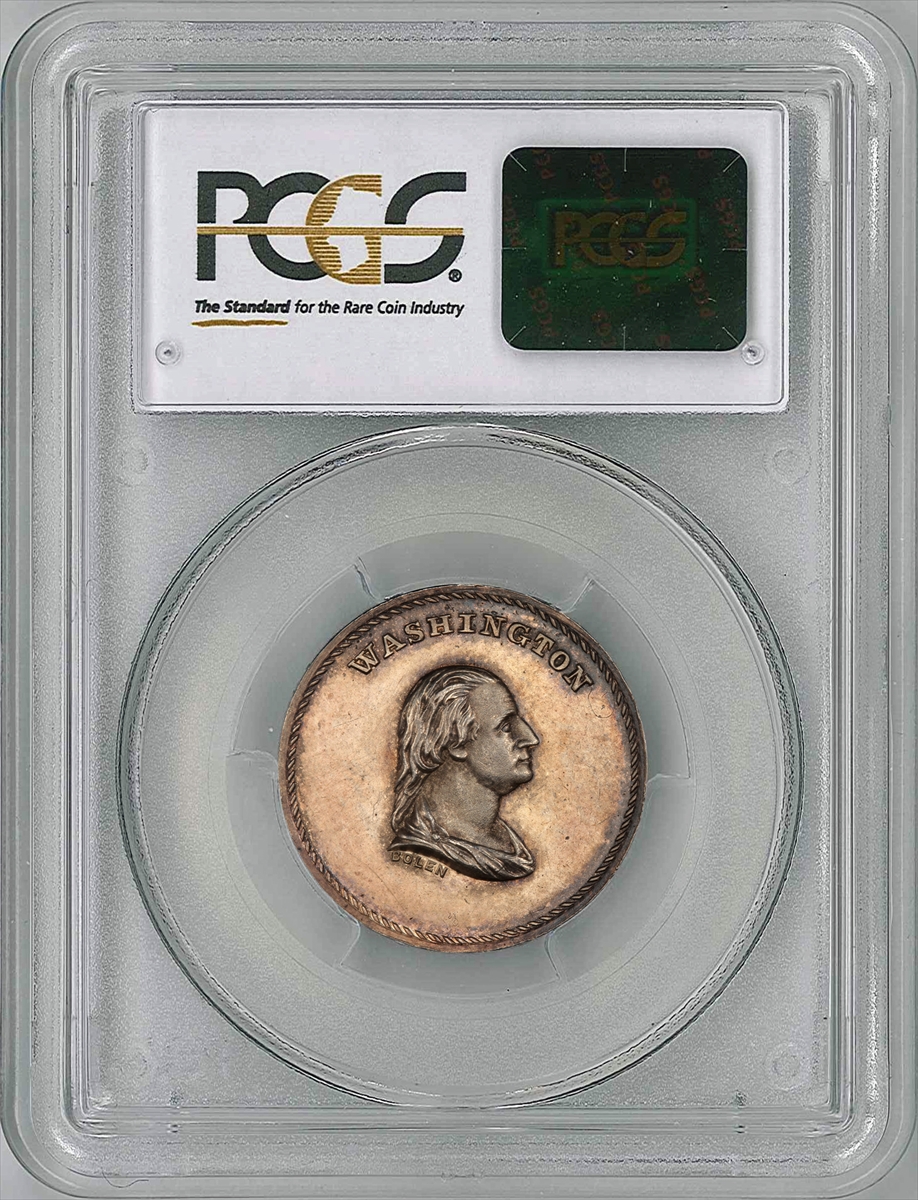
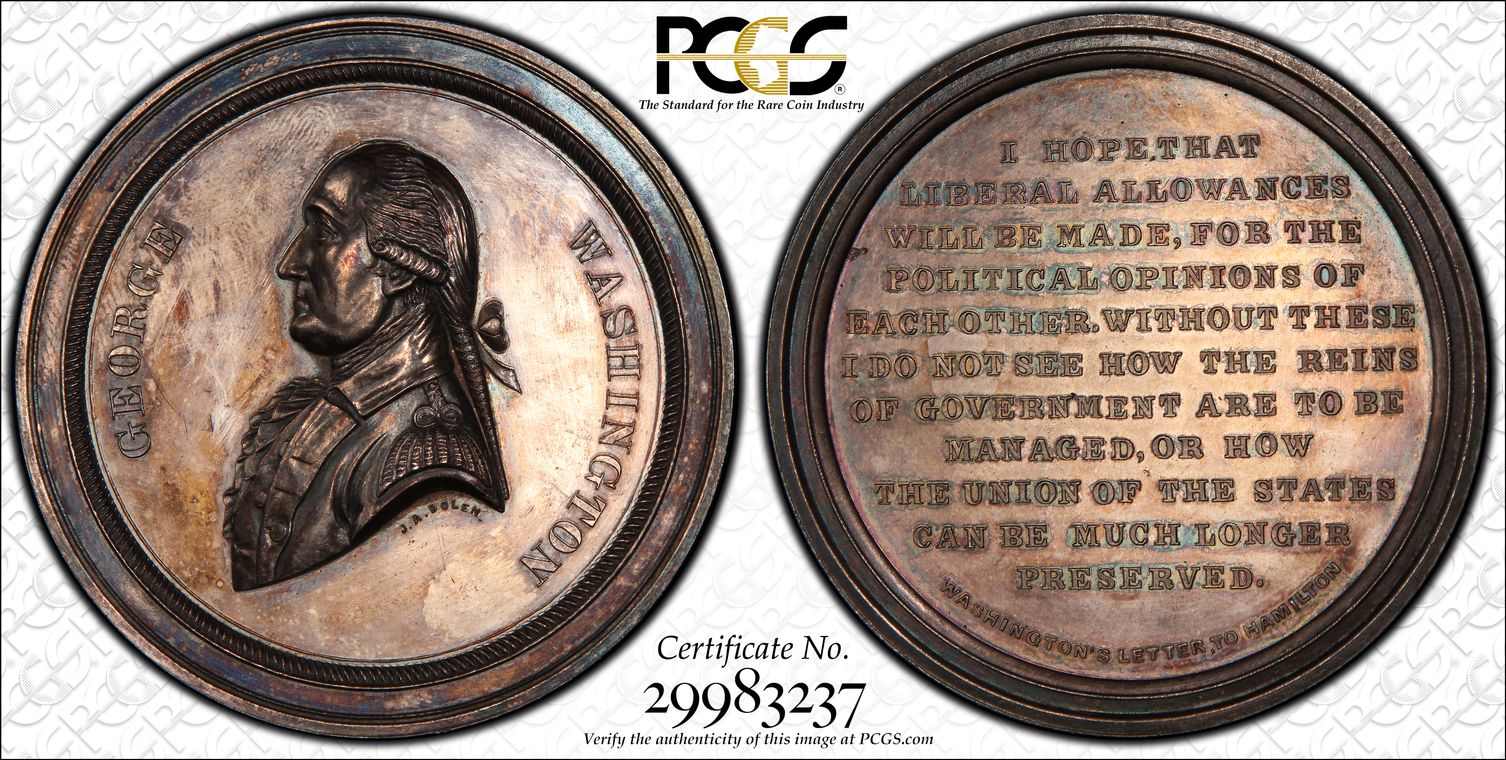
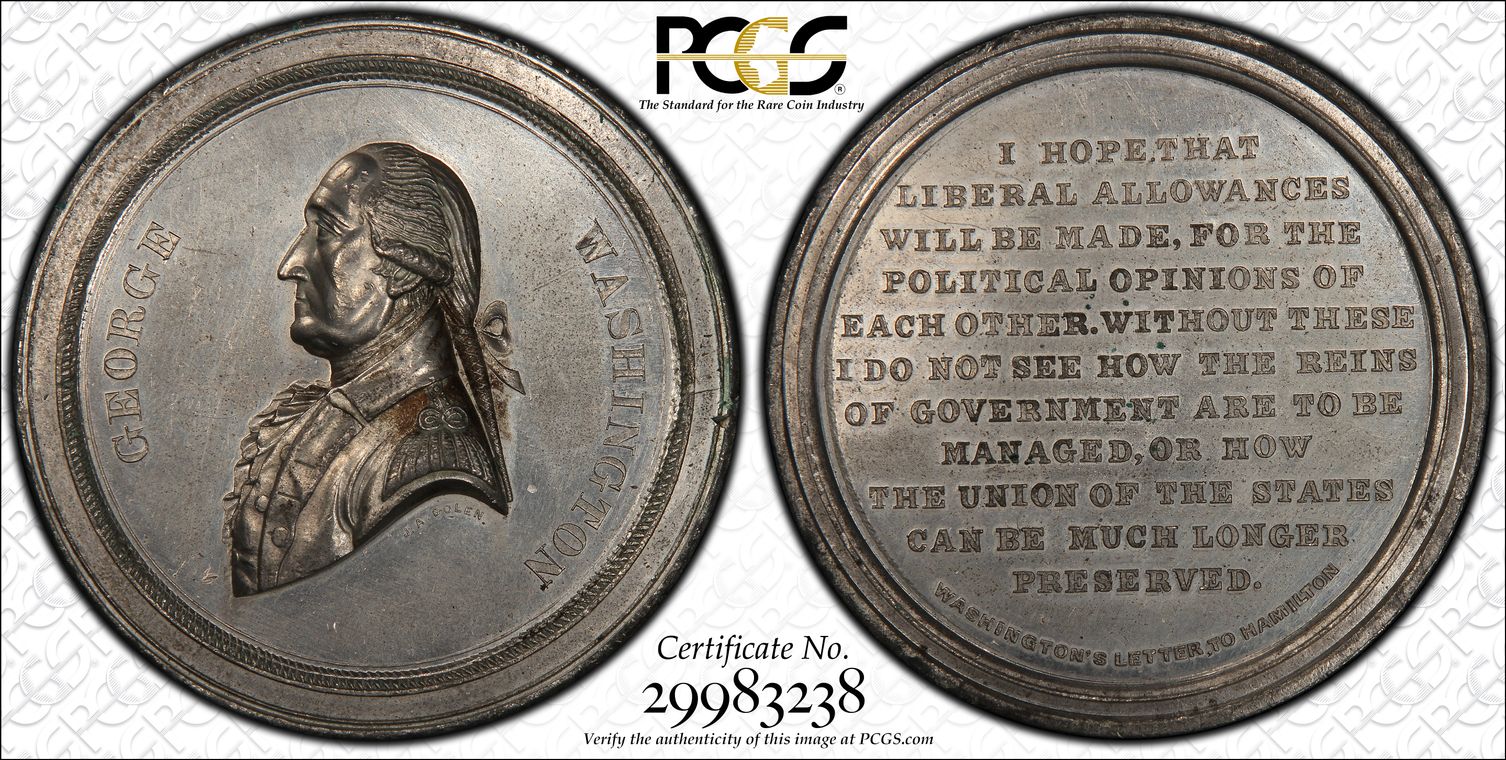
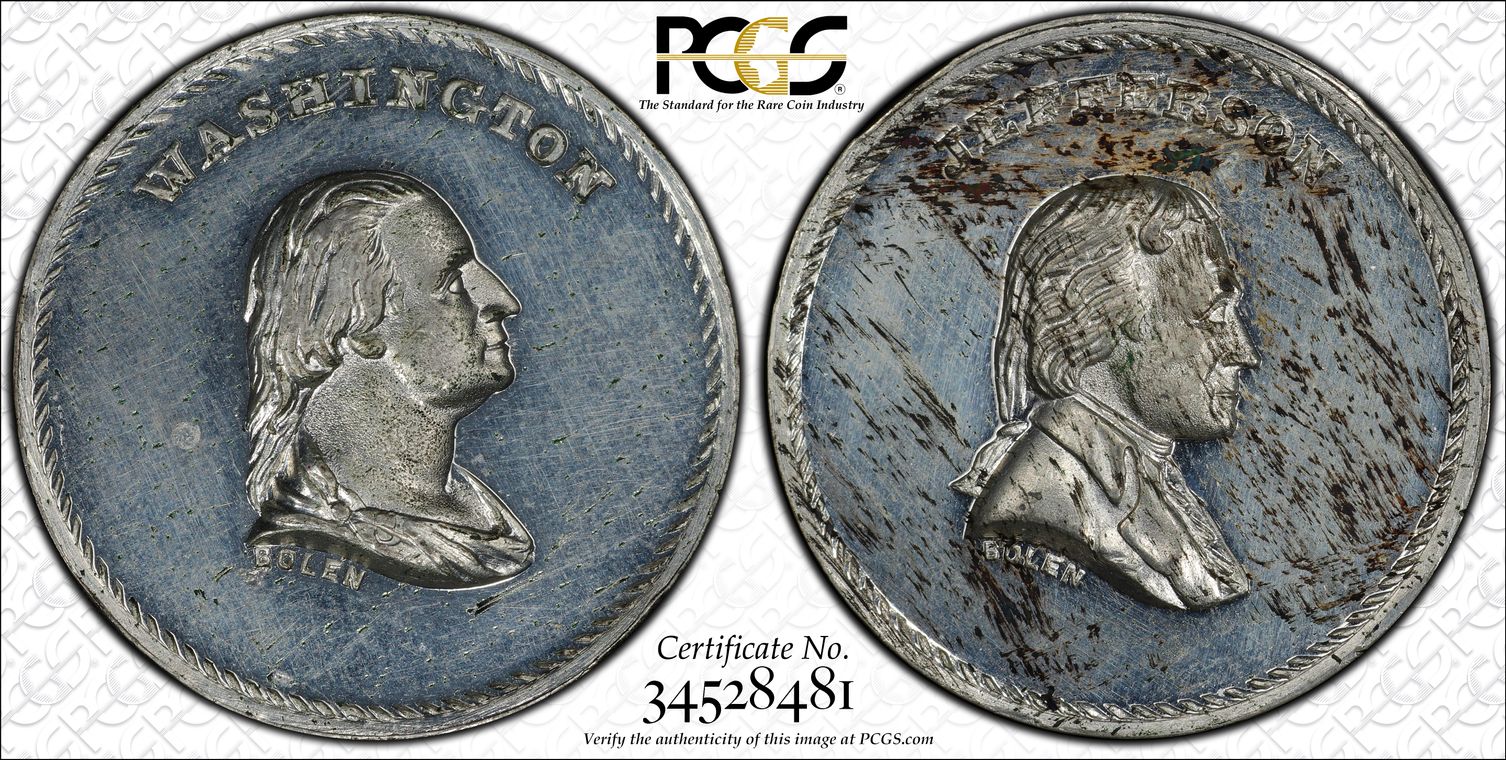
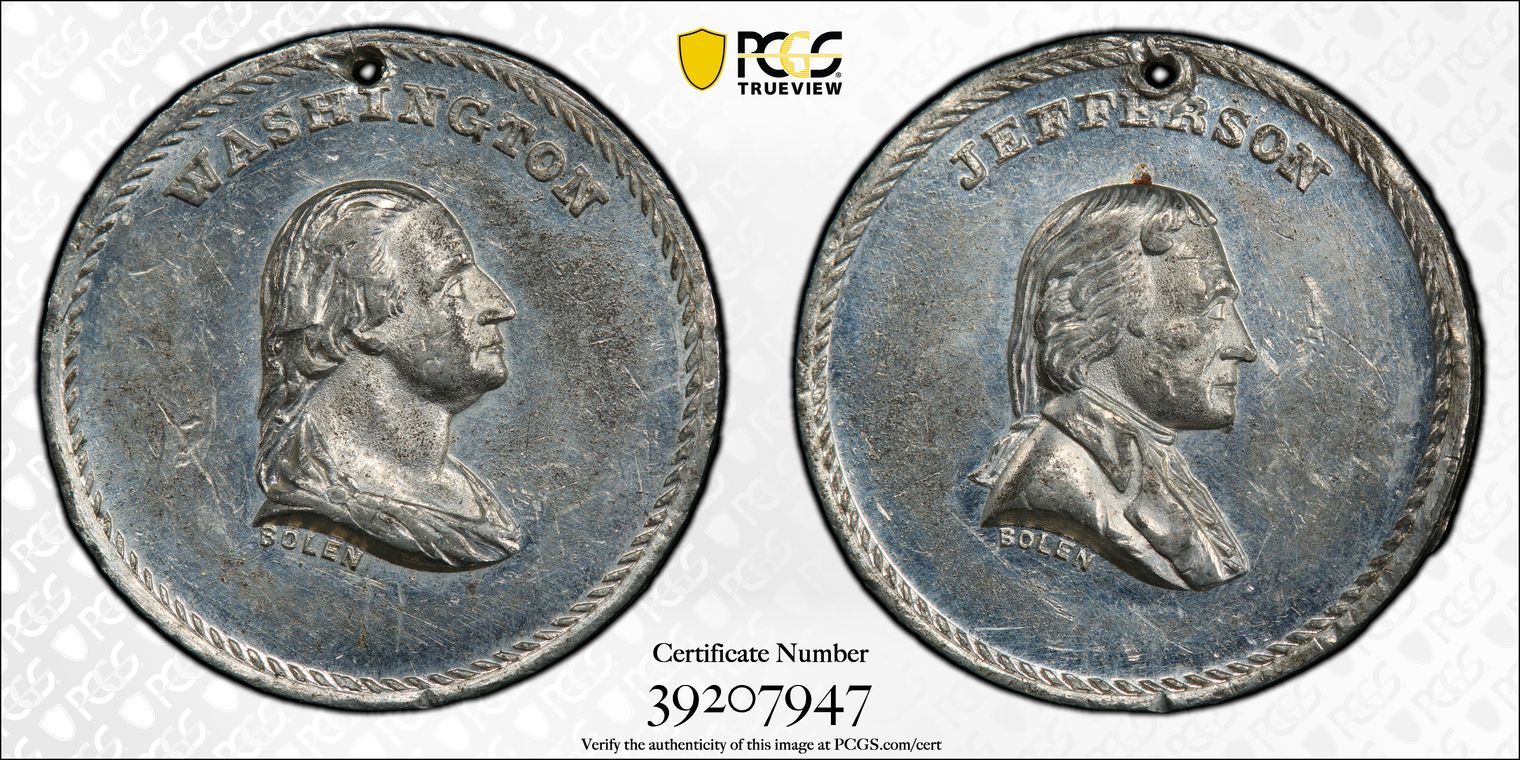
Here we see not only one of the very rarest of the Bolen medals, but one of the very rarest of all patriotic medals: the Baker-56 Washington medal (AKA Bolen's JAB-M-4), combining Bolen's Libertas die with his portait of George Washington, with just six such medals struck in silver. This specimen traces its provenance to Neil Musante, the author of the definitive reference of the medallic work of John Adams Bolen.
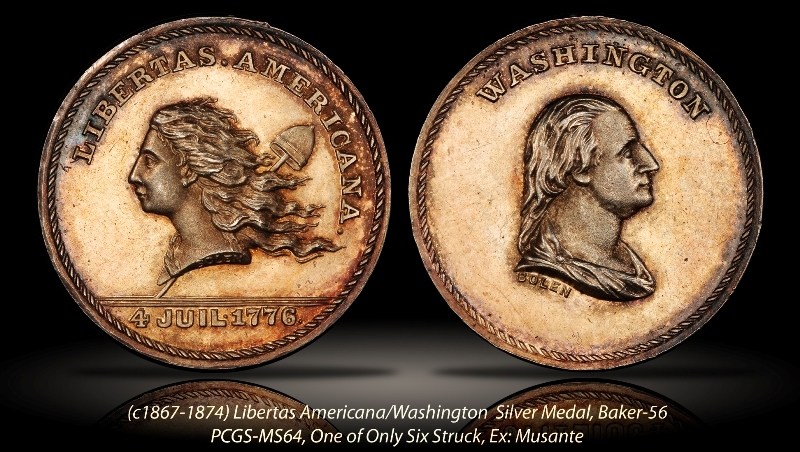
Here we see not only one of the very rarest of the Bolen medals, but one of the very rarest of all patriotic medals: the Baker-56 Washington medal (AKA Bolen's JAB-M-4), combining Bolen's Libertas die with his portait of George Washington, with just six such medals struck in silver. This specimen traces its provenance to Neil Musante, the author of the definitive reference of the medallic work of John Adams Bolen.
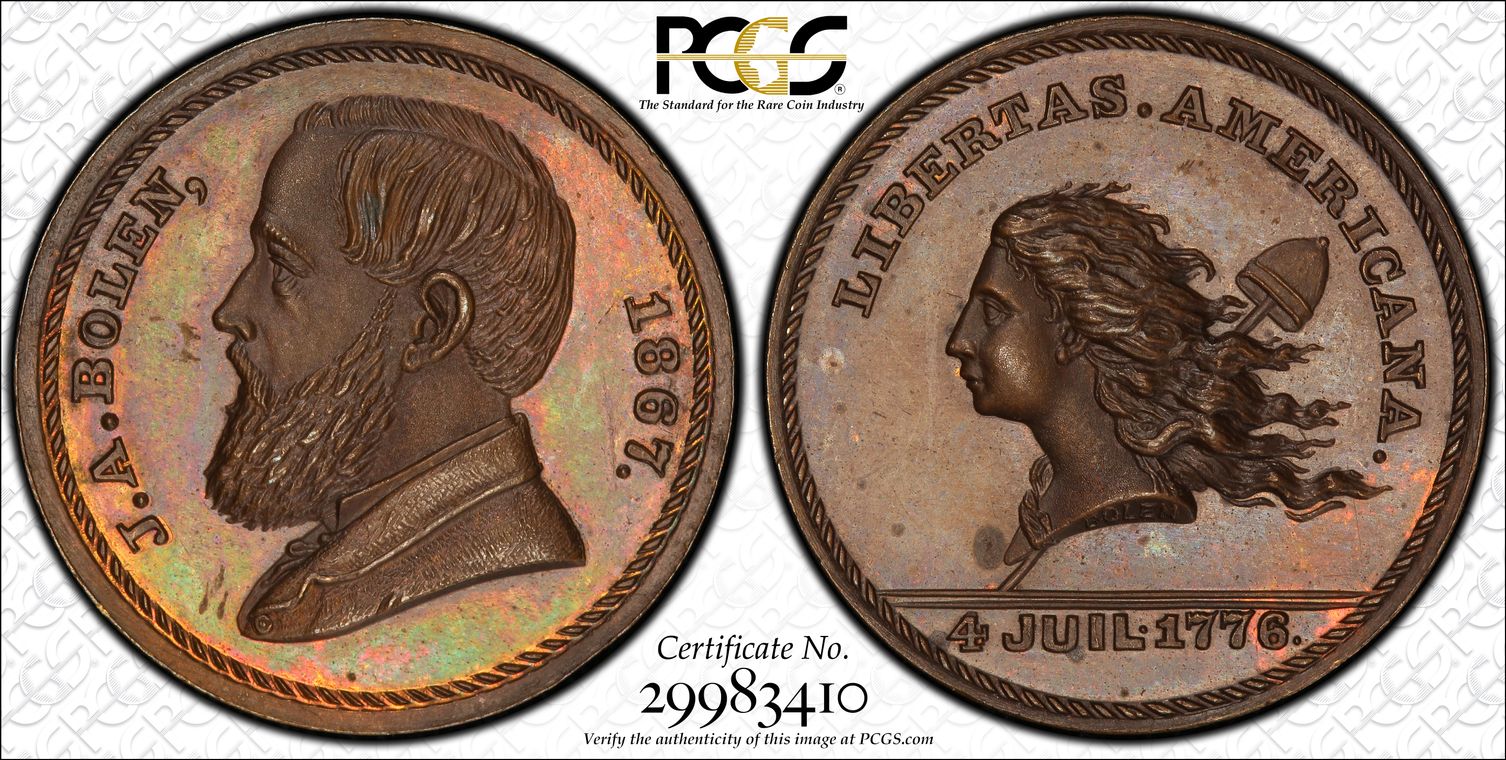


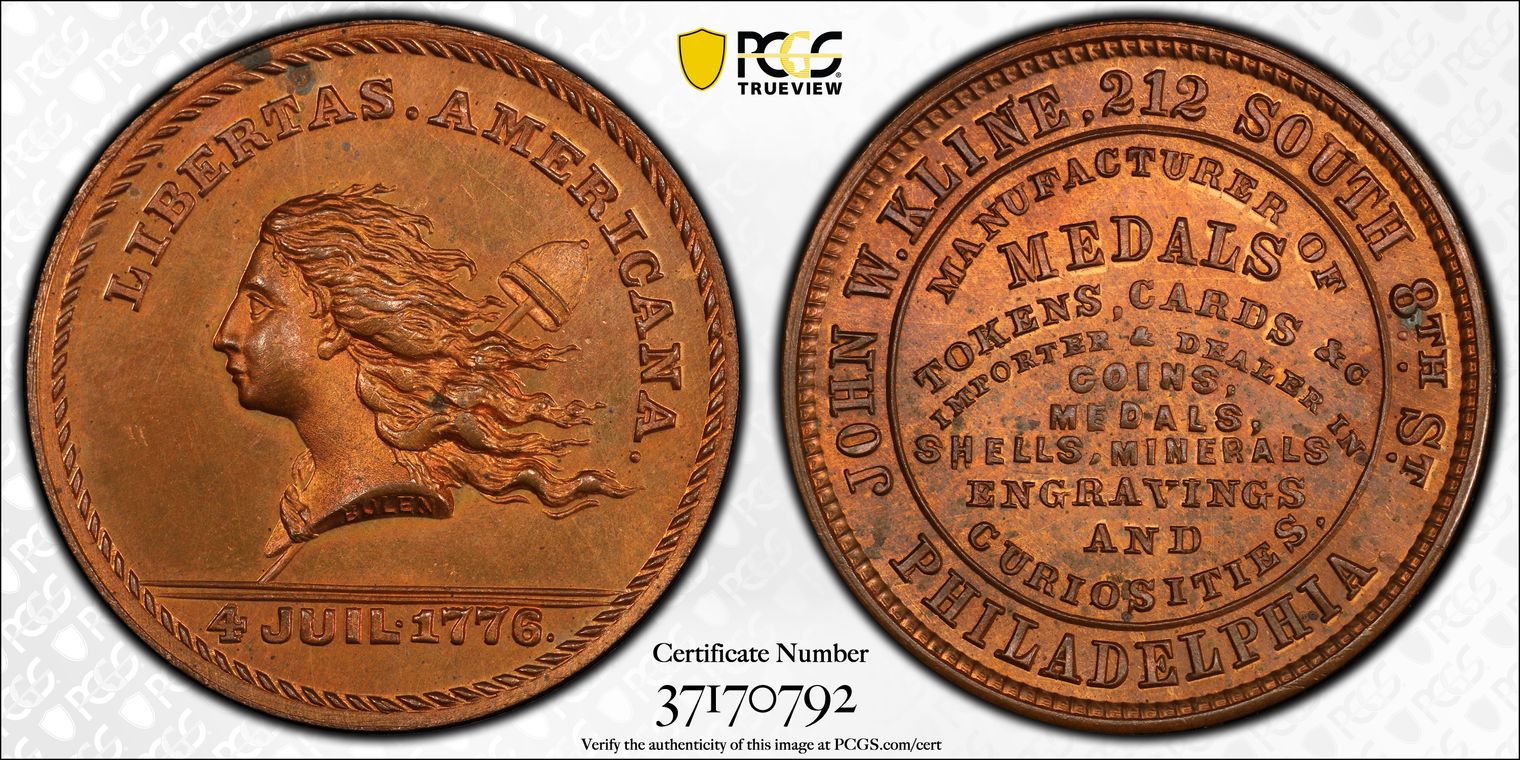
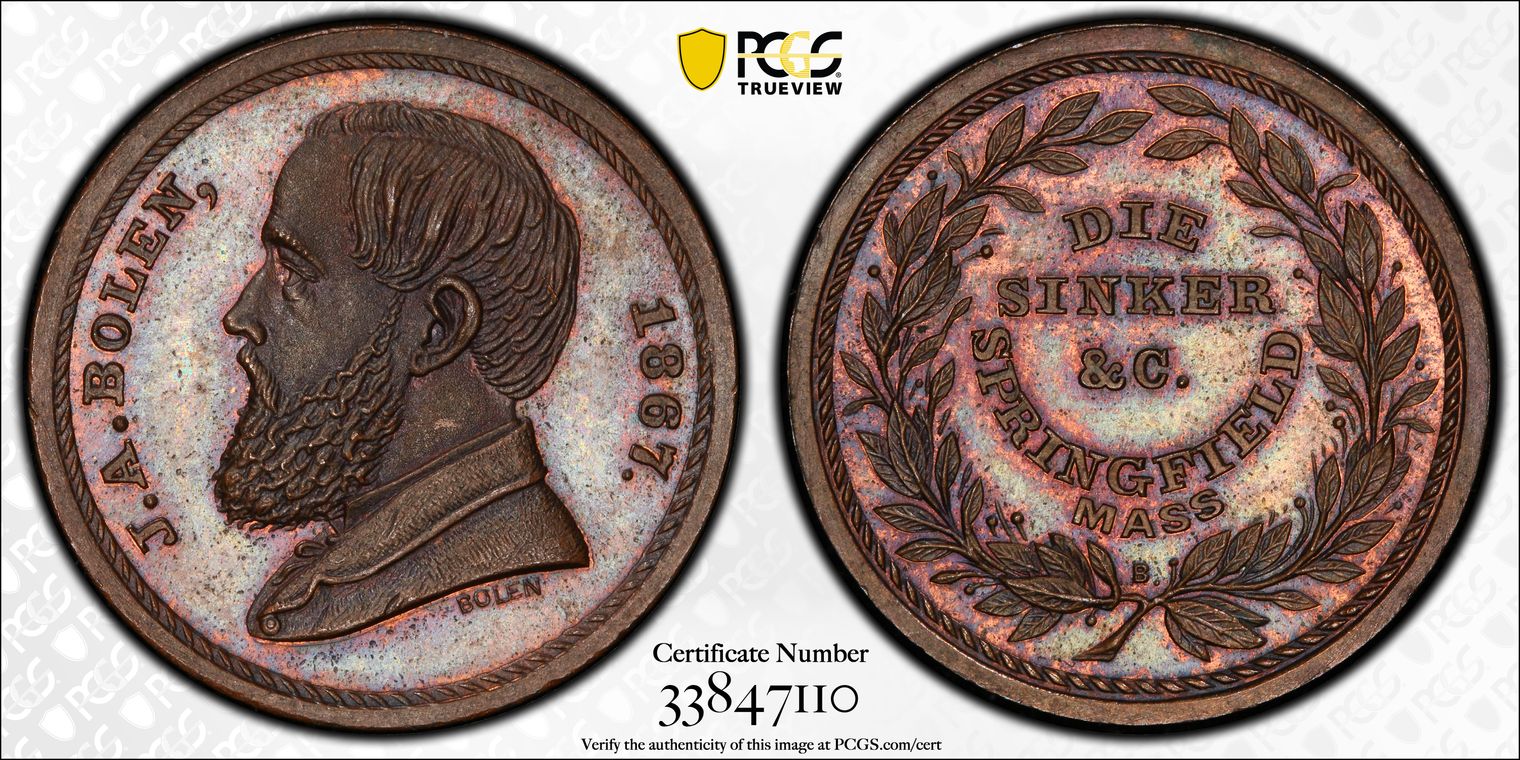
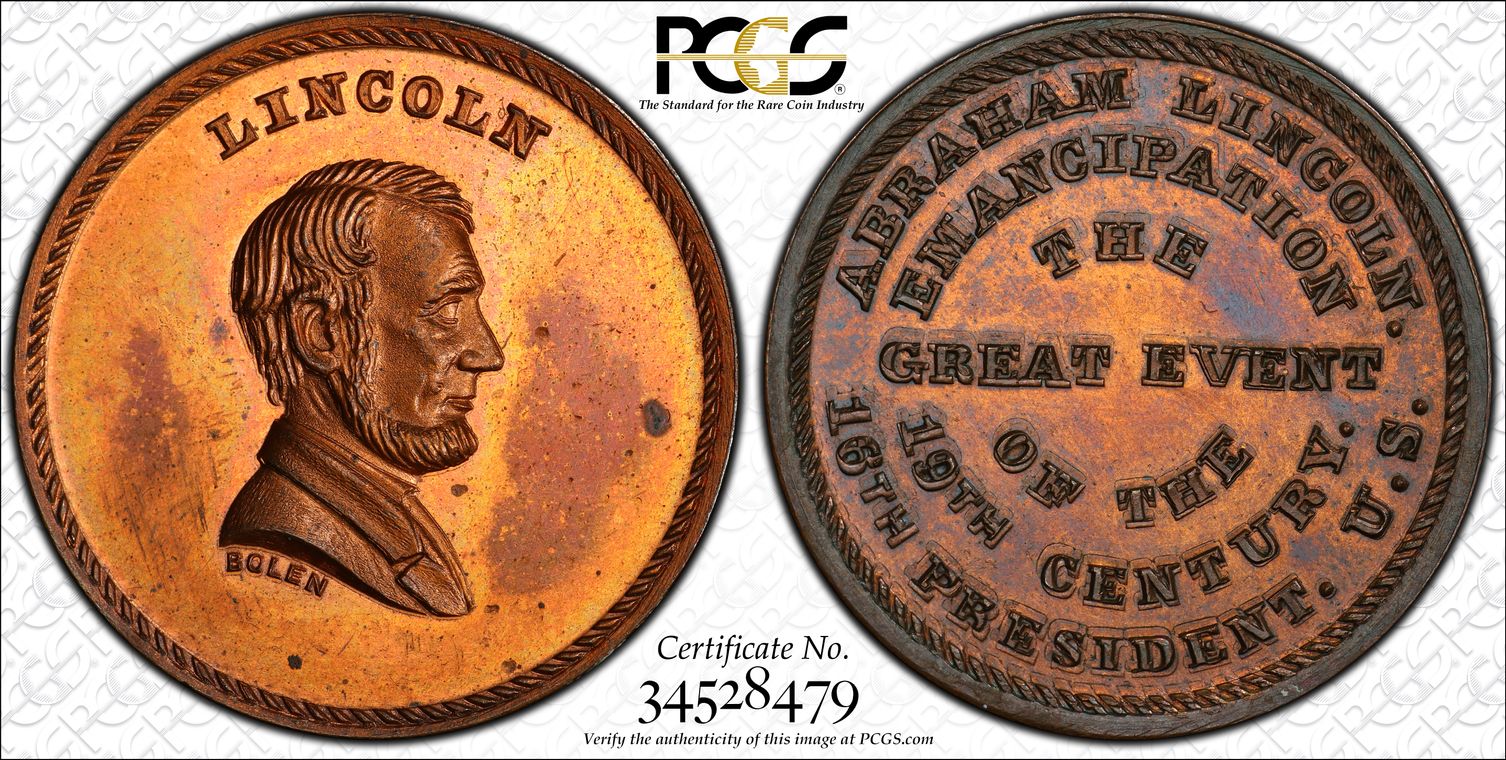
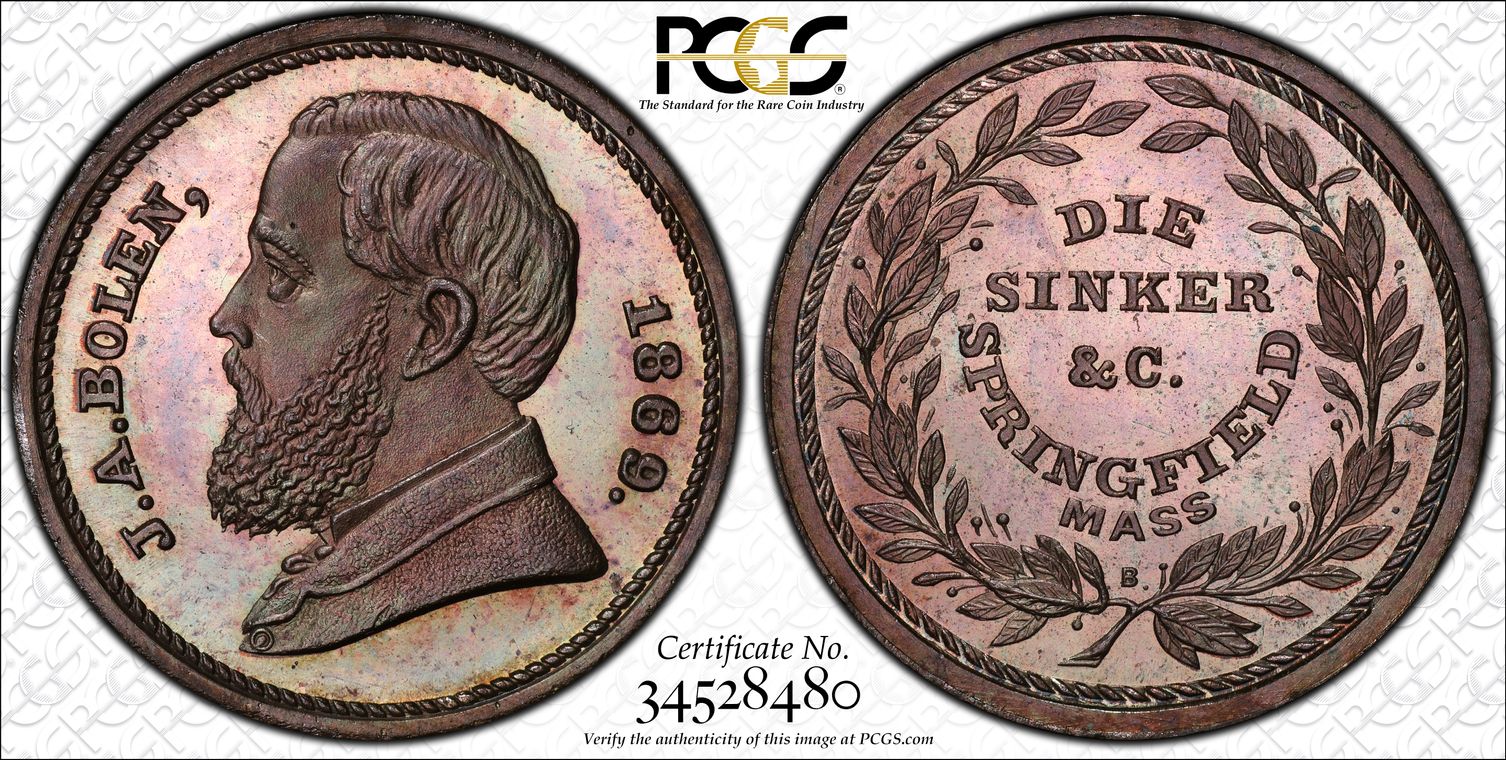
In the Post-Civil War era, as the once-divided country began to reunite in national patriotism, the image of the Libertas Americana medal again ascended as a national emblem. Medalist and Die Sinker John Adams Bolen created a 25mm die with the Libertas Americana design, to be used for patriotic medals and merchant tokens. Ultimately, this die was paired with 12 different reverse dies, resulting in 12 distinct die varieties. These pieces are all scarce to rare, and may be seen struck in silver, copper, bronze, brass and white metal. Considering the different metals that were used for production, there are a total of 32 die/metal combinations bearing Bolen's Libertas Americana obverse. As seen here, John Adams Bolen chose his Libertas Americana die to use with his own portrait medal -- with this specimen being one of just 16 examples struck in copper.
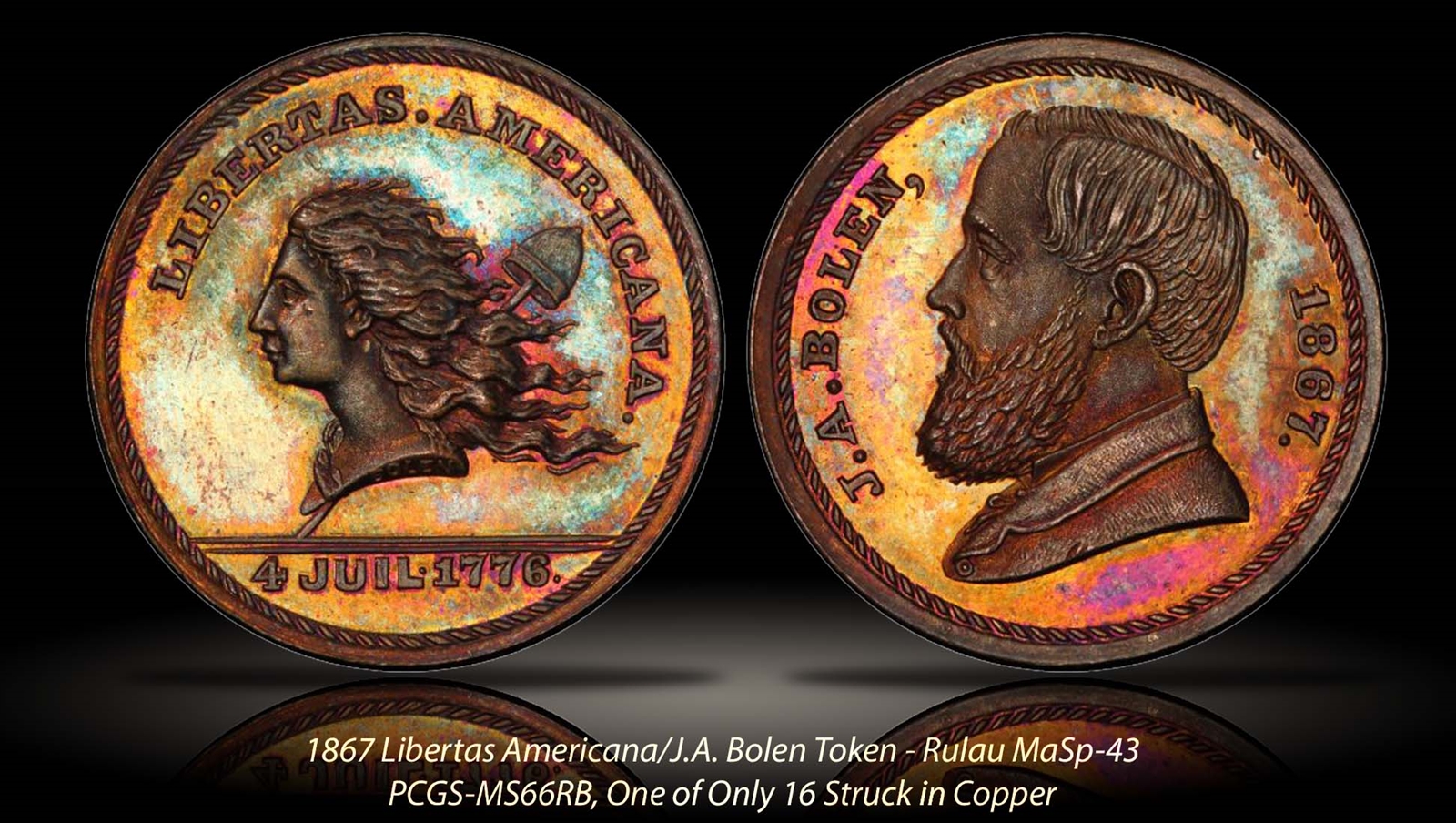
In the Post-Civil War era, as the once-divided country began to reunite in national patriotism, the image of the Libertas Americana medal again ascended as a national emblem. Medalist and Die Sinker John Adams Bolen created a 25mm die with the Libertas Americana design, to be used for patriotic medals and merchant tokens. Ultimately, this die was paired with 12 different reverse dies, resulting in 12 distinct die varieties. These pieces are all scarce to rare, and may be seen struck in silver, copper, bronze, brass and white metal. Considering the different metals that were used for production, there are a total of 32 die/metal combinations bearing Bolen's Libertas Americana obverse. As seen here, John Adams Bolen chose his Libertas Americana die to use with his own portrait medal -- with this specimen being one of just 16 examples struck in copper. Ex: Don Miller, Charles Litman and Steve Tanenbaum.

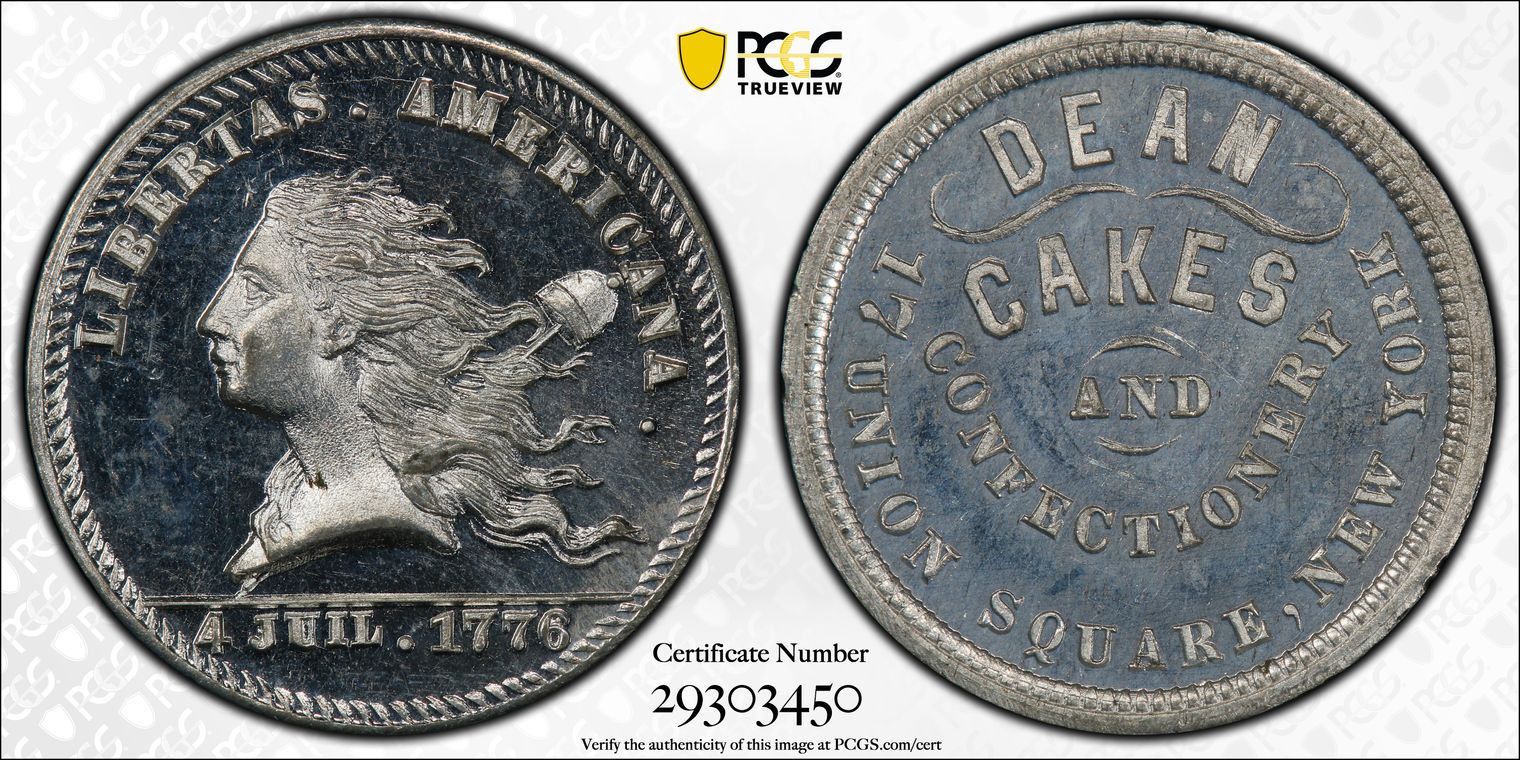
One of the more available New York City store tokens, this one from the collections of David Schenkman and Steve Tanenbaum.
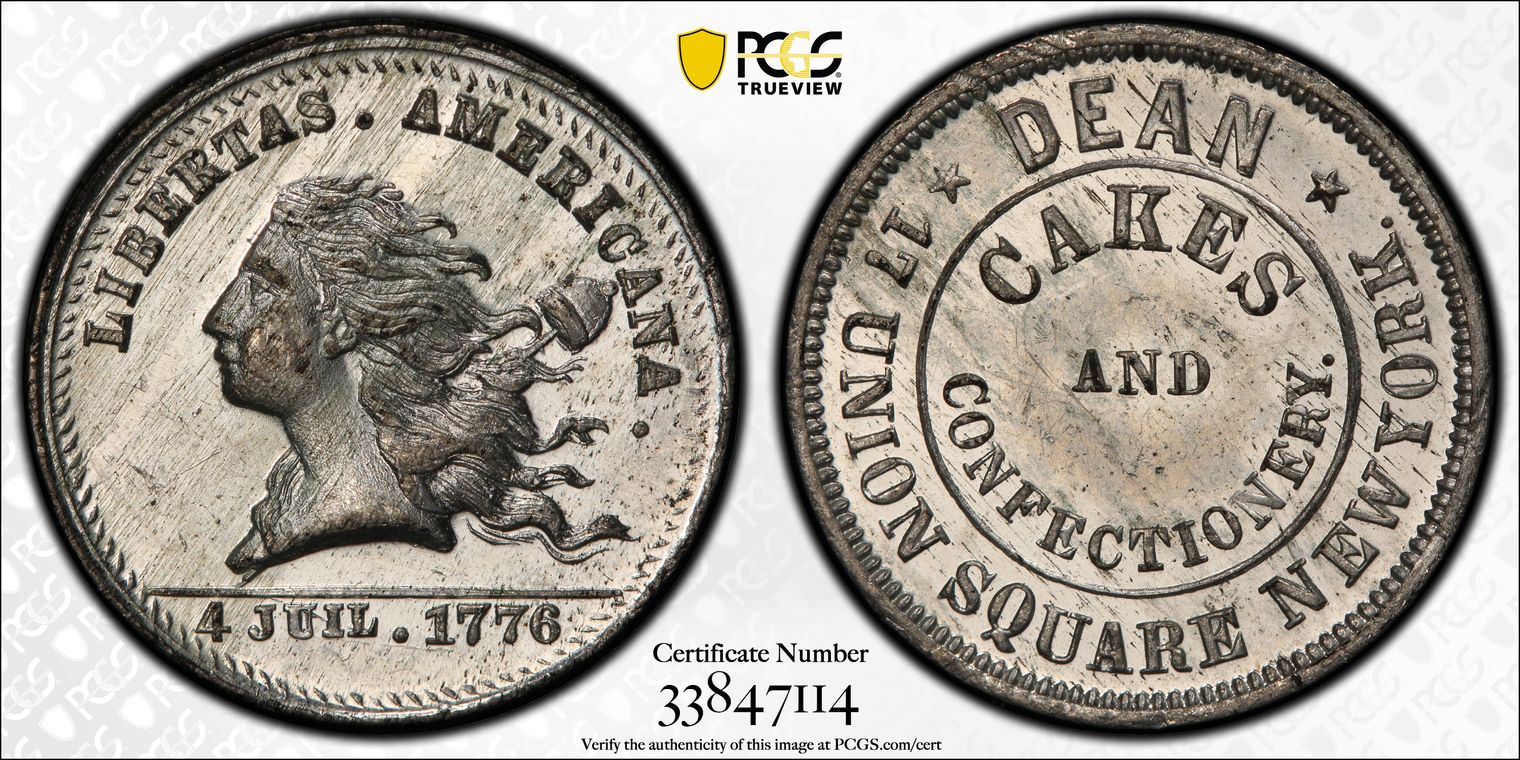
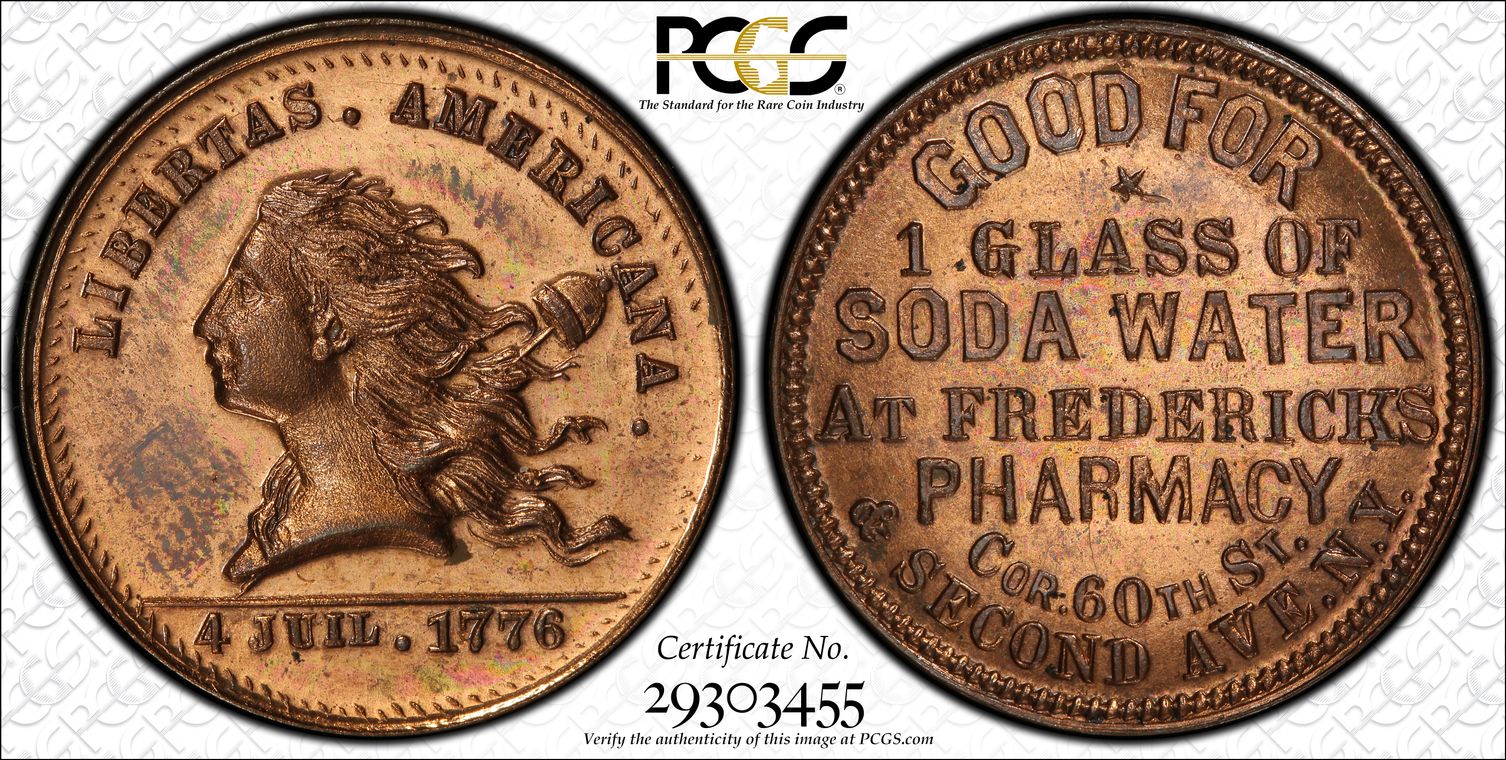
A wonderful red-brown copper store card, Ex: Robert Williams and Steve Tanenbaum
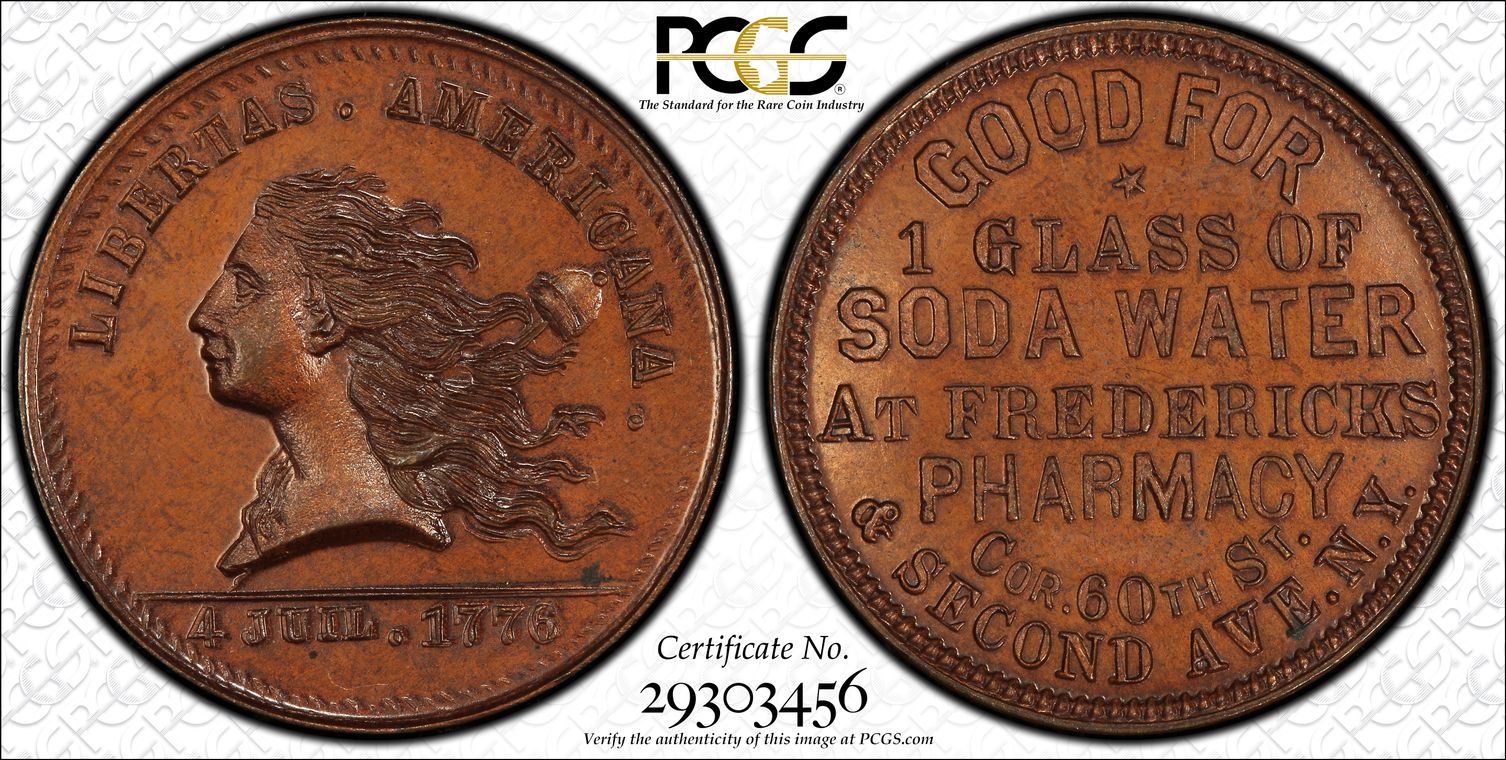
With this Lingg token produced for Fredericks Pharmacy of New York, we see the 23mm Libertas die in its scarcest format -- struck in Bronze. Ex: Max M Schwart, David E. Schenkman, and Steve Tanenbaum.
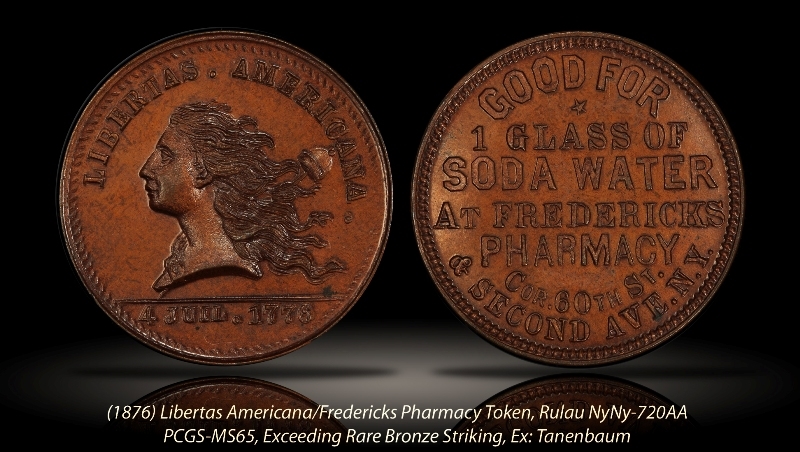
With this Lingg token produced for Fredericks Pharmacy of New York, we see the 23mm Libertas die in its scarcest format -- struck in Bronze. Ex: Max M Schwart, David E. Schenkman, and Steve Tanenbaum.

Ex: FCC Boyd, John J. Ford and Steve Tanenbaum.
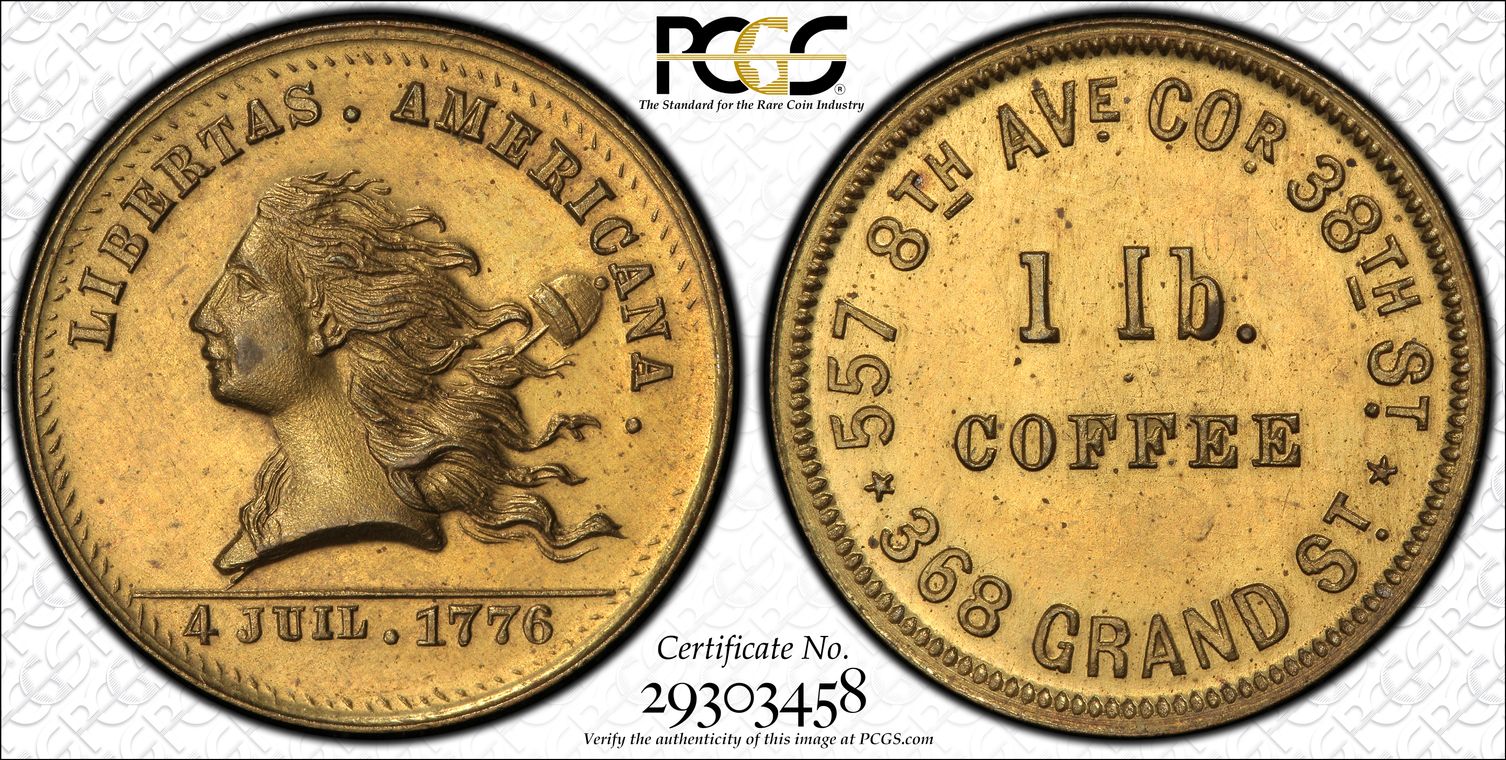
Ex: Max M Schwartz, PCAC, Ray Bryne, David E. Schenkman and Steve Tanenbaum

Ex: Max M Schwartz, HJ Levine, Ray Bryne, David E. Schenkman and Steve Tanenbaum
Ex: Max M Schwartz, HJ Levine, Ray Bryne, David E. Schenkman and Steve Tanenbaum
Ex: Max M Schwartz, HJ Levine, Ray Bryne, David E. Schenkman and Steve Tanenbaum
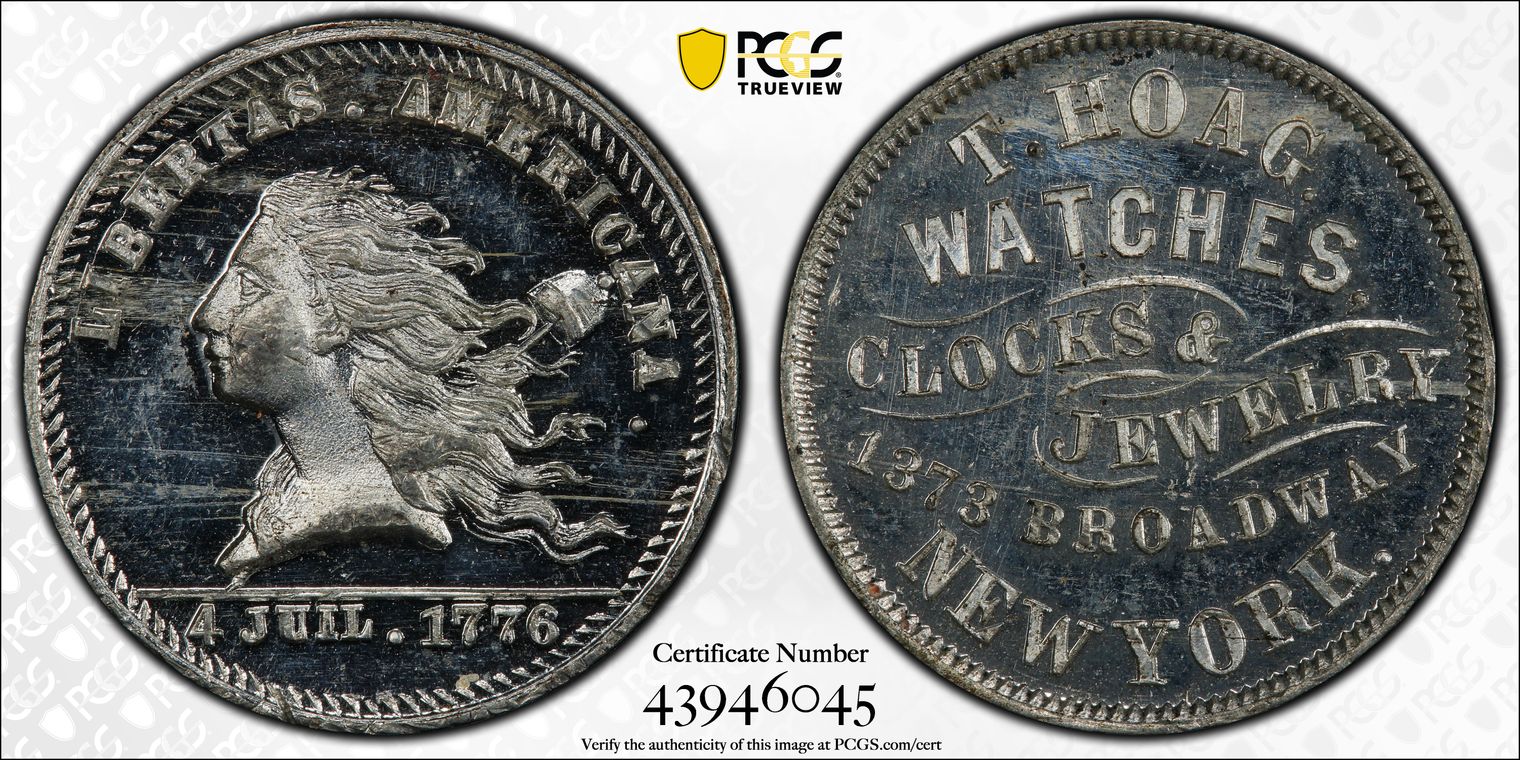
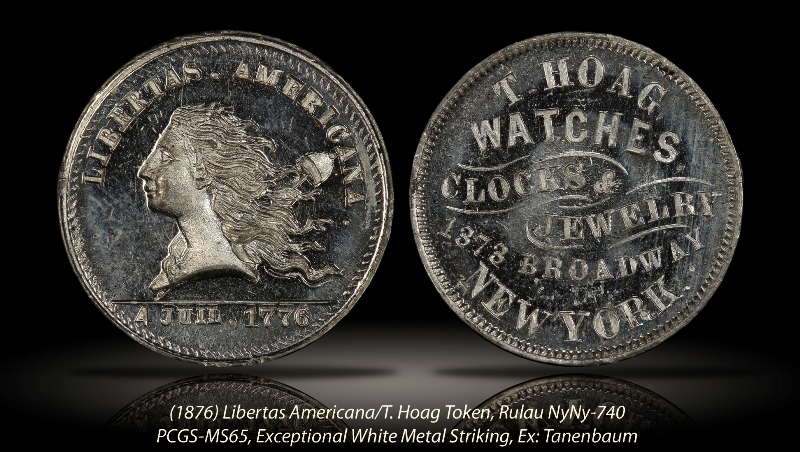
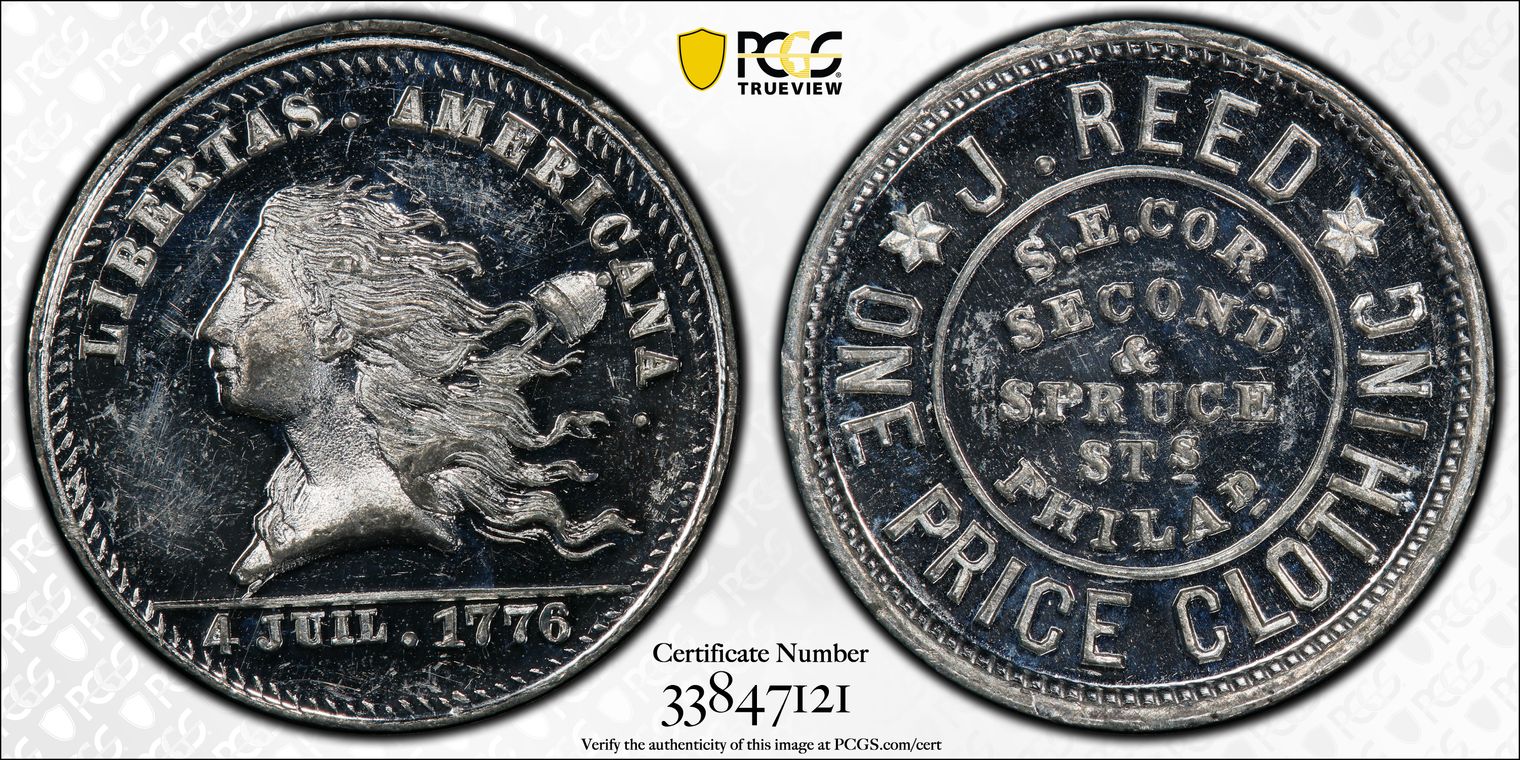
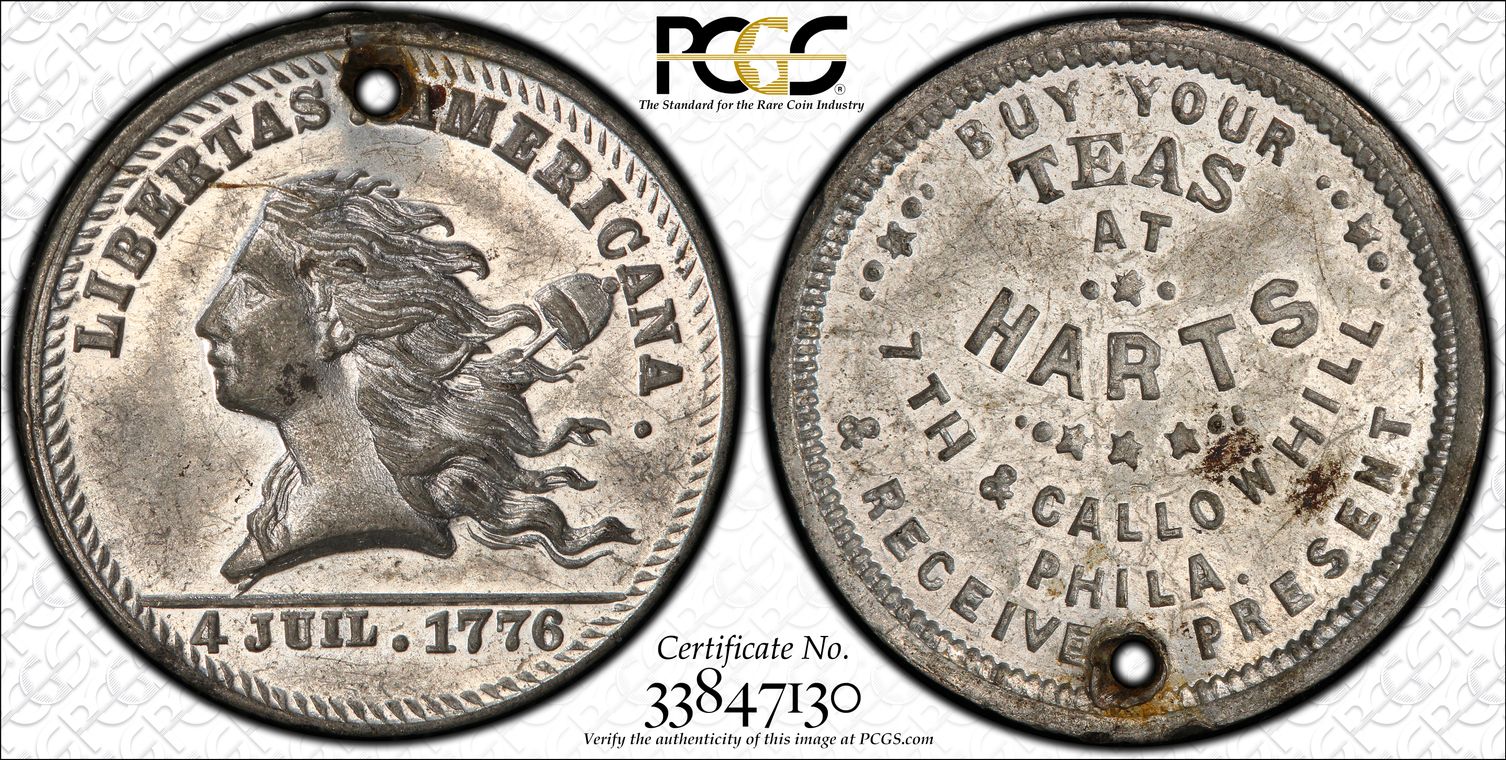
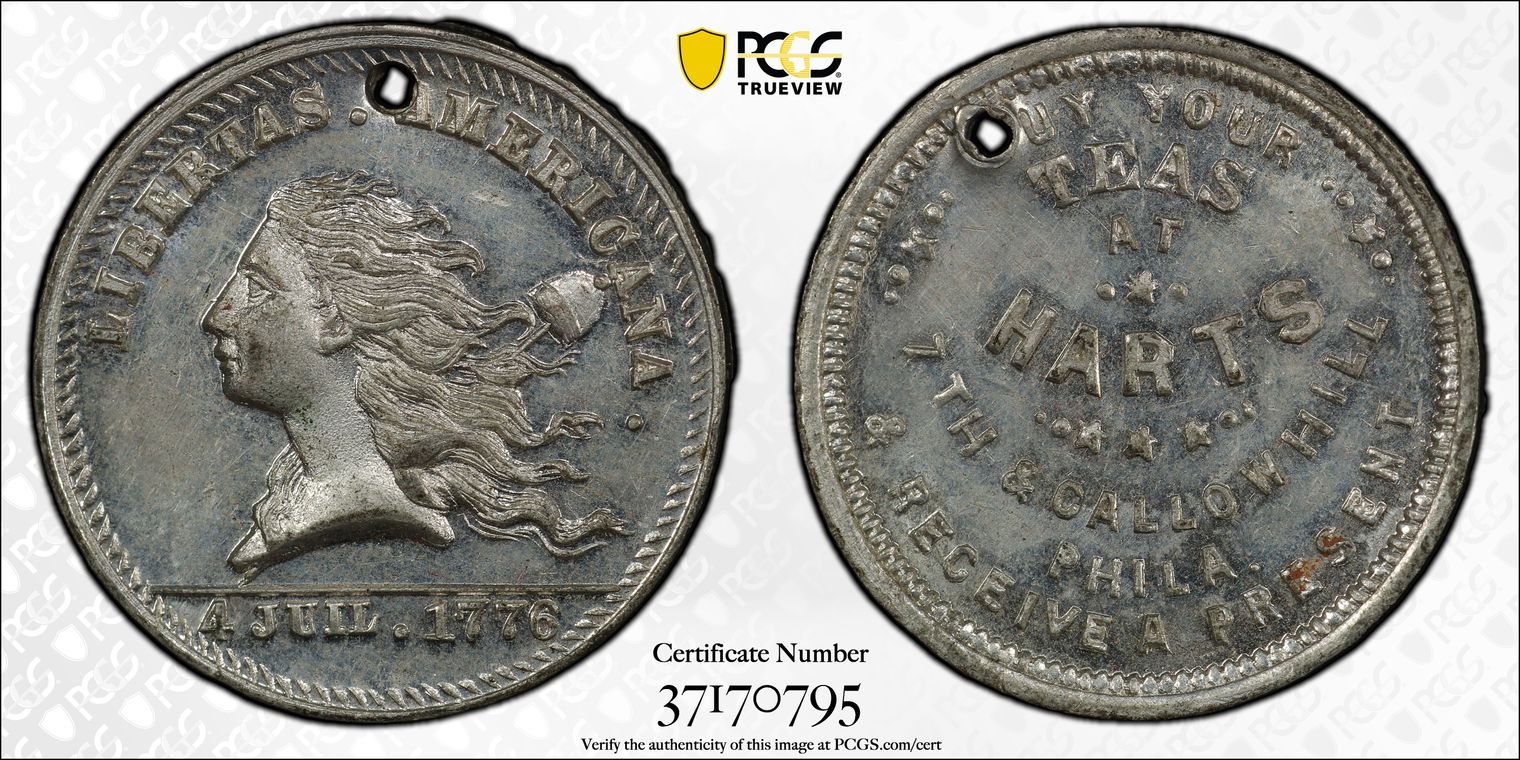
White metal strikings of the various merchant tokens are the most commonly seen, and decidedly the most common of the Libertas Americana tokens. White metal is quite soft and easily impressed by the dies, and this sometimes results in a highly reflective prooflike surface -- as seen here with the Libertas token for T. Hoag Watches of New York. Ex: Donald Schram and Steve Tanenbaum
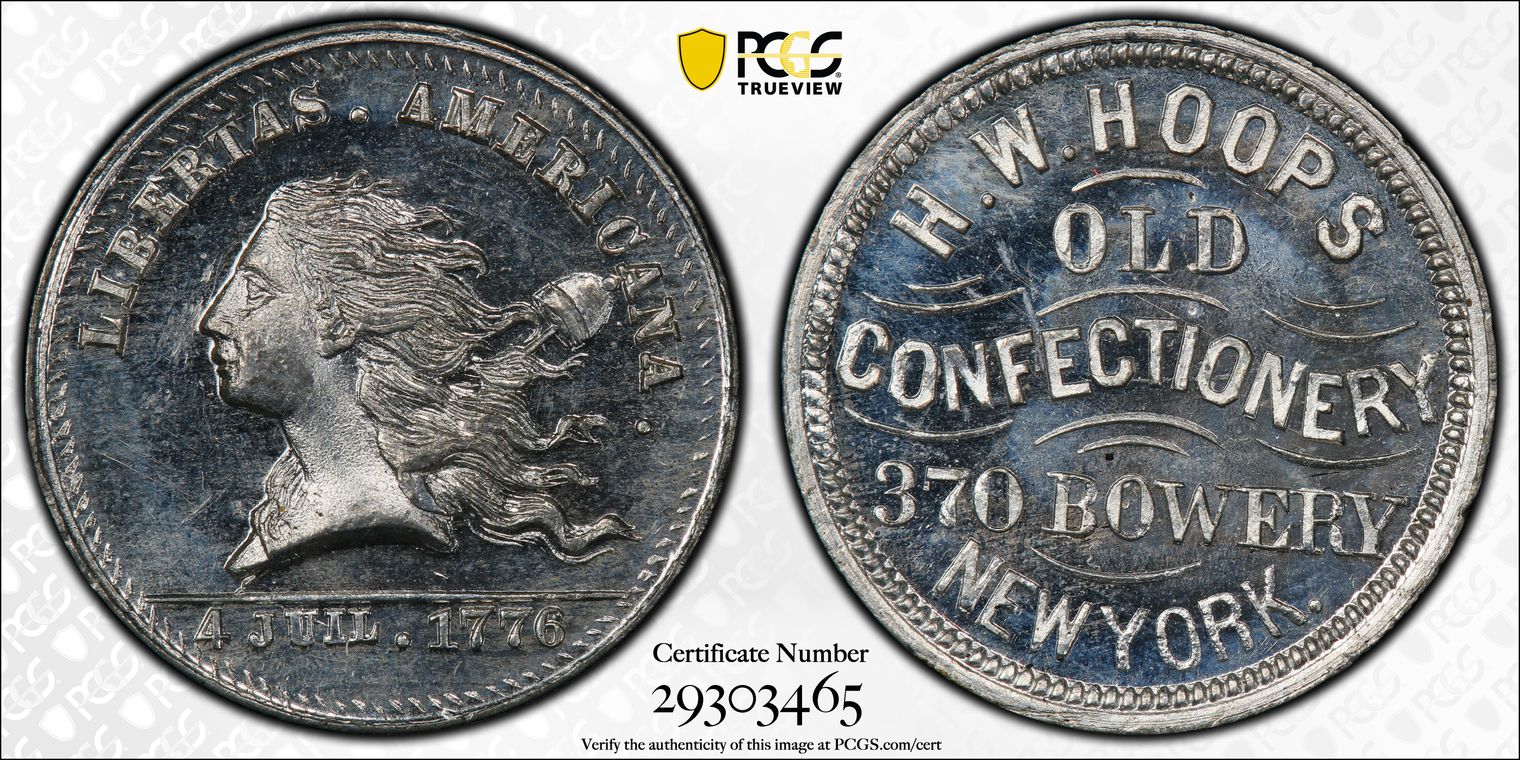
Ex: Herbert Bardes and Steve Tanenbaum


Ex: FCC Boyd, John J. Ford and Steve Tanenbaum
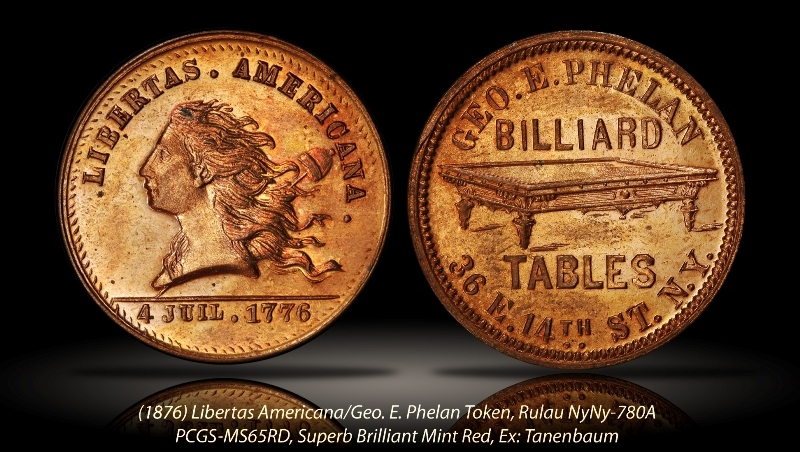
Apart from the patriotic medals, the Lingg Brothers used their Libertas Americana die in commerical production, creating advertising tokens for numerous merchants. Here we see the Geo. E. Phelan merchant token struck in copper, and still fully Mint Red! Ex: Max M. Schwartz, David E. Schenkman and Steve Tanenbaum
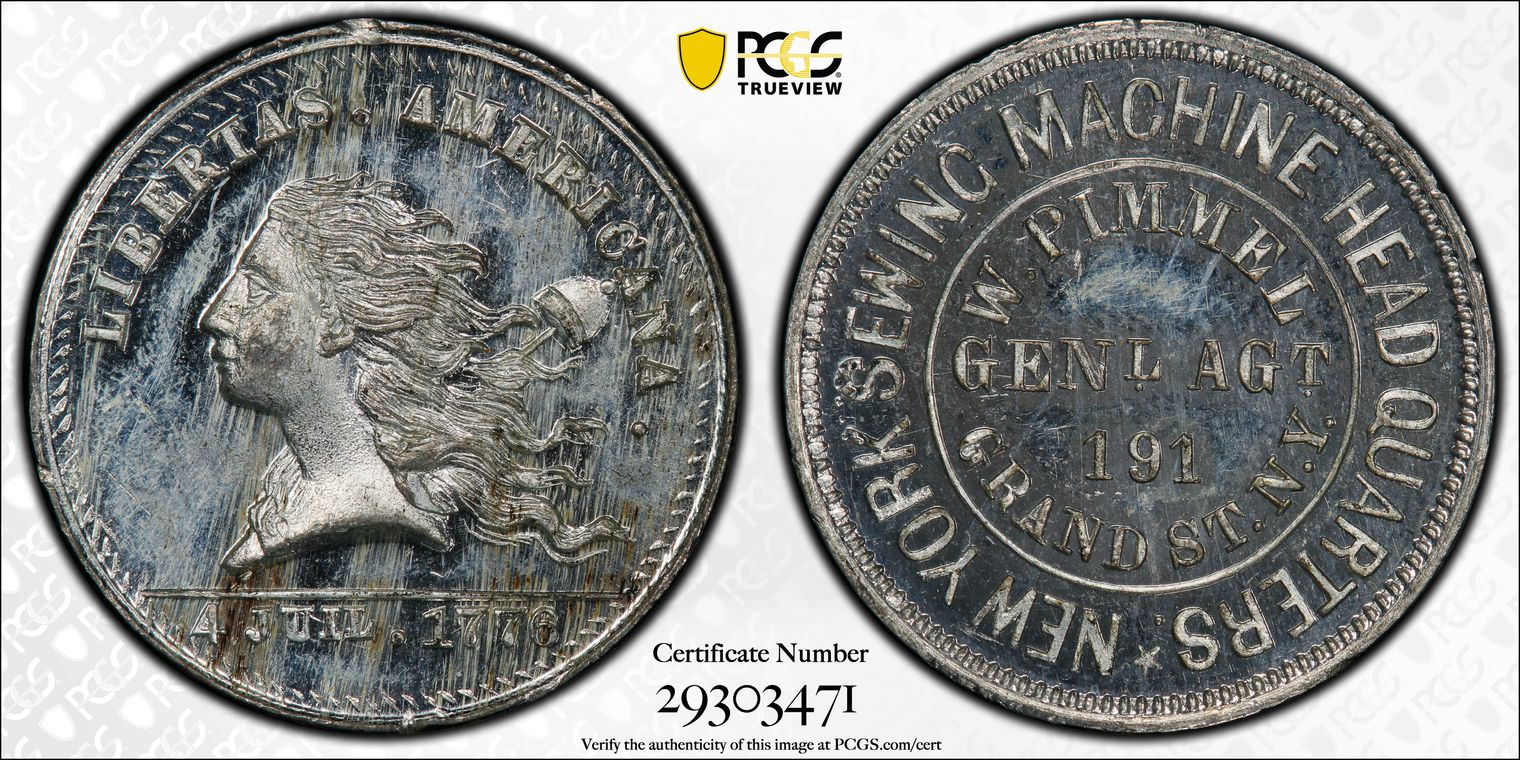
Ex: Springfield Library and Museum, and Steve Tanenbaum
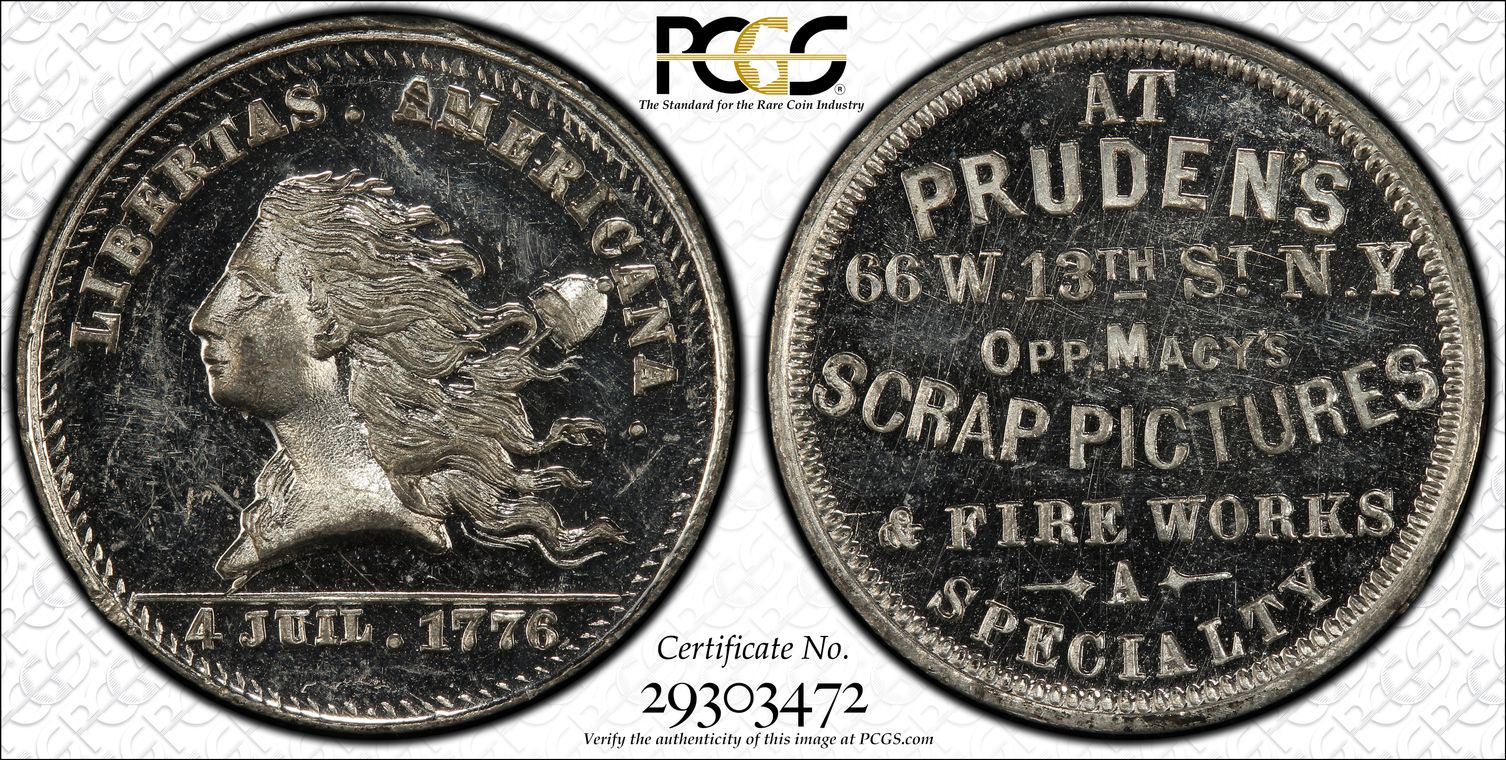
Ex: Max M. Schwartz, David E. Schenkman and Steve Tanenbaum
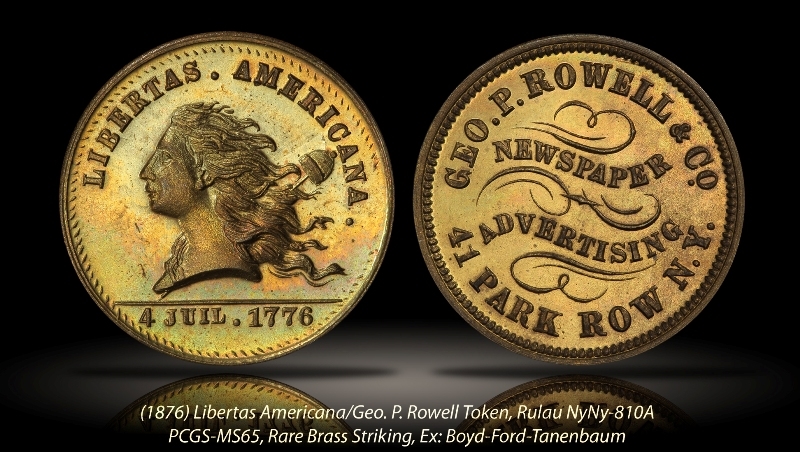
This merchant token was produced for the Geo. P. Rowell & Co. Newspaper company of New York. While these Rowell tokens are fairly available in the common "white metal" (tin), they are truly rare in the Brass composition seen here. Indeed, this particular specimen has been highly prized for generations, having been featured in the collections of FCC Boyd, John J. Ford, and Stephen Tanenbaum.
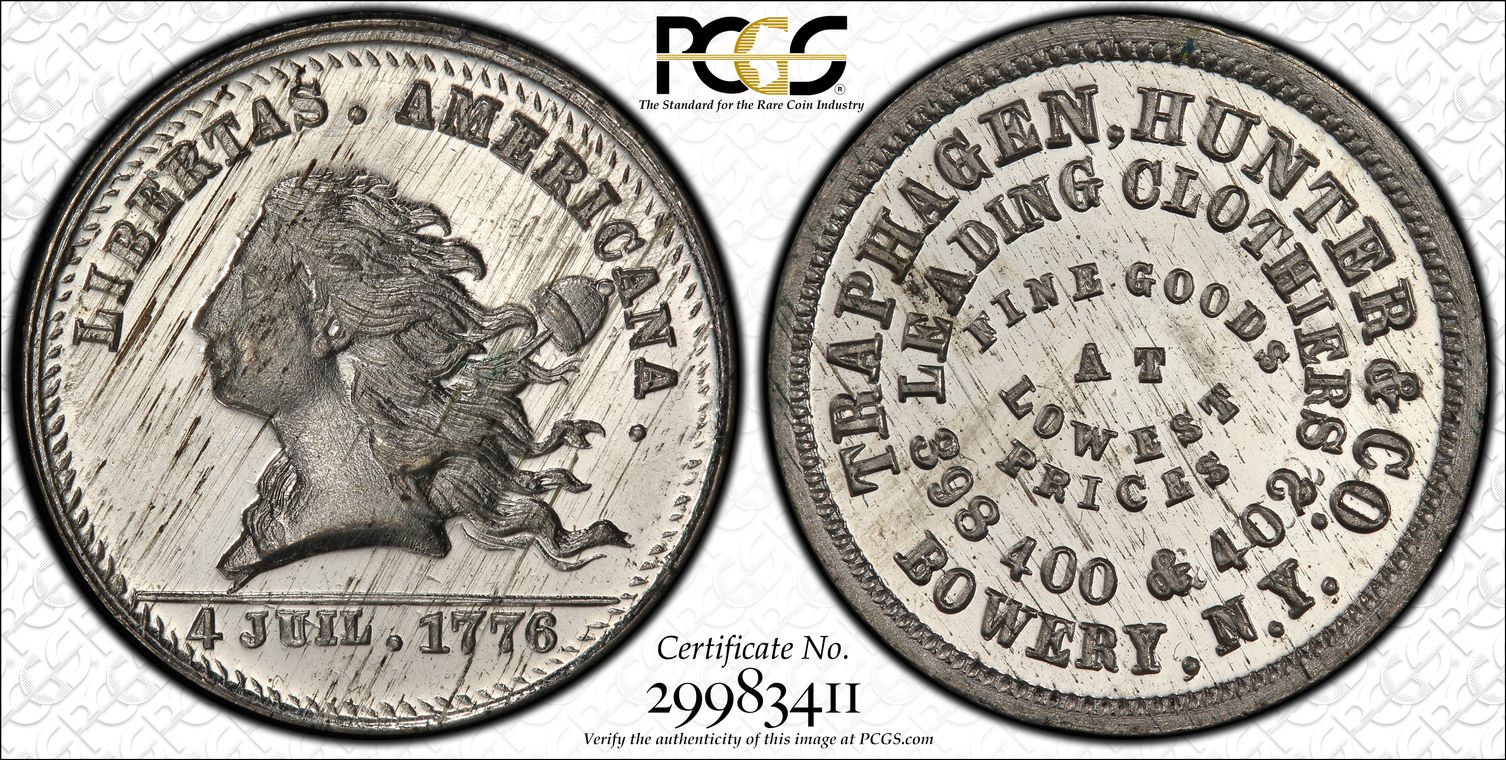
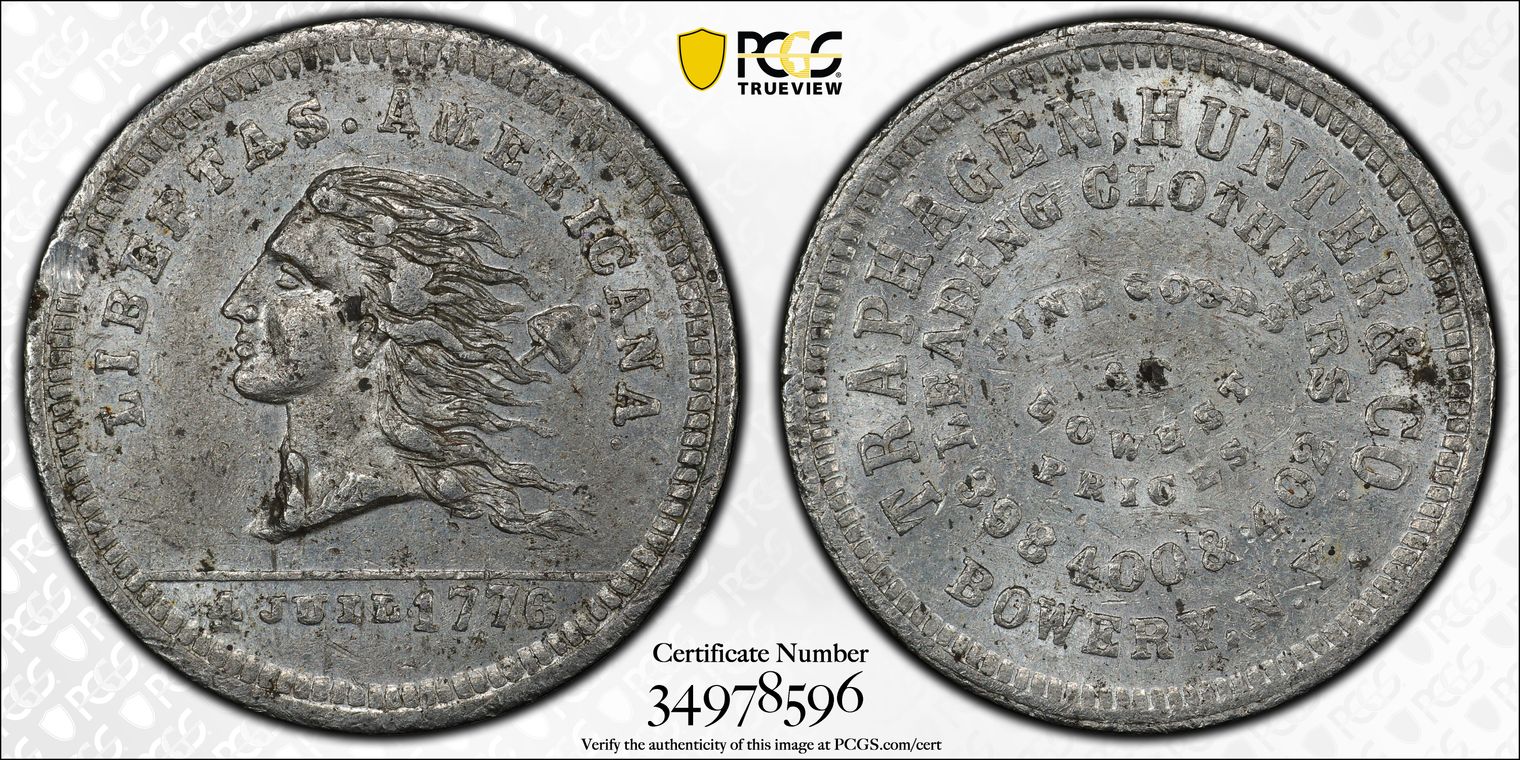

The third known Libertas Americana token obverse die is seen here. An odd rarity among the Libertas Americana tokens, this obverse die displays a very uniform denticulated border, but a rather crude portrait of Liberty. One might call this the "apprentice die," as it appears to have been made by someone still learning their craft. Raised guidelines can been seen framing the denticulation and legend, to ensure their proper placement and uniformity, but it would seem that the portrait was executed freehand. This third Libertas obverse die is only known in combination with this particular Traphagen Hunter reverse die, and is seen only in white metal and brass. Ex: Max M. Schwartz, David E. Schenkman and Steve Tanenbaum
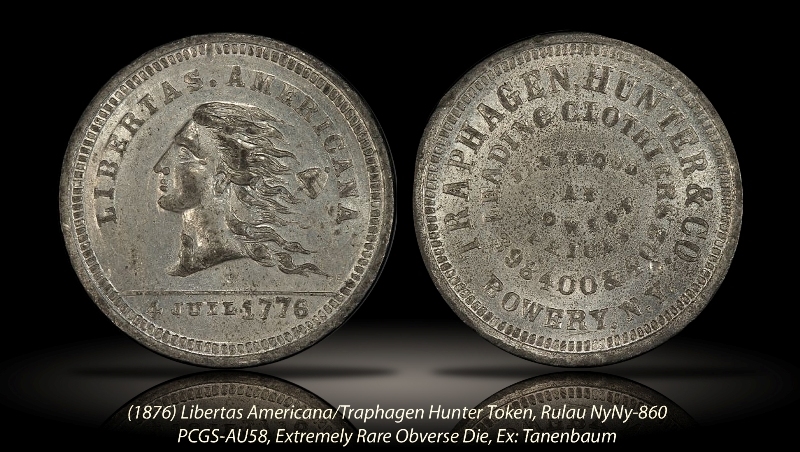
The third known Libertas Americana token obverse die is seen here. An odd rarity among the Libertas Americana tokens, this obverse die displays a very uniform denticulated border, but a rather crude portrait of Liberty. One might call this the "apprentice die," as it appears to have been made by someone still learning their craft. Raised guidelines can been seen framing the denticulation and legend, to ensure their proper placement and uniformity, but it would seem that the portrait was executed freehand. This third Libertas obverse die is only known in combination with this particular Traphagen Hunter reverse die, and is seen only in white metal and brass. Ex: Max M. Schwartz, David E. Schenkman and Steve Tanenbaum
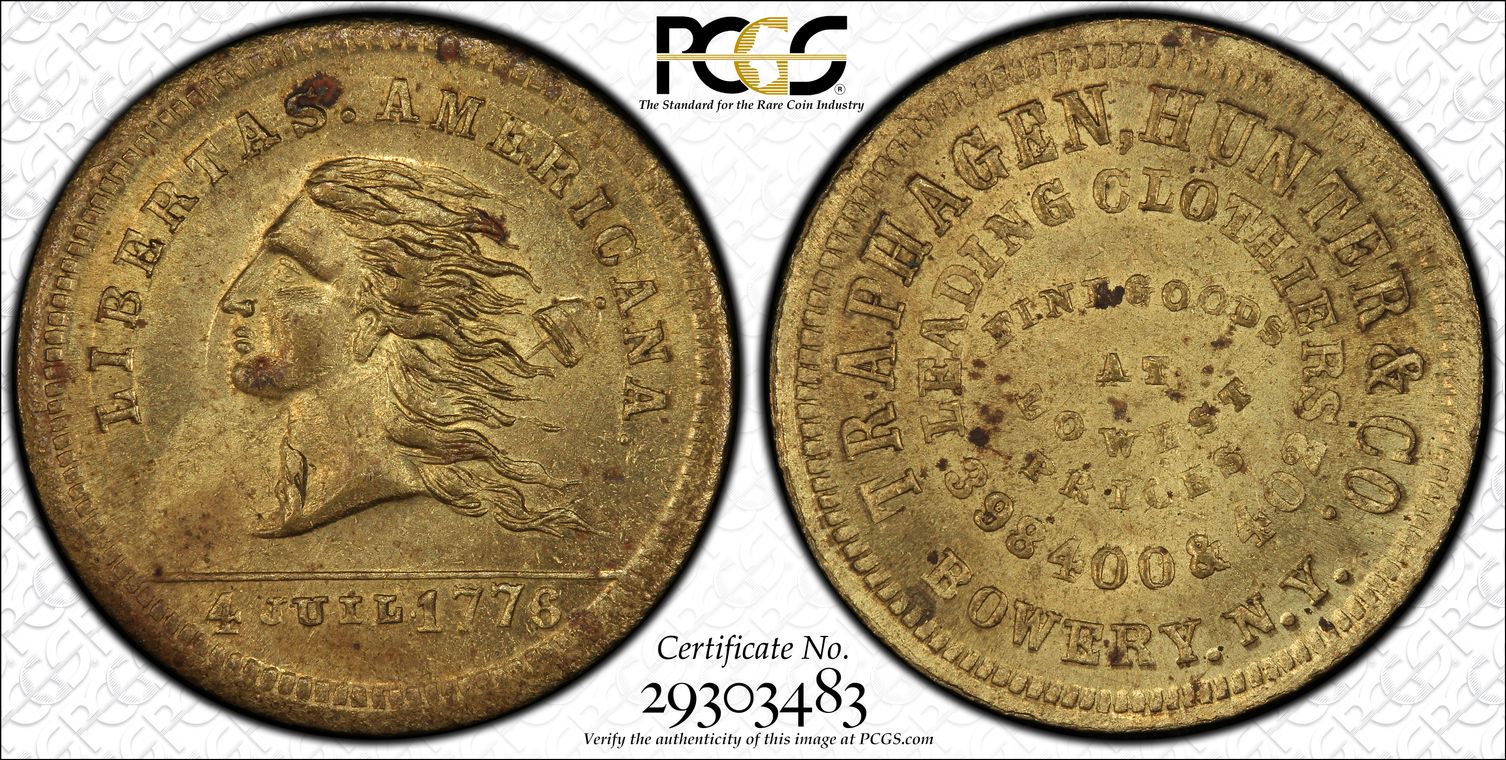
Here again is the "apprentice" die of the Libertas Americana token, this time seen in its rarest composition in Brass. With its provenance tracing to Stephen Tanenbaum, this specimen is the sole known brass striking of the token.

Here again is the "apprentice" die of the Libertas Americana token, this time seen in its rarest composition in Brass. With its provenance tracing to Stephen Tanenbaum, this specimen is the sole known brass striking of the token.
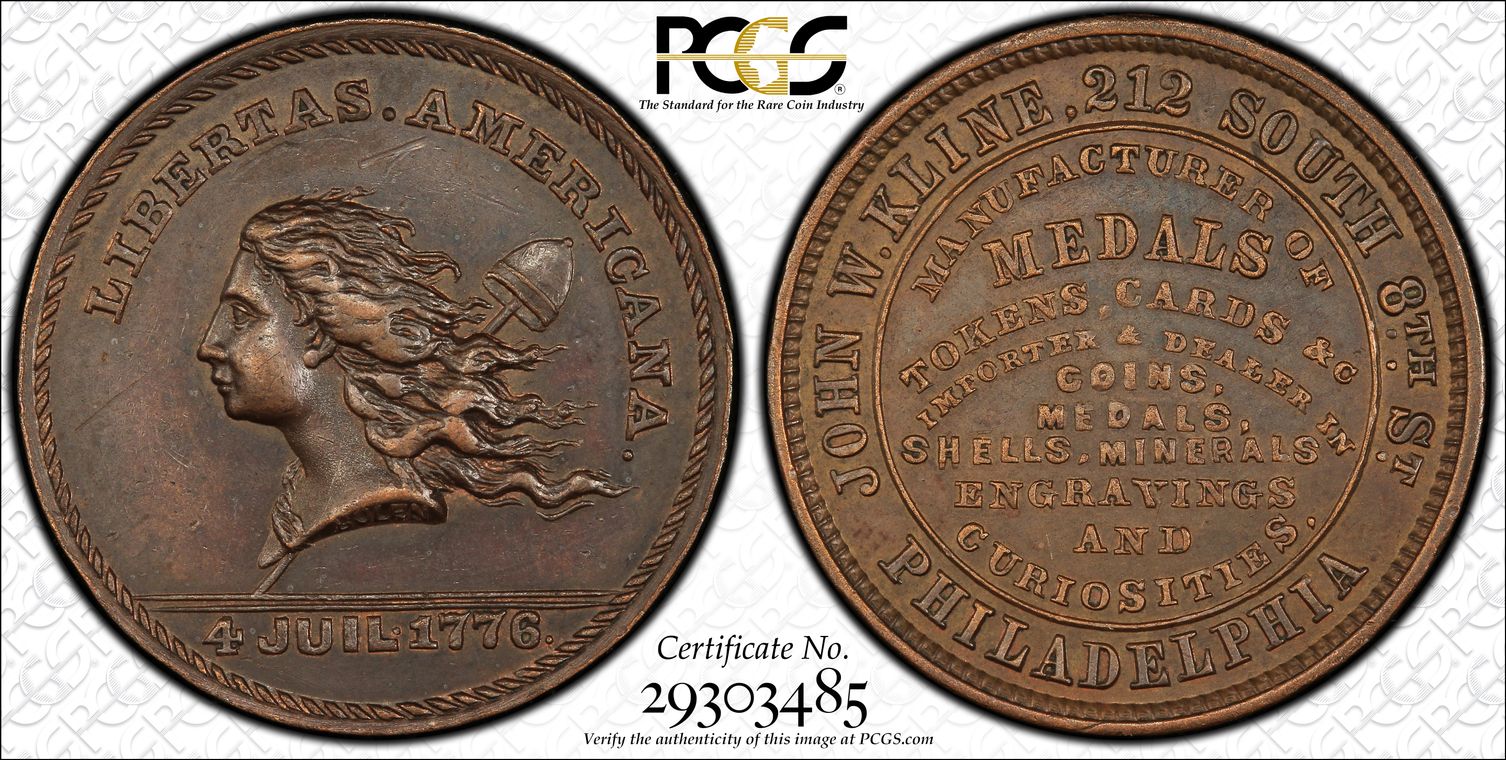
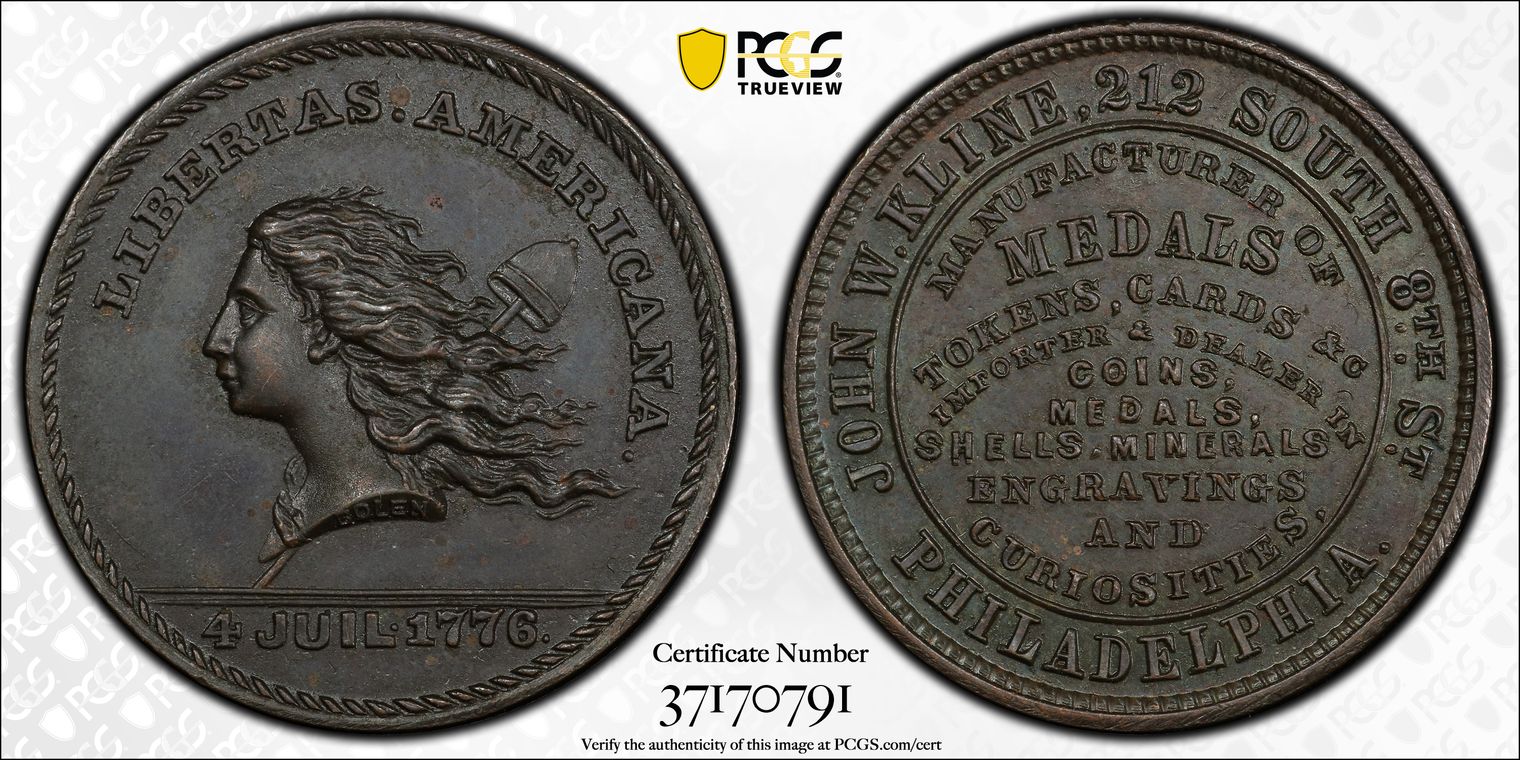
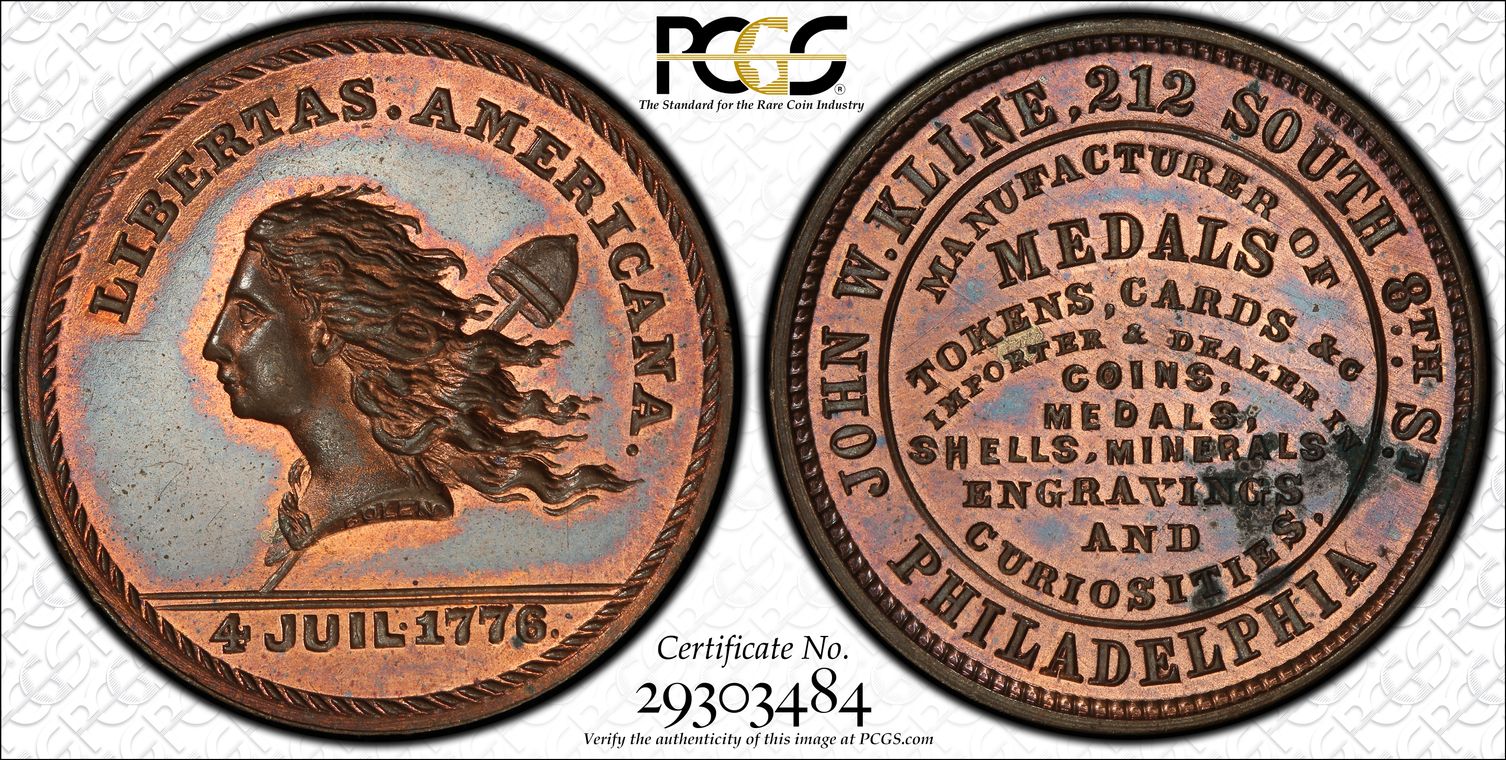

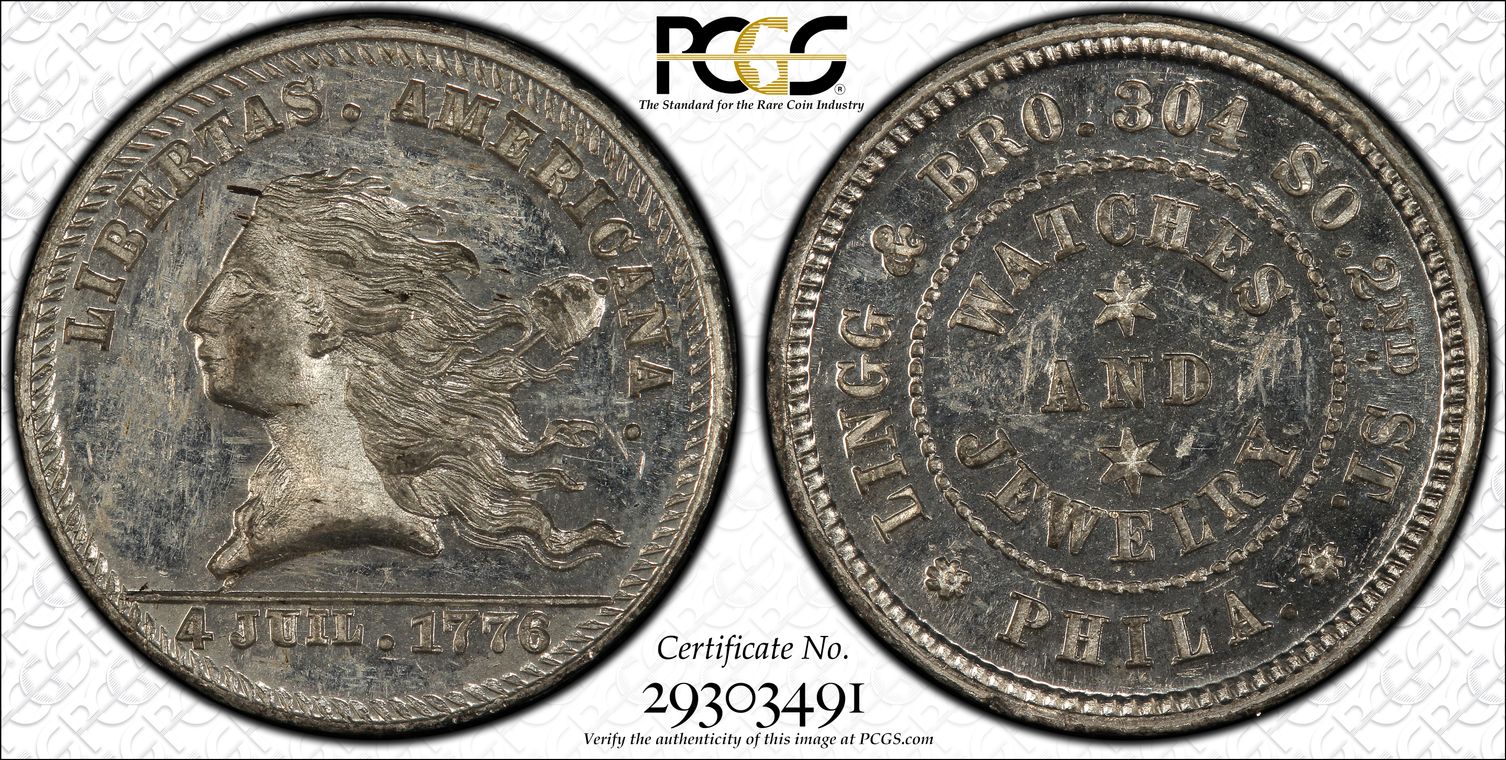
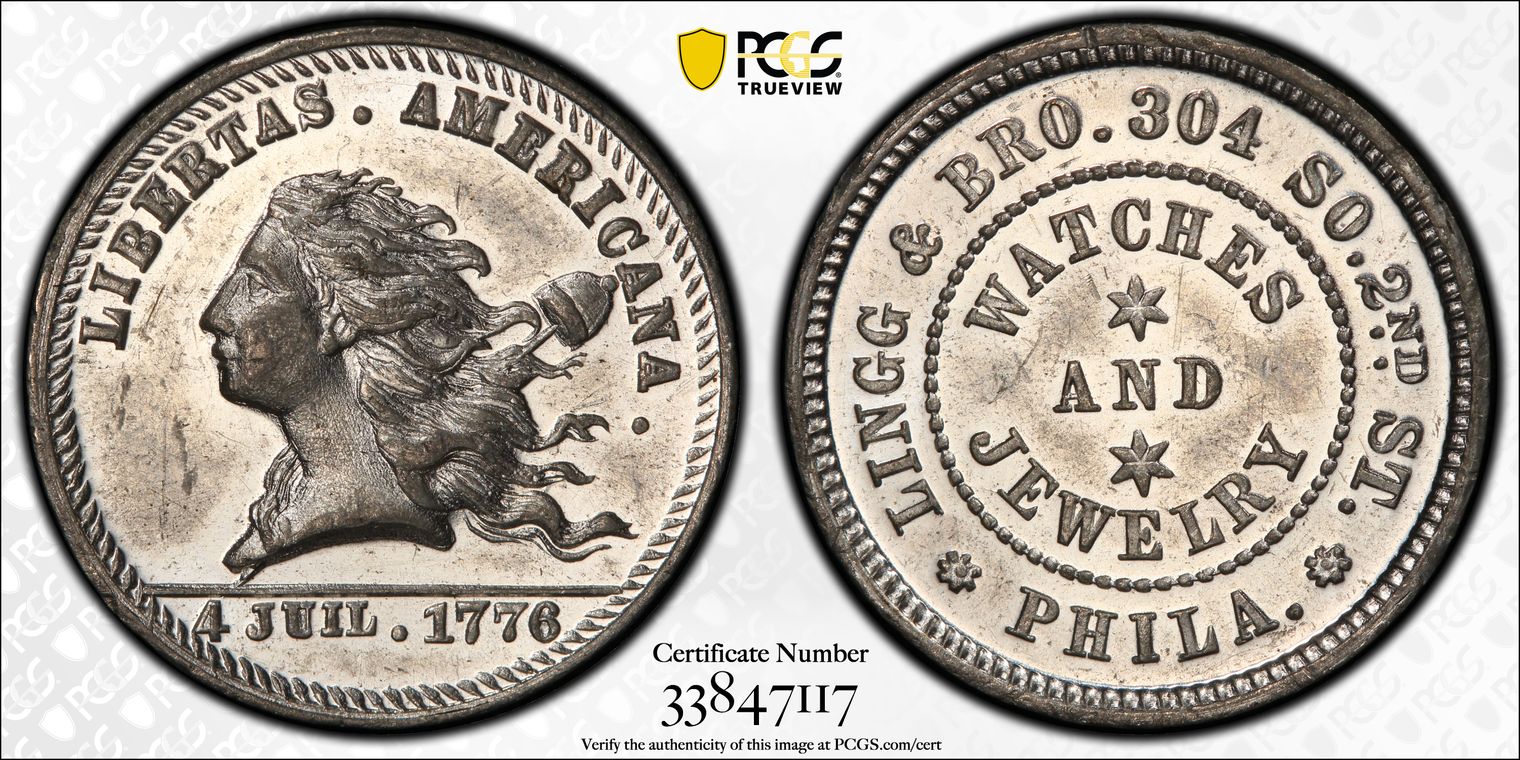
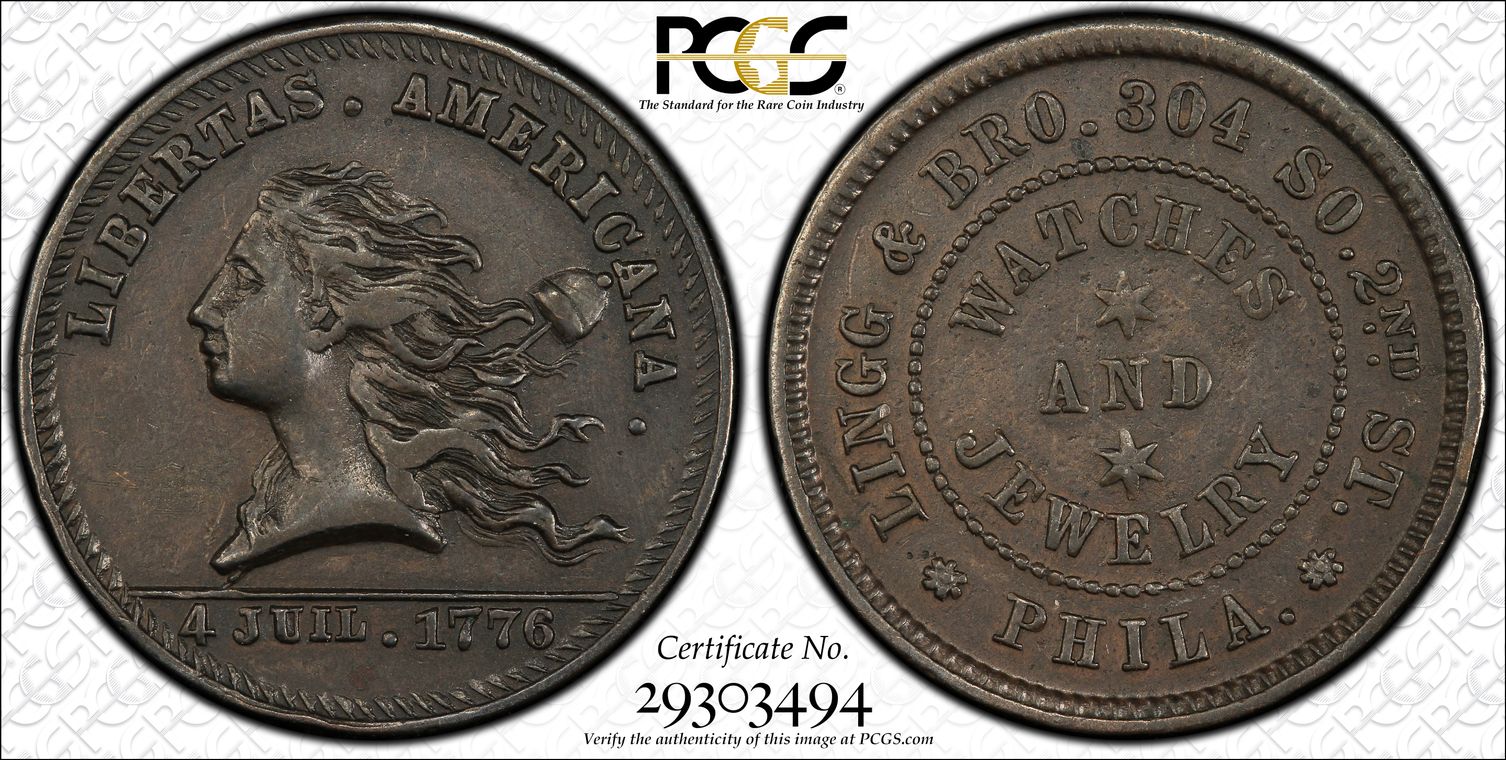
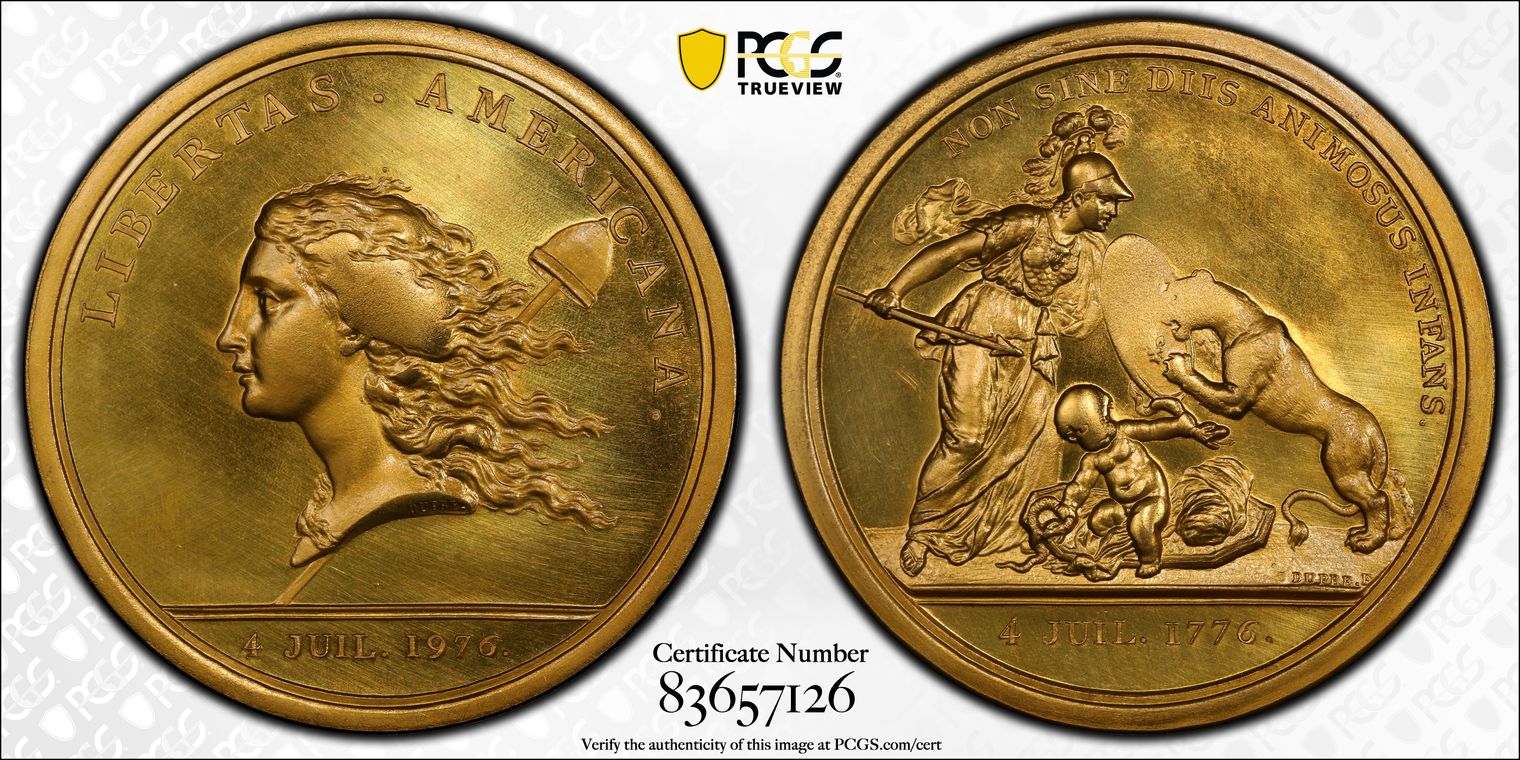
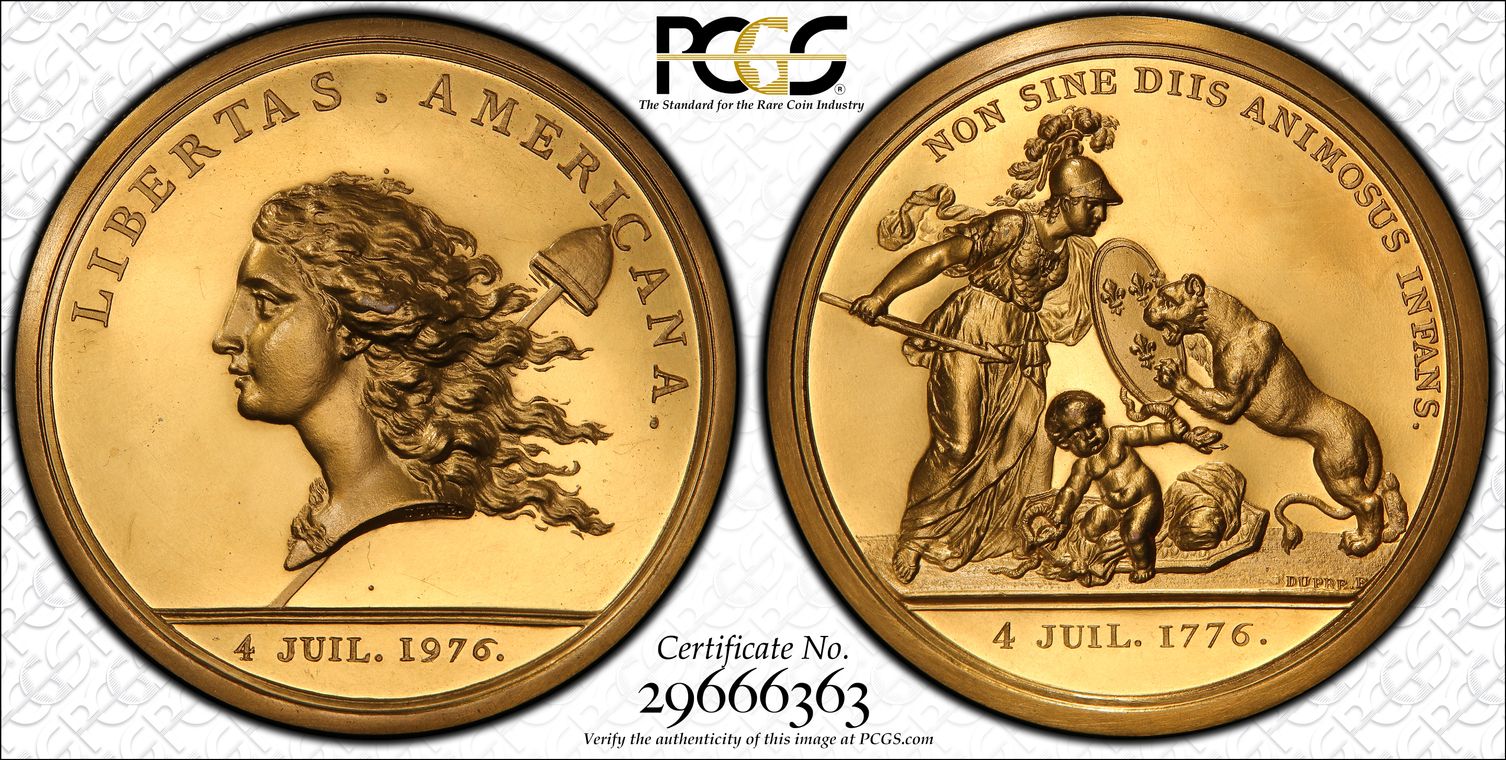
Prior to the striking of the planned production run of 500 silver medals for First Coinvestors, the Paris Mint tested the dies by producing 5 trial strikes in bronze, as seen here. Clearly, these were executed in brass or "yellow bronze," in keeping with U.S. Mint trends during the latter 20th Century. A careful comparison of the brass specimen with the silver examples confirms its trial strike status, as it displays a definitively earlier die state than seen on the silver medals.
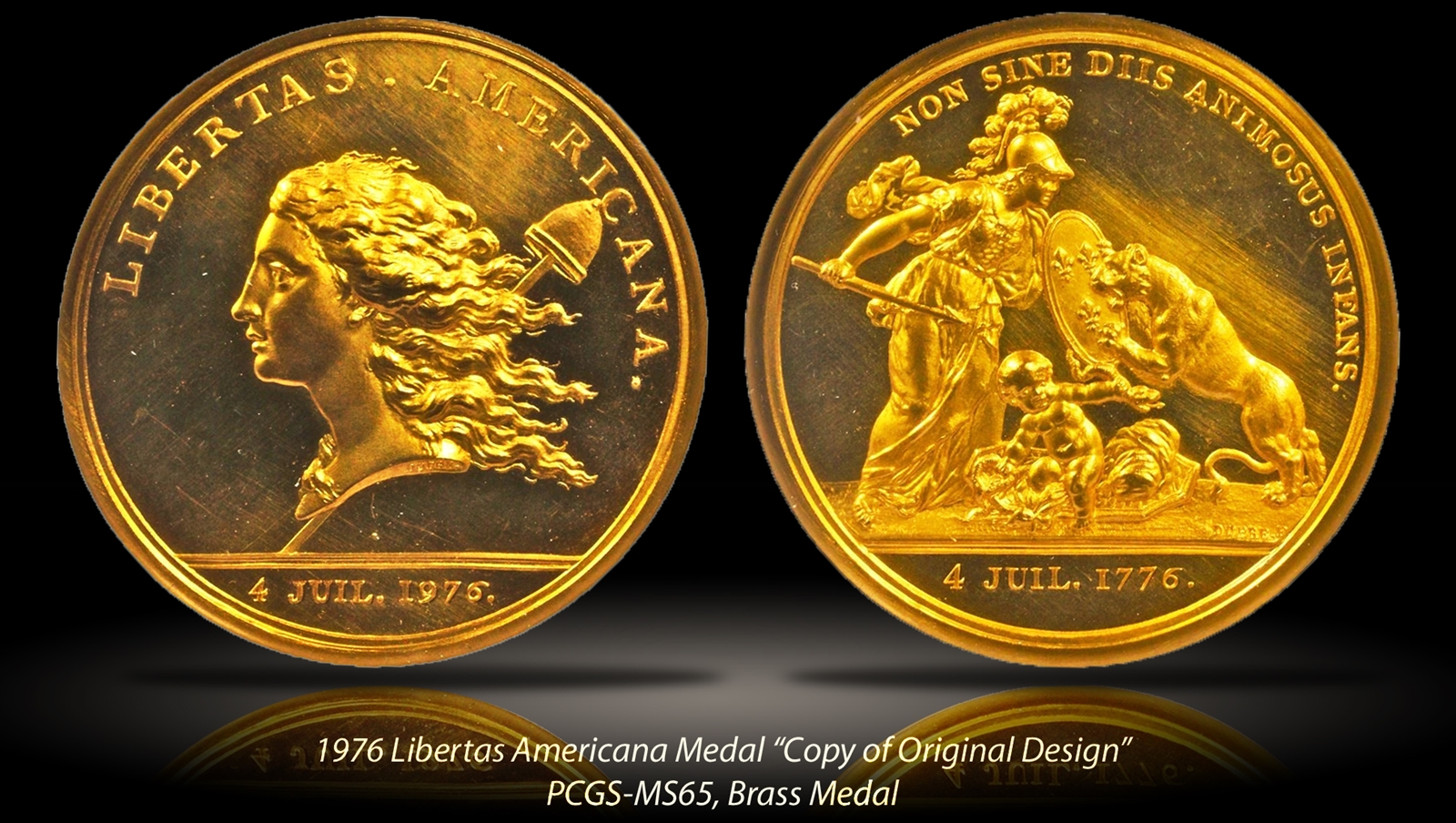
Prior to the striking of the planned production run of 500 silver medals for First Coinvestors, the Paris Mint tested the dies by producing 5 trial strikes in bronze, as seen here. Clearly, these were executed in brass or "yellow bronze," in keeping with U.S. Mint trends during the latter 20th Century. A careful comparison of the brass specimen with the silver examples confirms its trial strike status, as it displays a definitively earlier die state than seen on the silver medals.
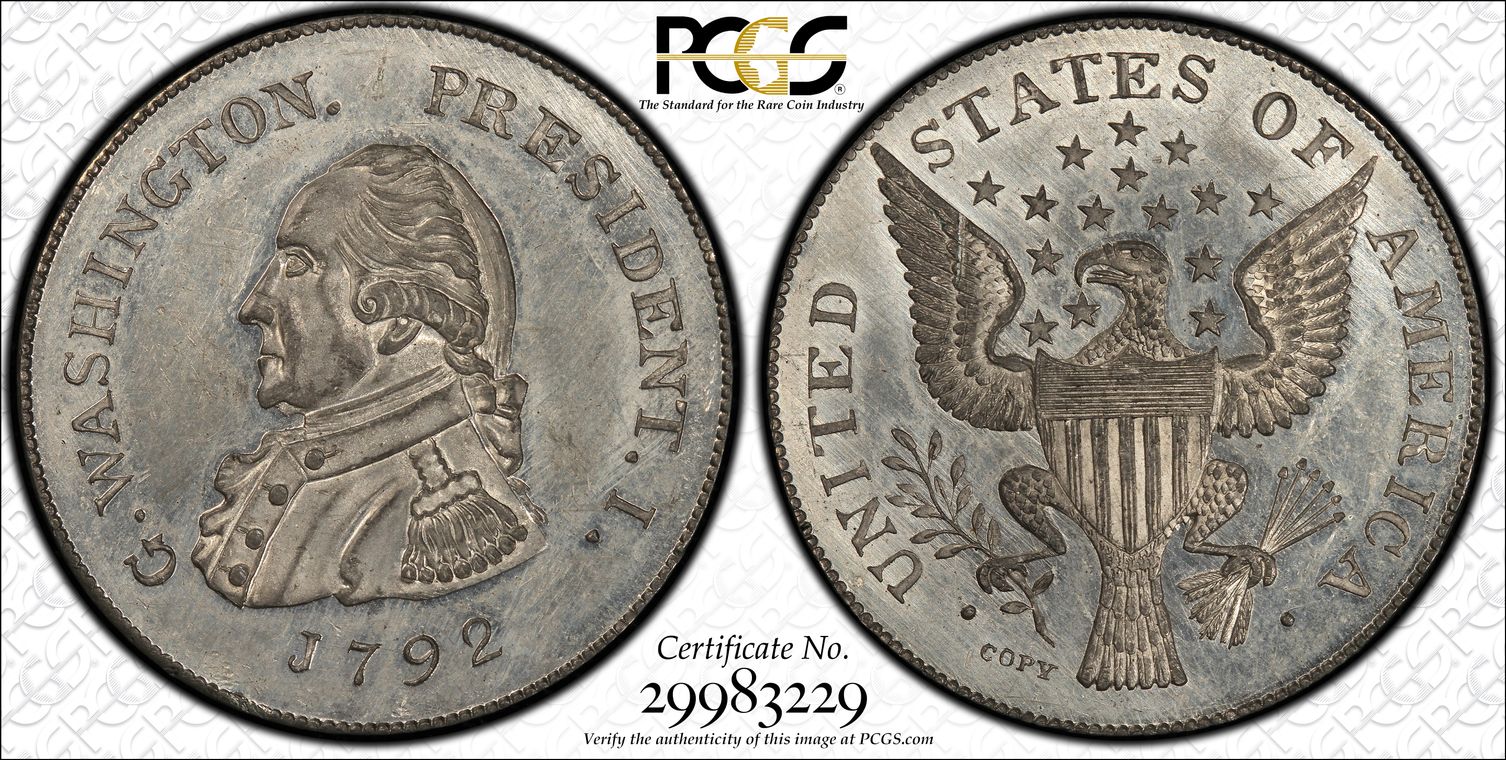
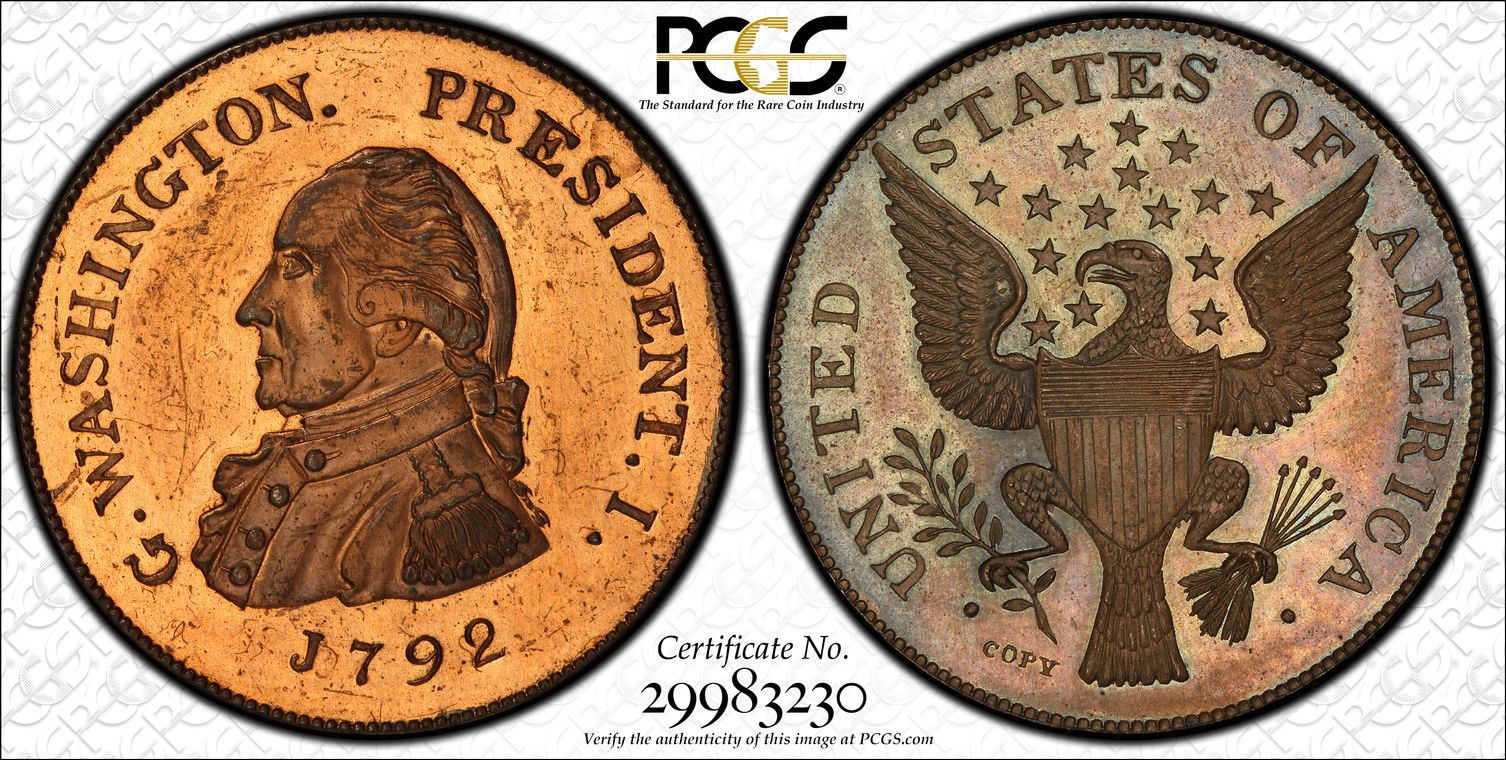
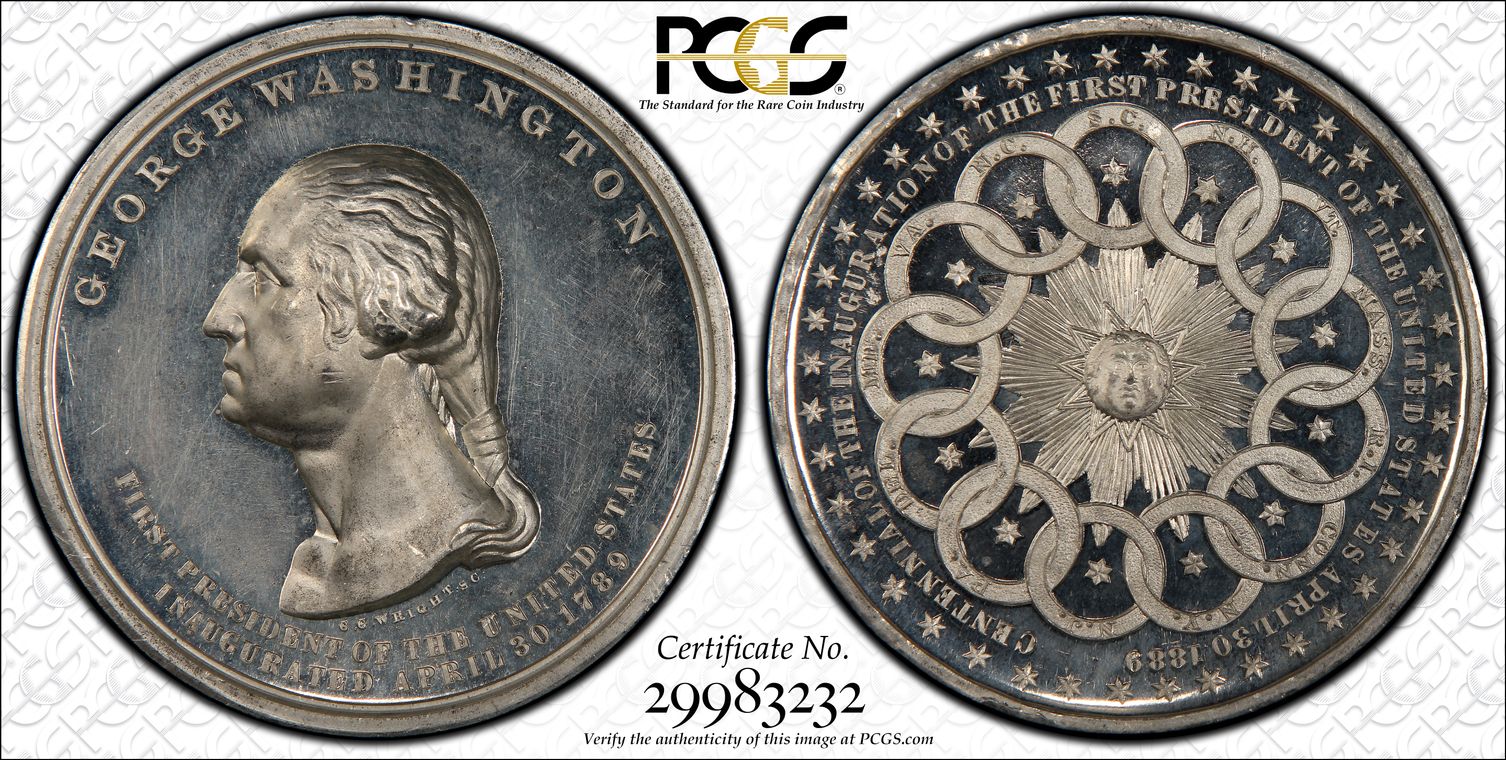
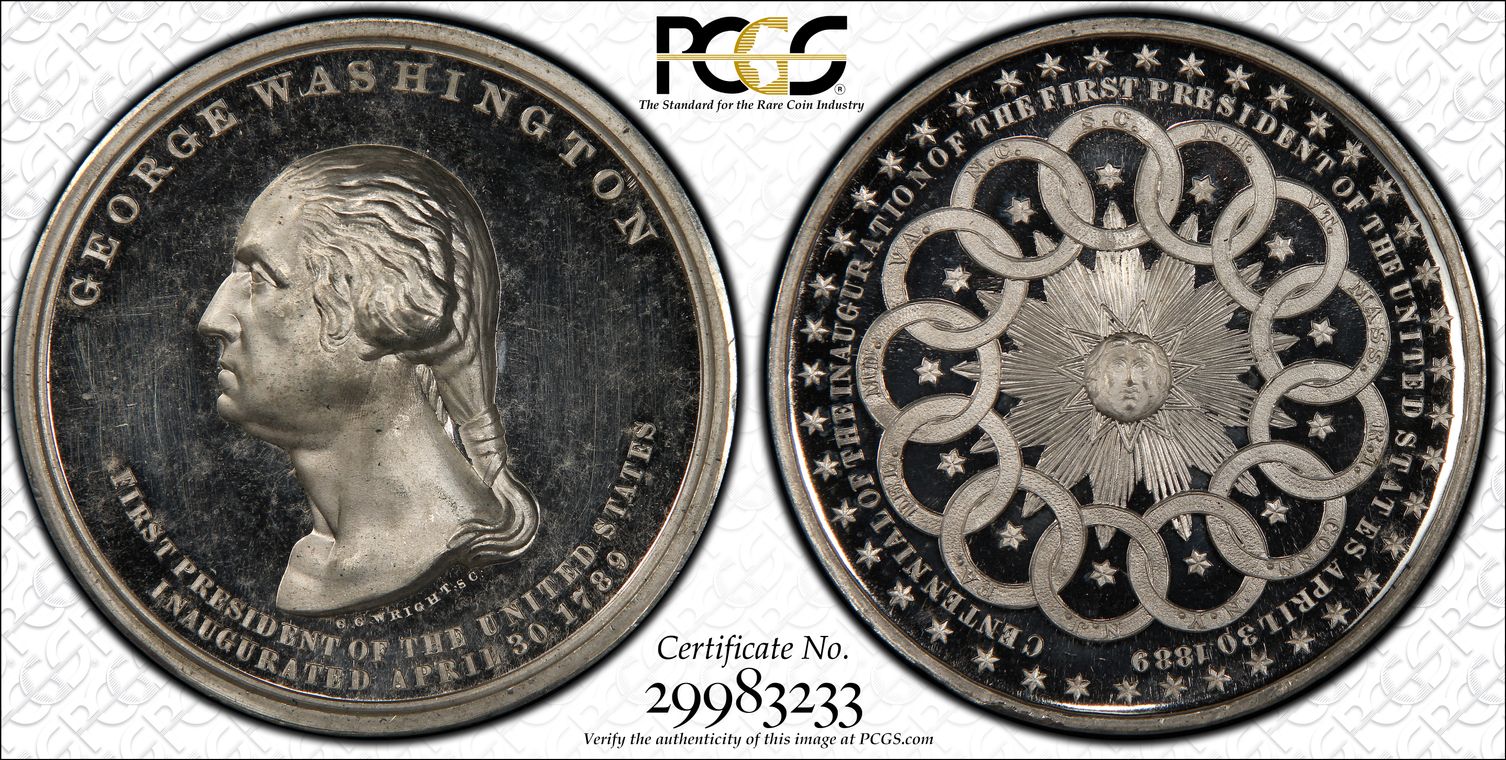
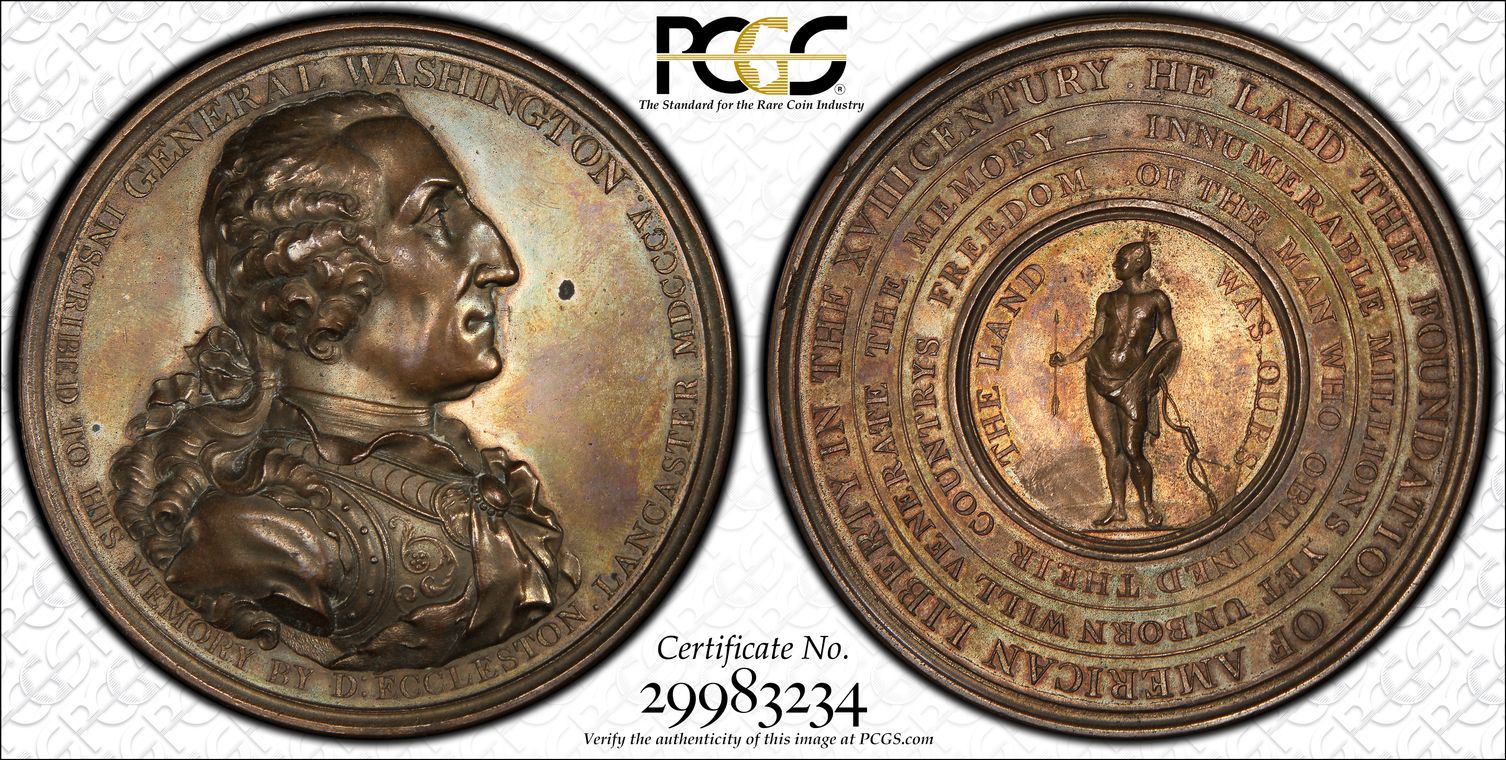
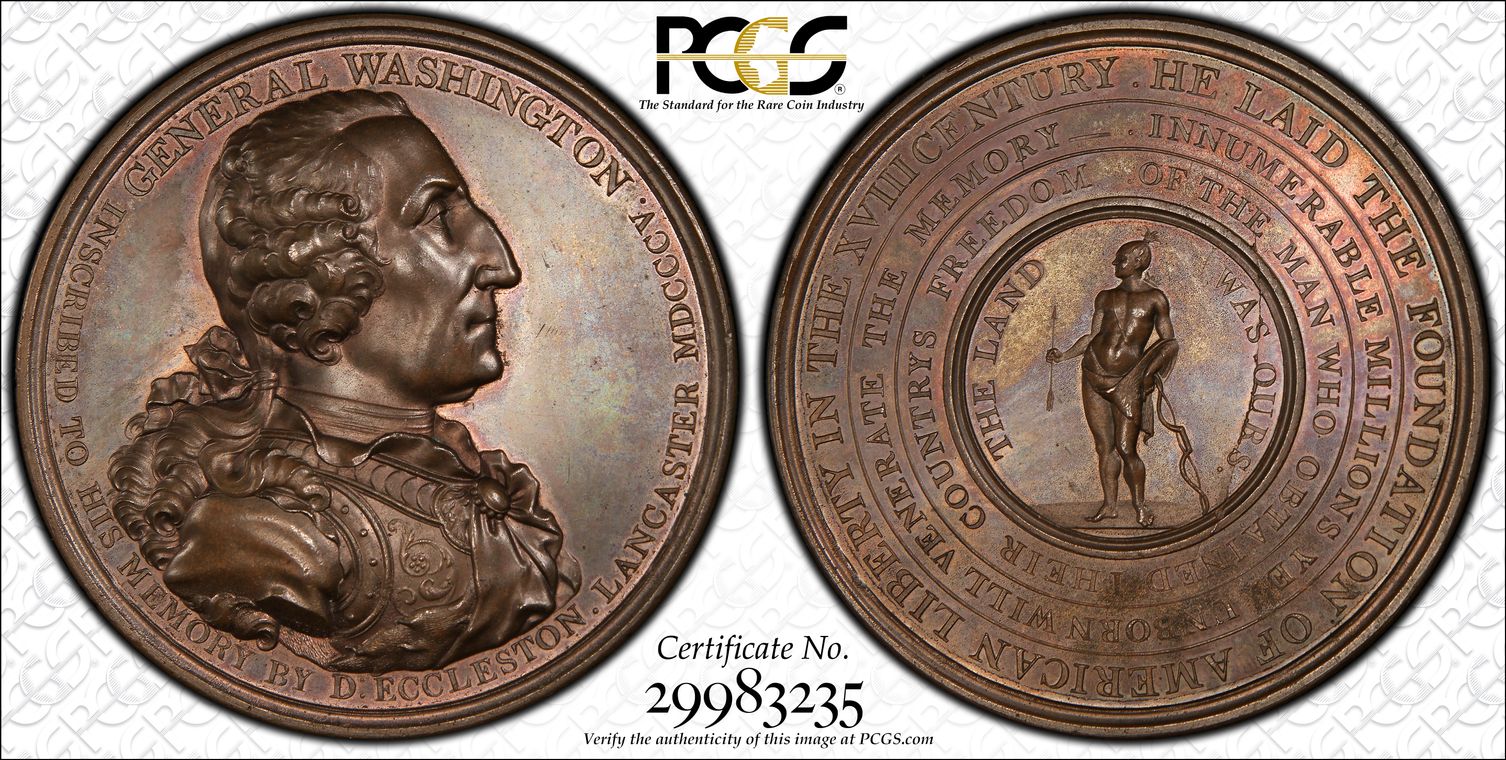
Ex: Garrett, Steinberg, Farfax, Wharton
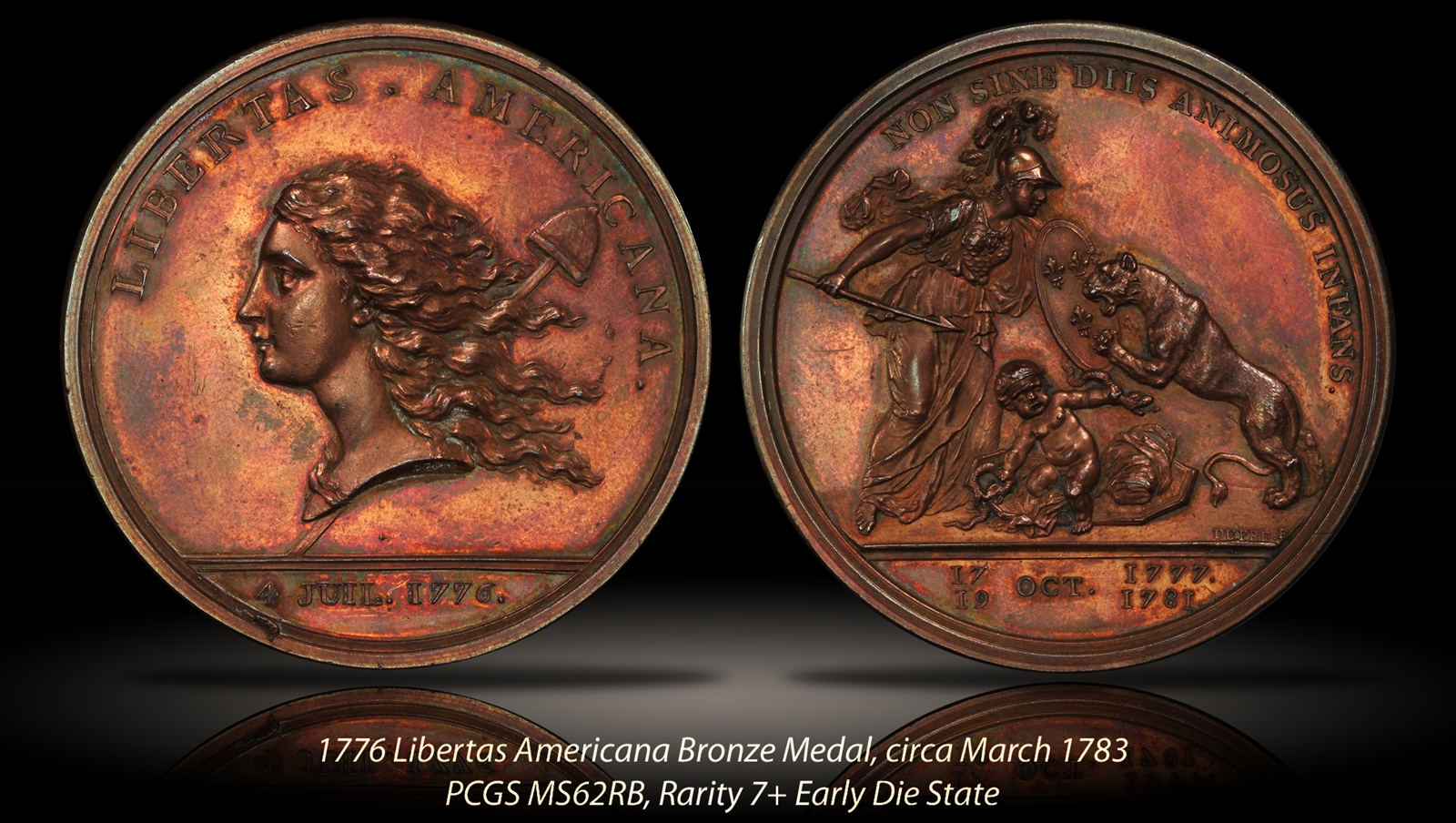
Though bearing the evidence of its share of handling over the centuries, this particular specimen of the Libertas Americana medal is the single earliest example struck in Bronze that this researcher has found. The obverse plainly displays multiple strikings from the dies -- with offsets between strikes -- and yet there is very little evidence of the extensive die damage that is displayed on the vast majority of the Bronze Medals. In addition to the earliest die state specimen of the Libertas Medal (and Red Brown!), the collection includes a fantastically preserved specimen, gem MS65 Bronze example of the Libertas Americana Medal that is the finest seen by this researcher. Its die state places it near the middle of the production period, with considerable die damage now visible in comparison to the early die state silver and bronze medals in the Collection, yet not so advanced as the very latest die state examples.


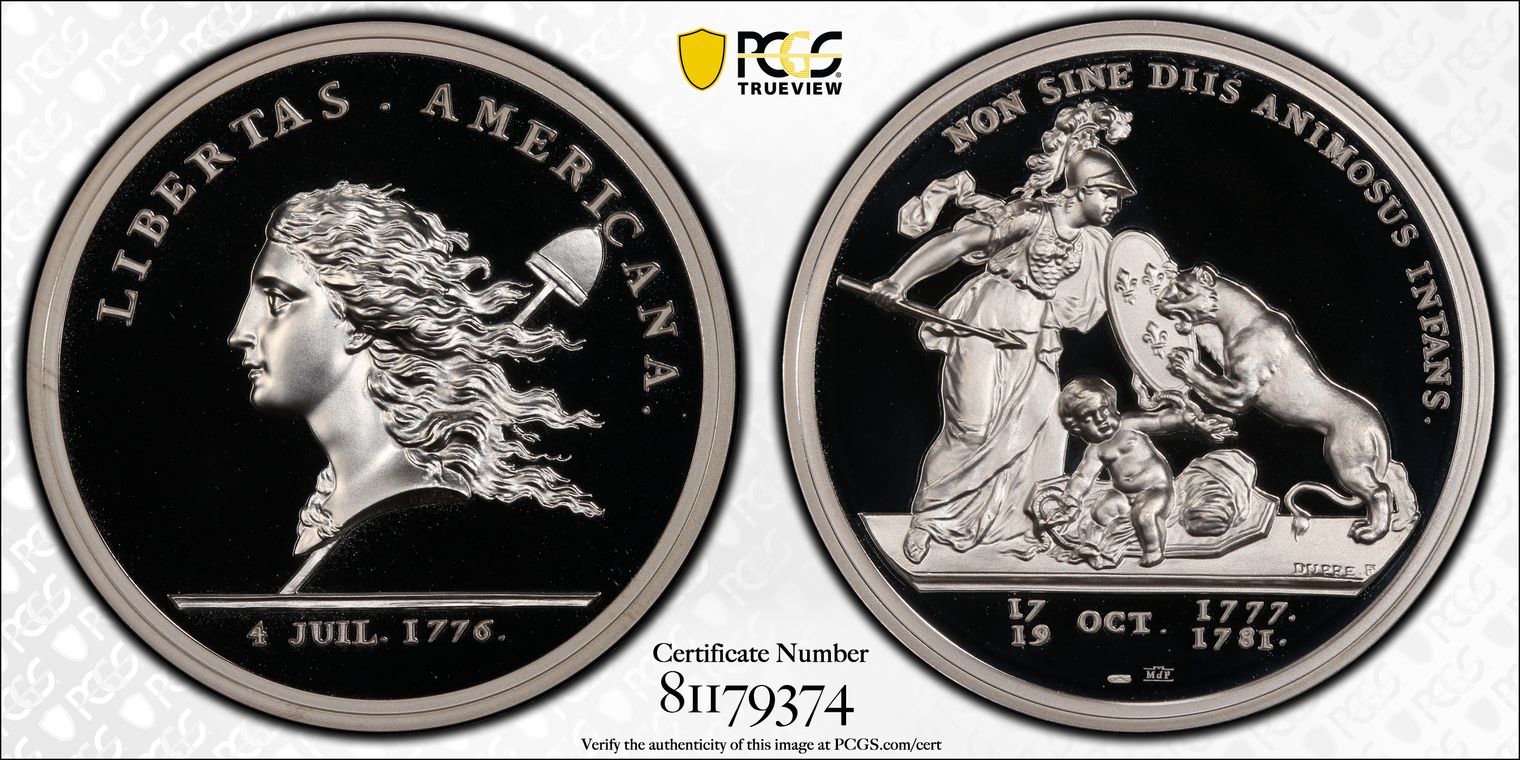


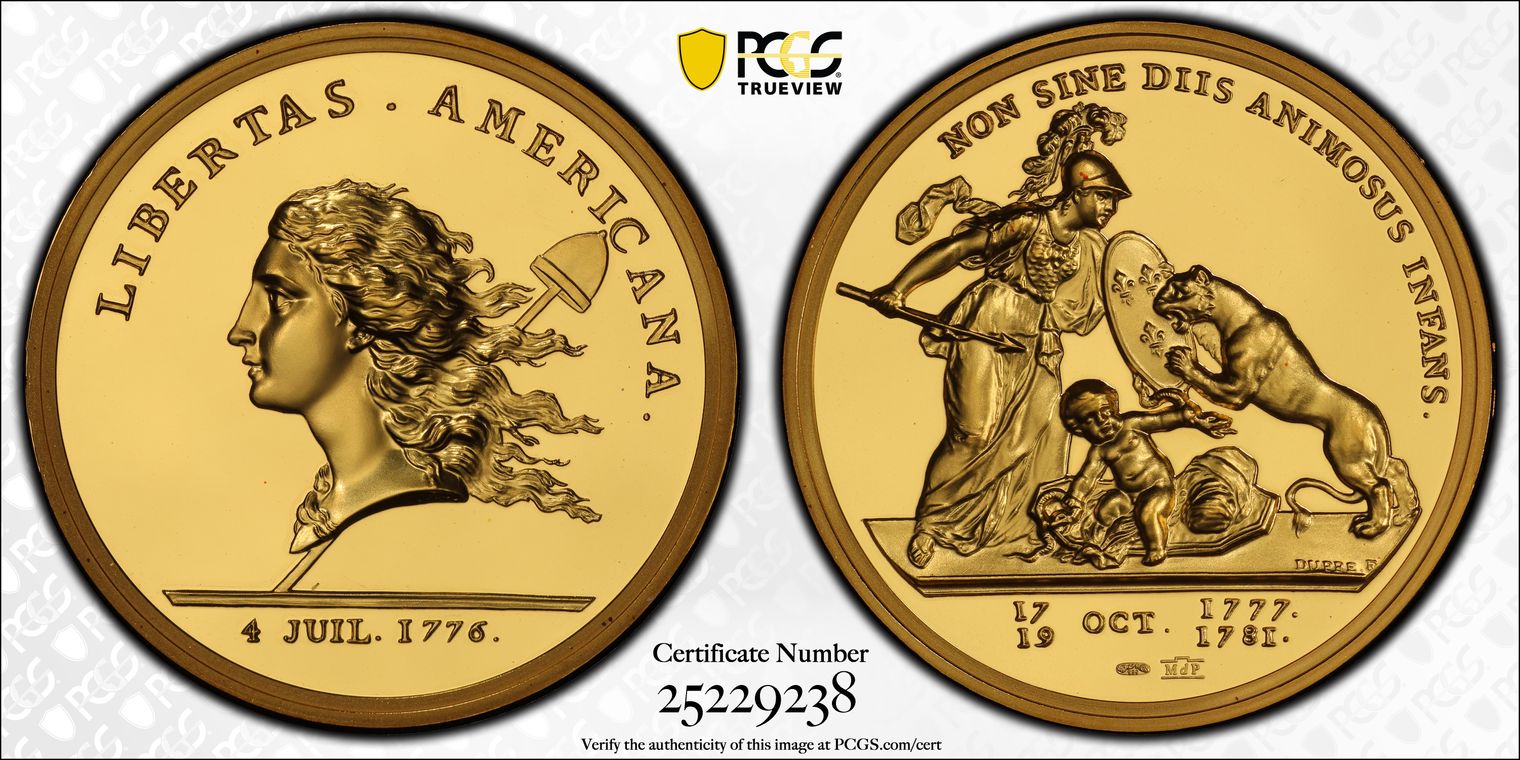
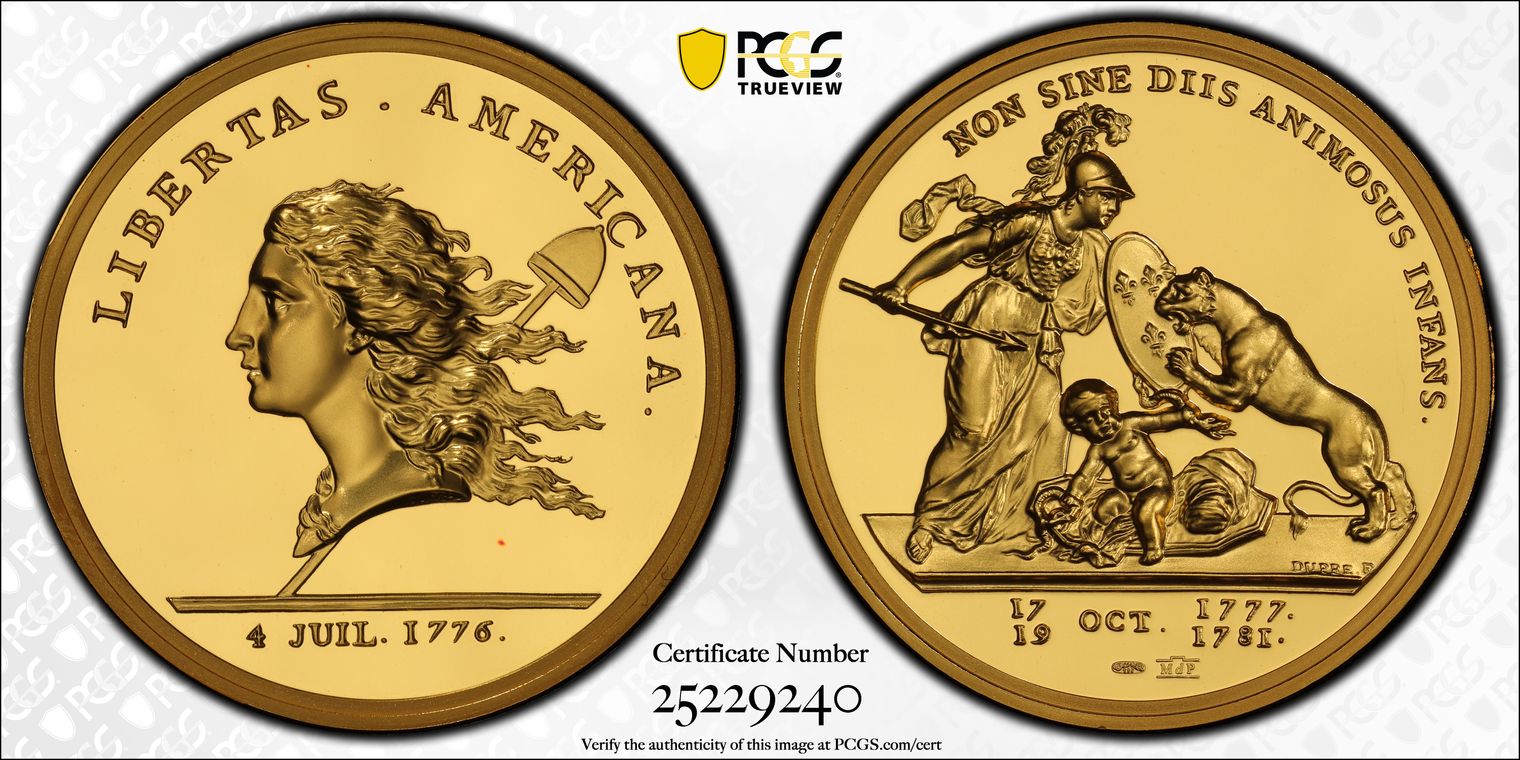
In addition to the stunning 5oz/50mm silver and gold restrikes, the Paris Mint also produced high relief gold Libertas Americana medals in a one troy ounce format, with a mintage limit of 5,000 pieces. With the diameter reduced to 34mm, but still containing a 31.104 grams of .999 gold, these are the smallest in diameter of all of the official Mint restrikes, but still very impressive in hand.
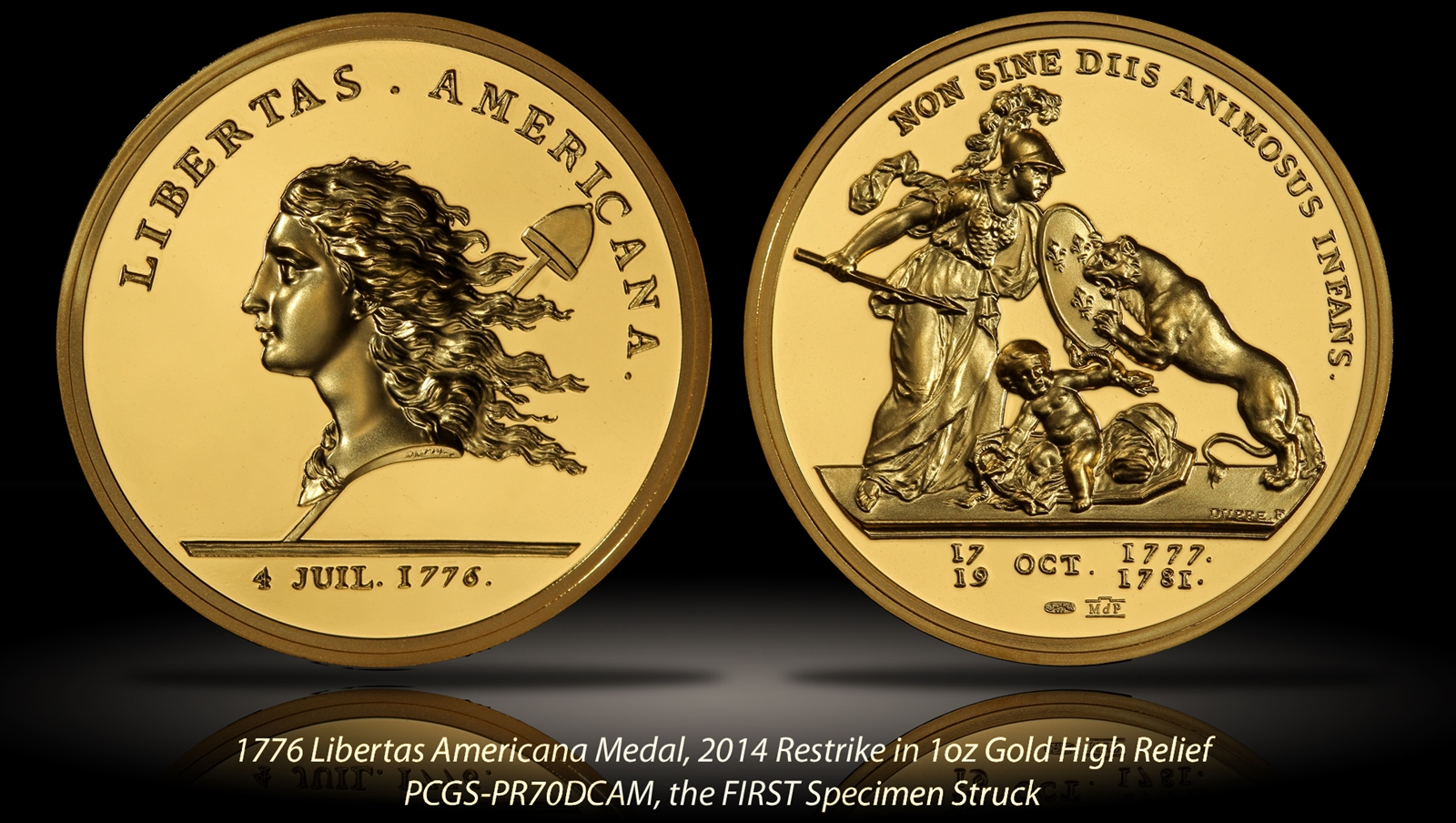
In addition to the stunning 5oz/50mm silver and gold restrikes, the Paris Mint also produced high relief gold Libertas Americana medals in a one troy ounce format, with a mintage limit of 5,000 pieces. With the diameter reduced to 34mm, but still containing a 31.104 grams of .999 gold, these are the smallest in diameter of all of the official Mint restrikes, but still very impressive in hand.
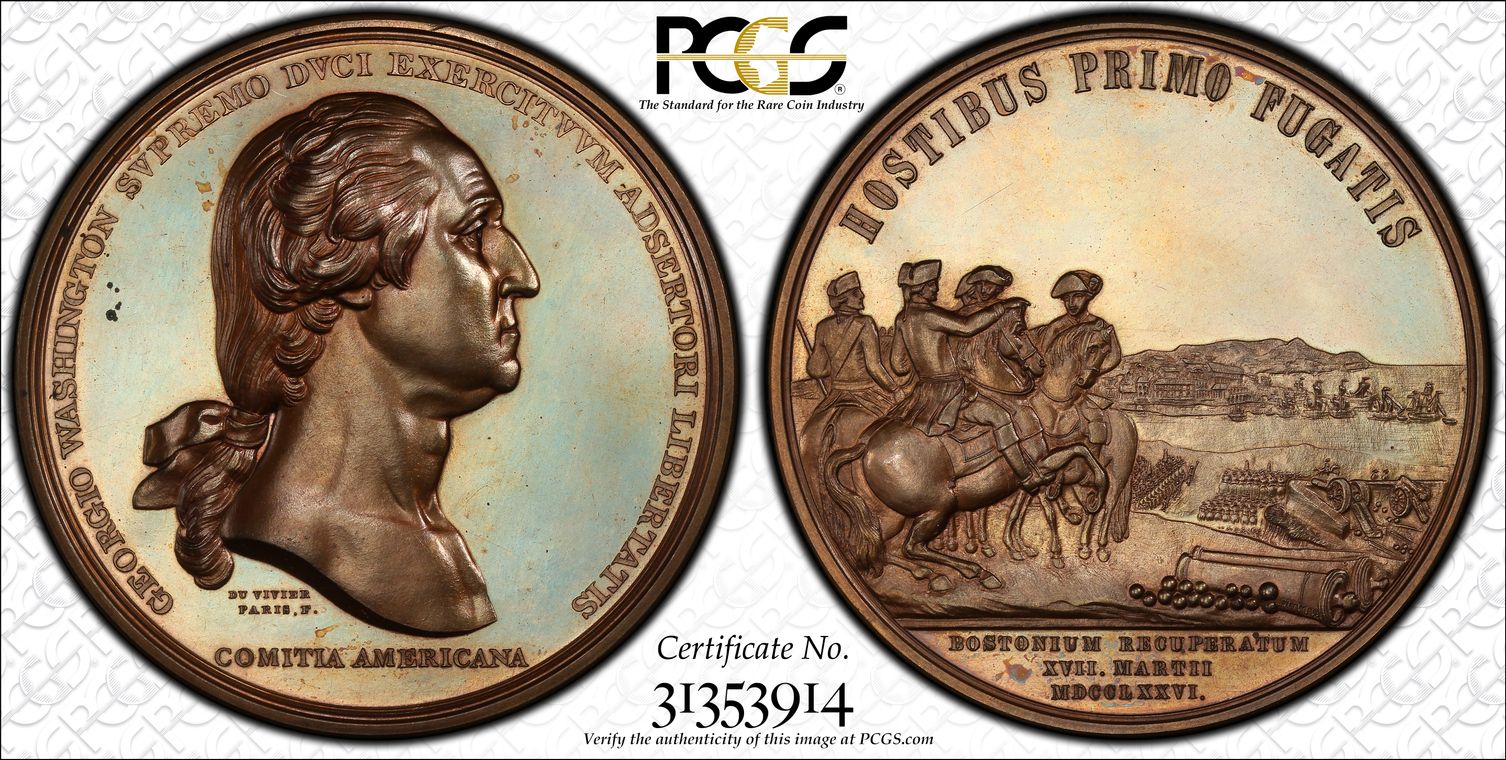
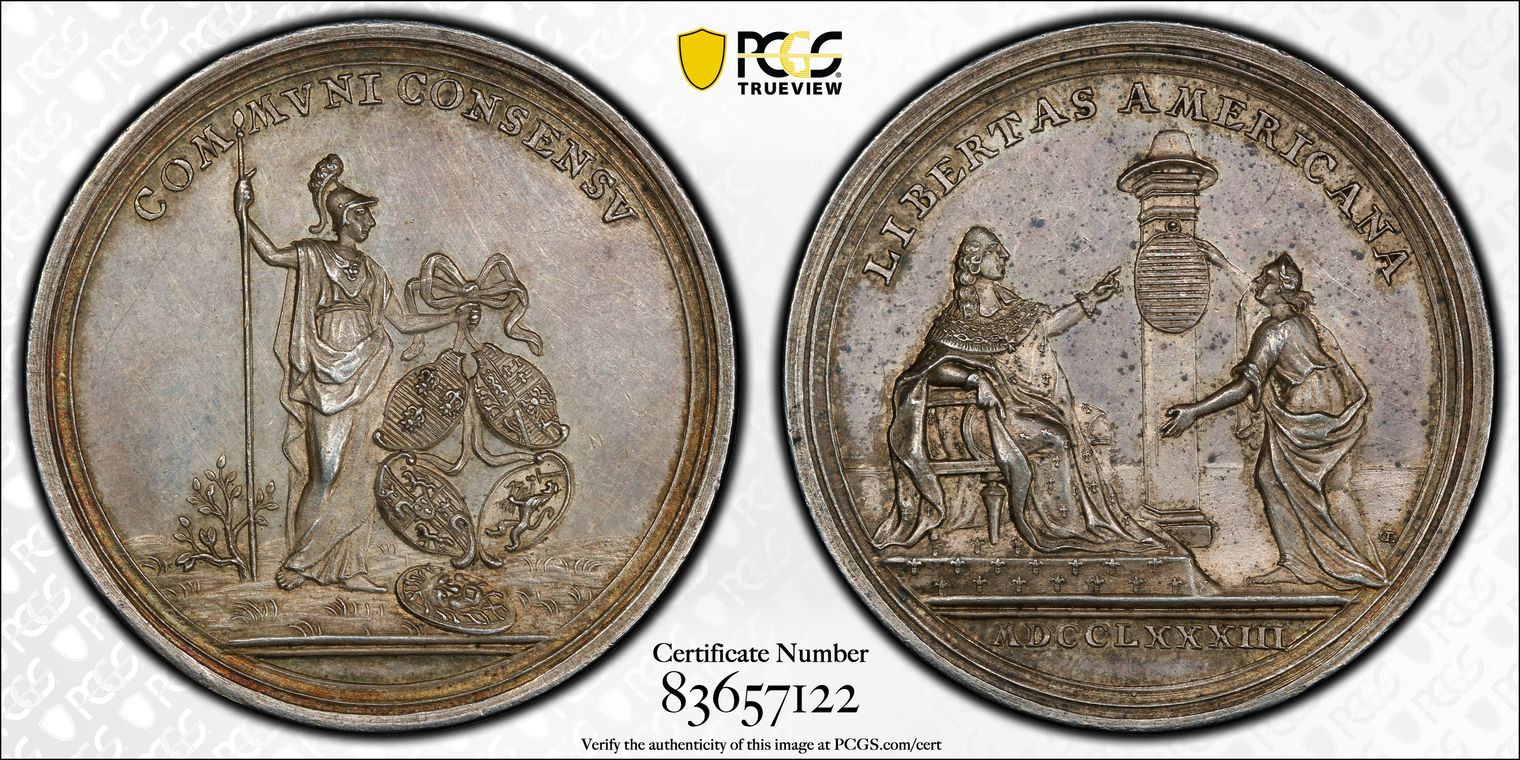
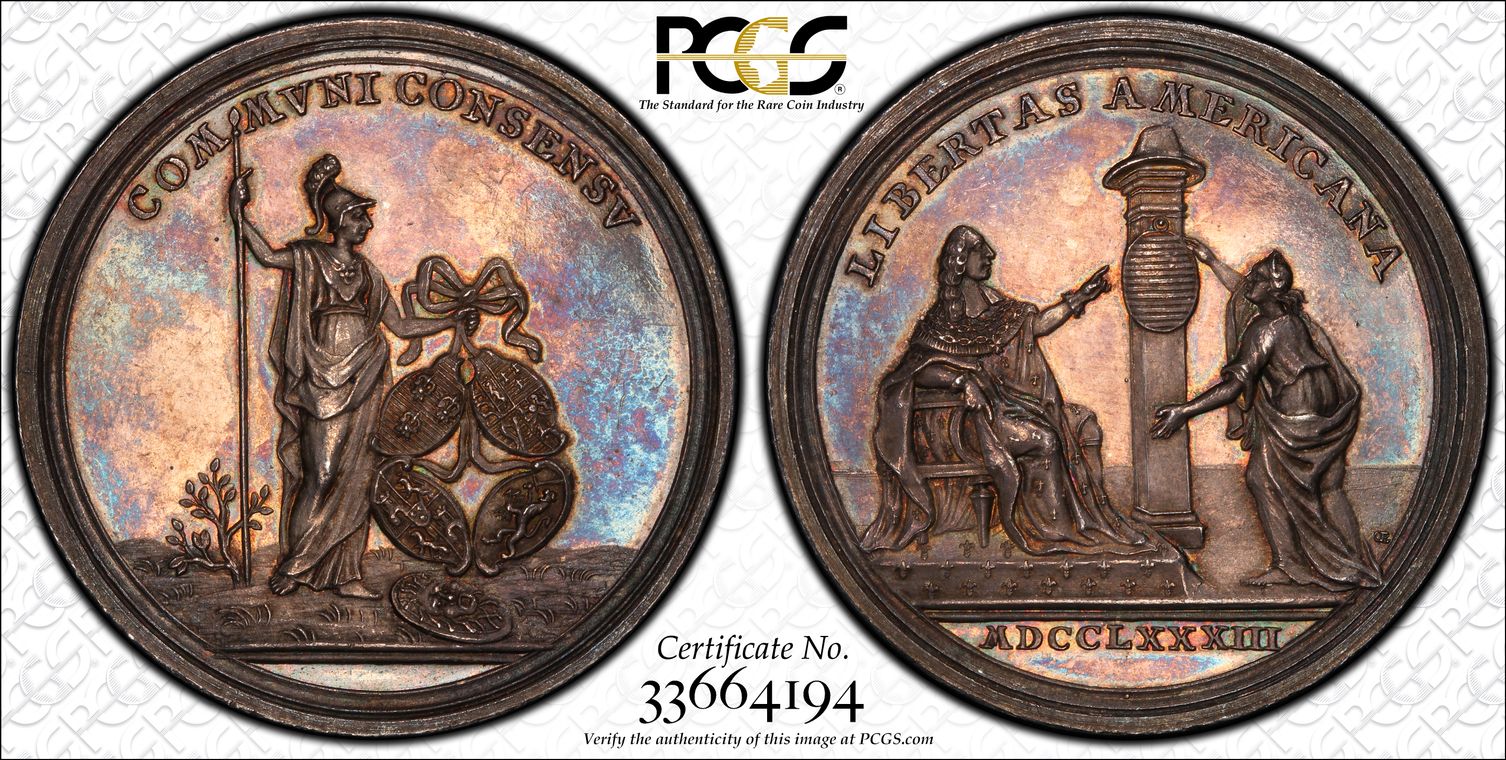
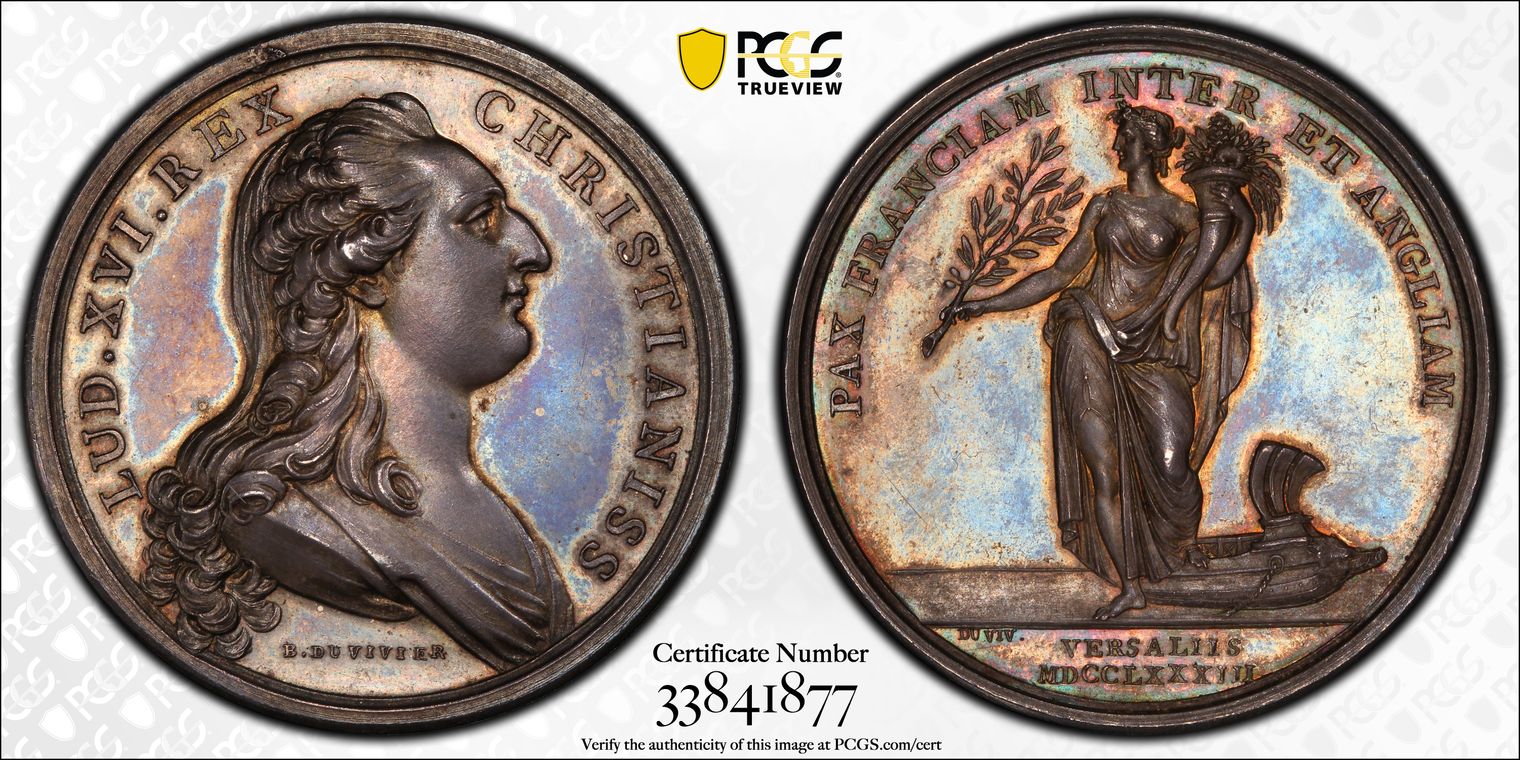
Related to the famous Libertas Americana medals, the Peace of Versailles medal bears the obverse legend of "Libertas Americana." Sometimes also called the "Communi Consensu" medal, this issue commemorates the acceptance of the America's newborn liberty by the "common consent" of the nations of the world. Seen here is a superbly toned example of the medal struck in silver.
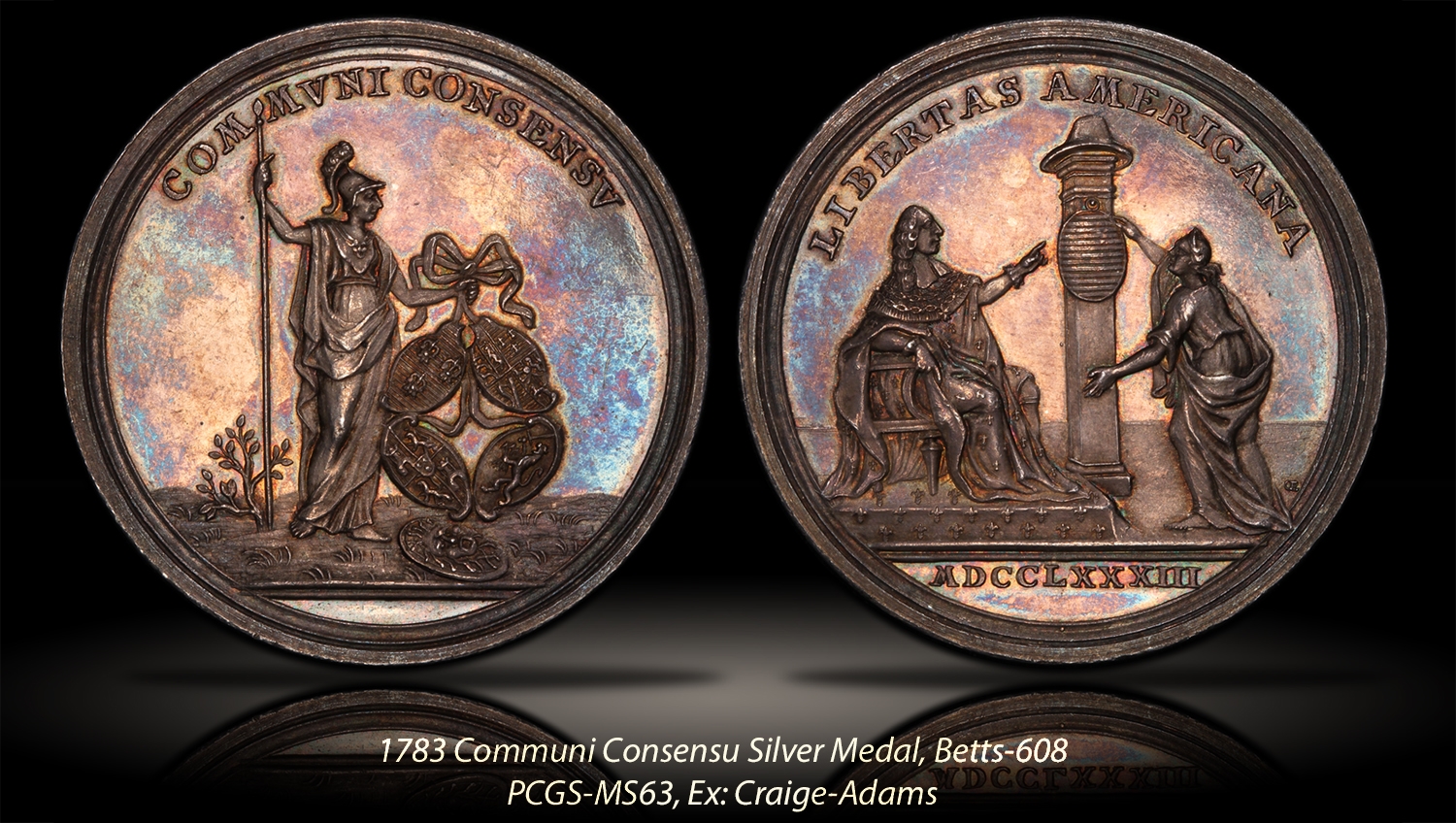
Related to the famous Libertas Americana medals, the Peace of Versailles medal bears the obverse legend of "Libertas Americana." Sometimes also called the "Communi Consensu" medal, this issue commemorates the acceptance of the America's newborn liberty by the "common consent" of the nations of the world. Seen here is a superbly toned example of the medal struck in silver.
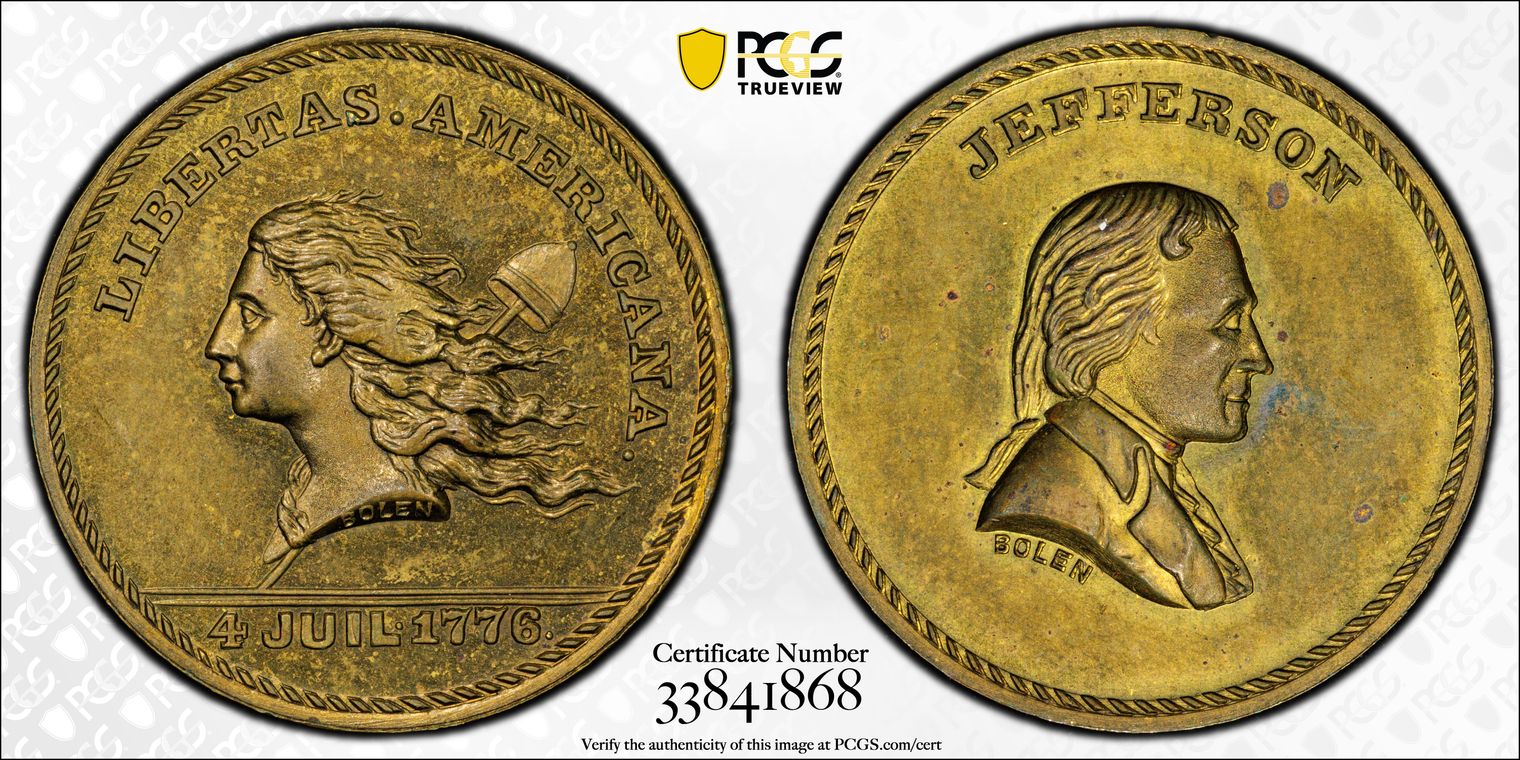
The only known specimen struck on a thick brass planchet. Ex: Q. David Bowers
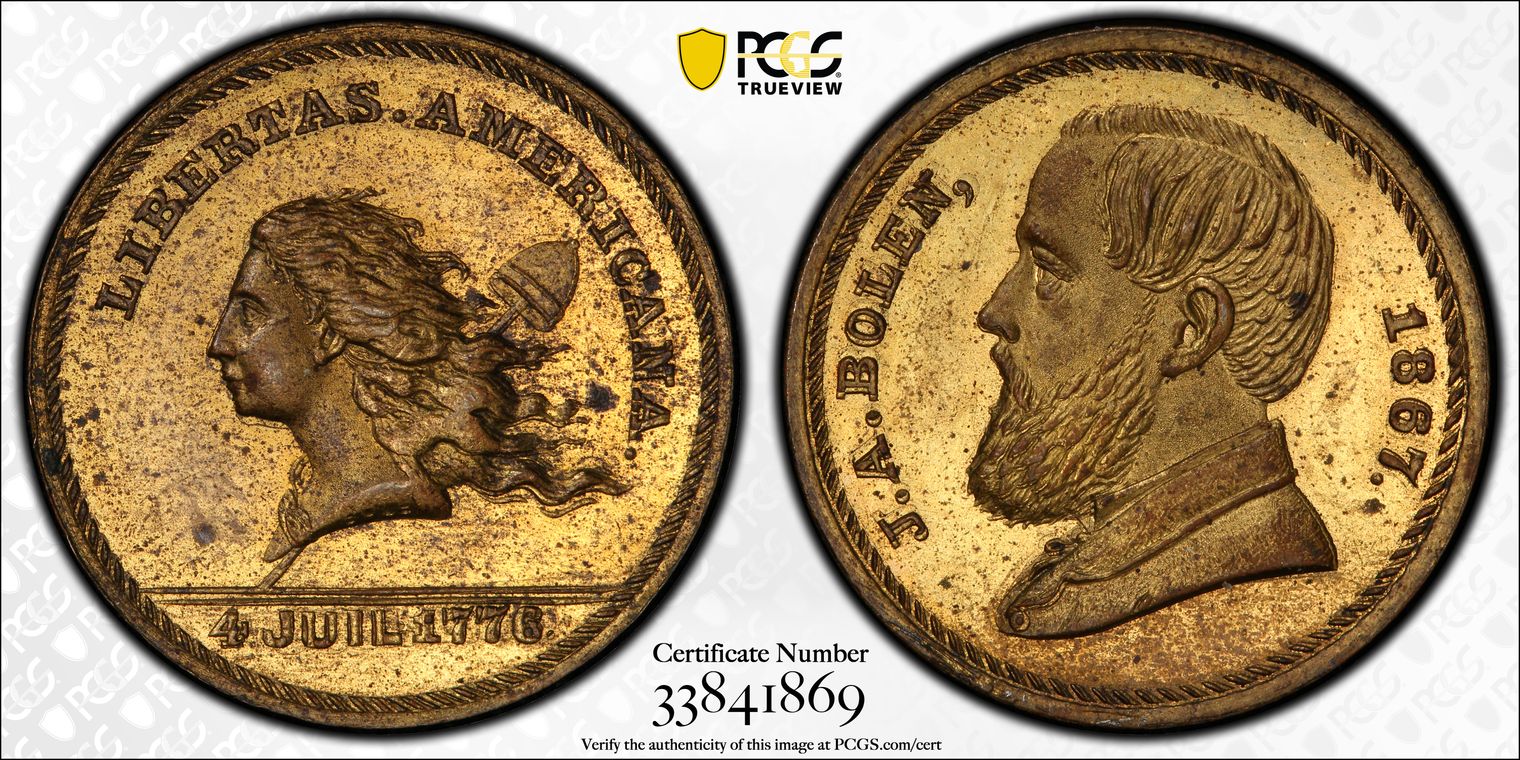
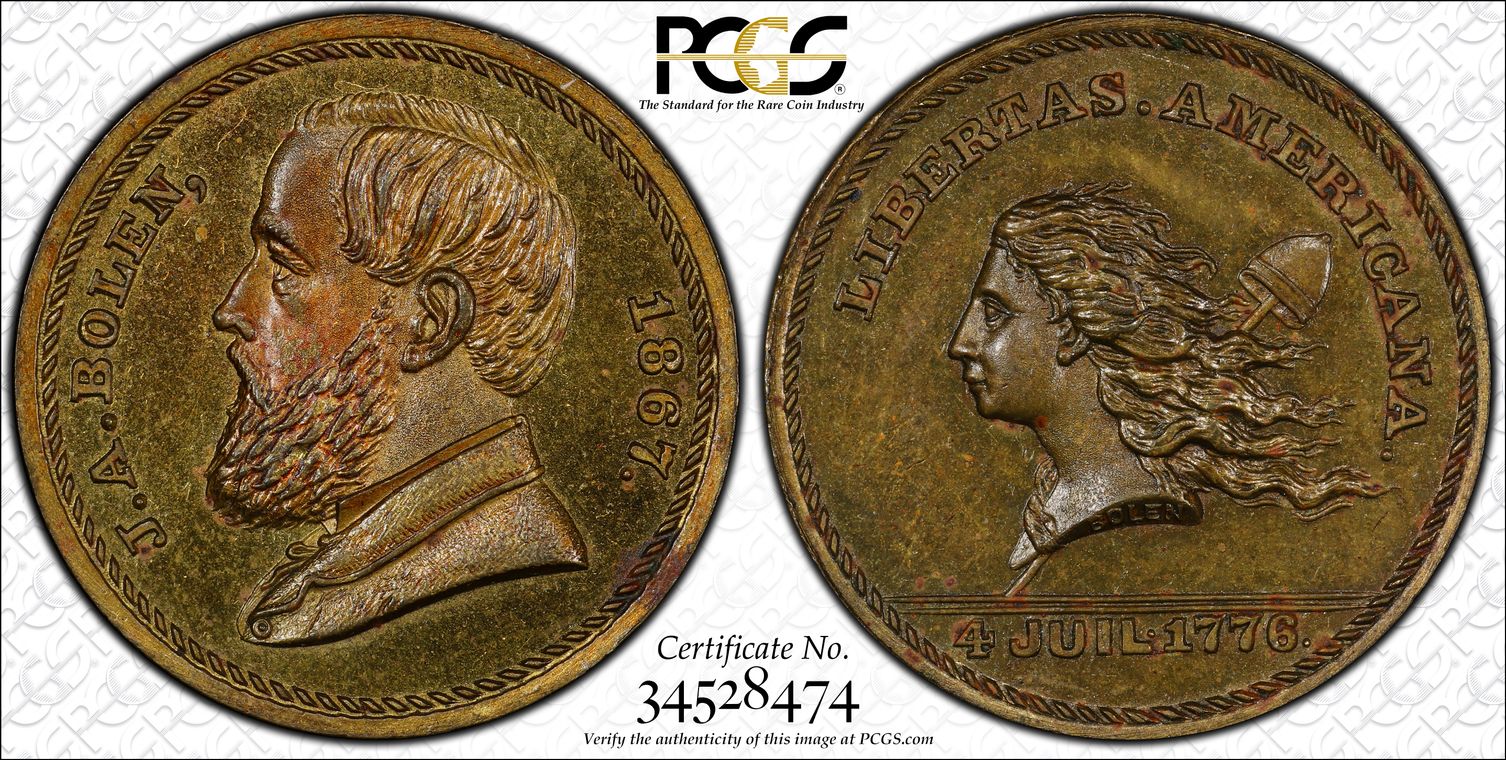
Finest known of just 3 specimens struck. Ex: Tim Gabriele and Q. David Bowers.
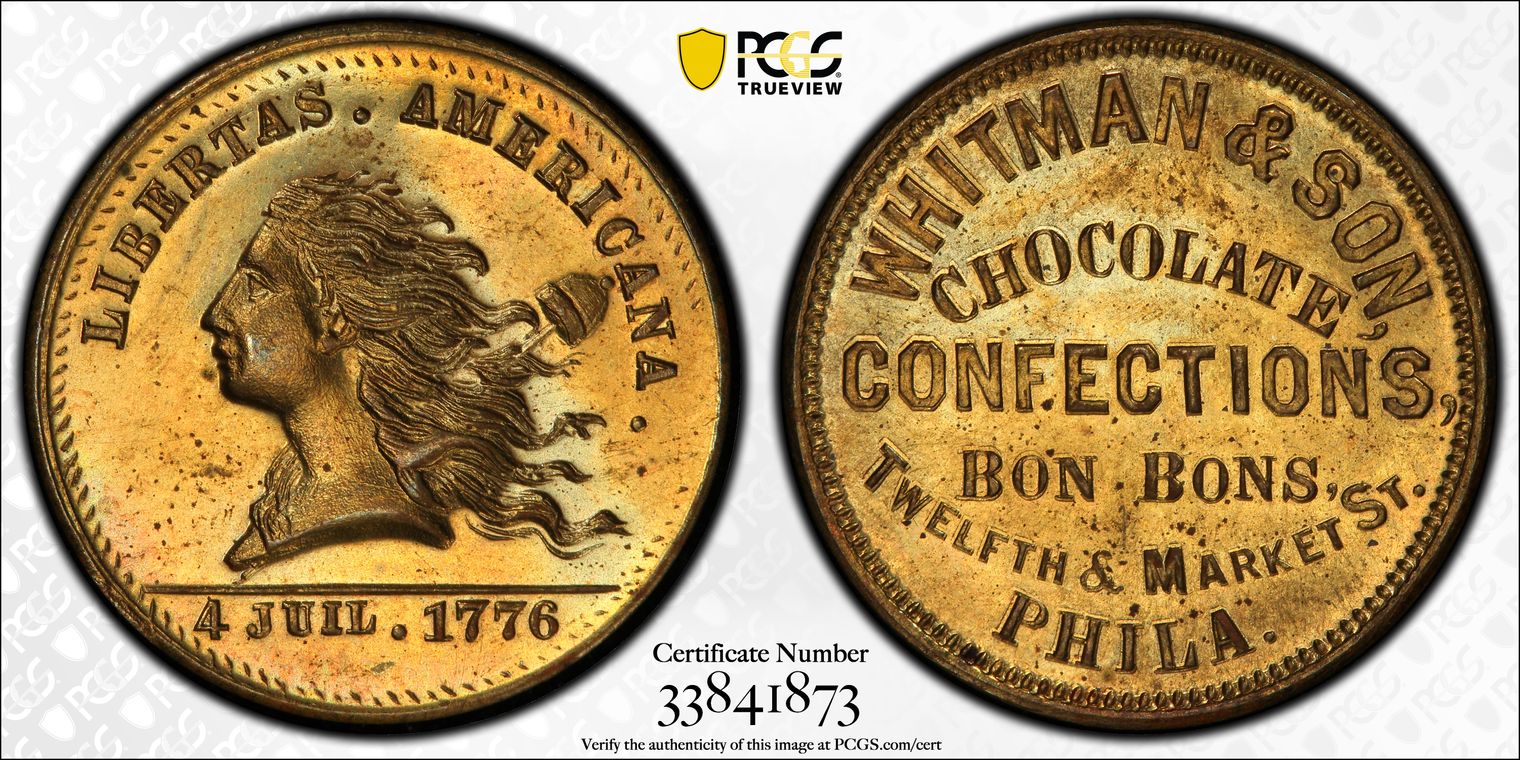
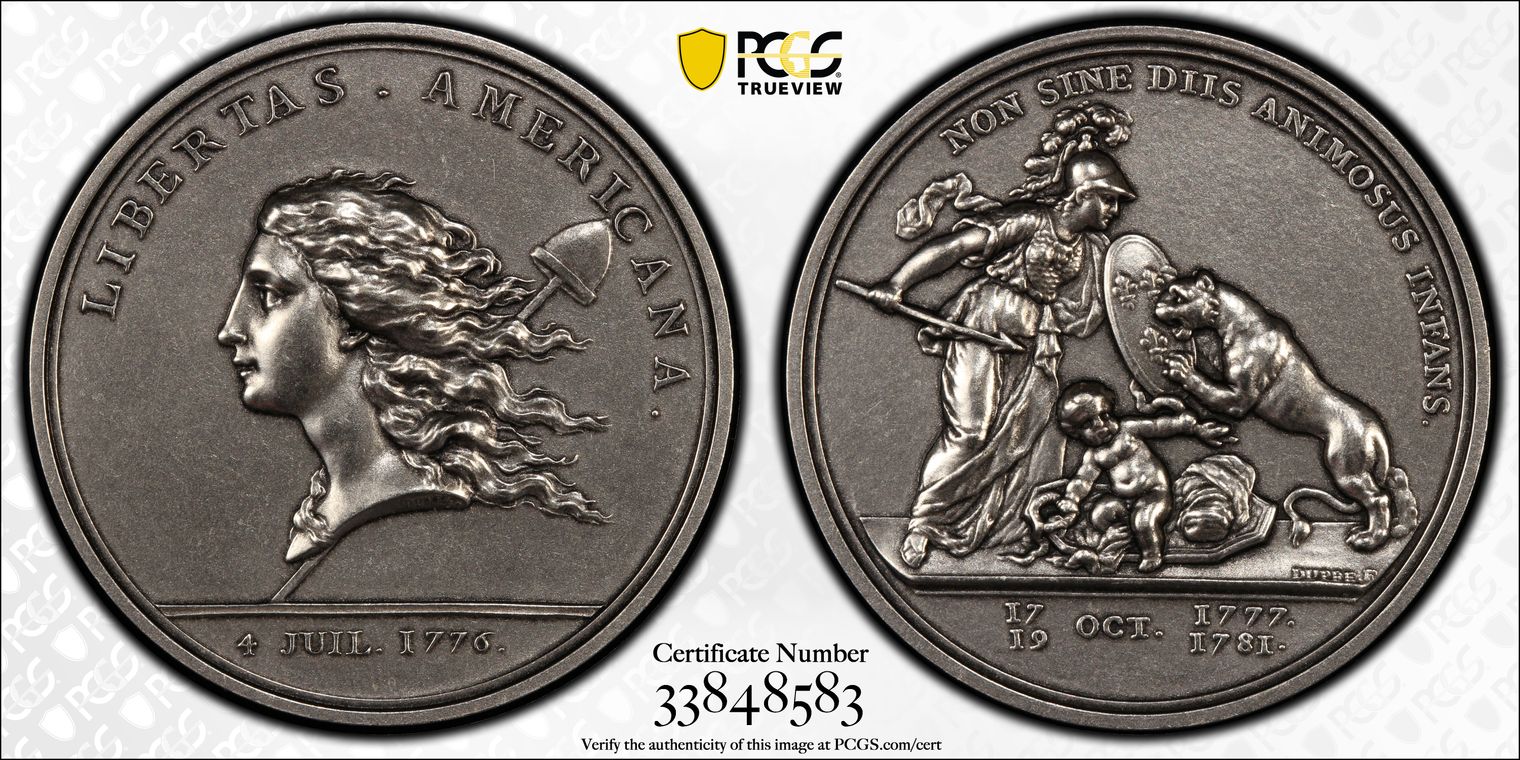
While the Paris Mint may have given First Coinvestors the exclusive rights to the 77mm dies, it reserved for itself the rights to restrike the Libertas Americana medals in other sizes, and a number of restrikes have appeared since that time. The Silver Restrike seen here was produced in an open issue for visitors to the Mint beginning shortly after the U.S. Bicentennial. These are distinguished by a double cornucopia edge mark and a stamp of ".925" to designate the fineness of the silver. Similarly, Bronze Restrikes were also produced in open issue and bear edge markings to designate their official Paris Mint origin.

While the Paris Mint may have given First Coinvestors the exclusive rights to the 77mm dies, it reserved for itself the rights to restrike the Libertas Americana medals in other sizes, and a number of restrikes have appeared since that time. The Silver Restrike seen here was produced in an open issue for visitors to the Mint beginning shortly after the U.S. Bicentennial. These are distinguished by a double cornucopia edge mark and a stamp of ".925" to designate the fineness of the silver. Similarly, Bronze Restrikes were also produced in open issue and bear edge markings to designate their official Paris Mint origin.
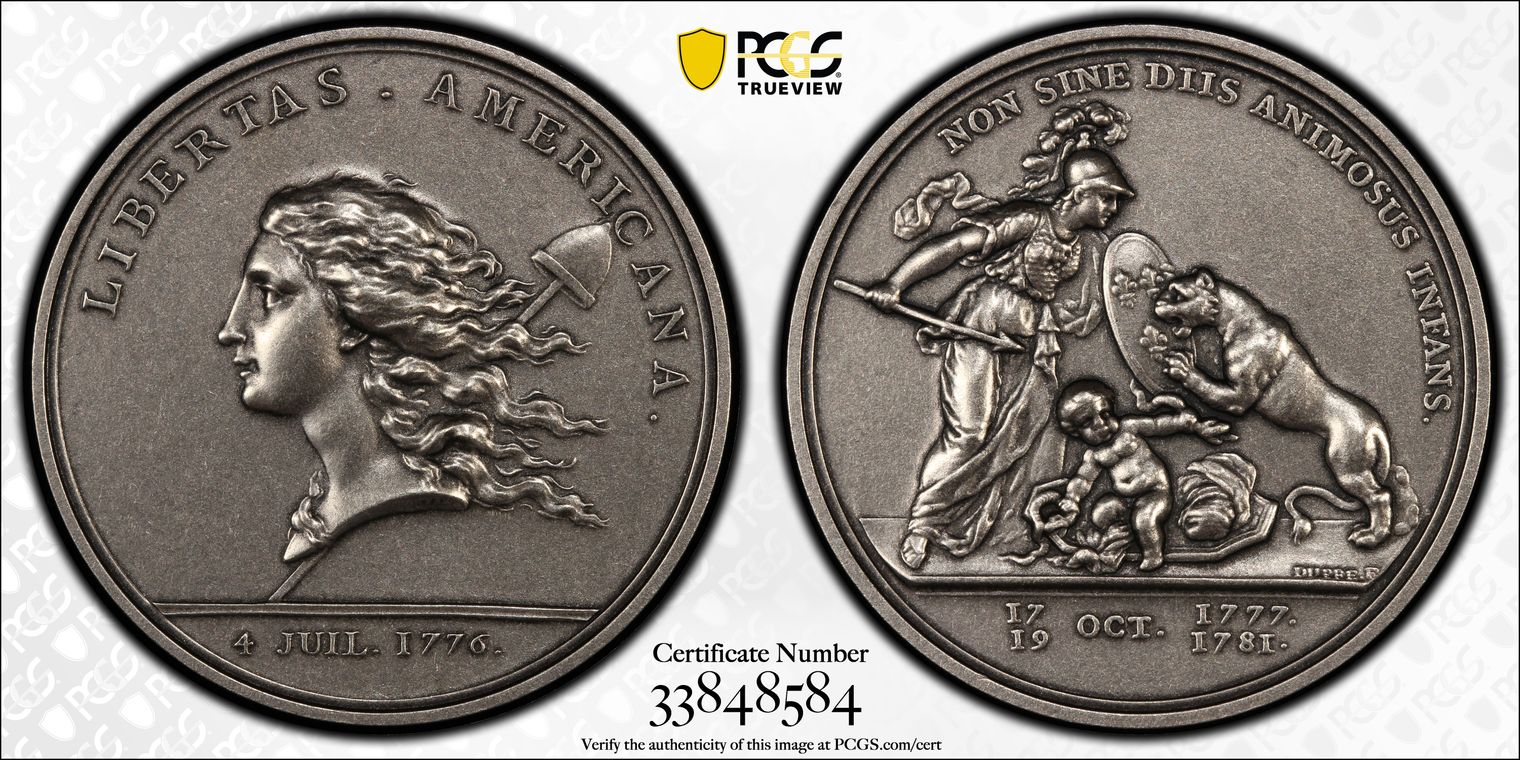
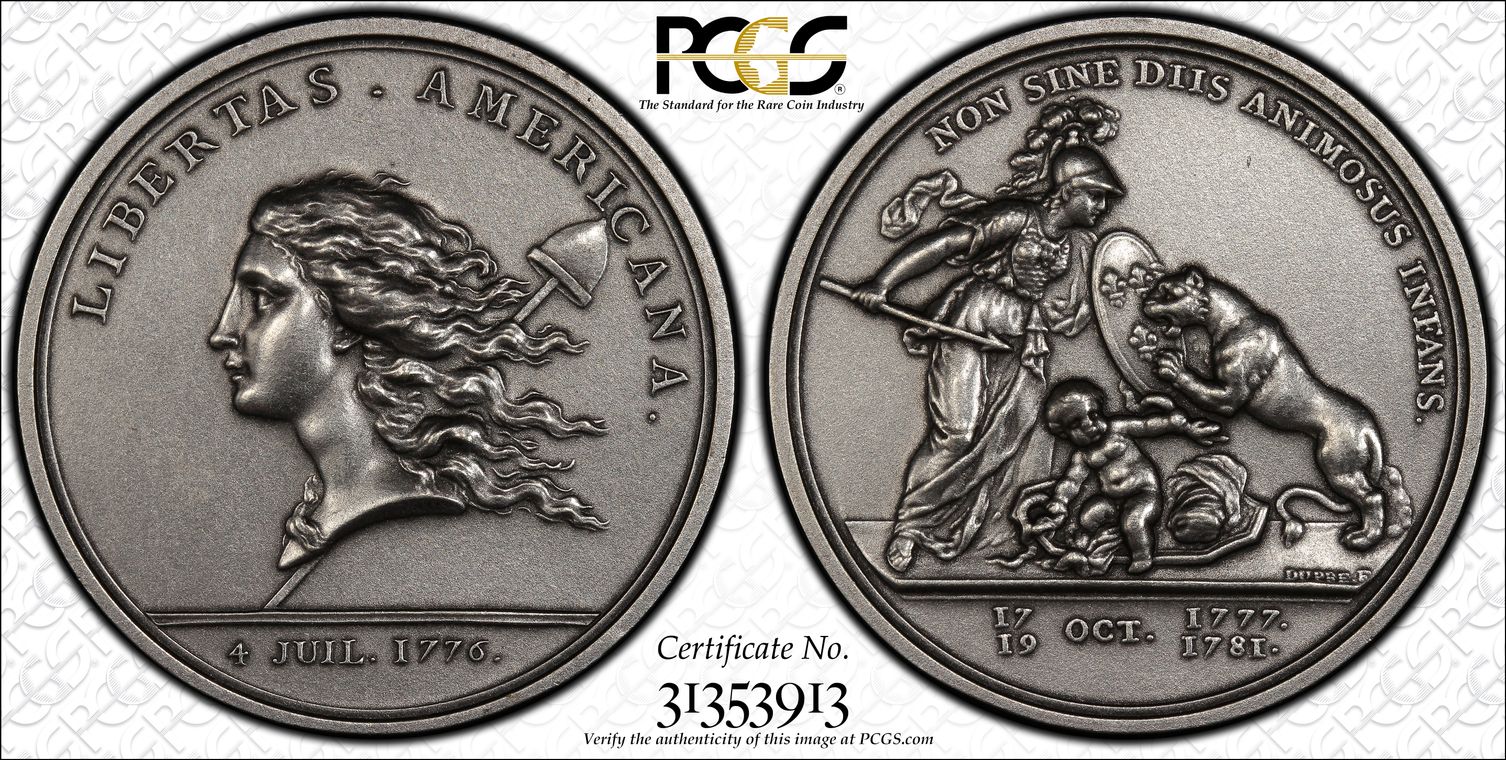
While the Paris Mint may have given First Coinvestors the exclusive rights to the 77mm dies, it reserved for itself the rights to restrike the Libertas Americana medals in other sizes, and a number of restrikes have appeared since that time. The Silver Restrike seen here was produced in an open issue for visitors to the Mint beginning shortly after the U.S. Bicentennial. These are distinguished by a double cornucopia edge mark and a stamp of ".925" to designate the fineness of the silver. Similarly, Bronze Restrikes were also produced in open issue and bear edge markings to designate their official Paris Mint origin.
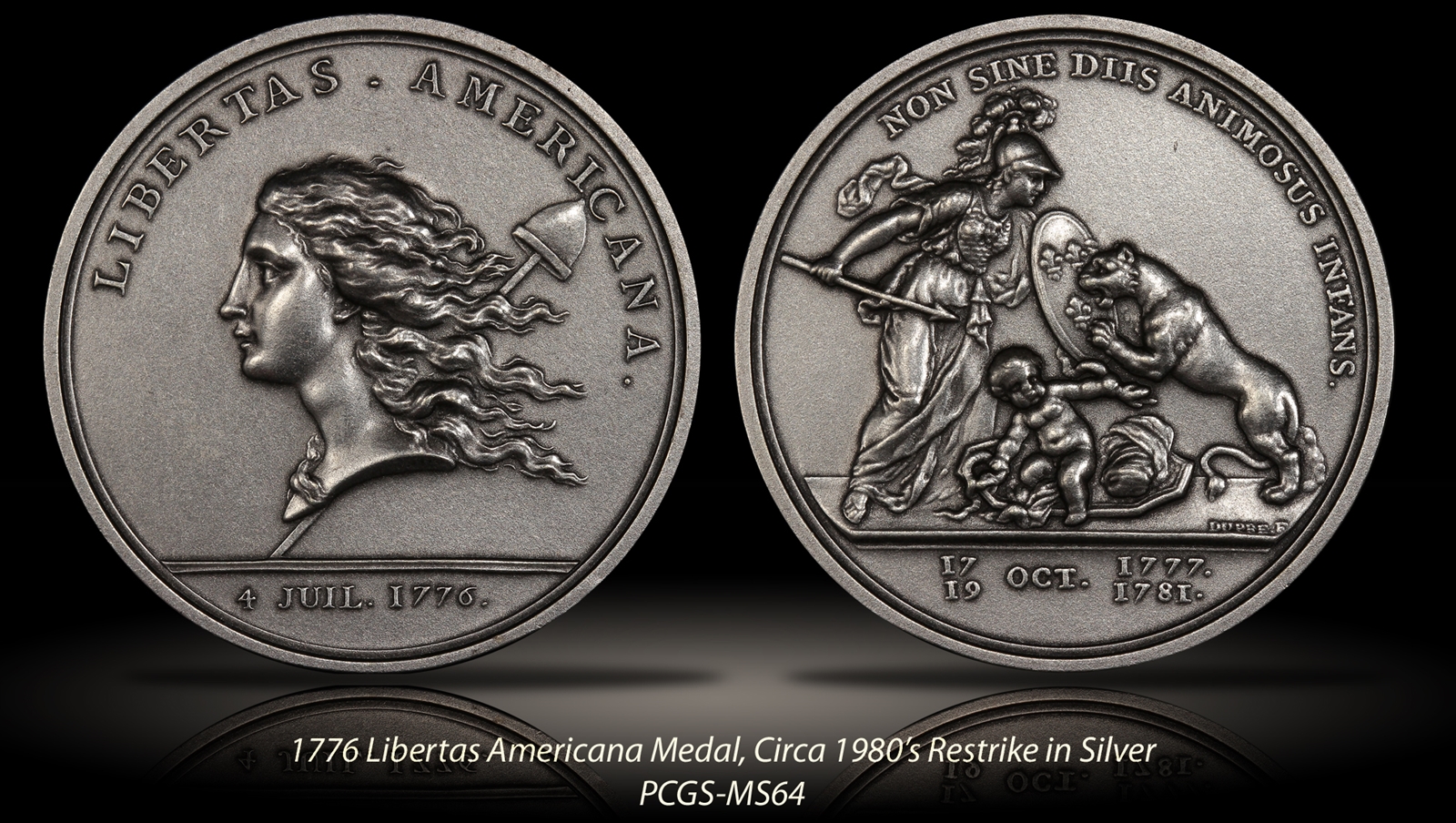
While the Paris Mint may have given First Coinvestors the exclusive rights to the 77mm dies, it reserved for itself the rights to restrike the Libertas Americana medals in other sizes, and a number of restrikes have appeared since that time. The Silver Restrike seen here was produced in an open issue for visitors to the Mint beginning shortly after the U.S. Bicentennial. These are distinguished by a double cornucopia edge mark and a stamp of ".925" to designate the fineness of the silver. Similarly, Bronze Restrikes were also produced in open issue and bear edge markings to designate their official Paris Mint origin.
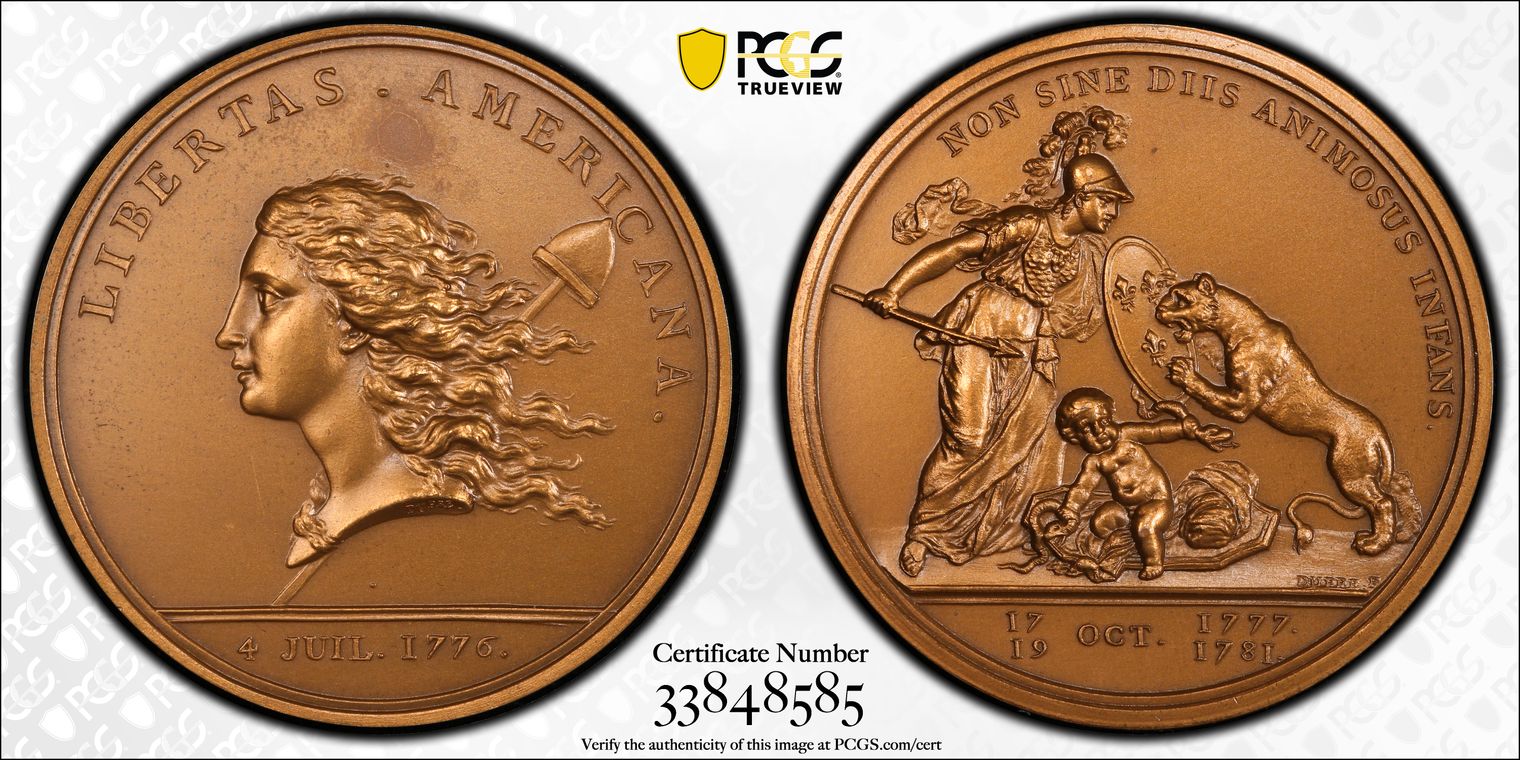
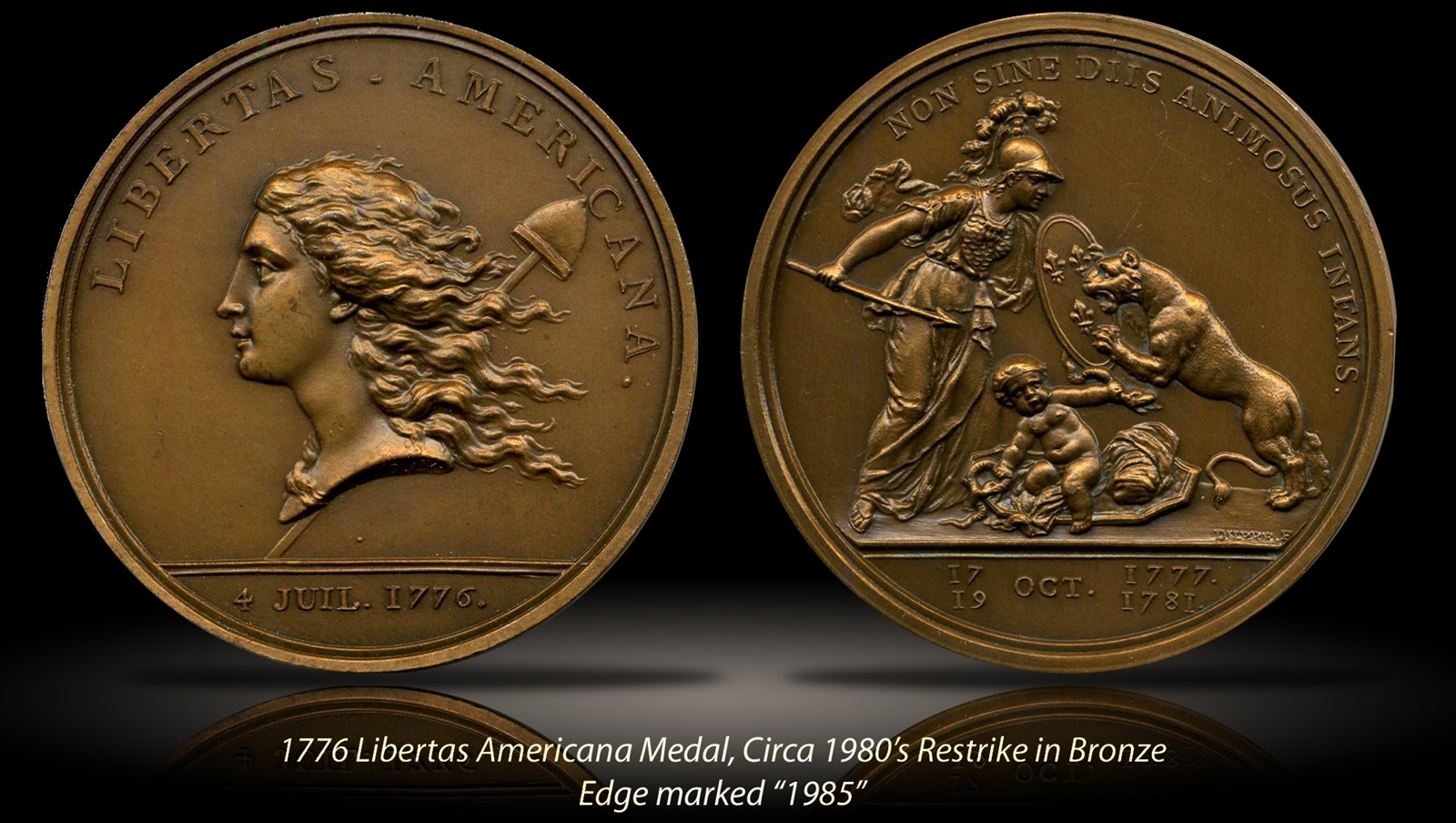
In addition to the open issue silver restrikes, Bronze Restrikes were also produced by the Paris Mint in an open issue following the U.S. Bicentennial. These bear edge markings to designate their official Paris Mint origin.



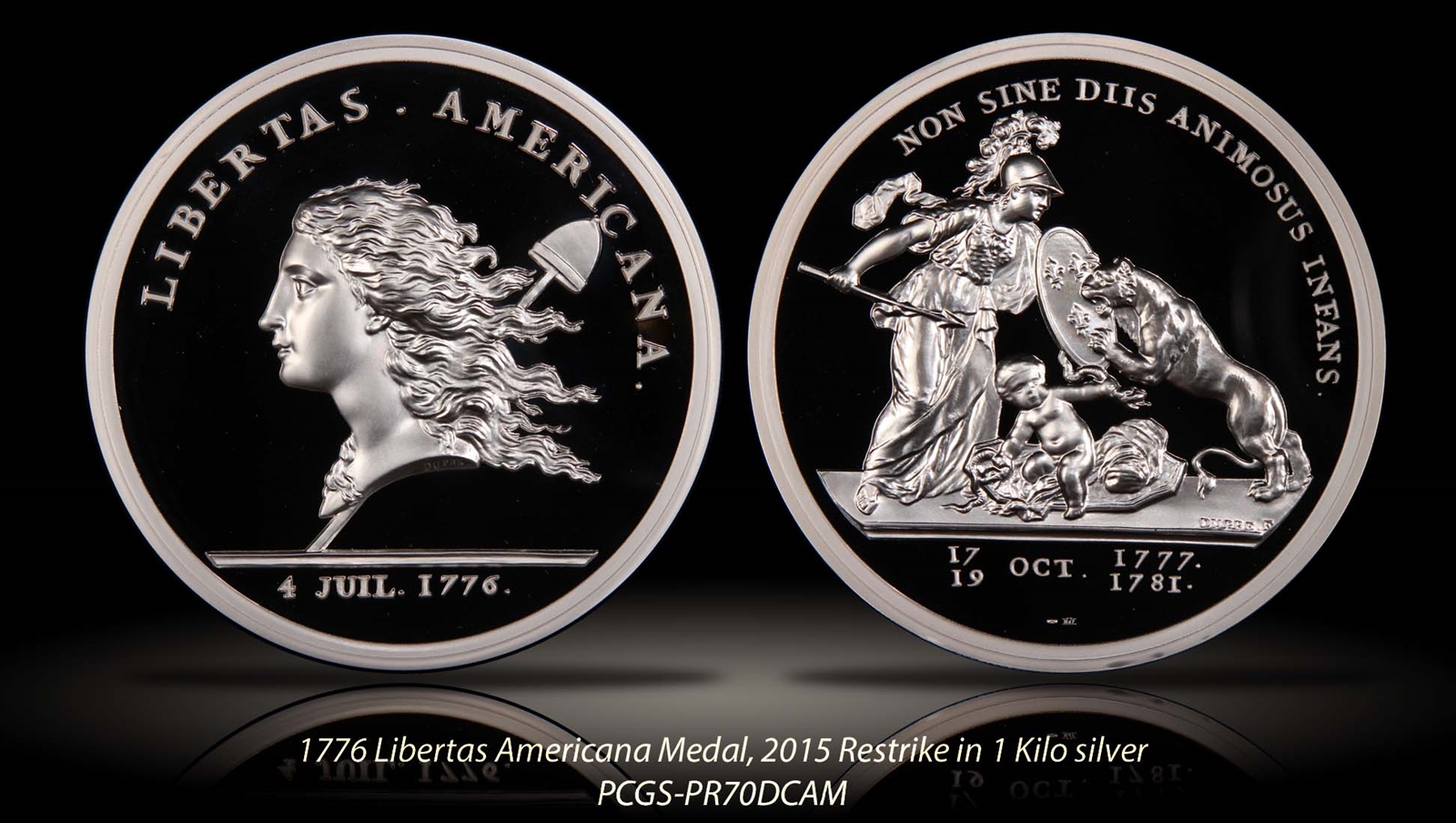
Undoubtedly, the largest format ever issued for the Libertas Americana medals were released in 2015. Weighing in at 1 full kilogram of .999 silver, these restrikes command attention with their 100mm diameters -- readily dwarfing the Coinvestors Bicentennial issue. As a testament to Paris Mint standards, sufficient care was taken that the example in the collection fully merits its PR70DCAM rating from PCGS! Production of this massive issue was limited to just 1,000 pieces. While that may seem like a small number, their production required one full metric ton of pure silver!
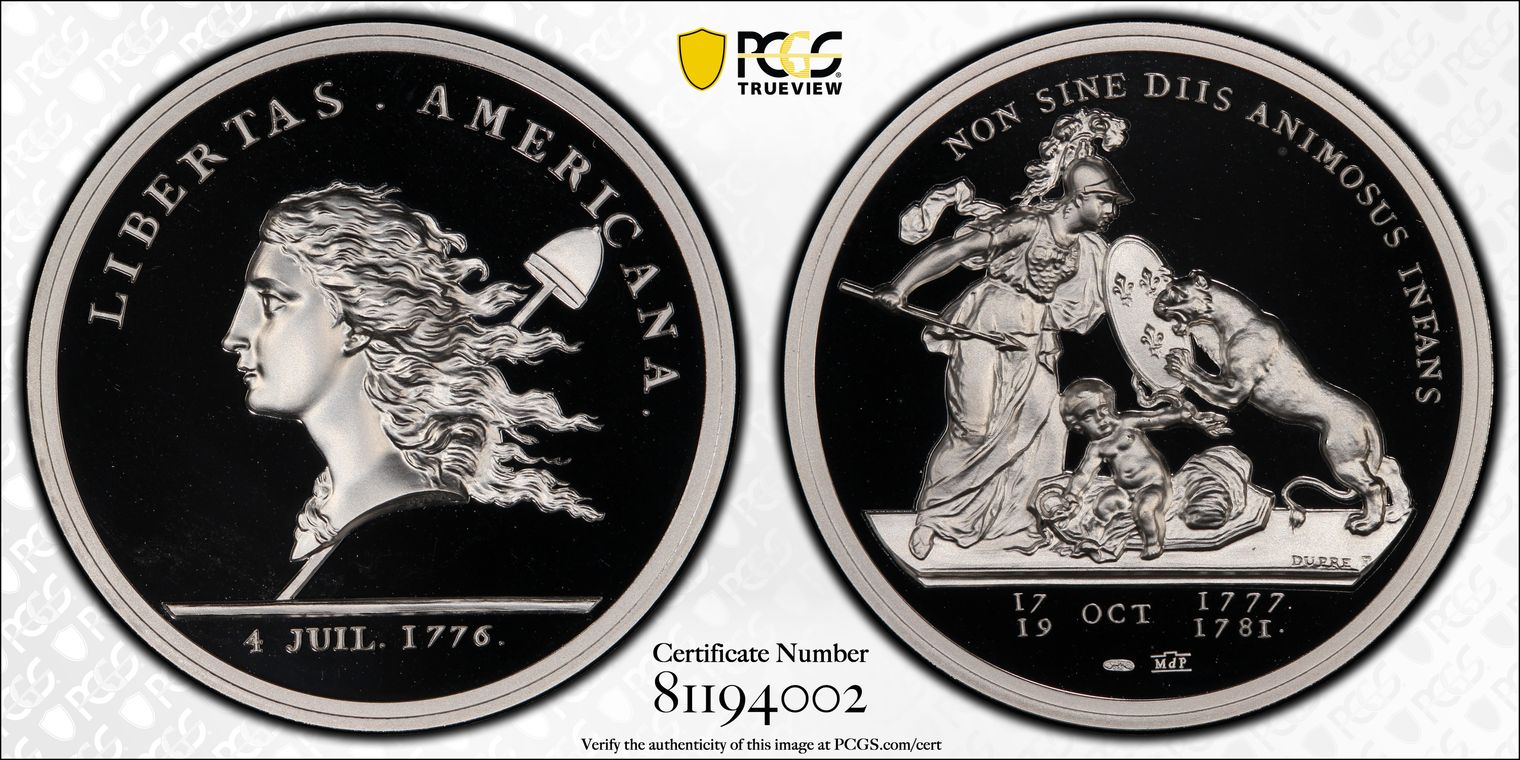
The Monnaie de Paris released further silver editions in 2015, with much more modest mintages. Seen here is the Libertas Americana medal rendered in a 37mm format, bearing 31.1g of .950 silver. Whereas the 2014 silver issue was minted to a limit of 10,000 pieces, these 2015 1oz medals were limited to 5,000 pieces.

The Monnaie de Paris released further silver editions in 2015, with much more modest mintages. Seen here is the Libertas Americana medal rendered in a 37mm format, bearing 31.1g of .950 silver. Whereas the 2014 silver issue was minted to a limit of 10,000 pieces, these 2015 1oz medals were limited to 5,000 pieces.

The Monnaie de Paris released further silver editions in 2015, with much more modest mintages. Seen here is the Libertas Americana medal rendered in a 37mm format, bearing 31.1g of .950 silver. Whereas the 2014 silver issue was minted to a limit of 10,000 pieces, these 2015 1oz medals were limited to 5,000 pieces.
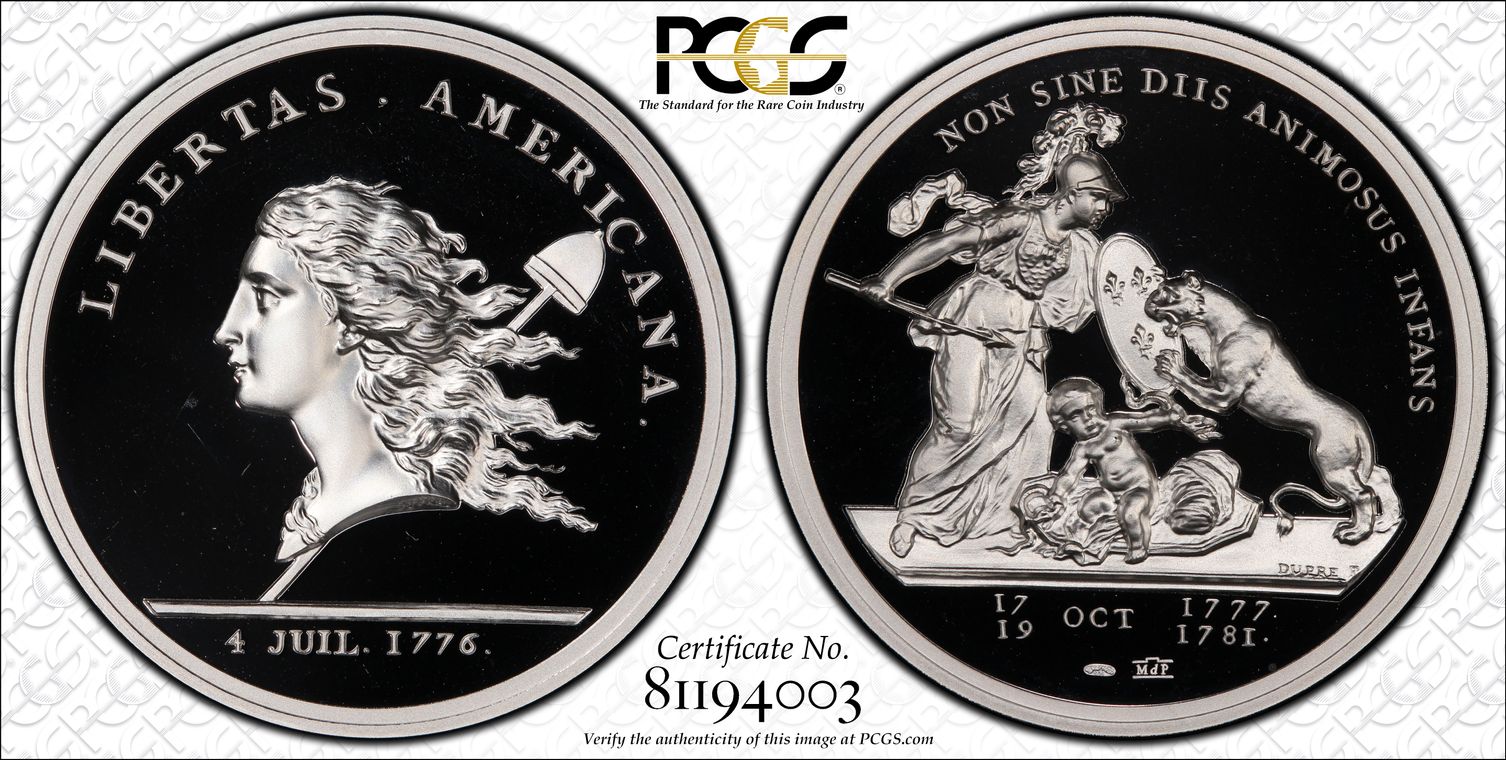
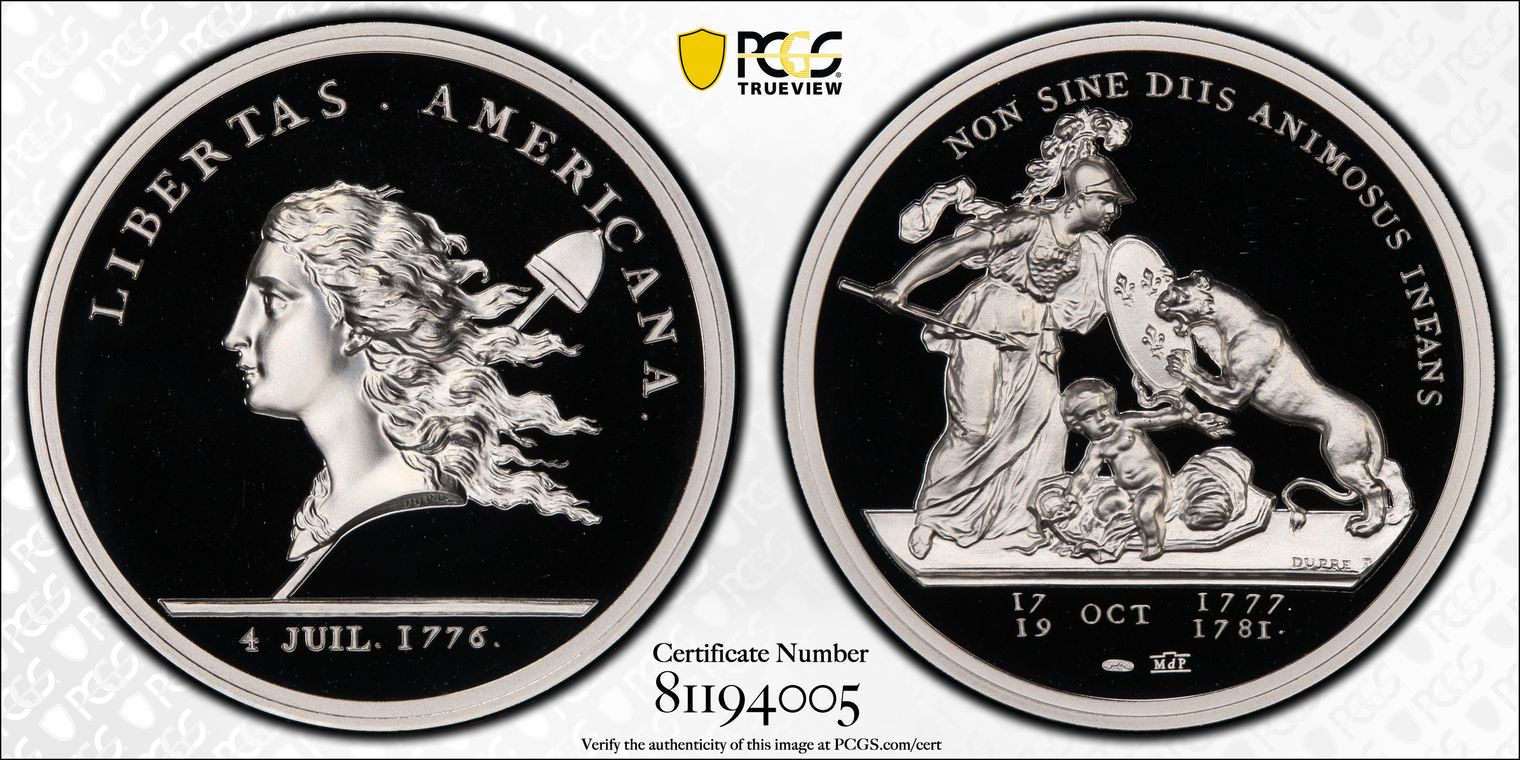
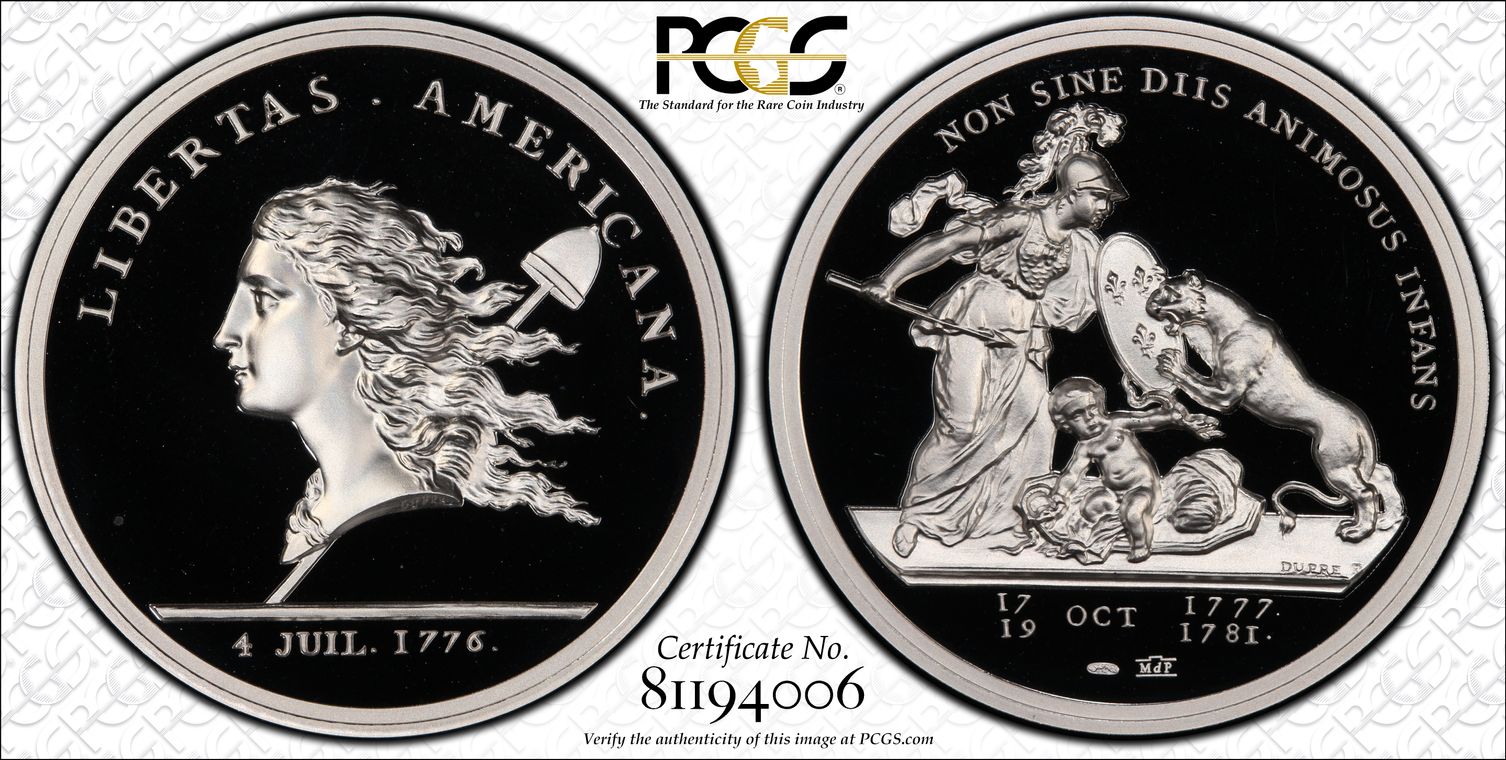
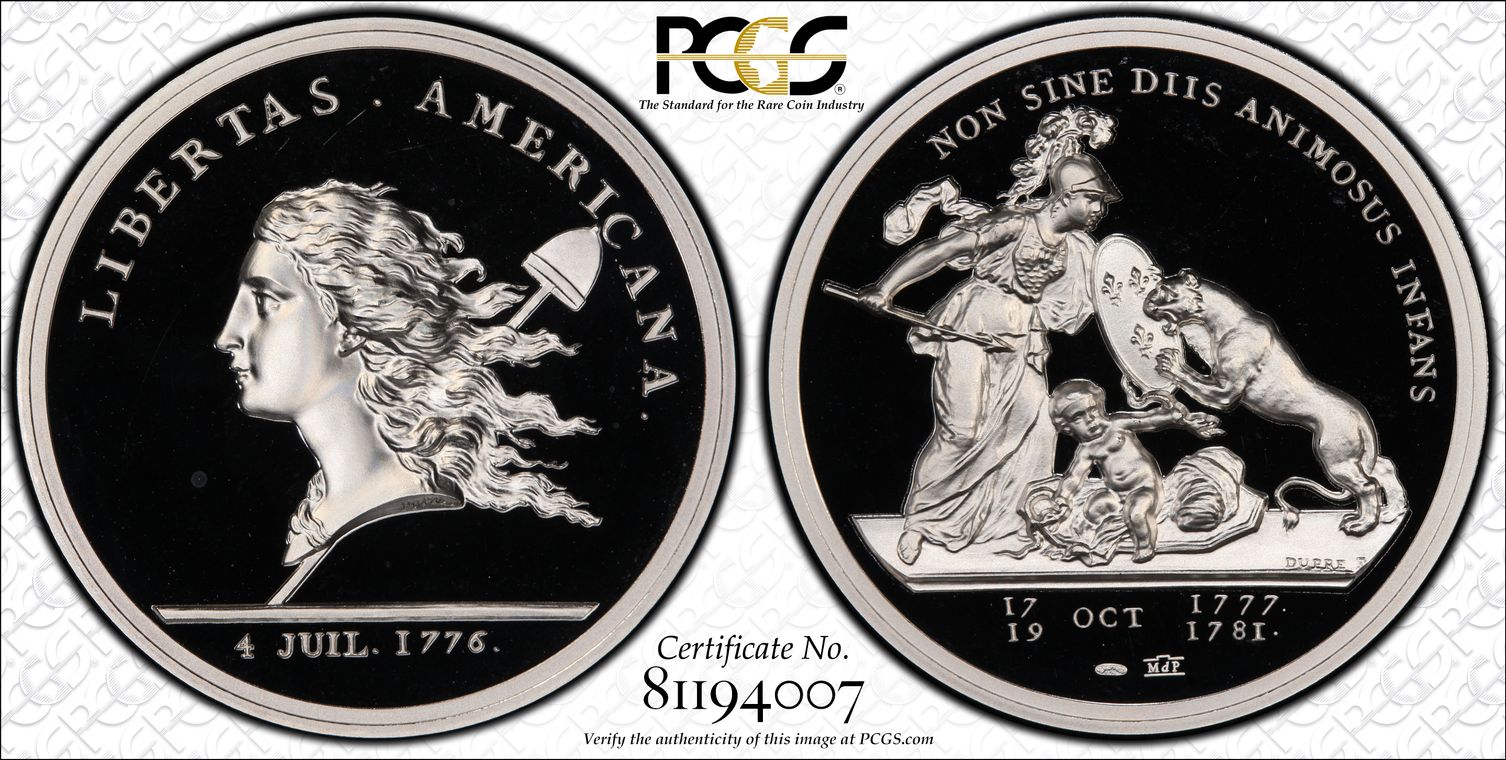
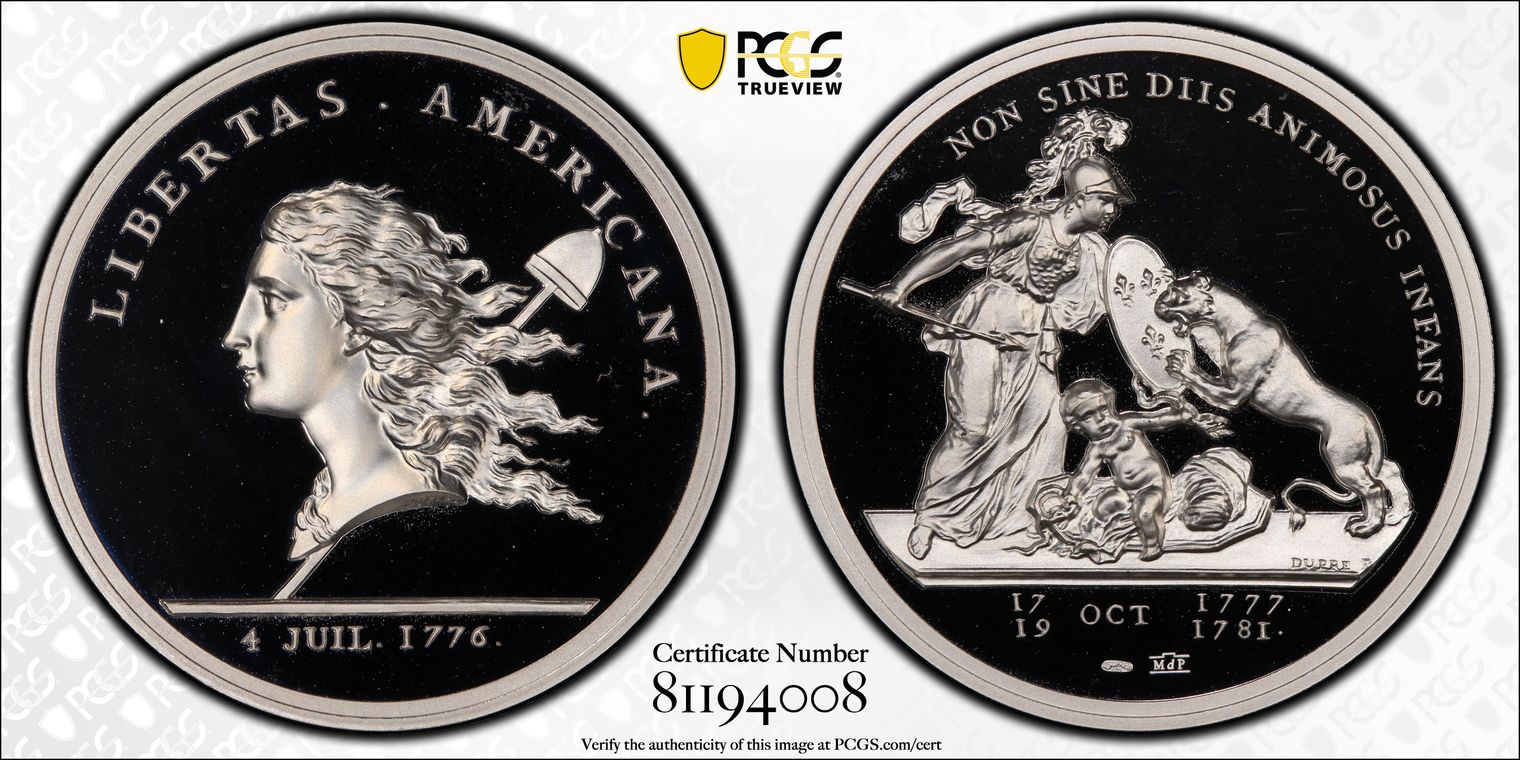
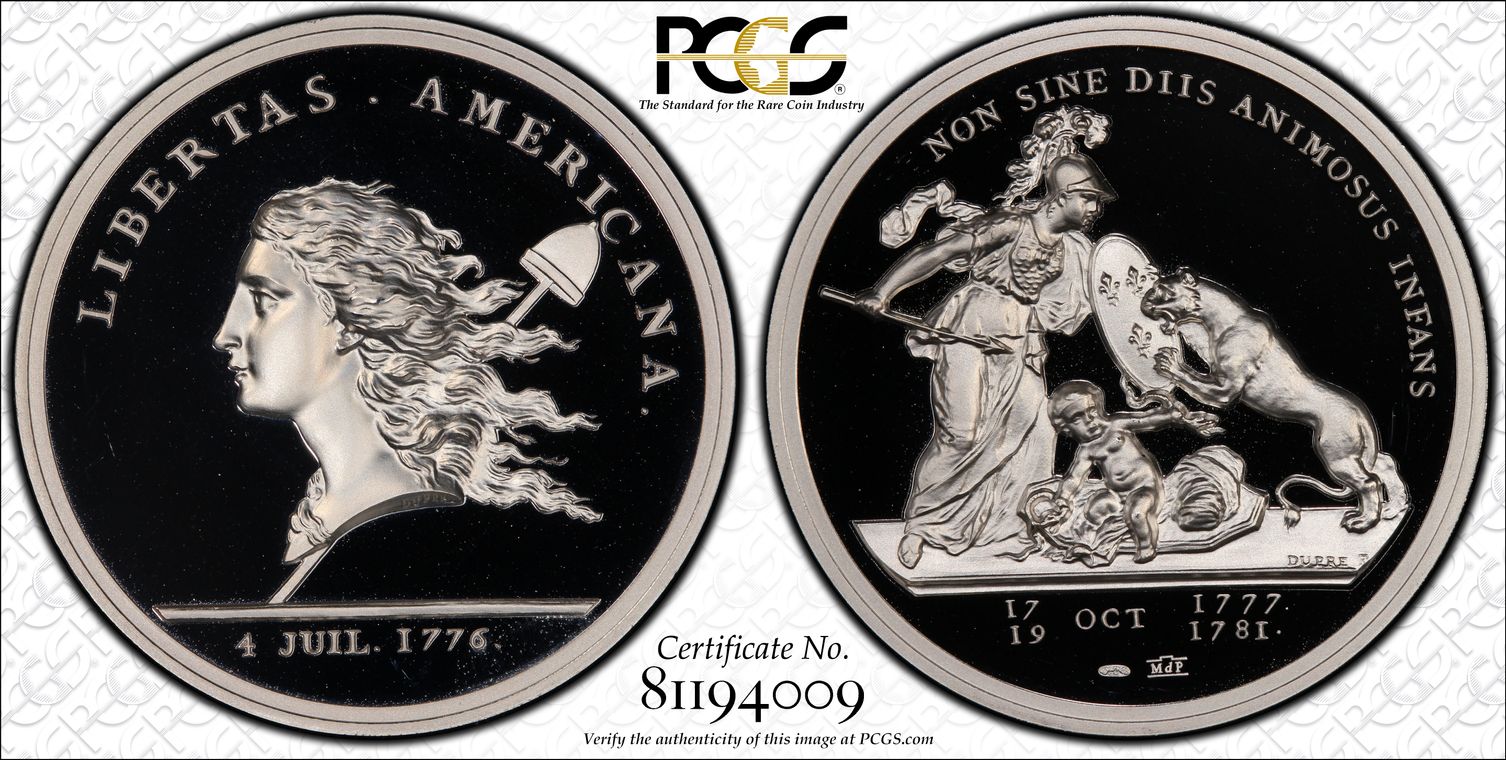
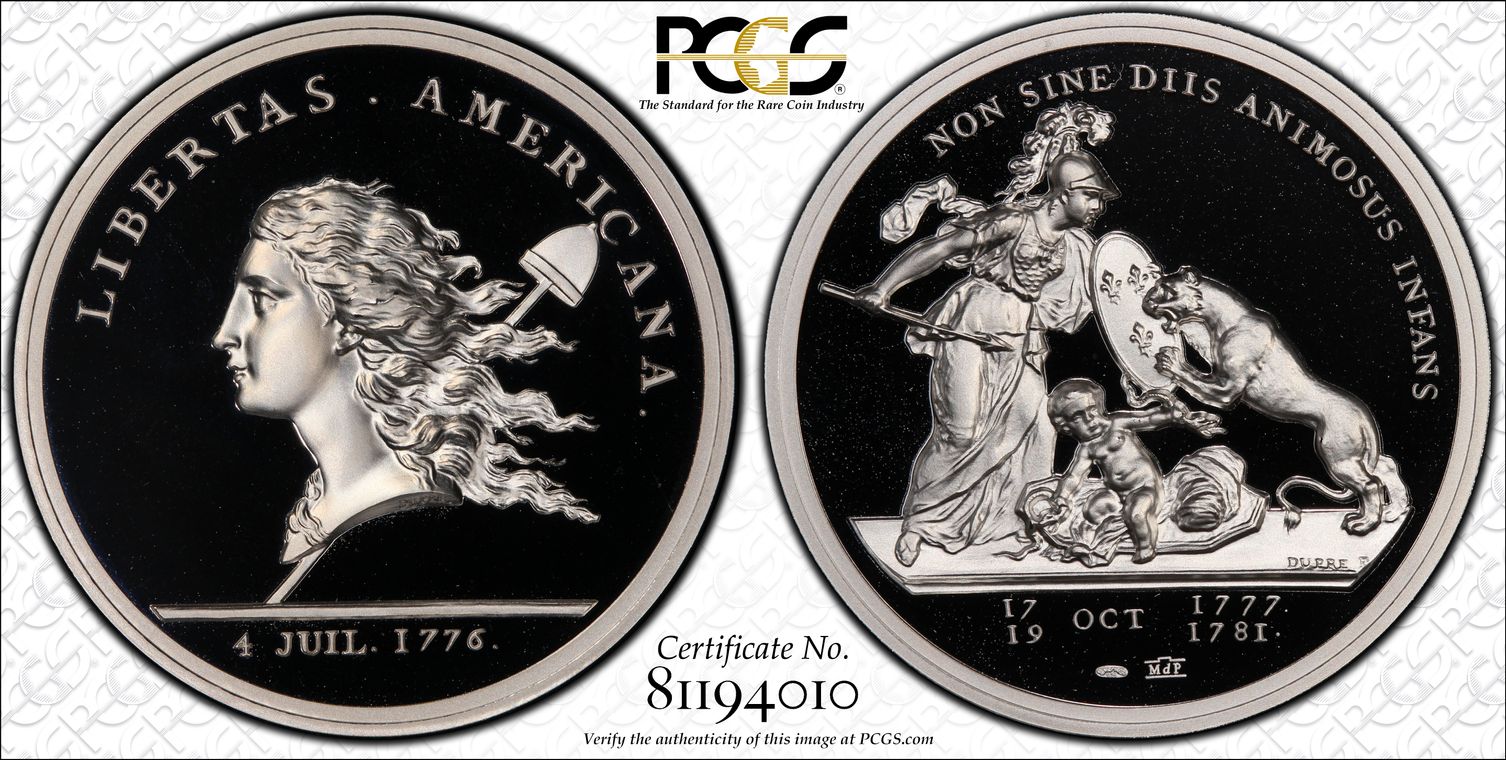
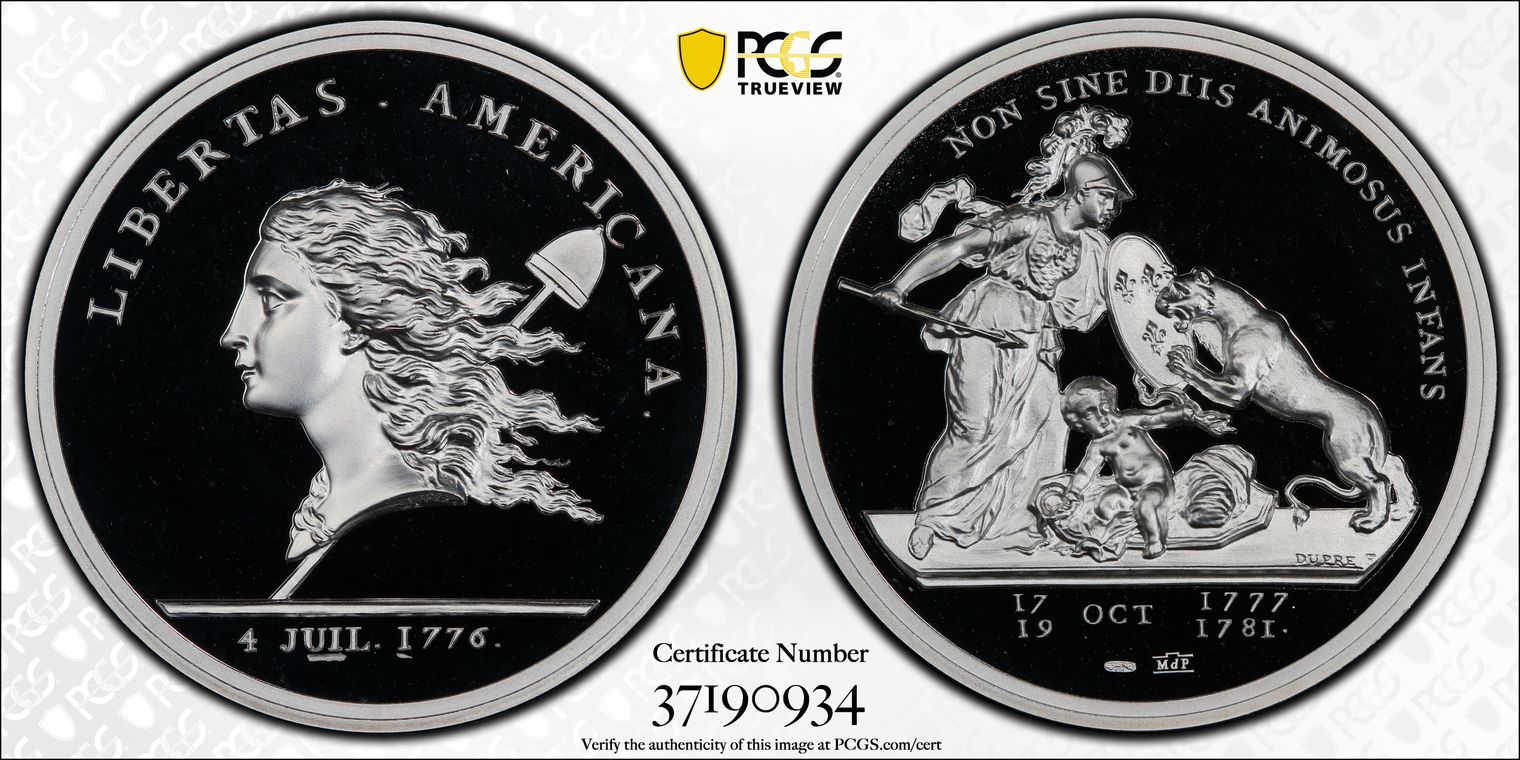
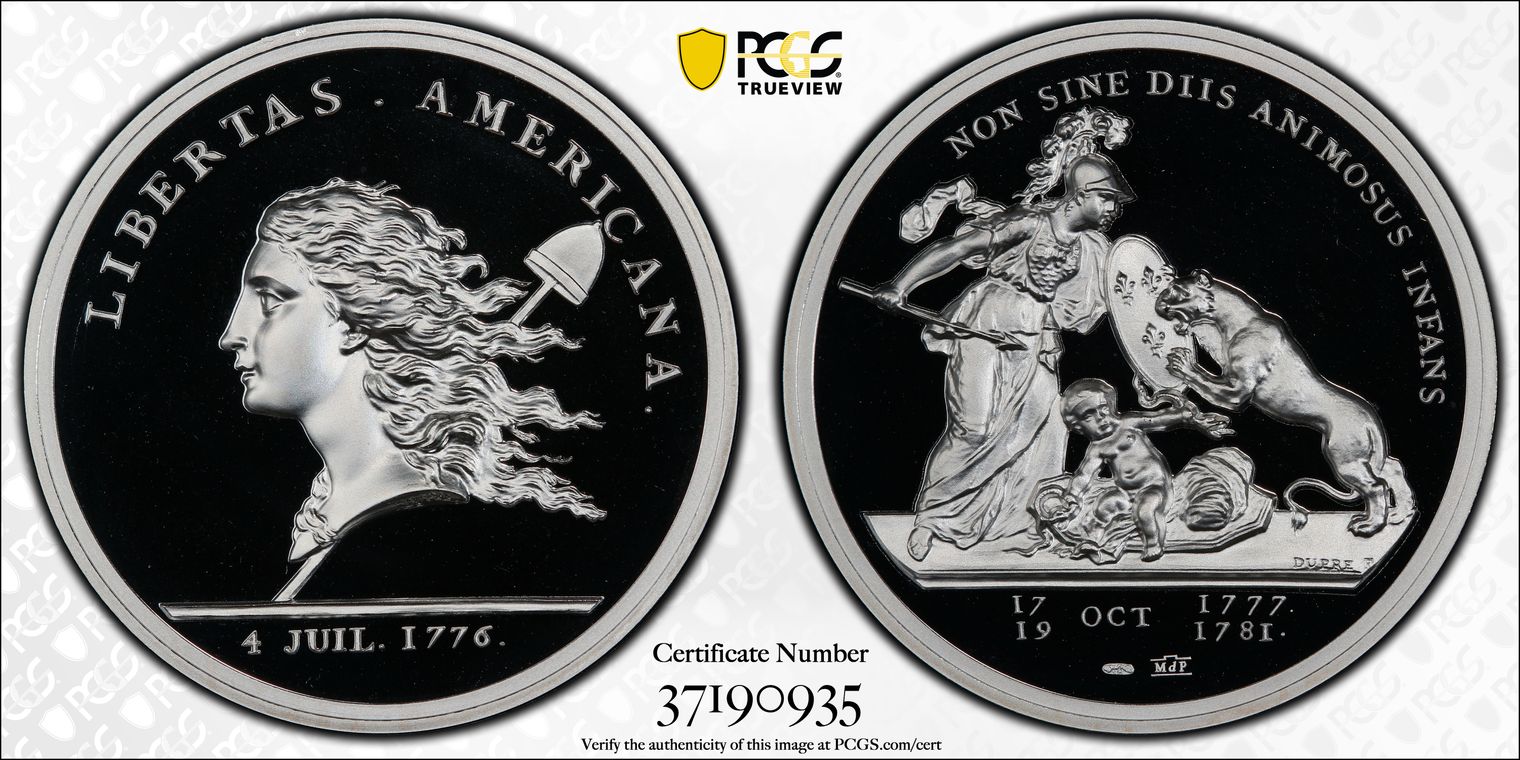
The Monnaie de Paris released further silver editions in 2015, with much more modest mintages. Seen here is the Libertas Americana medal rendered in a 37mm format, bearing 31.1g of .950 silver. Whereas the 2014 silver issue was minted to a limit of 10,000 pieces, these 2015 1oz medals were limited to 5,000 pieces.
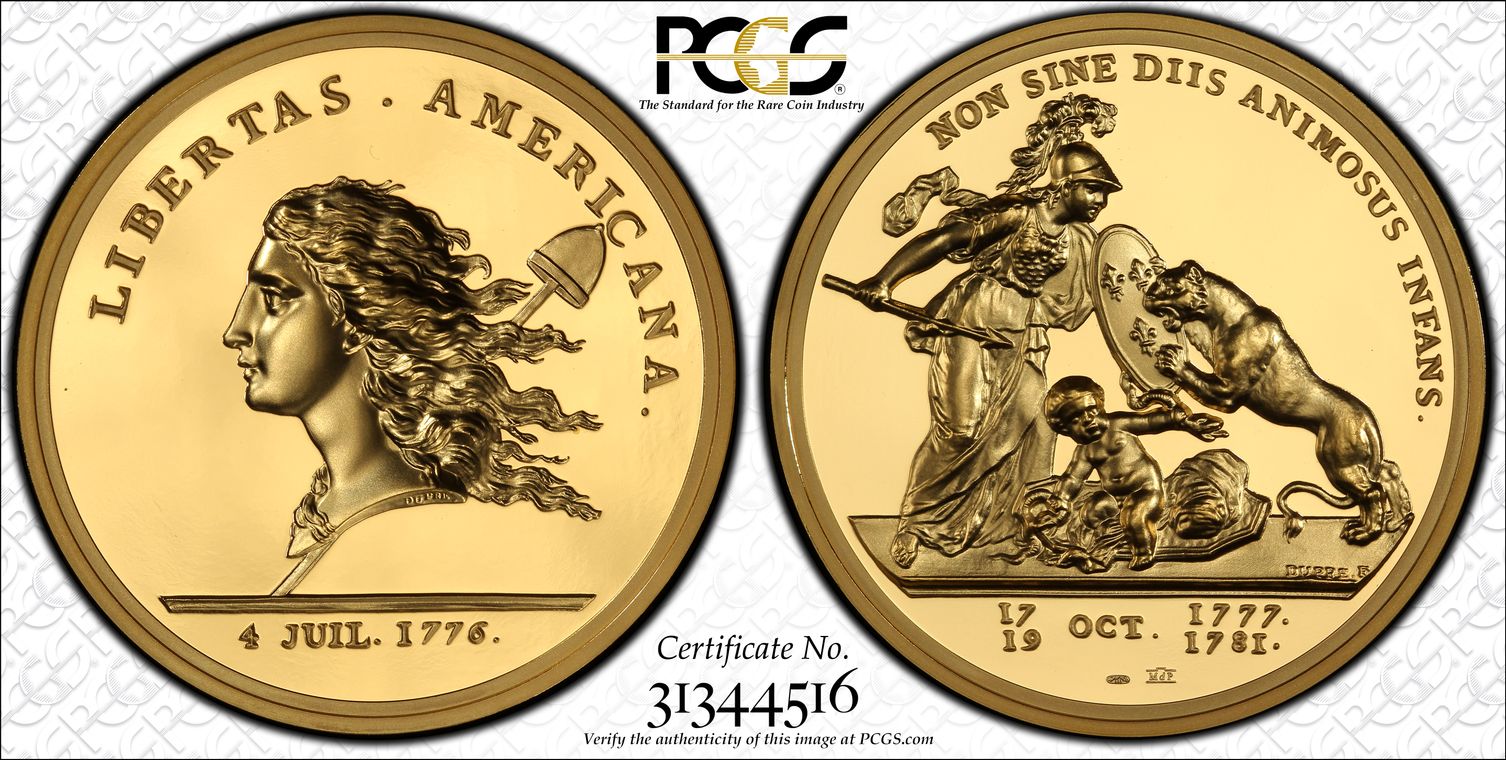
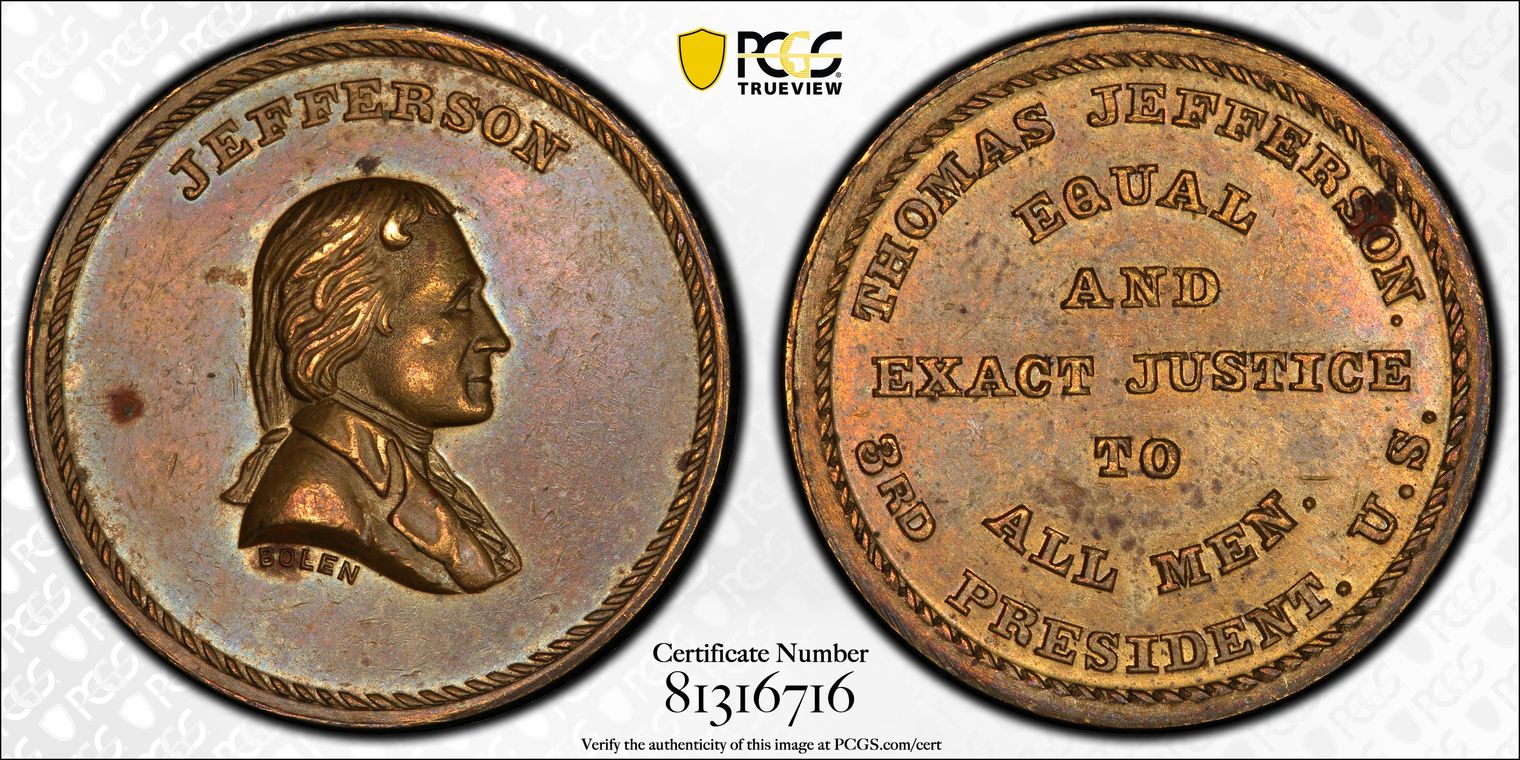
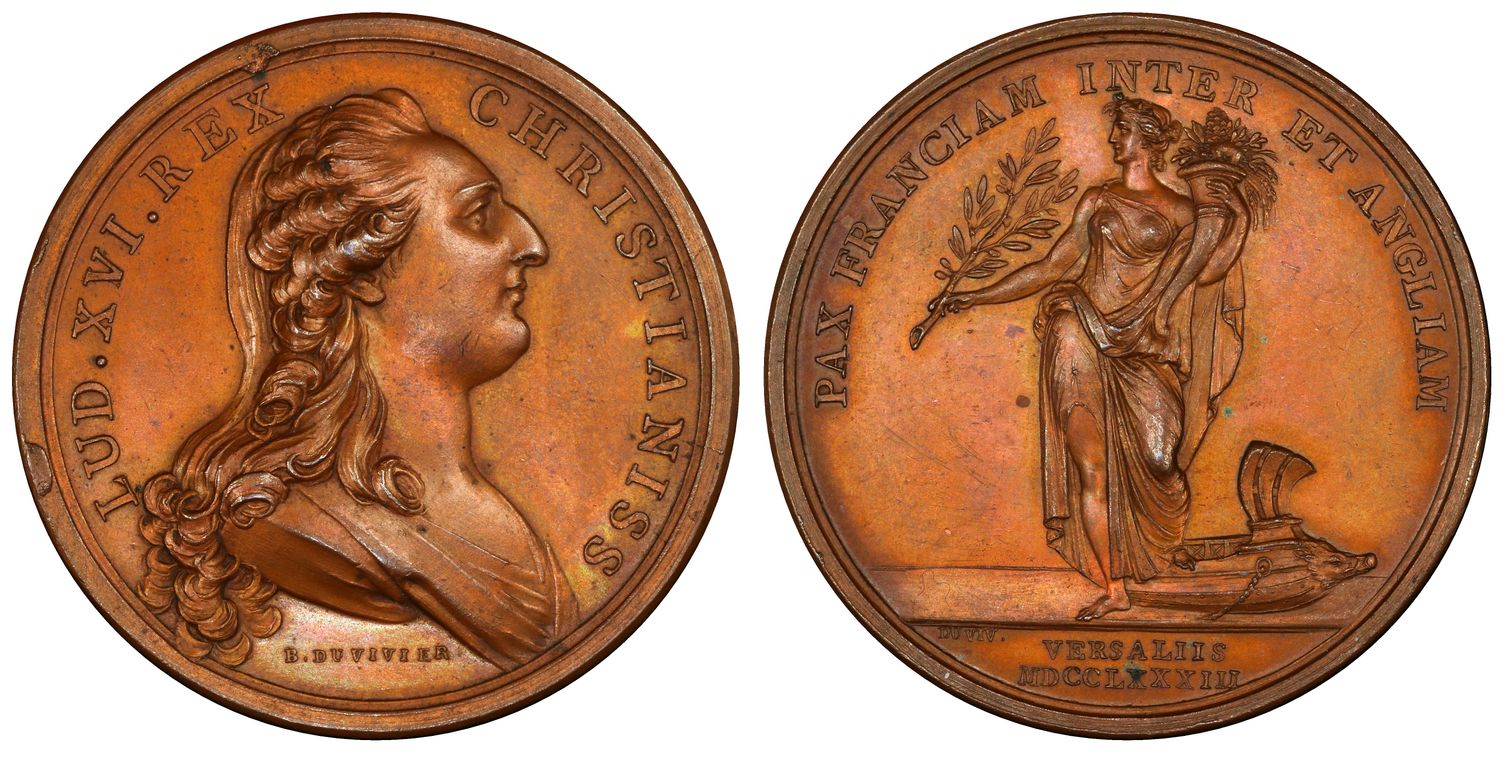
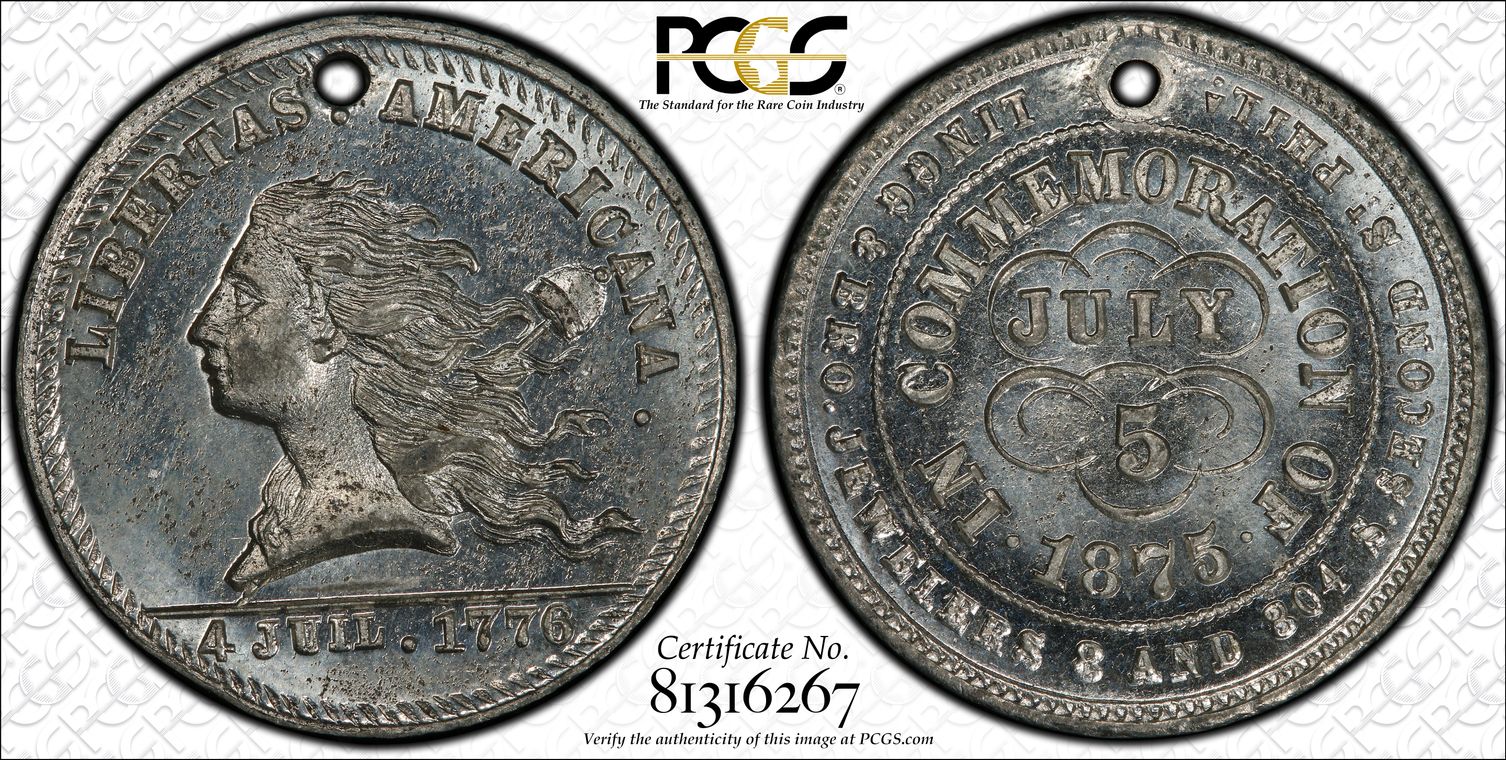
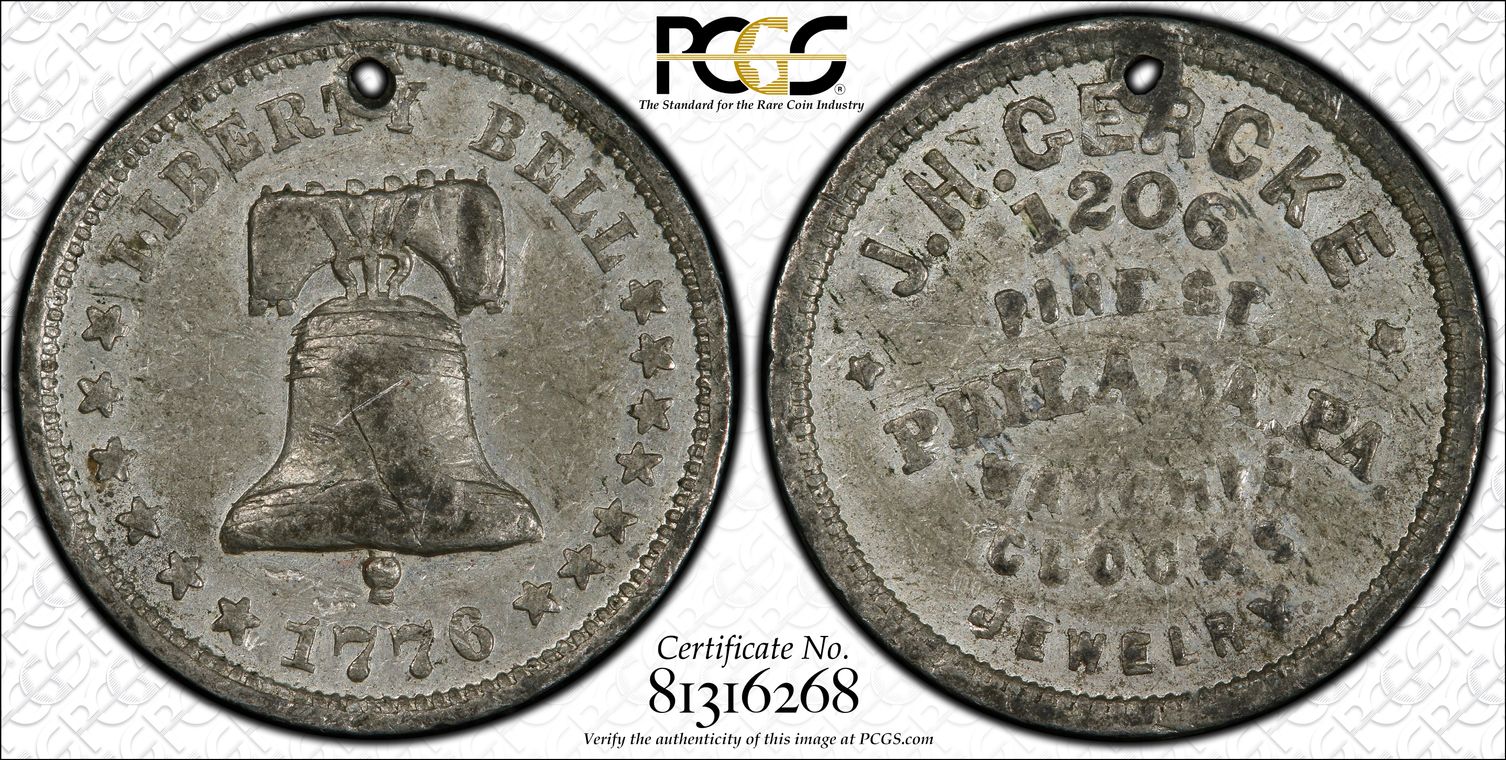
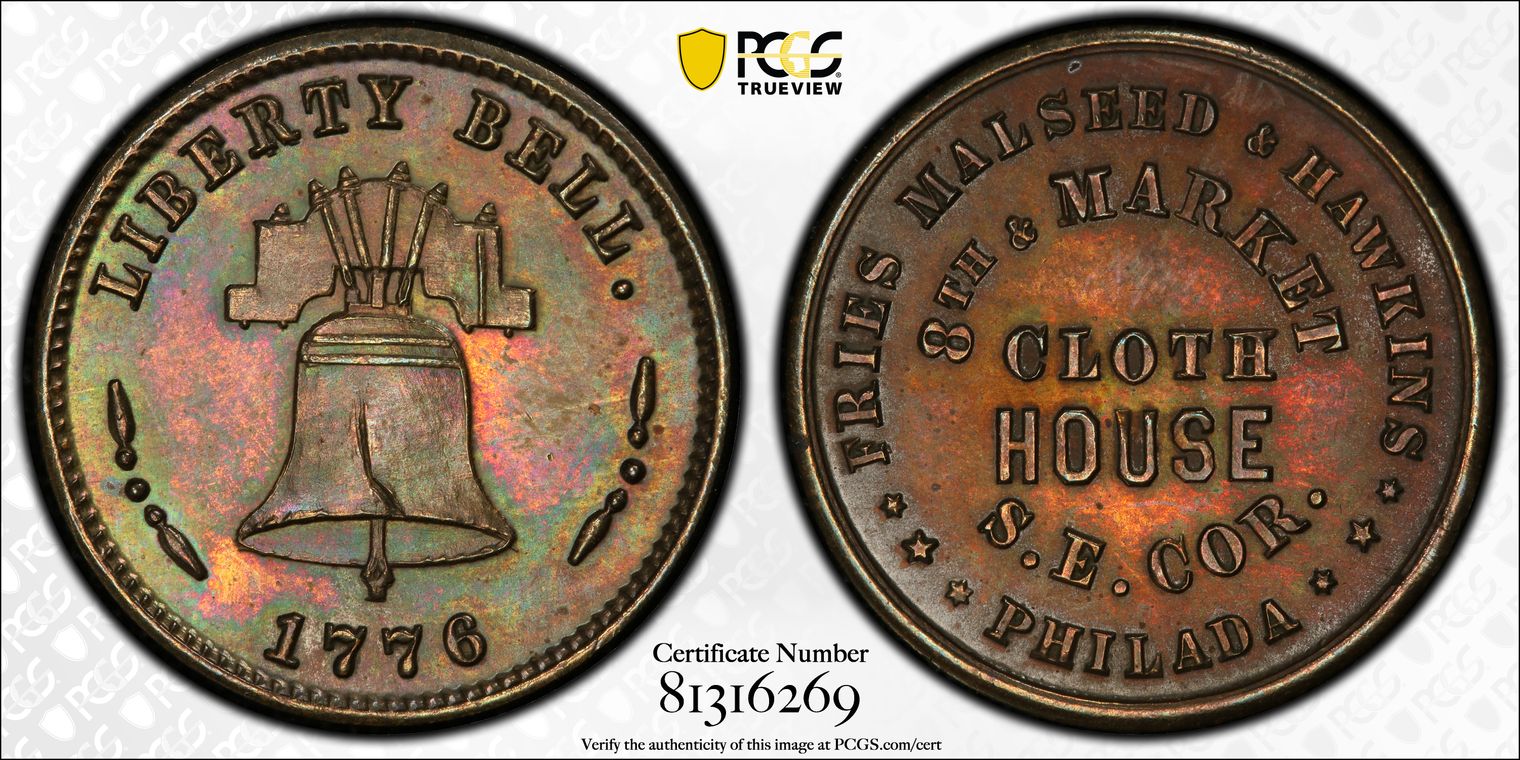
Ex: Steve Tanenbaum
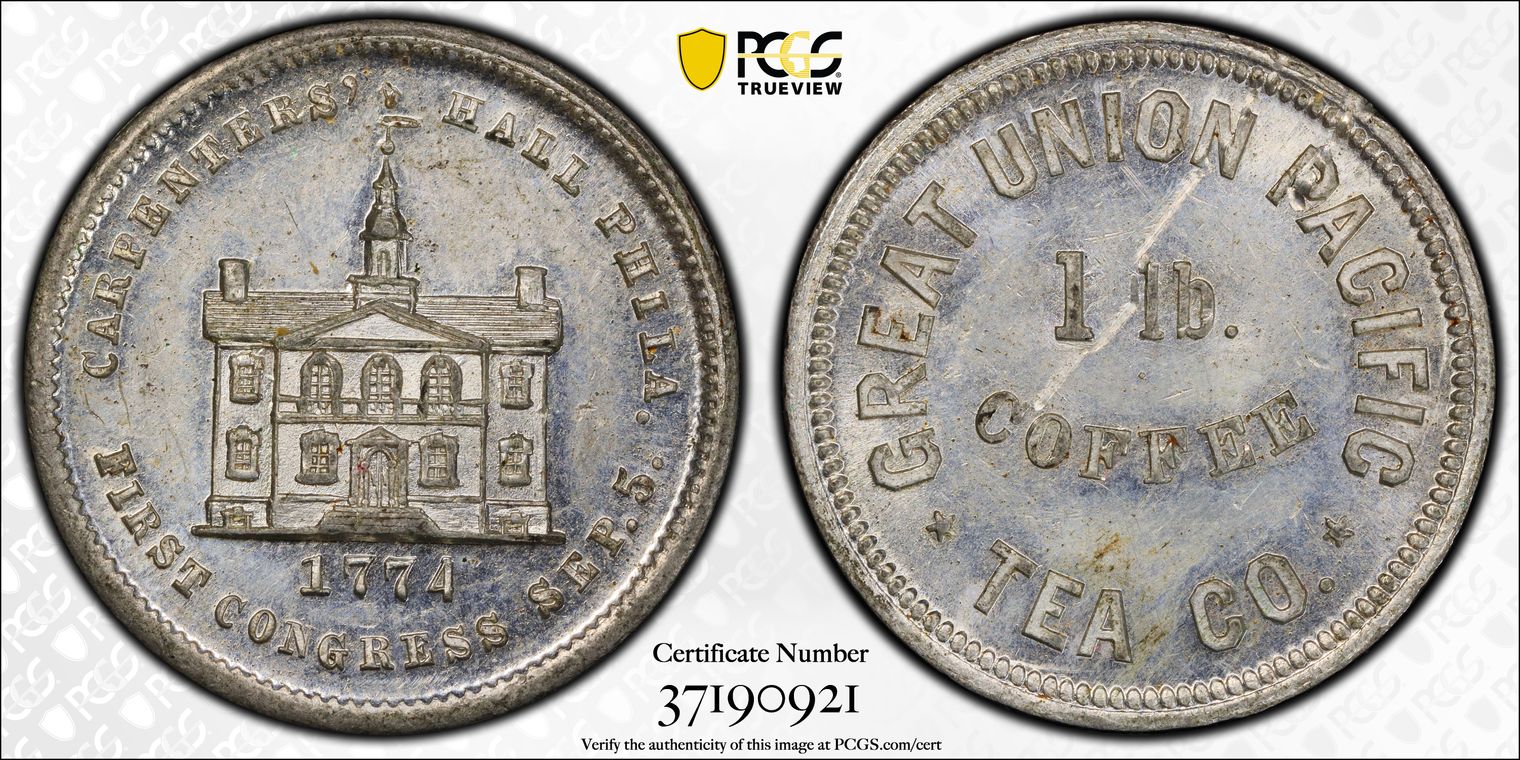
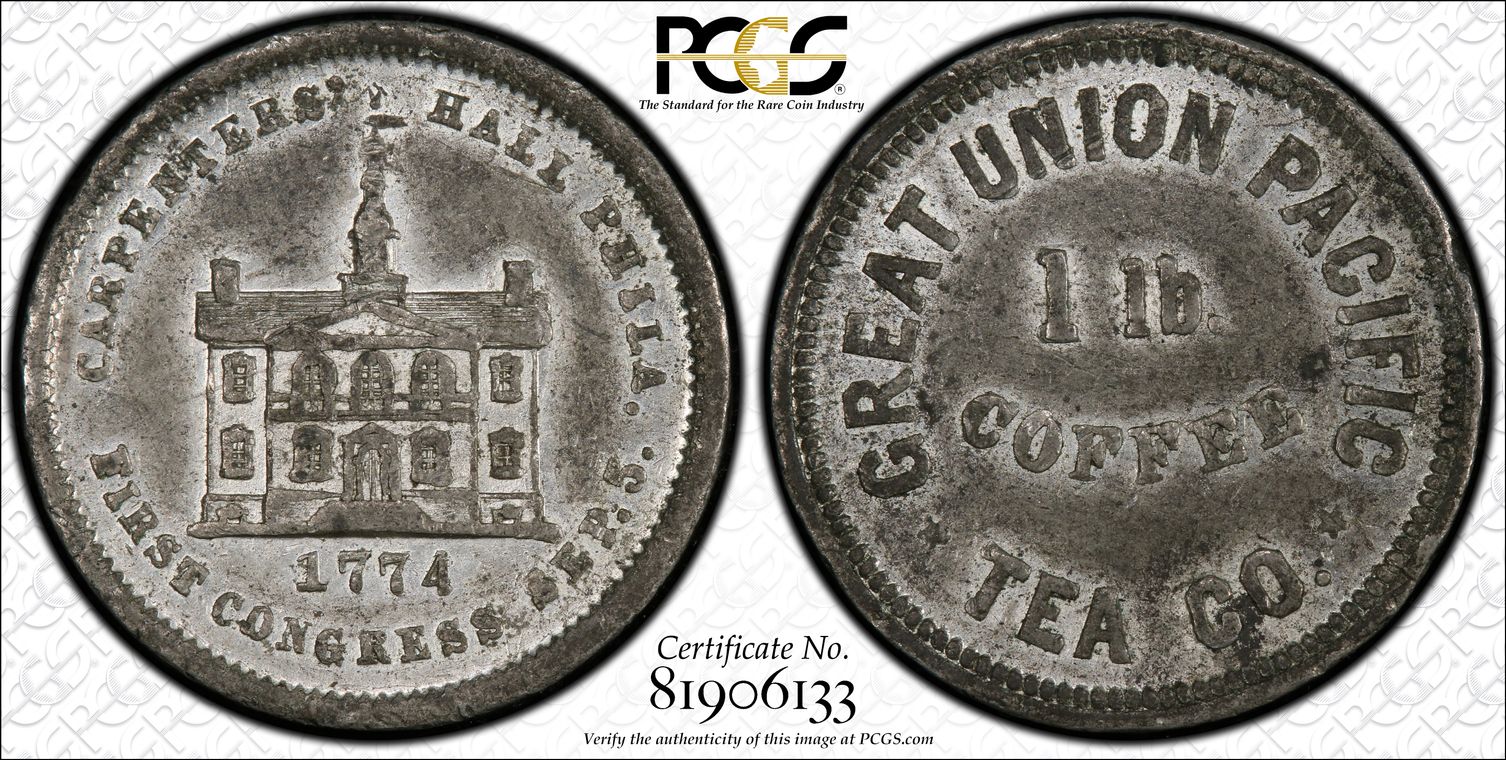
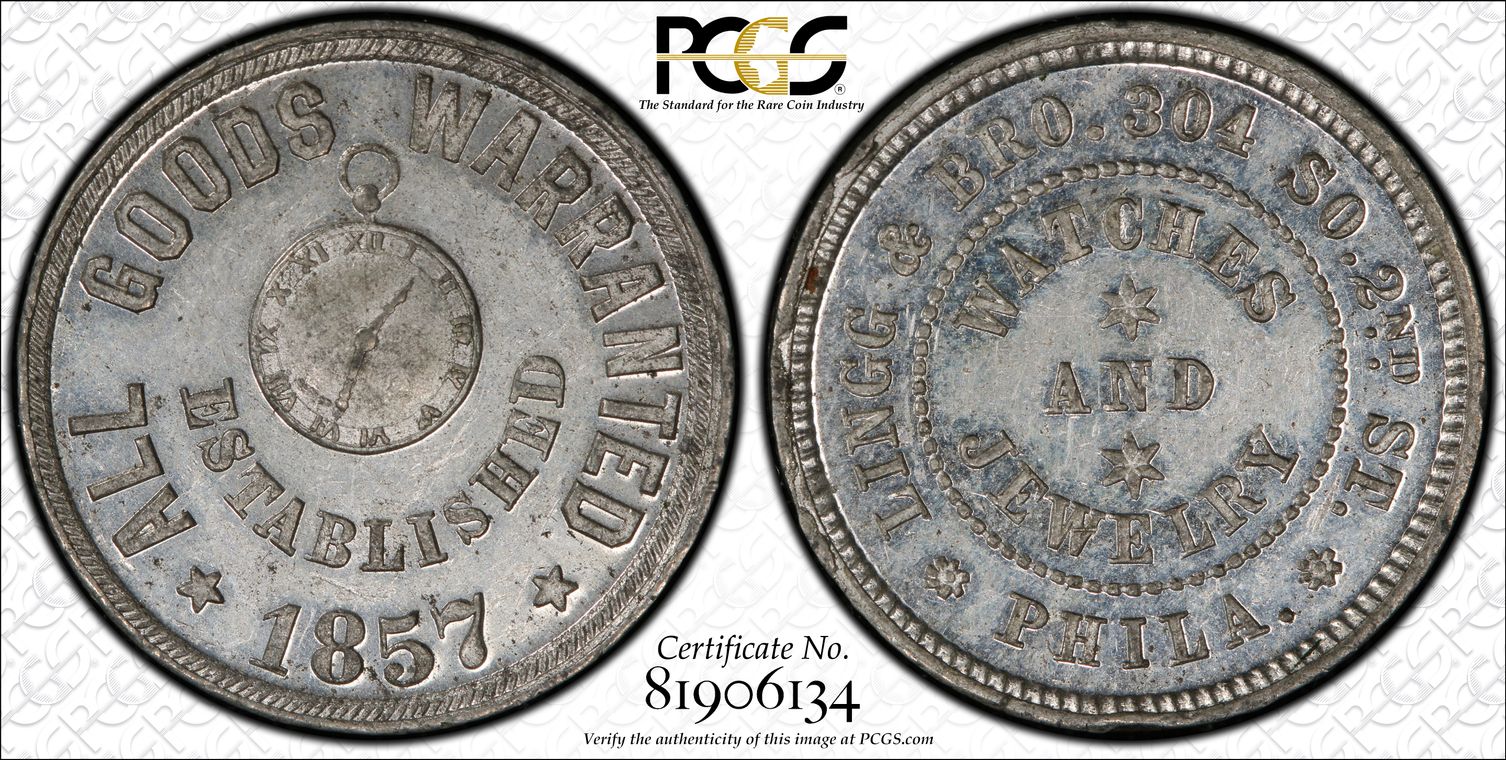

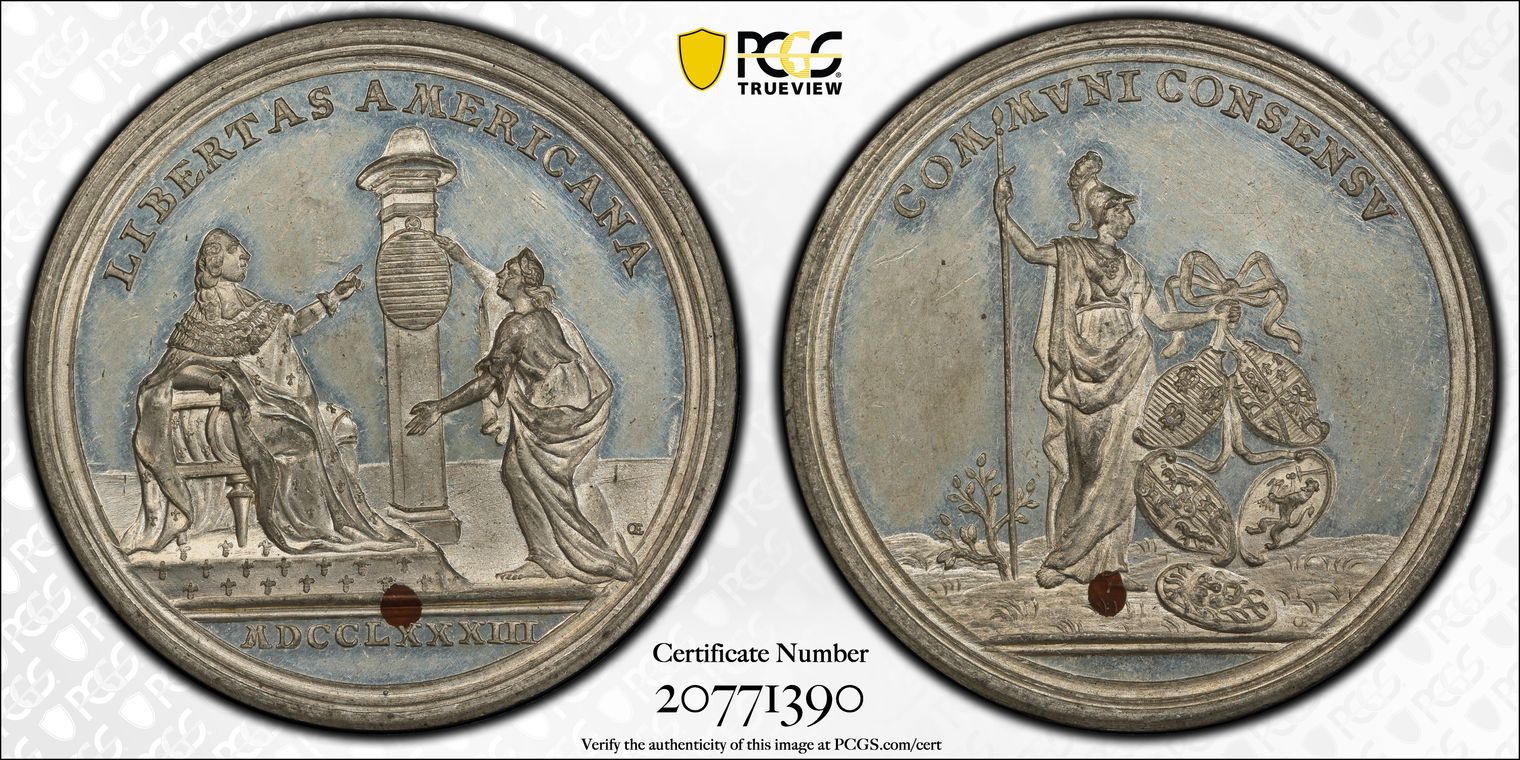
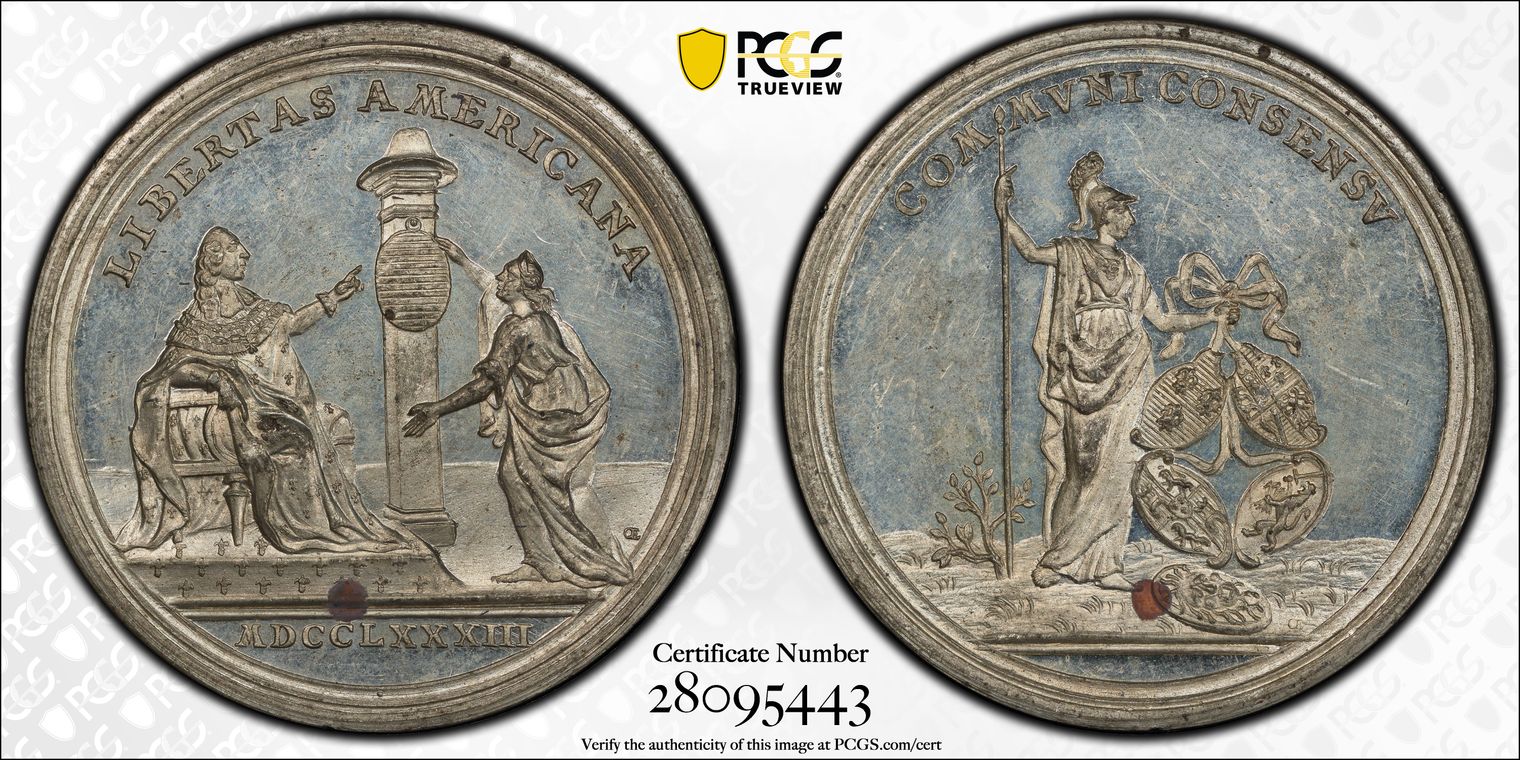
The "Libertas Americana/Communi Consensu" medal is more commonly seen struck in "white metal" (tin), as seen here. To help preserve the white metal from corrosion, a small plug of copper was inserted in the planchet before striking, allowing the copper plug to absorb any corrosive agents and preserve the rest of the medal.
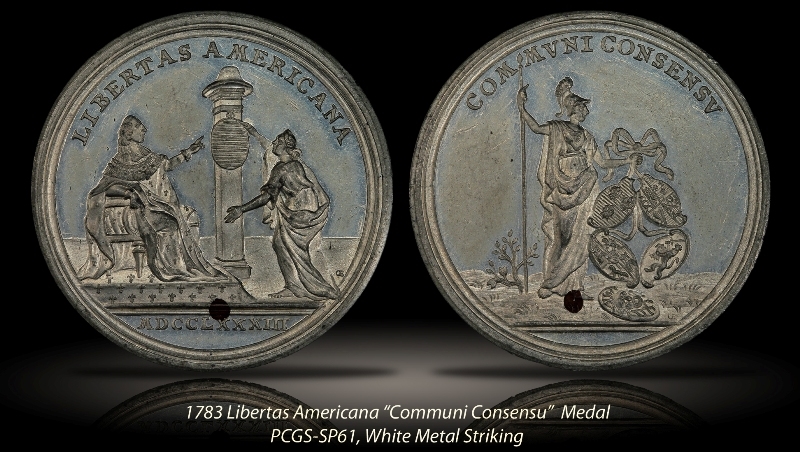
The "Libertas Americana/Communi Consensu" medal is more commonly seen struck in "white metal" (tin), as seen here. To help preserve the white metal from corrosion, a small plug of copper was inserted in the planchet before striking, allowing the copper plug to absorb any corrosive agents and preserve the rest of the medal.
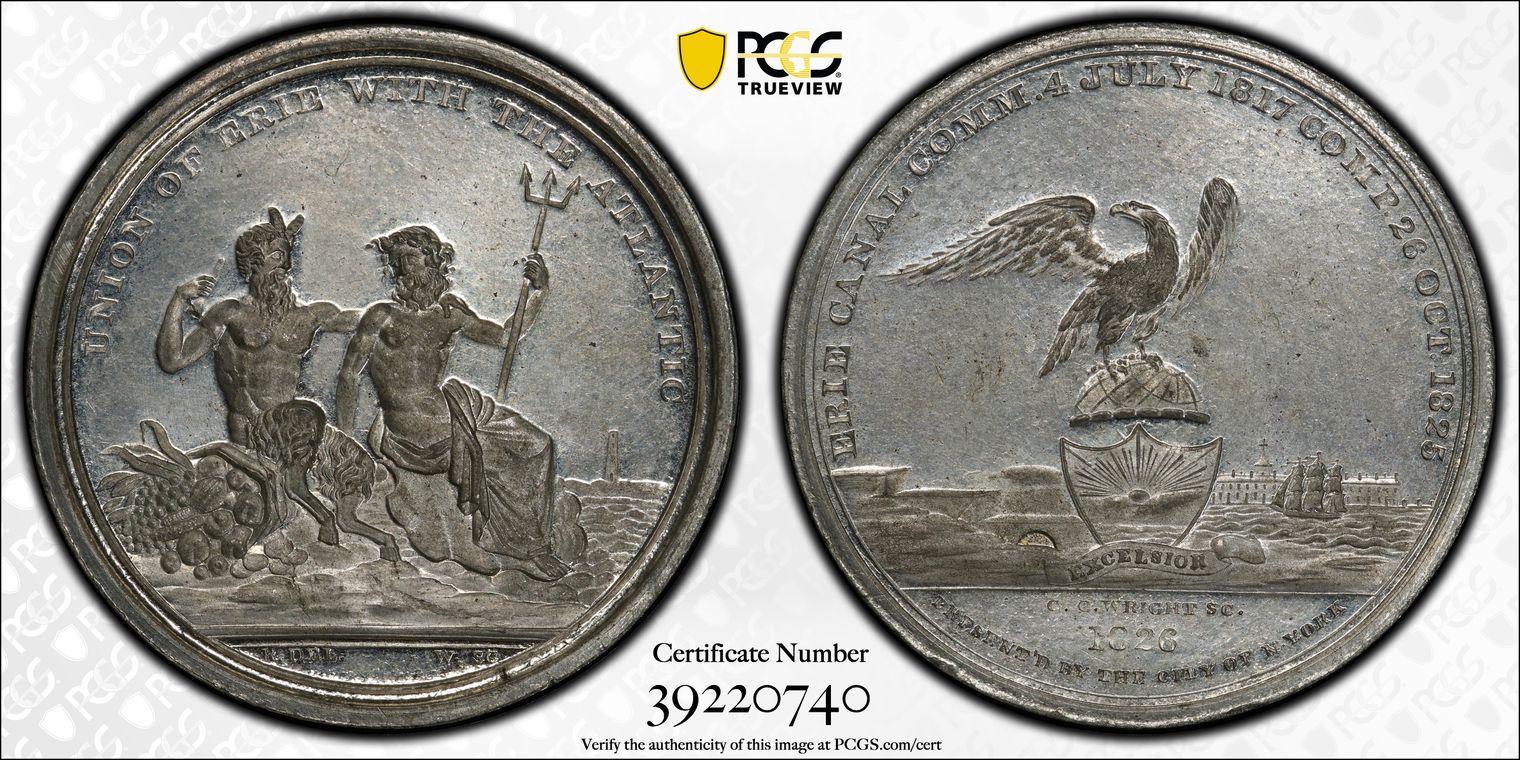
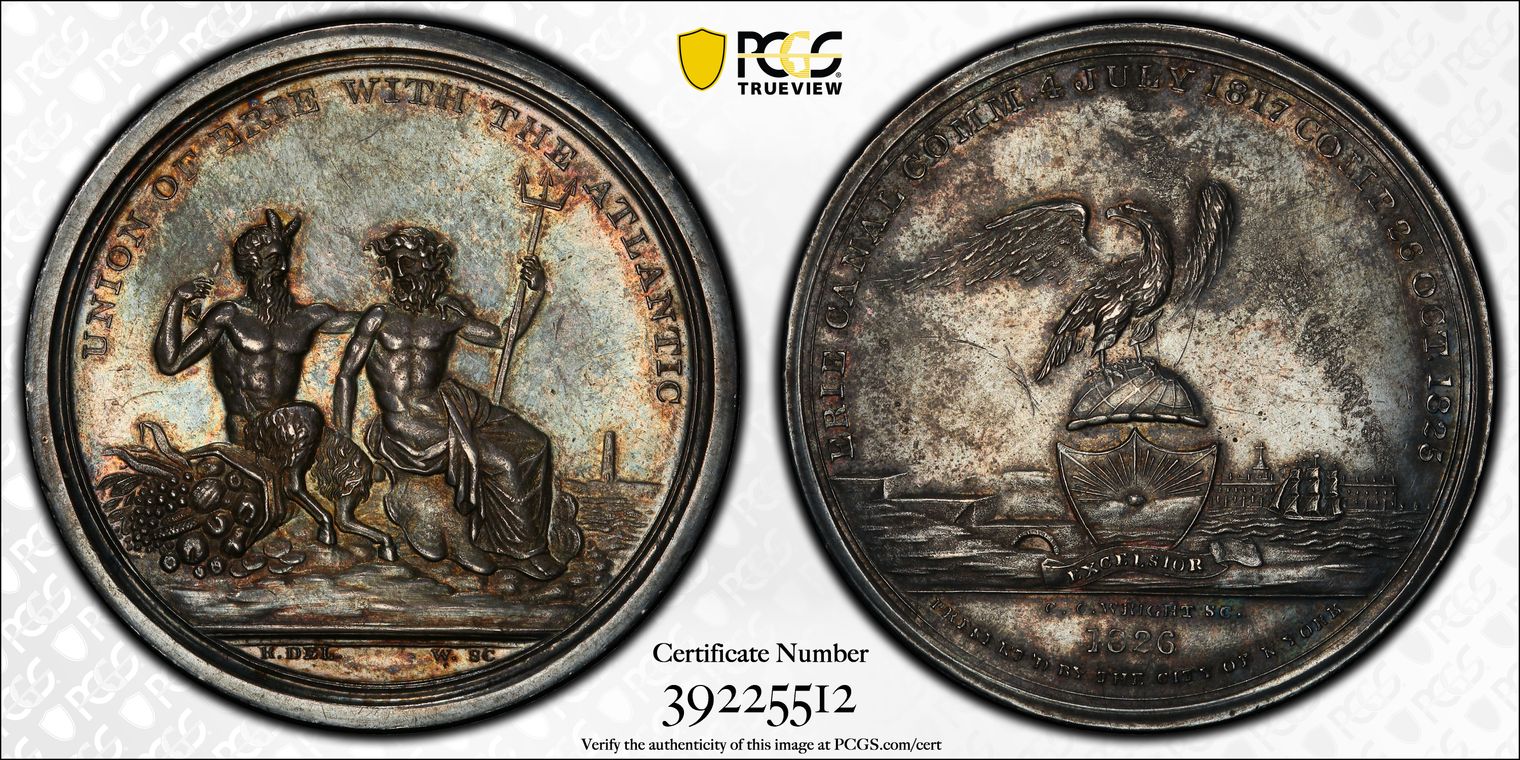
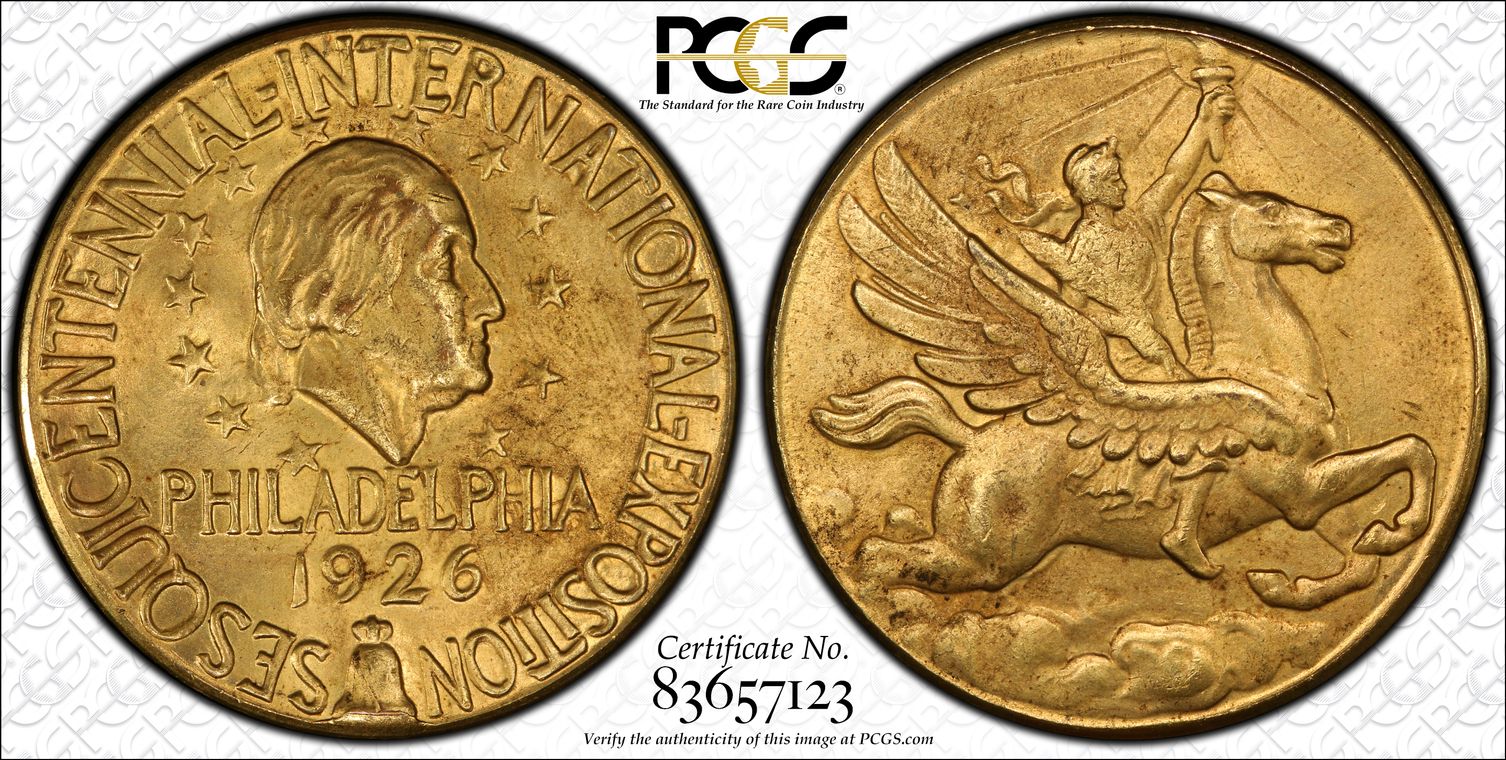
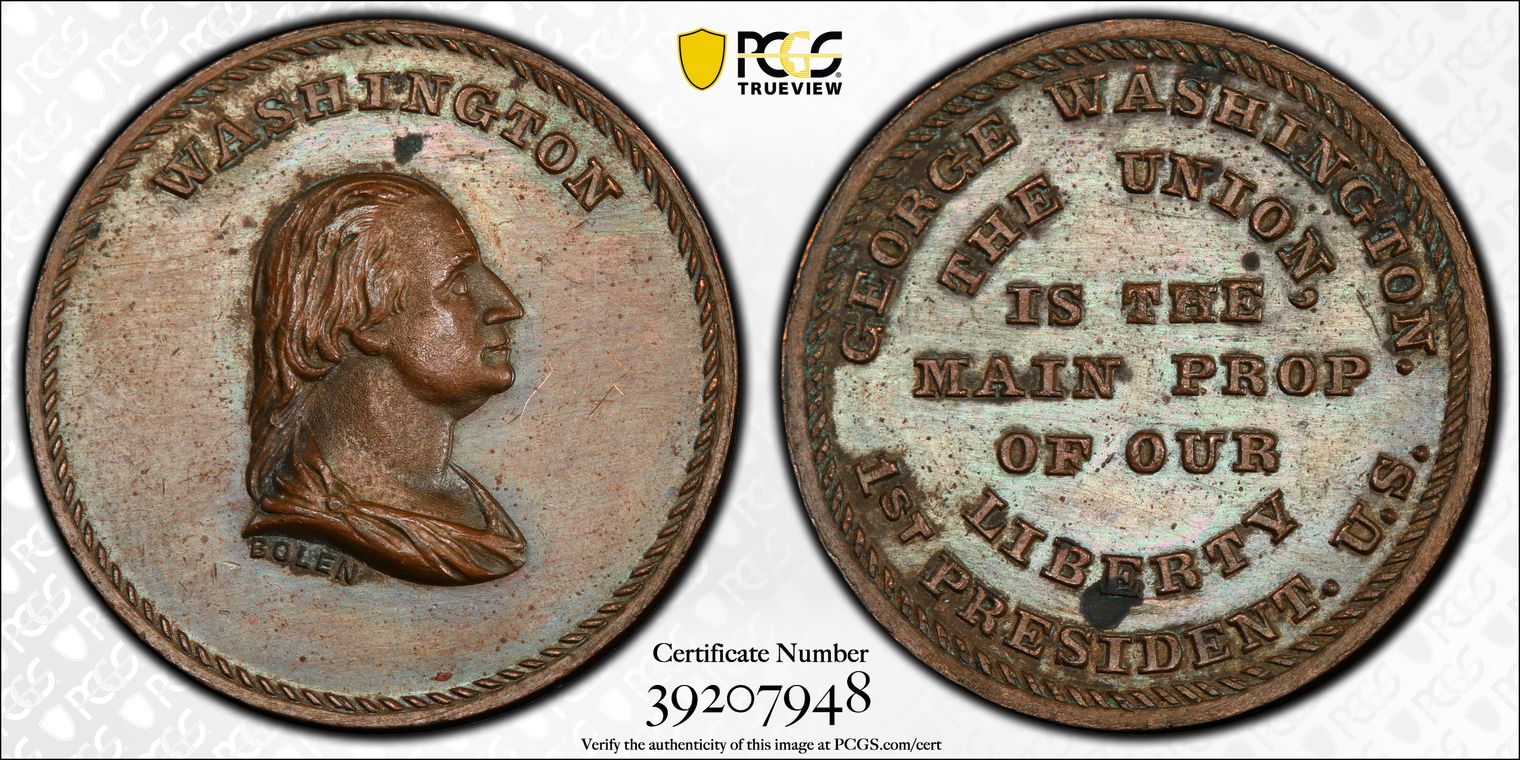
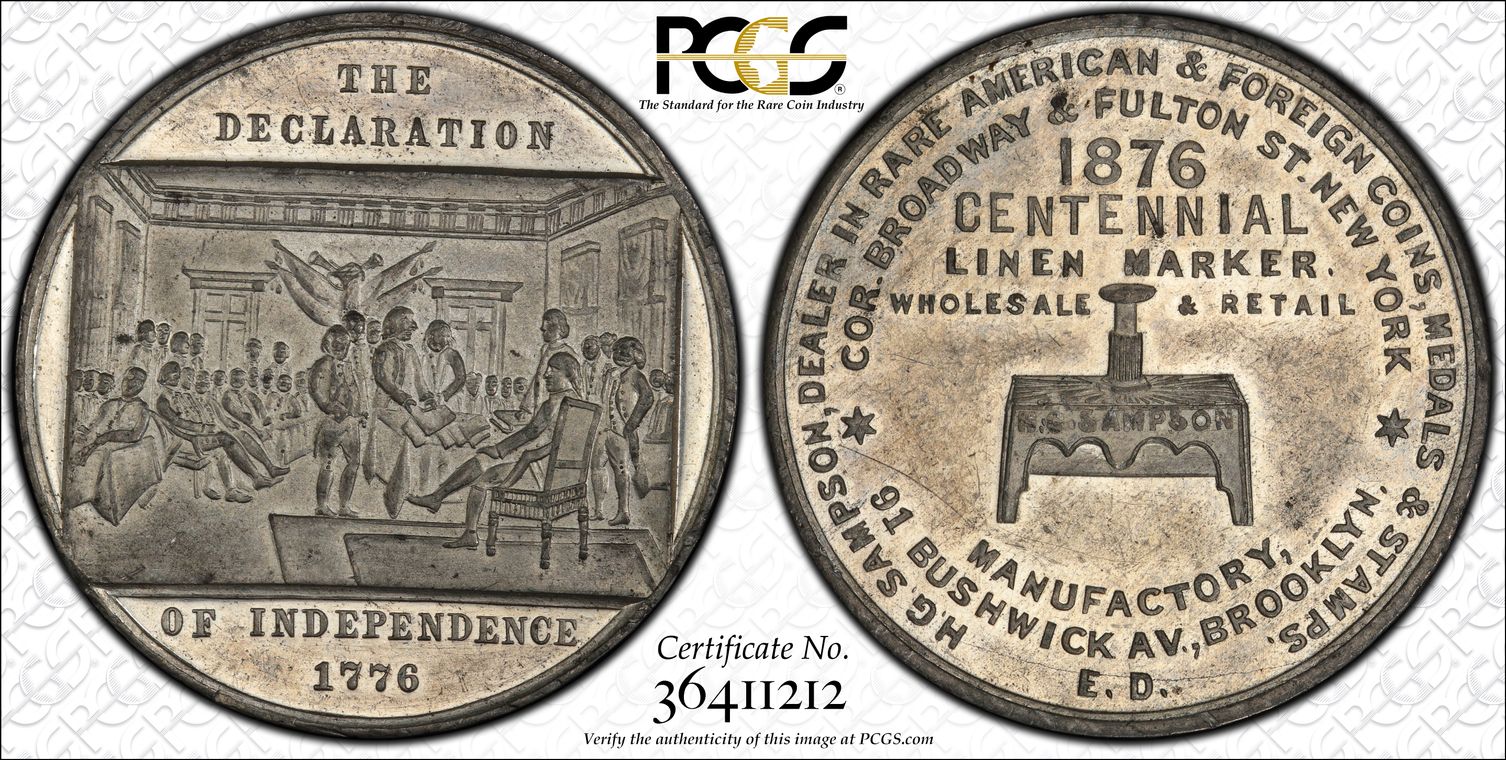
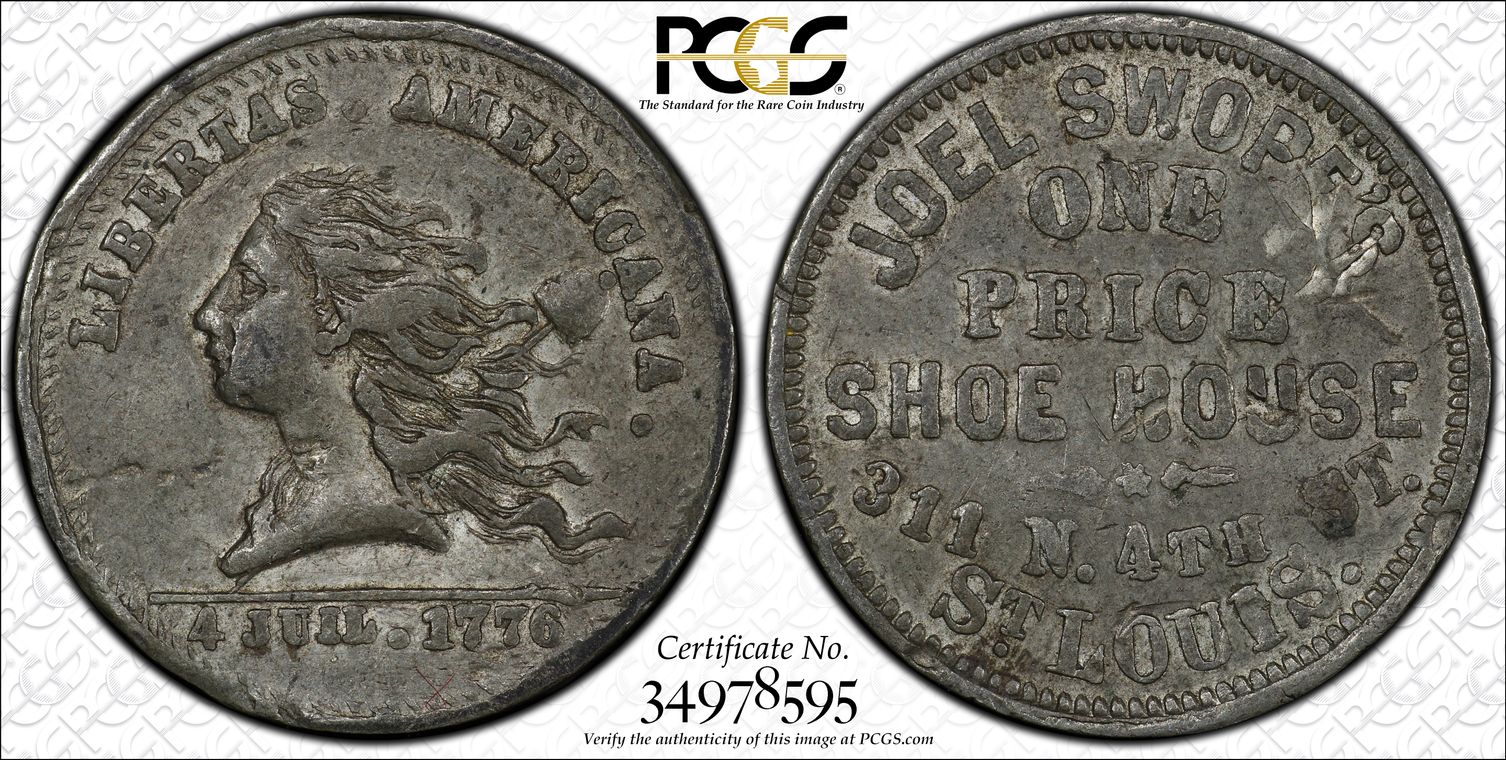
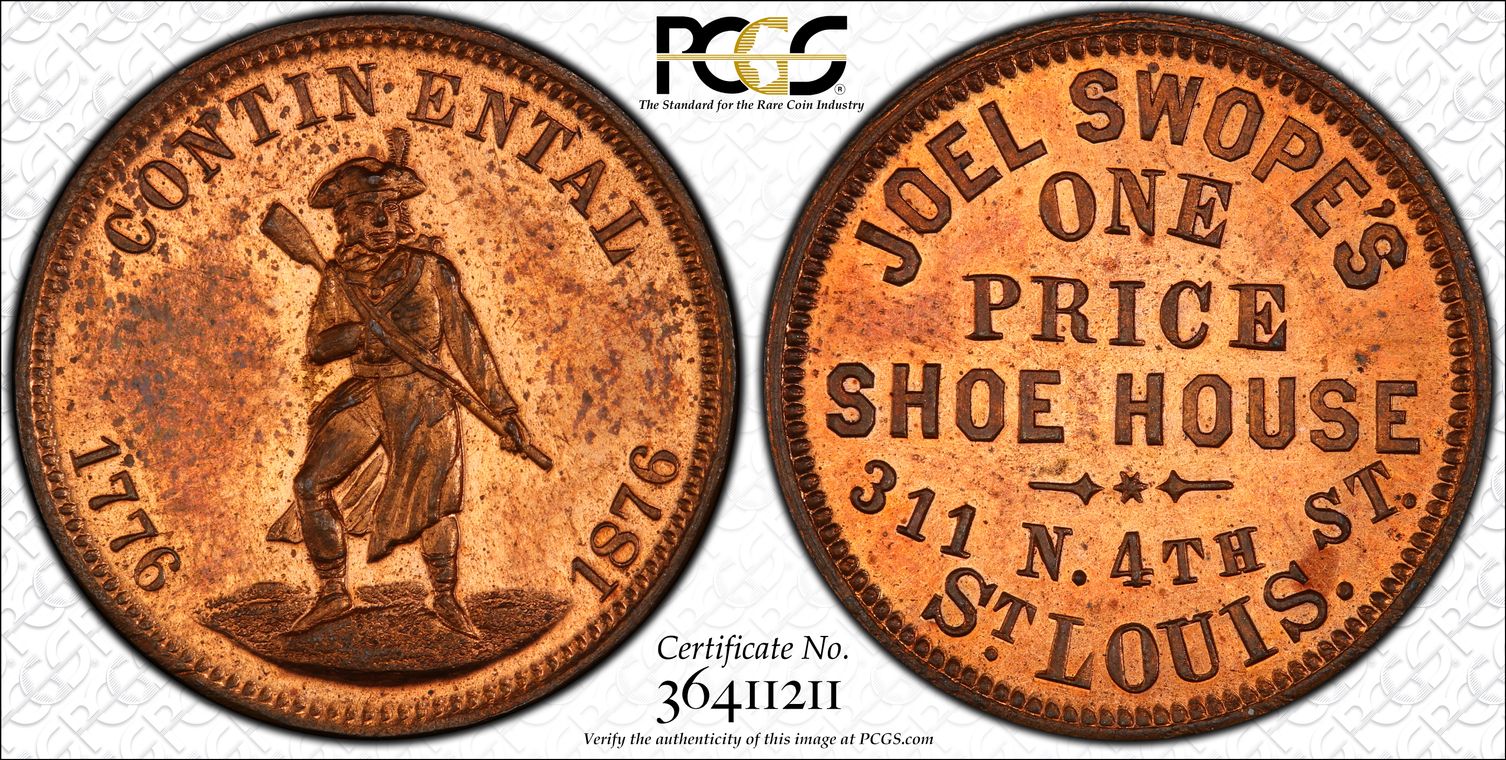
A very rare store card from St. Louis.
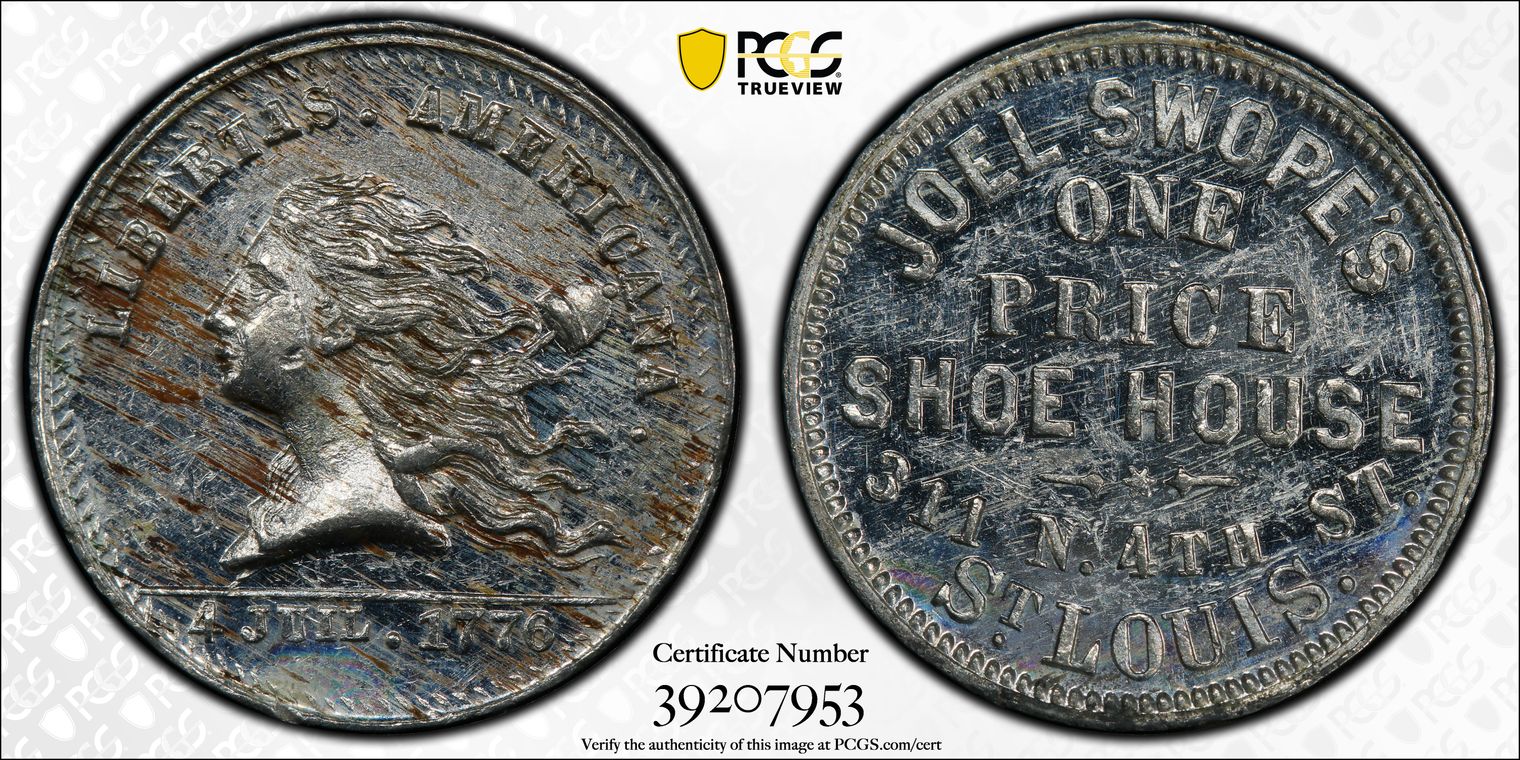
A very rare store card from St. Louis.

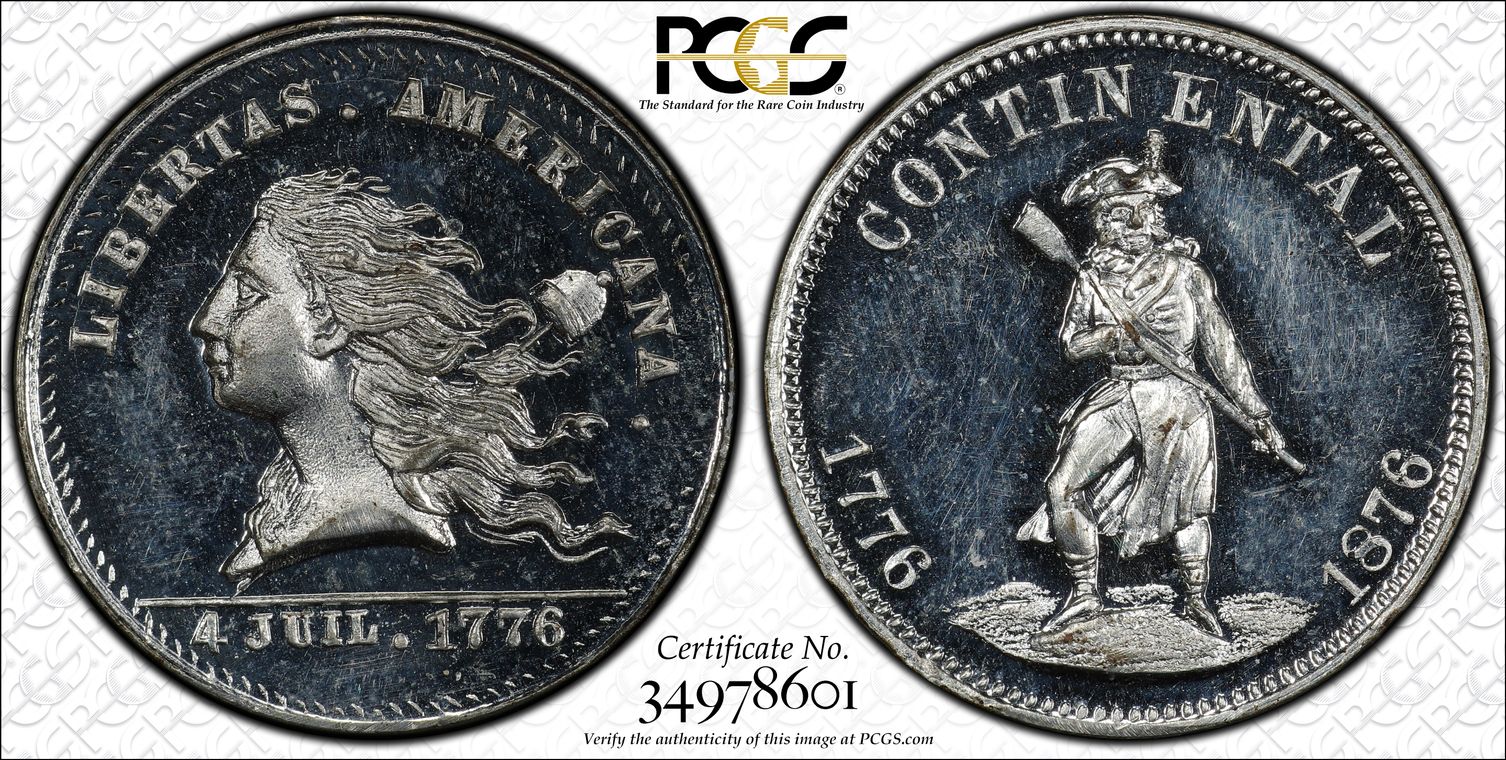
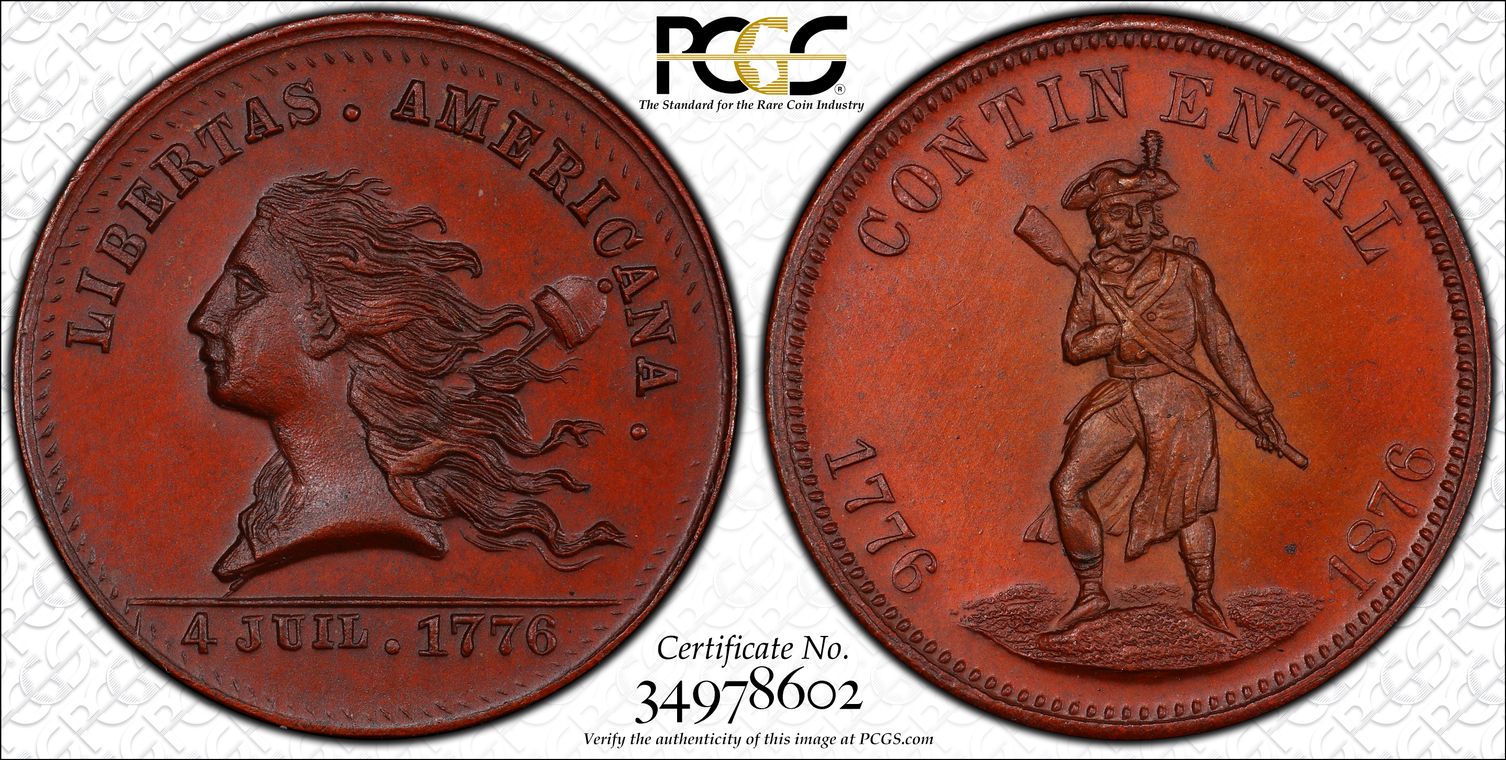
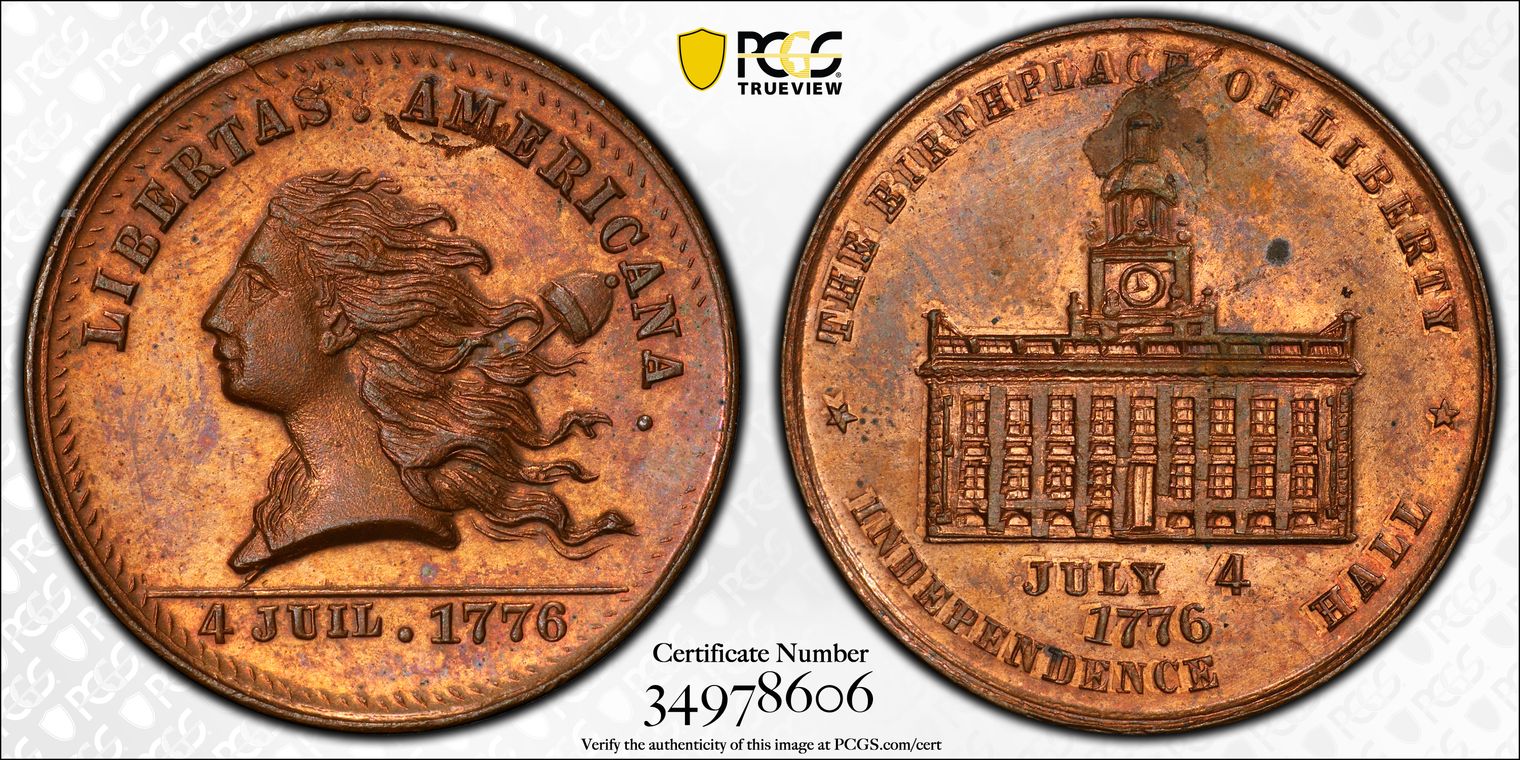
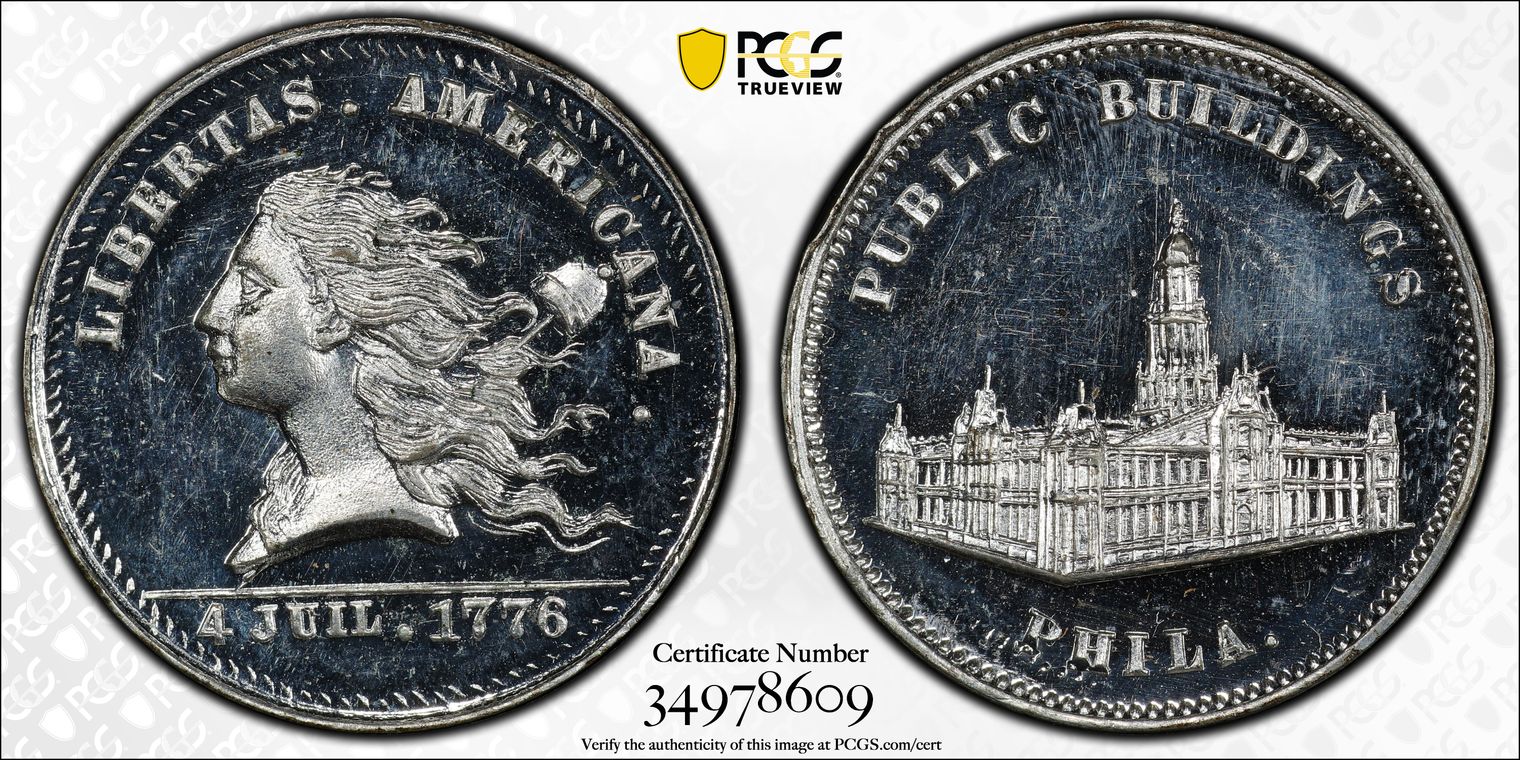

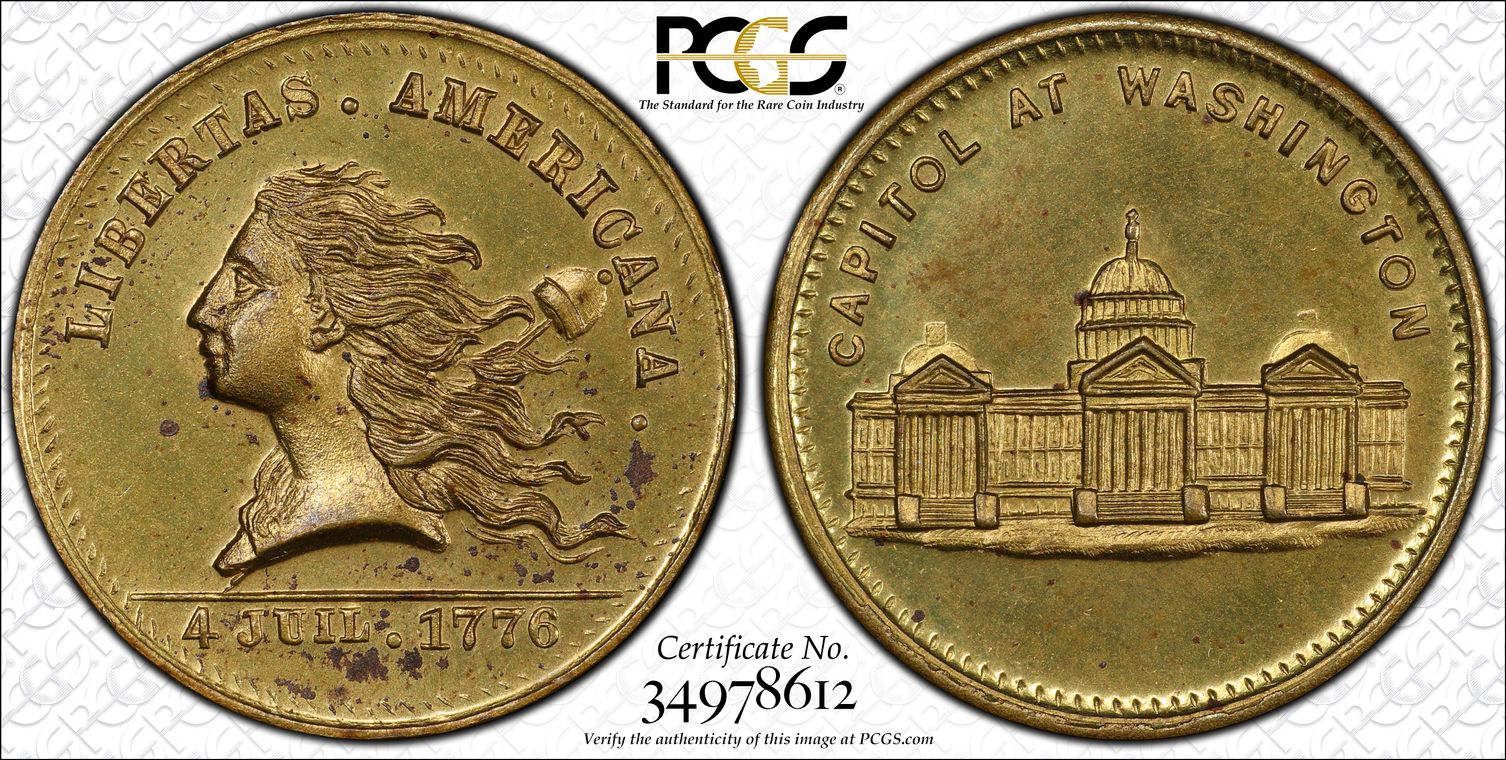
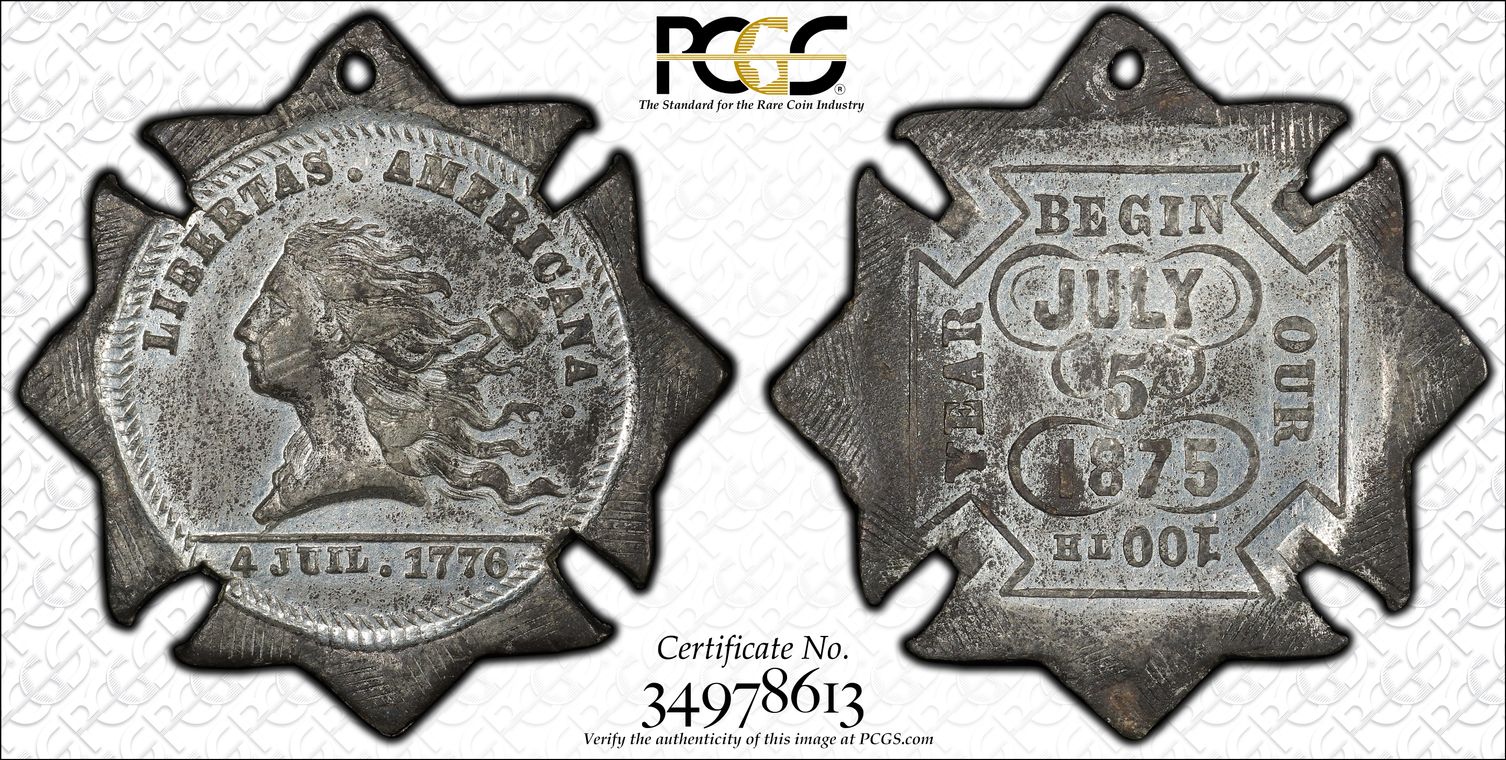
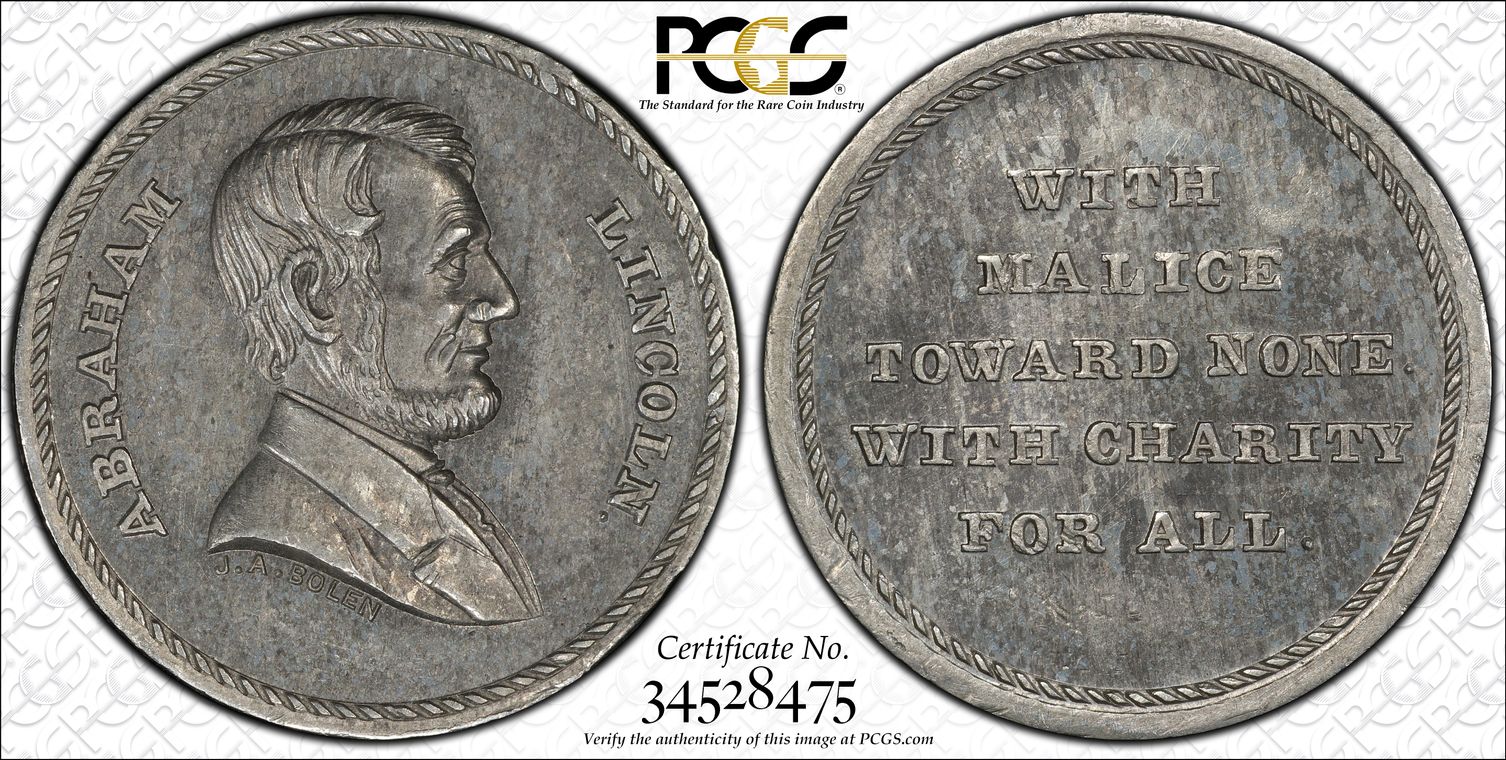
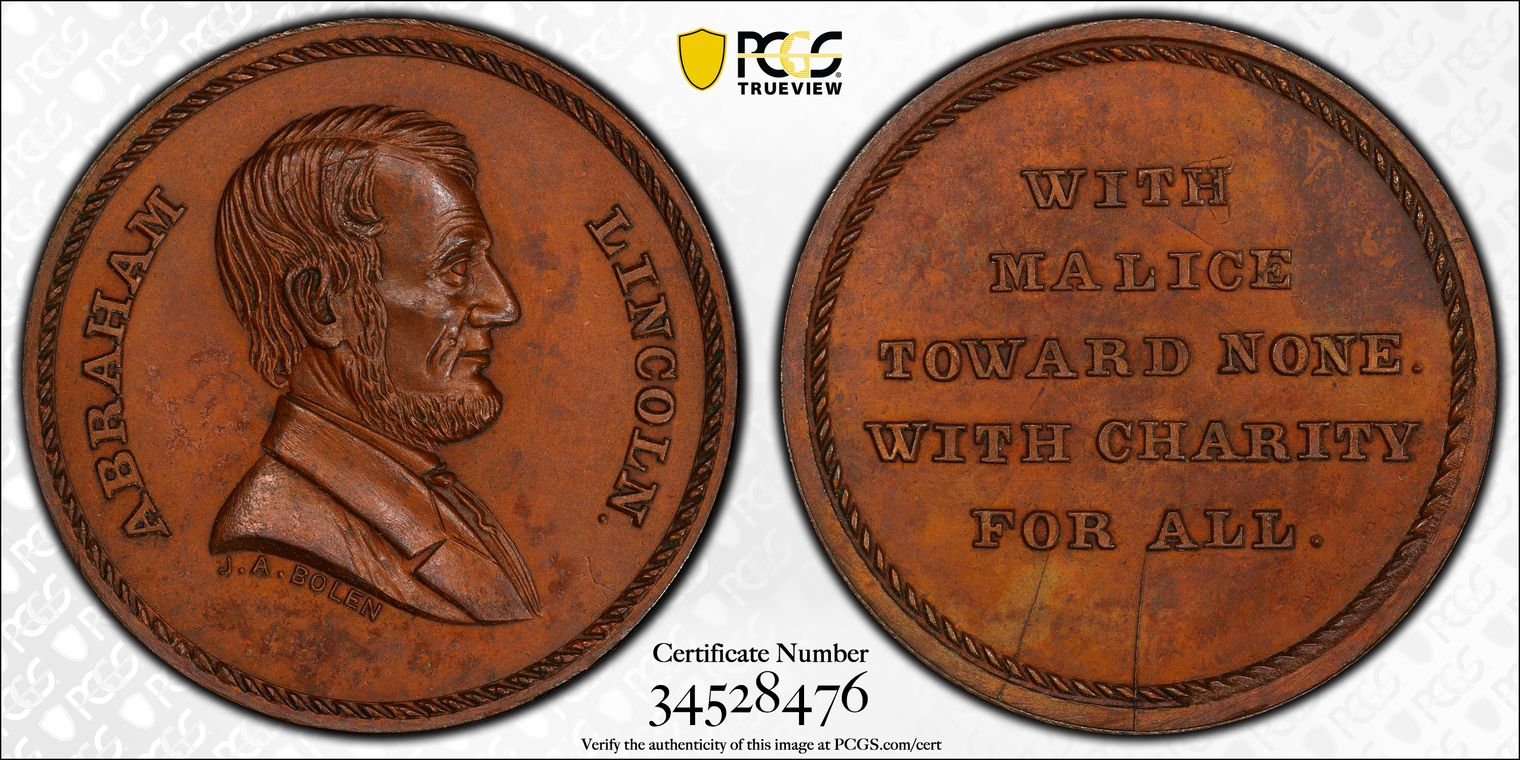
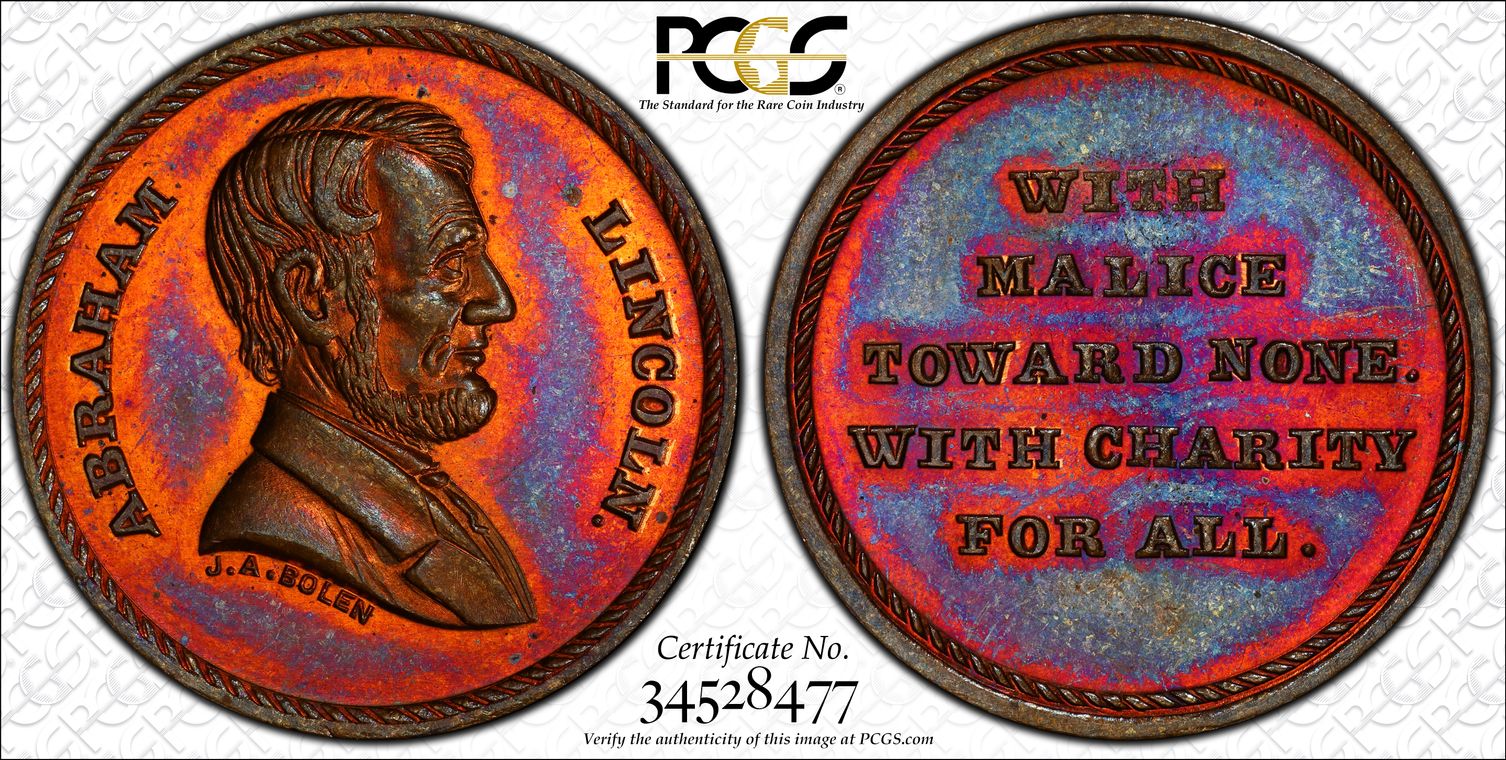
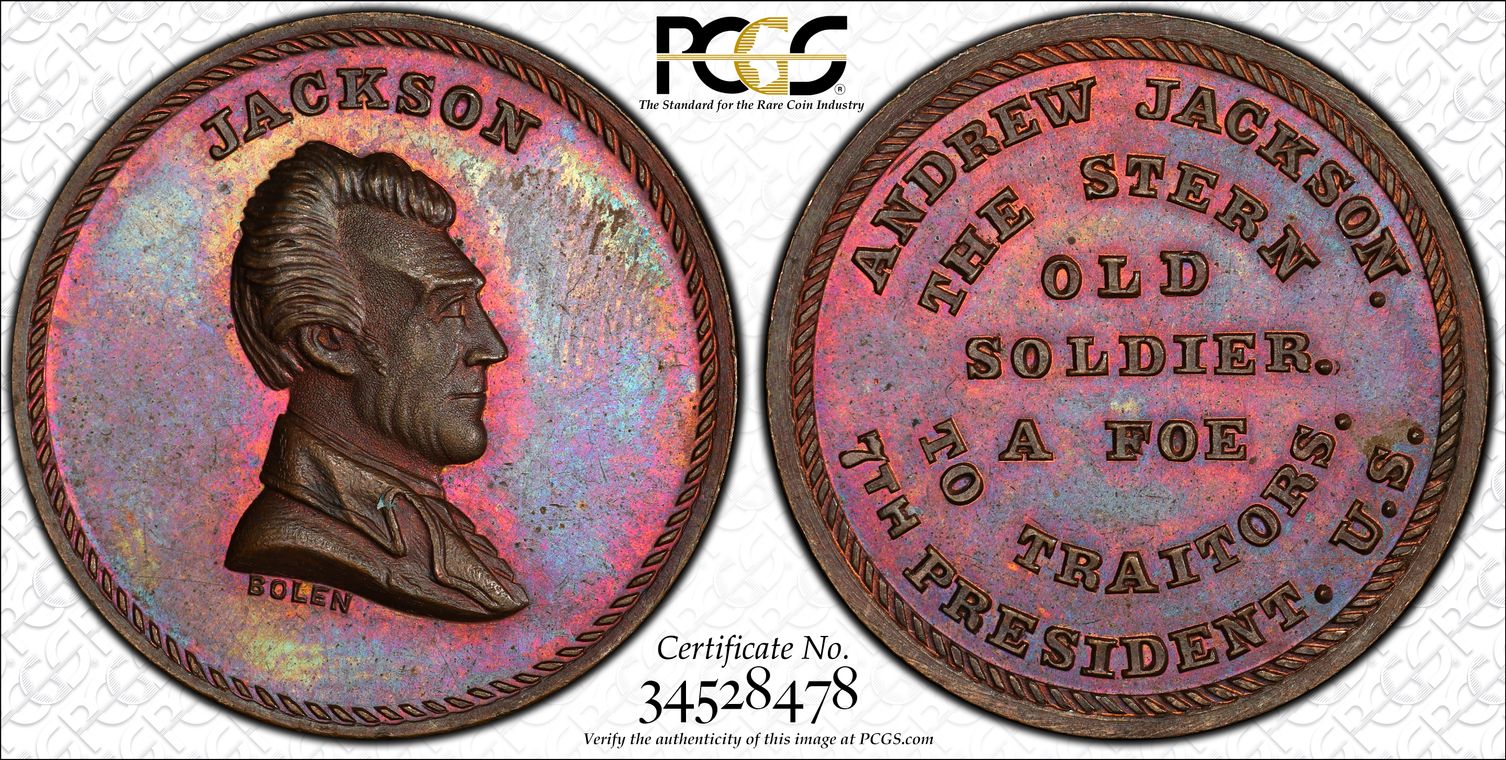
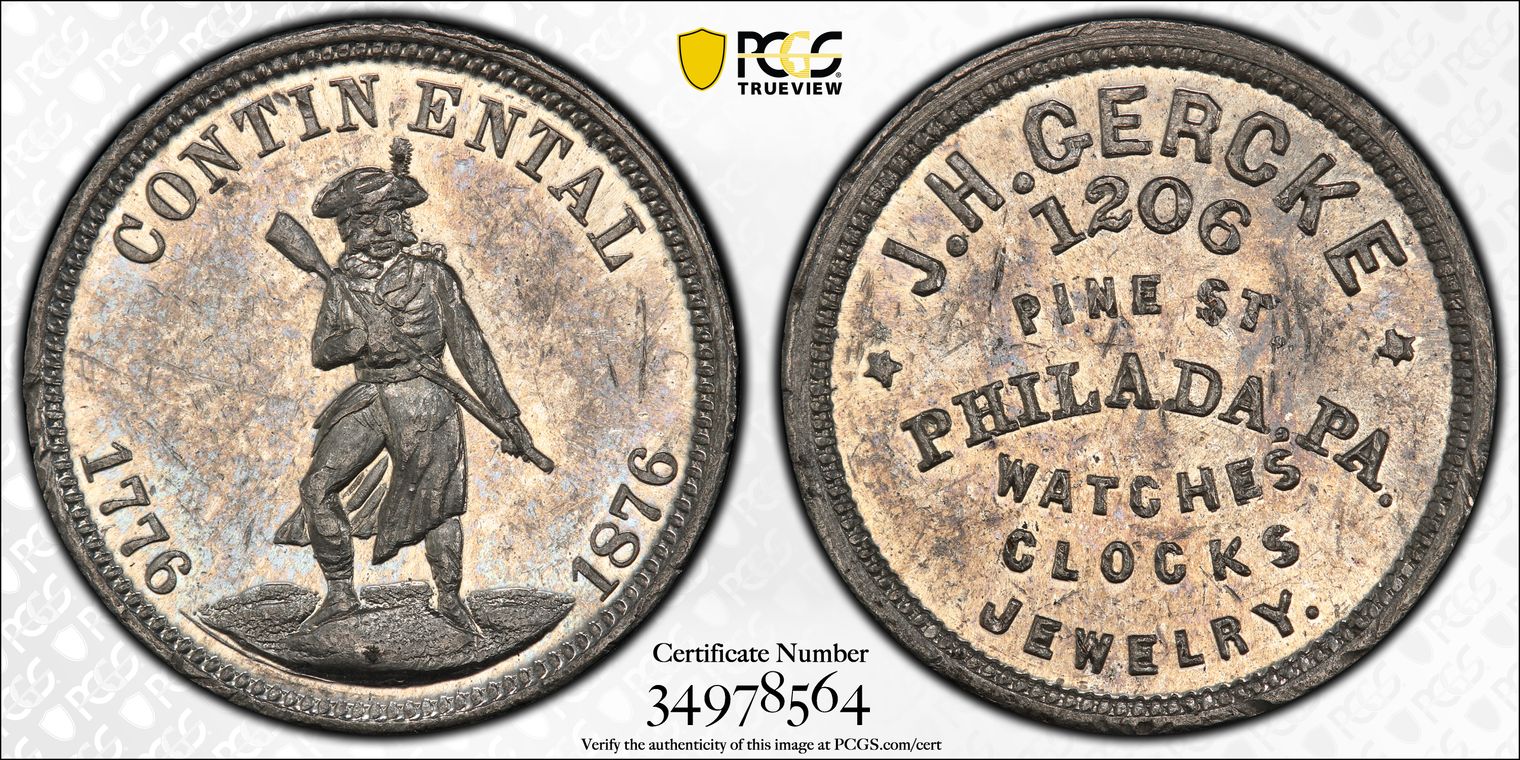
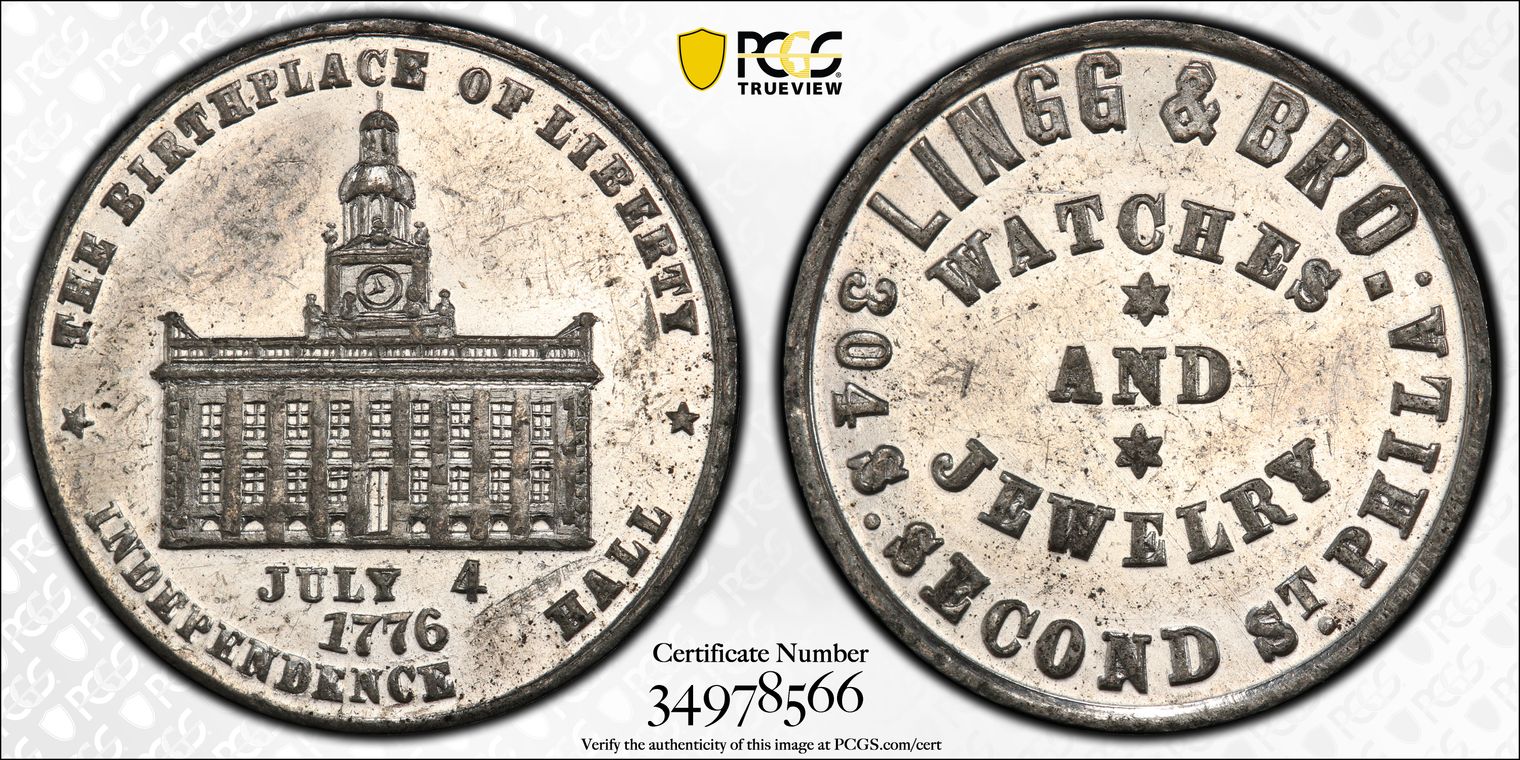
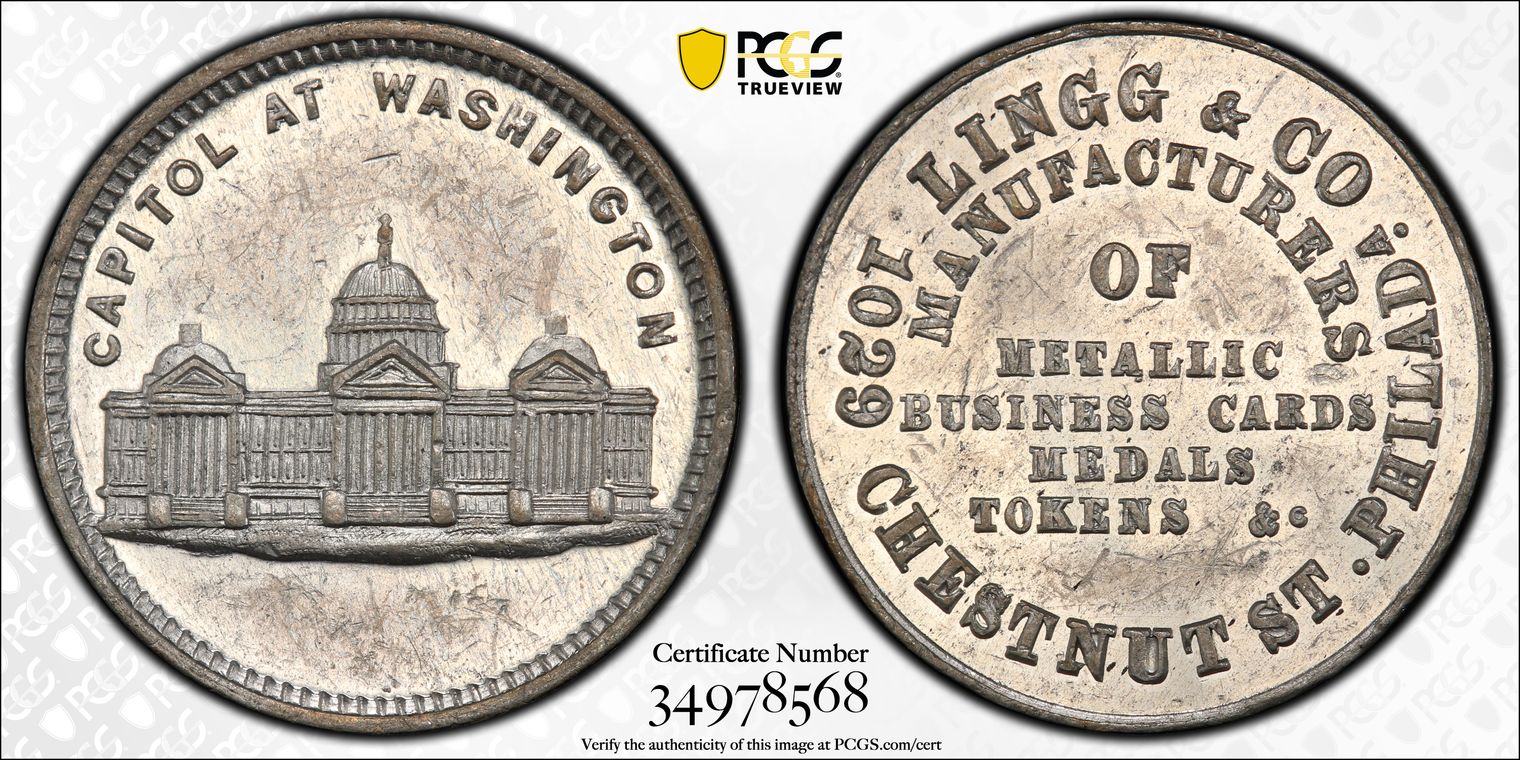
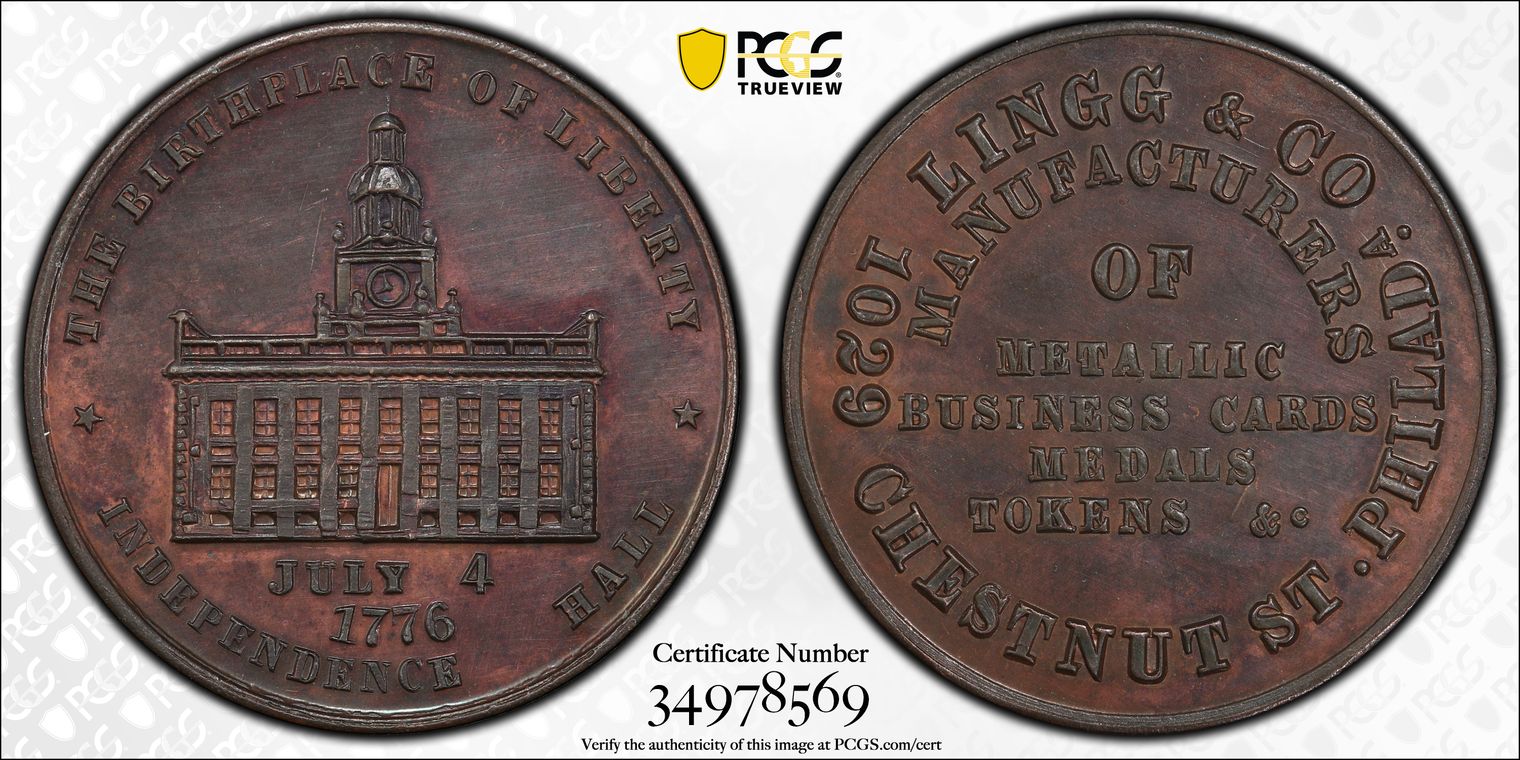
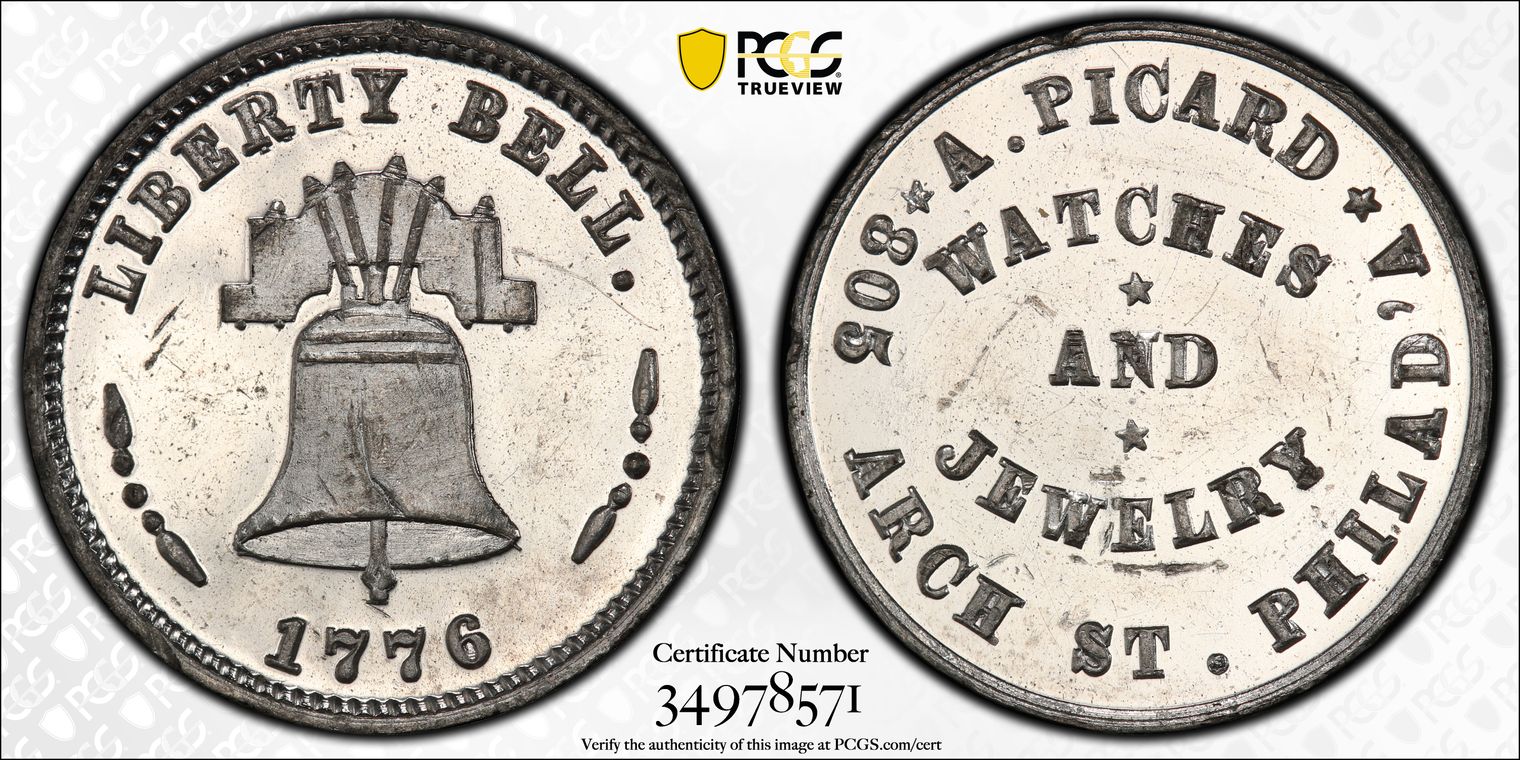
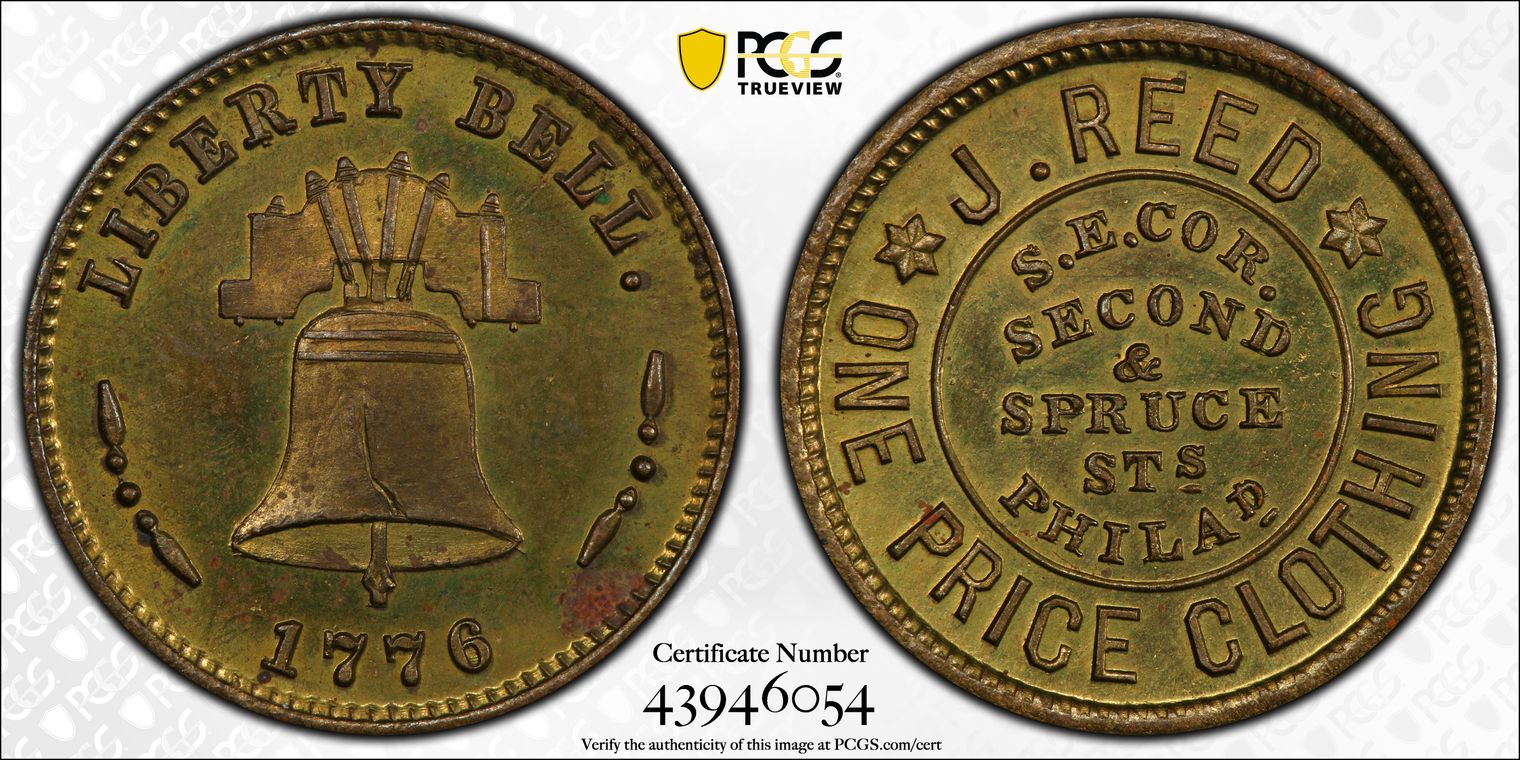
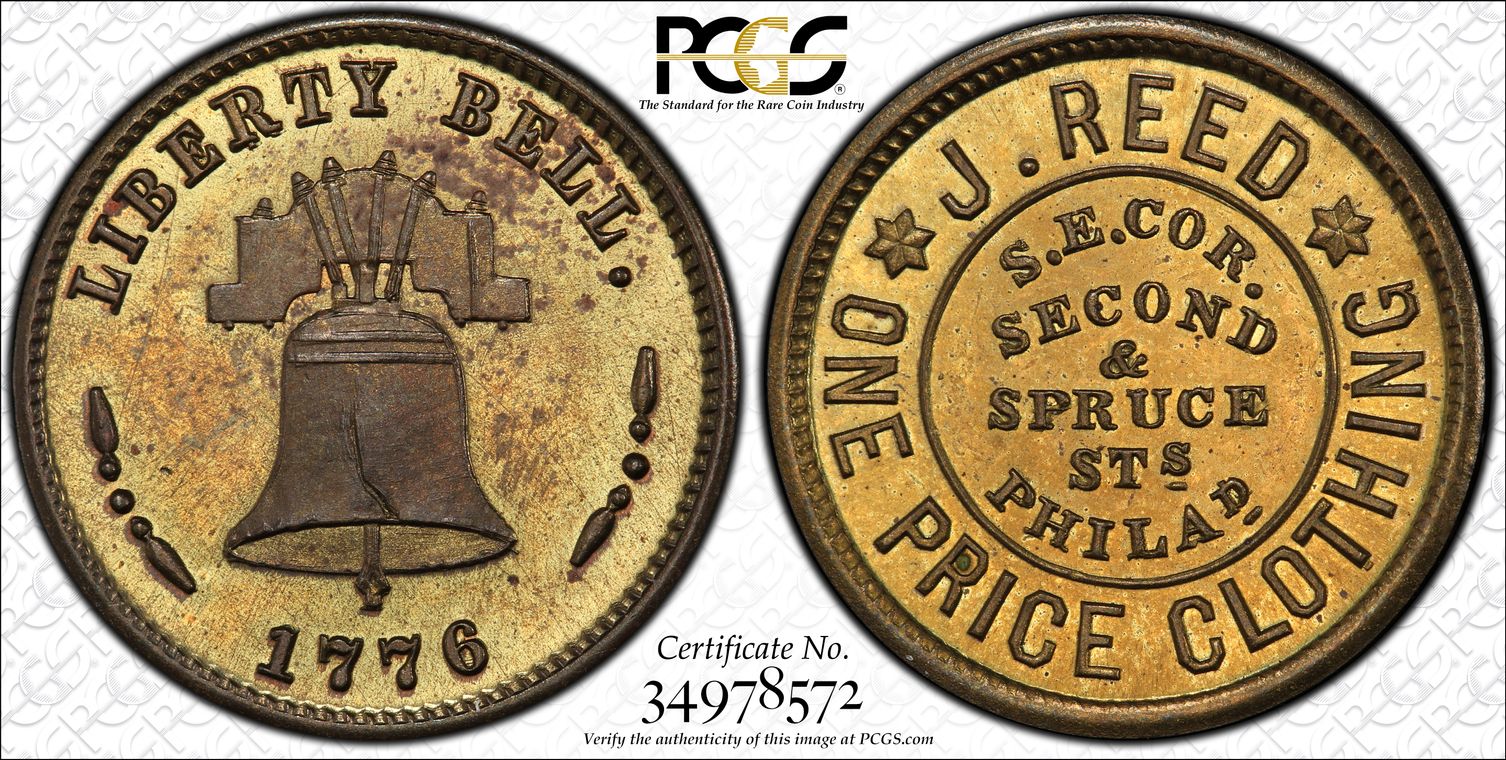
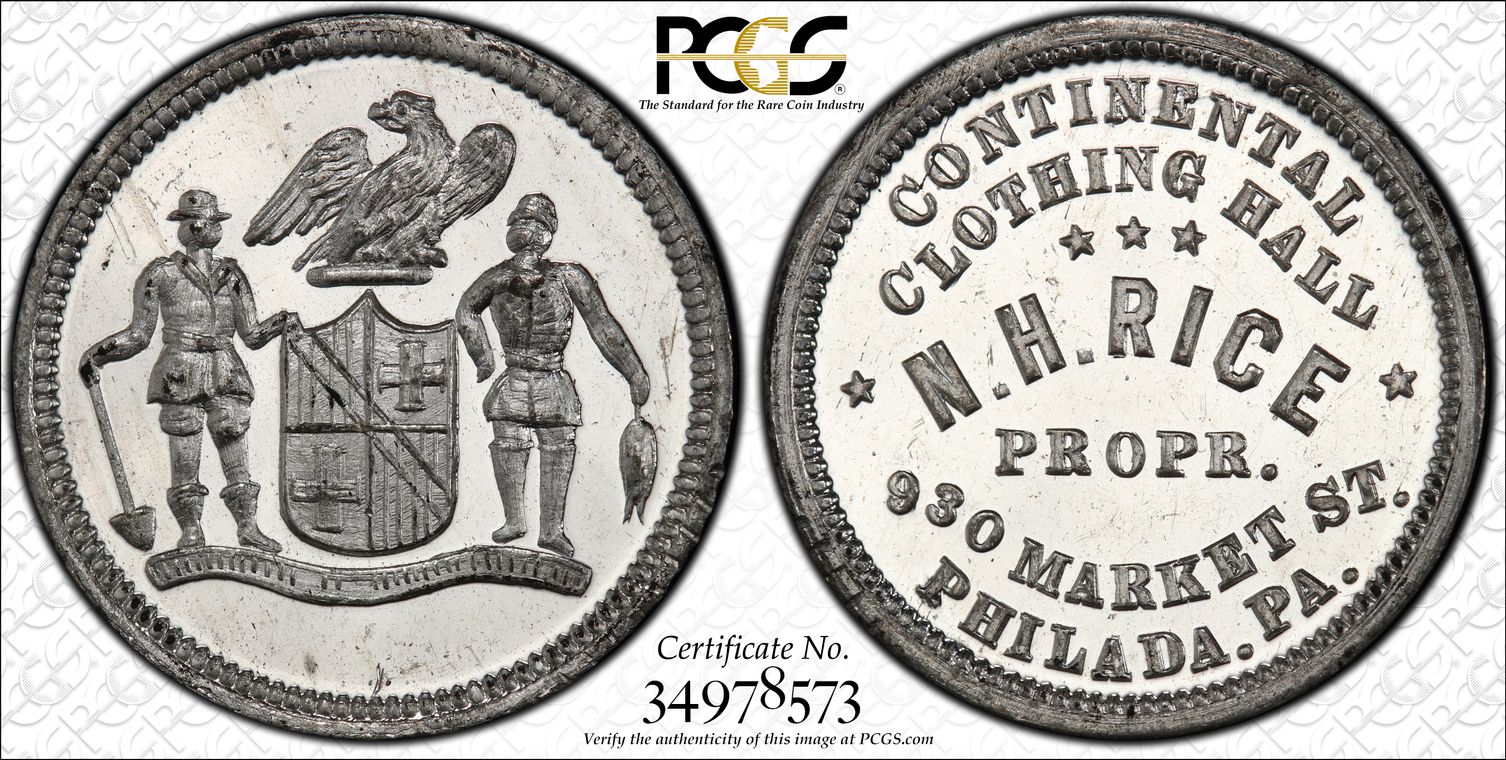
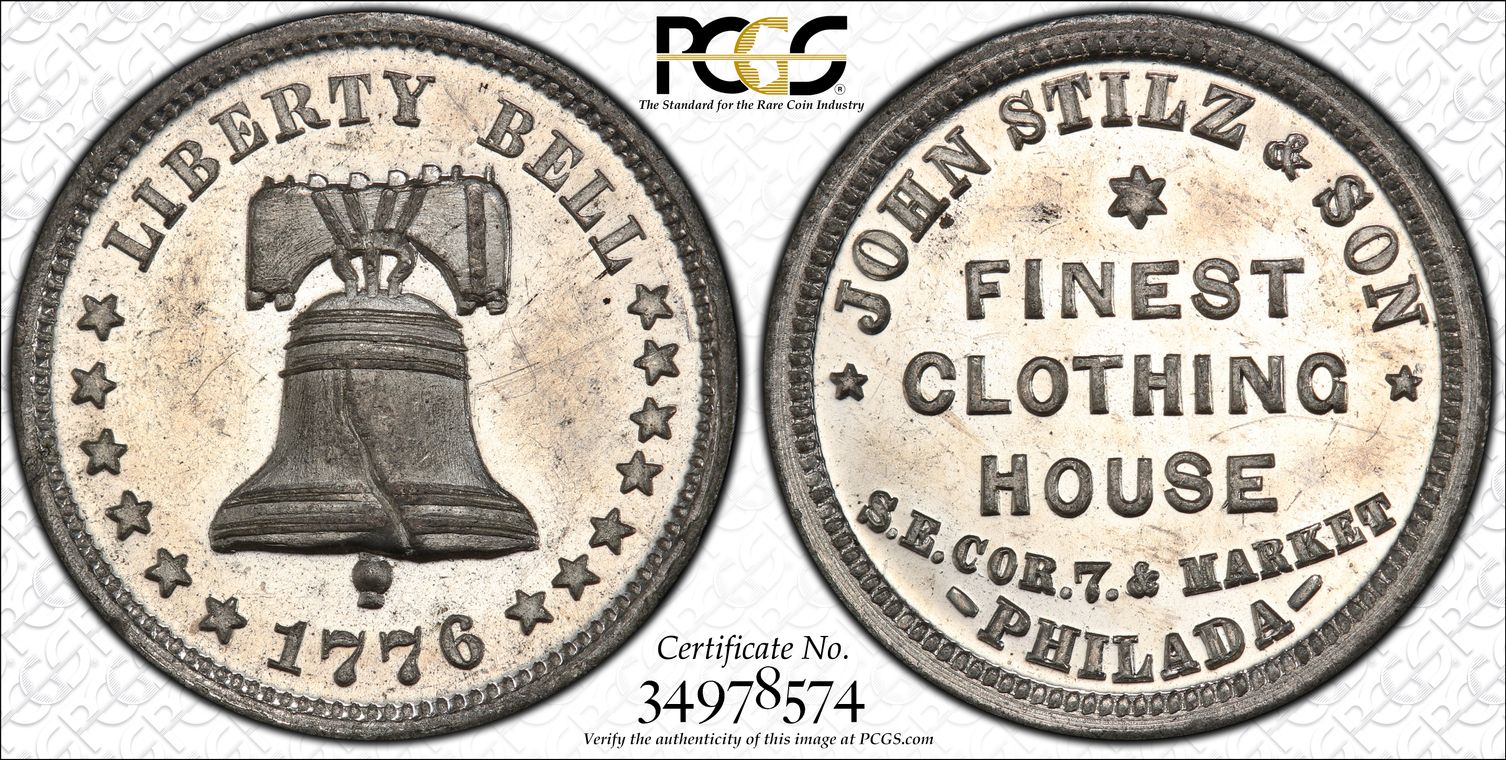
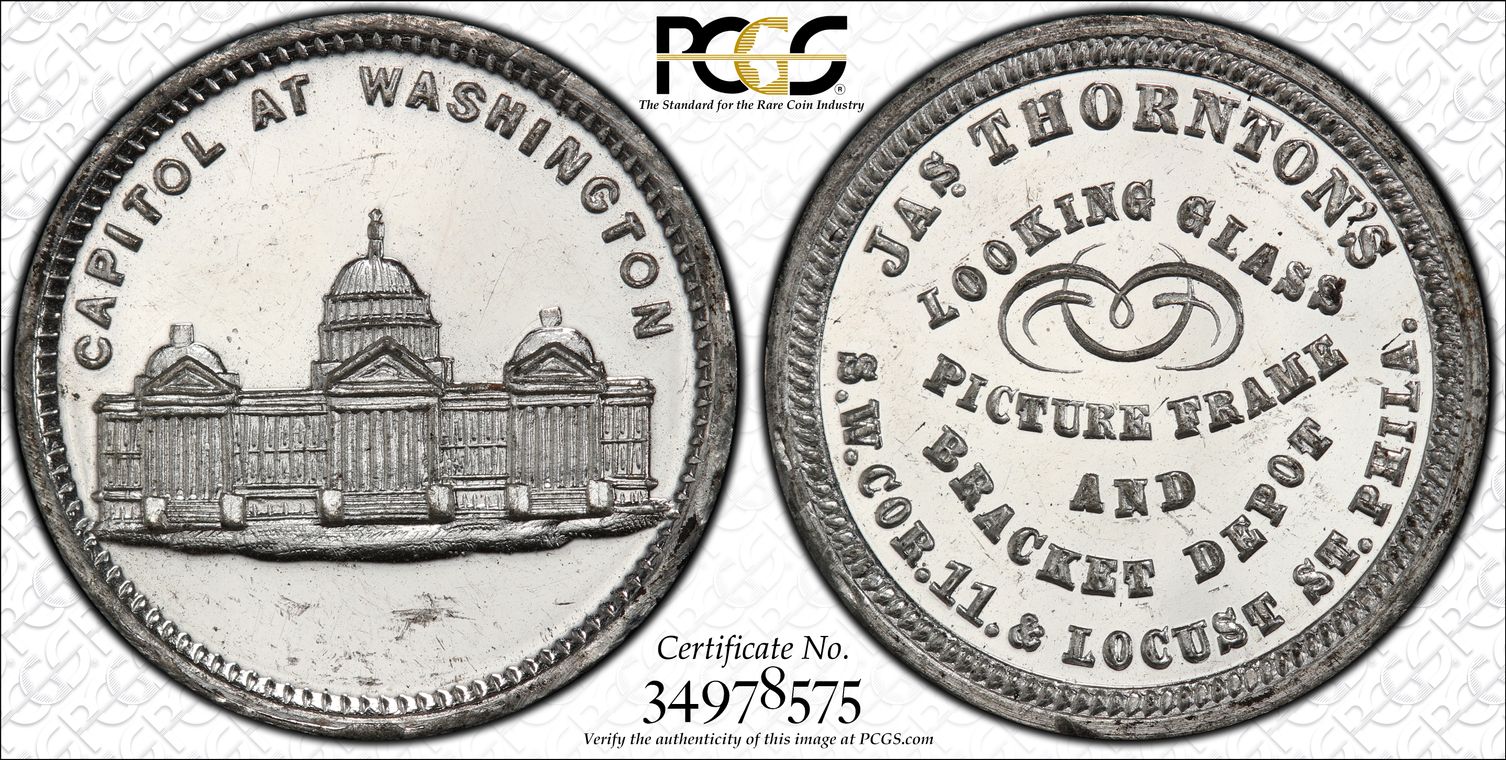
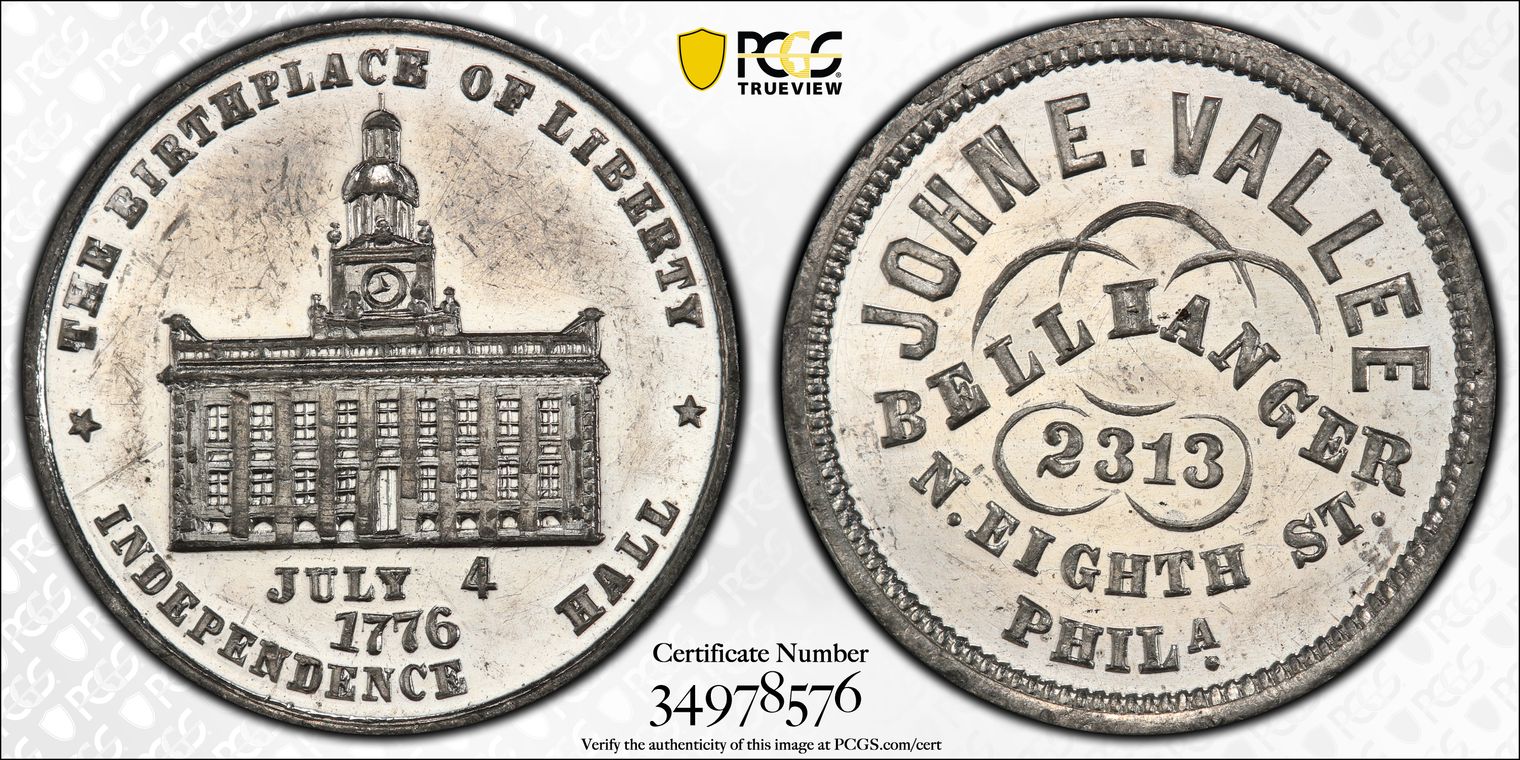
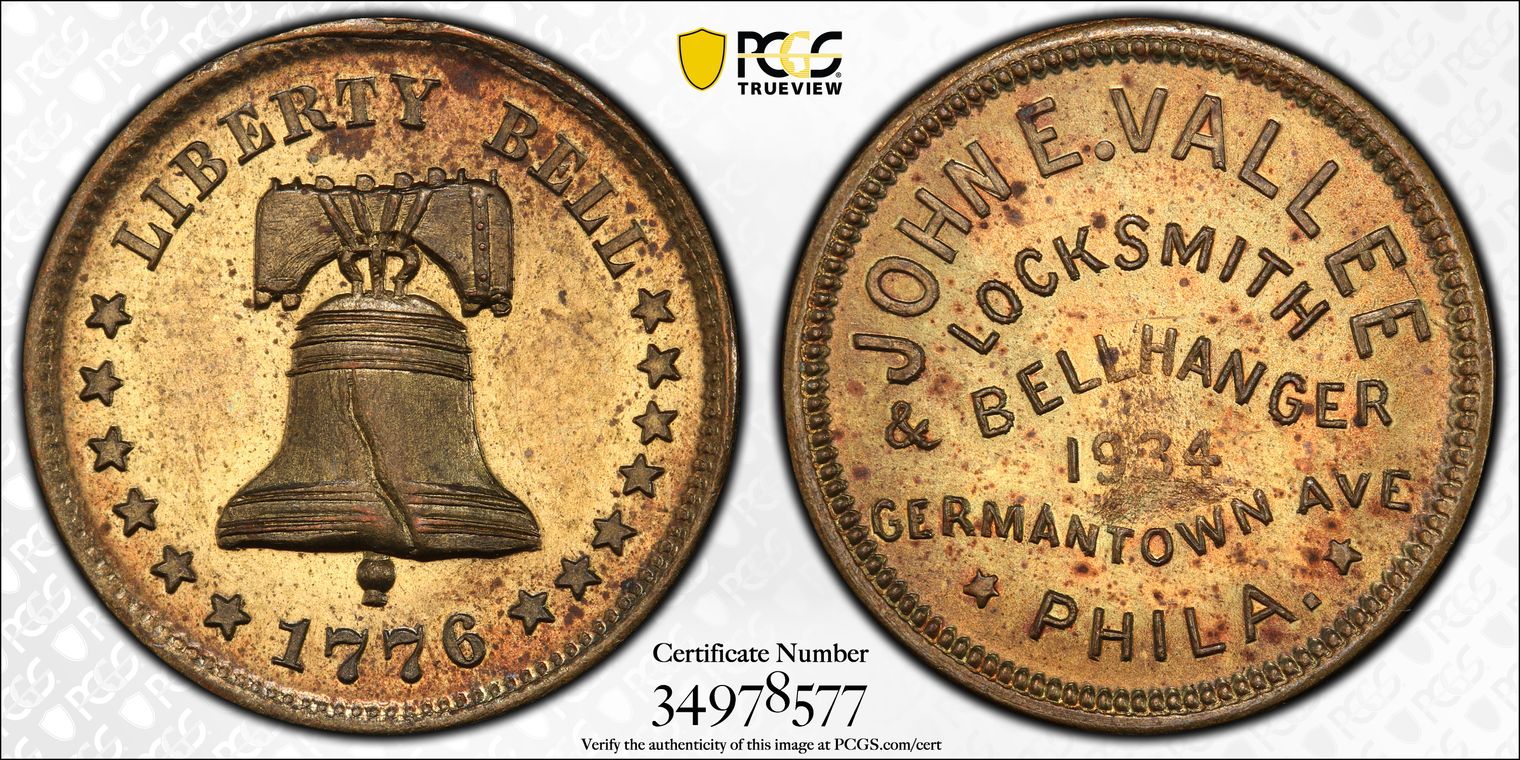
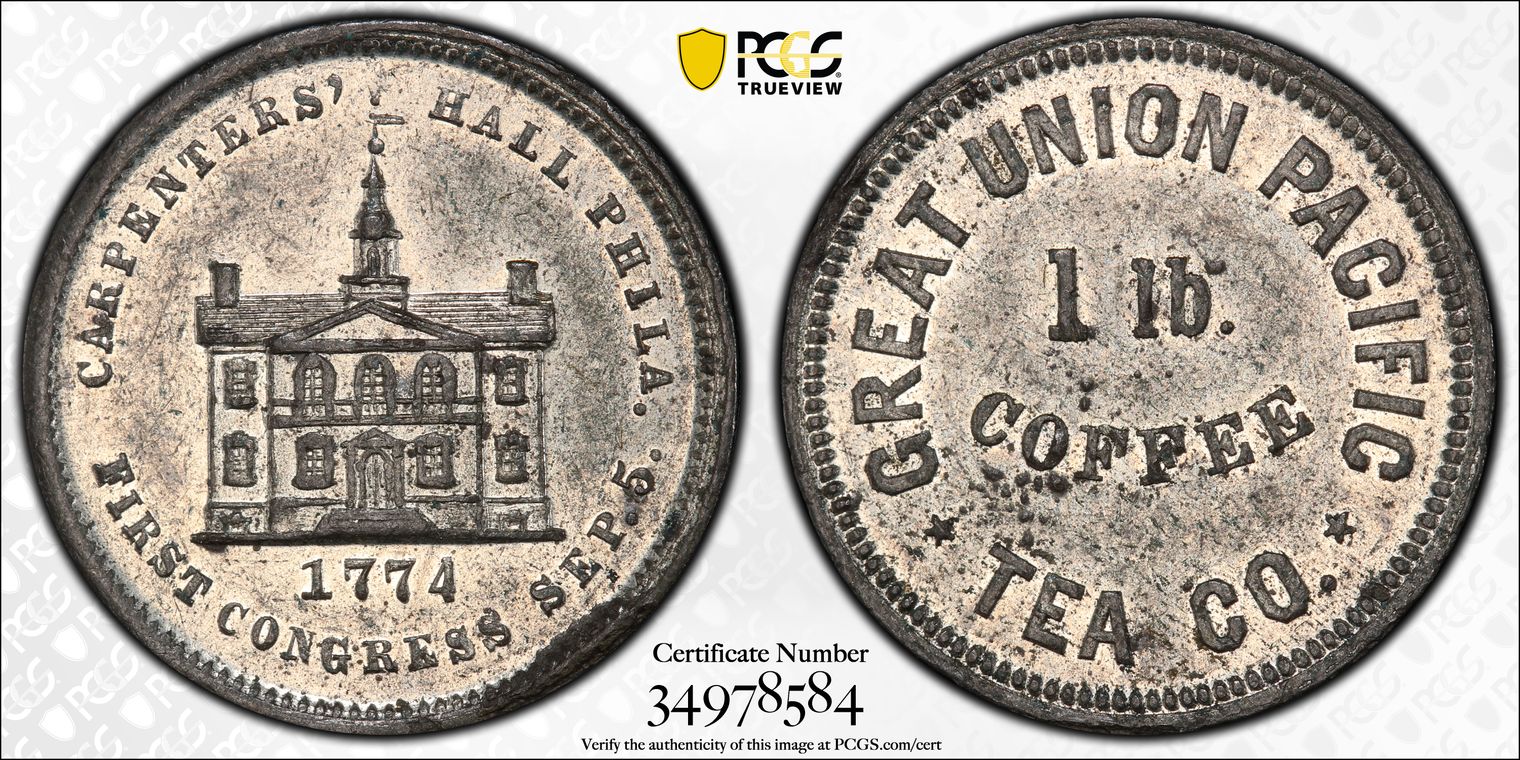
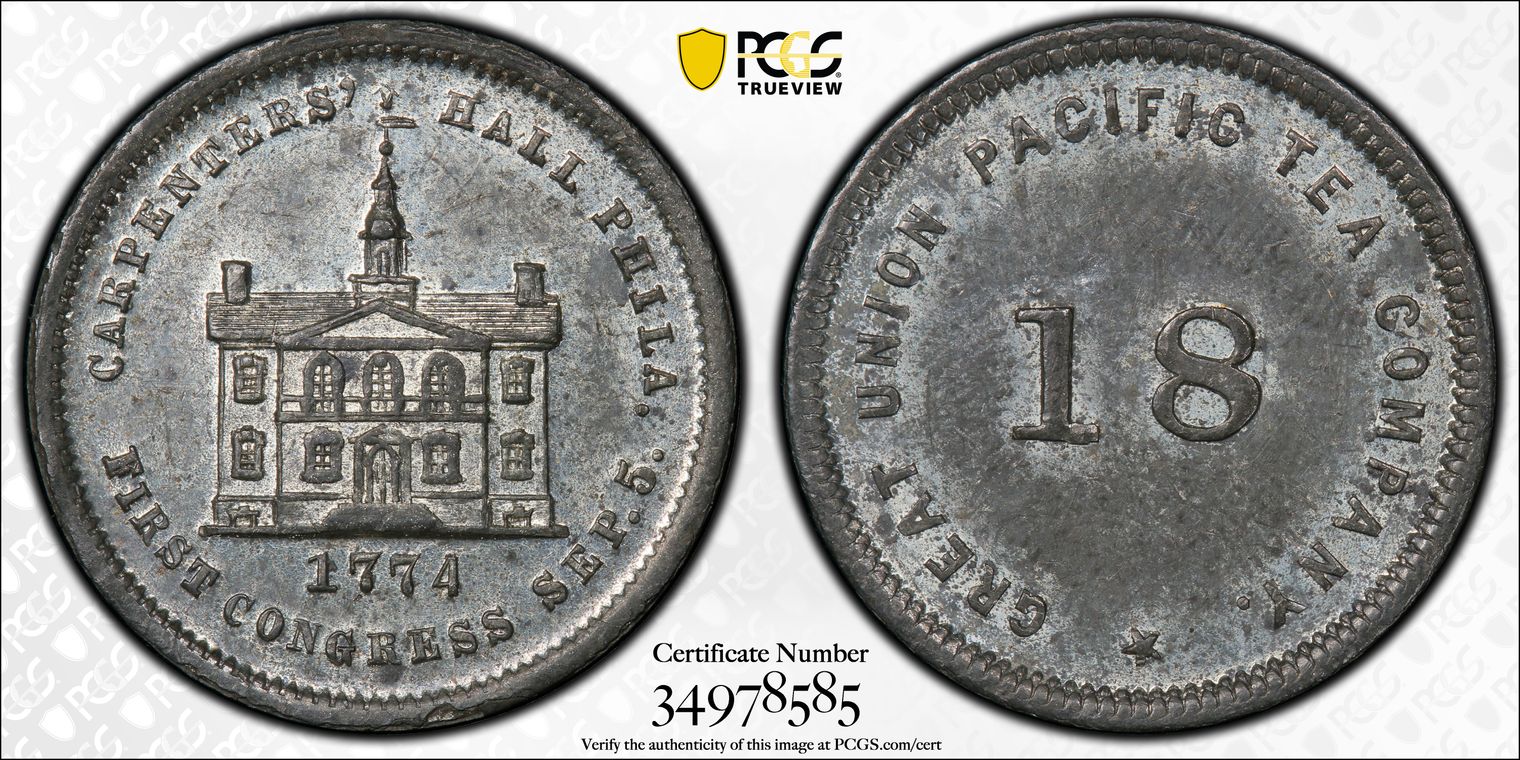
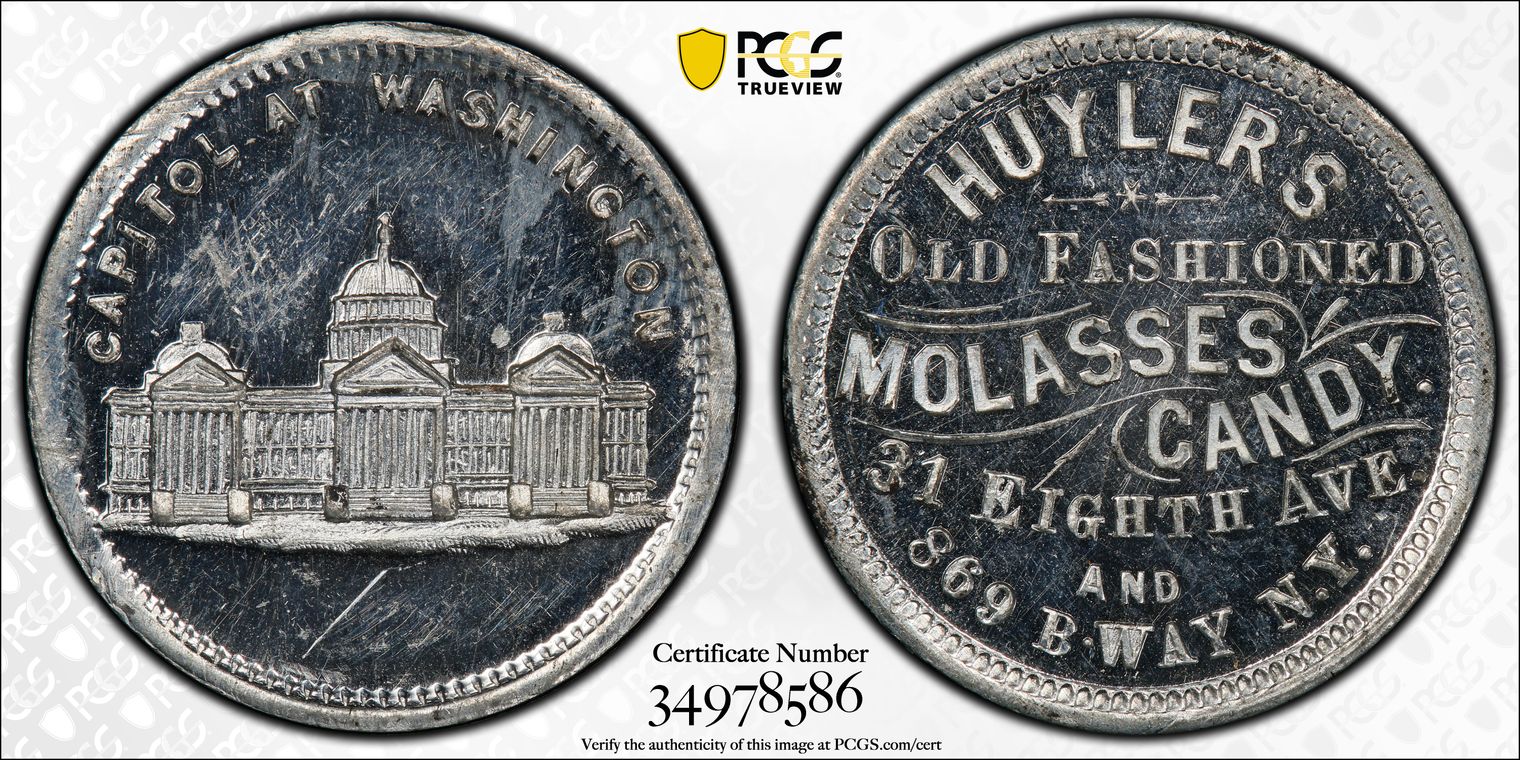
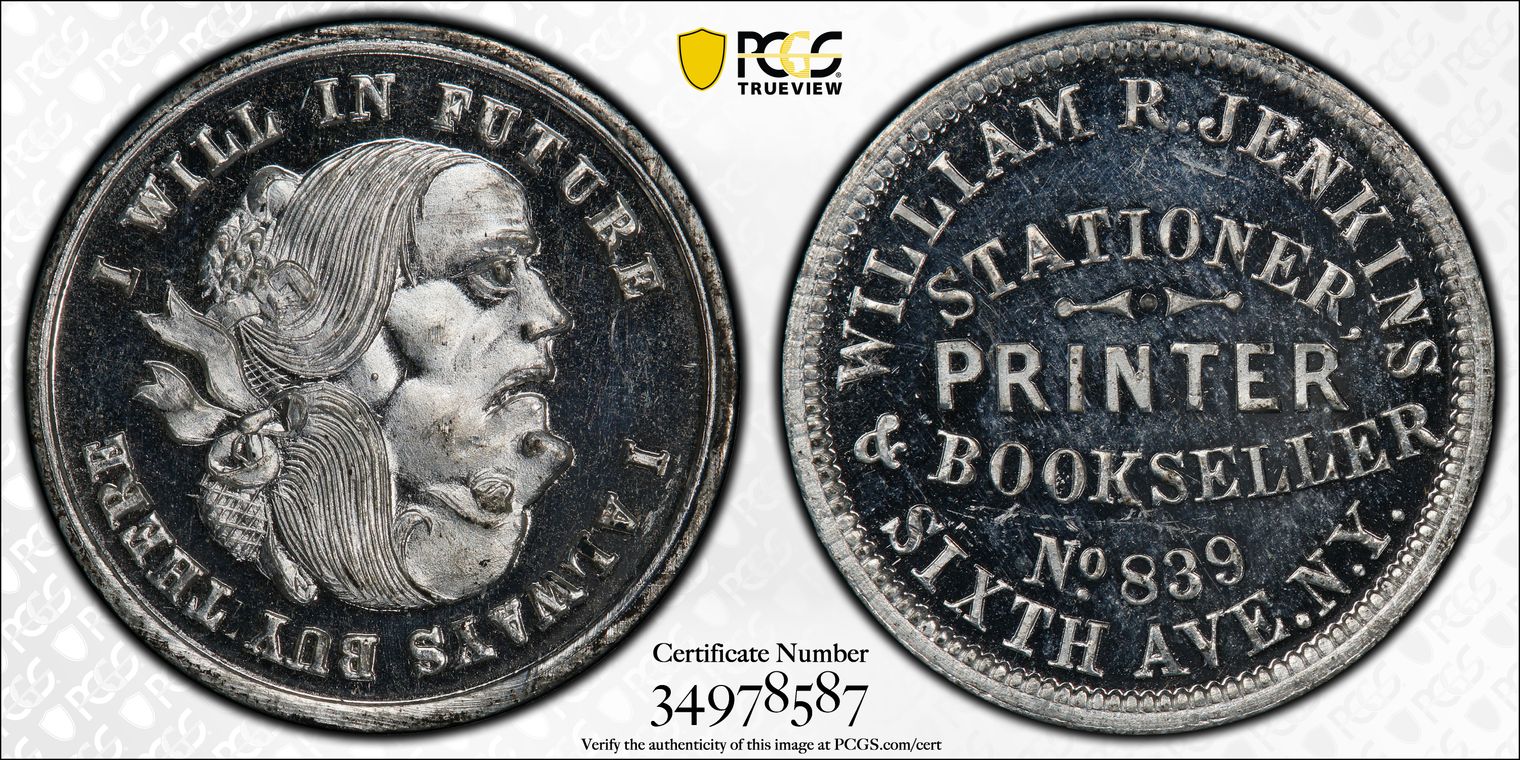
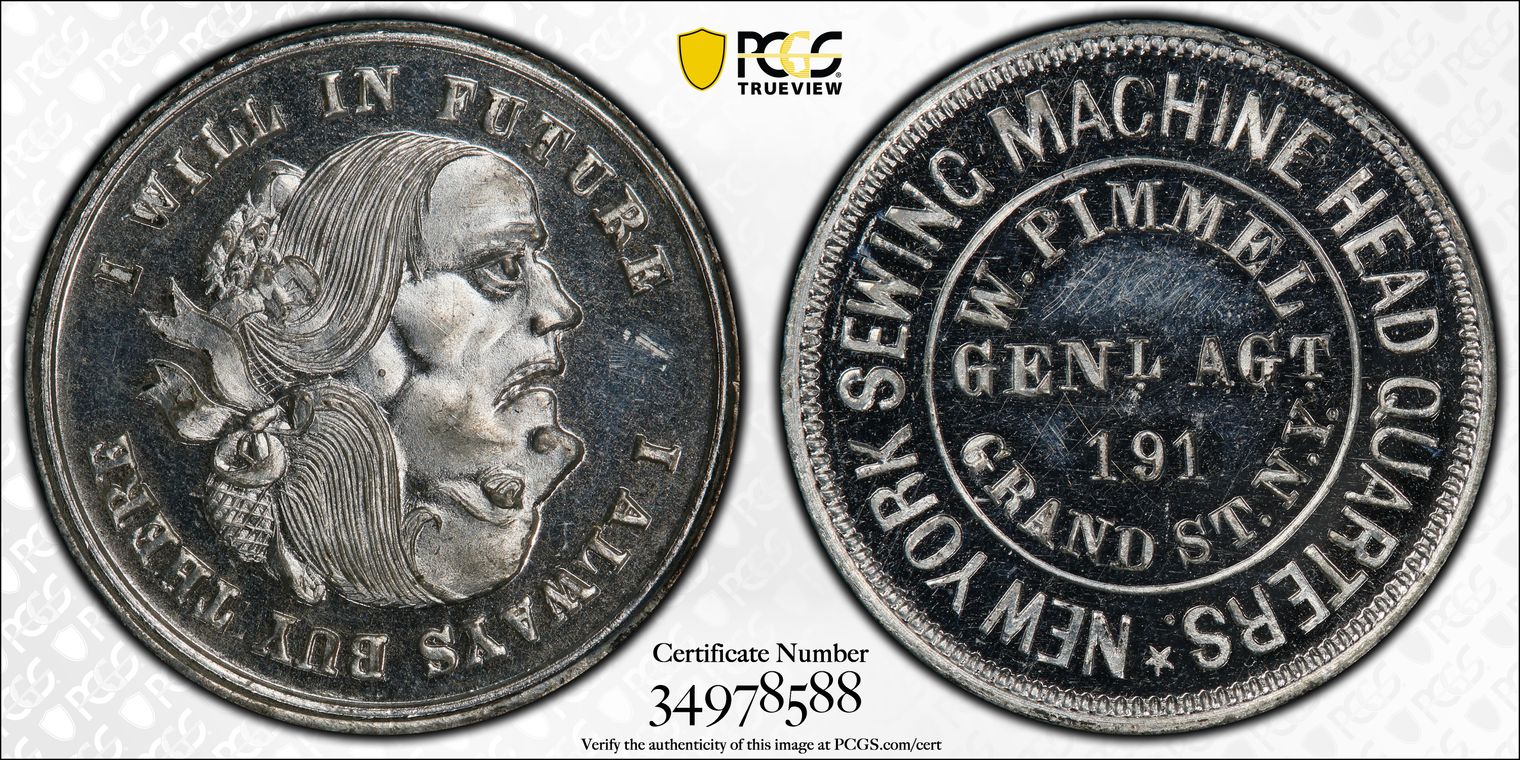
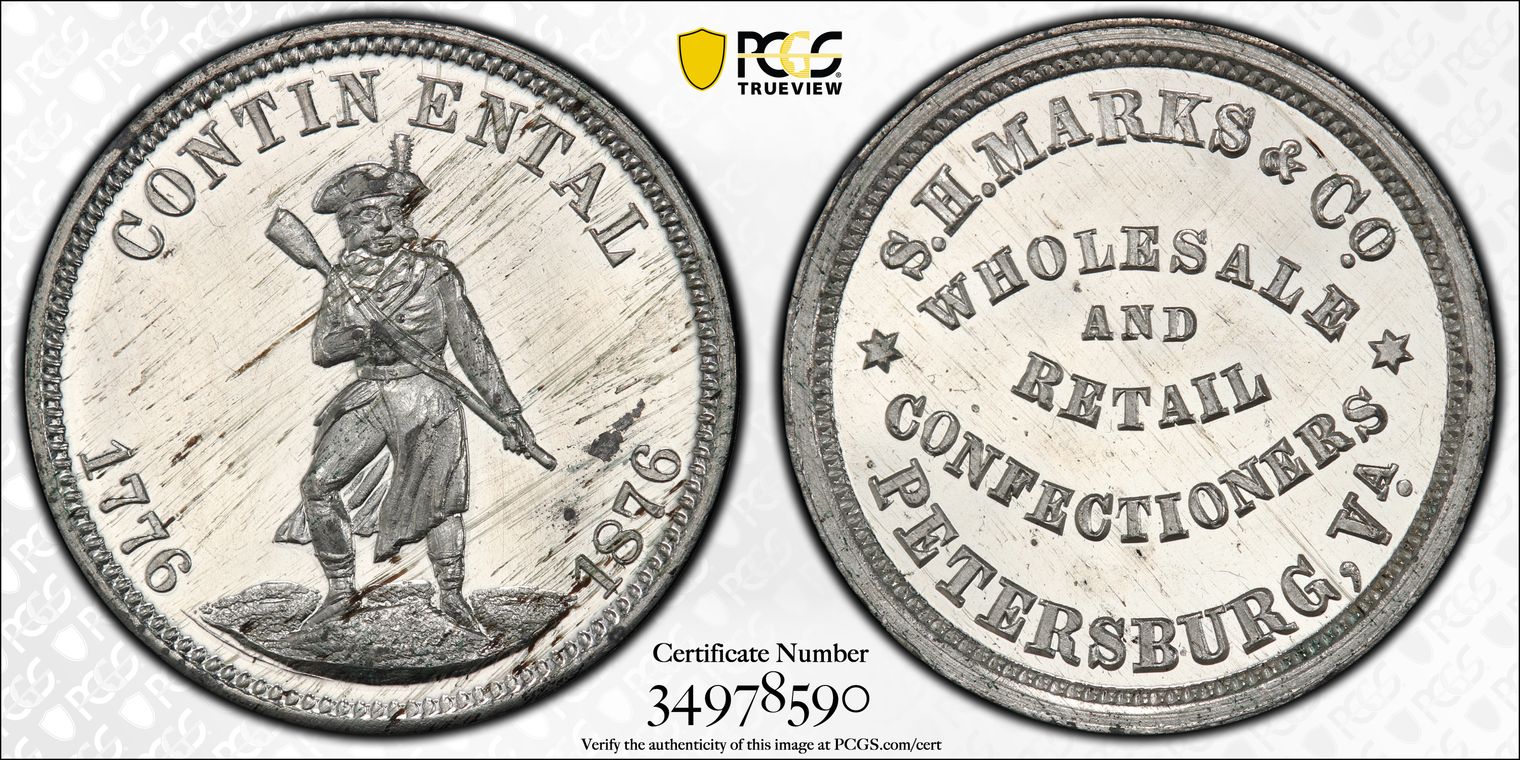
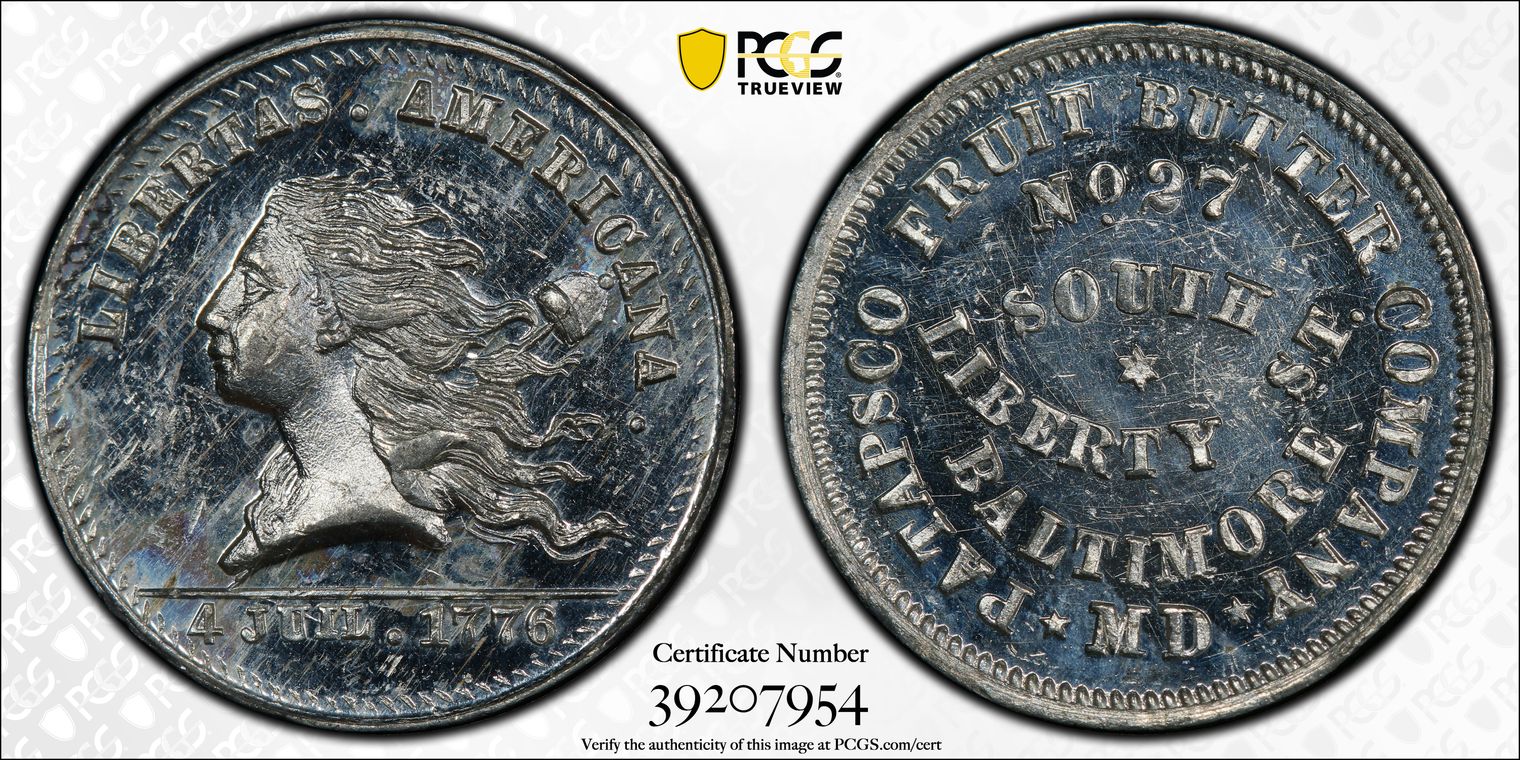
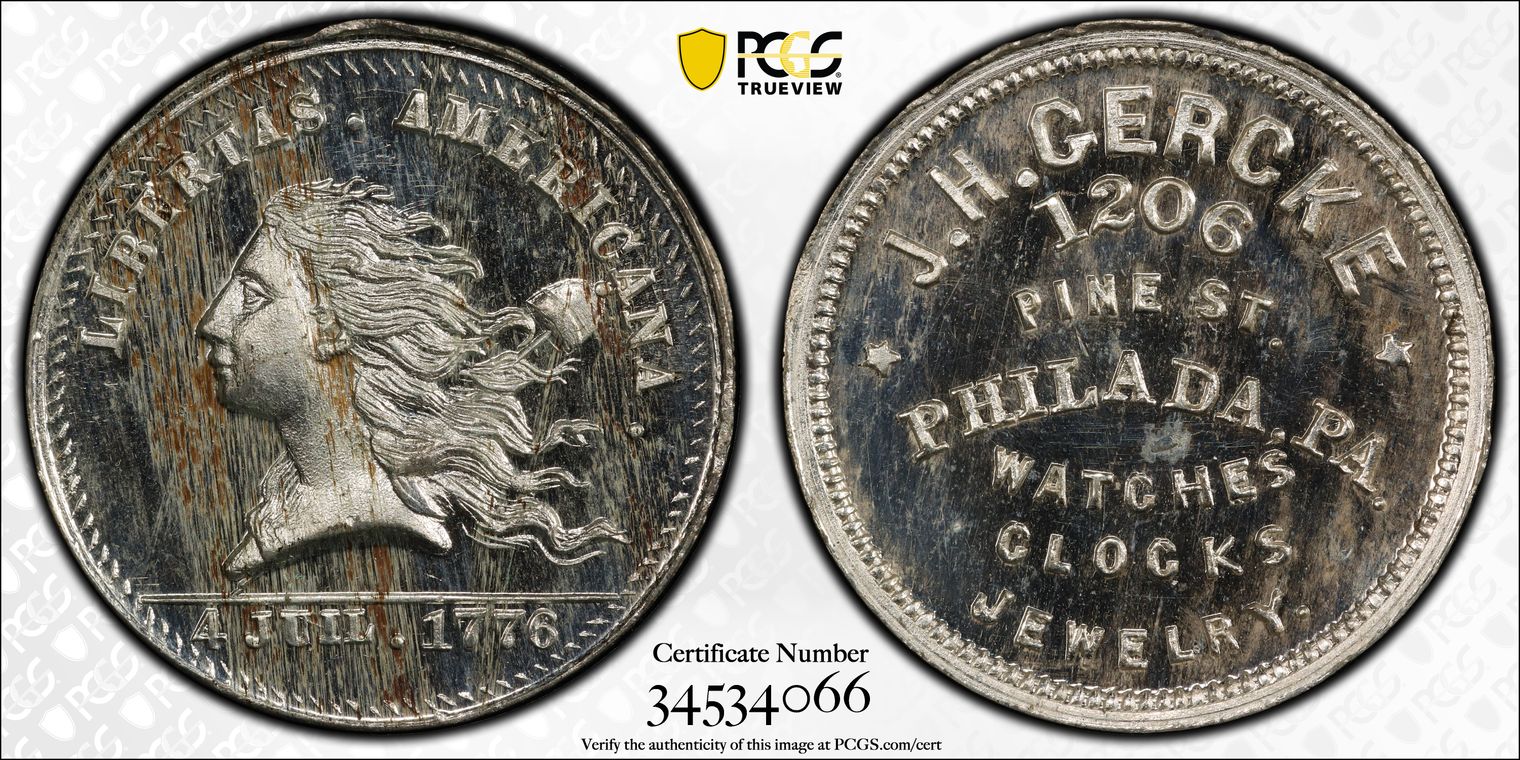
Ex: Larry Dziubek, Charles Litman, Don Miller and Joseph Barnet




Unique “Intans” Libertas Americana Medal Cliche "The Piece That Kept Franklin From Making a Mistake" Struck in January 1783 1781 (Before January 23, 1783) Libertas Americana Medal reverse cliché. As Betts-615. White metal. Original. Workshop of Augustin Dupre. 47.0 x 46.8 mm., 214.0 grains. 0.5 - 1.5 mm thick. Choice About Uncirculated. Plain trimmed edge. Traces of paper fiber present on plain back. A superbly preserved soft metal impression, with only minor surface wear and most of the original paper still present on the blank back. Bright lustrous evidence of the tin beneath is visible at the peripheries of the unadorned back. The struck side is glossy and appealing, even dark gray with no major defects. Details are spectacularly sharp, including the cuirass on Minerva's chest, an addition between the time the previous lot was made and when this one was struck. The face of Minerva appears more refined here as well. This fascinating progress proof was made at a very particular moment of this die's journey to completion. The exergual legend is not present, though various raised scribe lines are visible in the exergue. The peripheral legend is the most interesting part of this piece's design, however: NON SINE DIIS ANIMOSUS INTANS - INTANS, rather than the correct spelling, INFANS. Fortunately, the person to whom Benjamin Franklin sent this cliche noticed: Alexandre-Theodore Brongniart, an architect and man of letters who was a vital link in the chain that connected Franklin with both the designer of the reverse, E.A. Gibelin, and medalist Augustin Dupre who brought the Libertas Americana medal to fruition. On January 23, 1783, Brongniart wrote to Franklin: "I have the honor of sending to Mr Franklin two new proofs of the medal, noting that the head is not quite as perfect as it should be, that the serpents held by the child will be larger and better drawn; moreover the engraver put 'intans' instead of 'infans' and this spelling mistake shall be corrected. "I have the honor of reminding Mr Franklin that he had promised what he shall have inscribed on both sides at the bottom of the medal, and this matter alone prevents its completion." Brongniart is acting as a go-between from Dupre, who produced this object, to Franklin, who commissioned it, all while serving as a vital critical eye. In a February 1785 to Franklin, Gibelin attests to Brogniart's role in his involvement: "the medal of the United States of America that you had struck last year (sic) was modeled after the design that I composed at the request of Monsieur Brongniart." This is the Cliche created by Augustin Dupre, passed on to Alexander Theodore Brongniart who drafted the letter dated January 23, 1783 that accompanied the Cliche as it was sent on to Benjamin Franklin, presented to Franklin on January 31, 1783. Thereafter, the Cliche graced the collections of Wayte Raymond, John J. Ford, John W. Adams, and the Cardinal Collection Educational Foundation.

Unique “Intans” Libertas Americana Medal Cliche "The Piece That Kept Franklin From Making a Mistake" Struck in January 1783 1781 (Before January 23, 1783) Libertas Americana Medal reverse cliché. As Betts-615. White metal. Original. Workshop of Augustin Dupre. 47.0 x 46.8 mm., 214.0 grains. 0.5 - 1.5 mm thick. Choice About Uncirculated. Plain trimmed edge. Traces of paper fiber present on plain back. A superbly preserved soft metal impression, with only minor surface wear and most of the original paper still present on the blank back. Bright lustrous evidence of the tin beneath is visible at the peripheries of the unadorned back. The struck side is glossy and appealing, even dark gray with no major defects. Details are spectacularly sharp, including the cuirass on Minerva's chest, an addition between the time the previous lot was made and when this one was struck. The face of Minerva appears more refined here as well. This fascinating progress proof was made at a very particular moment of this die's journey to completion. The exergual legend is not present, though various raised scribe lines are visible in the exergue. The peripheral legend is the most interesting part of this piece's design, however: NON SINE DIIS ANIMOSUS INTANS - INTANS, rather than the correct spelling, INFANS. Fortunately, the person to whom Benjamin Franklin sent this cliche noticed: Alexandre-Theodore Brongniart, an architect and man of letters who was a vital link in the chain that connected Franklin with both the designer of the reverse, E.A. Gibelin, and medalist Augustin Dupre who brought the Libertas Americana medal to fruition. On January 23, 1783, Brongniart wrote to Franklin: "I have the honor of sending to Mr Franklin two new proofs of the medal, noting that the head is not quite as perfect as it should be, that the serpents held by the child will be larger and better drawn; moreover the engraver put 'intans' instead of 'infans' and this spelling mistake shall be corrected. "I have the honor of reminding Mr Franklin that he had promised what he shall have inscribed on both sides at the bottom of the medal, and this matter alone prevents its completion." Brongniart is acting as a go-between from Dupre, who produced this object, to Franklin, who commissioned it, all while serving as a vital critical eye. In a February 1785 to Franklin, Gibelin attests to Brogniart's role in his involvement: "the medal of the United States of America that you had struck last year (sic) was modeled after the design that I composed at the request of Monsieur Brongniart." This is the Cliche created by Augustin Dupre, passed on to Alexander Theodore Brongniart who drafted the letter dated January 23, 1783 that accompanied the Cliche as it was sent on to Benjamin Franklin, presented to Franklin on January 31, 1783. Thereafter, the Cliche graced the collections of Wayte Raymond, John J. Ford, John W. Adams, and the Cardinal Collection Educational Foundation.
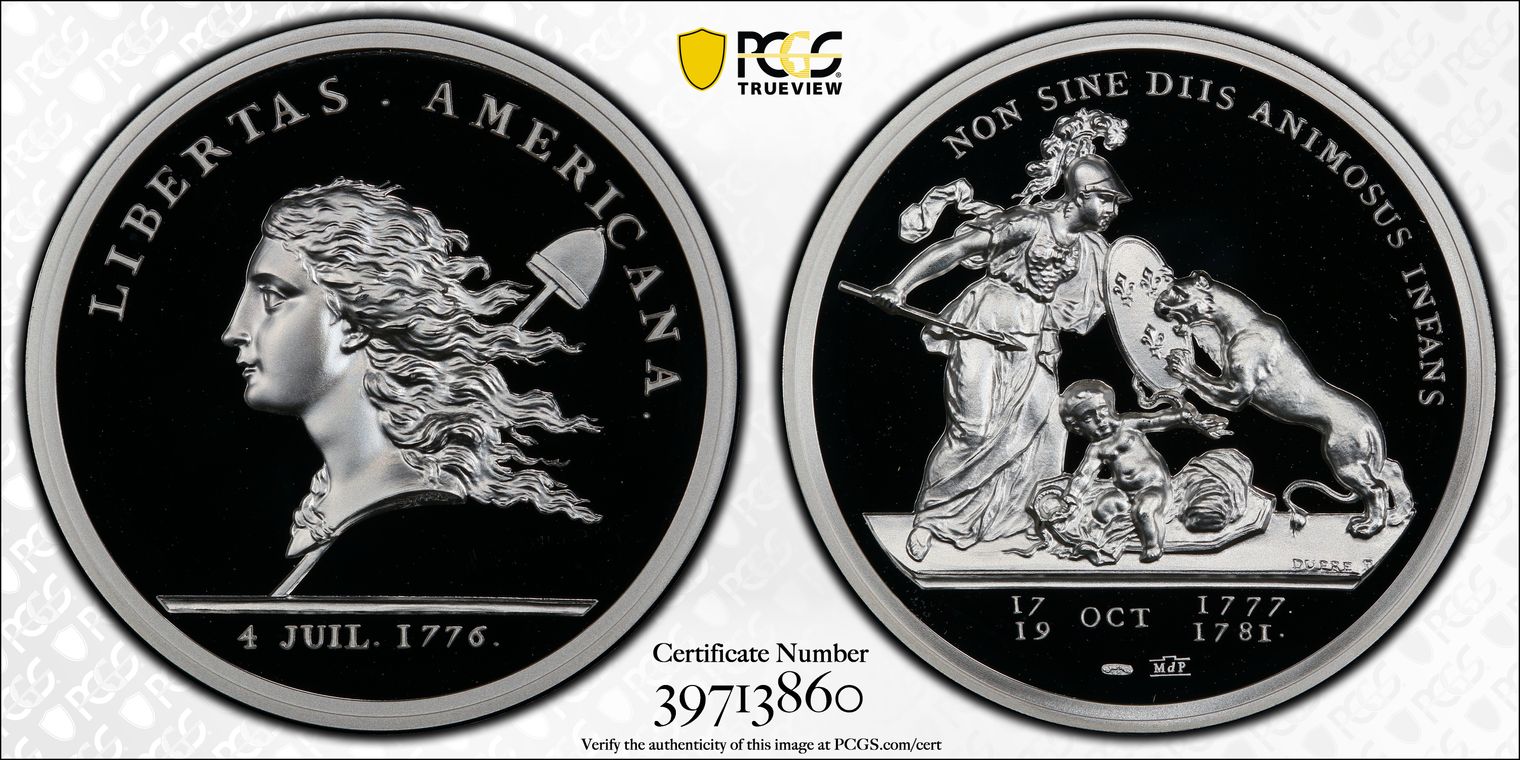
After a span of 5 years, the Paris Mint created another group of 1 ounce silver Libertas Americana medals. Like the 2015 issue, these are 37mm in diameter, and the production authorized allowed for 5,000 to be struck.